



Key Takeaways
- Staff augmentation gives businesses immediate access to specialist skills without long-term hiring commitments or overhead costs.
- In-house teams build deeper institutional knowledge and cultural alignment that external talent cannot replicate over time.
- The right model depends on project duration, budget constraints, required expertise, and the business's current growth stage.
- Most businesses use a hybrid approach that combines both models depending on the nature of each project or business function.
Every business reaches a point where the team it has is not quite the team the next project demands. The options feel binary, hiring full-time employees and absorbing the cost, time, and commitment that come with them, or bringing in external talent and accepting whatever trade-offs that model introduces to how the team operates day to day. Most business owners make this decision based on immediate budget pressure or hiring urgency rather than a clear understanding of what each model actually delivers across a full project lifecycle.
The reality is more nuanced than that binary framing suggests, and the businesses that navigate it well understand what each model delivers in practice rather than in theory. Staff augmentation and in-house hiring are not competing philosophies fighting for the same space in a talent strategy. They are different tools built for different situations, and the wrong choice at the wrong moment costs more than the model that looked more expensive on paper before the decision was made.
Choosing between them without understanding what each genuinely costs, what each genuinely provides, and what each genuinely risks is the decision that most commonly leads to the wrong outcome for the specific business need that prompted it.
What Is Staff Augmentation?
Staff augmentation is a hiring model where a business brings external professionals into its existing team for a defined period or project scope. The augmented staff work under the company's direction, follow its processes, and integrate into its workflows without being permanently employed by the business itself.
The engagement runs through a staffing or technology partner rather than a direct employment relationship. That distinction removes the overhead of recruitment, benefits, payroll processing, and the legal complexity of termination when the project concludes or priorities shift in a different direction.
Benefits of Staff Augmentation
Staff augmentation helps businesses strengthen technical capabilities by providing faster access to skilled professionals, improving flexibility, reducing hiring costs, and supporting scalable project delivery.
Access to Specialized Talent
Staff augmentation gives businesses direct access to specialists in narrow technical disciplines without maintaining those skills on the payroll permanently. AI developers, blockchain engineers, and cybersecurity specialists can be engaged for the duration they are needed and released when the work is complete.
Faster Hiring Process
An augmentation partner with a pre-vetted talent network places qualified professionals within one to two weeks in most cases. That speed is not available through traditional recruitment processes that take three to five months to produce a comparable outcome in technical disciplines.
Cost Efficiency
The total cost of an augmented professional is the engagement fee without the additional thirty to forty percent overhead that benefits, equipment, training, and administrative costs add to every permanent hire the company brings on, regardless of their seniority level.
Easy Team Scalability
Augmentation scales up or down based on project phase without the hiring overhead that adding permanent headcount requires at each growth stage. A team can expand for a product sprint and contract when the sprint concludes without any impact on the permanent workforce structure.
Reduced Recruitment and HR Effort
The staffing partner handles sourcing, screening, and initial assessment. The business evaluates pre-qualified candidates rather than managing the full recruitment pipeline from job posting through to final offer negotiation and acceptance.
Challenges of Staff Augmentation
While staff augmentation offers significant advantages, businesses should address communication, knowledge transfer, team integration, and external dependency to maximise engagement success and productivity.
Communication Challenges
Augmented professionals working remotely across time zones require structured communication processes that permanent teams in the same office do not need to establish as formally. Without those processes, coordination gaps reduce productivity and create misalignment between the external contributor and the internal team.
Knowledge Transfer Risks
When an augmented engagement concludes, the knowledge the external professional accumulated during the project leaves with them unless explicit documentation and knowledge transfer processes were built into the engagement from the beginning rather than added as an afterthought at the conclusion.
Dependency on External Talent
A business that relies heavily on augmented staff for core technical functions creates a dependency on external talent availability and pricing that introduces risk when the market for specific skills tightens and the augmentation partner cannot maintain the same supply at the same cost.
Managing Remote Teams
Remote augmented teams require management overhead that collocated teams do not generate at the same level. Tools, processes, and the cultural investment required to make distributed teams function well are real costs that need to be factored into the total engagement cost rather than treated as zero.
What Is an In-House Team?
An in-house team consists of permanent employees who work exclusively for the business under a direct employment relationship. They are hired, onboarded, trained, and developed by the company and contribute to the business across the full scope of their role rather than being engaged for a specific project or time period
Benefits of an In-House Team
An in-house team provides long-term value by building organisational knowledge, strengthening collaboration, and ensuring employees remain aligned with the company's goals and culture.
Strong Company Culture
Permanent employees develop deep alignment with the company's values, ways of working, and long-term vision in a way that short-term external contributors cannot replicate regardless of how professionally they integrate during the engagement period.
Better Collaboration
Teams that work together every day across months and years develop communication patterns, working relationships, and collaborative efficiency that new team members, whether permanent or augmented, take time to build regardless of their individual technical capability.
Long-Term Business Knowledge
In-house employees accumulate institutional knowledge about the product, the customer base, the technical decisions that were made and why, and the business context that informs every subsequent decision. That knowledge compounds in value over time in ways that external talent rarely has the opportunity to develop during a defined engagement.
Greater Control Over Projects
Permanent employees are fully aligned with the company's priorities, available for the full scope of their role rather than a defined project. They can be redirected as business needs change without the contractual considerations that govern augmented engagements.
Challenges of an In-House Team
While in-house teams offer stability and continuity, businesses must also consider the higher costs, longer hiring timelines, and challenges of retaining specialised talent.
Higher Hiring Costs
Recruiting a senior technical hire costs between fifteen and thirty percent of their annual salary in recruitment fees alone before any onboarding, equipment, or training costs are considered. The total first-year cost of a permanent hire consistently exceeds the stated salary by a significant margin.
Longer Recruitment Time
Technical hiring in most markets takes three to five months from job posting to a productive new employee. Projects that cannot wait for that timeline need a different approach regardless of the long-term preference for permanent hiring.
Employee Retention Challenges
Skilled technical professionals are in demand across the market. Retaining them requires ongoing investment in salary competitiveness, development opportunities, and working environment quality that adds ongoing cost and management attention beyond the initial hiring investment.
Limited Access to Specialized Skills
Niche technical skills in areas like AI, blockchain, and emerging cloud architectures are difficult to hire for permanently because the talent pool is small, the salaries are high, and the need may be project-specific rather than permanent. Building these skills in-house takes years of development investment.
Businesses looking for a long-term approach to scaling their technology capabilities can explore how staff augmentation supports scalable growth by providing access to specialised talent while maintaining flexibility and cost control.
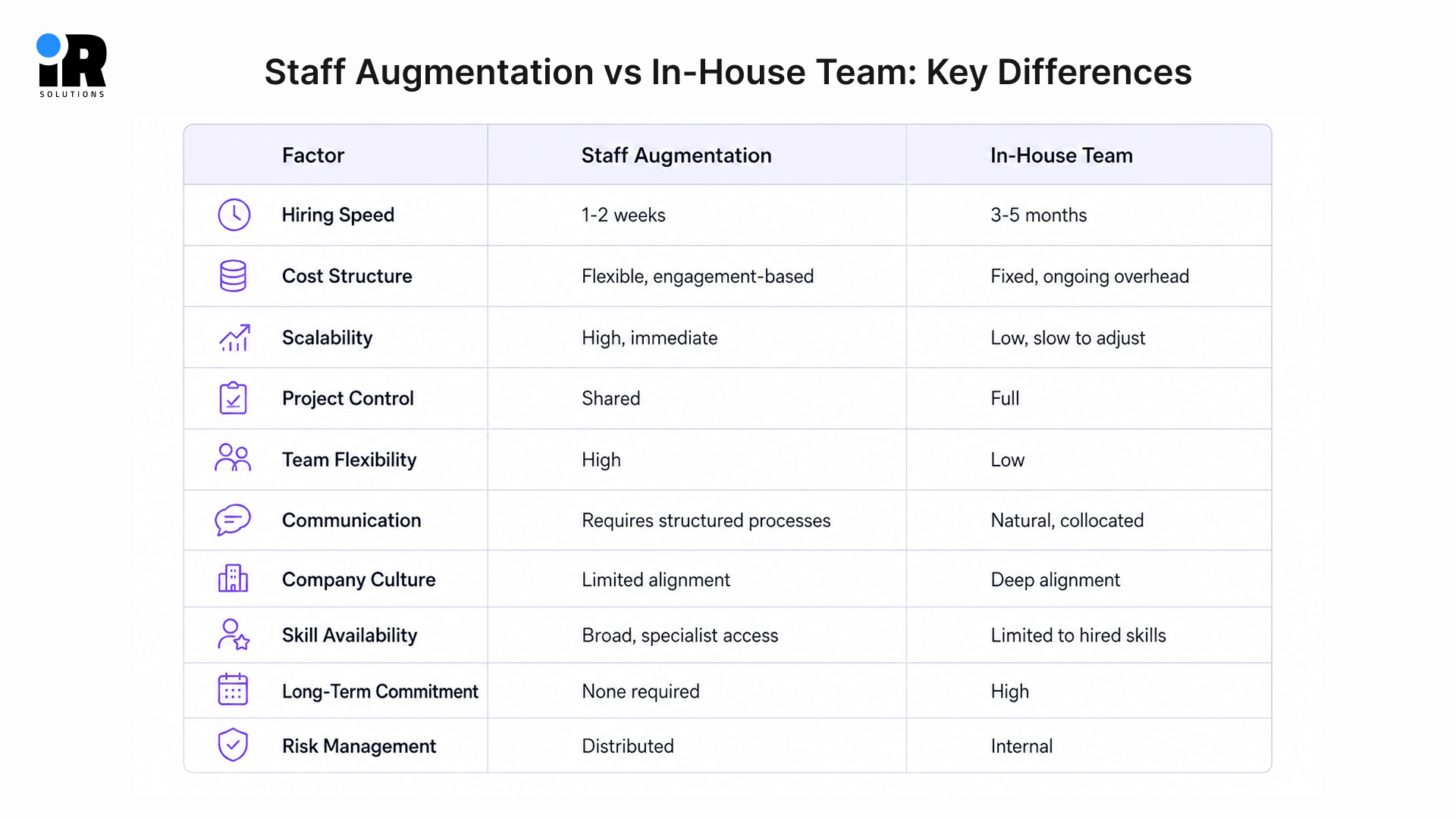
Staff Augmentation vs In-House Team: Key Differences
Comparing both hiring models across essential business factors helps organisations identify the approach that best supports their project requirements and long-term growth strategy.
Cost Comparison Between Staff Augmentation and In-House Team
Understanding the true costs of each hiring model helps businesses make informed decisions based on recruitment expenses, operational overhead, and long-term return on investment.
Recruitment Costs
In-house recruitment costs fifteen to thirty percent of annual salary through agencies or significant internal HR time through direct hiring. Augmentation engagement fees are typically included in the agreed professional day rate without a separate recruitment cost charged to the business.
Salaries and Benefits
A permanent senior developer at eighty thousand pounds annually costs closer to one hundred and ten thousand when employer taxes, pension contributions, healthcare, and equipment are included. An augmented developer at a comparable skill level costs the engagement fee without those additional components attached.
Infrastructure Costs
In-house employees require office space, equipment, software licences, and IT infrastructure that augmented remote professionals provide for themselves within their engagement arrangement. For businesses in growth mode without established office infrastructure, this difference is commercially significant.
Training and Onboarding Costs
Permanent hires require structured onboarding that takes three to six months to reach full productivity. Augmented professionals with pre-verified experience in the specific required skills contribute meaningfully within days rather than months.
Overall Return on Investment
A direct cost breakdown comparing flexible staff augmentation with traditional in-house hiring.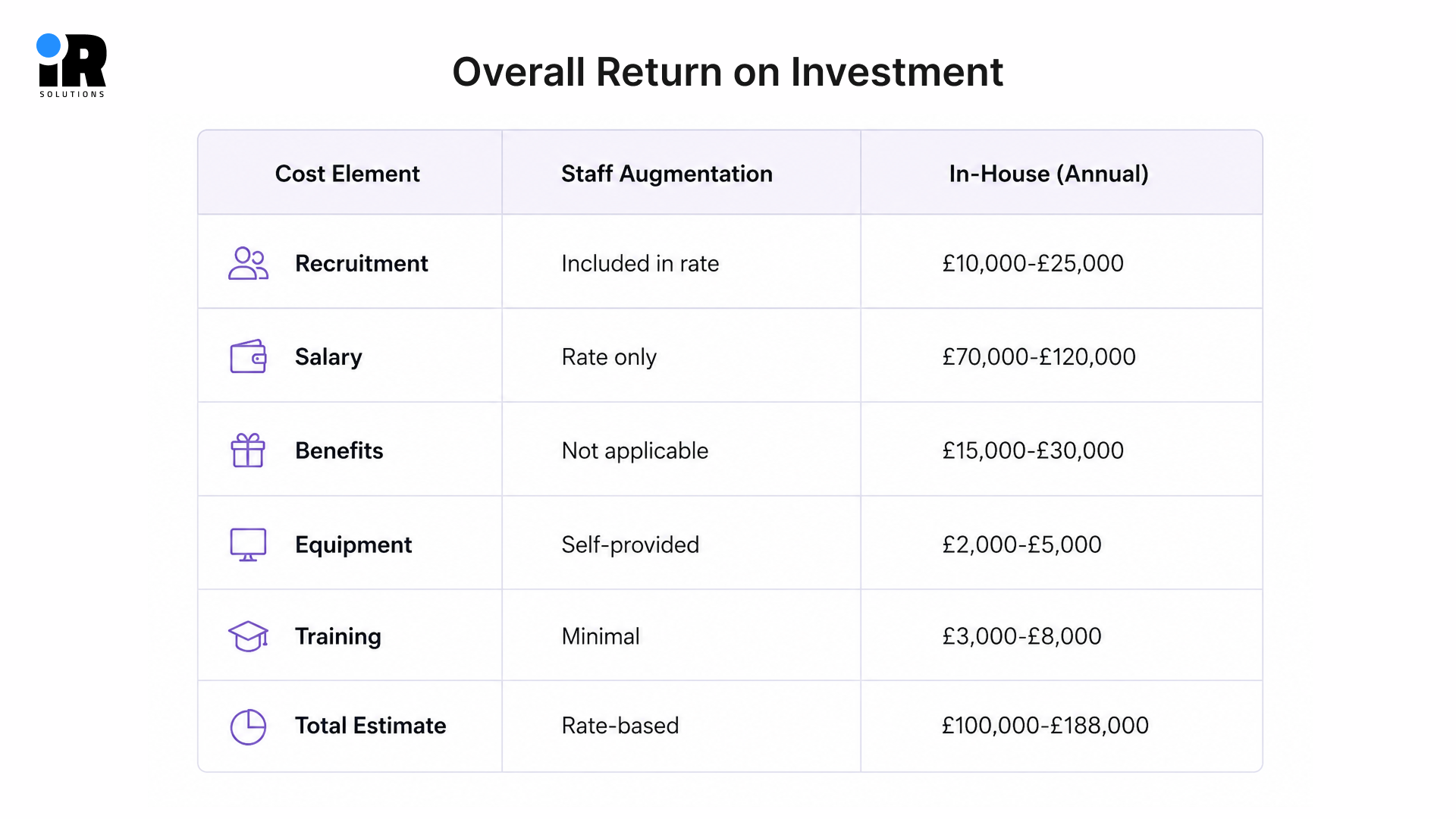
Learn how resource augmentation services drive business growth by helping companies overcome skill gaps, accelerate project delivery, and build stronger technical teams without increasing permanent hiring commitments.
Why Companies Choose Staff Augmentation Over Traditional Hiring
The technology hiring market has become increasingly competitive as demand for specialists in AI, cloud computing, cybersecurity, blockchain, and other emerging technologies continues to outpace the available talent pool. Traditional hiring often takes months, making it difficult for businesses to secure the expertise they need when projects are already underway. For organisations working with tight product roadmaps and delivery deadlines, waiting for permanent hires can delay innovation and increase overall project costs.
Staff augmentation services provide a faster and more flexible way to bridge these talent gaps. Instead of committing to long-term hiring, businesses can quickly access pre-vetted developers, engineers, and technical specialists with the exact skills required for a project. This approach allows companies to scale teams based on current business needs, reduce recruitment overhead, and maintain delivery momentum without adding unnecessary permanent headcount once a project is complete. As technology projects become more specialised and project-driven, staff augmentation has become a practical workforce strategy for businesses that need to move quickly while controlling costs.
Staff Augmentation vs In-House Team for Startups
Startups require hiring strategies that balance limited budgets with rapid growth, making it essential to evaluate which model best supports early-stage development.
Budget Considerations
Startups with limited runway cannot absorb the full cost of building a permanent technical team before the product has generated the revenue needed to sustain that headcount. Augmentation provides access to the skills required to build without the financial commitment that full employment requires before product-market fit is established.
Speed to Market
A startup that needs to ship a product in twelve weeks cannot wait five months for the right permanent hire to be recruited, onboarded, and productive. Augmentation puts qualified contributors on the project within weeks rather than months. Software staff augmentation gives early-stage teams the technical depth to build and ship competitive products without waiting for a permanent engineering team to be fully assembled and onboarded before meaningful work can begin.
Growth Flexibility
Startup requirements change rapidly as the product evolves and the market responds to early versions. Augmented teams flex with those changes without the workforce management complexity that permanent hiring creates when the team that was right for version one is not quite right for version three.
Staff Augmentation vs In-House Team for Enterprises
Large organisations often require scalable workforce solutions that support complex projects, business continuity, and access to emerging technical expertise.
Scaling Large Projects
Enterprise projects that require rapid team expansion to meet delivery deadlines cannot scale through permanent hiring alone within the timelines most enterprise programmes operate under. Augmentation provides the additional capacity without disrupting the permanent team structure.
Maintaining Business Continuity
Enterprises use augmentation to maintain business continuity during permanent team transitions, parental leave, illness, or sudden departures from critical roles that cannot remain unfilled for the duration of a standard recruitment process.
Access to Emerging Technologies
Enterprise organisations with established permanent teams in proven technology stacks augment with specialists in emerging technologies for specific innovation projects rather than building that expertise permanently into a team that may not need it once the project is complete.
For startups evaluating the financial impact of different hiring models, understanding how staff augmentation can improve ROI provides deeper insight into reducing costs, accessing specialised talent, and scaling development efforts efficiently.
When to Choose Staff Augmentation
Staff augmentation is most effective when businesses need specialised expertise, rapid team expansion, or flexible resources for project-based work.
Short-Term Projects
A defined project with a clear endpoint and specific technical requirements that the permanent team does not cover is the clearest case for augmentation rather than permanent hiring that outlasts the need it was created to address.
Specialized Technical Expertise
Niche skills in AI, machine learning, blockchain, or cybersecurity that are needed for a specific project phase but not permanently are better accessed through augmentation than through the permanent hiring of expensive specialists whose full cost is not justified by ongoing demand. Software development staff augmentation is particularly valuable for teams that need to ship a product on a compressed timeline without the luxury of a full permanent engineering team in place before work begins.
Rapid Team Expansion
A sudden increase in workload from a large client win or product launch that exceeds the current team's capacity is addressed through augmentation faster than permanent hiring can respond to the same situation.
Seasonal or Fluctuating Workloads
Businesses with predictable seasonal demand peaks use augmentation to add capacity during high-demand periods and reduce it when demand normalises without the workforce management challenges that permanent headcount fluctuations create.
When to Choose an In-House Team
An in-house team is the preferred option for businesses focused on long-term product development, operational continuity, and building internal expertise.
Long-Term Product Development
A product that will be developed, maintained, and evolved over years requires permanent team members who accumulate product knowledge that informs every subsequent decision across the product's lifespan.
Building Company Knowledge
Core business functions that depend on institutional knowledge, proprietary processes, and accumulated customer understanding are better served by permanent employees who develop and retain that knowledge over time.
Strengthening Internal Culture
A business in an early growth phase that is actively building its culture, values, and ways of working needs permanent employees who are invested in that process rather than external contributors focused on a defined deliverable.
Managing Core Business Operations
Operations, customer success, finance, and other functions that run continuously and require deep company knowledge are not suitable candidates for augmentation as the primary staffing approach, regardless of the cost efficiency the model offers in project contexts.
Need skilled professionals to expand your development team without the cost and delays of traditional hiring?
Our staff augmentation services help businesses access experienced developers and technical specialists who integrate with existing teams and deliver project-ready expertise. Book a consultation with our team today to discuss your requirements and find the right talent solution for your next project.
Common Mistakes to Avoid
Avoiding common hiring mistakes helps businesses maximise the value of their chosen workforce model while reducing unnecessary costs, delays, and project risks.
Focusing Only on Cost
Choosing augmentation purely because the day rate looks lower than a salary misses the management overhead, knowledge transfer risk, and integration effort that augmented teams require to function effectively alongside permanent colleagues.
Ignoring Future Growth Plans
A business that plans to scale significantly within twelve months should build permanent capability in the areas that will be central to that growth rather than augmenting indefinitely in functions that will require permanent ownership as the business matures.
Hiring Without Defined Project Goals
Augmenting without clear project scope and success criteria produces engagements that extend beyond their intended duration without producing the defined outcome that justified the engagement cost in the first place.
Choosing the Wrong Model for the Business Stage
An early-stage startup that builds an expensive permanent team before product-market fit and an established enterprise that relies entirely on augmentation for core functions are both misaligned between their model choice and their actual business stage and needs.
How to Choose the Right Staff Augmentation Partner
The decision to use staff augmentation is only the first step. The partner chosen to deliver it determines whether the model produces the outcomes that justify the decision or introduces new problems that offset the advantages the model was selected for in the first place. With so many IT staff augmentation companies operating in the market today, the difference between a reliable partner and an unreliable one is not always visible until the engagement is already underway.
The right augmentation partner, like IR Solutions, does more than provide CVs from a candidate database. They verify technical capability through rigorous pre-screening that goes beyond self-reported experience, they match candidates to the specific project context rather than providing the nearest available professional regardless of fit, and they remain accountable for the quality of the engagement throughout its duration rather than treating placement as the end of their responsibility. Taking the time to evaluate and compare top IT staff augmentation companies before committing to a partner produces better long-term outcomes than selecting the first available provider based on rate alone without assessing the depth of their technical vetting or their track record across comparable engagements.
What to Evaluate Before Committing
A staff augmentation company with a documented history of successful placements in your specific technical domain is worth paying a modest premium over a cheaper generalist provider with no comparable track record.
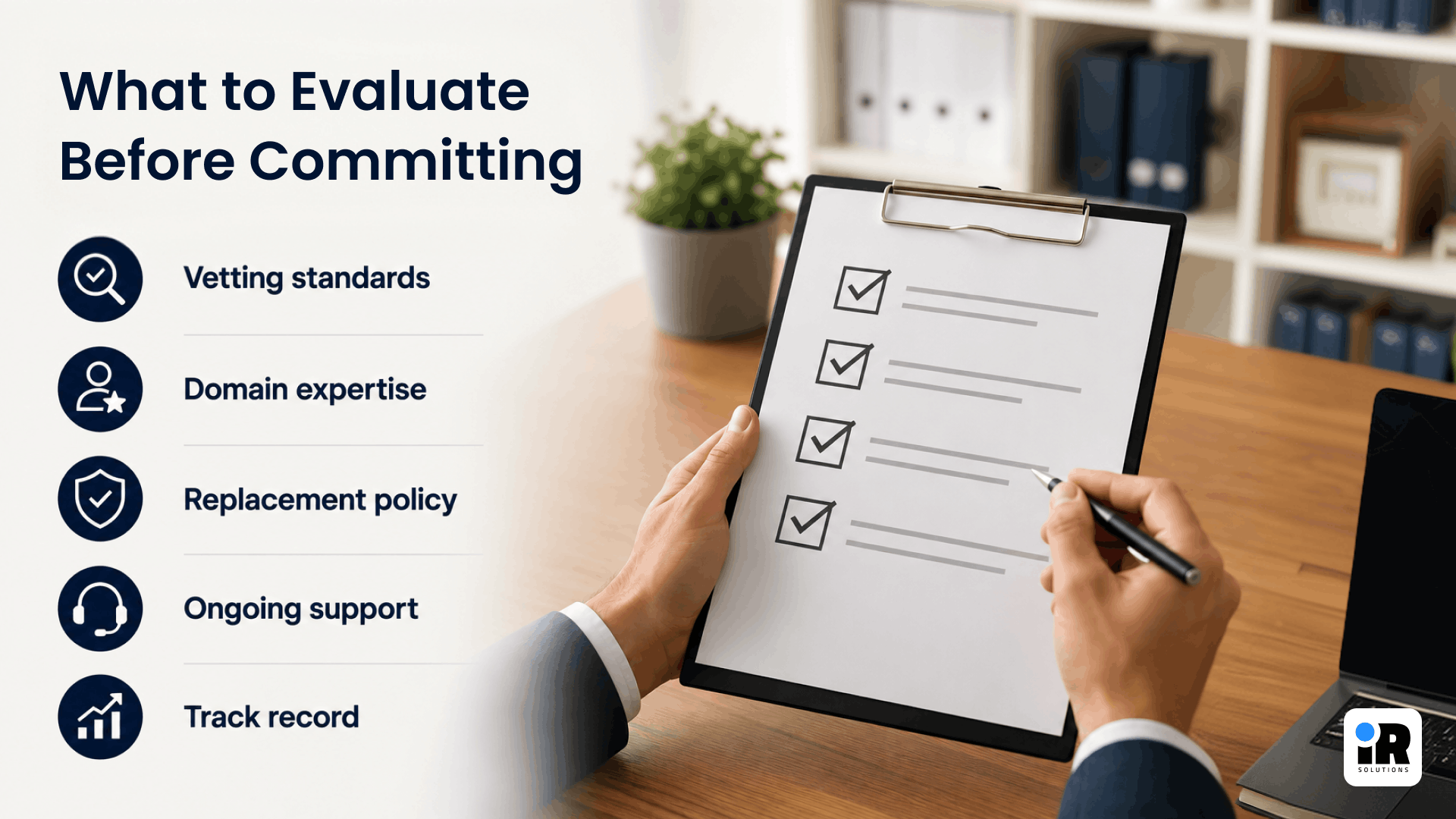
- Vetting standards: Ask specifically how candidates are assessed before they are presented to clients. A partner that relies on CV review and a brief interview provides weaker quality assurance than one that conducts technical assessments, reference checks, and contextual capability evaluation before any candidate enters the available pool.
- Domain expertise: A partner with specific experience in the technical disciplines relevant to your project provides candidates with a genuinely relevant background rather than broad technology generalists whose experience does not match the specific demands of the work.
- Replacement policy: The right partner has a clear process for replacing a professional who does not perform to the expected standard within a defined period without charging the client for the replacement process on top of the original engagement cost.
- Ongoing support: The partner should remain a point of contact throughout the engagement rather than disappearing after placement. Regular check-ins, performance visibility, and responsive account management are the differences between a transactional supplier and a genuine capability partner.
- Track record: References from clients who have used the partner for similar technical work provide the most reliable signal of what the engagement will actually deliver compared to what the sales process suggests it will produce.
Conclusion
Choosing between staff augmentation and an in-house team depends on your business goals, project scope, budget, and long-term growth plans. In-house teams provide continuity, strong collaboration, and deep business knowledge, while staff augmentation offers faster access to specialised talent, greater flexibility, and the ability to scale resources as project demands change. Many successful businesses combine both models, using permanent employees for core operations and augmented professionals for specialised or time-sensitive work. By evaluating your hiring needs carefully and selecting the right workforce strategy, you can improve productivity, control costs, and accelerate project delivery. The right approach is the one that gives your business the expertise, agility, and scalability needed to support sustainable growth in an increasingly competitive technology landscape.
Frequently Asked Questions
Is Staff Augmentation Better Than Hiring Full-Time Employees?
Neither model is universally better because the right choice depends entirely on the specific project duration, skill requirements, budget constraints, and growth stage of the business, making the decision at that particular moment.
Is Staff Augmentation More Affordable?
For defined project work, augmentation typically costs less than permanent hiring when total employment costs are compared accurately, rather than day rate against salary alone without the additional cost components that permanent employment carries.
Can Augmented Staff Work With Internal Teams?
Yes, and the most effective augmentation engagements are structured so that augmented professionals integrate directly into the existing team workflow rather than operating as a separate external unit alongside the permanent team.
Is Staff Augmentation Suitable for Startups?
Augmentation is particularly well-suited to startups because it provides access to specialist skills without the financial commitment of permanent hiring before revenue is established and the product direction is sufficiently clear to justify permanent team investment.
What Is the Difference Between Staff Augmentation and Outsourcing?
Augmentation places external professionals within your team under your direction. Outsourcing transfers an entire function or project to an external provider who manages it independently with their own processes and reporting structure rather than integrating into your team.
Which Model Offers Better Scalability?
Staff augmentation offers significantly better short-term scalability because team size can be adjusted within weeks based on project demands without the hiring, onboarding, or workforce reduction processes that permanent headcount changes require at each adjustment point.