



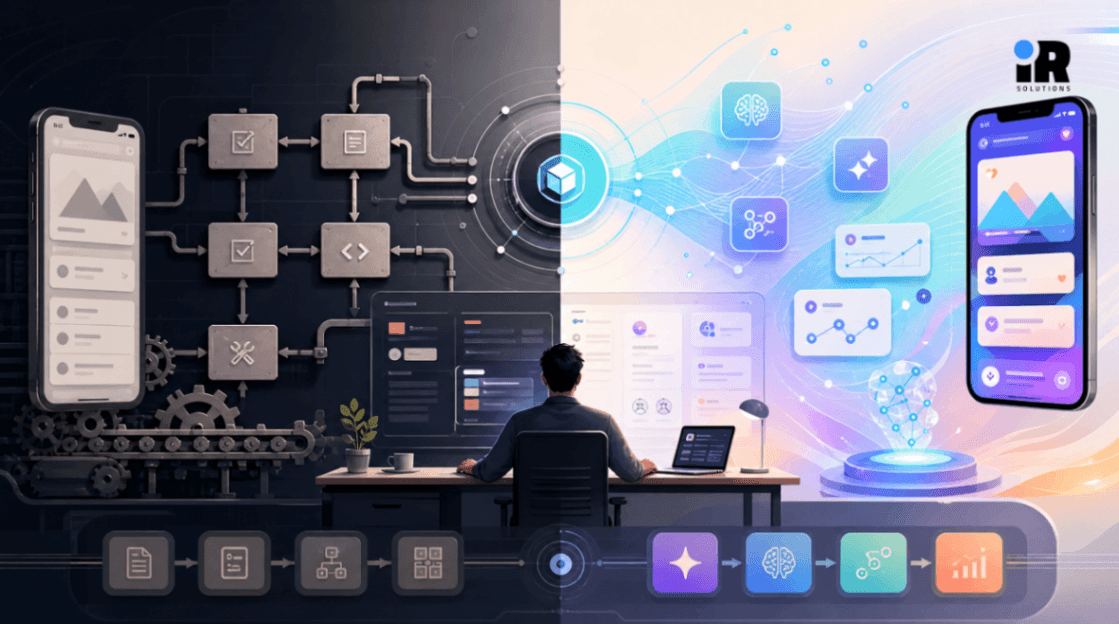

Nobody saw the last five years of software development coming, not really. Businesses that spent years perfecting their development cycles are now looking at AI-powered tools and wondering whether they have been doing things the hard way all along. The honest answer is: sometimes yes, sometimes no, and it depends entirely on what you are building and for whom. Many growing companies reach this decision point, where choosing the right approach can shape long-term outcomes. This blog explains how the two differ, where each applies, and how to use them together without unnecessary risk, and when it makes sense to hire AI & ML developers to get there faster.
What Exactly Is Traditional Software Development?
Think of traditional software development as the way software has always been built by people, line by line, with human judgment driving every decision from the first requirement to the final deploy.
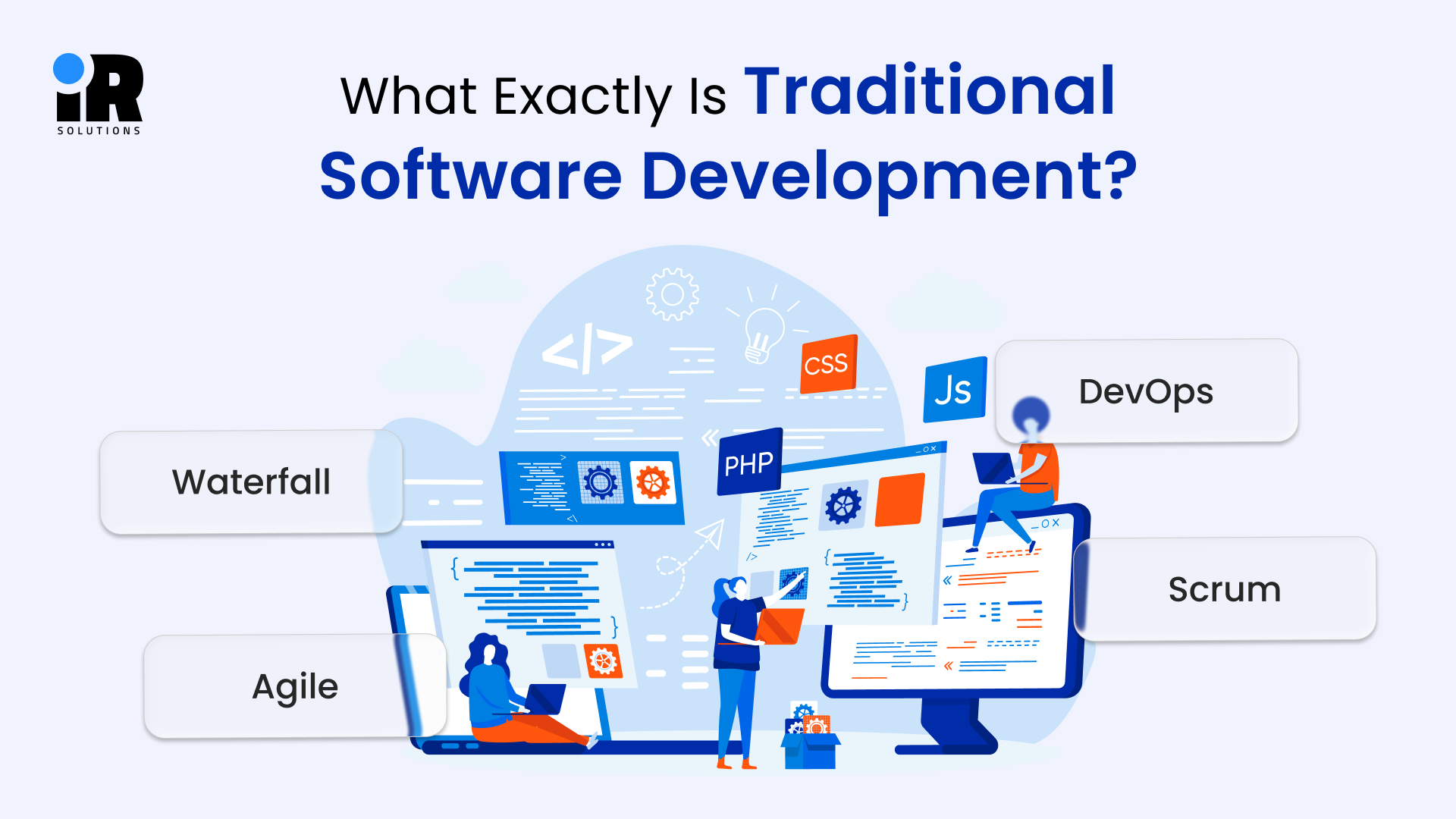
Teams that follow traditional development typically work inside one of these structured frameworks:
- Waterfall: The whole project gets planned before anyone writes a single line of code, and development moves through stages without much room to revisit and change earlier decisions.
- Agile: Work is broken into short delivery sprints, and the team revisits priorities based on real feedback collected after each cycle completes.
- DevOps: Development and operations teams stop working in separate silos and start collaborating continuously to reduce the gap between writing code and shipping it safely.
- Scrum: A specific version of Agile with daily standups, sprint reviews, and regular retrospectives that give teams a clear rhythm and accountability structure to work within.
Experienced teams know which framework fits the project: a locked government contract needs Waterfall, a startup finding product-market fit needs flexibility. Banks, hospitals, and government agencies have run on traditionally built software for decades not out of sentiment, but because consistent and predictable performance in high-stakes environments has earned that trust.
What Exactly Is AI-Driven Software Development?
AI-driven development is not what the headlines make it sound like. It is not robots writing software while engineers sit back and watch. It is developers working faster and spending less time on the parts of their job that never required much creative thinking in the first place.
The tools that engineering teams are actually using day to day right now include:
- GitHub Copilot: Watches what you are typing inside your code editor and suggests completions, full functions, and relevant test cases before you have finished asking for them.
- ChatGPT and Claude: Useful for thinking through architecture decisions, drafting documentation, working through a stubborn bug, or exploring design options without breaking your concentration for an hour.
- Tabnine: Learn from your own codebase specifically, so its suggestions match your team's conventions rather than pulling generic patterns from the public internet.
- Amazon CodeWhisperer: Particularly useful for AWS-heavy teams because it understands the cloud infrastructure context your code is operating inside and adjusts suggestions accordingly.
- Cursor: An AI-native editor where you can describe what you want changed in plain language and watch it apply across entire files or large portions of the codebase instantly.
AI shifts developer attention away from repetitive, low-value coding tasks toward the decisions and edge cases that actually require real experience to solve well. AI can speed up development and assist with coding tasks, but experienced engineers are still responsible for making the final decisions around quality, security, and maintainability.
AI for Business in 2026: Use Cases, Automation, Tools & Implementation Guide explains how companies are applying AI across operations, marketing, customer support, and product development.
Core Differences That Matter to Businesses
The practical differences between these two approaches only become obvious when you measure them against things that actually affect your business: how fast you can ship, what it costs, how well the product holds up over time, and what happens when requirements shift unexpectedly.
Speed and Time to Ship
- Traditional development moves a moderately complex feature from spec to production in two to four weeks.
- AI tools cut portions of that cycle by generating boilerplate, suggested tests, and documentation in seconds.
- Speed gains are real, but not guaranteed, bad suggestions, invented APIs, and untested edge cases introduce their own delays.
Cost and Resource Requirements
- Traditional development costs scale linearly with headcount, putting a ceiling on what smaller teams can ship each quarter.
- AI tools carry their own costs, including licensing, compute, data preparation, and integration work add up quickly.
- The real advantage is that one AI-assisted developer can deliver what previously required two or three people.
Flexibility When Requirements Change
- Waterfall projects hit with a major mid-project change rarely recover cleanly without slipping scope or timeline.
- Agile handles shifts better by design, but significant rework still burns sprint capacity that stakeholders were counting on.
- AI tools adjust feature-level behavior in days rather than weeks, giving teams real flexibility while the product is still taking shape.
Reliability and Long-Term Maintainability
- A mature codebase built by a consistent team is stable because every decision has documented context.
- AI-generated code can pass every test and still behave unexpectedly under specific production conditions that the model never encountered.
- Codebases filled with code nobody fully owns become harder and slower to maintain and extend over time.
Security, Compliance, and Audit Readiness
- Traditional development builds security requirements into the workflow from the very start of every project.
- AI models trained on public repositories can suggest patterns with known vulnerabilities without any awareness of their existence.
- Regulated environments need clear written answers to AI governance questions before any generated code touches sensitive data.
When Traditional Development Is the Right Choice
Newer approaches are not automatically better for every situation, and traditional development is specifically well-suited for contexts where reliability, compliance, and long-term maintainability matter more than raw delivery speed.
Traditional development is the right call when:
- Healthcare, financial, and government systems require auditable development processes that traditional workflows support without special accommodations.
- Legacy system integration demands contextual knowledge about specific infrastructure that no AI model can reliably generate without human expertise.
- Enterprise software maintained over ten to fifteen years needs a codebase that new engineers can understand without reverse-engineering inherited logic.
- Medical devices, aviation, and industrial platforms require documented human accountability at every development layer where errors have physical consequences.
- Fixed-scope projects with locked requirements are a natural fit for structured traditional methodologies with clear, predictable delivery milestones.
Traditional development still powers a substantial amount of the software businesses rely on daily because it remains the right choice for projects that demand stability, structure, and proven reliability.
When AI Development Delivers Real Business Value
AI development earns its place in specific situations where speed, adaptability, and intelligent capabilities create outcomes that traditional development simply cannot match on the same timeline or with the same budget.
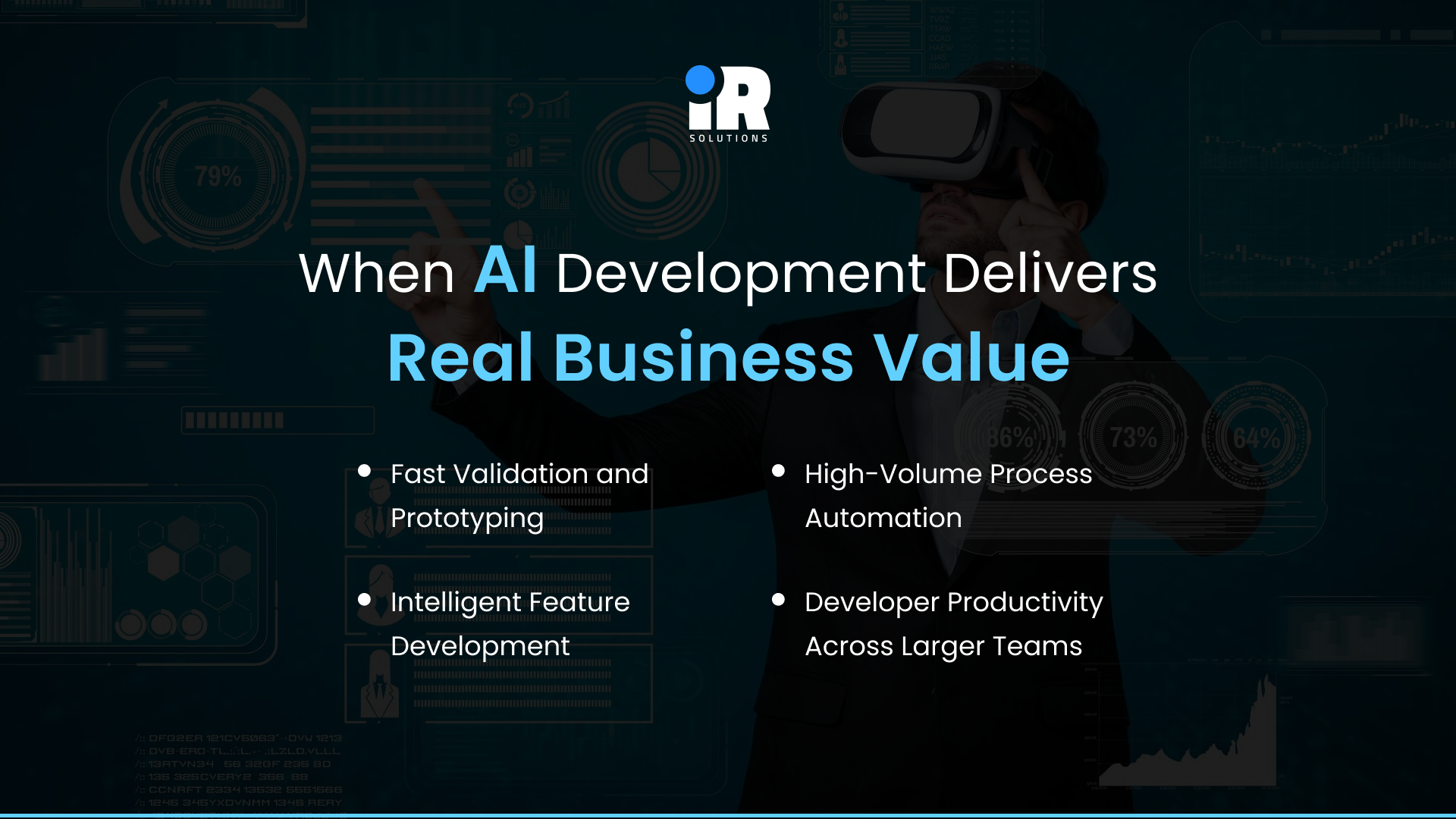
Fast Validation and Prototyping
Getting from an idea to a working prototype used to require weeks of focused engineering effort from a team of developers. With AI tools, a functional proof of concept can come together in two or three days of concentrated work by one or two engineers. That matters when you are testing whether an idea is worth investing serious money in before committing budget to full-scale development. Working software is a significantly better validation tool than a polished slide deck, and AI development makes it accessible much earlier in the process.
Intelligent Feature Development
Features that adapt to user behavior, generate content from structured data, or surface patterns across large datasets used to require dedicated data science teams with significant infrastructure behind them. Pre-built AI models and accessible APIs have changed that calculus recommendation engines, intelligent search, document summarization, and automated categorization are now within reach for product teams without machine learning researchers on staff. If this is the direction your product is heading, exploring a dedicated AI & ML Development service is worth the conversation before you start scoping the build.
High-Volume Process Automation
Businesses processing large volumes of repetitive work, such as document intake, data extraction, inquiry routing, and invoice review, can use AI development to build automation that scales without hiring proportionally more people to handle the growing volume. The value compounds over time as the system encounters more real-world examples and improves its accuracy on the specific inputs your business actually processes day to day.
Developer Productivity Across Larger Teams
Larger engineering teams face a coordination challenge that grows with team size in ways that feel manageable until suddenly they do not. Documentation goes unwritten because nobody has time. Onboarding a new engineer takes weeks. Knowledge about specific parts of the system lives exclusively in the heads of the two people who originally built them and then went on vacation. AI tools reduce that overhead in specific, measurable ways. Documentation gets written while the code is still fresh, new engineers answer questions about the codebase faster. Senior engineers spend less time on boilerplate and more time on the problems that actually need their experience and accumulated judgment.
Industry-Specific Use Cases Worth Knowing
The pattern of how businesses combine these two approaches looks similar across very different industries, even when the surface-level details diverge considerably.
E-commerce and Retail
Recommendation engines, dynamic pricing systems, and customer support automation are strong AI applications in retail. The transaction processing systems, inventory logic, and checkout infrastructure underneath run on traditionally built code where correctness directly affects revenue every single day. A problem with the recommendation engine loses some sales. A problem in the payment system is a completely different category of crisis that nobody wants to manage.
Healthcare and Life Sciences
Diagnostic imaging analysis, clinical note summarization, and patient communication tools benefit from AI's ability to process large volumes of unstructured data and surface patterns faster than any human team could manage. Electronic health records, billing platforms, and systems handling patient data under HIPAA compliance requirements are built and maintained in the traditional way. The compliance requirements in clinical infrastructure are not optional and are not negotiable, regardless of what your development team prefers to use.
Financial Services and Fintech
Fraud detection and credit risk scoring are genuinely strong AI use cases because they are fundamentally pattern recognition problems where models trained on large volumes of historical transaction data outperform static rule-based systems at a meaningful scale. Core banking infrastructure, regulatory reporting pipelines, and the audit trails that financial regulators examine during examinations are traditionally built because they need to be consistently correct, traceable, and explainable under direct scrutiny.
SaaS and B2B Products
SaaS companies have adopted AI development most aggressively because their competitive environment directly and visibly rewards shipping speed and feature depth. AI tools accelerate feature development cycles, power in-app personalization, and enable capabilities that would have required a significantly larger team to deliver just a few years ago. The core product infrastructure, authentication, billing, and data isolation between customers are built the traditional way because that layer cannot afford to be experimental or uncertain.
Logistics and Supply Chain
Route optimization, demand forecasting, and inventory prediction deliver measurable cost savings at scale and are natural applications for AI development. The warehouse management systems, carrier integration platforms, and order tracking systems underneath these intelligent features are traditionally built because operations teams who are not engineers need to trust, understand, and work with those systems reliably every day without needing a data science background to do so.
The Hybrid Model Most Businesses Actually Need
Positioning AI and traditional development as competing choices creates a false problem. Most well-run engineering teams already use both in some form, the question is whether they are doing it deliberately with a clear structure or stumbling into it without much intention behind the decisions.
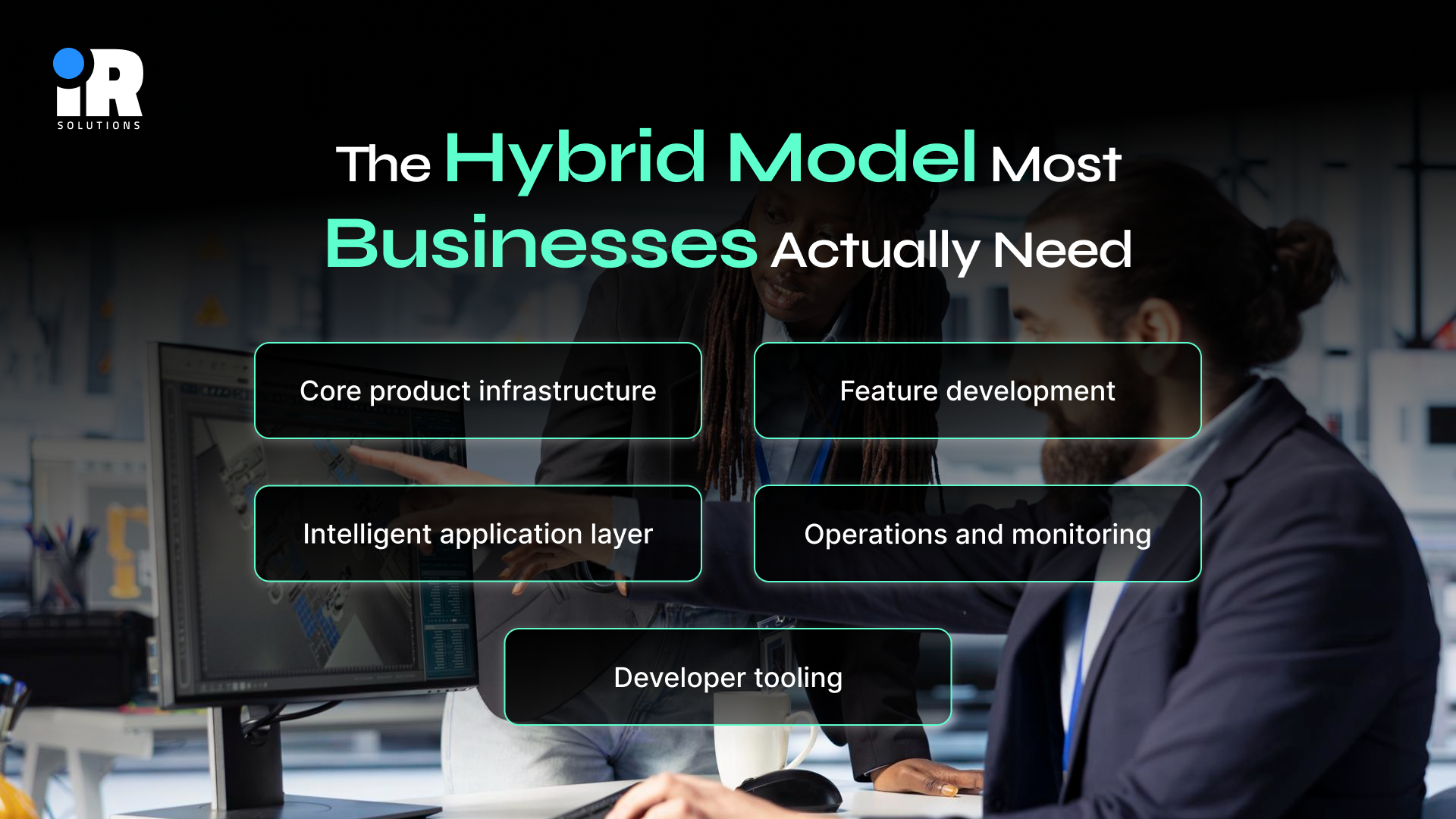
A practical hybrid approach divides the work like this:
- Core product infrastructure: Authentication, billing, data storage, and foundational business logic built with traditional development practices for stability that survives team changes, scaling events, and years of daily use.
- Feature development: New features built with AI assistance for coding, testing, and documentation, while engineers retain full ownership and genuine understanding of everything that gets merged into the main codebase.
- Intelligent application layer: User-facing AI capabilities like recommendations, summarization, and process automation delivered through clean, well-tested APIs that connect to the traditionally built foundation underneath them.
- Operations and monitoring: Traditional DevOps practices for deployment, incident response, and infrastructure management, with AI-powered anomaly detection layered in to surface issues before alert thresholds catch up to them.
- Developer tooling: AI-assisted code review, documentation generation, and onboarding support running across the whole team to raise overall output without relaxing the engineering standards that protect product quality over time.
- Traditional development remains essential for software that demands stability, structure, and long-term reliability.
If you want a practical conversation about where this balance makes sense for your specific product, team size, and growth timeline, book a call with our team, and we will work through the specifics together.
Mistakes Businesses Make in Picking Development Approaches
Rushing into AI tools without governance creates slow-motion problems that are expensive to fix. Teams that push AI-generated code into production without clear review standards end up with codebases full of logic that nobody fully owns, and the productivity gains from faster generation get absorbed by debugging costs when something fails in a way nobody tested for or anticipated.
Avoiding AI tools entirely because leadership is uncomfortable with them is an equally costly mistake on the opposite end of the spectrum. Businesses that stick exclusively with traditional development in fast-moving markets leave real productivity gains unused and end up competing against teams shipping meaningfully faster on the same engineering budget, a gap that compounds over time and becomes harder to close.
Underestimating integration work consistently catches businesses new to AI development off guard. Connecting AI capabilities to existing production systems is rarely as straightforward as making a correctly formatted API call. Data pipelines need cleaning, model outputs need explicit error handling, and businesses that treat integration as an afterthought tend to discover the gaps in production, where fixing them costs significantly more than catching them earlier would have.
Explore how AI automation is helping businesses streamline operations and save costs in: How Businesses Use AI Automation to Reduce Costs and Increase Efficiency
Conclusion
Traditional development and AI development are not rivals in a competition where one approach wins, and the other gets retired. They solve different problems and perform best under different conditions. Traditional development gives you a stable, auditable, maintainable codebase that engineers fully understand and can work with over many years. AI development gives you speed, leverage, and capabilities that would have cost considerably more to build from scratch just a few years ago.
Most growing businesses benefit from both, used deliberately in the right parts of the product for the right reasons at the right stage of growth. The mistake is picking one and forcing every decision through it, regardless of fit. Businesses that get this balance right usually have an AI software development partner who has navigated both approaches across enough real projects to know where each one earns its place and where it doesn't.
Frequently Asked Questions
What separates AI from traditional software development?
Traditional development is fully human-written code managed manually, while AI development uses intelligent tools to assist and partly automate parts of the engineering process.
Is AI-driven development faster than traditional approaches?
For prototyping, boilerplate, and documentation, it generally is, but actual speed depends on developer's skill and how complex the task is.
Can AI tools fully replace experienced software engineers?
No, AI tools handle repetitive suggestions and generation, but engineers still own every architecture, security, and long-term quality decision.
Which development method suits early-stage startups best?
Startups validating ideas fast often benefit from AI tools for speed, but product type and compliance requirements shape the right answer considerably.
What industries are best suited for AI development?
E-commerce, SaaS, healthcare diagnostics, fintech, and logistics see the strongest outcomes when AI capabilities are integrated thoughtfully alongside traditional systems.
Is AI-generated code safe enough for production environments?
It can be, but it needs the same rigorous review, security checks, and testing standards applied to any manually written production code.


