



AI has quickly become the factor separating fast-moving businesses from companies struggling to keep pace with changing markets. The conversation is no longer about whether companies should adopt AI, but how quickly they can integrate it before competitors pull further ahead. Businesses already benefiting from AI automation services inside their operations are cutting costs, automating repetitive work, improving customer experiences, and making faster decisions with real-time data. Meanwhile, companies still delaying adoption are finding themselves stuck with slower workflows, rising operational costs, and growing pressure to keep up. Over the next twelve months, the gap between businesses using AI effectively and those still hesitating will become impossible to ignore.
What AI Means for Business in 2026
Forget the keynote stage because AI doesn't live in research labs or innovation departments anymore inside companies. It now sits inside the daily tools your team already uses, often without anyone noticing the actual technology behind it. Sales reps see AI-suggested next steps in their CRM, and recruiters get resumes pre-ranked by fit automatically each day. Finance teams catch fraud before it hits the books, and marketing teams ship 10 times more content per month. The businesses treating AI that way are pulling ahead while everyone else still debates the philosophy of it all, and this is exactly what separates modern businesses from the ones still stuck inside outdated workflows.
Why Businesses Cannot Afford to Ignore AI Anymore
The companies that pushed off AI between 2023 and 2025 are now stuck in serious catch-up mode this year. Those same competitors now run leaner teams and price products smarter, while predicting customer behavior with surprising weekly accuracy. Customer expectations have shifted along with it, and people now expect instant answers and personal recommendations from every brand. When your support ticket sits two days while a competitor's chatbot resolves it in two minutes, the customer notices fast. Skipping AI Automation in 2026 looks a lot like skipping the internet back in 2002 or mobile apps in 2012. A few signals show your window is closing faster than most business leaders expected at the start of this year.
- Operating costs keep creeping up while customer acquisition gets harder, and margins are getting squeezed every single quarter now.
- Competitors are openly shipping AI features inside products that used to look almost identical to yours from the outside.
- Your best people want to work with modern tools rather than waste hours on the repetitive busywork that bores them.
- Investors and enterprise buyers now ask about your AI roadmap before they sign anything serious with your company directly.
Top AI Use Cases Driving Business Growth Now
Most of what gets called AI for business is really eight or ten use cases applied in slightly different ways, and the strongest AI use cases for businesses usually fall inside the categories listed below. Pick the one that hurts your team the most right now, and start there before trying anything else at all.
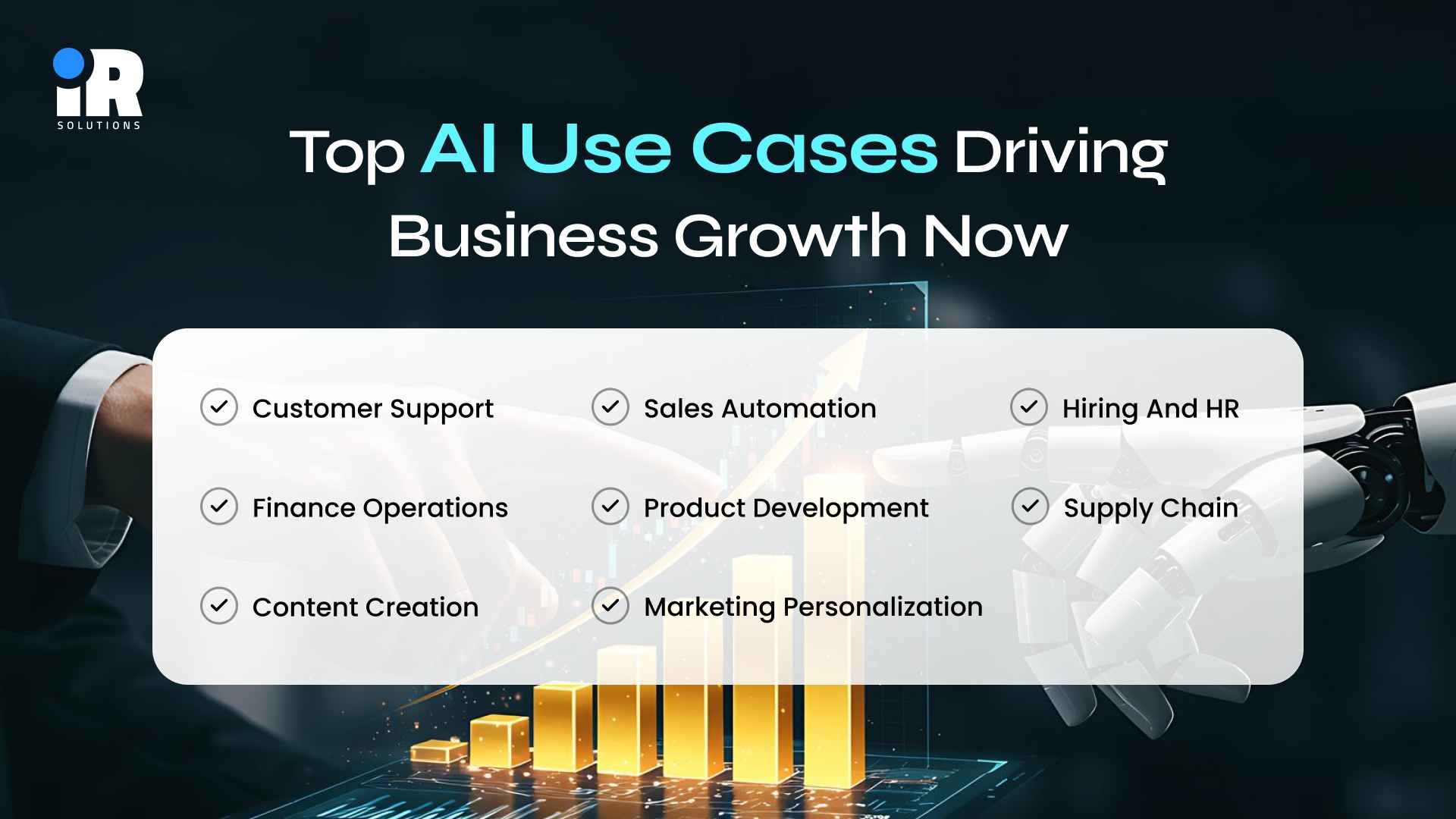
- Customer Support: Chatbots and voice agents power AI in customer service by taking the load off your team, and most repeat questions never reach a real rep anymore.
- Sales Automation: Smart CRMs score leads, draft outreach emails, and tell your reps which deals are actually closeable this current quarter.
- Marketing Personalization: AI engines tailor ads, landing pages, and product recommendations for each visitor based on actual browsing behavior on your website.
- Hiring And HR: Recruiters screen resumes, schedule interviews, and predict candidate fit without wasting hours on phone screens that always go nowhere.
- Finance Operations: AI categorizes transactions, spots anomalies, forecasts cash flow, and flags fraud long before your accountant notices anything is wrong.
- Product Development: Engineers use copilots inside AI Product Development to write code, generate tests, and debug bugs faster than they could ever do alone, most days.
- Supply Chain: Predictive models forecast demand, optimize routes, and prevent stockouts before your old planning system even sees the problem coming.
- Content Creation: Marketing teams now use AI for Content, Code & Operations to produce blogs, videos, and ad creatives in hours instead of weeks, and the quality is honestly fine.
Where AI Automation Truly Pays Off Today
Automation is where you will see returns the fastest, sometimes inside the first three months of working with it. The reason businesses use AI automation so aggressively now is simple, because it strips out repeat work, cuts errors, and gives your team time for the things humans actually do well anyway. That means more time for strategy calls, real customer conversations, and the judgment calls that actually matter every week. Modern automation is not the rigid rule-based scripts of the old RPA era that fell apart on any change. Today's tools blend rules with smart models that learn from your data and keep getting better over time naturally. The result is faster turnaround, lower cost, and customers who actually notice the difference in their experience with you.
A few places we have seen this pay off cleanly across companies of every size and industry vertical recently. Customer onboarding now runs end-to-end without a human, from document verification through KYC checks to welcome email sequences. Streamlining operations with AI is now visible inside invoice processing, expense approvals, and vendor reconciliation that run on Autonomous AI Agents working around the clock without breaks. Even meeting notes and follow-up emails are automatically drafted by the assistant sitting right inside your team's daily workspace.
For workflow examples and tool picks, take a look at our breakdown of Will AI Automation Redefine Business Growth in the Coming Years?
Most Practical AI Tools Powering Business in 2026
AI tooling has come a long way recently, so you no longer need a research team to use these solutions. Most working stacks combine proven platforms with a custom AI layer built around your specific data and business workflows, and the AI Development Tools listed below are the categories worth knowing first.
- Conversational AI: Chatbots and voice agents handle tickets, qualify leads, and book meetings without ever getting tired or needing coffee breaks.
- Generative AI: Platforms produce text, images, video, and code on demand, so teams ship content in a fraction of the old timeline.
- Predictive Analytics: Smart dashboards forecast revenue, churn, demand, and risk by combining historical data with live signals from your connected systems.
- AI Copilots: They live inside your sales, support, design, and engineering tools and suggest the next best move in real context.
- Workflow Automation: Visual builders connect AI models with existing apps, so non-technical teams can design complex automations without writing any code.
- Custom Solutions: Tailored models built around your own data deliver more accuracy and competitive edge than any generic off-the-shelf tool can.
We covered the wider list in our blog. Give it a read: Which top 5 AI automation tools help businesses increase efficiency?
How to Implement AI Inside Your Business
Most AI projects fail because of planning, not because the underlying technology actually broke down anywhere along the way. The step-by-step strategy outlined in the six steps below has helped our clients move from idea to working AI inside weeks instead of getting stuck. This is also where the real difference between AI vs Traditional Software Development shows up, because AI products need data discipline and continuous tuning rather than a one-time build and ship cycle.
Step 1: Identify the right business problem
Start by listing your team's most painful, repetitive, or expensive workflows that drain real hours from your week every Monday. Pick one problem with clean data behind it, real measurable impact, and a clear way for everyone to track success. Trying to use AI everywhere at once usually ends in confusion, wasted budgets, and quiet abandonment six months later.
Step 2: Audit your data readiness
AI is only as good as the data feeding it, so quality matters more than picking the perfect model upfront. Look at where data lives, how clean it actually is, and whether the right teams can pull it when needed. If data sits scattered across spreadsheets, emails, and old SaaS tools, fix that foundation before training any model at all.
Step 3: Choose build, buy, or blend
Some problems get solved by buying a ready tool, while others need a custom AI build from scratch instead. A blended approach usually works best, mixing a proven platform with a custom layer built around your specific edge cases. Talk to an experienced AI partner before you commit to anything because the wrong choice here can cost you months.
Step 4: Run a small pilot first
Pick one workflow, set clear metrics, and run a four to eight week pilot before scaling anywhere else right away. Measure time saved, errors reduced, customer feedback, and revenue impact, then compare honestly against the original manual baseline numbers. A small early win builds internal trust, frees up budget for the next round, and gives your team real confidence.
Step 5: Train teams and manage change
Technology by itself never delivers results, and people inside your company need to actually understand, trust, and use the tools. Run hands-on training sessions, share early wins openly with the team, and answer job security questions with real honesty. Senior leaders must use the tools themselves because adoption falls apart fast when managers stay on the sidelines watching.
Step 6: Scale, monitor, and improve
Once your pilot proves out, roll AI across other departments while monitoring performance, accuracy, and any drift in model quality. Set up review cycles where your data team or delivery partner retrains models on fresh data every few months consistently. AI is never a one-time setup, and companies that keep winning are the ones that keep tuning their models always.
Industries Already Winning Big With AI Adoption
Some industries moved faster than others, and the gap between leaders and the rest is widening every business quarter now. From global enterprises down to lean AI for small businesses and startups, these are the places where returns show up not in slide decks but in actual financial reports at the end of each quarter. AI for startups in particular has opened doors that used to require enterprise-level budgets, putting powerful automation within reach of smaller, faster-moving teams.
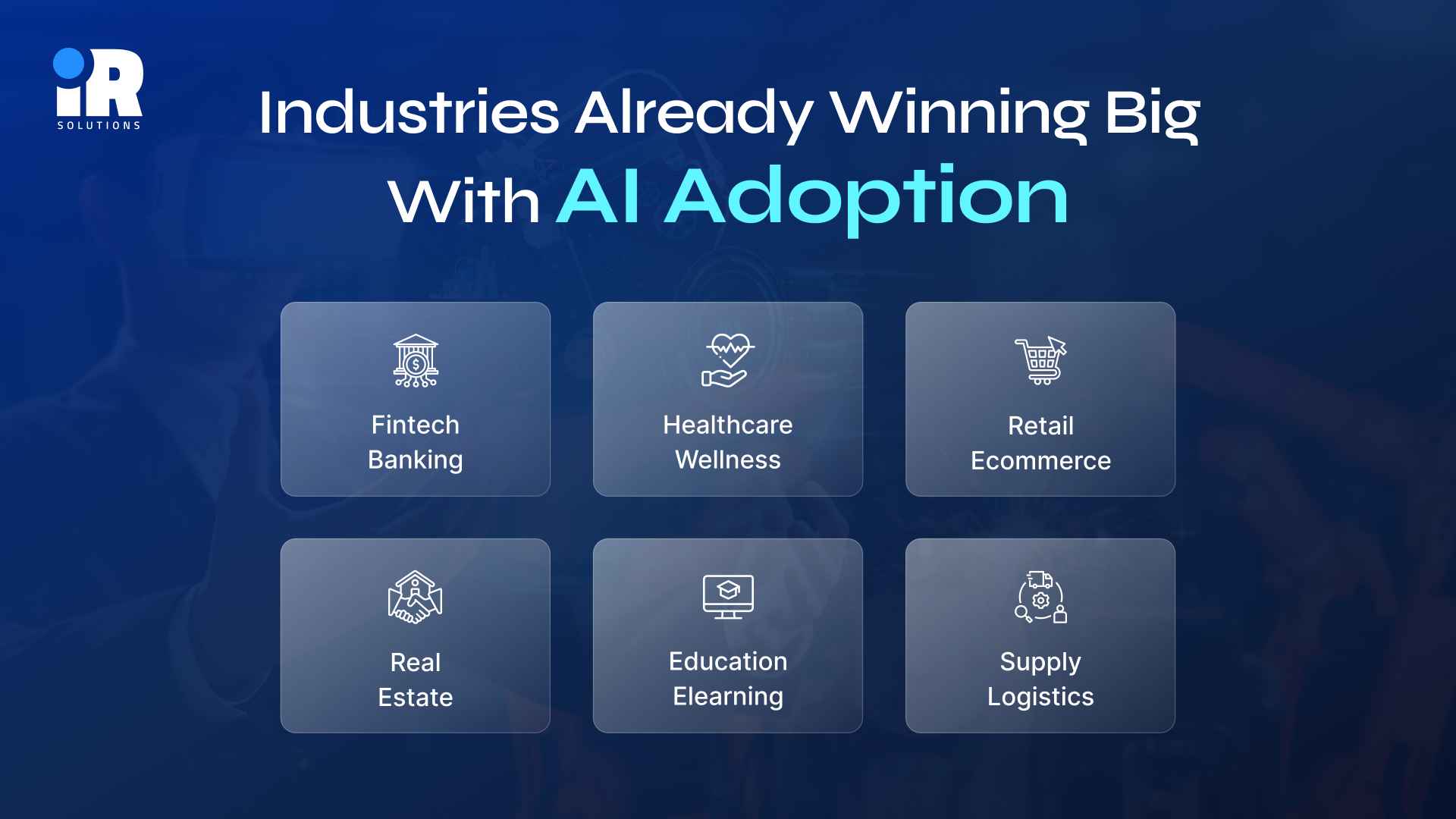
- Fintech Banking: Fraud detection, risk scoring, and AI support agents are cutting losses while tightening compliance across modern digital banking platforms.
- Healthcare & Wellness: Diagnostic tools and AI assistants reduce repetitive work and save clinical staff valuable time. AI is revolutionizing healthcare through faster, more efficient patient care.
- Retail Ecommerce: Personalized recommendations, dynamic pricing, and demand forecasting are pushing conversion rates and average order values steadily higher each quarter.
- Real Estate: Smart property matching, predictive pricing, and AI document assistants cut paperwork time on every single deal your team closes.
- Education E-learning: AI tutors, automated grading, and personalized learning paths help students learn faster while easing the workload on tired teachers.
- Supply Logistics: Route optimization, predictive maintenance, and demand forecasting cut fuel and delivery costs across complex global supply chain networks today.
Common Mistakes Businesses Make While Adopting AI
Most AI failures are not technology failures at all, but the same handful of mistakes repeating across different companies. The common challenges below show up over and over again inside companies that waste real money on projects that never deliver.
- Companies treat AI like a magic fix for vague goals instead of using it to solve one specific measurable problem.
- Teams skip data cleanup and then feed unreliable inputs into models that output unreliable predictions and unreliable garbage every time.
- Many leaders buy expensive enterprise platforms when a lean custom build would deliver more value for far less total money.
- Change management gets ignored, and employees are expected to adopt new tools without training, communication, or leadership backing.
- Teams try to scale AI everywhere at once instead of proving one win first inside a single, focused pilot project.
- Some leaders pick generic vendors who do not actually understand their industry, their data, or their team's daily operational reality.
Choosing the Right AI Development Company for Automation
Choosing the right AI development company for automation often matters more than picking the right tool, and the difference between a team that ships and one that stalls usually shows up within the first month of working together. The strongest partners have spent years building AI products that actually run in production for real users, not just proofs of concept that live inside slide decks. Trusted companies provide custom AI development services built around your operational data, workflows, and business priorities, focusing on outcomes that actually drive measurable growth. Solid work in this space spans predictive dashboards, generative AI tools, intelligent automation agents, and the full delivery lifecycle wrapping around them.
Depending on the project scope, businesses hire dedicated AI and ML developers on demand or build a full project team for end-to-end delivery. Strong custom IT development services combine AI with web, mobile, blockchain, and IoT expertise to support larger digital transformation initiatives. Global delivery capabilities also matter more than most companies expect, because distributed teams across multiple time zones provide faster support, continuous development, and quicker resolution when critical production issues arise.
To plan your AI roadmap with someone who has done this work before, book a free consultation with our experts.
Conclusion
AI in 2026 stopped being the future, and it has become the operating system of every business chasing real growth. The technology works, the tools are everywhere, and the playbooks have already been proven by companies that moved early and executed well. What's left is starting small first, before scaling it across the organization over time. IR Solutions helps businesses move from planning to execution by building and integrating AI systems that actually fit real workflows. The smartest approach is to focus on one high-impact problem, solve it practically, and convert it into a system that can be repeated and expanded across the business. That simple approach is the real formula for AI adoption in 2026, even though many companies still overcomplicate it.
Frequently Asked Questions
How long does AI implementation usually take for a business?
Pilot AI projects usually run four to twelve weeks, while larger custom builds normally take three to 6 months overall.
Is AI only useful for large enterprises and not small businesses?
AI is fully accessible to startups and small businesses today, thanks to affordable APIs, prebuilt platforms, and flexible engagement models.
Will AI replace my employees inside the company?
AI mostly replaces repetitive tasks rather than entire people, freeing your team to focus on creative work and real strategy.
How much does AI implementation actually cost for a business?
Costs swing widely, from a few thousand dollars for simple tools to hundreds of thousands for full enterprise builds today.
How do I choose the right AI development partner for my company?
Look for proven case studies, transparent pricing, a strong delivery team, and real experience inside your specific industry vertical now.
Which industries currently benefit the most from adopting AI?
Fintech, healthcare, retail, real estate, logistics, and education are seeing the biggest measurable returns from properly implemented AI solutions.
Do I need an in-house data science team to start with AI?
You do not need an in-house data science team if you partner with a specialized AI development firm instead today.