


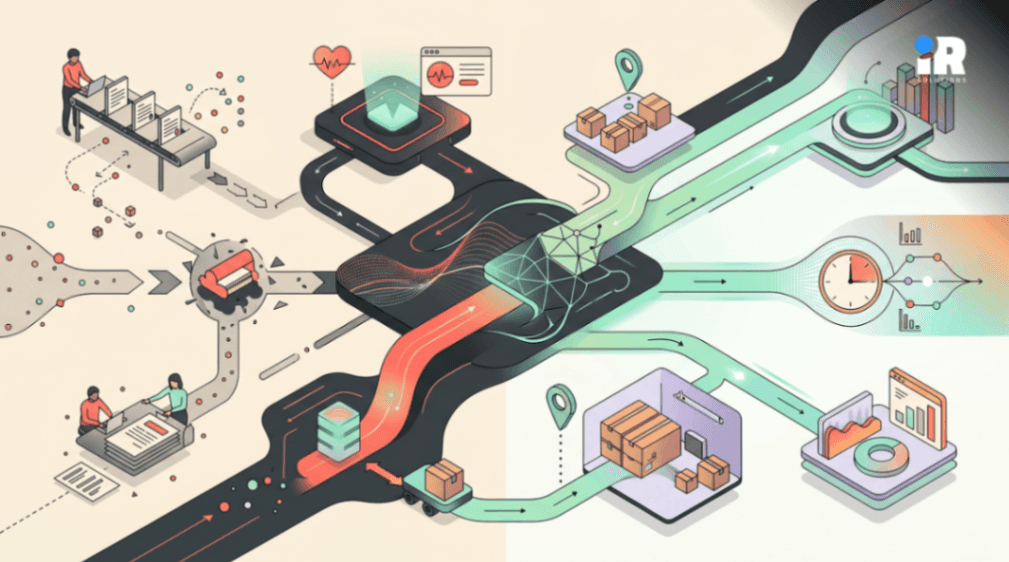
A clear gap is widening between businesses that have adopted AI and those still watching from the sidelines when analyzing ai use cases by industry. The companies pulling ahead aren't always the biggest or best-funded ones in their industry. They're the teams that stopped waiting and quietly started building something real. AI is infrastructure now, much like electricity or the internet once was, and the longer you delay, the more expensive the catch-up becomes for everyone involved. The businesses gaining ground identified one real problem worth actually solving. They invested in custom AI & ML development built around their context, then scaled from that first measurable win.
How AI Is Reshaping Industries Right Now

1. Healthcare & Wellness
Healthcare moves cautiously, but AI is making its greatest strides here, when a diagnostic model catches what a radiologist missed, the results speak for themselves.
- Early Diagnostics: AI imaging can detect cancer, cardiac, and neurological disease much earlier than standard screening.
- Remote Monitoring: Wearables feed continuous vitals into clinical systems that escalate automatically.
- Drug Discovery: Years of lab work are now done in months thanks to artificial intelligence molecular scanning.
- Clinical Workflow: Scheduling, billing, insurance verification, and documentation are now powered by AI. This will allow clinical staff to focus on patient care without the distraction.
- Personalized Treatment: ML models surface fitting treatment paths that take into account genetics, lifestyle, history, and medication.
2. Fintech & Banking
Banks adopted AI because money moves fast and fraud moves faster, the industry needed real-time intelligence long before most sectors asked the question.
- Fraud Detection: ML flags suspicious patterns in milliseconds, before charges even complete.
- Credit Scoring: Alternative data, rent, utilities, and spending behavior fill gaps in traditional credit histories.
- Robo-Advisory: Automated platforms rebalance portfolios based on live market conditions instantly.
- Regulatory Compliance: NLP tools read regulatory updates and flag policy gaps before they become audit findings.
- Customer Personalization: AI times product recommendations, targets segments, and adjusts to behavioral signals at scale.
3. Retail & E-Commerce
E-commerce didn't wait for a consensus on AI, early movers tested it, saw the revenue numbers, and scaled fast.
Recommendation engines surface the right product at the right moment. They use purchase history, session behavior, and signals most retailers never thought to track. Visual search changed how product discovery works entirely upload a photo and skip the keywords.
Inventory forecasting models predict demand shifts weeks in advance. That's the difference between a fulfilled order and a costly stockout. Dynamic pricing responds to competitor moves and real market demand, not the monthly pricing review.
AI isn't a growth lever for retail anymore, it's the cost of playing at a competitive level.
4. Supply Chain & Logistics
Supply chains broke publicly a few years back, and they were rebuilt through better data and smarter automation.
- Route Optimization: Platforms cut last-mile delivery costs using real-time traffic and logistics data.
- Predictive Maintenance: Sensors detect equipment issues before machines fail mid-peak season.
- Demand Forecasting: Models reposition inventory weeks ahead of actual demand shifts.
- Computer Vision Robots: They pick, sort, and pack with speed and accuracy that humans can't sustain all day.
- Supplier Risk Tools: They monitor geopolitical events, weather, and financials, alerting procurement teams early.
5. Education & E-Learning
Education technology has been overpromised for decades, and AI is actually delivering where earlier tech didn't.
Adaptive platforms adjust pacing, format, and content sequence based on each student's actual responses. Intelligent tutoring systems give immediate, contextual feedback, not just "wrong, try again."
AI proctoring solved one of online education's biggest logistics headaches. Automated grading handles volume that teaching staff can't keep up with at scale. Institutions improving completion rates aren't those with the most technology they use AI, which removes friction, not adds it.
6. Real Estate & Property
Real estate companies are using AI to optimize daily operations and reduce delays in property management.
- Valuation Models: ML runs through thousands of data points, location, comparables, market trends, and returns valuations faster and more consistently than any appraiser working alone.
- Virtual Tours: AI-powered 3D platforms let buyers walk through properties without leaving their couch. For serious buyers, this has become where the search actually starts.
- Tenant Screening: Instead of gut-checking an application, AI pulls together applicant data and flags reliability issues that manual review tends to miss or inconsistently apply.
- Market Forecasting: Predictive models connect economic indicators and local demand signals to project where prices are heading, often months before the market moves.
- Smart Buildings: AI manages energy use, HVAC schedules, and building security on a rolling basis. Not quarterly check-ins. Continuously.
7. Manufacturing & Industrial Operations
Factory floors are getting quieter and more efficient at the same time. AI handles the monitoring, flagging, and optimization that used to eat up constant human attention.
- Quality Control: Computer vision inspects goods at a pace no human QA team can hold across a full production run, and it doesn't get tired at hour six.
- Predictive Maintenance: Sensors catch machine wear before it becomes a mid-run failure. Scheduled downtime is cheap. Unplanned downtime is not.
- Process Optimization: ML surfaces bottlenecks and recommends process changes that improve throughput without adding headcount.
- Energy Management: AI watches consumption in real time and adjusts equipment cycles to cut costs, without touching output.
8. Telecommunications
Telecom networks are among the most complex infrastructures on earth. Data volume alone makes manual management impossible.
Network optimization tools reroute traffic before congestion causes visible service degradation. Churn prediction models identify at-risk subscribers weeks before cancellation, giving retention teams a real window to act. Virtual agents now handle the majority of tier-one support queries without human involvement. Security platforms monitor millions of connection points simultaneously, catching intrusion patterns before they escalate.
Check AI for Business in 2026: Use Cases, Automation, Tools & Implementation Guide for real examples of how businesses are using AI in 2026.
Core AI Technologies Driving AI Applications

AI & ML development team works across all of these disciplines. Hire specialized engineers for agentic AI, NLP, computer vision, and generative AI specifically.
Why AI Directly Fuels Faster Business Growth
The mistake most businesses make is treating AI purely as a cost-reduction play, which frames it badly.
AI makes personalization scalable instead of targeting segments, you respond to individual behavior in real time at volume. That's a fundamentally different kind of customer relationship, and the revenue difference is measurable.
It accelerates decision-making by surfacing data patterns that would take analysts weeks to find. It removes repetitive, low-value work and redirects your best people toward strategic priorities.
The compounding effect is what most business cases miss. Every week you run an AI model, it trains on more data. Every quarter, your team acts on outputs more effectively. Businesses that were built two years ago are building on a foundation that can't be replicated overnight.
Real Barriers Businesses Face When Adopting AI
Most AI projects don't fail because of the technology they fail for predictable, avoidable reasons.

- Data Readiness: The model is only as good as what you feed it. Most businesses find their data is messier than expected, fragmented, inconsistent, or labeled differently across departments.
- Legacy Integration: Old infrastructure rarely cooperates with modern AI systems without a fight. Middleware work, API wrangling, and occasional re-architecture almost always add more time and cost than the original estimate accounts for.
- Talent Gap: Good AI engineers and data scientists are hard to find, and expensive once you do. Building an in-house team from scratch takes longer than most budgets plan for staff augmentation tends to get teams moving faster without the recruiting overhead.
- Model Bias: A model trained on incomplete or skewed data produces skewed outputs. That's not just a technical problem it can create legal exposure and erode user trust, often before anyone inside the company realizes something is wrong.
- ROI Measurement: Without clear, specific success metrics, AI projects are nearly impossible to defend to leadership. The work looks like cost, not investment, when there's nothing concrete to point to.
- Change Management: Teams resist what they don't understand. Even technically sound implementations fail when users don't trust the output or know how to act on it.
What a Real AI Strategy Actually Looks Like
Most businesses that struggle with AI made the same mistake at the start: they led with technology instead of a problem.
A strategy that starts with a specific question: where are decisions being made slowly? Where do errors cost real money? Where is a manual process creating a bottleneck that automation could eliminate? The answer to one of those questions is your starting point. Technology choice comes after, not before.
Then comes the data conversation, almost every business has data. The real questions are whether it's structured, clean, and relevant to the outcome you're trying to predict or automate.
Most organizations find that foundational work is needed before any model can train effectively. Build that into the plan from day one.
The last piece is integration, a model that runs in isolation doesn't generate business value. ROI shows up when AI outputs feed directly into the workflows and decisions your teams already make, not in a separate dashboard someone checks once a week.
Contact us to identify where slow decisions and manual work are holding things back.
How to Choose the Right AI Development Partner
This decision matters more than most businesses expect. The wrong partner builds something technically impressive that doesn't fit how you actually operate.
Domain experience over general capability. A team that's built AI solutions inside your industry understands the data patterns, regulatory constraints, and operational realities specific to your context. Generic shops underestimate that complexity, and you pay for it in rework and delays.
Watch the discovery process closely. A serious partner spends real time understanding your data and workflows before proposing anything. If a vendor is pitching a specific stack before an honest look at your situation, that's a signal worth paying attention to.
Post-launch support isn't optional. Models drift. Business requirements change. Data distributions shift. The partner that disappears after go-live is a liability. Make sure the engagement includes ongoing monitoring and optimization not as an expensive add-on, but as part of the structure.
Book a free strategy session to get a clear, honest picture of what's possible for your business.
Conclusion
AI is no longer a future consideration, it is happening right now, and the businesses moving early are already pulling ahead. Faster decisions, leaner operations, and stronger customer relationships are becoming the norm for those who get it right. The secret is not adopting AI everywhere but using it where it genuinely solves problems and delivers measurable results. That requires the right strategy, trustworthy data, and integration that actually fits how your teams work. IR Solutions helps businesses turn AI into practical, working systems that improve efficiency, sharpen decision-making, and build growth that is both sustainable and scalable across industries.
FAQs
What are the best AI applications for companies in 2026?
Fraud detection, personalization engines, predictive analytics, computer vision, NLP and intelligent workflow automation are among the most common and widespread applications in the industry today.
What sectors are benefiting the most from AI?
At this moment, the return on investment can be easily tracked and demonstrated in the fields of healthcare, fintech, retail, logistics, and manufacturing.
How long does a custom AI solution typically take to build?
Most projects run between eight and twenty weeks from discovery to deployment, depending on data readiness and scope complexity.
Can smaller businesses realistically afford AI development?
Yes. The right partner scopes an engagement around what the business needs and what the budget can support not a fixed package.
What data does a business need before starting an AI project?
Clean, structured historical data relevant to the target outcome is the foundation. That's what gets trained into a model worth using.
Will AI integrate with our existing software and platforms?
Well-engineered AI systems include API-based integration layers built to connect with existing stacks without requiring a full infrastructure rebuild.
What is the difference between AI and machine learning?
AI is a broader discipline. Machine learning is one of its core methods, how systems learn patterns from data without being explicitly programmed.
Can non-technical teams actually use AI-powered tools day to day?
When built correctly, the interface is designed for the end user, not the engineer. Business teams interact with outputs and insights, not the underlying model.