




Many organizations focus on deploying AI tools quickly, yet far fewer build the systems needed to measure their real impact. Activity alone cannot justify budgets, support expansion plans, or prove that AI is improving business performance. Without clear metrics, even successful AI initiatives become difficult to defend when leadership asks for results. Partnering with IR Solutions helps businesses build AI-powered solutions with measurable performance, scalable implementation, and clear business objectives from the start. Measuring AI ROI helps connect every customer interaction to meaningful outcomes such as revenue growth, cost savings, operational efficiency, and customer satisfaction. Businesses that track the right performance indicators gain the confidence to improve strategies, optimize investments, and make smarter decisions.
Why AI ROI Measurement Determines Long-Term Business Success
AI adoption in customer service took off fast, but nobody thought to bring measurement along for the ride. Businesses that bring in custom AI chatbot development early tend to build support systems around actual performance goals, not just automation for its own sake. Plenty of businesses rolled out chatbots and virtual agents without any real plan for tracking what they were worth. That oversight doesn't show up right away, it shows up at budget review time, every quarter, like clockwork. Leadership wants to know what the AI actually delivered, and all anyone can point to is how many conversations it handled.
Once you're past the pilot stage, results stop being about whether AI works and start being about what it's actually doing for the business. Stakeholders want proof, not promises, that the investment is paying off and lining up with where the company's headed long-term.
- Budget pressure: Finance teams want hard numbers before they renew any AI contracts.
- Service Providers: Providers should justify their pricing with real, verifiable performance data.
- Scaling decisions: You can't expand AI use without knowing what's already working well.
There's also a trust problem underneath the budget conversation, since leaders often defend AI spending without clear metrics to back it up. A proper measurement system swaps that guesswork for a story the whole room can agree on.
Building measurable AI systems starts long before performance reports and executive dashboards. Businesses that hire AI & ML developers can design AI solutions with reporting, analytics, and business objectives built into the implementation from day one, making it much easier to demonstrate measurable ROI as the system grows.
Revenue Impact From AI Customer Interactions
Revenue is the clearest signal of whether your AI investment is actually working for you. Every automated interaction is a chance to upsell, retain, or convert a customer faster than a person could alone.
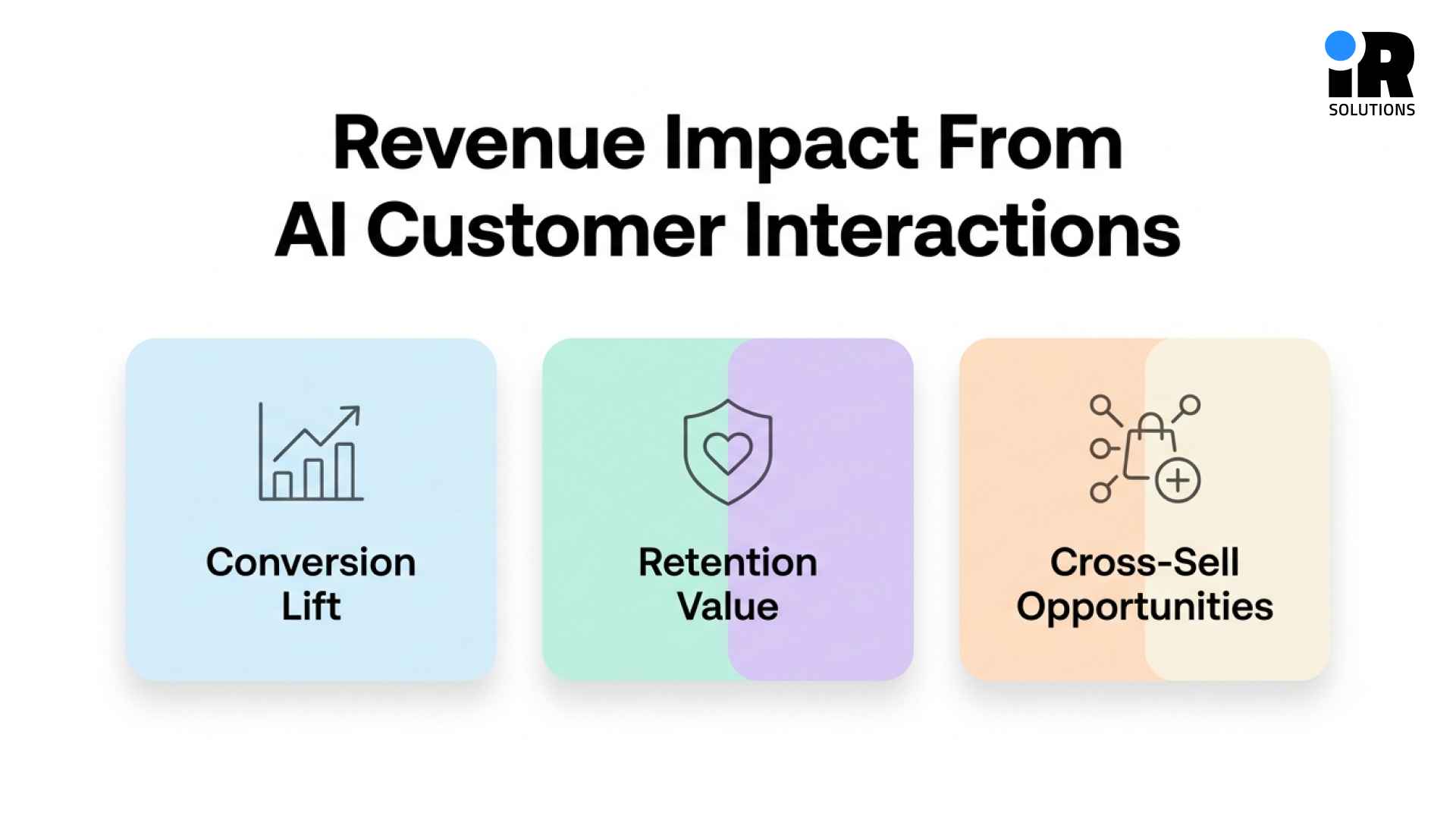
Conversion Lift
AI chat tools can respond to buying signals within seconds of a customer asking a question. Track how many AI-assisted conversations end in a completed purchase or a signed contract.
- Speed to answer: Faster responses shorten the window customers spend deciding whether to buy.
- Personalized offers: AI can suggest relevant add-ons based on browsing or prior chat history.
- Cart recovery: Automated follow-ups on abandoned carts often convert better than generic bulk emails.
Set up a simple tagging system that marks which conversations touched a sale before closing. A few months of that tagging gives you a solid picture of AI's real influence. Skip that step, and you're stuck guessing whether AI actually helped or just happened to be present.
Retention Value
Losing a customer costs a lot more than keeping one, so retention deserves its own column. AI-powered support that resolves issues fast keeps customers from churning to a competitor down the road.
- Repeat purchase rate: Compare customers who used AI support against those who didn't use it at all.
- Churn reduction: Measure how support response time actually affects customer renewal rates over time.
- Lifetime value shift: Track whether AI-assisted customers end up spending more over twelve months.
Cross-Sell Opportunities
Every support conversation is also a sales conversation waiting for the right moment to happen. AI tools can flag natural openings to suggest a relevant product or service upgrade.
- Attach rate: How often does an AI chat lead to an added product or plan?
- Revenue per interaction: Assign a realistic dollar value to each AI-handled customer conversation you track.
Don't assume AI deserves full credit for every closed deal it happens to touch. Build a fair attribution model that gives partial credit when AI starts, and a human closes. That keeps your revenue numbers honest, and it keeps finance from picking apart your whole report.
If you're ready to see how this approach can work for your business, schedule a free consultation with our team, and let's discuss your goals.
Where AI Actually Cuts Your Support Costs
AI reduces support expenses by automating routine requests while helping your team resolve complex issues more efficiently.
- Cost per ticket: Compare total payroll and tools before AI against the same formula after AI handles some volume.
- Staffing efficiency: AI deflects repetitive requests, so agents handle more complex tickets without needing extra hires.
- Tooling savings: One AI platform can replace several point solutions, cutting subscription costs across chat and ticketing tools.
- Hidden expenses: Factor in model retraining and integration upkeep, or you'll overstate your real savings later.
- Seasonal flexibility: AI absorbs demand spikes instantly, so you avoid the cost of hiring temporary seasonal staff.
How to Measure Productivity Improvements With AI
Productivity is harder to put a clean number on than cost or revenue figures. But it feeds both of those categories directly, whether or not you're tracking it well.
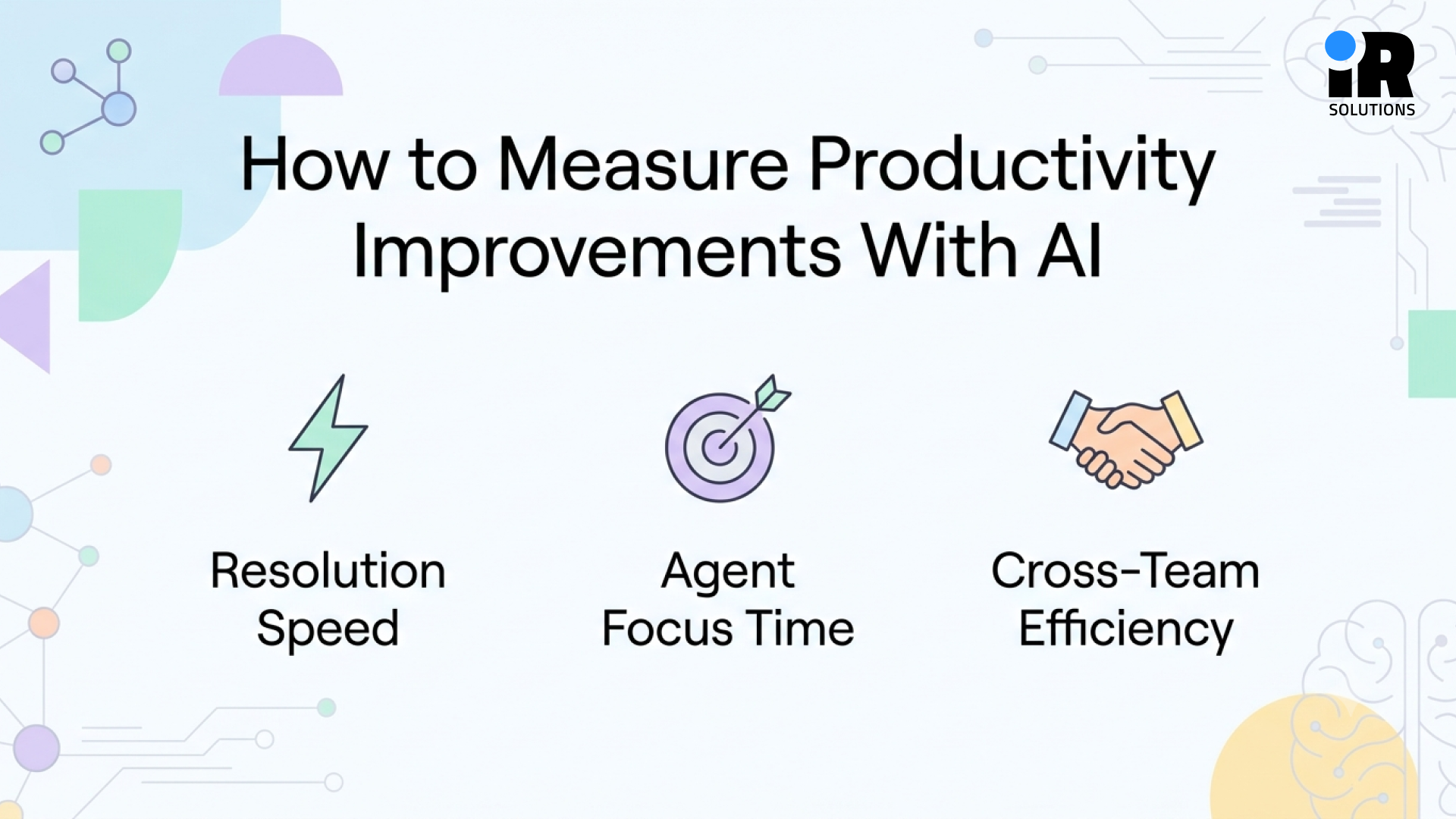
Resolution Speed
Measure how quickly issues get resolved from first contact to a final answer, not just the first reply. Faster response times change how customers perceive your brand right away, and lower escalation rates mean AI is actually solving problems instead of just stalling them.
Agent Focus Time
When AI handles routine questions, agents get more uninterrupted time for complex, high-value cases. Fewer simple interruptions throughout the day also mean fewer mistakes on the harder tickets that need real attention.
Cross-Team Efficiency
AI-powered customer data doesn't have to stay locked inside the support department. Sales, marketing, and product teams can use the same insights to spot trends and speed up handoffs, since AI summaries cut down the time reps spend digging through old ticket history.
Productivity gains rarely show up as one dramatic number sitting on a spreadsheet somewhere.
They show up as a team that feels less overwhelmed and delivers steadier work. That improvement is real, even if it takes a few extra weeks to appear clearly.
Long-Term Value Beyond Immediate Numbers
Short-term wins matter, but long-term value is what justifies sticking with AI investment over time. This is where a lot of businesses stop measuring too early and miss the bigger story.
Customer Trust Compounding
- Every fast, accurate AI interaction adds a small deposit to a customer's trust.
- Track Net Promoter Score trends across quarters instead of judging single, isolated campaigns.
- Happy customers who got AI help often end up referring new business themselves.
Data Quality Improvement
- AI systems get sharper as they process more real customer conversations over time.
- Track how often AI resolves issues without needing any human correction afterward at all.
- Better AI usually builds a richer, self-updating knowledge base for the whole team.
Competitive Positioning
- Companies good at AI-powered service build an edge over slower-moving competitors nearby.
- Customers talk about brands that respond faster than they were expecting them to.
- Faster service can quietly pull customers away from slower, less responsive competitors over time.
Employee Retention Impact
- Support teams that aren't buried under repetitive tickets tend to stay longer overall.
- Lower turnover significantly reduces recruiting and training costs for the business over time.
- Agents doing more meaningful work consistently report higher engagement scores in internal surveys.
None of these long-term gains show up cleanly on a single monthly report. They reveal themselves gradually over several quarters, which is why short-term thinking causes businesses to undersell AI's real value.
Key AI Metrics That Drive Better Business Decisions
Bringing all four categories together requires a shared dashboard that everyone in the company trusts. Here are the core metrics worth tracking together on one central scorecard.
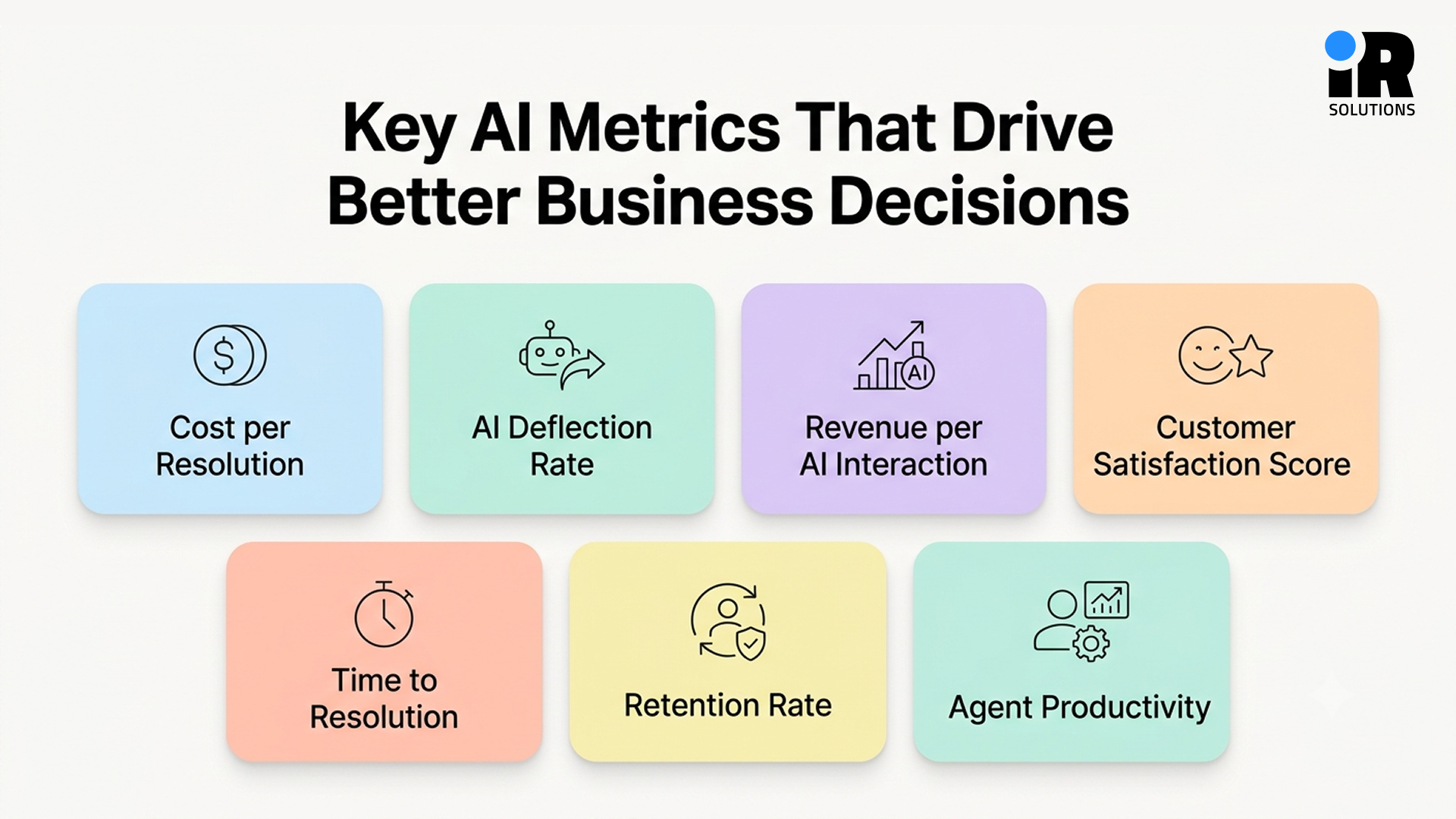
- Cost per resolution: Total support cost divided by the number of resolved tickets, tracked monthly.
- AI deflection rate: Percentage of tickets AI resolves entirely without any human involvement needed.
- Revenue per AI interaction: Average dollar value generated per automated conversation your AI handles.
- Customer satisfaction score: CSAT specifically for AI-handled interactions, tracked and reported separately from human-handled interactions.
- Time to resolution: Average time measured from first contact all the way to a closed ticket.
- Retention rate: Customer retention comparing AI-assisted support paths against fully human-handled ones.
- Agent productivity: Tickets handled per agent per shift, measured after your AI deployment went live.
Review these numbers monthly instead of annually, so problems get caught before they quietly pile up.
How to Track AI Performance Effectively
Good metrics need good systems supporting them, or the numbers will always feel like a guess. Most businesses already own more of this tracking infrastructure than they probably realize.
Analytics Dashboards
Centralized dashboards pull data from chat tools, CRMs, and ticketing systems into a single view. That stops different teams from working off conflicting numbers during the same meeting.
- Real-time tracking: See deflection rates and resolution times updating as they actually happen live.
- Custom reporting: Build separate views tailored specifically to sales, support, and finance teams.
Integration Requirements
AI tools work best when they're connected directly to your CRM and billing systems. Disconnected tools create extra manual work and make revenue attribution nearly impossible to trust fully. Better conversation analysis starts with the right expertise, making it important to hire NLP engineers when building AI systems that depend on accurate language processing.
- CRM sync: Match AI conversations automatically to actual, existing customer records in your system.
- API connections: Pull cost and usage data automatically, without relying on manual spreadsheet exports.
Businesses building a connected system like this often need engineering support to get it right. Successful AI deployments often rely on teams that hire AI developers to create custom integrations, automate workflows, and maintain data accuracy as operations grow.
Building an AI system with these capabilities often starts with Custom AI Chatbot Development: Complete Guide to Building Business-Specific AI Assistants, where every integration, workflow, and business requirement is planned from the beginning.
Why Regular AI Performance Reviews Matter
A great framework falls apart fast if nobody actually looks at the numbers regularly. Build a simple rhythm that fits how your team already works, week to week and quarter to quarter.
- Have operations leads glance at deflection rates and resolution times on a weekly basis.
- Keep the weekly scorecard to five or six metrics, with alerts if something drops below baseline.
- Bring cost, revenue, and productivity together once a month for one shared cross-team review.
- Invite finance and sales to that monthly review, not just the support team.
- Make sure every monthly review ends with at least one concrete, actionable change identified.
- Step back each quarter and decide whether to expand AI, pull back, or switch vendors.
Turning Measurement Into Business Growth
Numbers only really matter if they change what you actually do next with them. Use your ROI data to decide where AI should expand, retrain, or step back entirely. Businesses that treat this as an ongoing cycle, not a one-time report, get compounding returns from their AI investment over time.
The companies pulling ahead right now aren't the ones with the flashiest AI demo around. They're the ones who can explain, in plain numbers, exactly what their AI spends in return. That clarity builds trust with executives, investors, and customers all at once. It also makes every future AI decision faster, because you're working from evidence instead of instinct alone.
Conclusion
It's about knowing, in real dollars, what your AI spend returns each quarter. Revenue lift, cost savings, productivity gains, and long-term trust all belong on one scorecard. Reviewing these numbers together, instead of scattering them across teams, keeps everyone honest. Companies that track this consistently make sharper, faster calls about where AI deserves investment. They also know when it's time to pull back or rethink a struggling deployment. If your current AI tools aren't showing clear results, the setup is usually the problem. The technology itself rarely deserves the blame when numbers fall short of expectations. That clarity turns every future AI decision into something backed by real evidence.
Frequently Asked Questions
What counts as AI customer interaction ROI?
Basically, it's what you get back from AI compared to what you put into it think revenue, saved hours, and lower support costs. If those gains don't outweigh the subscription and setup costs, it's not really paying off yet.
Which metric matters most for AI ROI?
Most teams lean on cost per resolution since it shows efficiency in plain numbers. But pairing it with revenue per interaction gives you the fuller story, one tells you what you're spending, the other tells you what you're earning.
Can AI ROI include customer retention?
Definitely, retention is honestly one of the most overlooked pieces of this puzzle. If AI is helping people stick around longer and spend more time, that's real ROI, even if it doesn't show up on day one.
Do small businesses need AI ROI tracking too?
Yes, maybe even more so, it's easy to get talked into tools that sound impressive but don't actually match how your team works, and tracking ROI early saves you from that mistake.
How often should ROI reports be reviewed?
Monthly check-ins tend to work best for most teams, it's frequent enough to catch issues before they snowball, but not so often that you're chasing noise instead of trends.
What tools help track ROI from AI interactions?
A CRM that's actually connected to your AI tools makes a huge difference here. Add an analytics platform on top, and you'll start seeing patterns you'd otherwise miss in spreadsheets alone.
Should AI ROI include employee retention data?
Yes, and people forget this one a lot. When AI takes repetitive work off agents' plates, burnout drops, and that translates into real savings on hiring and training down the line.
Is AI ROI different for small teams?
Not really in terms of the approach, the framework itself stays consistent. What changes is scale your benchmarks and expectations to reflect your team size, not someone else's.