


Losing a customer rarely comes down to a bad product or a poor experience with your team. It usually happens because nobody was available to answer a straightforward question at exactly the right moment. A customer lands on your website at midnight, types something into the chat box, and walks away with either a useless canned reply or complete silence. That missed conversation costs you real revenue every single week, and it adds up faster than most business owners realize. Custom AI chatbots solve this problem by learning your actual products, pricing, FAQs, and workflows before they ever handle a live customer conversation. Every response sounds like it came from a trained member of your own team, not a generic platform reading from a recycled script.
Why Custom AI Chatbots Deliver Better Business Results
Standard chatbots are built for everyone, which in practice means they work well for no one specific. They don't know your products, your pricing, or the real questions your customers ask daily. A custom AI chatbot is trained entirely on your business data, your catalogue, your FAQs, and your workflows, so every response is accurate, on-brand, and actually useful. Investing in custom chatbot development means every response is accurate, on-brand, and actually useful.
Here is what separates a custom chatbot from anything you can download and plug in today:
- Business-specific training: The chatbot studies your actual documents, support tickets, and customer history before it ever handles a live conversation.
- Brand-matched responses: Every single reply sounds like it came from a trained member of your own team, not a robot reading from a script.
- Deep system access: It connects directly into your CRM, helpdesk, order management system, or any internal tool your team already relies on.
When a customer lands on your website at 2 AM with a question, a custom chatbot gives them the right answer immediately and moves them closer to buying.
If you want a deeper technical walkthrough of each stage, this guide on how to build a custom AI chatbot for your business covers the full process in detail.
Industries Getting the Strongest ROI from Chatbots
Some sectors extract significantly more value from custom chatbot technology simply because of how high their customer interaction volumes are and how repeatable most of those interactions tend to be across the working week.
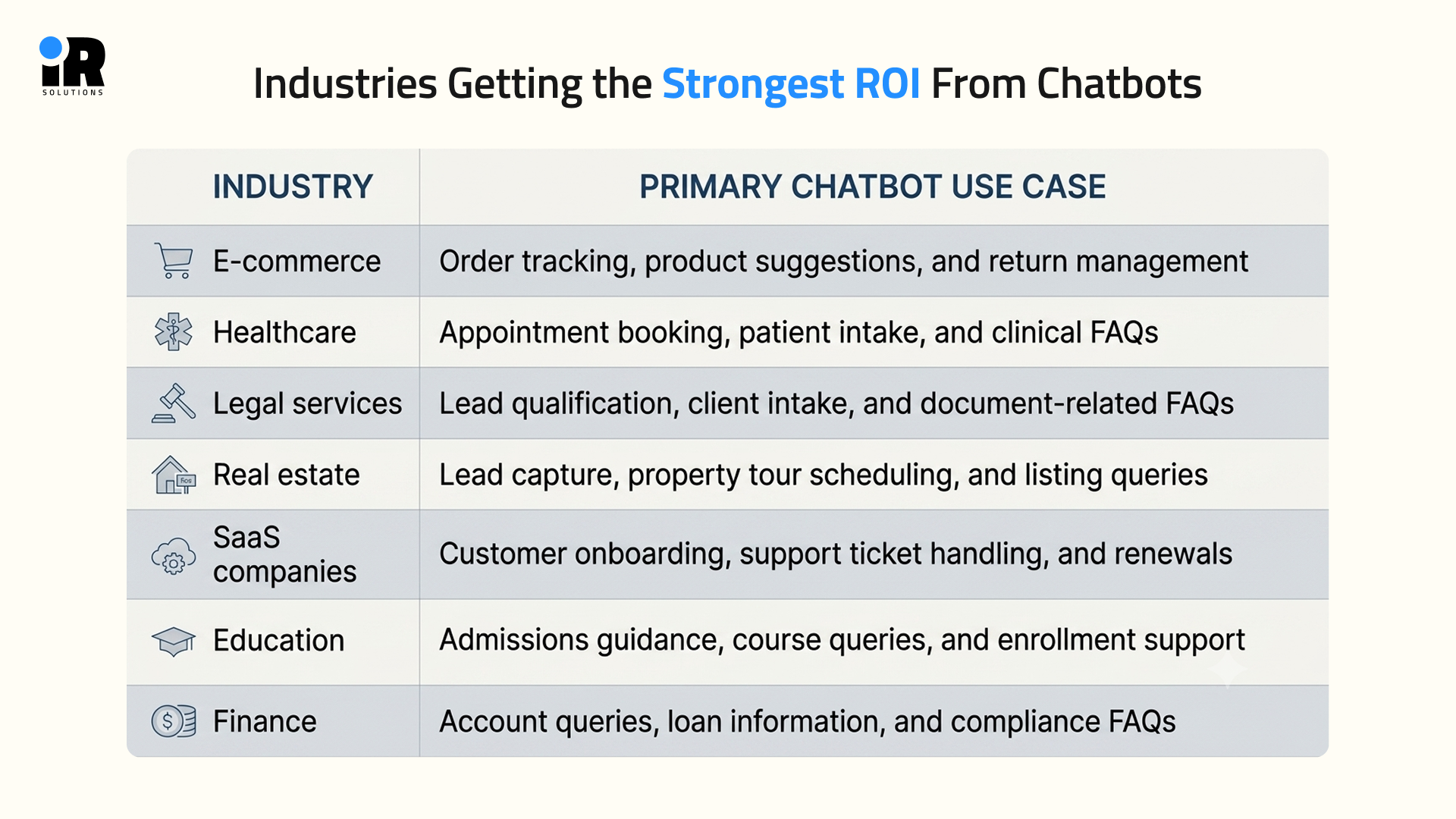
E-commerce: Repetitive customer queries get handled automatically so support teams can focus on what actually matters.
- Order tracking
- Product suggestions
- Return management
Healthcare: Front-end workload stays managed so medical staff remain focused on patient care.
- Appointment booking
- Patient intake
- Clinical FAQs
Legal Services: Client interactions get filtered and organized before anyone billable gets involved.
- Lead qualification
- Client intake
- Document FAQs
Real Estate: Leads stay engaged and questions get answered even when agents are off the clock.
- Lead capture
- Tour scheduling
- Listing queries
SaaS Companies: The customer journey from first login to renewal runs smoother without adding headcount.
- Customer onboarding
- Ticket handling
- Renewal support
Education: Admissions teams stay focused during high-volume enrollment periods without getting overwhelmed.
- Admissions guidance
- Course queries
- Enrollment support
Finance: Routine queries get resolved instantly so financial teams aren't tied up in repetitive conversations.
- Account queries
- Loan information
- Compliance FAQs
Custom Chatbot vs Generic Bot Key Differences
Many business owners try generic chatbot platforms first because they look fast and affordable to get running. The problem shows up quickly once real customers start asking questions that go beyond basic FAQs and scripted flows.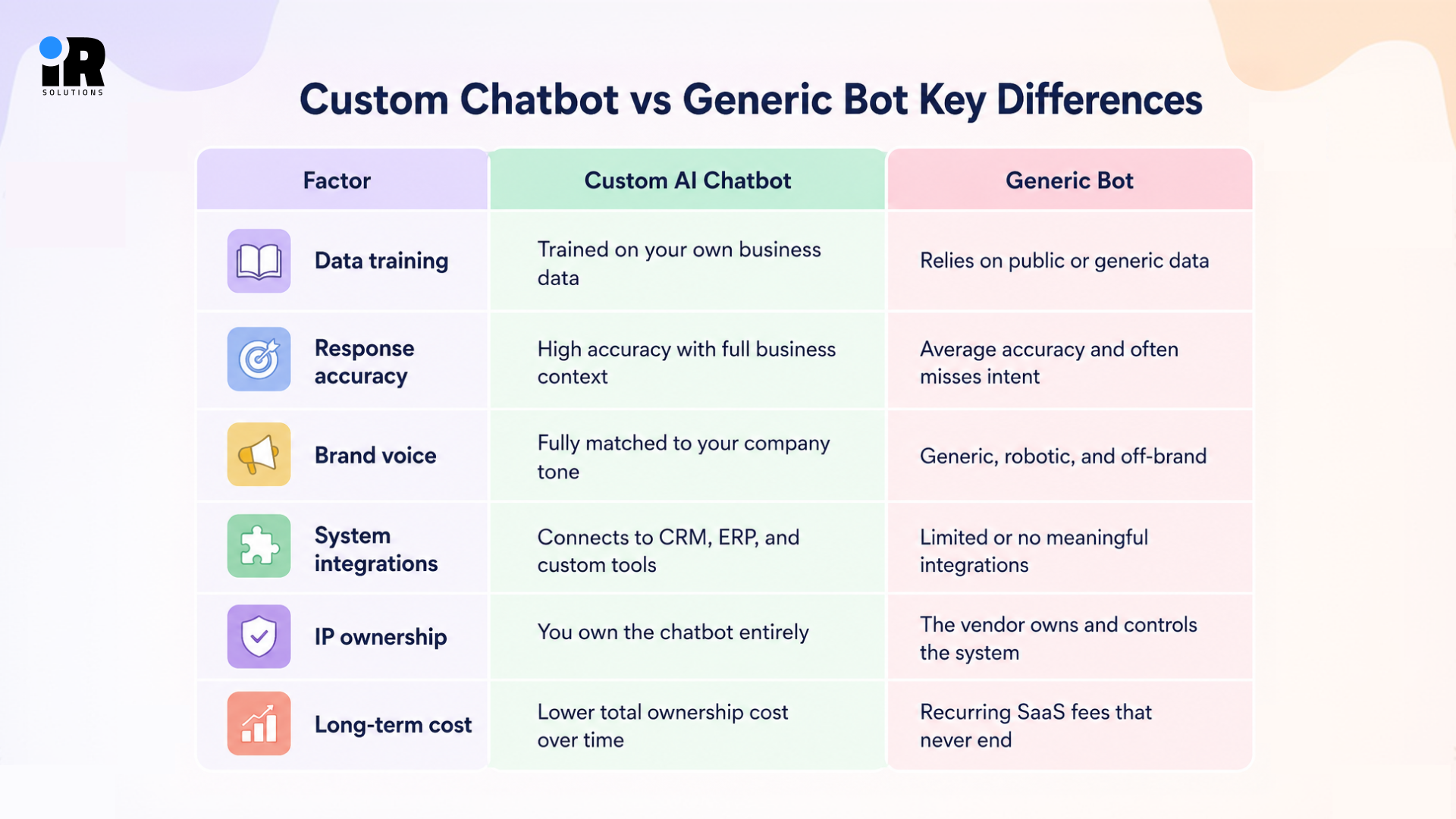
Pre-built bots simply cannot reach into your internal product catalogue or pull from your customer interaction history when answering questions. That inability to access real business data is the precise gap where custom development changes everything for growing companies.
AI Technologies That Make Business Chatbots Intelligent
Every high-performing custom chatbot runs on a carefully selected combination of technologies that work together to produce accurate, natural, and genuinely useful conversations. Understanding what these technologies do helps you ask sharper questions when evaluating any development team you are considering working with.
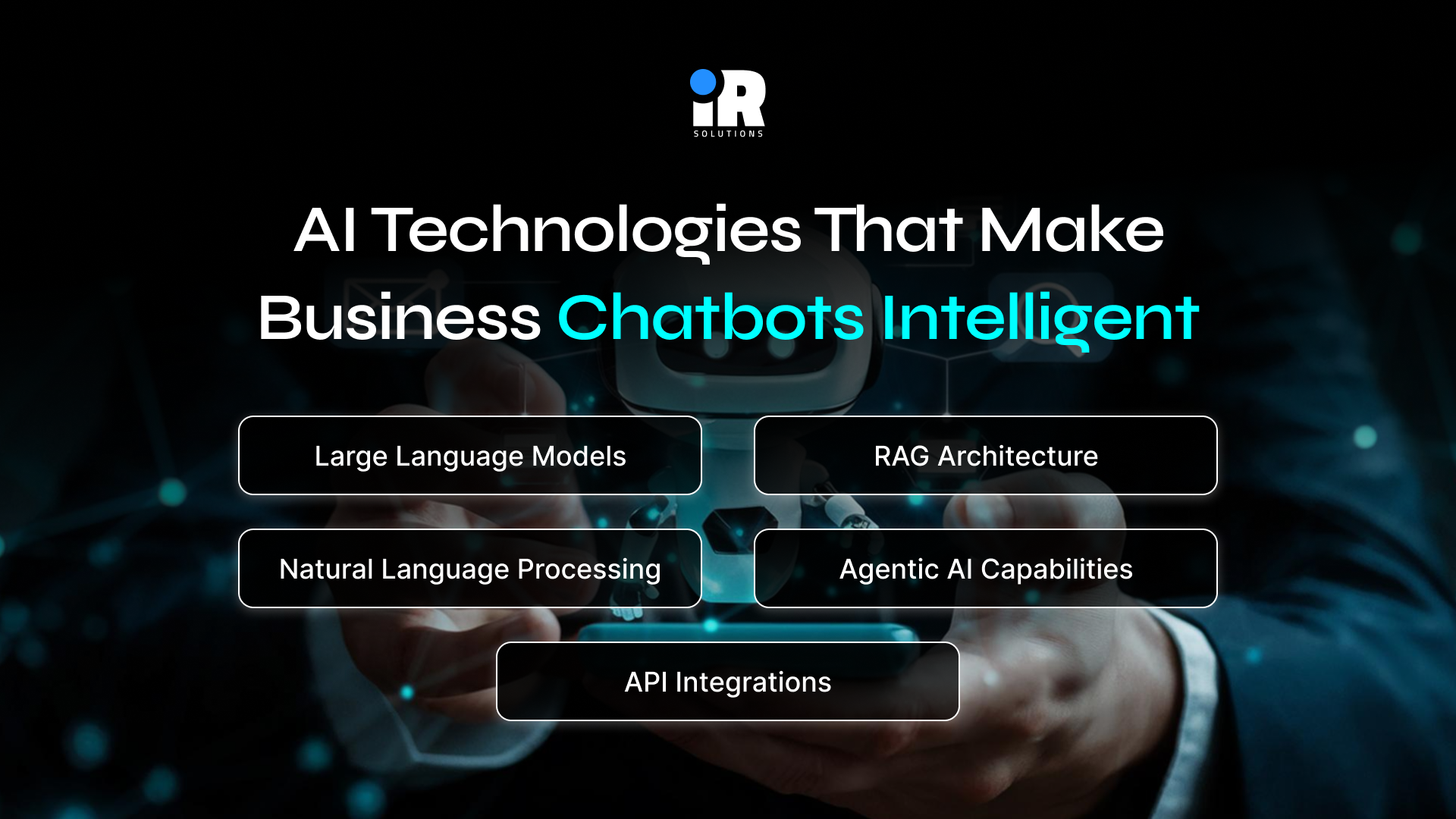
Large Language Models
- LLMs act as the reasoning engine that powers every response your chatbot generates.
- They understand complex customer questions and produce replies that sound naturally human every time.
- LLMs track full conversation context so customers never have to repeat themselves mid-chat.
RAG Architecture
- RAG fetches answers directly from your live business documents instead of relying on old data.
- Every response stays grounded in your actual current pricing, policies, and product information always.
- Businesses with changing offerings benefit most since RAG updates accuracy without costly model retraining.
Natural Language Processing
- NLP helps the chatbot understand what customers actually mean, not just what they typed.
- "Where is my order?" and "give me a delivery update" both trigger the same accurate response.
- Intent recognition means customers get the right answer regardless of how they phrase their question.
Agentic AI Capabilities
- Agentic AI moves your chatbot from answering questions to actually completing tasks for users.
- It books meetings, updates CRM records, and sends confirmation emails without any human involvement needed.
- Your team saves hours daily because the chatbot handles real operational work end to end.
API Integrations
- APIs connect your chatbot to payment gateways, helpdesk tools, and customer databases you already use.
- Without solid integrations, even the smartest chatbot cannot deliver the operational value your business needs.
- Well-built API connections turn your chatbot into a central hub across your entire tech stack.
Why Smart Businesses Choose Custom Chatbot Development
Smart businesses choose custom chatbot development because it delivers solutions tailored to their specific goals, processes, and customer needs. By working with custom AI chat developers, businesses can build solutions that go beyond the limitations of generic platforms. Custom AI chatbots provide greater flexibility, better accuracy, seamless integrations, and the ability to scale as the business grows, helping improve efficiency, customer experience, and overall performance.
- Data First: Every chatbot gets trained on real documents, historical transcripts, and genuine customer interactions from day one.
- Deep Integration: Chatbots connect cleanly to CRM platforms, payment systems, and databases without creating new technical debt.
- Always Improving: Live performance gets monitored, conversation quality gets tracked, and the system keeps improving after launch.
- Clear Communication: Every decision gets explained in plain language so clients always understand what is being built and why.
- Built Scalable: Every chatbot gets engineered from day one to handle the volume two years of growth will bring.
If you want to understand exactly what a custom AI chatbot could do for your specific business situation, schedule a free strategy call with our team.
Where Custom Chatbot Technology Is Heading Next
The pace of progress in AI technology is accelerating, and the chatbots businesses deploy today will look very different from the systems available just two or three years from now. Here is what is coming and why it matters for the investment decisions you are making right now.
1. Voice and text in one system
Future chatbots will handle both spoken conversations and typed messages within a single unified platform, removing the friction of switching between different tools for different channels.
2. Real-time knowledge syncing
Business chatbots will pull live information updates from internal databases and external sources automatically, keeping every response current without requiring manual retraining or content updates from your team.
3. Agentic multi-step workflows
Next-generation chatbots will independently execute complex, multi-step tasks like processing a full refund, coordinating a cross-department approval, or managing an entire onboarding sequence from start to finish.
4. Proactive customer engagement
Rather than sitting passively and waiting for a customer to start a conversation, future chatbots will reach out first based on user behaviour signals, purchase history patterns, and predictive intent data.
5. Hyper-personalised conversations
Every response a chatbot delivers will be tailored to the specific individual using previous purchase data, browsing behaviour, and full interaction history from every prior touchpoint.
Businesses that invest in custom chatbot development now will be positioned well ahead of competitors when these capabilities become standard practice across every industry. Generic off-the-shelf bots will not keep pace with what is coming.
Conclusion
Every customer question that goes unanswered at 11 PM is a missed sale. Every repetitive support ticket your team handles manually is time pulled away from work that actually moves the business forward. Custom AI chatbots solve both problems at once, and the businesses deploying them right now are building a response speed advantage that generic tools simply cannot match. IR Solutions provides AI chatbot development services that help businesses design and implement these systems in a way that fits real operational needs, not just template-based automation. The technology is no longer reserved for large enterprises with deep budgets, it is accessible, proven, and delivering measurable returns across industries of every size. If the gap between where your customer support is today and where it needs to be feels wide, closing it starts with one conversation.
Frequently Asked Questions
How does a custom chatbot differ from ChatGPT?
ChatGPT is broad. It knows a little about everything and nothing specific about you. A custom chatbot is built around your products, your policies, your customers. That gap shows fast especially when someone needs a real answer at 2am and "it depends" won't cut it.
How long does the full development process take?
Somewhere between four and twelve weeks, the range depends on how complex your workflows are and how much of your data is actually ready to work with. Simple setups move faster. Messy data or tangled integrations slow things down.
Can the chatbot connect with my existing CRM system?
If your CRM, ERP, or helpdesk has an API, yes. Most modern platforms do, so this usually isn't the sticking point people worry it will be.
Which industries benefit most from custom chatbots?
E-commerce, healthcare, legal, real estate, SaaS, education, enterprise IT. These tend to see the strongest results because they deal with high volumes of the same questions over and over and a slow or inconsistent answer costs them.
Do I need any technical skills to manage it afterward?
No. There's a dashboard where you can update content and review conversations. No coding, no IT background needed.
Can a custom chatbot support multiple languages?
Yes, and you can build that in from day one, a customer writing in French or Arabic gets a real response instead of falling through the cracks. No separate support teams required.
Can the chatbot keep improving after launch?
It can, and honestly it should. Conversation data and user feedback show you exactly where it's getting things wrong or coming up short so you refine it as your business changes rather than letting it go stale.
What should I look for when choosing a development company?
Real AI experience, not just the buzzwords, a clear integration process. Honest answers about what happens when you scale. Solid data security. And support that doesn't disappear once the project ships. Ask to see examples of business-specific chatbots they've actually built and launched.
How is customer and business data protected?
A properly built solution uses encryption, secure hosting, and role-based access controls so only the right people see the right data. Compliance requirements like GDPR or HIPAA aren't an afterthought they get built in from the start.