




Every business owner insists their support bot works great, until one customer proves them wrong. Then the same bot hands out an answer that makes absolutely no sense at all. This isn't some rare glitch buried deep inside an old, quietly forgotten support ticket somewhere. It happens every single day, across healthcare, fintech, ecommerce, real estate, and education platforms, too. Generic AI gets handed jobs that demand real expertise, it was simply never built for that. Businesses eventually notice the pattern and start searching for something built specifically for them instead. That search usually leads straight toward custom AI/ML services built around real workflows, where the AI is trained on business-specific data, understands industry terminology, integrates with existing systems, and delivers reliable, context-aware responses that improve both customer experiences and operational efficiency.
What Makes a Generic Chatbot Fall Short
A generic chatbot is built for broad coverage, which sounds useful until real users start asking real questions. A patient, a fintech customer, or a student each needs an answer tied to their exact situation, and a bot trained on general internet data simply cannot give that.
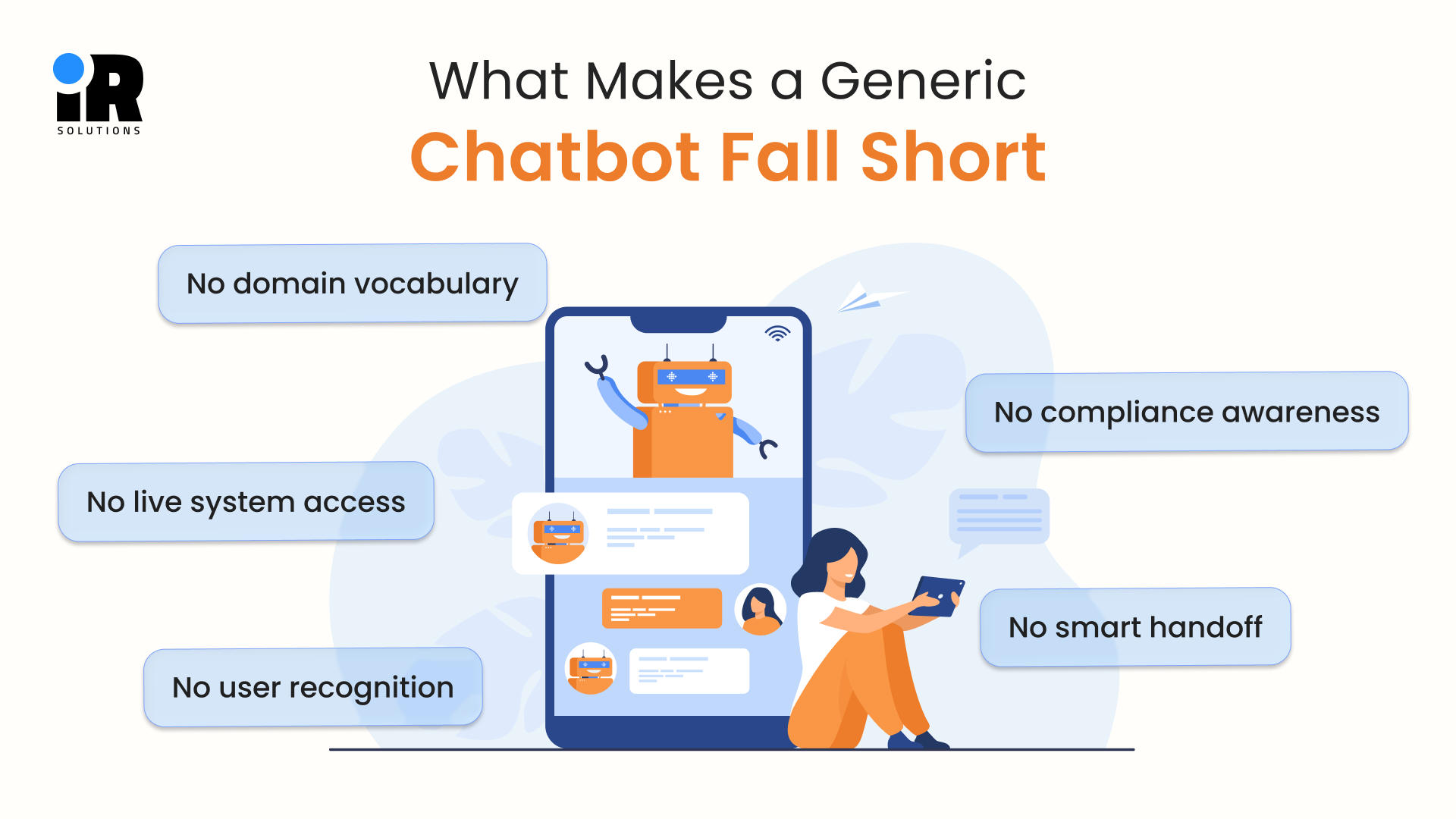
Here is where generic chatbots consistently create problems for businesses:
- No domain vocabulary: They miss clinical shorthand, financial terminology, real estate language, and other sector-specific terms users expect to be understood.
- No live system access: They have no connection to your EHR, CRM, LMS, product catalog, or order management system, where real answers actually live.
- No compliance awareness: They produce responses that can cross legal and regulatory lines in industries like healthcare, finance, and education without any warning.
- No user recognition: They treat a first-time visitor and a customer with a three-year purchase history in the same way, which wastes both.
- No smart handoff: They cannot identify when a conversation has gone beyond their capability and needs to be escalated to a real person on your team.
A generic chatbot is built to be inoffensive and broadly applicable across a wide range of situations. That design goal is exactly what makes it the wrong choice for any business operating inside a specific industry with specific rules and specific users.
Why Industry-Specific AI Assistants Perform Better
An industry-specific AI assistant is built differently from the ground up, and the difference shows up in ways that matter to your bottom line. It is not trained on everything available and then pointed at your users. It is trained on the data, language, workflows, and logic that define how your industry actually operates day-to-day. Achieving this level of customization requires experienced engineers who understand both AI technologies and business workflows. Many organizations choose to hire AI/ML developers to build, train, and continuously optimize these intelligent systems for long-term performance.
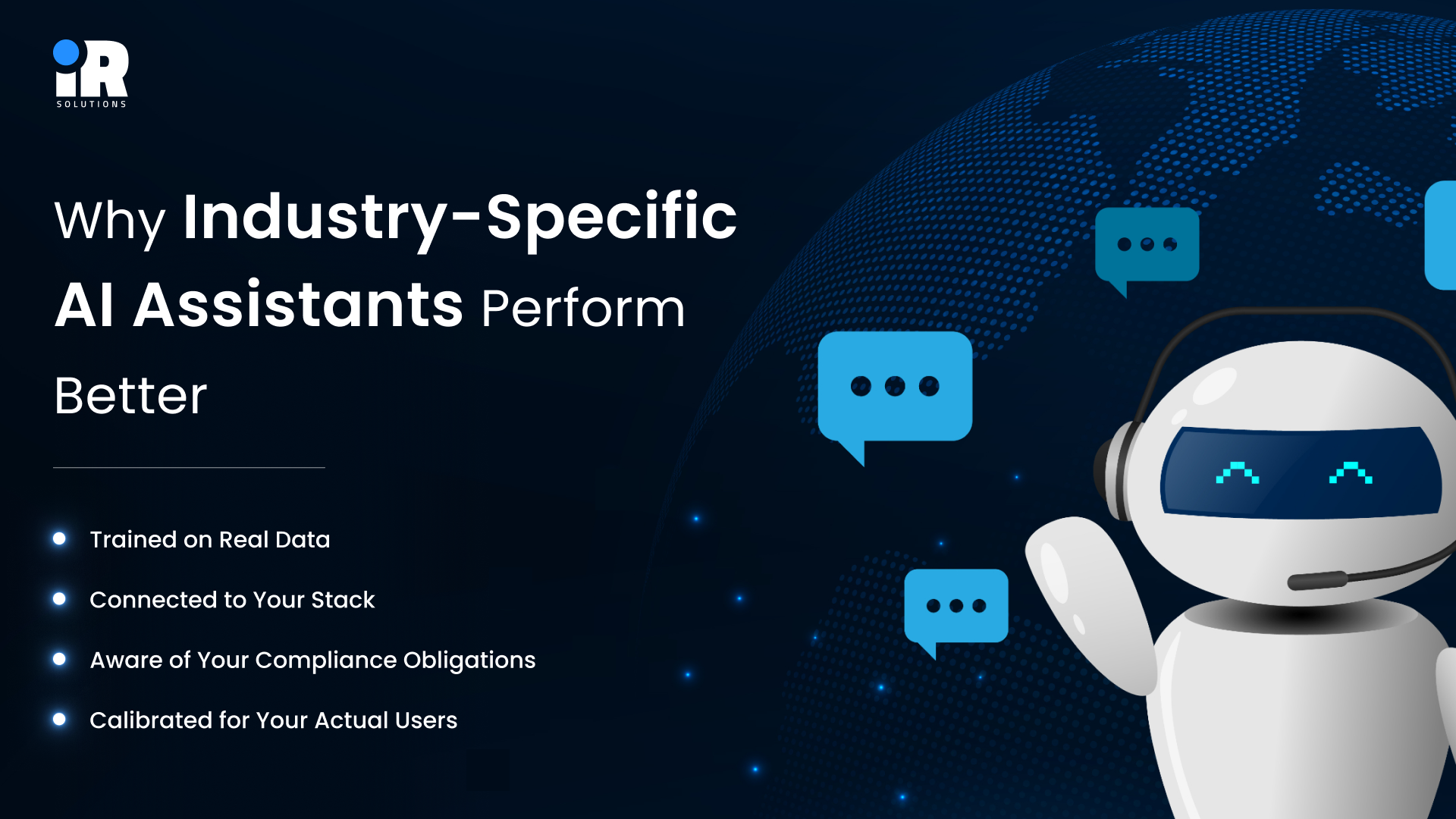
Trained on Real Data
It learns from the same sources your team relies on, whether those are clinical documentation systems, financial product libraries, property databases, course catalogs, or ecommerce inventory records. When a user asks a question, the answer it gives reflects what is actually true in your business context, not what was statistically probable across generic internet training data.
Connected to Your Stack
It pulls live information from the systems your business already uses, so users get answers that reflect what is actually happening right now in their account, order, application, or enrollment status. No guessing, no outdated information, and no dead ends that push users back to your support queue.
Aware of Your Compliance Obligations
It is built to know what it can and cannot say in your regulatory environment, which means it handles sensitive topics without creating legal exposure for your business. It knows when a disclosure is required, when a topic needs to be escalated, and how to handle user data to meet your sector's legal requirements.
Calibrated for Your Actual Users
It recognizes meaningful differences between different types of users, a new patient versus a returning one, a first-time buyer versus a qualified investor, a prospective student versus an enrolled one, and it adjusts its responses accordingly. The result is a tool that users actually trust because it consistently gives them answers that feel relevant to their specific situation.
If you're considering a business-specific AI assistant, our guide on Custom AI Chatbot Development: Complete Guide to Building Business-Specific AI Assistant walks you through the entire development process, from planning to deployment.
Healthcare: Where Generic AI Creates Real Risk
Healthcare is one of the industries where the gap between a generic chatbot and a purpose-built AI assistant becomes immediately visible and potentially dangerous. Patients come to digital tools in moments of stress, confusion, or genuine medical need, and they deserve responses that reflect the seriousness of those moments.
What Patients Actually Get
A purpose-built healthcare AI reads a patient's chart, understands their diagnosis, and connects every question to their actual care plan. When someone who has just had cardiac surgery asks whether a particular symptom is normal, the assistant pulls their procedure history and discharge instructions before responding. That means the patient gets a real, protocol-aligned answer instead of being told to call their doctor, which is the outcome they were hoping to avoid by reaching out in the first place.
How Purpose-Built Healthcare AI Helps Patients
- Clinical vocabulary: Reads ICD codes, medication names, and drug interactions without misreading what the patient is asking.
- EHR integration: Pulls patient records in real time to tailor responses to history, prescriptions, and care plan details.
- HIPAA-compliant handling: Manages protected health information correctly, including consent, data storage, and access restrictions across interactions.
- Triage capability: Identifies urgency signals in the patient's message and routes them to clinical staff when needed.
- Post-discharge follow-up: Walks patients through recovery steps tied directly to their specific procedure and care instructions.
Fintech: Where Accuracy and Compliance Are Non-Negotiable
Financial services companies operate inside one of the tightest regulatory environments of any industry, and the stakes attached to a wrong answer are not abstract. A misstatement about an interest rate, a vague response about account eligibility, or a poorly handled fraud alert can create legal liability that far exceeds the cost of whatever the chatbot saved the company in support hours.
The Problem with Generic Tools
Generic AI tools do not know the difference between your financial products and your competitors'. They cannot access live rate data, current account information, or the specific compliance framework that governs what you are and are not permitted to tell a customer. They also have no mechanism for recognizing when a response is approaching a regulatory boundary, which means they cross those boundaries regularly without any awareness that they are doing so.
How Purpose-Built Fintech AI Handles Risk
- Product knowledge: Accurately explains differences between loan products, account types, and investment vehicles without confusing or conflating them.
- Account access: Pulls current balances, recent transactions, and application status directly from your core banking systems.
- Regulatory guardrails: Know what can and cannot be said around investment advice, credit eligibility, and financial disclosures.
- Fraud detection: Detects unusual conversation patterns and routes those interactions to your risk team before damage occurs.
- KYC guidance: Walks users through identity verification in a structured, compliant sequence that keeps the process audit-ready.
Ecommerce: Where Personalization Drives Revenue
In ecommerce, a chatbot is far more than a support tool, serving as a powerful sales channel that engages shoppers, answers buying questions, and helps convert visitors into customers.
The Problem with Generic Tools
A generic chatbot has no access to your product catalog, your inventory system, your fulfillment timelines, or your promotional logic. When a customer asks whether a specific item is in stock in their size and whether it can arrive by Friday, the bot either makes something up or deflects entirely, and neither outcome is acceptable when the sale depends on the answer.
How Purpose-Built Ecommerce AI Closes More Sales
- Catalog search: Searches your actual product database and returns recommendations based on exactly what the user described.
- Order management: Accesses order data so users can check shipping status or request returns without leaving the chat.
- Behavior suggestions: Use purchase history and session behavior to surface products customers are genuinely likely to want.
- Promotional accuracy: Knows which discounts apply to which users and when the window closes, keeping recommendations accurate.
- Session recovery: Sends follow-up messages that address the specific concern that caused the user to leave.
Learn how businesses use AI assistants to automate repetitive support tasks and deliver faster, more consistent customer experiences in our blog on How AI Assistants Are Transforming Customer Support Workflows.
Real Estate: Where Context and Timing Matter Most
Real estate leads go cold faster than in almost any other industry. A buyer who cannot get a quick answer about a listing, an estimated mortgage payment, or an available showing time will move on within minutes, and they will find that answer somewhere else. Speed matters here, but so does specificity, because vague answers in real estate are almost as useless as no answer at all.
The Problem with Generic Tools
Generic AI tools have no access to your listings, your agent schedules, your local market data, or the buyer's qualification profile. When someone asks whether a three-bedroom listing in a specific neighborhood fits within a budget of a certain amount, the bot cannot answer that question with any accuracy. It either redirects them to a form, gives a generic range, or simply admits it does not know, and all three outcomes end the conversation without moving the lead forward.
How Purpose-Built Real Estate AI Converts Leads
- Listing search: Searches active listings using the buyer's budget, location, size, and feature preferences in real time.
- Mortgage estimation: Calculates an approximate monthly payment based on user inputs without an external calculator redirect.
- Lead qualification: Asks targeted questions to identify buying intent and routes serious buyers to the right agent.
- Showing scheduler: Books a property showing directly within the conversation without a call or callback wait.
- Neighborhood data: Delivers school ratings, commute estimates, and amenity information as part of the listing chat.
Education: Where Student Success Depends on Right Answers
Students interact with their institution's digital tools at some of the most stressful moments of their academic experience, and they need accurate, specific answers. A student asking about the consequence of dropping a course mid-semester or the deadline for submitting a FAFSA verification document needs correct information tied to their specific school, program, and enrollment status, not a general summary pulled from public educational resources.
The Problem with Generic Tools
Generic chatbots cannot access your institution's course catalog, academic calendar, financial aid system, or student records. They do not know your specific grading policies, your withdrawal deadlines, or the prerequisites for a course a student is trying to register for. When a student asks a specific question and gets back a generic answer that does not apply to their school, they leave frustrated, and many of them never try the digital channel again.
How Purpose-Built Education AI Supports Students
- Course access: Answers questions about specific programs, prerequisites, class times, and instructors from your live database.
- Enrollment help: Guides students through registration step by step and checks eligibility in real time.
- Policy clarity: Explains grading systems, withdrawal rules, and appeal processes as they apply to your school.
- Wellbeing checks: Notices stress signals in student messages and connects them with counseling resources quickly.
Generic chatbots don't solve industry-specific challenges. Book a free consultation to discuss an AI assistant built for your business.
The Business Impact of Choosing the Wrong AI Solution
A lot of businesses frame the choice between a generic chatbot and a purpose-built assistant as a question of budget, a better frame is a question of cost. Keeping the wrong tool in place has a real, measurable cost that often goes unnoticed because it does not show up as a line item on a monthly invoice.
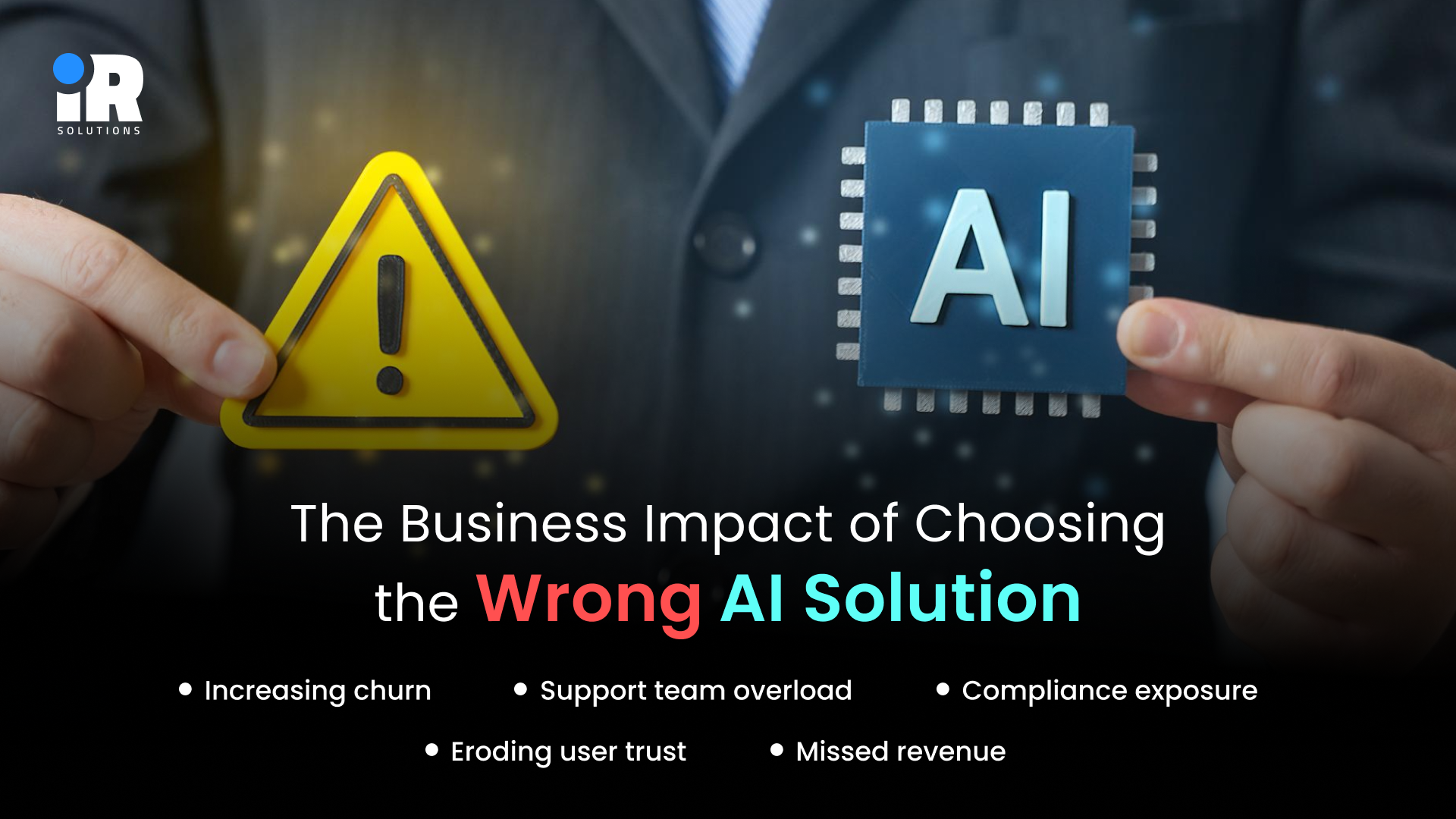
Here is what poor AI performance actually costs your business over time:
- Increasing churn: Users who do not get the answers they need find a competitor who gives them those answers, and they often do not announce that they are leaving.
- Support team overload: Your staff ends up handling tickets and calls that the AI was supposed to resolve, which defeats the original purpose of deploying the tool.
- Compliance exposure: In regulated industries, a single response that crosses a legal line can trigger regulatory attention, fines, or reputational damage that is very difficult to recover from.
- Eroding user trust: A customer who gets a wrong or irrelevant answer loses confidence in the business that provided it, and that confidence is hard to rebuild through other channels.
- Missed revenue: Every unanswered product question, every failed cross-sell, and every abandoned checkout that the bot could not rescue is direct revenue that went somewhere else.
The businesses that recognize this cost early enough to act on it before it compounds are the ones that end up building a meaningful competitive advantage through AI rather than just checking a box.
The difference usually comes down to implementation, so businesses that hire AI chatbot experts can design assistants around their industry requirements, existing systems, and customer expectations instead of relying on generic solutions that struggle to deliver meaningful results.
Conclusion
At some point, every business running a generic chatbot has to ask why it isn't actually working. The answer usually comes down to fit, not effort or budget. Healthcare, fintech, ecommerce, real estate, and education all run on details that a broad AI tool was never trained to understand. Patients need protocol-aware answers, customers need real account data, and buyers need listings that match their actual budget. None of that happens with a one-size-fits-all bot bolted onto your website. The businesses pulling ahead right now are the ones building AI around their own workflows, their own users, and their own rules. IR Solutions helps businesses build AI systems tailored to their unique workflows, users, and industry requirements so they can move beyond generic automation and achieve measurable business outcomes. That's not a small upgrade. It's the difference between a tool that frustrates people and one that actually earns their trust.
Frequently Asked Questions
What is an industry-specific AI assistant?
It is an AI assistant that is trained on the data, workflows, and terminology specific to your industry rather than general internet content. It gives users accurate, relevant responses instead of broad answers that may or may not apply to their actual situation.
Why do generic chatbots fail in regulated industries?
They are built without any understanding of the compliance requirements that govern your industry, so they regularly produce responses that cross legal or regulatory lines. That creates real liability for your business in industries where a wrong answer has legal consequences.
How long does it take to deploy a custom AI assistant?
Most purpose-built deployments take somewhere between four and twelve weeks, depending on the complexity of your integrations, the state of your training data, and the number of systems the assistant needs to connect with. Simpler use cases with clean data can go live faster than that.
Can an industry-specific AI integrate with my existing software?
Yes, it is designed from the beginning to connect with the platforms your business already depends on, including your CRM, EHR, LMS, or ecommerce backend. You do not need to replace or restructure your current tech stack to make it work.
Is a custom AI assistant more expensive than a generic chatbot?
The initial investment is higher, but the ongoing return typically offsets that difference quickly through reduced support costs, higher conversion rates, and fewer compliance-related incidents. Most businesses see a positive return within the first year of deployment.
What industries benefit most from purpose-built AI?
Healthcare, fintech, ecommerce, real estate, and education consistently produce the strongest results because their users have needs that are highly specific to the industry and cannot be served well by tools trained on general data.
How does IR Solutions handle data security in its AI systems?
Every system is built with encryption, role-based access controls, and full compliance with the data privacy and security regulations that apply to your specific industry. Data security is a design requirement, not an optional feature added at the end.
Can the AI assistant be updated and improved after it goes live?
Yes, ongoing model updates are part of how the system works rather than something you have to request separately. As your business evolves, as your product changes, and as regulations shift, the assistant is updated to reflect that, so it stays accurate over time.