



Support teams are under pressure as customer expectations continue to rise across every digital channel. Queries arrive around the clock, and customers expect instant, accurate responses without repeating their issues. Traditional support systems struggle to keep up, creating delays, inconsistency, and rising operational costs for businesses. This gap is now being solved through AI-driven automation and intelligent conversational systems. Many organizations are investing in custom AI chatbot development to align automation with specific workflows and customer journeys. Companies offering AI/ML services for building intelligent systems help unify data, improve response accuracy, and streamline interactions across channels. This blog explores how AI assistants transform workflows and improve support efficiency at scale while improving customer satisfaction outcomes overall.
How AI Assistants Function Within Customer Support Workflows
Most businesses picture a chatbot that answers frequently what they get with a properly built AI assistant is closer to an extra team member who works every shift and never misses context.
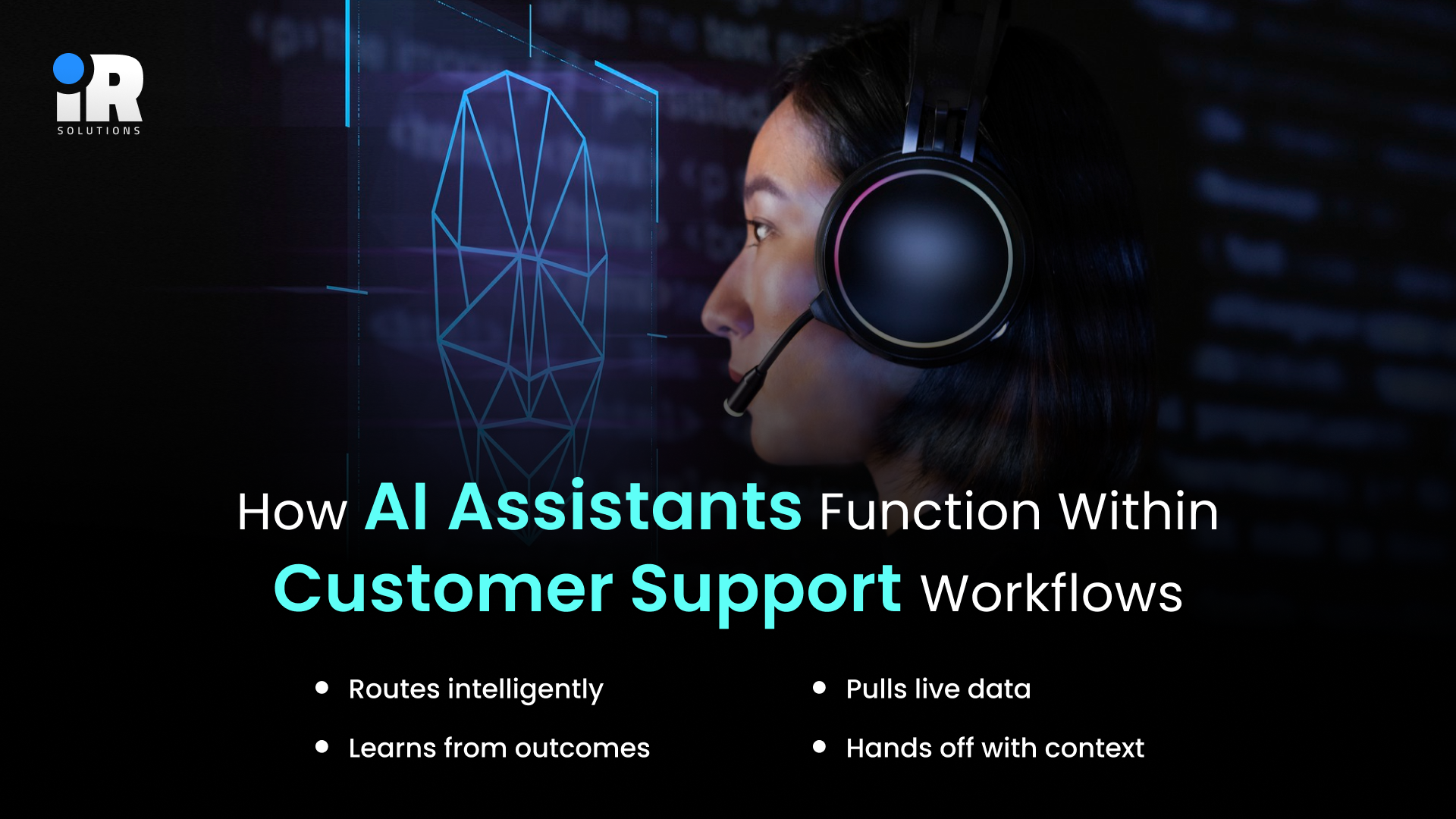
- Routes intelligently: It reads the message, checks the customer's history, and sends it straight to the right queue without anyone lifting a finger.
- Pulls live data: It checks orders, CRMs, and internal systems in real time, so the answer it gives actually matches what's true right now.
- Learns from outcomes: It tracks which responses close tickets and which ones get escalated, then quietly gets sharper at picking the right path next time.
- Hands off with context: When a human needs to step in, the agent already has the full conversation, so the customer never has to repeat themselves.
How AI Connects Customer Interactions Across Email, Chat, and Social Media
Most businesses handle customer support via email, live chat, social media, and phone, but these channels rarely communicate with each other. A customer who complained on Twitter yesterday shouldn't have to repeat everything when they call in today. AI assistants fix this by sitting in the middle, maintaining a shared view of every interaction across every channel.
The AI keeps a running record of what a customer said and did, no matter where they showed up. If someone started a return request on chat and followed up by email, the AI connects those threads. When a human agent steps in, they already know the context not starting from scratch. Building this level of unified customer intelligence often requires experienced AI/ML developers who can integrate multiple data sources effectively.
Consistency matters too, when a customer gets one answer on chat and a different one by email, trust takes a hit. AI assistants make sure the same information goes out regardless of the channel, same policy, same answer, adjusted to fit the tone of wherever the conversation is happening.
Industry Use Cases Where AI Is Already Delivering Results
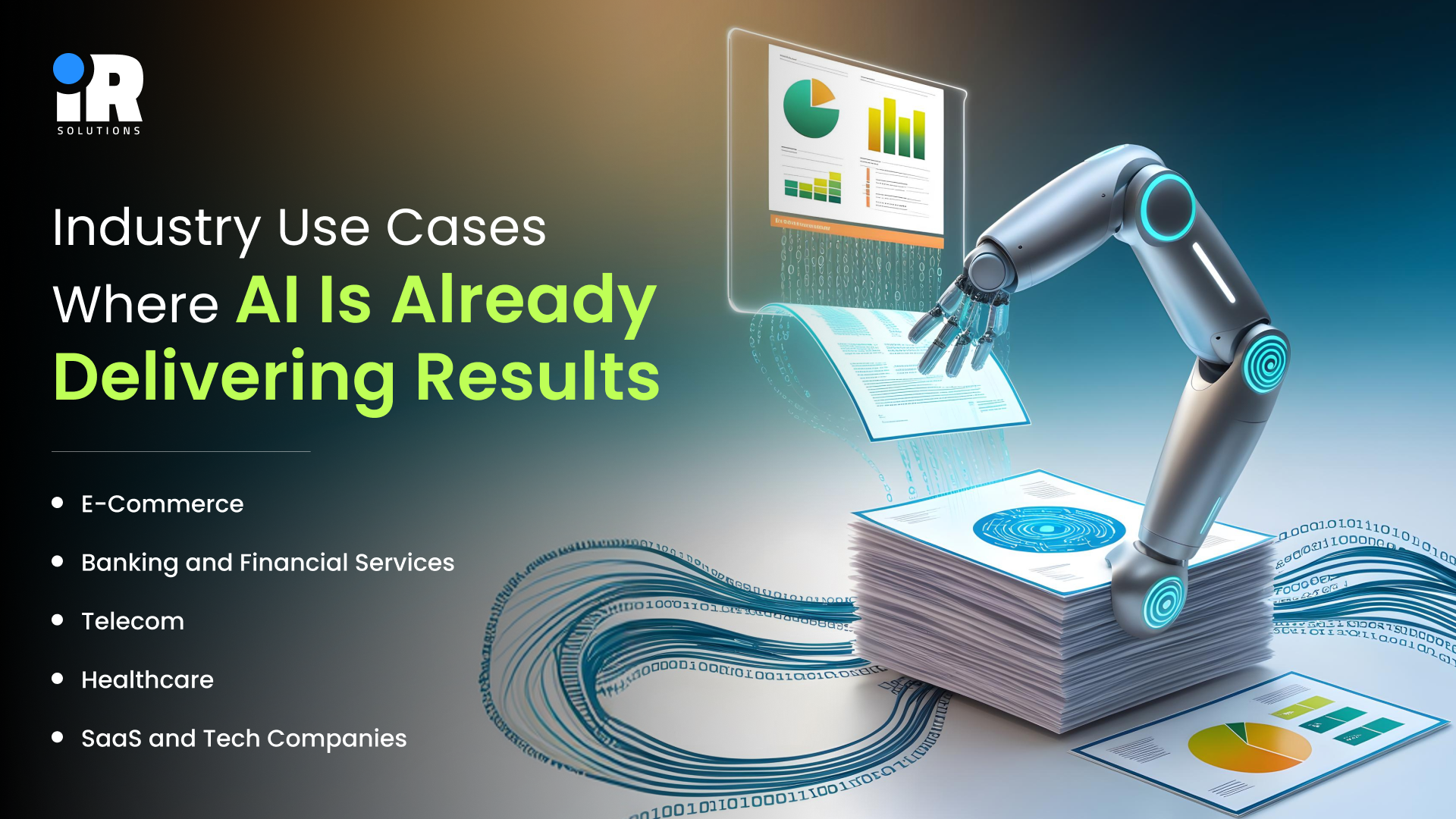
E-Commerce
Retailers answer the same questions thousands of times a week, and a big portion of that load, sometimes 30 to 40 percent, is customers asking where their order is.
- E-commerce assistants provide live order status from systems, reducing the need for human support agents directly.
- Customers complete returns through AI flows from eligibility checks to labels without agent involvement entirely.
- Product questions about inventory size and shipping timelines are answered instantly from connected database systems.
Banking and Financial Services
Banks deal with high volumes of routine inquiries and very low tolerance for errors, which makes them a good fit for AI that is trained carefully and connected to the right systems.
- Account inquiries like balance statements and updates are handled simultaneously without fatigue-driven human errors occurring.
- Loan and dispute status queries are resolved using core banking data instead of callbacks later.
- Compliance-safe responses follow approved frameworks, ensuring regulatory boundaries are never exceeded in customer replies.
Telecom
Telecom support runs into a specific problem: most incoming tickets are not technically hard to resolve, but there are so many of them that they bury agents who should be on harder problems.
- AI guides customers through step-by-step network diagnostics, resolving common connectivity issues without agents.
- When customers ask about disruptions, AI checks live outage maps and provides real-time answers.
- Plan changes, upgrades, and downgrades are processed through AI-connected billing systems in real time.
Healthcare
Healthcare organizations carry heavy administrative volume and need a clear line between what AI handles and what stays with licensed staff.
- Patients book, reschedule, and cancel appointments through AI, accessing live provider schedules with instant confirmation.
- AI verifies insurance eligibility against payer databases in real time, reducing calls and waiting periods.
- Billing inquiries, including balances, payment plans, and statements, are handled securely with built-in compliance.
SaaS and Tech Companies
Software companies with small support teams carry more customer volume than their headcount can handle, and AI gives them a way to keep response quality up without the cost of scaling the team proportionally.
- AI trained on documentation resolves common product configuration issues before engineers are involved in support.
- Subscription changes, invoice questions, and upgrades are automated through the billing platform without manual intervention required.
- New users receive conversational AI onboarding support, adapting guidance based on plan setup and progress.
AI Assistants vs Traditional Customer Support Models
Businesses have been debating this for a while now, and honestly, it's not as black and white as most people make it out to be. Here's a straight comparison of how both approaches actually hold up.
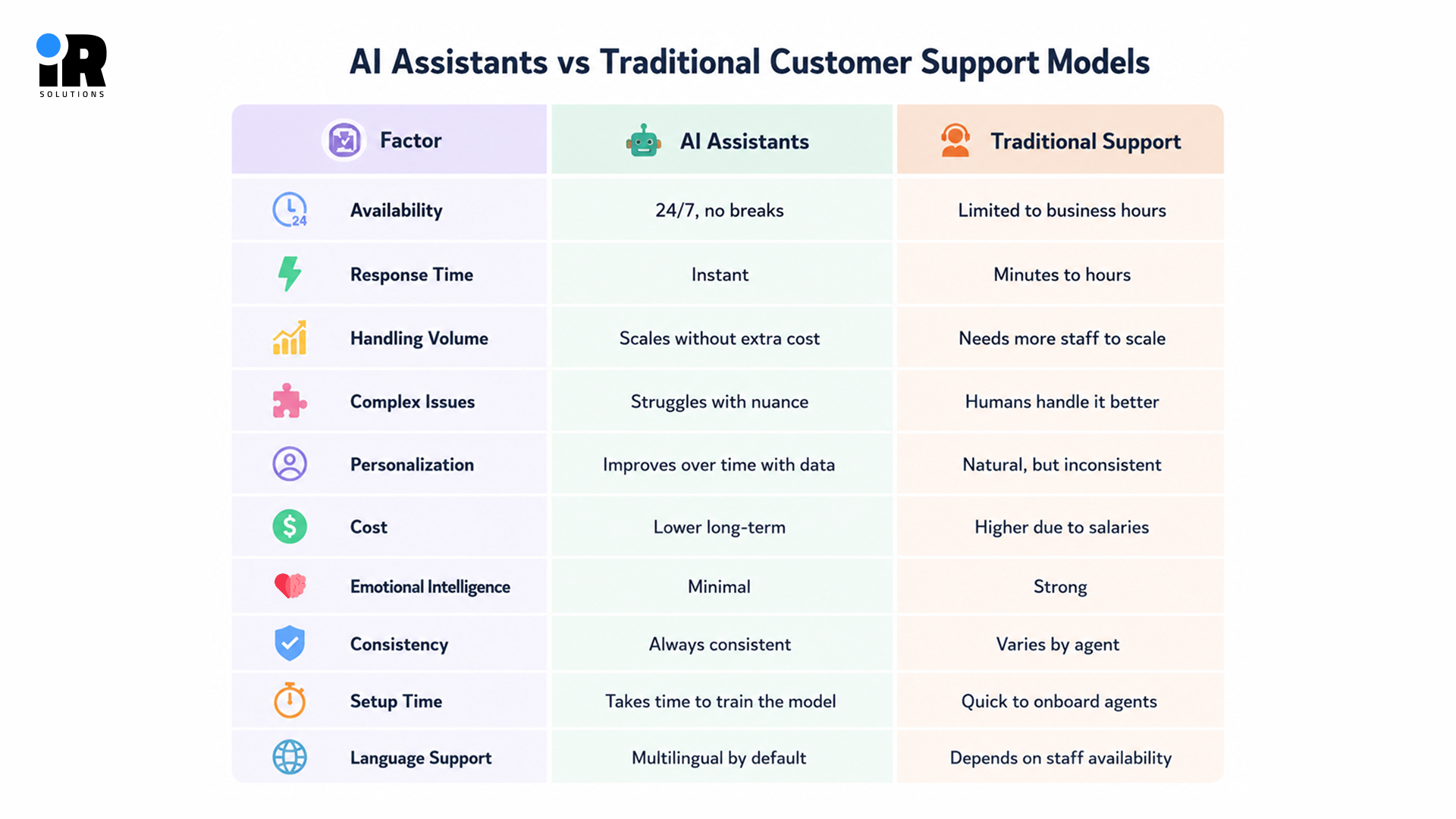
AI handles the volume and speed side well, traditional support wins when things get messy or emotional. Most businesses that get this right don't choose one over the other they use both and let each do what it's actually good at.
Companies improving digital operations often start with AI-driven support, read this blog on Custom AI Chatbot Development covers how business-specific chatbots are created from the ground up.
How AI Assistants Resolve More Customer Issues With Less Human Effort
AI closes a large share of incoming cases before they ever enter the human agent queue, not by deflecting customers but by actually resolving their issues faster than a queue could.
- First-contact resolution: Customers get an accurate answer at the first touchpoint, which means no ticket gets submitted and no agent time gets spent on something that did not need a person involved.
- 40 to 70% deflection: This is the range most businesses land in when the AI is properly trained, connected to live data, and given enough of their product knowledge to answer accurately from day one.
- No repeat contacts: When issues get resolved completely rather than acknowledged, customers do not come back with the same problem a few days later because the first answer did not actually fix anything.
- Lower cost per case: An AI-handled interaction costs a fraction of an agent-handled one, and that gap matters a lot when the volume runs into thousands of contacts a week rather than hundreds.
- Less agent burnout: Agents who are not overwhelmed by repetitive low-complexity tickets do better work on the cases that need them. This shows up in resolution quality, not just in headcount savings.
If your team spends more than half its time answering questions that have the same answer every time, AI can absorb most of that load within a few weeks of going live.
How Customer Satisfaction Improves After AI Implementation
Faster response times move satisfaction scores up quickly. The bigger gains over time come from consistency and personalization that most support teams cannot deliver at scale without automation behind them.
- Returning customers get answers that reflect what they have actually bought and done before, not a generic reply written for whoever might be asking on any given day.
- A customer who starts on the website chat and follows up by email does not re-explain their situation the AI brings the full thread into every new conversation automatically.
- AI reaches out before a subscription lapses rather than waiting for the customer to notice it expired, contact support, and then feel like they should have been warned ahead of time.
- Shipping delay alerts go out before the customer starts tracking their order repeatedly, which turns a potentially frustrating experience into something that just requires a heads-up.
- Most businesses see measurable improvement within the first few months, and the biggest drivers are first-response time and the ability to close tickets outside of standard business hours.
Essential Features Every AI Customer Support Assistant Must Have
Not every AI support tool is built the same, some features genuinely matter more than others when it comes to real customer interactions.
- Omnichannel Support: A good AI assistant should work across email, chat, and social media smoothly.
- Natural Language Understanding: It must understand what customers actually mean, not just what they typed literally.
- CRM Integration: The tool should connect with your existing systems without requiring a full technical overhaul.
- Handoff to Human Agents: When things get complicated, it should transfer the conversation without losing any context.
- Multilingual Capability: Customers come from everywhere, so the assistant must handle multiple languages without breaking down.
- Analytics and Reporting: You need clear data on how the assistant is performing across every single channel.
Many businesses work with AI chatbot experts to ensure these features are implemented correctly and aligned with business goals.
Setup Mistakes That Quietly Undermine Your AI Investment
Deploying without proper training
Generic AI setups give generic answers, and generic answers frustrate customers faster than no automation at all. The AI needs to be trained on your product knowledge, your policies, and the specific phrasing your customers actually use when they write in none of that comes pre-loaded out of the box, regardless of how good the underlying model is.
Skipping deliberate handoff design
Most teams spend a lot of time deciding what the AI will handle and almost no time designing what happens when it cannot. Customers who have to re-explain a problem they already described to an AI to an agent who has no record of it end the conversation more frustrated than they started. That is a design failure, not a technology failure.
Tracking the wrong performance metrics
Deflection rate is easy to measure, but it does not tell you whether problems are being solved. If AI deflects a ticket but the customer calls back the next day with the same issue, the deflection number goes up, and the customer experience gets worse. Resolution quality, escalation rate, and post-contact satisfaction scores together give a more honest read on whether the system is doing its job.
Treating it as a one-time setup
The AI does not improve on its own it improves when someone updates the training data as the product changes and reviews the performance data on a regular schedule. Teams that do this consistently see better results over time. Teams that treat the launch as the finish line see performance plateau within a few months and cannot figure out why.
Ready to get this right from the start? Book a free strategy call before you commit to a platform or an approach.
For a clearer view of early planning, see How Businesses Define AI Chatbot Requirements Before Development, which explains how requirements are defined before development starts.
Conclusion
AI in customer support is not something you adopt because everyone else seems to be doing it. You adopt it because your team is stretched, your customers are impatient, and the old way stopped scaling a while ago. The businesses seeing real results are not the ones who picked the fanciest tool. They are the ones who trained it properly, designed the handoffs carefully, and kept checking the numbers after launch. AI handles the load, humans handle the hard stuff, and together they cover ground neither could manage alone. Working with an AI chatbot development company can help businesses implement support automation without compromising customer experience. Start small if you need to, but start with a clear idea of what you actually want it to fix. That clarity is what separates a successful rollout from an expensive lesson.
Frequently Asked Questions
How much can AI reduce support ticket volume?
Most businesses with properly trained and integrated AI see 40 to 70% of tier-one inquiries resolved before they reach a human agent. The actual number depends on how specifically the AI has been trained on your products, your policies, and the way your customers actually phrase their questions when they write in.
Does AI replace human support agents completely?
No, it takes the repetitive, high-volume work off the team, so agents spend their time on the cases that actually need a person in the conversation. The two work together, with AI handling routine contacts and humans handling anything that needs judgment, empathy, or authority.
Can AI assistants work across multiple support channels?
Yes, and carrying context across channels is one of the more useful practical features for customers who switch platforms mid-conversation. Chat, email, WhatsApp, and other channels all feed into the same conversation thread, so the customer never has to re-explain what they already described somewhere else.
How long does an AI support implementation take?
Most projects go from kickoff to live in four to twelve weeks, depending on how complex the support workflows are, how many systems need to be integrated, and how much custom training content has to be built before the AI can answer accurately.
Is AI customer support secure enough for regulated industries?
Yes, when the system is designed with data privacy and compliance requirements built in from the start rather than patched in after deployment. Banks, healthcare organizations, and financial services companies use AI-powered support today within their regulatory requirements, and the compliance work gets done at the design stage.
What happens when AI cannot resolve a customer issue?
It transfers the conversation to a human agent and sends the full conversation history and context along with it automatically. The customer does not have to repeat anything, and the agent has what they need to respond before they send their first message.
How do I know if AI support is right for my business?
If your team handles a high volume of repetitive questions that have the same answer most of the time, AI will almost certainly pay for itself within a few months of going live. Looking at your current ticket categories and identifying which ones follow predictable patterns is usually enough to make the business case clear without needing a detailed study first.