



Blockchain gaming has rapidly captured the attention of the gaming world, offering players true ownership of in-game assets, play-to-earn rewards, and participation in decentralized economies. While excitement around these models sparked massive anticipation, challenges like player retention, sustainability, and economic balance have emerged. Today, blockchain games represent 3-5% of the global market, with growing interest from engaged communities. Leading game developer teams are exploring how to integrate blockchain thoughtfully, combining secure ownership, immersive gameplay, and token-driven economies to create experiences that are both engaging and profitable.
How Blockchain Is Reshaping Traditional Game Development
Traditionally, in-game assets, progression, and player data are under the full control of the developers or studios in traditional games. However, blockchain allows players to own digital items in reality, with provability on distributed networks, generating new possibilities in player-driven economies, cross-game compatibility, and long-term value models. The shift places a game developer team in the position of needing to restructure the outdated design processes, so that progression systems, rewarding systems, and in-game marketplaces may suit the principles of decentralised ownership.
Meanwhile, blockchain does not replace the key tasks of game development. It requires the quality of the gameplay, the richness of the story, and the technical performance, as well. The best blockchain games include the element of decentralization as a secondary element that enhances engagement and immersion instead of prioritizing it. This is an effort to balance a strong and interesting gaming experience through a combination of new technology and conventional game design practices.
Do Blockchain Games Really Offer More Reliable Profits?
Blockchain games open up new revenue opportunities that traditional games often cannot match. Unlike conventional models such as upfront purchases, subscriptions, or in-game purchases, they rely on digital asset sales, token economies, and player-driven marketplaces. These revenue channels can generate strong returns in the early stages, especially when NFTs or tokens are limited and demand is high. However, earnings can change sharply due to market trends, cryptocurrency price shifts, and changes in player activity. While blockchain introduces innovative ways to monetize games, it does not automatically provide consistent or predictable income.
How Innovative Models Like Play-to-Earn Change the Revenue Game
Play-to-earn models have become a defining feature of blockchain gaming, offering players direct financial incentives for participation. The model transforms the character of the revenue creation and distribution to a great extent.
- Player Engagement Drives Revenue: Players can get tokens or in-game assets of real-world value by playing games, so there is a continuous cycle of activity and transaction.
- Ongoing Market Activity: Players can trade assets again and again on secondary marketplaces, while developers receive a share from each sale.
- Incentivized Retention: When the rewards are sensible, players will be more active, and it will stabilize the revenue streams and contribute to building the community in the long run.
- Revenue Linked to Tokenomics: Unlike fixed pricing in traditional games, blockchain profits are closely tied to token value and demand. While this can lead to strong returns, it also exposes developers to market volatility and requires careful economic design.
The combination of play-to-earn models will allow the game developers to transform players into active participants in the game economy and not inactive consumers. Nonetheless, the trick is to balance the quality of the gameplay with the potential monetization to prevent the construction of a completely speculative environment that undermines long-term involvement.
Why Most Blockchain Games Fail to Retain Players
Keeping players interested is one of the biggest challenges in blockchain games. Many games attract users mainly through financial incentives, often neglecting engaging gameplay. Once token rewards decline or asset values drop, players lose interest, showing the risks of relying on short-term profit rather than meaningful entertainment.
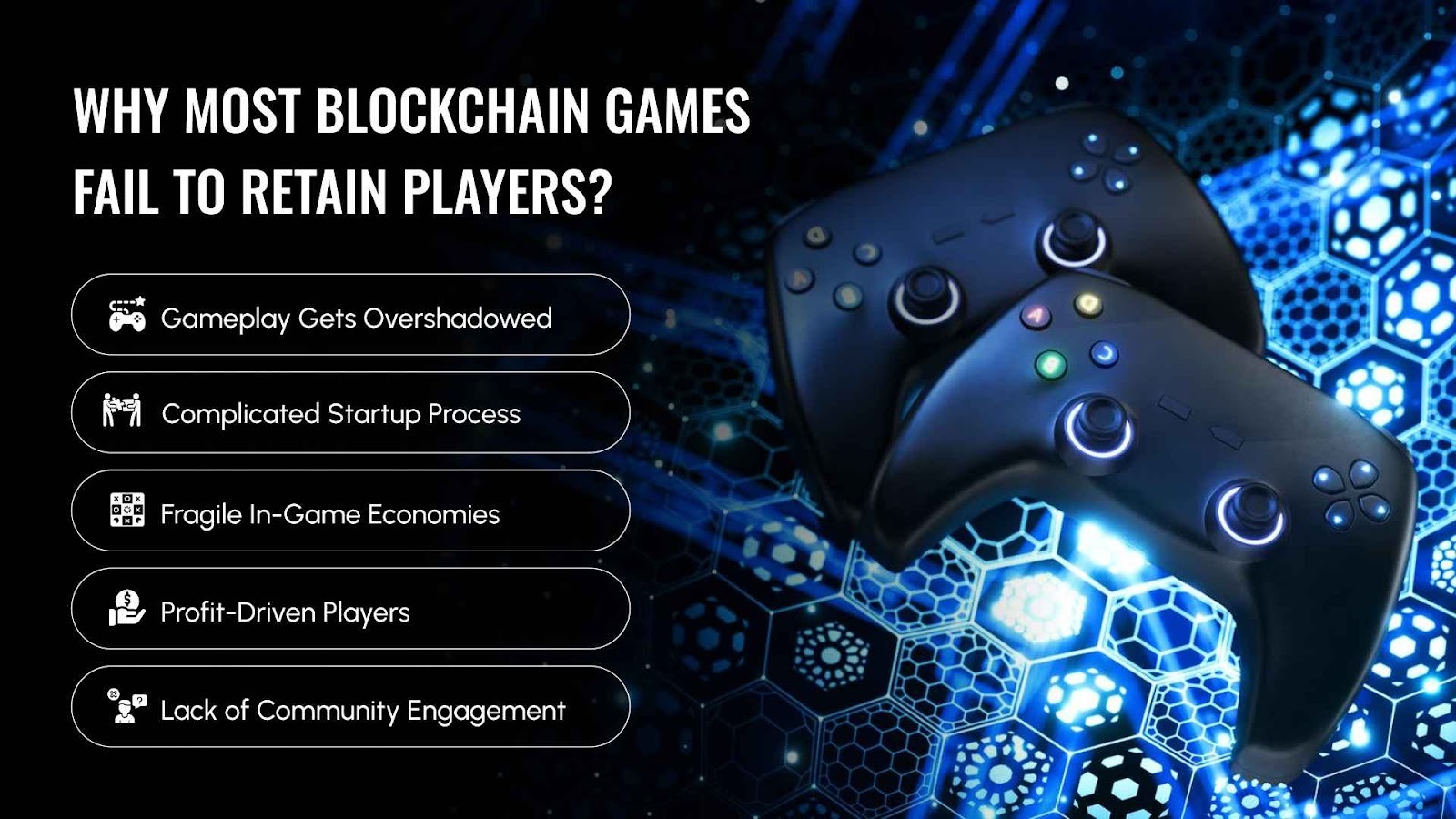
Gameplay Gets Overshadowed
Earning mechanics often dominate gameplay, resulting in shallow and forgettable experiences.
Complicated Startup Process
Setting up wallets, paying fees, and learning unfamiliar game systems can frustrate new players and discourage them from continuing.
Fragile In-Game Economies
Inflation, poorly designed tokenomics, and exploitative mechanics erode trust and long-term participation.
Profit-Driven Players
Users motivated solely by financial gain are less likely to stay loyal once rewards decrease.
Lack of Community Engagement
Limited social features or player interaction reduce emotional investment and long-term involvement.
Player interest improves when blockchain games focus on traditional game design principles such as meaningful progression, balanced challenge, social interaction, and continuous content updates. In this model, the blockchain serves as a supporting layer rather than the primary reason players engage with the game.
How Blockchain Technology Enhances Game Security
Blockchain improves game security by reducing dependence on single servers, which are often the main targets for hacking and data manipulation. It keeps a flexible, non-modifiable record of all transactions and ownership of assets and gives the players and developers a transparent and verifiable log of all in-game activity. Blockchain ensures transparency, preventing disputes and giving players confidence that the game is fair and trustworthy. Smart contracts also boost security as they automate several crucial operations, including transferring assets, reward distribution, and marketplace activity management, decreasing human factor and lowering the chances of fraud.
However, blockchain alone is not enough to guarantee complete security. Smart contracts must be carefully tested, audited, and continuously monitored, while wallets and in-game systems need strong protection. By combining blockchain with robust cybersecurity practices, games can safeguard players' assets, maintain balanced, fair economies, and create a secure environment where players are confident in investing both time and resources.
The Role of NFTs in Blockchain Gaming Economies
NFTs are transforming how players interact with games by giving them true ownership of digital assets. More than just collectibles, these assets create new opportunities for trading, participation, and lasting value, reshaping in-game economies and player engagement.
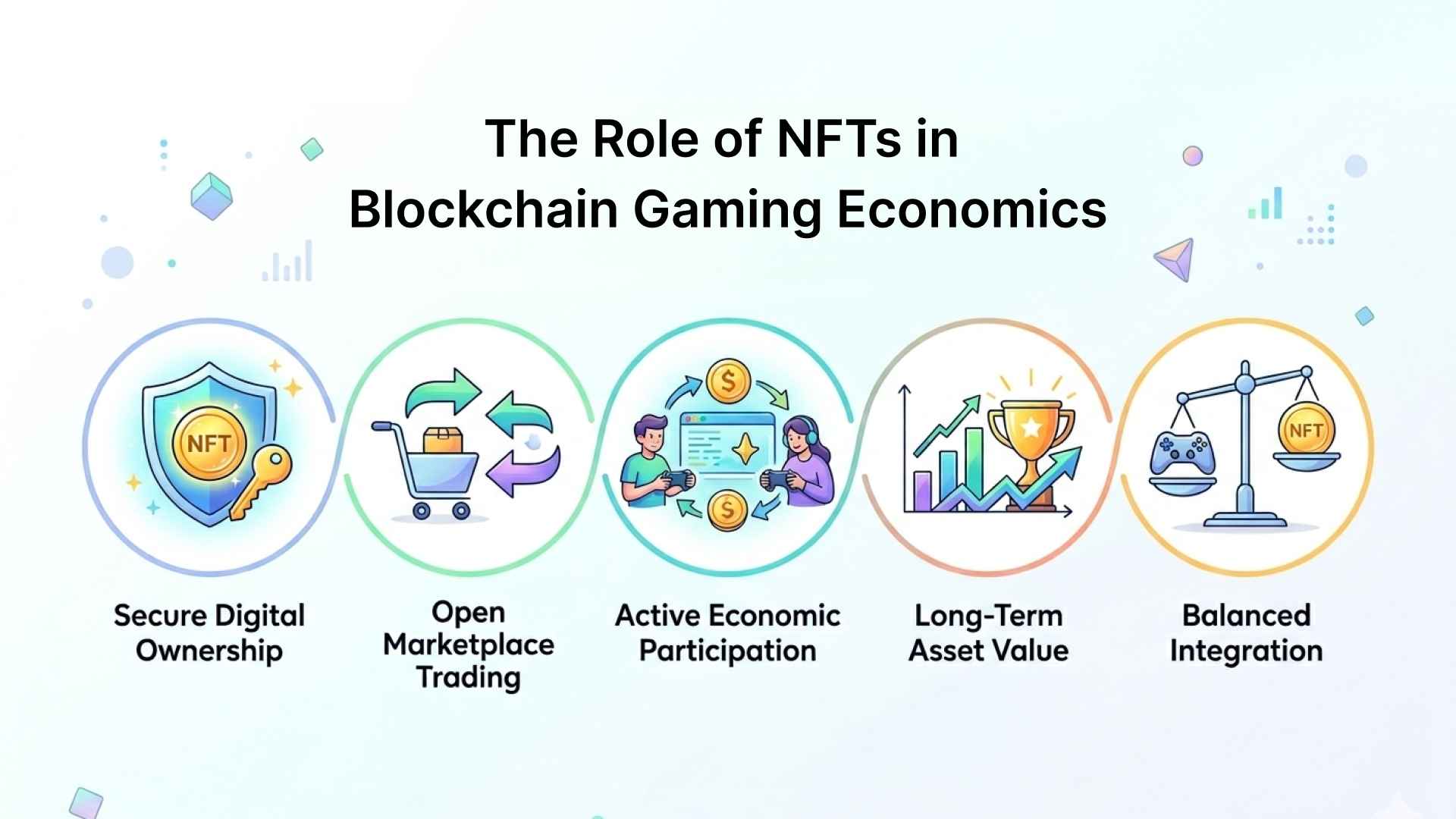
Secure Digital Ownership
NFTs give players true ownership of unique digital assets, independent of a game’s servers, ensuring that ownership is secure, transparent, and cannot be altered without consent.
Open Marketplace Trading
The assets, in the form of NFTs, are free to trade on open marketplaces, which have added real-world supply and demand dynamics to the traditional in-game economy.
Active Economic Participation
The game economy engages players more than it passively consumes the player, enhancing both engagement and loyalty as well as a feeling of investment in the game world.
Long-Term Asset Value
Those NFTs with a role in the game can maintain value and relevance over time and bring long-term benefits even during the initial purchase.
Balanced Integration
While NFTs can drive excitement and revenue, too much focus on investing rather than gameplay can harm trust and game balance. Effective integration focuses on the experience of players and financial prospects.
Want to know what comes after mobile and cloud gaming? Read our blog: The Future of Game Development: What’s Next After Mobile and Cloud Gaming?
Conclusion
Blockchain game development is not just a temporary trend, it’s a strategic opportunity to redefine how players experience games. By combining secure digital ownership, dynamic in-game economies, innovative play-to-earn models, and NFTs that enable true ownership of in-game assets, developers can create immersive worlds that retain players for the long term. The key to success lies in integrating blockchain thoughtfully, ensuring technology enhances the gaming experience rather than overshadowing it. For gaming studios and businesses aiming to navigate this evolving landscape, IR Solutions delivers end-to-end blockchain game development services, helping turn ideas into engaging, secure, and profitable games.
Frequently Asked Questions
What makes blockchain games different from traditional games?
Blockchain games allow players to gain ownership of digital assets in reality, decentralized economies, and to be able to buy and sell in-game items, not in-game.
Is blockchain gaming a sustainable long-term opportunity?
Yes, when games focus on meaningful gameplay, balanced tokenomics, and community engagement, blockchain can provide lasting value rather than being a short-lived trend.
How do NFTs enhance player experience in games?
As a result of NFTs, players have an opportunity to safely possess distinctive digital items, trade in the open market, and have the utility that has a long-term effect, generating a deeper attachment to the game world.
Can blockchain games generate consistent profits?
Blockchain opens new sources of revenue, such as token economies and marketplace royalties and profitability is subject to market forces and effective in-game economics.
Why do many blockchain games fail to retain players?
Games with a focus on short-term profitability, onboarding rather than involving gameplay, and unhealthy economies tend to lose player attention.