





Key Takeaways
- Smart contract developer skills go far beyond Solidity because contract code often controls tokens, payments, and ownership.
- Security knowledge, testing habits, and gas awareness matter as much as clean code when real money is involved.
- Always verify claims through GitHub work, mainnet deployments, and audit history before you sign any contract.
- A short technical interview with targeted questions reveals real production experience faster than a resume ever will.
- The right hire depends on your project, so match the developer type to the complexity and risk.
Hiring a smart contract developer is not the same as hiring a regular software developer. A bug in a smart contract can put tokens, payments, ownership, and other on-chain assets at risk, making security and testing critical from the start.
Once a flawed contract goes live, fixing the issue may not be simple. That’s why Solidity alone isn’t enough. You also need to assess security knowledge, testing practices, development tools, gas optimization, and blockchain experience.
This guide covers the key smart contract developer skills to check before hiring and explains how to verify them through a candidate’s work and technical experience. When evaluating candidates, consider both their smart contract developer skills and experience to make a more informed hiring decision.
What Skills Should a Smart Contract Developer Have?
A strong smart contract developer combines coding ability with security awareness, testing discipline, and real deployment experience. Use this quick list as a first filter before you dig into each skill in detail. These are the core smart contract developer requirements to consider before moving a candidate to the next stage.
- Blockchain fundamentals: They should understand how blocks, transactions, consensus, and wallets work before writing any contract logic.
- Contract programming: They need to write contract logic that behaves correctly under every possible on-chain condition.
- Solidity language: Solidity remains the main language for EVM chains, though Rust matters for Solana and others.
- Contract security: They must know common attack patterns and how to design code that resists them from day one.
- Testing skills: A good developer writes tests before deployment and treats a failing test as a blocker.
- Gas optimization: Every operation costs money on-chain, so efficient code directly lowers what your users pay.
- Development tools: Comfort with frameworks like Hardhat and Foundry speeds up building, testing, and shipping contracts safely.
- Token standards: They should know ERC20, ERC721, and ERC1155 well enough to extend them without breaking compatibility.
- Architecture knowledge: They should understand how contracts, oracles, frontends, and off-chain services fit together in one system.
- Deployment experience: Real mainnet deployments and post-launch maintenance separate seasoned developers from those who only build demos.
10 Essential Smart Contract Developer Skills to Check
Each skill below comes with a short explanation and a practical sign that shows whether a candidate really has it. The following sections highlight the skills to look for in a smart contract developer and the practical signs that can help you evaluate each one.
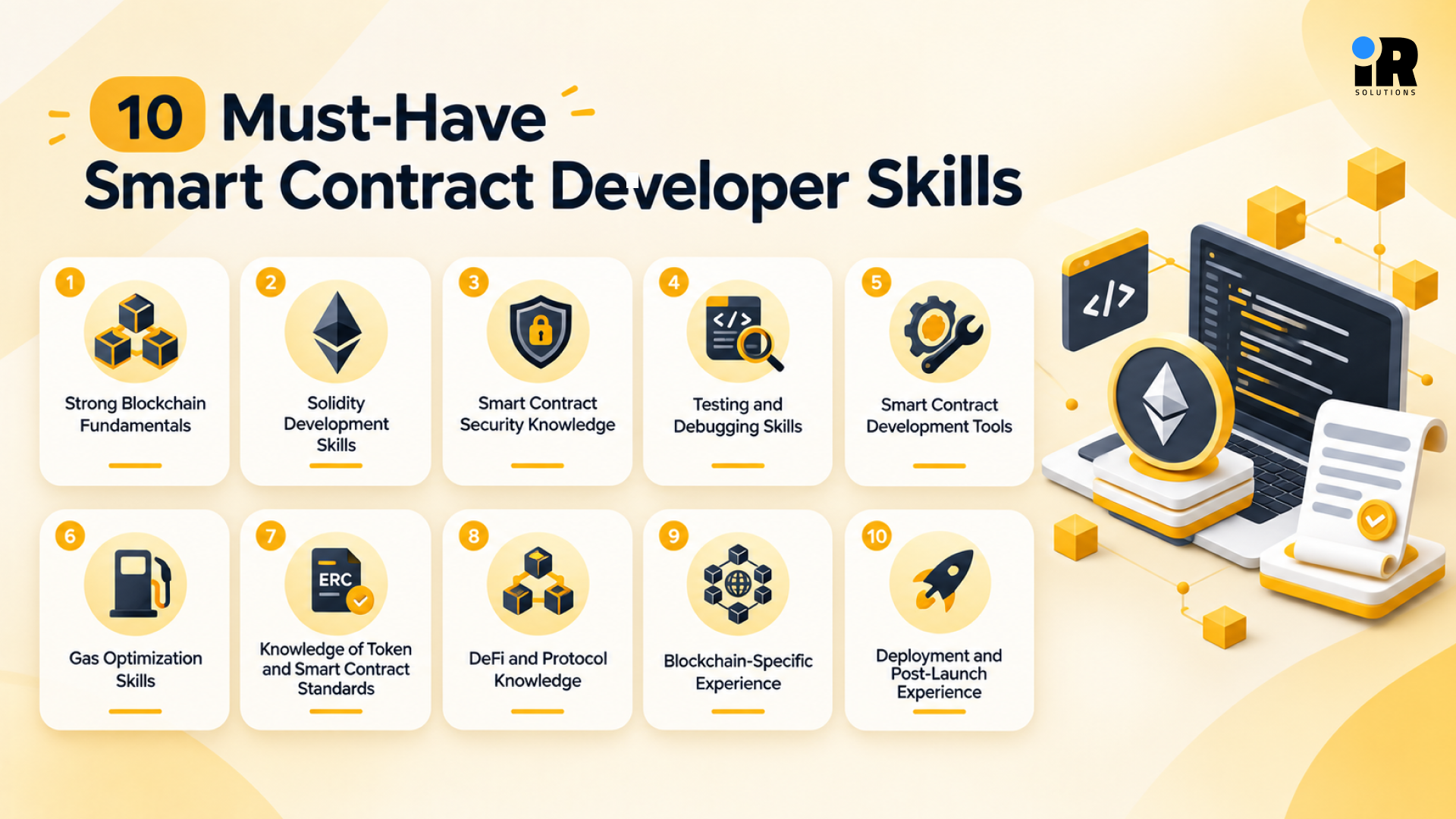
1. Strong Blockchain Fundamentals
Blockchain fundamentals are the base layer, and weak basics show up later as strange bugs in production. A developer should explain how transactions get ordered, how finality works, and why block timestamps are unreliable. Ask them to describe what a nonce does and what happens when two transactions compete for one slot. These fundamentals are also among the most important blockchain developer skills to assess when the role covers more than smart contract development.
2. Solidity Development Skills
Solidity developer skills go beyond syntax and include knowing the language's sharp edges and version differences. A capable developer understands storage layout, inheritance order, events, modifiers, and the risks of delegatecall. They should also understand Solidity's checked arithmetic introduced in 0.8.0 and know when using unchecked can introduce additional risk. These details matter when a developer is working on production contracts where small implementation mistakes can have serious consequences.
3. Smart Contract Security Knowledge
Smart contract security skills are the single most important area because most major losses trace back to preventable bugs. Your candidate should recognize reentrancy, front-running, integer issues, unchecked external calls, and broken access control immediately. These risks are covered by the OWASP Smart Contract Top 10, a useful reference for understanding common smart contract security vulnerabilities.
4. Testing and Debugging Skills
Testing is where good developers prove their code works before real users and real funds touch it. Look for unit tests, integration tests, fuzz tests, and invariant tests rather than a single happy path script. Fork testing against live mainnet state shows they understand how their contract behaves with real protocols. Debugging skills matter too, because reading a failed transaction trace quickly can save hours during an incident.
5. Smart Contract Development Tools
The right tools shorten development cycles and catch problems that manual review would miss under deadline pressure.
- Foundry: A fast Rust-based toolkit that many teams now prefer for fuzzing, testing, and scripting deployments.
- Hardhat: A JavaScript environment that fits well with existing web teams and has a large plugin ecosystem.
- Static analysis: Tools like Slither flag common vulnerabilities automatically before a human auditor ever reads the code.
- Block explorers: Comfort with Etherscan and similar explorers helps with verification, debugging, and monitoring of live contracts.
- Version control: Clean Git history with meaningful commits shows discipline and makes audits far easier to run.
6. Gas Optimization Skills
Gas optimization skills directly affect user costs, and a wasteful contract can make a product unusable during congestion. A skilled developer packs storage variables, avoids repeated storage reads, and uses events instead of storing logs. They should also know when optimization hurts readability and be honest about that balance in code reviews.
7. Knowledge of Token and Smart Contract Standards
Standards exist so wallets, exchanges, and other contracts can interact with your code without custom integrations. A developer should know ERC20 for tokens, ERC721 for NFTs, ERC1155 for mixed assets, and ERC4626 for vaults. Just as important, they should know when to inherit a standard and when a custom design is safer.
8. DeFi and Protocol Knowledge
DeFi knowledge matters even for non-DeFi projects because most contracts eventually touch swaps, lending, or staking. A strong developer understands automated market makers, flash loans, liquidations, and how composability creates hidden risk. Ask them to explain a well-known exploit and what design choice would have prevented it.
9. Blockchain-Specific Experience
Experience on one chain does not transfer perfectly to another, so match the developer to your target network.
- EVM projects: Ethereum, Polygon, Arbitrum, Base, and BNB Chain share the EVM, so Solidity skills carry across them.
- Solana projects: Solana uses Rust and a completely different account model, so EVM experience alone is not enough.
- Other chains: Networks like Sui, Aptos, and Cosmos chains each have their own languages, tooling, and security quirks.
10. Deployment and Post-Launch Experience
Deployment is not the finish line, and the months after launch reveal whether a developer understands production. They should have run testnet rollouts, verified source code on explorers, and handled upgrades without breaking user state. Ask about monitoring setups, pause mechanisms, and how they responded the last time something went wrong.
How to Verify a Smart Contract Developer's Skills
Claims on a resume mean little in this field, so verification is the most useful step in your process.
Review Their GitHub Projects
GitHub shows how a developer really works when nobody is watching, which tells you more than any interview. Look for meaningful tests that cover normal flows, edge cases, failure conditions, and security-sensitive behavior. Also check whether commits clearly explain what was changed and why. Check whether they use established libraries, write NatSpec comments, and respond to issues raised by other people. Forked repositories with no original commits are a warning sign that the portfolio may be borrowed.
Check Their Mainnet Experience
Mainnet experience proves a developer has shipped code that handled real value under real conditions. Ask for contract addresses, then check the verified source, transaction volume, and how long the contract has run. A contract with thousands of transactions and no incidents says more than a dozen testnet demos.
Ask for Audit Experience
Audit experience shows the developer has had their code challenged by professionals and learned from the findings. Request audit reports for past projects and ask how they fixed the high-severity issues that were found. A developer who has never been audited may still be skilled, but they carry more unknown risk.
Smart Contract Developer Technical Interview Questions
These questions work well in a one-hour technical interview and each one targets a specific skill area.
Question | What It Tests |
How does reentrancy happen? | Security knowledge |
How would you secure an admin function? | Access control |
How do you test a smart contract? | Testing process |
How do you reduce gas costs? | Optimization |
What happens when a transaction reverts? | EVM knowledge |
When would you use a proxy contract? | Architecture |
How do you test for unexpected inputs? | Edge case thinking |
How do you prepare a contract for an audit? | Security workflow |
What is the difference between storage and memory? | Solidity knowledge |
How would you monitor a contract after deployment? | Production experience |
Listen for concrete examples from past work rather than textbook definitions, since experience shows in the details.
Smart Contract Developer Skills Checklist
Print this smart contract developer checklist and tick each item as you verify it during your hiring process.
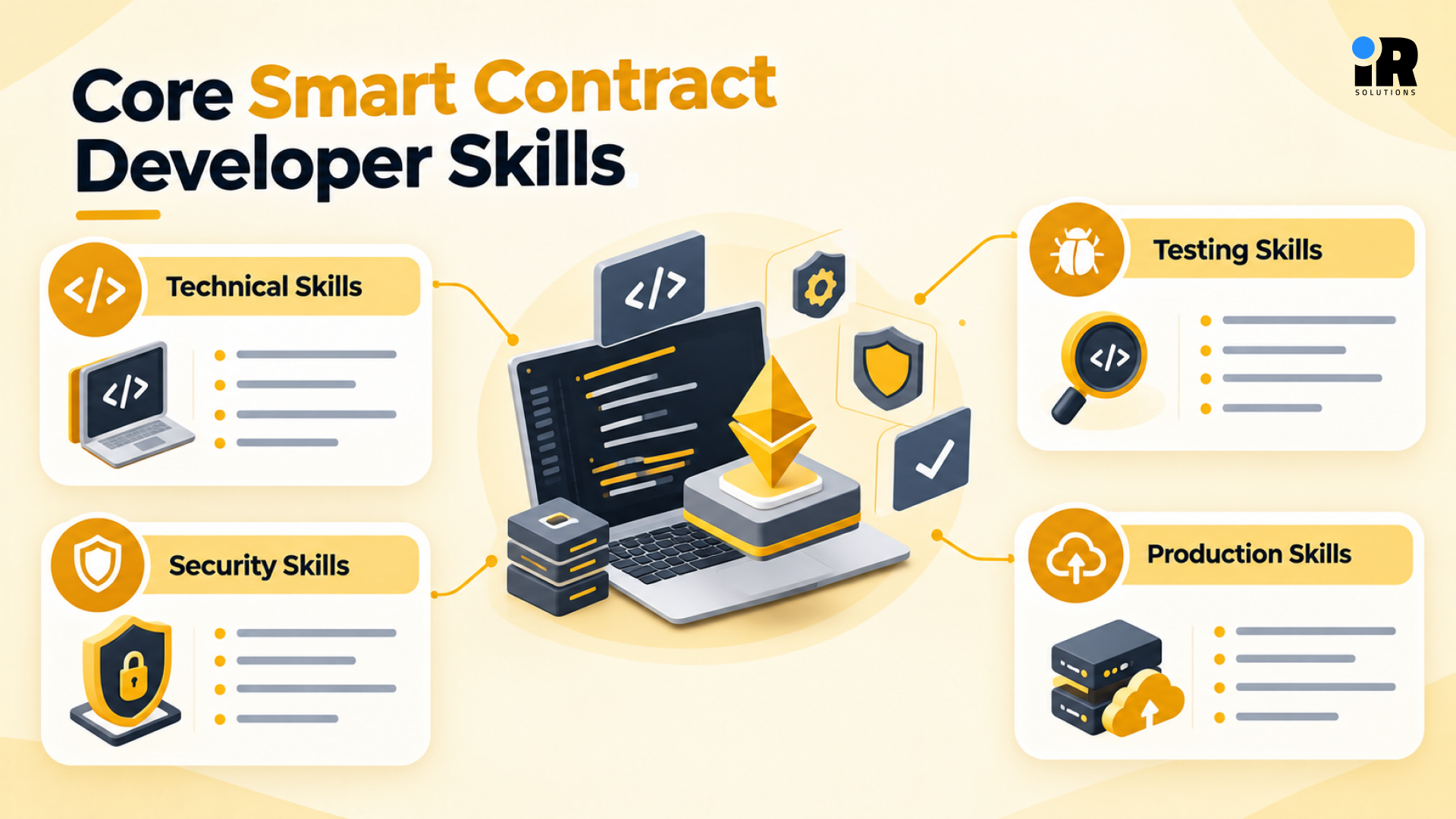
This checklist covers the skills stage specifically pair it with our complete guide to hiring smart contract developers for the full process, from writing the job post to final offer.
Technical Skills
- Solidity or relevant blockchain language
- Blockchain fundamentals
- EVM or chain-specific knowledge
- Smart contract architecture
- Token standards
- Web3 integrations
Security Skills
- Reentrancy prevention
- Access control
- Input validation
- Signature security
- Oracle security
- Secure upgrade patterns
Testing Skills
- Unit testing
- Integration testing
- Fuzz testing
- Invariant testing
- Fork testing
- Automated testing
Production Skills
- Testnet deployment
- Mainnet deployment
- Contract verification
- Gas optimization
- Monitoring
- Post-launch support
Should You Hire a General Blockchain Developer or a Smart Contract Specialist?
The right choice depends on how much custom contract logic your project needs and how much value it will hold. A general blockchain developer handles wallet connections, API integrations, and reading chain data for your application. A smart contract specialist focuses on writing, testing, and securing the on-chain logic that holds funds.
Beyond the type of developer, you'll also need to decide the hiring model, our comparison of freelance, agency, and in-house smart contract developers breaks down that trade-off in detail.
Need | Best Fit |
Simple blockchain integration | Blockchain developer |
Custom Solidity contracts | Smart contract developer |
DeFi protocol | Senior smart contract specialist |
NFT marketplace | Smart contract developer + Web3 team |
Complex multi-contract system | Smart contract team |
Security-critical protocol | Senior developer + independent audit |
Larger projects often need a mix, which is where staff augmentation, dedicated teams, or full outsourcing become practical. Staff augmentation adds one specialist to your team, while a dedicated team takes ownership of the whole build.
How IR Solutions Evaluates Smart Contract Development
At IR Solutions, every smart contract project follows the same process, and each stage checks the skills covered above.
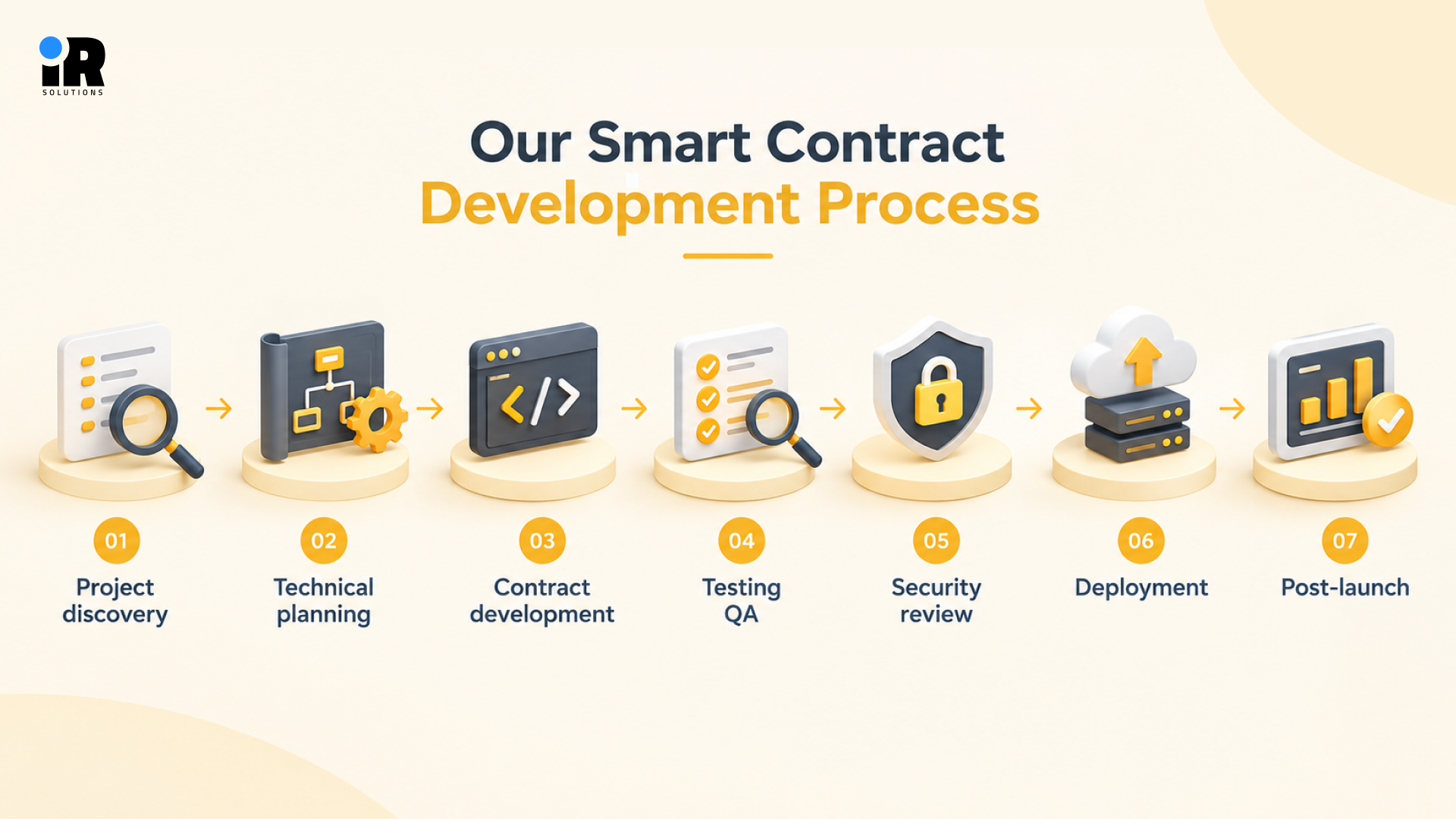
- Project discovery: We start by understanding your business goals, target chain, user flows, and the value the contracts will hold.
- Technical planning: Our architects map out contract structure, upgrade strategy, and how on-chain and off-chain pieces connect.
- Contract development: Developers build in small, reviewed increments using established libraries rather than reinventing sensitive logic from scratch.
- Testing QA: Every contract goes through unit, integration, fuzz, and fork tests before anyone considers it ready.
- Security review: An internal review runs static analysis and manual checks, and we recommend an independent audit for high-value systems.
- Deployment: We deploy to testnet first, verify source code publicly, and use staged mainnet rollouts where possible.
- Post-launch: Monitoring, incident response, and ongoing support continue after launch because production is where risk lives.
Need experienced smart contract developers for your project?
Hire developers with experience across Solidity, Rust, EVM chains, DeFi, NFTs, token systems, testing, and smart contract security.
Hire Smart Contract Developers
Frequently Asked Questions
What are the most important smart contract developer skills?
Security knowledge, thorough testing habits, and real mainnet experience matter most because contract bugs cannot be patched easily. Solid language skills and gas awareness come next, followed by familiarity with standards and tooling.
What programming language should a smart contract developer know?
Solidity is the main language for Ethereum and every EVM-compatible chain, so it covers most projects today. Rust is needed for Solana, Move for Sui and Aptos, and Vyper appears in some Ethereum projects.
Does every smart contract developer need Solidity?
No, but most do, because most contract work still happens on EVM chains where Solidity dominates. A Solana or Move developer can be excellent without it, as long as your project targets those chains.
What security skills should a smart contract developer have?
They should prevent reentrancy, enforce strict access control, validate all inputs, and handle signatures and oracles safely. Knowledge of secure upgrade patterns and past exploit case studies rounds out a strong security profile.
How can I test a smart contract developer's technical skills?
Give them a small contract with planted bugs and ask them to identify, explain, and fix each issue. Review their GitHub work, mainnet deployments, testing practices, and answers to technical interview questions.
What tools should a smart contract developer know?
Foundry or Hardhat for development, Slither for static analysis, OpenZeppelin for libraries, and Etherscan for verification. Familiarity with Tenderly or similar monitoring platforms is a bonus for anyone handling production contracts.
Should a smart contract developer have audit experience?
It is strongly preferred for any project holding real value, since audits teach lessons that tutorials never cover. For low-risk or experimental work, a developer without audit history can still be a good fit.
How do I know if a smart contract developer has real production experience?
Ask for live contract addresses, check the transaction history yourself, and ask how they handled a past incident. Developers with real production experience talk openly about monitoring, upgrades, and past mistakes without any hesitation.


