





Key Takeaways
- Smart contract developers need blockchain-specific skills that general software developers do not possess, including Solidity, Rust, gas optimisation, and security knowledge.
- Defining your project requirements, blockchain, and hiring model before outreach consistently produces better results than searching broadly and evaluating candidates reactively.
- Freelance developers suit short, defined contracts while dedicated teams and development companies suit complex, ongoing, or compliance-heavy smart contract builds.
- Evaluating a smart contract developer requires reviewing live mainnet deployments, audit reports, and GitHub code quality rather than relying on CV claims alone.
- The cost to hire a smart contract developer in the USA ranges from $80 to $250 per hour depending on experience, specialisation, and engagement model.
Hiring a smart contract developer is one of the most consequential technical decisions a blockchain project will make. The wrong hire introduces security vulnerabilities that are difficult and expensive to fix after deployment, delays that compound across the full project timeline, and compliance gaps that create legal exposure once real user capital is at risk.
It explains what smart contract developers actually do, how to define project requirements before starting the search, which hiring models suit which project types, what skills and tools to evaluate, where to find credible candidates, how to assess them before making any commitment, what the process costs, and the most common hiring mistakes that teams make when urgency overrides rigour.
Whether you are building a DeFi protocol, tokenizing a real-world asset, or deploying an NFT platform, this guide gives you a practical framework for finding and hiring the developer your project actually needs rather than the most available or the least expensive one you can find quickly.
What Does a Smart Contract Developer Do?
Smart contract developers write, test, deploy, and maintain self-executing code on blockchain networks that runs automatically when predefined conditions are satisfied.
Their work spans the full contract lifecycle from initial architecture design through security testing, deployment, and post-launch monitoring. A smart contract developer working on a DeFi lending protocol is writing the code that manages user deposits, loan issuance, interest accrual, and liquidation logic without any human intermediary executing those functions manually between events.
The role requires a combination of software engineering discipline, blockchain protocol knowledge, and security awareness that general backend or full-stack developers do not typically possess without specific blockchain experience. Every line of code a smart contract developer writes can directly control user funds or legally recognised asset ownership, which is why the technical and security standards the role demands are meaningfully higher than most other software engineering positions.
Define Your Smart Contract Project Requirements Before You Hire
Defining requirements clearly before starting the search prevents the most common and most expensive hiring mistake, recruiting for a broadly described role and discovering mid-engagement that the developer's actual specialisation does not match the project's real technical demands.
Before reaching out to any candidate or agency, confirm the specific blockchain the project will deploy on. Ethereum and EVM-compatible chain development requires Solidity expertise. Solana development requires Rust. These are different disciplines with different talent pools, different tooling, and different security considerations that cannot be interchanged based on developer availability.
Define the contract complexity as specifically as possible. A basic ERC-20 token contract has fundamentally different development and audit requirements from a multi-contract DeFi protocol handling automated liquidations across several user positions simultaneously. Knowing which category your project falls into shapes every subsequent hiring decision, including which candidates to target, what technical test to run, and which audit standard to expect from the finished work.
Choose a Hiring Model for Smart Contract Development
Each model carries a different cost, control, and risk profile, so the right choice depends on project scope rather than availability or price alone.
Hiring Model | Best For | Cost Level | Team Control | Typical Timeline to Start |
In-House Developer | Long-term, ongoing blockchain product development | High (salary + benefits) | Full | Weeks to months |
Freelance Developer | Short, well-defined contract work | Low to moderate | Limited oversight | Days to weeks |
Dedicated Development Team | Complex, multi-discipline projects | Moderate to high | High, client-directed | 1–2 weeks |
Smart Contract Development Company | Full-scope builds, compliance-heavy projects | High | Managed by provider | 1–3 weeks |
In-House Developers
Hiring a permanent smart contract developer makes sense when the organisation plans ongoing blockchain product development that justifies full-time headcount over a multi-year horizon. The upside is deep institutional knowledge and full team integration. The downside is the length of the hiring process, the difficulty of evaluating candidates without internal blockchain expertise, and the cost of a permanent hire before the product has proven commercial demand.
Freelance Developers
Freelance smart contract developers are suitable for short, well-defined contract work where the scope is clear, the timeline is fixed, and the deliverable is specific enough to evaluate without ongoing oversight. The risk is quality variance between individual freelancers and the absence of the team accountability that a company engagement provides when something goes wrong after delivery.
Dedicated Development Teams
A dedicated smart contract development team from a specialist provider gives the client a structured team including a tech lead, developers, and QA working exclusively on the project under the client's direction. This model suits projects with a complex scope that requires multiple disciplines working together rather than a single developer handling everything sequentially and independently.
Smart Contract Development Companies
A smart contract development company handles the full scope of the build, including architecture, development, testing, audit coordination, and deployment. This model suits projects where the client does not have the internal technical infrastructure to manage a dedicated team or evaluate individual developer output at the required technical depth throughout the engagement.
Learn more about how outsourcing smart contract development drives business growth for teams without in-house blockchain expertise.
Key Skills to Look for in a Smart Contract Developer
The technical skill set a smart contract developer needs extends well beyond writing a basic token contract and pushing it to a testnet environment.
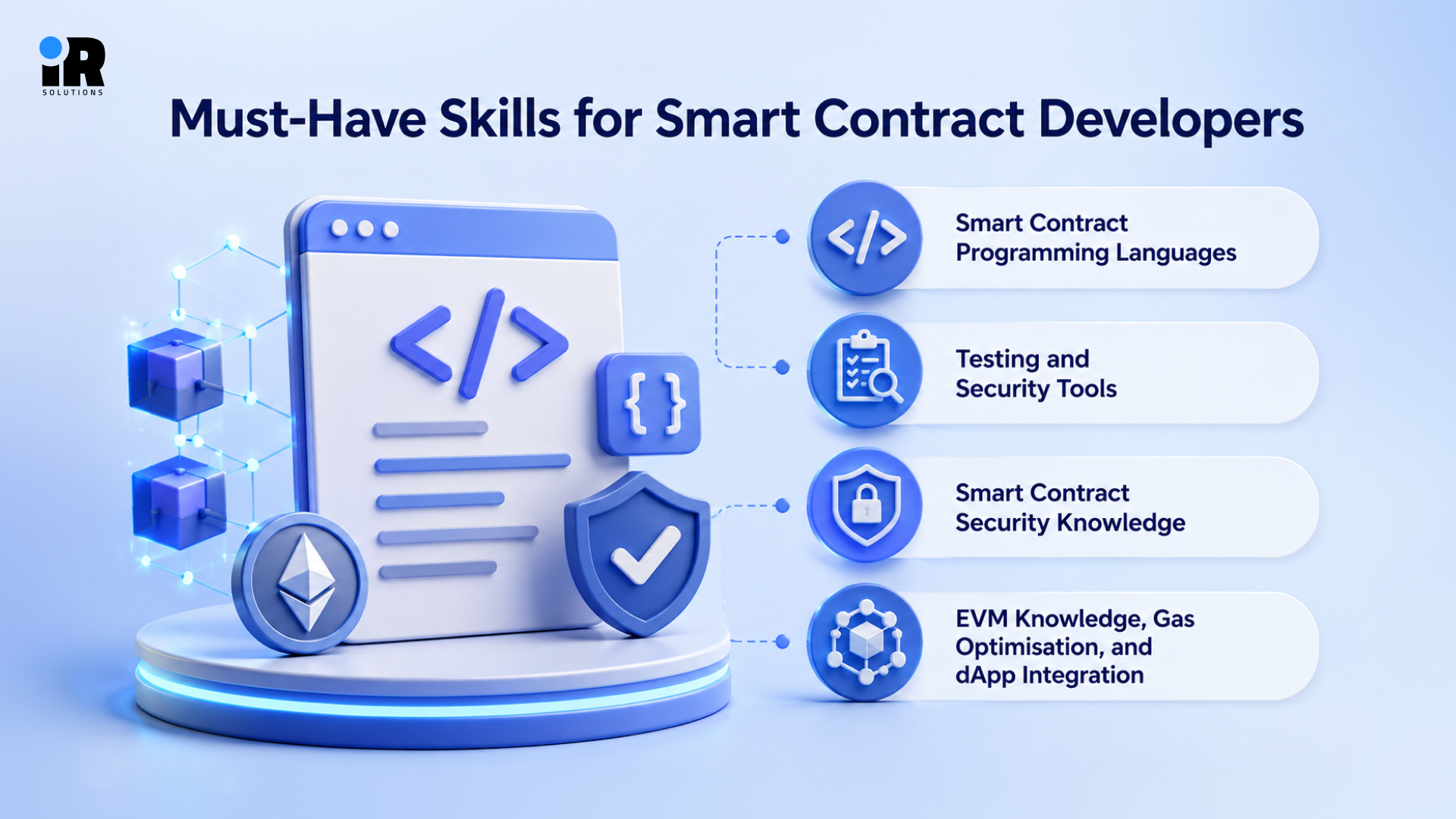
Smart Contract Programming Languages
Solidity is the primary language for Ethereum and EVM-compatible chain development. Rust is the primary language for Solana and NEAR protocol development. A candidate who lists both on a CV without verified production deployments in each is likely claiming broader experience than their actual work history supports at the depth the role requires.
Testing and Security Tools
Experienced smart contract developers work with Hardhat, Foundry, or Truffle for local development and testing environments. They write comprehensive test suites that cover edge cases, not just happy path scenarios that confirm the contract works under ideal conditions. Slither, MythX, and Echidna are the standard static analysis and fuzzing tools that serious security-aware developers integrate into their development workflow before submitting any contract for external audit.
Smart Contract Security Knowledge
A competent smart contract developer understands the specific vulnerability patterns that have caused the largest losses across deployed contracts. Reentrancy attacks, integer overflow and underflow, access control failures, front-running exposure, and oracle manipulation are the categories every developer working on contracts that handle funds needs to be able to explain, identify in existing code, and protect against in new code through design choices rather than only post-hoc mitigations.
EVM Knowledge, Gas Optimisation, and dApp Integration
Deep EVM knowledge allows a developer to write contracts that are not only functionally correct but gas-efficient enough to remain economically viable for users when network activity drives transaction costs upward. Gas optimisation is a practical skill that separates junior developers writing working contracts from senior developers writing contracts that remain commercially competitive at scale. dApp integration experience covering ethers.js, web3.js, and wallet connection patterns confirms that the developer understands how their contracts will actually be used rather than treating the frontend integration as someone else's problem entirely.
Where to Find and Hire Smart Contract Developers
Knowing how to find smart contract developers who match your project's blockchain and complexity level starts with picking the right platform, the source you use significantly affects the quality and relevance of applications, regardless of how well the job posting itself is written.
Vetted Developer Marketplaces
Toptal and Arc.dev maintain networks of pre-vetted blockchain developers who have passed technical screening before entering the available talent pool. This reduces the screening burden for clients who do not have internal blockchain expertise to evaluate candidates during initial outreach stages of the hiring process.
Web3 Job Boards and Hackathons
Crypto Jobs List, Web3 Career, and Gitcoin connect clients directly with developers who are actively working in the blockchain space rather than general software developers exploring blockchain as a career pivot. Hackathon participation, particularly events run by major blockchain protocols, surfaces developers who have produced working code under time pressure for external technical audiences who judged the quality of the output.
Audit Contest Platforms
Code4rena and Sherlock run competitive smart contract audit contests where developers identify vulnerabilities in live codebases for prizes. The leaderboards on these platforms are among the most reliable public signals of genuine smart contract security competence because the results reflect real vulnerability identification in real code rather than self-reported experience or portfolio projects the developer controlled entirely.
Smart Contract Development Companies
Engaging a development company rather than an individual developer provides a structured team, defined accountability, and the ability to scale the engagement up or down based on project phase without managing individual contractor relationships at each transition point across the development timeline. Clients looking to hire a smart contract developer without managing individual contractors can get this exact model here.
General Freelance Platforms
Upwork and Freelancer include blockchain developers but require significantly more screening effort than specialist platforms because the candidate pool mixes experienced smart contract developers with general software developers who have completed a few blockchain tutorials and positioned themselves as blockchain-capable based on that limited exposure alone.
How to Evaluate Smart Contract Developers
Evaluation should produce confident evidence of production capability rather than a positive impression of technical communication ability during a structured interview conversation.
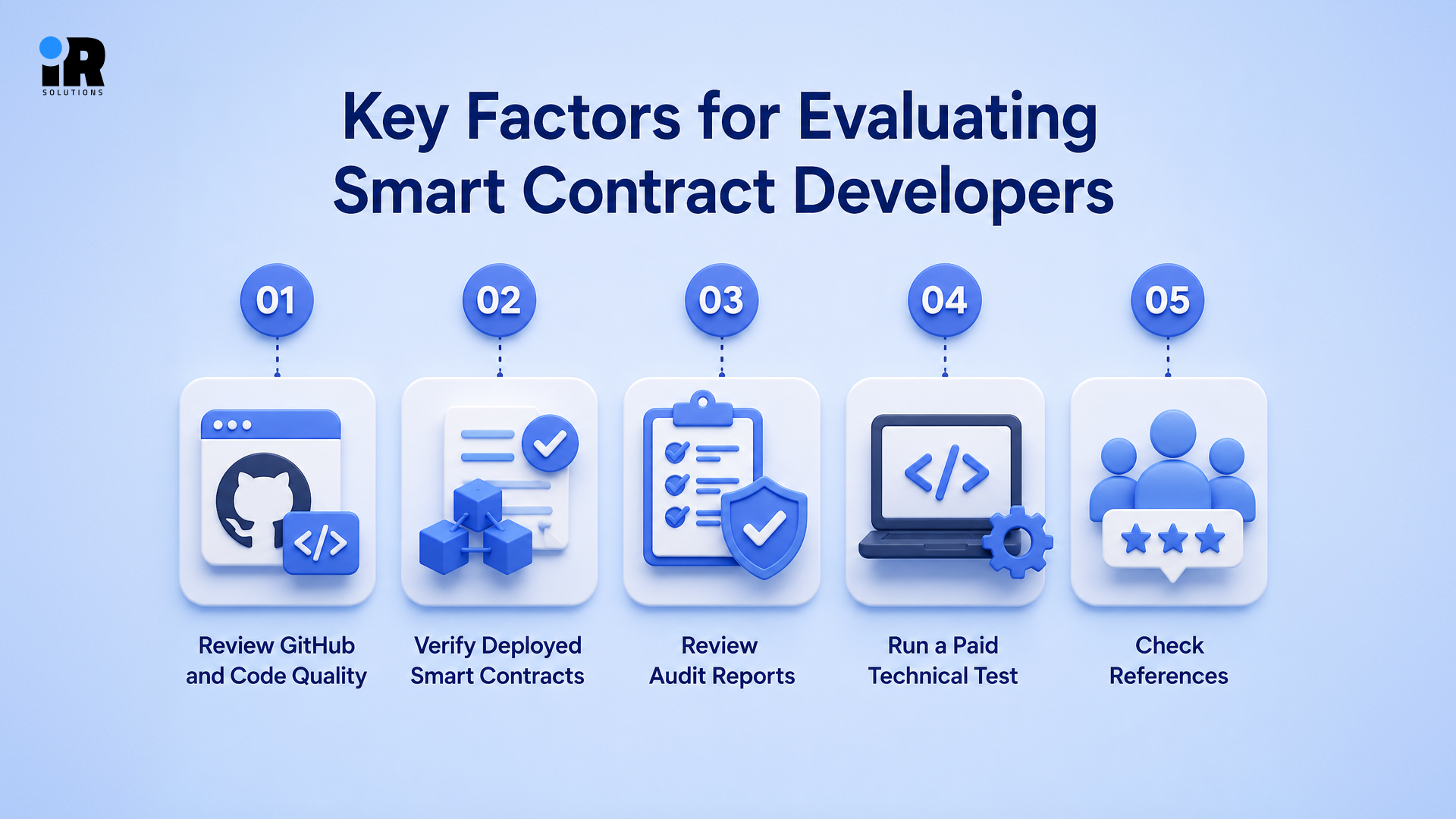
Review GitHub and Code Quality
A candidate's GitHub profile should include repositories with meaningful smart contract code, not just forked tutorial projects or Hello World token deployments that demonstrate basic familiarity rather than genuine development capability. Look for evidence of test coverage, comments explaining non-obvious design decisions, and consistent contribution patterns that suggest ongoing active engagement with blockchain development rather than a burst of activity specifically timed before the job search.
Verify Deployed Smart Contracts
Asking candidates to provide mainnet contract addresses that they deployed to production is the most direct verification of real-world experience. Etherscan and Solscan allow you to inspect the contract code, deployment history, and transaction volume that confirms whether the contract has been used by real users rather than only deployed and forgotten as a portfolio demonstration piece that never reached a production audience.
Review Audit Reports
Any smart contract developer claiming senior-level experience should be able to share or reference audit reports connected to contracts they developed. The findings in those reports, and more importantly how the developer responded to and resolved the findings, reveal far more about their security awareness and professional maturity than any technical interview question answered in a low-stakes conversational setting.
Run a Paid Technical Test
A paid technical assessment involving a realistic contract problem relevant to the actual project gives you direct evidence of how the candidate thinks through architecture decisions, handles edge cases, and writes test coverage for their own code. Unpaid tests produce lower engagement and signal a client relationship starting on the wrong footing for a technical discipline where the best candidates have multiple simultaneous opportunities to evaluate.
Check References
References from previous blockchain projects confirm the candidate's professional conduct, communication quality, and reliability under the specific conditions of a technical blockchain engagement rather than general software development work where the dynamics and pressures differ significantly from what a smart contract project introduces.
Smart Contract Developer Interview Questions
Ask targeted technical questions to determine whether a smart contract developer can apply their knowledge to real-world security, architecture, testing, and production challenges not simply recall Solidity concepts.
- Walk me through what happens between signing a transaction and its final confirmation.
- What is the difference between storage, memory, and calldata, and what does each cost?
- Explain delegatecall and give me one example of how it can go wrong.
- When do you use require, revert, and assert, and why are custom errors preferred?
- Explain reentrancy. Can you name a variant beyond the classic reentrancy attack?
- Why is tx.origin dangerous for authorization?
- How can flash loans turn a small vulnerability into a large loss, and what makes an oracle safe?
- Which ERC-20 tokens can break a naive integration, and how would you handle them?
- Which direction should rounding go in financial calculations, and why does it matter?
- What rules must you follow when changing storage layout across a contract upgrade?
- What is the difference between fuzz testing and invariant testing? Name one invariant you would write for a lending protocol.
- Describe a bug you shipped. What was the impact, and what changed in your development or review process afterward?
How Much Does It Cost to Hire a Smart Contract Developer in 2026?
Rates scale with experience and specialisation, and senior developers working on complex DeFi or RWA protocols command the top of the range.
For a detailed breakdown of smart contract developer costs, including hourly rates and hiring models, see our smart contract development cost guide.
Experience Level | Hourly Rate (USD) | Typical Profile |
Junior | $80 – $120 | Limited mainnet experience, basic contract types |
Mid-Level | $120 – $180 | Verified production deployments, solid testing practices |
Senior | $180 – $250+ | Deep security knowledge, audit experience, complex protocol/DeFi/RWA work |
Rates climb sharply with security expertise, senior developers pricing in audit experience and DeFi specialisation sit at the top of the range.
Common Mistakes to Avoid When Hiring Smart Contract Developers
Most expensive hiring mistakes in smart contract development follow a predictable pattern that is entirely avoidable when the evaluation process is taken seriously from the start.
Skipping the technical assessment and hiring based on a strong interview alone produces the most consistent disappointment because smart contract development ability and technical communication ability are genuinely different skills that do not reliably predict each other. A developer who explains Solidity concepts confidently in conversation may still write insecure or inefficient contracts when working independently without the structured discussion framing each design decision.
Hiring the cheapest available developer without verifying their mainnet track record introduces security risk that costs significantly more to remediate than the savings the lower rate appeared to produce at the point of engagement. Smart contract vulnerabilities discovered after deployment are not simply fixed through a software patch. They require contract migration, user communication, and often a fresh audit cycle that adds time and cost far exceeding the original development budget.
Treating the audit as optional to save budget at the end of the development cycle is the mistake that most consistently converts a successful development engagement into a failed production deployment. No smart contract developer, regardless of experience level, should be considered a substitute for an independent third-party security audit before any contract managing real user funds goes live on mainnet.
For a deeper breakdown of these risks, see our guide on how to fix critical mistakes in smart contract development before launch.
Smart Contract Developer Hiring Checklist
Working through this checklist before making any hiring commitment consistently reduces the risk of the most common and most expensive mistakes in this specific talent category.
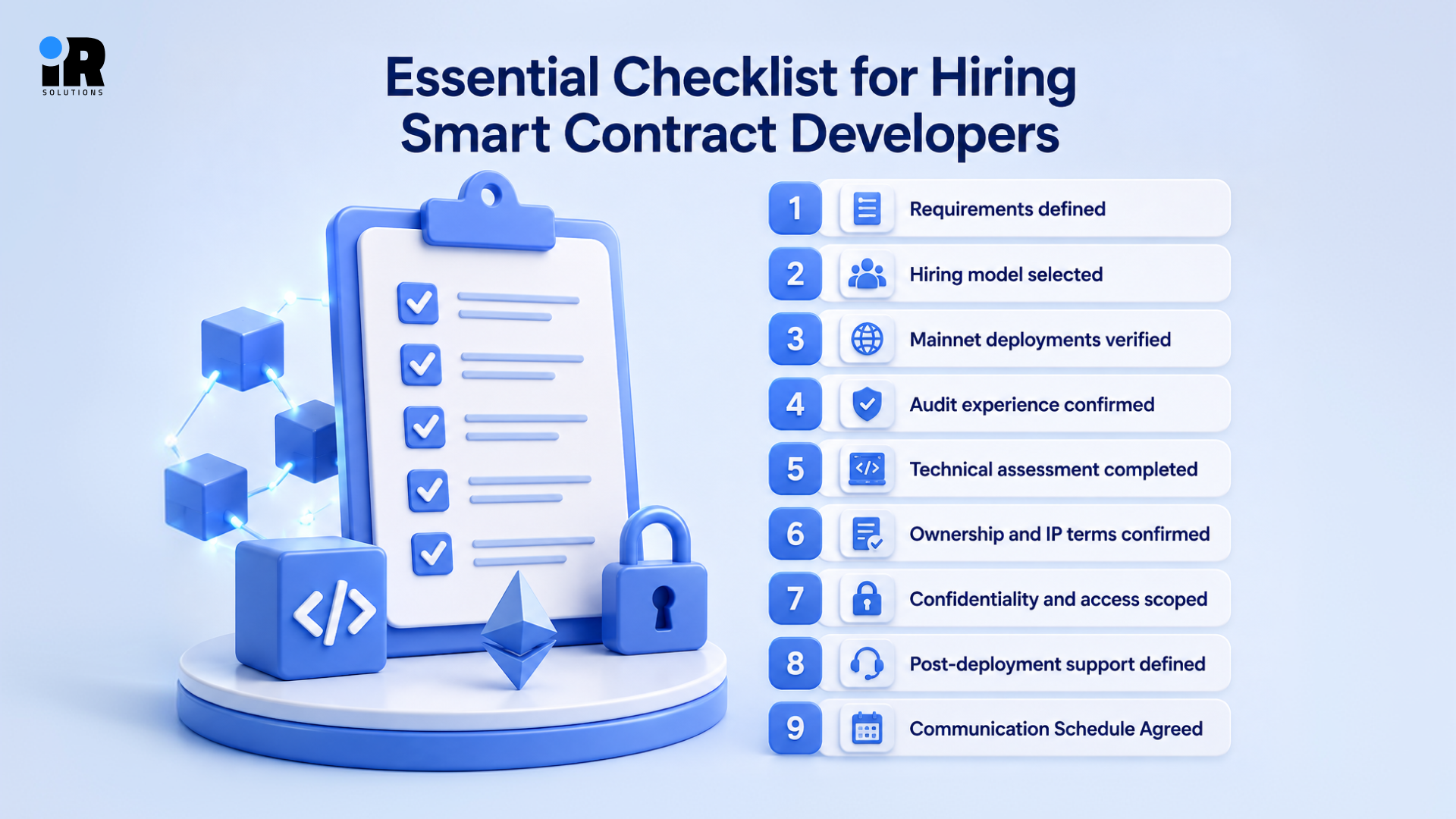
- Requirements defined: Blockchain, contract type, complexity level, and timeline are confirmed in writing before outreach begins.
- Hiring model selected: Freelance, dedicated team, or development company choice is made based on project scope rather than cost alone.
- Mainnet deployments verified: Contract addresses provided and confirmed on block explorer with real transaction history.
- Audit experience confirmed: Candidate has participated in audited projects and can speak specifically to how findings were resolved.
- Technical assessment completed: Paid test using a realistic contract problem relevant to the actual project has been evaluated by someone with blockchain technical knowledge.
- Ownership and IP terms confirmed: The contract states in writing that the code, the deployed smart contract, and any related intellectual property transfer to you, not just a license to use the developer's pre-existing tooling.
- Confidentiality and access scoped: An NDA is signed, and the developer's access to repositories, deployment keys, and wallets is limited to what the engagement genuinely requires.
- Post-deployment support defined: The agreement specifies who is responsible for monitoring, patching, and incident response after launch, and for how long that coverage lasts.
- Communication schedule agreed: Reporting frequency, check-in format, and an escalation path for urgent issues are set before work begins, not worked out reactively once something goes wrong.
Conclusion
Hiring the right smart contract developer requires more rigour than most technical hiring processes that companies apply to general software roles. The combination of production experience verification, security knowledge assessment, and independent audit planning separates successful smart contract projects from those that encounter expensive problems after deployment that a more careful hiring process would have prevented.
The investment in a thorough evaluation process at the hiring stage is consistently less costly than the remediation, reputational damage, and user impact that poorly evaluated smart contract developers introduce into projects that reach production without sufficient scrutiny of the technical team that built the core infrastructure investors and users are relying on.
Frequently Asked Questions
How do I evaluate a smart contract developer before hiring?
Review their GitHub for production-quality code with test coverage, verify mainnet deployments on a block explorer, ask for audit reports from previous projects, run a paid technical assessment using a realistic contract problem, and check references from previous blockchain-specific engagements rather than general software development work.
How much does it cost to hire a smart contract developer?
Costs range from $80 to $250 per hour depending on experience, blockchain specialisation, and engagement model. Full project costs, including development, testing, and independent audit, typically range from $15,000 for simple contracts to $200,000 or more for complex enterprise or regulated platform builds.
Should I hire freelance smart contract developers or a dedicated team?
Freelance developers suit short, well-defined contract work with a clear deliverable and fixed scope. Dedicated teams or development companies suit complex projects, compliance-heavy builds, or ongoing development that requires multiple disciplines working together rather than a single developer handling all technical layers sequentially.
How long does it take to hire a smart contract developer?
Finding and properly evaluating a qualified smart contract developer typically takes four to eight weeks when the process includes portfolio review, technical assessment, and reference checking. Rushing this timeline by skipping evaluation steps is the decision most consistently responsible for expensive post-hire problems in smart contract development engagements.
Do I still need a smart contract audit if my developer is experienced?
Yes. Developer experience reduces the likelihood of common vulnerabilities but does not eliminate the need for independent third-party validation before any contract managing real user funds goes live. An experienced developer and an independent audit are both required, not alternatives to each other in a properly structured smart contract development process.
Do I need a Solidity developer or a Rust developer?
The blockchain determines the language. Ethereum and all EVM-compatible chains, including Polygon, Avalanche, and Arbitrum, use Solidity. Solana uses Rust. A developer who claims fluency in both without verified production deployments in each should be evaluated against that specific claim before any engagement is confirmed.
What is the difference between a blockchain developer and a smart contract developer?
A blockchain developer is a broader term covering protocol development, node infrastructure, and application integration across the blockchain stack. A smart contract developer specialises specifically in writing, testing, and deploying the contract logic that executes on-chain. A smart contract developer is a type of blockchain developer, but not every blockchain developer has the specific smart contract security and architecture knowledge that production contract work requires.


