





Key Takeaways
- Basic token or NFT contracts usually cost between $5,000 and $25,000.
- Complex DeFi protocols and multi-contract platforms can reach $75,000 to $200,000 or more.
- Complexity, blockchain choice, integrations, and security requirements all shape the final price.
- Complex DeFi or RWA systems can push audit costs past 30,000 to 50,000 dollars.
- Developer rates range from $20 in South Asia to over $300 in the US.
- Freelancers, in-house teams, and development companies each carry different cost and risk trade-offs.
Smart contract development can cost anywhere from around $5,000 for a basic token contract to $500,000 or more for complex DeFi, cross-chain, and enterprise systems. Most projects fall between these ranges, depending on complexity, features, integrations, blockchain choice, testing, and security requirements.
A basic token contract may cost around $11,000 when development, auditing, and deployment are included. A full DeFi protocol with multiple contracts, oracle integrations, and a frontend can easily exceed $100,000. This guide breaks down the costs involved at each stage and covers tokens, NFTs, staking platforms, DAOs, DeFi, gaming, supply chain, and RWA projects.
Regional smart contract development rates, drawn from industry benchmarking data, show how freelancers, in-house teams, and development companies can affect your total budget. You will also see how audit, deployment, integration, testing, and maintenance costs add to the final price.
The cost of a smart contract depends on more than the blockchain you choose. Contract complexity, business logic, integrations, testing, and security requirements can have a bigger impact on the budget. By the end, you will have a clearer idea of what to budget for your project and how to evaluate smart contract development quotes.
How Much Does It Cost to Develop a Smart Contract?
Total cost depends heavily on the type of contract and how many moving parts it needs.
Smart Contract Type | Estimated Cost | Typical Timeline |
Basic Token | $5,000 to $15,000 | 1 to 3 weeks |
NFT Contract | $8,000 to $25,000 | 2 to 5 weeks |
Staking Contract | $15,000 to $40,000 | 3 to 8 weeks |
DAO Contract | $20,000 to $50,000 | 1 to 3 months |
RWA Tokenization Platform | $60,000 to $150,000 | 2 to 5 months |
Gaming Contract | $25,000 to $80,000 | 2 to 4 months |
Supply Chain Contract | $20,000 to $60,000 | 1 to 3 months |
DeFi Protocol | $75,000 to $200,000+ | 2 to 6+ months |
These ranges assume a working product, not just raw code sitting untested on a testnet.
Smart Contract Development Cost Calculator
A rough estimate comes from adding up every major cost component in the project.
Estimated Cost = Development Hours × Developer Rate + Audit + Deployment + Integrations + Maintenance
Example: Basic Token
A simple token project shows how quickly these smaller cost components add up together.
- Development. 100 hours at $50 per hour comes to $5,000 total.
- Audit. A standard security audit for a basic token adds 5,000 dollars.
- Deployment. Mainnet deployment typically adds around $1,000 depending on gas prices and network conditions.
- Total. The full project lands near $11,000 once every step is included.
Example: DeFi Protocol
A DeFi protocol involves far more architecture, testing, and third-party dependencies than a token.
- Development. Over 1,000 hours go into architecture, coding, and internal testing.
- Integrations. Oracle feeds and frontend integration add significant engineering time and cost.
- Audit. A thorough security audit for DeFi code often costs tens of thousands of dollars.
- Total. Most DeFi protocols land between $75,000 and $200,000 or more.
What Determines Smart Contract Development Cost?
Several factors combine to push a quote higher or keep it closer to the low end.
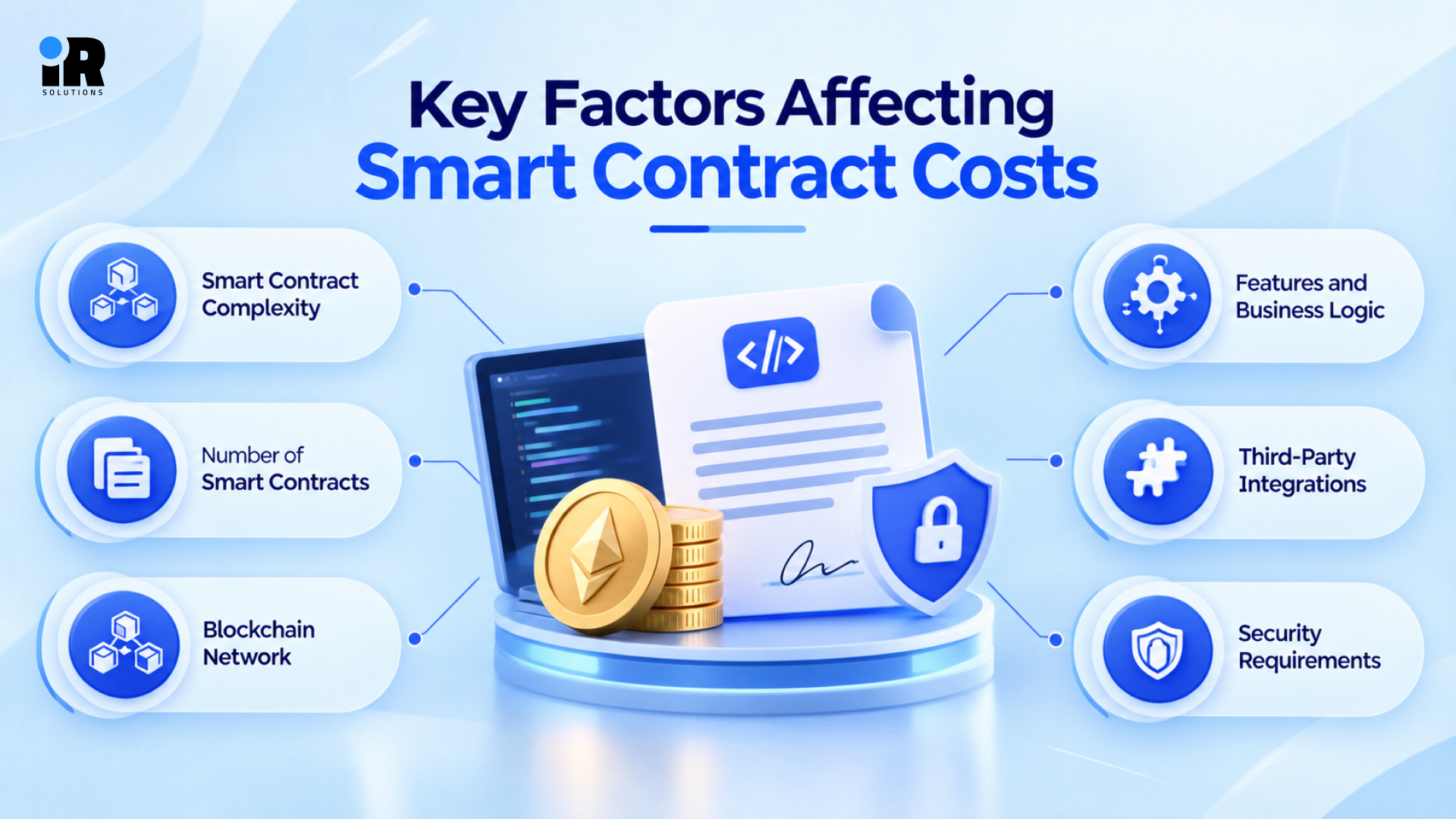
Smart Contract Complexity
More logic branches and edge cases mean more development time and more testing effort. A contract with several conditional paths needs careful review at every stage of coding. This extra care adds hours before the code ever reaches a security auditor.
Number of Smart Contracts
A single contract costs far less than a system built from several interacting contracts. Each additional contract adds new integration points that must be tested together, not separately. That testing overhead often costs more than writing the individual contracts themselves.
Blockchain Network
Ethereum may have higher deployment and transaction costs than many lower-fee networks, while development cost depends mainly on contract complexity, integrations, tooling, and developer expertise. Developers also need to account for mainnet congestion when estimating deployment and testing costs. Chains like Polygon or Base can lower both development time and ongoing fees. Working with an experienced blockchain developer helps you weigh these tradeoffs before committing to a network.
Features and Business Logic
Custom rules, governance mechanics, and reward systems all add development and testing hours. A simple transfer function is easy to write and easy to verify quickly. A custom staking formula with edge cases takes considerably longer to build safely.
Third-Party Integrations
Connecting to oracles, wallets, or other protocols adds both build time and testing risk. Every external dependency introduces a new failure point that auditors need to examine closely. Projects with multiple integrations should budget extra time for this stage alone.
Security Requirements
Contracts handling large sums of money need deeper audits and more conservative coding practices. High-value contracts often go through multiple audit rounds before anyone considers them production-ready. This extra diligence adds cost but prevents far more expensive exploits later.
Smart Contract Development Cost by Complexity
Complexity level is often the single biggest factor behind any smart contract quote.
Basic Smart Contract
A basic contract handles one clear function, like minting a token or running a simple sale. These projects usually cost between $5,000 and $15,000 and take a few weeks. Development stays fast because there are few edge cases to plan around.
Intermediate Smart Contract
An intermediate contract might combine staking, vesting, or governance logic into one system. Expect costs between $20,000 and $50,000 depending on how many features are involved. Testing takes longer here since multiple functions need to work together correctly.
Advanced Smart Contract
Advanced systems include DeFi protocols, RWA platforms, and multi-contract architectures with oracle dependencies. These typically run from $75,000 up to $200,000 or more. Security auditing alone can take several weeks given how much logic needs review.
Smart Contract Development Cost by Project Type
Different project types carry different technical demands, which show up directly in the price.
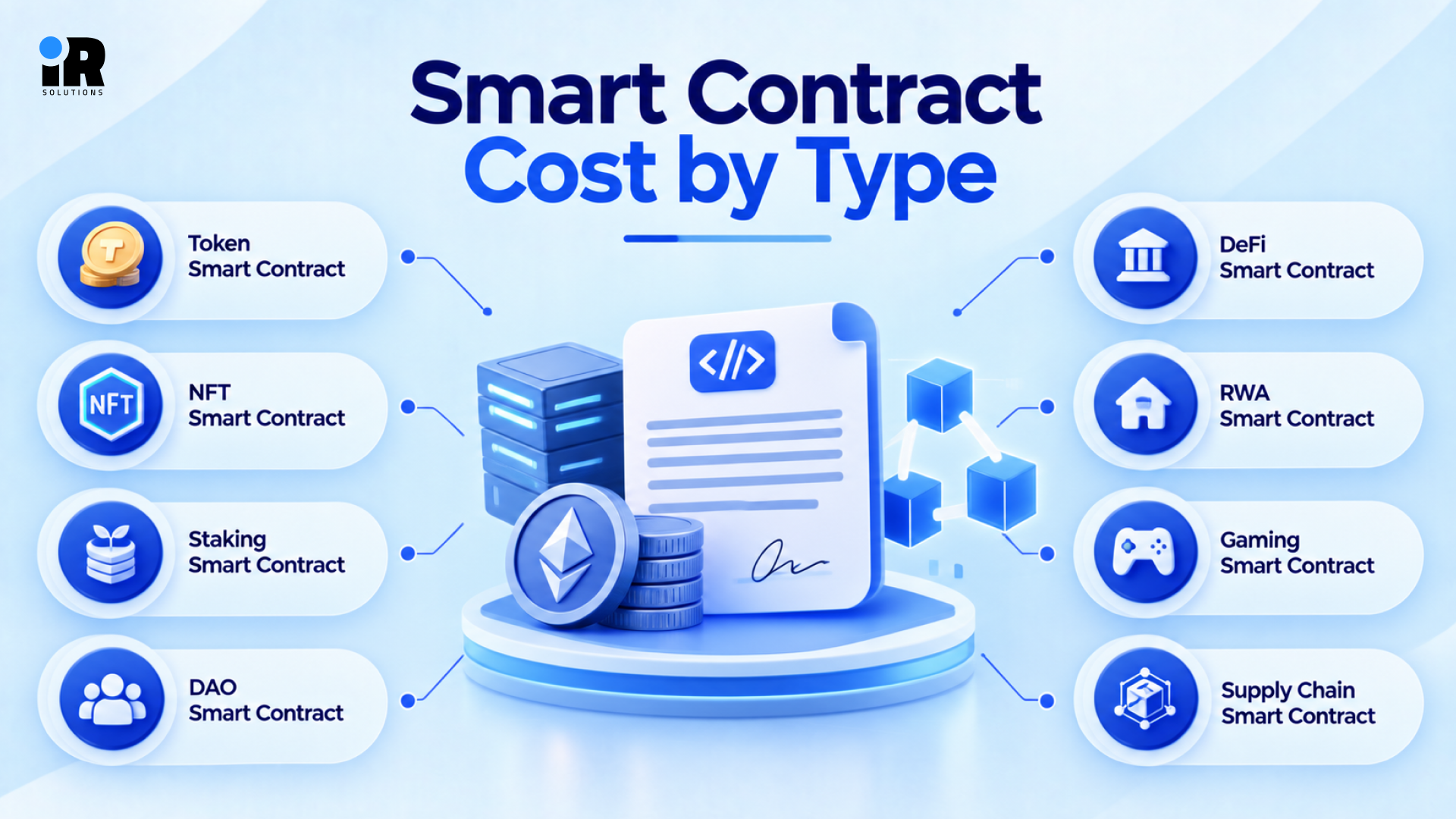
Token Smart Contract
Standard token contracts are relatively simple and usually cost between 5,000 and 15,000 dollars. Most of the budget goes toward basic testing and a lightweight security review.
NFT Smart Contract
NFT contracts need metadata handling and marketplace logic, pushing cost to 8,000 to 25,000 dollars. Royalty rules and minting limits are common features that add extra development time.
Staking Smart Contract
Staking contracts require reward calculations and lockup logic, typically costing 15,000 to 40,000 dollars. Getting the math right here matters, since reward errors can drain funds quickly.
DAO Smart Contract
DAO contracts need voting and treasury logic, usually landing between 20,000 and 50,000 dollars. Governance rules often get customized, which adds planning time before coding even starts.
DeFi Smart Contract
DeFi contracts involve lending, swaps, or yield logic, often costing 75,000 to 200,000 dollars. Oracle integration and liquidity handling are usually the most expensive parts to build.
RWA Smart Contract
RWA tokenization projects typically cost $60,000 to $150,000 for a mid-sized implementation, although legal, compliance, asset verification, and integration requirements can increase the total project cost.
Gaming Smart Contract
Gaming contracts manage in-game assets and economies, usually ranging from 25,000 to 80,000 dollars. Balancing in-game economics with on-chain logic adds a layer most projects underestimate.
Supply Chain Smart Contract
Supply chain contracts track shipments and milestones, generally costing 20,000 to 60,000 dollars. Integration with existing logistics systems is often the trickiest and most time-consuming part.
Smart Contract Development Cost by Blockchain
Blockchain choice affects both development difficulty and the ongoing cost of running the contract. Solana projects often cost more upfront since Rust developers are harder to find and hire.
Blockchain | Development | Estimated Cost | Main Language | Best For |
Ethereum | Higher | $15,000–$100,000+ | Solidity | DeFi, RWA, enterprise |
Polygon | Moderate | $10,000–$60,000 | Solidity | Consumer applications |
BNB Chain | Moderate | $8,000–$50,000 | Solidity | DeFi and tokens |
Arbitrum | Moderate | $10,000–$60,000 | Solidity | DeFi and scaling |
Base | Moderate | $8,000–$50,000 | Solidity | Consumer and DeFi apps |
Solana | Moderate to high | $15,000–$80,000+ | Rust | High-throughput apps |
Avalanche | Moderate | $10,000–$60,000 | Solidity | DeFi and enterprise |
Smart Contract Development Cost Breakdown
A full project budget is really a sum of several distinct work stages.
Business Analysis
Defining requirements and mapping user needs sets the foundation for accurate cost estimation. Skipping this stage often causes scope changes later, which end up costing far more.
Architecture and Planning
Designing contract structure and data flow prevents expensive rework later in development. Good planning also makes the eventual security audit faster and less costly overall.
Smart Contract Coding
Writing the actual contract logic usually makes up the largest single cost component. This stage is where developer rate and project complexity have the biggest combined impact.
Frontend and Web3 Integration
Connecting wallets and building a user interface adds meaningful time to most budgets. This work often runs in parallel with contract development to keep the timeline shorter.
Testing and QA
Unit tests and integration tests catch bugs before they become costly production issues. Thorough testing here reduces the number of issues an auditor later has to flag.
Security Audit
An independent audit reviews code line by line before real funds touch the contract. Complex projects sometimes need a second audit round once initial fixes are applied.
Deployment
Deploying to mainnet involves gas costs, verification, and final configuration steps. Costs here are usually smaller than development but can spike during network congestion.
Documentation
Clear technical documentation helps future developers maintain and extend the contract safely. Good documentation also speeds up any future audit if the contract gets upgraded.
Maintenance
Ongoing monitoring and updates keep the contract secure as the surrounding ecosystem changes. Projects that skip maintenance often face higher emergency costs when something breaks later.
Smart Contract Audit Cost
A security audit is one of the most important expenses to include in a smart contract budget. An audit reviews the code for vulnerabilities, logic errors, access control issues, and other security risks before the contract goes live.
The cost depends on the size and complexity of the codebase. A simple token contract with limited functionality may cost around $5,000 for a focused audit. More complex DeFi, RWA, or multi-contract systems require deeper testing and can push audit costs beyond $30,000 to $50,000.
Project Type | Typical Audit Cost |
Basic Token Contract | $5,000–$10,000 |
NFT Contract | $5,000–$15,000 |
Staking Contract | $10,000–$25,000 |
DeFi Protocol | $20,000–$50,000+ |
RWA Platform | $30,000–$50,000+ |
Complex Multi-Contract System | $50,000+ |
Audit pricing can also increase when the project has a large codebase, multiple contracts, complex financial logic, oracle integrations, or cross-chain functionality. Some projects may also need a re-audit after making changes to the code.
Skipping an audit to reduce development costs can create much larger expenses later. A vulnerability discovered after launch can lead to lost funds, emergency fixes, downtime, and damage to user trust. For this reason, security auditing should be treated as part of the development budget rather than an optional extra.
Smart Contract Developer Cost Per Hour
Hourly rates vary significantly based on where you hire a smart contract developer and their experience level.
Developer Location | Approx. Hourly Rate |
South Asia | $20–$85 |
Eastern Europe | $50–$120 |
Western Europe | $80–$200+ |
US | $120–$300+ |
These are indicative market ranges rather than fixed industry rates. Actual rates vary based on developer experience, blockchain specialization, location, project complexity, and engagement model.
Hourly rates vary significantly based on where you hire a smart contract developer and their experience level. Before comparing rates, it is important to understand what skills and experience you should look for when hiring. Our guide on how to hire smart contract developers covers the key factors to consider when evaluating developers.
Freelancer vs In-House Team vs Blockchain Development Company
Each hiring model comes with its own trade-offs around cost, speed, and long-term reliability.
Hiring a Freelancer
- Pros. Lower cost and faster onboarding for small, well-defined projects.
- Cons. Limited availability and less accountability if something goes wrong later.
- Best for. Simple token or NFT contracts with a tight, fixed budget.
Building an In-House Team
- Pros. Full control over priorities and deep long-term product knowledge.
- Cons. High fixed costs and slower hiring for specialized blockchain roles.
- Best for. Companies planning multiple ongoing blockchain products over several years.
Hiring a Blockchain Development Company
- Pros. Access to full teams, established processes, and audit relationships already in place.
Cons. Generally higher cost than a single freelancer for small projects.
- Best for. Complex DeFi, RWA, or multi-contract systems needing proven expertise.
Estimated costs typically run lowest with freelancers, moderate with agencies, and highest with full in-house teams.
Hidden Costs of Smart Contract Development
Several costs can be missed during the initial budgeting stage and appear later as the project moves toward launch and maintenance.
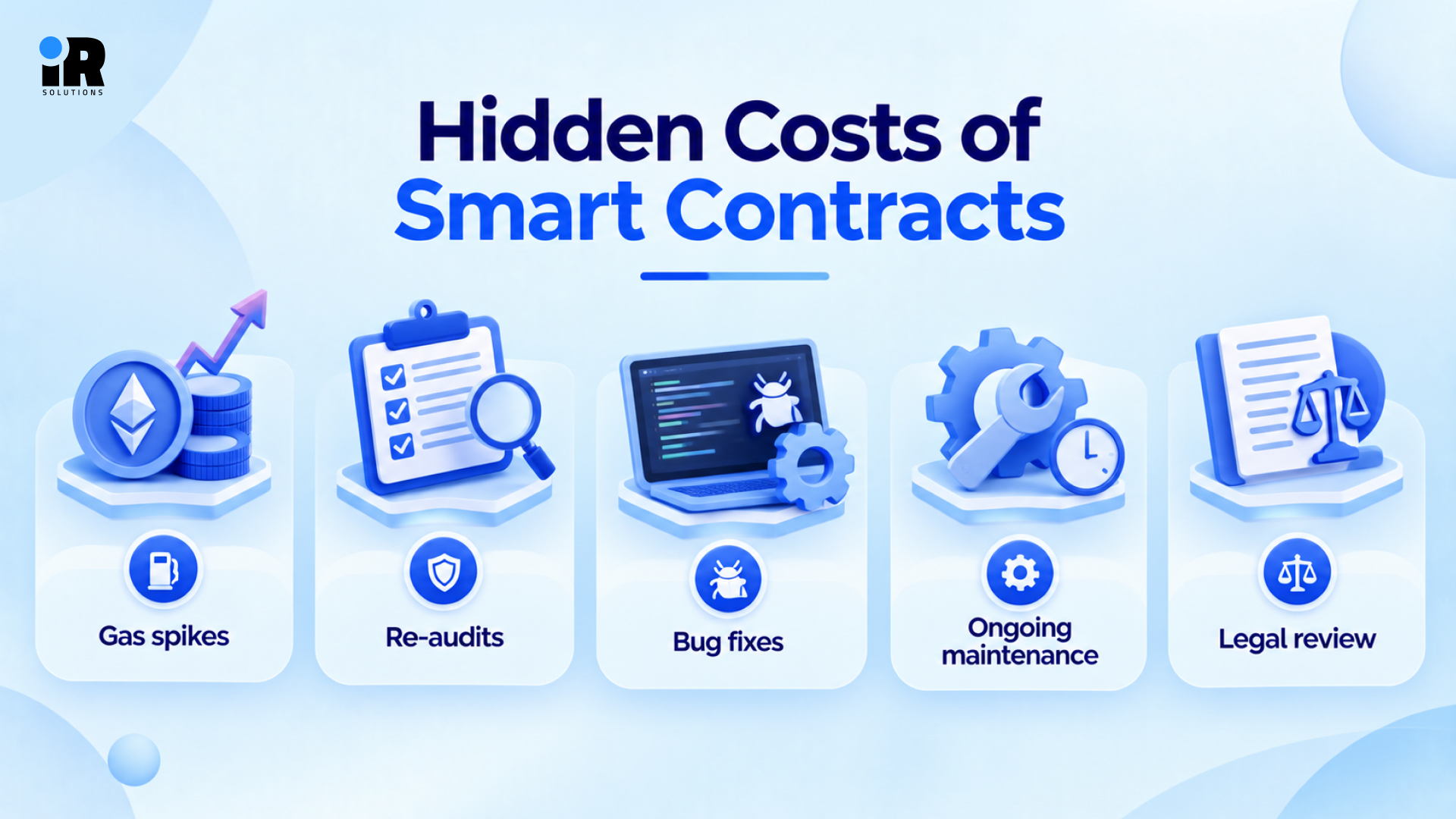
- Gas spikes. Network congestion can increase gas fees during testing or deployment. If a contract needs to be deployed or updated when network activity is high, the actual cost may be much higher than expected.
- Re-audits. Changes made after a security audit can introduce new risks. Even small modifications may require another review, adding extra audit costs and extending the project timeline.
- Bug fixes. Bugs discovered after launch can require urgent development work. Fixing issues in a live contract can also be more expensive because the team may need to investigate existing transactions and user activity.
- Ongoing maintenance. Smart contracts that interact with wallets, oracles, bridges, or other protocols may need regular monitoring. Changes to connected systems can require updates or additional testing to keep everything working correctly.
- Legal review. Projects involving tokenized assets, DAOs, or financial applications may require legal guidance. Regulatory requirements, token ownership rules, and compliance checks can add costs beyond the technical development budget.
Smart Contract Development vs Deployment Cost
These two cost categories often get confused, but they cover very different parts of a project.
Development Cost
- Coding
- Architecture
- Testing
- Security
- Integration
Deployment Cost
- Gas
- Network fees
- Contract verification
- Configuration
- Mainnet deployment
Development cost covers building the contract, while deployment cost covers putting it live on chain.
How to Reduce Smart Contract Development Cost
A few practical steps can lower costs without cutting corners on security.
- Scope tightly. Launch with core features first and add extras in later updates.
- Reuse code. Audited, open-source libraries reduce both development time and audit risk.
- Pick wisely. Choosing a lower-cost blockchain can meaningfully cut gas and testing expenses.
- Plan early. Clear requirements upfront prevent expensive mid-project changes and rework.
How to Choose a Smart Contract Development Company
The right partner should match your project's complexity and long-term support needs.
- Check history. Look for real production deployments, not just demo projects.
- Ask about audits. Confirm they work with reputable third-party security auditors.
- Review contracts. Ask to see public code from past client projects.
- Discuss support. Confirm what happens after launch if bugs or issues appear.
If you are looking for a development partner in the US, our list of the top smart contract development companies in the USA compares leading providers based on their expertise, services, and project capabilities. It can help you shortlist companies that match your budget and technical requirements.
Smart Contract Development Cost by Project Example
Real project examples help translate these ranges into something more concrete.
Example 1: ERC 20 Token
A standard ERC 20 token with basic minting logic typically costs around $10,000 to $15,000, including audit and deployment.
Example 2: NFT Marketplace
An NFT marketplace with minting, listing, and royalty logic usually costs $25,000 to $60,000 depending on custom features.
Example 3: DeFi Platform
A lending or swap-based DeFi platform with oracle integration often costs $100,000 to $200,000 once fully audited.
Example 4: RWA Tokenization Platform
An RWA platform with compliance logic and legal structuring typically costs $80,000 to $150,000 before launch.
Conclusion
Smart contract development cost in 2027 comes down to a handful of core factors. Complexity, blockchain choice, integrations, and security requirements together decide where a project lands. A basic token can be built and audited for around $11,000 total. A full DeFi protocol with oracle integrations often costs well past $100,000. Understanding these cost drivers helps you set a realistic budget before requesting quotes. It also helps you spot a quote that seems too low for the work involved.
Whether you hire a freelancer, build an in-house team, or work with a development company, the right fit depends on your project's complexity and timeline. Getting the security audit right matters more than shaving a few hours off development. A well-audited contract protects both your funds and your reputation long after launch. Use the ranges in this guide as a starting point, then get quotes based on your specific features and integrations.
Frequently Asked Questions
How much does it cost to develop a smart contract?
Costs range from around $5,000 for a basic token to over $200,000 for complex DeFi systems. The final number depends heavily on features, integrations, and audit depth. Most straightforward projects land somewhere between these two extremes.
What is the average cost of a smart contract?
There is no fixed average because smart contract scope varies widely. Basic token and NFT projects can cost such as $5,000–$25,000, while projects with custom logic, integrations, testing, and security audits can reach $10,000 to $30,000 or more.
How much does a DeFi smart contract cost?
DeFi contracts typically cost $75,000 to $200,000 due to their complexity and audit requirements. Oracle integrations, liquidity handling, and multiple audit rounds all add to that total. Larger protocols with several linked contracts often exceed this range entirely.
How long does it take to develop a smart contract?
Simple contracts take a few weeks, while complex DeFi protocols can take six months or longer. Timelines depend on the number of features and integrations required. Testing and audit rounds often add several additional weeks near the end.
Is smart contract deployment expensive?
Deployment itself is usually far cheaper than development, though gas fees vary with network congestion. A basic token deployment might cost under a dollar during normal network conditions. Larger contracts cost more to deploy simply because they store more code on chain.
What is the cheapest blockchain for smart contracts?
Chains like Polygon and BNB Chain generally offer lower gas costs than Ethereum mainnet. Layer 2 networks built on Ethereum also tend to reduce both deployment and transaction costs. The right choice still depends on where your target users already are.
How much does it cost to maintain a smart contract?
Ongoing maintenance costs vary widely but often run $1,000–$3,000 per year. For active monitoring. Projects with frequent updates or multiple integrations tend to sit at the higher end. Contracts left untouched after launch still need occasional security monitoring.


