




One bug can wipe out everything you built. Smart contract exploits have drained billions from projects that launched without fixing known vulnerabilities. Unlike traditional software, you cannot push a patch once your contract is live on mainnet. Every mistake you skip in development becomes a permanent risk for your business and your users. This post breaks down the most dangerous mistakes teams make before deployment. It also shows how working with an expert blockchain development company keeps your project secure from day one.
Why Smart Contract Errors Cost More Than You Expect
Smart contracts are permanent once deployed to the mainnet, and there is no quick hotfix or rollback button available to you. Your only options after discovering a critical bug are a full redeployment, a proxy upgrade, or a painful migration. All of these cost money and destroy user trust faster than most teams expect.
Reentrancy attacks, access control failures, and arithmetic errors have drained hundreds of millions from live protocols. Most of those contracts passed basic internal testing. They failed because teams treated deep review as optional. Catching these mistakes before you launch is the only practical option, because every hour spent on security before deployment saves days of crisis management after an exploit.
Skipping a Threat Model Before Writing Any Code
Most teams write the contract, test the happy path, and ship. Nobody stops to ask who would want to break this and exactly how they would do it. Without a structured threat model, you are guessing which tests actually matter. Gaps stay open, and attackers walk straight through them.
What a solid threat model covers:
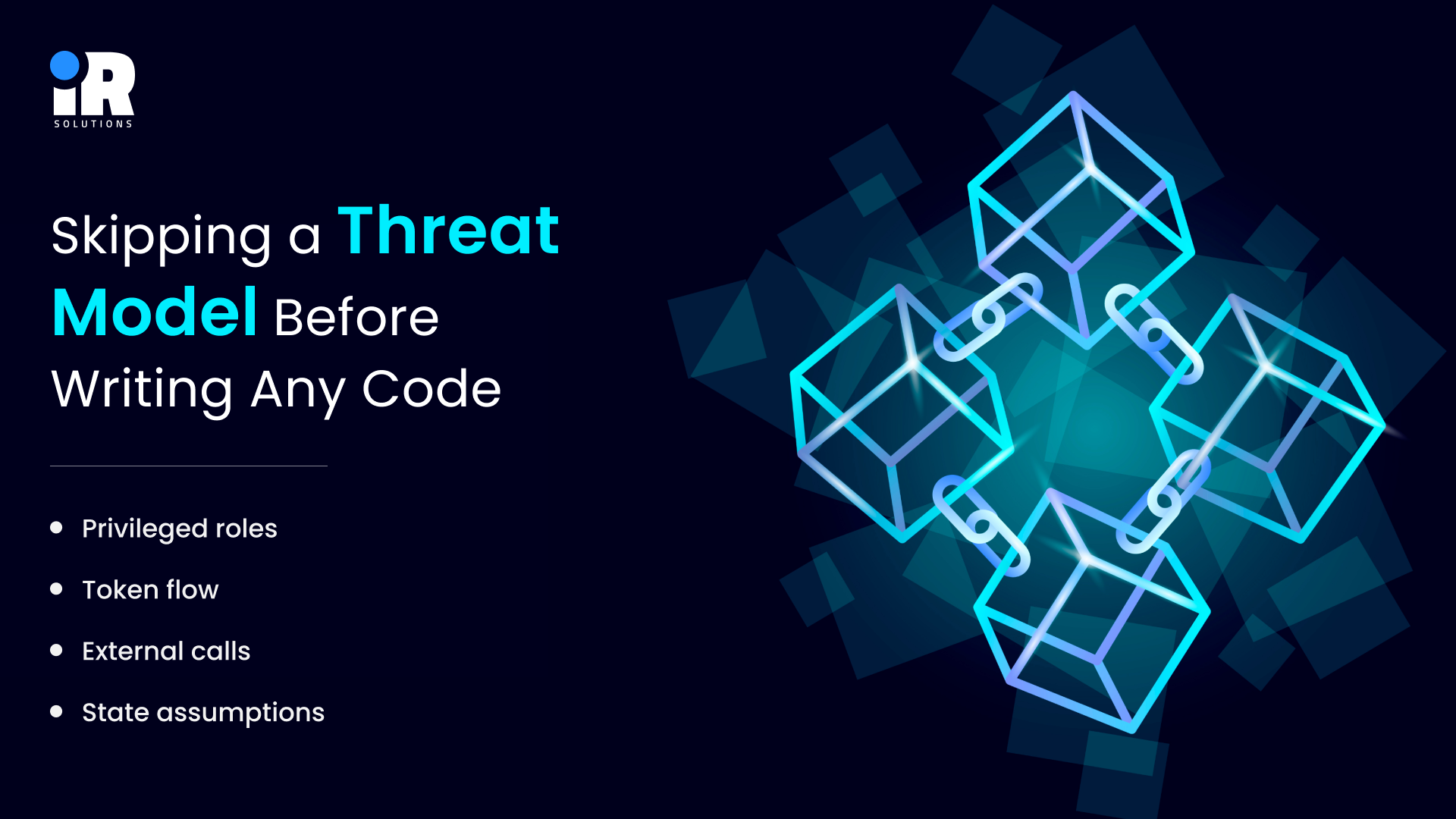
- Privileged roles: Who calls admin functions, and what happens if that wallet is compromised?
- Token flow: Where does value enter, move, and exit your contract?
- External calls: Which outside contracts does your organization interact with, and could any behave maliciously?
- State assumptions: What does your logic assume is always true, and can a user force that to break?
A threat model does not need to be a long document, it is a structured way of thinking through abuse scenarios before you write the first line of logic. Teams that skip this step are writing code without knowing what they are defending against.
Building the threat model early also makes testing far more targeted. Instead of writing generic unit tests, your team writes tests that specifically probe the attack paths you identified. That is the difference between a test suite that builds confidence and one that just runs green.
For a deeper understanding, check out Blockchain Development Guide 2026: Use Cases, Costs, Technologies & How to Get Started, covering use cases, tools, and development strategies.
Reentrancy Vulnerabilities Still Draining Live Contracts
Reentrancy drained sixty million dollars from The DAO back in 2016, it still shows up in audits today. The bug happens when your contract sends ETH or calls an external contract before updating its own state. That external contract can call back to yours before the first execution finishes. The state has not updated yet, so the second call passes every check again.
- Always update the internal state before making any external calls.
- Use the checks-effects-interactions pattern in every function that moves value.
- Add a reentrancy guard modifier to every sensitive function.
Battle-tested guard implementations are freely available and widely used across production contracts, so there is no good reason to build your own version from scratch. The pattern that gets exploited looks like this: check a balance, call transfer, then set the balance to zero. An attacker never lets you reach that last update.
Weak Access Control Leaving Admin Functions Wide Open
Access control sounds straightforward to implement, but in practice, it is where some of the costliest and most embarrassing mistakes in smart contract development tend to happen.
The failures tend to cluster around the same recurring issues, functions that should be owner-only get left public. Authentication uses the transaction origin instead of the message sender, which phishing contracts can bypass entirely. Ownership cannot be transferred safely when needed. A single private key controls everything.
The most frequent access control failures:
- Missing modifier: A critical admin function is callable by any address.
- Origin-based auth: Phishing attacks can bypass this check with zero effort.
- Single-owner key: One compromised wallet ends the entire project.
- No time locks: An admin can drain the contract instantly without any delay.
Well-audited access control libraries handle most of these cases correctly, and multi-signature wallets should be controlling any function that can move significant value or pause the entire protocol. If a single wallet address can upgrade, pause, or drain your contract without any additional approvals, that wallet is your single biggest security risk on the entire platform.
Arithmetic Errors That Wrap Numbers to Unexpected Values
Before Solidity version 0.8.0, arithmetic had no built-in overflow protection, so values could silently wrap around on overflow or underflow. Even in newer versions, risks still exist when using unchecked blocks for gas savings or when older contracts rely on unsafe arithmetic without proper safeguards like a secure arithmetic utility library.
- Compiler version below 0.8.0 requires SafeMath on every arithmetic operation, no exceptions.
- Every unchecked block needs a manual line-by-line review of the arithmetic inside it.
- Token calculations involving decimals carry extra precision loss risk worth specific testing.
These bugs rarely surface in unit tests unless the team specifically tests boundary values and edge cases.
Front-Running Exposure in a Public Transaction Queue
The Ethereum transaction queue is fully public,anyone watching it can see your pending transaction before it gets confirmed. Bots and searchers monitor this constantly, if your contract depends on transaction ordering or if outcomes depend on prices at execution time, you are exposed.
- DEX trades: A bot copies your trade with higher gas and executes ahead of you.
- Oracle updates: Attackers act on stale prices before the new data lands on-chain.
- NFT mints: Bots see your transaction and race to claim a specific token ID first.
- Auction bids: Competitors see your exact bid amount and outbid you at the last second.
Commit-reveal schemes, slippage protection, and private transaction relays help, but the right solution depends on the contract. Time-sensitive logic is actively targeted on-chain, so mapping MEV risks early prevents costly fixes after exploits.
Scalable Ethereum Development Services for Modern Startups in 2026 explains how startups build Ethereum infrastructure ready for growth and higher transaction demand.
Trusting Block Timestamps for Time-Sensitive Logic
Validators have a limited but real ability to manipulate block timestamps, and that limited window is enough to exploit poorly designed contracts.
A validator can shift a timestamp by roughly fifteen seconds in either direction. For vesting schedules or staking periods, fifteen seconds is irrelevant. For lottery randomness or flash loan windows where timing creates a financial edge, 15 seconds is exploitable.
Block timestamps are acceptable for low-precision time logic where small deviations do not matter. They are not acceptable anywhere precision timing affects financial outcomes.
For anything requiring randomness, use a verifiable random function from a trusted oracle provider rather than timestamp-based logic, and for time-sensitive conditions that require precision, block numbers are generally far more reliable than timestamps.
Insufficient Testing That Fails to Catch Exploits
Unit tests covering only the happy path are not enough for a financial contract, a 100% line coverage score means nothing if the tests never examine the edge cases an attacker would target. Coverage metrics only track executed code, not whether the underlying logic is actually validated. Testing behavior at the exact boundaries of every condition in the system.
- Ensuring all expected reverts trigger correctly with precise error messages.
- Randomized inputs help expose unexpected behavior across different contract functions.
- Core properties must always hold regardless of input or state changes.
Modern testing frameworks make fuzz testing and invariant testing accessible without deep expertise. The question is whether your test suite would catch a real exploit scenario, not just pass routine function calls.
Gas Costs That Make Functions Unusable Under Load
Gas optimization is often treated as something you do after the contract works correctly. That is the wrong sequence.
When users interact with a contract and hit unexpectedly high gas fees, they abandon the transaction. Functions with unbounded loops or repeated storage reads can become unusable during network congestion, which tends to happen exactly when your product is getting attention

- Storage reads: Read from memory inside functions rather than hitting storage repeatedly.
- Variable packing: Group smaller types together so they fit in a single storage slot.
- Loop length: Unbounded loops that grow with contract state can eventually hit the block gas limit.
- Events over storage: Emit events for data users who need to read, but do not need to compute.
Gas also affects correctness, a function that runs out of gas mid-execution can leave the state only partially updated, which is a security bug, not just a cost annoyance.
Teams often discover gas problems after users start complaining about failed transactions. By that point, fixing loop structures or storage patterns sometimes requires a full redeployment. Building gas awareness into the development process from the start avoids that situation entirely.
Launching Without a Professional Security Audit
Launching without a professional security audit is one of the most common and costly mistakes in smart contract development. An internal code review is not an audit it helps catch logic errors and typos, but misses the deeper vulnerability patterns that trained security engineers are specifically looking for. Auditors work with an adversarial mindset and focus on how similar systems have been exploited in the past.
A proper audit includes manual review by experienced smart contract security engineers, supported by automated static and dynamic analysis tools. It also delivers a detailed written report with severity ratings and clear remediation steps, followed by a second review after fixes are applied to ensure issues are properly resolved before deployment. While audit costs often discourage teams, the impact of a single exploit is far greater.
Timing also matters as much as the audit itself. Code should only be sent once logic is stable and tests are passing, not during active development, since shifting code reduces audit reliability. Beyond security, an audit report also serves as a credibility asset, as investors and users often rely on it, and a strong report from a reputable company can build trust more effectively than marketing.
What the Right Development Partner Actually Does for Your Business
Working with an experienced team changes the risk profile of your entire project. When you bring in a specialist software development partner, you stop relying on a single developer to write and review their own code. You get a team with structured processes, dedicated QA, and direct experience with the exact failure modes described throughout this post.
- Architecture Review: Structure validated before any business logic is written.
- Security Integration: Threat modelling built into the development workflow from the start.
- Test Coverage: Unit, integration, randomized input, and invariant tests are included by default.
- Audit Management: External audit coordination with complete remediation handling.
- Post-Launch Monitoring: Ongoing anomaly detection, upgrades, and incident response support.
Blockchain projects differ from typical software because deployment errors are permanent, so experienced partners design with production risk in mind. When security shapes architecture from the start, it reduces costly retrofitting later and improves audit readiness, gas efficiency, and upgrade flexibility throughout the project.
If you are in the planning or early development stage, book a technical consultation to walk through your contract architecture before committing to a structure you will live with permanently.
What Mistakes Actually Cost at Each Stage
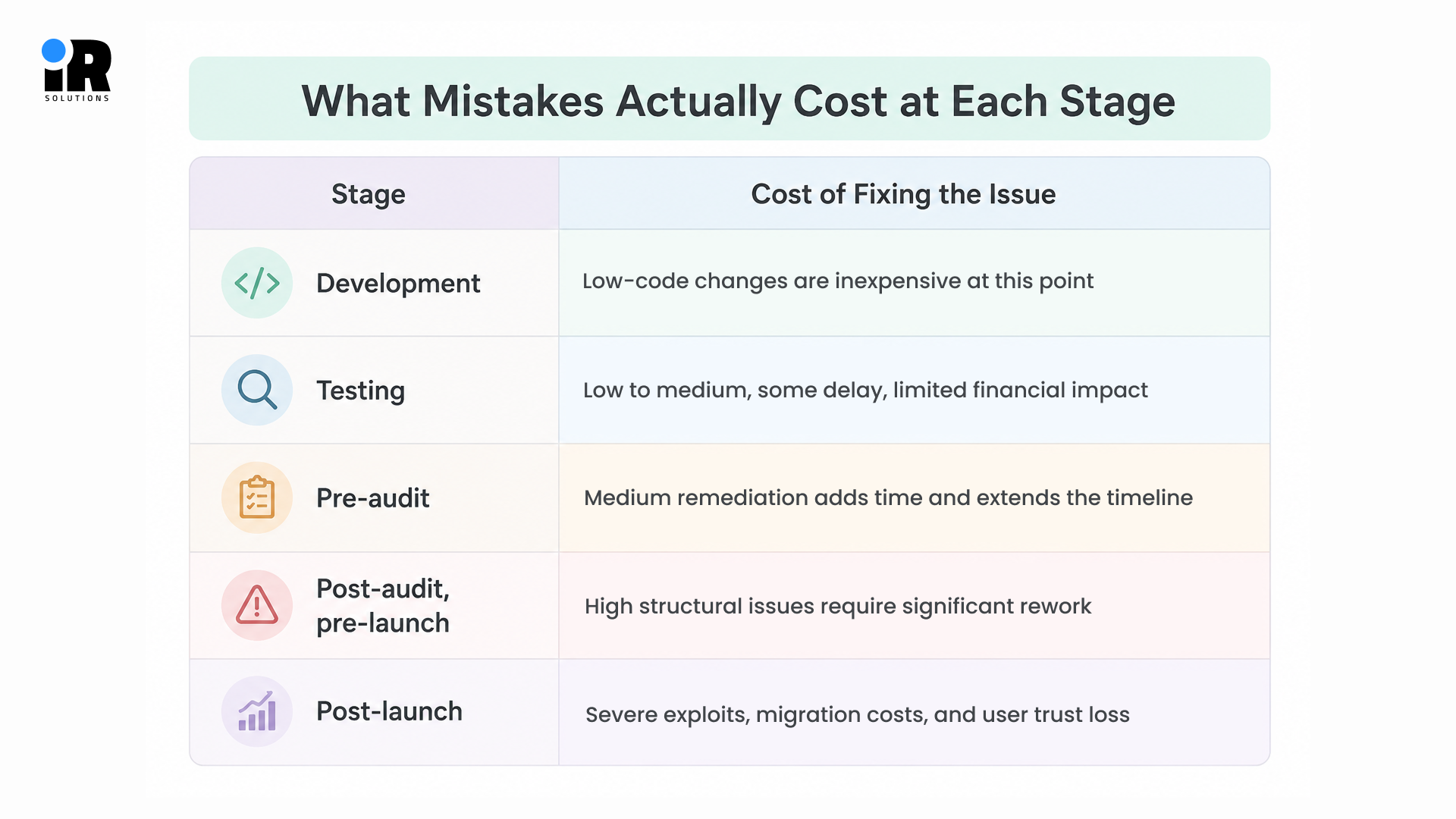
The earlier you catch a problem, the cheaper it is to fix, that is true in all software. In smart contracts, catching it late is not just expensive, it can be fatal to the project.
Conclusion
Smart contract vulnerabilities follow the same patterns across every project that gets exploited. Reentrancy, broken access control, arithmetic errors, and poor audit processes show up repeatedly because teams rush the preparation phase and treat security as something to address later. The projects that launch cleanly are not necessarily the ones with the biggest budgets or the most experienced solo developers. They are the ones who treated the pre-launch process seriously, worked with engineers who understood the real attack surfaces, and did not skip the steps that felt inconvenient. If your business is building on-chain and needs a team that embeds security into every stage of development, explore what a dedicated blockchain developer can do before your contract ever goes live.
Frequently Asked Questions
What is the most common smart contract vulnerability?
Reentrancy and improper access control remain the two most frequently exploited issues found in deployed contracts.
How long does a smart contract audit take?
A standard audit for a mid-sized contract typically takes between one and three weeks, depending on the scope.
Can smart contracts be updated after deployment?
Only if they were built with a proxy upgrade pattern; contracts without one cannot be changed after deployment.
What is the checks-effects-interactions pattern?
It is a development practice where you validate inputs, update state, and then make external calls in that exact order.
How much does a smart contract audit cost?
Costs range from a few thousand dollars for simple contracts to over fifty thousand dollars for complex DeFi protocols.
Is internal testing enough without a professional audit?
No, internal testing and external auditing serve different purposes, and both are required for a production contract.
How do you prevent front-running in smart contracts?
Commit-reveal schemes, slippage tolerances, and private mempool services are the primary approaches teams use today.