



Are you building a startup in 2026 and still unsure which blockchain infrastructure can actually support your long-term growth? Ethereum has quietly become the most trusted blockchain foundation for scalable digital products operating globally today. It offers transparent transactions, programmable smart contracts, and capabilities that no other chain has replicated at scale. Whether you are launching a DeFi protocol, an NFT marketplace, or a tokenized asset platform, an Ethereum developer handles it confidently. Layer 2 networks have reduced transaction costs to nearly zero while preserving Ethereum's proven security and network stability
Why Are Startups Choosing Ethereum Development Services?
Startups need reliability, flexibility, and community support, and Ethereum blockchain development delivers all three without compromise. It has been battle-tested for nearly a decade, with thousands of projects launching, iterating, and eventually thriving on it. That track record carries real weight when raising capital, attracting early users, or simply trying to build something that lasts. Funding confidence is strong, regulatory structures are catching up, and the developer ecosystem is the largest in the entire blockchain space, making Ethereum development the most practical and proven choice for startups serious about building.
Here is why startups are actively choosing Ethereum development services today:
- Ethereum development has been live for nearly a decade, and thousands of real products have successfully launched, scaled, and grown on top of it without issues.
- Venture capital firms and institutional backers are far more comfortable writing checks for Ethereum-based products because they have watched it work consistently over the years.
- Layer 2 networks like Arbitrum, Base, and Optimism have made it realistic to build affordable products on Ethereum, bringing transaction costs down to almost nothing for end users.
- The development of Ethereum has become the chain with the fastest-growing legal certainty in 2026, providing startups with a significantly more secure basis to navigate compliance and token-related rules.
- Everything a startup needs to build, launch, and scale is already available within the Ethereum ecosystem, from security checks to live network tracking and deployment support.
How Do Ethereum Development Services Support Business Growth?
Ethereum development service goes beyond coding it partners with your business to understand your goals and helps you build a solution tailored to your needs from the ground up. The right team understands both the technical side and the business context, and that depth of knowledge is what separates average blockchain shops from development teams that actually move the needle. They help startups design systems built to scale from day one, choosing the right Layer 2, structuring smart contracts for upgradability, and anticipating how the system behaves under heavy user load before problems arise.
Token design, integration, and analytics are three areas where experienced teams add serious value beyond just development. One of the most prevalent errors in the blockchain industry is launching a token without a well-defined economic model, and a competent team can help to ensure that supply, token release schedule, and incentive alignment are all correct early in the game. Smart contracts also need to connect cleanly to front-end applications, wallets, APIs, and data feeds, and professional teams handle all of those layers so the internal team stays focused on product and growth.
What does a reliable Ethereum development partner continue to deliver after launch?
- Network upgrades and protocol changes are handled without disrupting the product or the users depending on it every day.
- Security vulnerabilities are tracked and resolved quickly before they turn into problems that affect real funds or user trust.
- Ongoing code reviews and iterative improvements keep the product running smoothly and competitively as the market evolves.
Want to scale smarter? Schedule a call with experts to see how Ethereum development services support business growth.
Hire Ethereum Developers for Scalable Blockchain Solutions
Finding the right Ethereum developer is often more challenging than it seems, and many startups realize this only after facing setbacks. When you hire Ethereum developers, you cannot just have technical coding skills to create a product that is reliable. What truly matters is their hands-on experience in the ecosystem, active involvement in real projects, and whether their past work can withstand technical and security scrutiny.
What Skill Set Does an Ethereum Developer Must Have?
- Expert Ethereum developers do not merely know Solidity but instead go beyond that and never settle for surface-level understanding.
- They also have knowledge about EVM internals, storage layout, and processing and validation of transactions on Ethereum nodes on the network.
- Greater understanding enables them to write smart contracts that work in a consistent and correct manner in any condition, not only in the simple cases.
- When evaluating candidates or agencies, always ask for prior security review reports from projects they have worked on before making any decision. Those reports reveal far more about code quality than any portfolio page ever will.
- Also, look for developers who actively contribute to the Ethereum community, participate in builder events, and consistently keep up with how the ecosystem is shifting and growing over time.
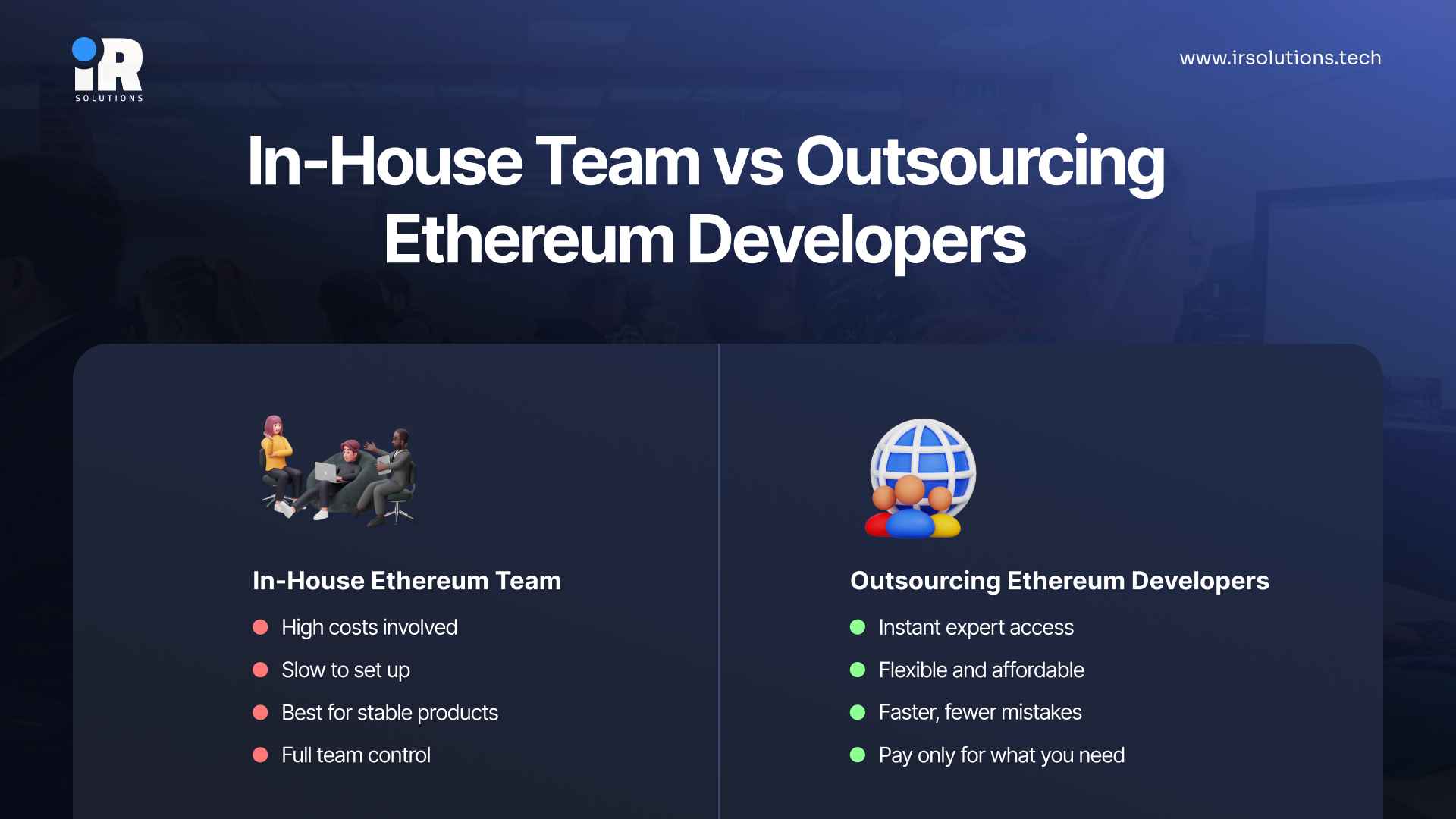
In-House Team vs Outsourcing Ethereum Developers
Role of Smart Contracts in Ethereum Development
Smart contracts are the fundamental building blocks of all things constructed and implemented on Ethereum today. These are self-executing pieces of code that run exactly as written without needing any third party to monitor or approve anything. Smart contracts are deployed to conduct transactions, execute regulations, and control funds without human intervention. For startups, this involves developing products that do not need any manual operations or central control by a single point.
So what role do smart contracts actually play within an Ethereum-based product?
- Smart contracts are programmed to execute a transaction when predefined conditions are met thus, no human consent or intervention is required.
- Funds are stored and handled fully on-chain, meaning that no individual or organization has free will over the money circulating in the system.
- Smart contracts run decentralized applications, which execute core business logic on the blockchain without having to use a central server.
- Every interaction is recorded in a transparent and tamper-proof way, giving users full visibility into how the system operates at all times.
- Operational costs drop significantly because smart contracts replace manual processes and intermediaries with automated code that runs continuously around the clock.
Read our blog on How Outsourcing Smart Contract Development Drives Business Growth to explore how outsourcing improves scalability and efficiency.
How Do Teams Prevent Failures in Blockchain Deployment?
Blockchain deployment failures are costly and often very public because every transaction is visible on-chain for anyone to see. A single failed deployment can damage community trust in ways that take months to repair. Preventing failures is not about being overly careful it is about building a disciplined process that removes guesswork, reduces human error, and ensures nothing critical is left to last-minute decisions when it matters most.
Professional Ethereum teams put these practices in place before anything goes live:
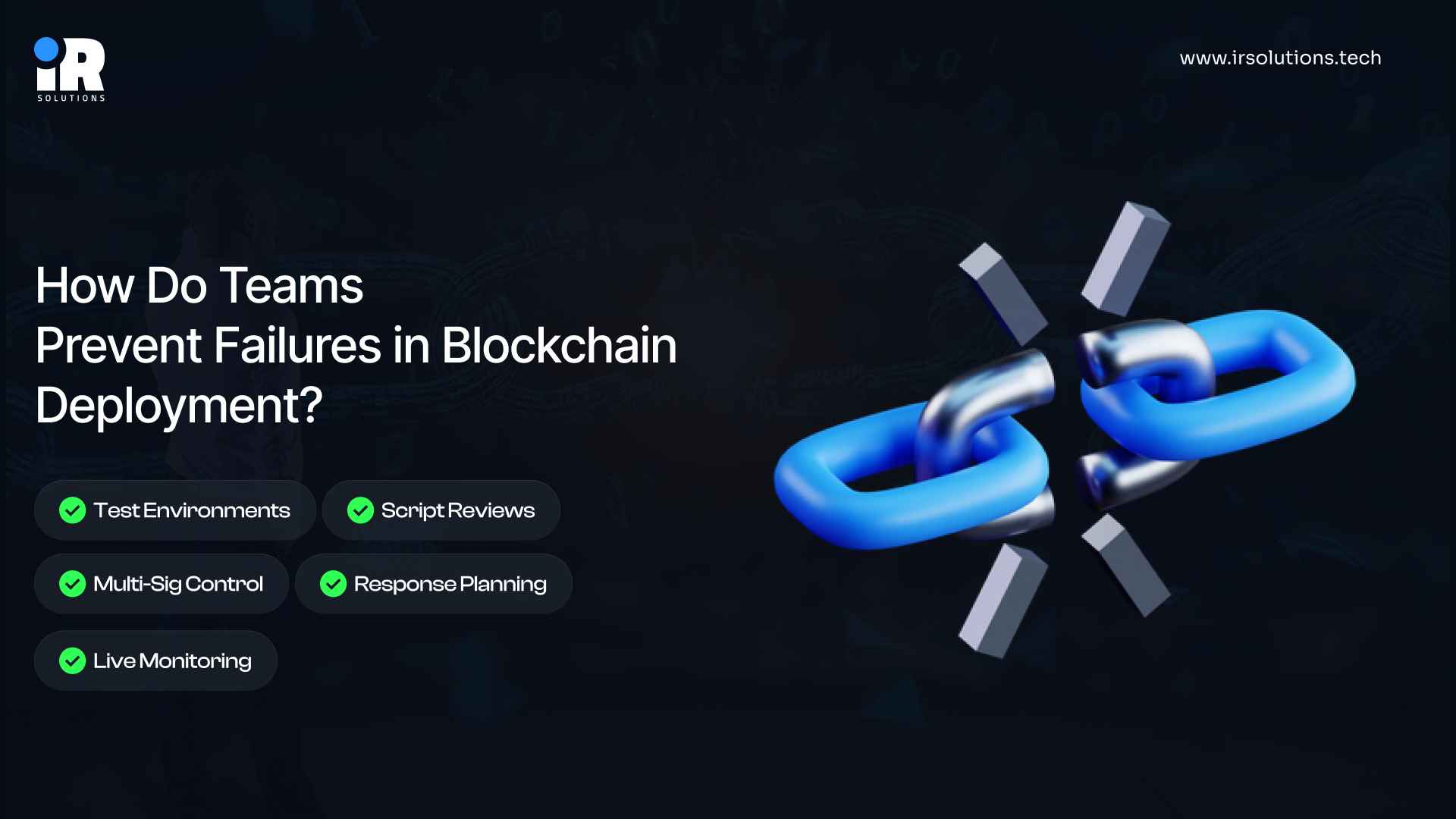 Test Environments: Every contract is deployed and thoroughly tested on a staging network that mirrors the live network as closely as possible, covering all integrations and dependencies before the real launch.
Script Reviews: Deployment scripts are version-controlled and reviewed with the same level of attention as contract code itself, preventing wrong configurations or missed steps from reaching production.
Multi-Sig Control: Administrative control is handled using wallets, which take multiple parties to authorize sensitive operations, eliminating single points of failure that may be exploited or compromised.
Response Planning: The answers to what occurs when something goes wrong are clearly prepared in advance, including who is notified, who decides to act, and who communicates with the community.
Live Monitoring: Software, such as Forta and Tenderly, looks after suspicious on-chain activity in real time, enabling teams to monitor and react to suspicious activity before it escalates into a major loss.
Conclusion
Building on Ethereum is one of the smartest decisions a startup can make, but only when the right people and processes are in place from the beginning. Smart contracts, scalable architecture, and disciplined deployment practices all play a role in whether a product succeeds or falls apart under real conditions. Every decision made during development has a direct impact on how the product performs, grows, and holds up over time. If you are ready to build something that genuinely lasts, IR Solutions provides Ethereum development services that take your product from concept to a fully functioning blockchain solution with confidence.
Frequently Asked Questions
What are Ethereum development services?
These services cover everything from building smart contracts to deploying, securing, and maintaining a blockchain product from start to finish.
Why is Ethereum a better choice for startups compared to other blockchains?
It has been around for nearly a decade with thousands of real products built on it, which makes it far more reliable than anything newer out there.
How long does it take to develop and deploy a smart contract on Ethereum?
It really depends on how complex the project is, but most builds take anywhere from a few weeks to a couple of months.
What should startups look for when hiring Ethereum developers?
The developers must have deep Solidity knowledge, a verifiable track record, and genuine involvement in the Ethereum space, which matters far more than just a polished portfolio.
Is outsourcing Ethereum development a good option for early-stage startups?
Honestly, yes, it gives you immediate access to an experienced team without burning time and budget on a lengthy hiring process.
Do smart contracts need to be audited before going live?
Without a doubt. Skipping an independent security review before deployment is a risk that no serious startup should ever take.