


Blockchain projects fail not because the idea was bad, but because the chain was wrong. That gap between concept and execution costs businesses real money, sometimes hundreds of thousands, before anyone notices the misfit. IR Solutions helps businesses evaluate blockchain platforms, choose the right technology stack, and build secure blockchain solutions that align with their long-term business goals.
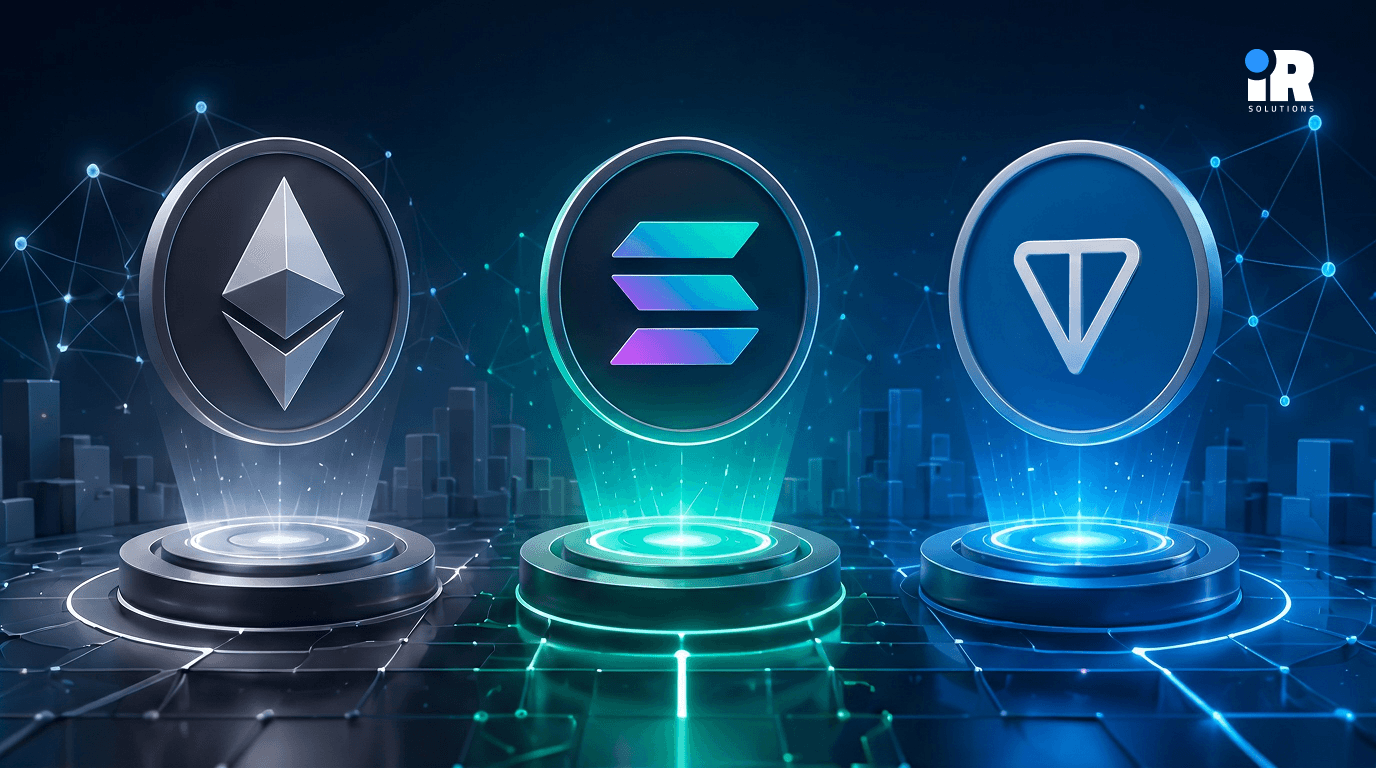
Ethereum, Solana, and TON each attract serious investment and serious developers. But they were not built for the same problems, and they do not serve the same business needs. Transaction costs, uptime history, developer availability, and ecosystem depth vary widely between them. Getting this decision right at the start is the difference between a product that scales and one that gets rebuilt from scratch after launch.
This guide breaks down all three chains, side by side, in plain terms so the decision is based on actual requirements, not marketing noise.
What to Evaluate Before Picking a Blockchain
There is a tendency to treat blockchain selection as a purely technical call, it is not. The chain a product is built on shapes its operating costs, its user experience, the speed of hiring, and the long-term maintenance burden. A chain with great raw speed but frequent outages is a customer service problem. A chain with cheap transactions but a shallow auditing ecosystem is a security liability.
Before comparing the three networks, these are the factors that matter most at a business level:

- Transaction cost: Affects margins on every single on-chain interaction and shapes product pricing.
- Speed and finality: Determines whether the product feels instant or sluggish to real users.
- Developer availability: Dictates hiring timelines, contract rates, and how fast the team can ship.
- Security track record: Non-negotiable for businesses operating in finance, healthcare, or asset management.
- Ecosystem integrations: Determine how much infrastructure needs to be built from scratch versus reused.
- User distribution: Shows where the target audience already holds active wallets and transacts.
These six factors shape the recommendation far more than raw benchmarks in practice.
Before starting a blockchain project, explore Blockchain Development Guide 2026: Use Cases, Costs, Technologies & How to Get Started to learn what it takes to build a successful solution.
Ethereum – Built for Security at Enterprise Scale
Ethereum has been running production smart contracts since 2015. That is a long time in blockchain terms, long enough that the security assumptions, the edge cases, and the failure modes are reasonably well understood.
The 2022 Merge moved Ethereum from Proof of Work to Proof of Stake. Energy consumption dropped by over 99%. Validator count grew. The base layer became more stable. Then, as Layer 2 networks matured, Arbitrum, Optimism, and Base now handle enormous transaction volumes at a fraction of mainnet cost, while settling the final state on Ethereum's base layer.
What It Runs On
Ethereum's smart contracts are written in Solidity, the most widely used contract language globally. The tooling ecosystem is deep, Hardhat, Foundry, OpenZeppelin, Tenderly. Security audit firms have years of Solidity-specific expertise. Finding vetted, tested templates for common contract patterns, token standards, multisig wallets, and governance modules takes hours, not weeks.
Where Ethereum Wins for Business
- Banks, asset managers, and governments have chosen Ethereum for real asset tokenization projects.
- Over 60% of global DeFi liquidity sits on Ethereum or its Layer 2 networks today.
- More Solidity developers are available for hire than Rust or FunC developers combined globally.
- More audit firms specialize in Ethereum contracts than any other chain in production.
- No consensus-level failures have occurred since the genesis block launched in 2015.
Where Ethereum Struggles
- Mainnet transaction costs can hit $30 to $80 during high network congestion periods.
- The base layer processes roughly 15 transactions per second on Layer 1 alone.
- Bridging between Layer 2 networks adds UX complexity for everyday end users.
- The conservative upgrade philosophy means new features roll out more slowly than competing chains.
Ethereum is the default for businesses where security, credibility, and ecosystem depth outweigh cost and speed.
Solana - Built for Speed at Consumer Scale
Solana launched in 2020 with a clear architectural bet optimize for throughput above everything else. The result is a chain that processes transactions faster and cheaper than nearly anything else at a production scale.
The technical approach combines Proof of History with Proof of Stake. Proof of History is a cryptographic timestamping method that allows validators to agree on transaction ordering without heavy communication overhead. The outcome is sub-second finality and fees that average well under $0.001 per transaction.
What It Runs On
Solana smart contracts, called programs, are written primarily in Rust, a language known for memory safety and performance. Rust has a notoriously steep learning curve. The Anchor framework reduces boilerplate and makes Solana development more approachable, but it still requires niche expertise. Contract auditing capacity is smaller than Ethereum's, and audit costs are generally higher per line of code.
Where Solana Wins for Business
- Transaction speed: Settlements confirm in under a second, no waiting around.
- Fee structure: Near-zero costs make micro-transactions financially viable at scale.
- NFT infrastructure: The dominant chain for high-volume NFT projects and collectibles.
- Payment integrations: Visa, Stripe, and Shopify have all run live Solana pilots.
- Consumer product fit: Phantom and Backpack wallets are polished and mobile-ready.
Where Solana Struggles
- Outage history: The network went down multiple times between 2021 and 2023.
- Validator centralization: High hardware costs push out smaller validators over time.
- Smaller DeFi ecosystem: Fewer audited protocols and noticeably less total liquidity.
- Developer hiring: Experienced Rust developers are scarce and command premium market rates.
For businesses building high-volume consumer products, payment tools, gaming economies, and NFT marketplaces, Solana's cost and speed profile is hard to beat. The reliability question is manageable with good architecture, but it deserves honest attention.
TON - The Blockchain Built Into a Billion-User App
The Open Network was created by Telegram's founders, Pavel and Nikolai Durov. After a forced shutdown following an SEC action in 2020, the community relaunched it as a decentralized, independent protocol. What happened next was unexpected, Telegram integrated TON deeply into its platform, and everything changed.
TON now has native wallet functionality inside Telegram. Payments, staking, and NFT transfers all happen without leaving the app. For any business that targets Telegram's 900 million-plus monthly active users, this is a distribution channel that no other blockchain can replicate.
The technical architecture uses dynamic sharding with Proof of Stake. Theoretical throughput is in the millions of transactions per second across shards. In practice, the ecosystem is still maturing, and that ceiling has not been tested at real scale.
What It Runs On
TON smart contracts are written in FunC, a low-level functional language that is fast but difficult to write correctly without experience. A newer language, Tact, lowers the barrier and is gaining traction. Developer tooling is improving, but remains behind Ethereum and Solana in maturity.
Where TON Wins for Business
- Telegram distribution: Direct access to hundreds of millions of users with zero friction.
- Mini App ecosystem: Web3 products embed inside Telegram bots and channels seamlessly.
- Bot-native payments: Subscriptions and one-time purchases run natively through Telegram bots.
- Rapid user growth: Active TON wallets grew over 400% across 2024 alone.
- Low competition: The ecosystem is early, so first movers face far less saturation.
Where TON Struggles
- Developer scarcity: Experienced TON developers make up a very small global pool.
- Immature DeFi: Protocol depth and audited tooling are still catching up noticeably.
- Platform dependency: Telegram's product decisions directly shape TON's distribution reach.
- Documentation gaps: Resources are improving, but still patchy in several key areas.
For businesses that already operate Telegram channels or communities, or that want to reach a social and messaging-native audience with commerce, payments, or token mechanics, TON is the most natural starting point. IR Solutions builds Telegram Mini Apps that connect TON-based payments to real product workflows.
Ethereum vs Solana vs TON Head-to-Head Comparison
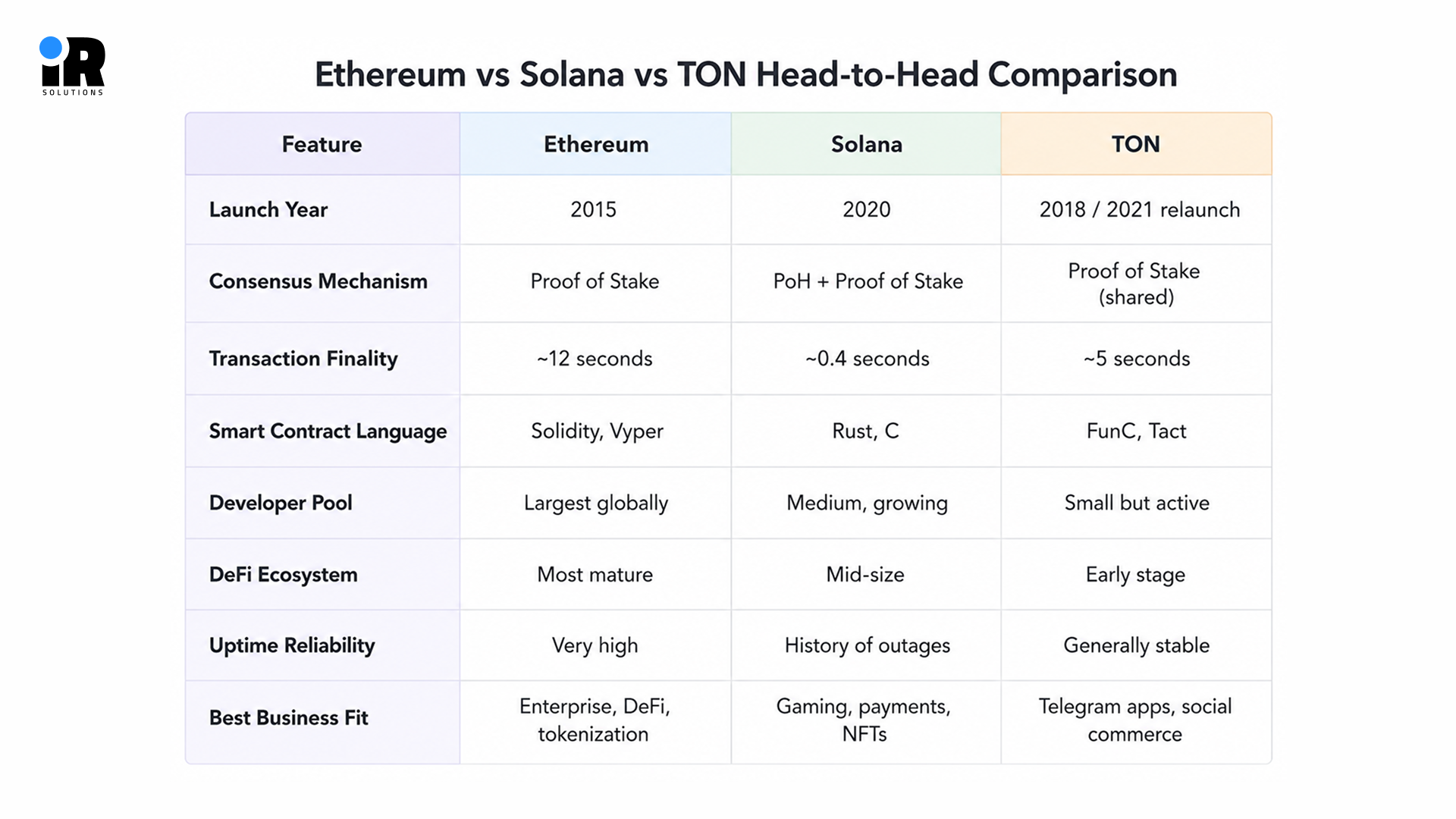
Not sure which row applies to the product being built? Book a free consultation and get a clear chain recommendation based on the actual use case, timeline, and budget.
Smart Contract Development Speed, Expertise, and Tooling
The chain choice affects how fast a product ships and what it costs to build and maintain. Access to experienced talent plays a major role in delivery timelines, which is why many businesses choose to hire smart contract developers instead of spending months building an in-house team.
Building on Ethereum
Solidity is the most documented smart contract language in existence. Stack Overflow answers, GitHub repos, audit reports, and developer tutorials exist in huge volumes. OpenZeppelin's contract library provides audited, reusable components for almost every standard use case ERC-20 tokens, NFTs, access control, multisig, and governance.
Hiring is easier here than in any other chain, and rate benchmarks are well established. Contract auditors are plentiful, and their Solidity expertise is deep.
Businesses looking to accelerate enterprise blockchain projects often choose to hire Ethereum developers with proven Solidity expertise and experience building secure smart contracts.
Building on Solana
Rust is a high-performance language but it takes longer to learn and to write safely. The Anchor framework reduces development time, but bugs in Solana programs have caused significant losses across multiple high-profile projects. Audit firms exist, but there are fewer of them, and they charge more for Solana-specific work.
For businesses with tight hiring budgets or short timelines, Solana's development environment adds friction.
Many organizations overcome this challenge by choosing to hire Solana developers who already have production experience with Rust and Solana smart contracts.
Building on TON
FunC requires real expertise. Writing safe contracts in it is not beginner territory. Tact is more accessible, but the community around it is smaller, and finding developers with production TON experience outside specialized teams requires effort.
The developer scarcity on TON is the biggest practical constraint for businesses that want to ship quickly.
Businesses planning Telegram-native applications often hire TON blockchain developers with hands-on experience in TON smart contracts and Mini App development to reduce delivery time.
Security and Uptime Risk Every Business Should Know
Security in a blockchain context is not just about hackers. It also covers uptime, decentralization, and how thoroughly the codebase has been stress-tested over time.
Ethereum Security Record
Ethereum's base consensus layer has never failed since the 2015 genesis block. No double spends, no consensus splits, no critical validator exploits. The number of independent validators runs into the hundreds of thousands. No single actor can take the network down.
Smart contract vulnerabilities are a different story the DAO hack, the Parity wallet freeze, and dozens of DeFi exploits have all occurred on Ethereum. But the chain itself has been rock solid. The ecosystem for catching contract bugs before deployment, audits, formal verification, and bug bounties is the most mature in the industry.
Solana Uptime History
Solana's speed comes with a cost. The network has experienced several significant outages since launch, including a full 17-hour halt in September 2021 and partial degradation events in 2022 and 2023. These have been caused by validator flooding, misconfigured clients, and resource exhaustion.
The Solana team fixes issues quickly, and uptime has improved significantly. But for applications where five-nines availability is a commercial requirement, this history needs to factor into the risk model.
TON Reliability
TON has not experienced major consensus-level failures since the community relaunch. The smaller ecosystem means a narrower attack surface, but it also means fewer eyes on potential vulnerabilities. Smart contract security on TON is an area that deserves careful attention, as the auditing ecosystem is still growing.
Ethereum vs Solana vs TON Real Business Applications
Ethereum in Practice
- Government bonds and real-world assets, tokenized for actual trading.
- Lending and borrowing protocols built for institutional-grade DeFi.
- Tracking supply chains with certification and provenance built right in.
- Decentralized identity systems that handle KYC credentials.
- Settlement infrastructure for moving money across borders.
Solana in Practice
- NFT platforms that mint and trade at high volume without slowing down.
- Payment apps built for everyday micro-transactions.
- Gaming economies that run in real time, in-chain.
- Loyalty programs that use token mechanics instead of points.
- DePIN networks tying physical infrastructure to the chain.
TON in Practice
- E-commerce catalogs that live natively inside Telegram.
- Subscription billing handled through bots, no manual invoicing needed.
- Airdrops and token campaigns built around community growth.
- Web3 tools embedded directly into Telegram groups and channels.
- Social games that pay out token rewards right in the chat.
Which Blockchain Is the Right Fit for Your Business
The decision comes down to what the product actually needs to do and who it needs to serve.
Ethereum makes sense when:
- The product handles high-value or regulated assets.
- Institutional trust or credibility is part of the value proposition.
- Deep DeFi ecosystem integrations are part of the product design.
- The development team has existing Solidity expertise.
- Long-term maintenance and auditing support matter at the enterprise level.
Businesses considering Ethereum-based solutions should also read Scalable Ethereum Development Services for Modern Startups in 2026 to understand the development strategies behind reliable, scalable decentralized applications.
Solana makes sense when:
- Transaction volume is high, and per-transaction cost directly affects unit economics.
- The product is consumer-facing and demands near-instant settlement.
- The target audience already holds funds in Solana-native wallets.
- NFTs, gaming, or payment rails are central to the product.
- Speed and cost efficiency matter more than ecosystem depth at this stage.
TON makes sense when:
- The product lives inside Telegram, or benefits from Telegram's audience reach.
- Commerce, payments, or token distribution happen through chat interfaces.
- Bot-driven automation is part of the user experience.
- An early-mover position in a less crowded ecosystem is strategically valuable
- The development timeline allows for building with a smaller developer pool.
None of these is a permanent commitment, multi-chain architectures exist, and some businesses run components on different chains based on the specific function each component serves. That is a valid strategy with its own complexity tradeoffs.
Conclusion
Ethereum, Solana, and TON are three serious platforms with distinct strengths, real weaknesses, and specific business contexts where each one belongs. Ethereum gives credibility, security, and the deepest ecosystem, especially for finance and asset management. Solana gives speed and low cost at a consumer scale, especially for gaming, NFTs, and payments. TON gives access to Telegram's massive user base with frictionless payment mechanics, especially for social commerce and bot-driven products. The wrong choice at the start of a project can mean a rebuild six months in. The right one can give a product a structural advantage over competitors who made the decision casually. Selecting the right blockchain is only the beginning. Successful blockchain products also require the right architecture, smart contracts, security reviews, and deployment strategy. Our blockchain development services help businesses build reliable blockchain applications from planning to launch.
Frequently Asked Questions
Which blockchain processes transactions the fastest overall?
Solana has the fastest finality in practice, averaging under one second per transaction. It is currently the go-to chain for applications where speed is a core product requirement.
Is Ethereum still a good choice for new projects?
Yes, Layer 2 networks like Arbitrum and Base make it affordable and fast without sacrificing security. For regulated or enterprise-grade products, Ethereum remains the most trusted option available.
Which chain has the cheapest transaction fees right now?
Solana averages under $0.001 per transaction TON stays comfortably under $0.01 in normal conditions. Both are viable for high-volume consumer apps where per-transaction cost directly affects margins.
Can a business deploy smart contracts on multiple chains?
Yes, multi-chain deployments are common and allow reaching different user bases simultaneously. The tradeoff is added development and maintenance complexity across separate contract environments.
Is TON secure enough for real business applications?
TON is production-ready for Telegram-native use cases when contracts are properly audited. The auditing ecosystem is smaller than Ethereum's, so choosing an experienced team matters more here.
Which blockchain is easiest to find developers for?
Ethereum has the largest global developer community, making Solidity talent far easier to source. Rust developers for Solana and FunC developers for TON exist, but require more targeted hiring effort.
How long does blockchain app development typically take?
Simple smart contracts can be ready in 2 to 4 weeks with proper requirements and an experienced team. Full decentralized applications with front-end, wallet integration, and auditing typically take 3 to 6 months.
Which chain suits a fintech startup building payments?
Solana is the strongest fit for speed and low fees at high transaction volume. Ethereum Layer 2 is worth considering if regulatory credibility or institutional partnerships are part of the roadmap.