

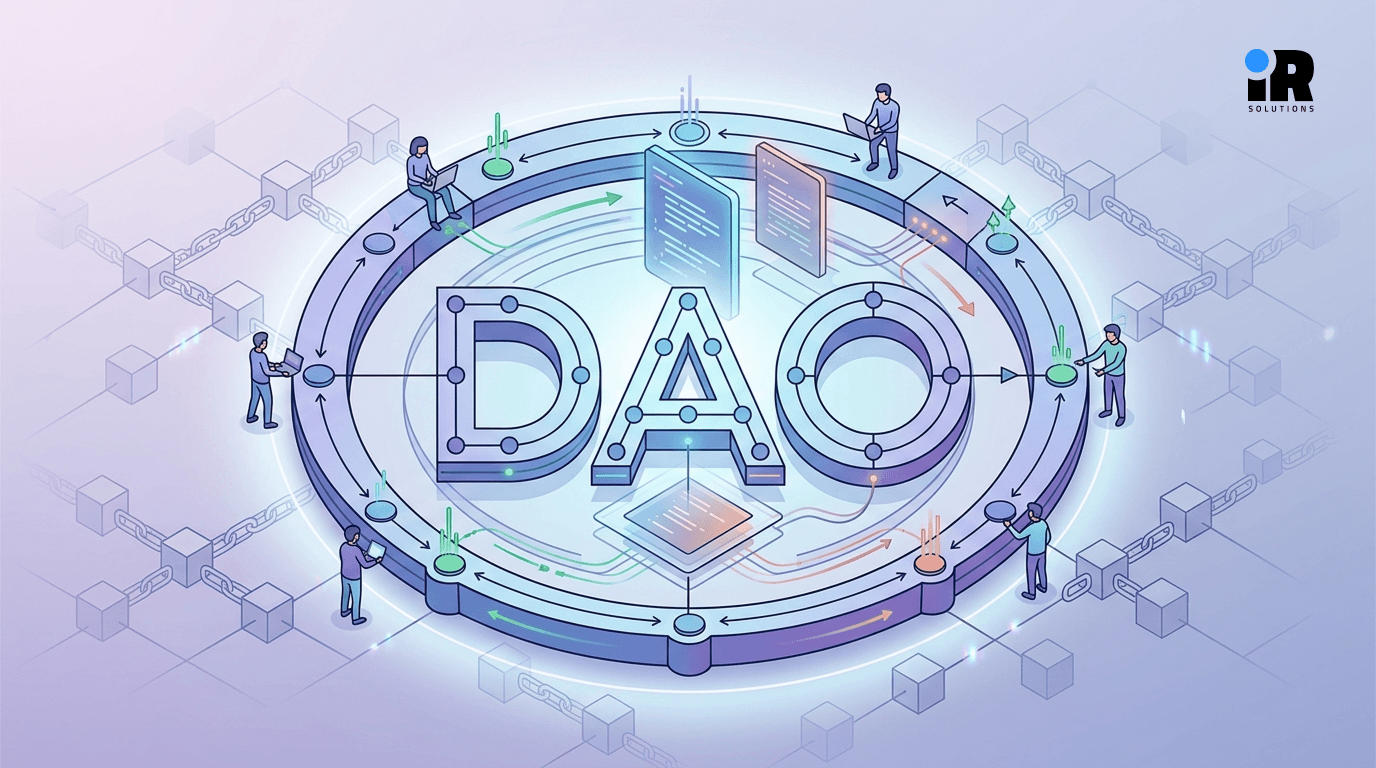

Most people assume DAOs run themselves, but that assumption overlooks the entire technical layer beneath the surface. Smart contract developers write the code that turns community votes into real, executed decisions on a blockchain. They encode governance rules, protect treasury funds, and design logic that keeps decentralized organizations honest and operational. Without their work, a DAO is just a group of token holders with no real decision-making infrastructure holding things together.
This blog explains how smart contract developers power every layer of DAO governance, and why their work matters more than most people acknowledge.
What DAO Governance Actually Requires
Decentralized governance doesn't come pre-installed on any blockchain someone has to build it from the ground up. Developers design, write, test, and deploy the contracts that handle proposals, record votes, and execute decisions. Every rule a DAO community follows lives inside code that a developer wrote and deployed to a public chain. Those contracts manage funds, count votes, and carry out approved actions without anyone sitting in the middle.
Blockchain developers translate governance ideas into executable, tamper-resistant logic that runs without human supervision. They decide how quorum works, what triggers execution, and how funds move after a community vote passes. Getting that logic right means thinking through security risks, fairness trade-offs, and failure modes before a single vote is ever cast.
Why Code Replaces Trust
Traditional organizations rely on legal documents, human judgment, and institutional trust built up over many years. DAOs replace all of that with code that runs automatically on-chain when the right conditions are met. When a vote passes, the contract executes the result without any individual needing to manually approve or trigger it. That automation is what genuine decentralization looks like, and it puts real weight on the developers who build it.
What Are the Core Technical Responsibilities of Smart Contract Developers in DAOs?
How Do Developers Design Governance Logic for a DAO?
Designing governance logic isn't just about writing code. It's about thinking through every possible problem before real money is at stake. Developers set the rules the whole community follows, like how long voting lasts, how many people need to vote for it to count, and how much power each token gives someone. These decisions affect who actually shows up to vote, how power is spread out, and how easy it is for bad actors to cheat the system. Developers also have to plan for the messy situations most people never think about, like a tie vote or two conflicting proposals both passing at the same time, and make sure the contract handles all of it cleanly before any of it becomes a real problem.
How Does Proposal Execution Work in Smart Contract Governance?
- Automatic Execution. After a vote passes, the contract carries out the approved action without any individual needing to manually trigger anything afterward.
- Timelock Contracts. A built-in delay runs between vote approval and execution, giving members time to catch and challenge suspicious outcomes before they take effect.
- Cancellation Logic. Developers write cancellation paths for approved proposals that the community later identifies as harmful or incorrectly submitted by mistake.
- Multi-Contract Calls. Many proposals touch several contracts at once, so developers must sequence those calls carefully to prevent failures mid-execution.
None of these is an optional extra, they are required components of any governance system that a community can genuinely trust with real money and real decisions over time.
How Do Developers Secure DAO Treasury Contracts?
DAO treasuries hold community funds that can reach hundreds of millions of dollars, and developers write the contracts that control how those funds move, who can request transfers, and what limits apply. One mistake in treasury logic can cause permanent losses that no vote can fix, which is why security patterns like multi-sig wallets, time delays, and spending caps are essential even when one layer fails. Some developers also connect treasuries to DeFi protocols so idle funds keep earning. IR Solutions blockchain development services cover exactly this kind of treasury and governance architecture for Web3 teams building serious infrastructure.
Essential Skills That Define Effective Governance Developers
Why Is Solidity Security Critical for DAO Smart Contracts?
Solidity is the primary smart contract language for Ethereum and every EVM-compatible blockchain running governance today. Writing Solidity that functions is the baseline requirement, the real skill is writing code that holds up under active attack from experienced exploiters. Governance contracts attract sophisticated attackers because they control access to large treasuries and high-value protocol parameters worth pursuing.
Developers must know the full list of known vulnerabilities and write code that defends against each one before any deployment. Reentrancy exploits, flash loan manipulation, and integer overflow bugs have each caused major losses in governance systems that passed audits before going live. Public sector looking to hire Ethereum developers should specifically look for hands-on experience defending against these attack vectors.
What Is Formal Verification and Why Do DAOs Need It?
Formal verification uses mathematical proofs to confirm how a contract behaves under every possible input that could occur. This method doesn't replace testing, but it catches entire classes of bugs that even thorough test suites regularly miss. For governance contracts managing large community treasuries, that extra rigor often justifies the significant time and cost it requires to complete properly.
How Do Developers Test DAO Governance Contracts Before Deployment?
Unit Tests: Each governance function gets tested independently to confirm it behaves exactly as the developer originally intended it to behave.
Integration Tests: The full system runs end-to-end simulations of real proposal and voting cycles across multiple contracts simultaneously.
Attack Simulations: Developers write adversarial tests that actively try to exploit the contract using real strategies observed in previous live attacks.
Edge Coverage: Tests include rare but possible scenarios like tied votes, zero-quorum edge cases, and conflicting simultaneous proposals submitted together.
No governance contract is ready for mainnet without passing every layer of this testing process without any exceptions made.
Which Governance Frameworks Do Smart Contract Developers Use to Build DAOs?
Building governance from zero every time would be slow, expensive, and needlessly risky for most development teams working under real deadlines. Established frameworks provide audited, battle-tested starting points that handle standard governance functions without introducing new unknown risks. The developer's job is customizing, extending, and securing those frameworks to match what each specific DAO actually needs from its governance system.
Read our blog on How Outsourcing Smart Contract Development Drives Business Growth to explore how companies stay competitive with on-demand blockchain expertise.
How Do Developers Use OpenZeppelin Governor for DAO Governance?
OpenZeppelin Governor is the most widely used governance framework across the Ethereum ecosystem right now by a wide margin. It handles proposal creation, vote counting, quorum calculation, and timelock integration in a modular structure that extends cleanly.
Why Do Many DAOs Still Build on Compound's GovernorBravo?
Compound's GovernorBravo was among the first governance systems to prove that on-chain governance could run a major financial protocol reliably without centralized control. Its voting delays and proposal threshold design became reference points that dozens of other protocols copied and adapted for their own governance systems. Many teams still use it directly or treat its architecture as a baseline when designing their own custom governance contracts from scratch.
When Should a DAO Use Aragon Infrastructure Instead?
Aragon offers a broader organizational infrastructure layer that includes governance, permissions management, and multi-group coordination tools for complex organizations. It works especially well for DAOs that need flexible permission structures across multiple working groups or committees operating within one larger organization. Developers reach for it when a DAO's needs go beyond what a single governance contract can reasonably handle on its own.
How Do Voting Mechanisms Shape Power in a DAO Governance System?
The voting mechanism a developer implements permanently shapes how power moves inside the DAO from the moment it launches. Token-weighted voting is straightforward to build, but it hands disproportionate control to the largest holders with the most accumulated tokens over time. Quadratic voting charges progressively more tokens per extra vote, spreading influence more evenly across members regardless of their individual holdings. Conviction voting removes the binary format entirely and measures ongoing preference strength over a continuous, rolling time window instead.
Each mechanism needs different contract logic, different token accounting, and different protections against the manipulation it specifically attracts from bad actors. Developers need to understand both the technical requirements and the social consequences of each option before locking into one permanently.
How Does Delegation Architecture Work in DAO Voting Contracts?
- Vote Assignment: Token holders transfer voting power to a trusted delegate without giving up ownership of their underlying tokens at any point.
- Snapshot Tracking: Contracts record delegation state at specific block numbers so active voting periods can't be gamed by last-second balance changes.
- Re-delegation Support: Members can change their delegate anytime, and the contract updates all future vote calculations to reflect that change immediately.
- Double-Count Prevention: When a delegate holds personal tokens alongside delegated tokens, the contract counts both separately to avoid inflated vote totals.
Delegation directly affects how many community members actually show up to vote, so developers put real effort into making it gas-efficient and easy to use for non-technical members.
What Security Threats Are Unique to DAO Governance Systems?
How Do Flash Loan Attacks Target DAO Governance Contracts?
Flash loans let an attacker borrow massive token amounts, vote on a malicious proposal, and repay everything within a single blockchain transaction. Without snapshot-based vote counting in place, this attack bypasses quorum thresholds and pushes fraudulent proposals through before anyone can respond in time. Developers prevent this by recording token balances at a block before the voting period opens, making borrowed tokens useless for influencing that specific vote.
How Do Developers Protect DAOs Against Proposal Spam Attacks?
Flooding Risk. Attackers submit large volumes of fake proposals to exhaust community attention and bury real governance activity inside the noise.
Token Thresholds. Developers require a minimum token balance to submit any proposal, making large-scale flooding economically painful for attackers to sustain long-term.
Threshold Calibration. The minimum must be high enough to block spam but low enough that regular members can still participate without major financial strain.
What Makes Upgrade Vulnerabilities Dangerous in Live Governance Systems?
- Proxy Patterns. Upgradeable contracts use proxies that let developers swap logic while preserving existing state, balances, and user permissions across upgrades.
- Storage Collisions. When logic contracts are swapped, misaligned storage slots between old and new versions can silently corrupt critical contract state without any warning.
- Admin Key Exposure. Upgrade permissions tied to a single private key create a centralization risk that directly undermines the DAO's entire decentralization promise.
- Governance Gating. Routing all upgrades through the governance process itself requires full community approval before any logic change takes effect on-chain.
Real Governance Systems That Proved the Model Works
How Did Compound Finance Shape On-Chain Governance Standards?
Compound's GovernorAlpha and GovernorBravo contracts were among the first on-chain governance systems to run a major financial protocol without any centralized oversight at all. The voting delays, proposal thresholds, and quorum parameters that developers chose became industry reference points for dozens of governance systems built afterward. Their work proved that code could govern a multi-billion-dollar protocol reliably enough that communities would trust it with real money.
What Makes Uniswap's Governance System a DeFi Benchmark?
Uniswap's governance system manages one of the largest community-owned treasuries anywhere in the DeFi ecosystem today. Developers who maintain it are directly responsible for protecting those assets through every upgrade, parameter adjustment, and new deployment the protocol needs. Every governance action runs through smart contracts that those developers originally wrote and actively continue maintaining as Uniswap keeps scaling globally. Solana developers and EVM specialists at firms like IR Solutions bring this same level of protocol-grade rigor to client governance builds.
How Have These Systems Influenced the Broader Web3 Industry?
These systems didn't just govern their own protocols, they changed how the broader industry thinks about on-chain governance architecture entirely. The downstream influence of those early developer decisions still shows up in governance systems being deployed across Web3 right now. Getting foundational infrastructure right from the start has compounding effects that extend well beyond the original protocol that first used it. Fintech and banking organizations exploring on-chain governance are increasingly learning from these early DeFi models.
What does a High-Quality Smart Contract Governance Developer Must Have?
Strong governance developers combine deep technical ability with genuine curiosity about how communities actually make decisions together under pressure. They study voting theory, track governance failures across the industry, and pay attention to the social dynamics that drive real participation rates over time. They understand that a technically perfect contract still fails if the community doesn't trust it or understand what it actually does.
Communication matters as much as code in this specific role inside a DAO organization. A developer who can only explain design choices to other engineers is doing half the job at best right now. Community members need to understand trade-offs clearly before they vote to deploy a system controlling their funds and their organization's future direction.
The best developers approach security with real humility and refuse to cut corners under any kind of deadline pressure. They document every major design decision so future maintainers can understand why specific choices were made at the time. If you're building a DAO and need this caliber of expertise without full-time hiring overhead, IR Solutions' staff augmentation model lets you bring in vetted blockchain engineers on demand, slots filled within 48 hours. Many startups building in Web3 use exactly this model to move fast without compromising on governance quality.
Read our blog on Business Benefits of Hiring Experienced Smart Contract Developers to learn how experts reduce risk and speed up delivery.
Conclusion
Smart contract experts are the reason DAO governance functions in practice rather than existing only as a concept on paper. They write the code that enforces community rules, secures treasury funds, and executes decisions without any central authority sitting in the middle. Their technical choices determine how power is distributed, how secure the system is, and how long the organization runs without needing emergency intervention. As DAOs take on more financial and social responsibility across Web3, the developers behind those governance systems deserve far more recognition than they currently receive. Decentralized governance only works when someone builds it right. If you're ready to build it that way, talk to the IR Solutions team today.
Frequently Asked Questions
What exactly does a smart contract developer do in a DAO?
They write the code that turns community votes into real actions without any middleman involved. Everything from proposal submission to fund movement runs through the logic they built and deployed.
Can a DAO function without smart contract developers?
Not really. Without developers, a DAO is just a group chat with no way to actually enforce decisions. The contracts they write are what make decentralized governance real and trustworthy.
How do developers keep DAO treasury funds safe?
They use security patterns like multi-signature wallets, spending limits, and time-delayed withdrawals to protect community funds. Even if one layer fails, the others keep the treasury from being drained.
What makes one voting mechanism better than another?
It depends on what the DAO values most speed, fairness, or long-term commitment. Each mechanism has trade-offs, and the developer's job is to pick the one that fits the community's actual needs.
How do developers stop flash loan attacks on governance systems?
They record token balances before the voting period starts, so borrowed tokens have no effect on the outcome. By the time an attacker repays the loan, the vote is already locked in.
Do you need a full-time developer to build DAO governance?
Not necessarily many teams bring in experienced blockchain engineers on demand instead of hiring full-time. This way, they get the same quality of work without the long-term overhead.