




Most business owners think game development is something reserved for large studios with multi-million dollar budgets and teams of hundreds working across years of production cycles. That assumption is costing them a genuinely powerful business tool that smaller budgets can now access with the right development partner and the right strategic approach to what gets built and why. Affordable game development is not about cutting corners on quality. It is about building the right product at the right scope for the specific business outcome it is designed to achieve. The ROI potential from a well-executed business game consistently surprises the companies that finally try it.
How Much Does It Cost to Develop a Custom Game for a Business?
Development costs vary enormously depending on the type of game, the platform it runs on, the complexity of its features, and the geographic location of the development team building it. Choosing to hire game developers with the right technical expertise can also influence both project costs and overall quality.
Cost Ranges by Project Type
A simple browser-based or mobile casual game with basic mechanics and limited content can be developed for between $5,000 and $20,000 with a competent development partner. Mid-complexity games with custom art, multiple game modes, and basic backend infrastructure typically fall between $20,000 and $100,000. Complex simulations, multiplayer experiences, and games with significant content libraries sit above that range and can extend considerably higher depending on specific requirements.
What Drives Cost Up
- Custom art: Original character design, animation, and environmental art represent a significant portion of most game development budgets and are the single biggest driver of cost increase between simple and complex projects.
- Platform breadth: Building for iOS, Android, and browser simultaneously requires more development work than building for a single platform and increases the testing and quality assurance overhead proportionally.
- Backend systems: Leaderboards, user accounts, progress saving, analytics, and multiplayer functionality all require server infrastructure and backend development that add meaningful cost to any game that requires persistent data beyond the local device.
As the gaming industry continues to evolve, it's worth looking beyond today's trends. Read The Future of Game Development: What’s Next After Mobile and Cloud Gaming? to explore what's coming next.
Real Signals That Point to Strong ROI From Game Development
Plenty of game ideas never pay off, and catching the right signals early saves both time and money. A few practical checks can tell you whether an idea is worth pursuing at all.
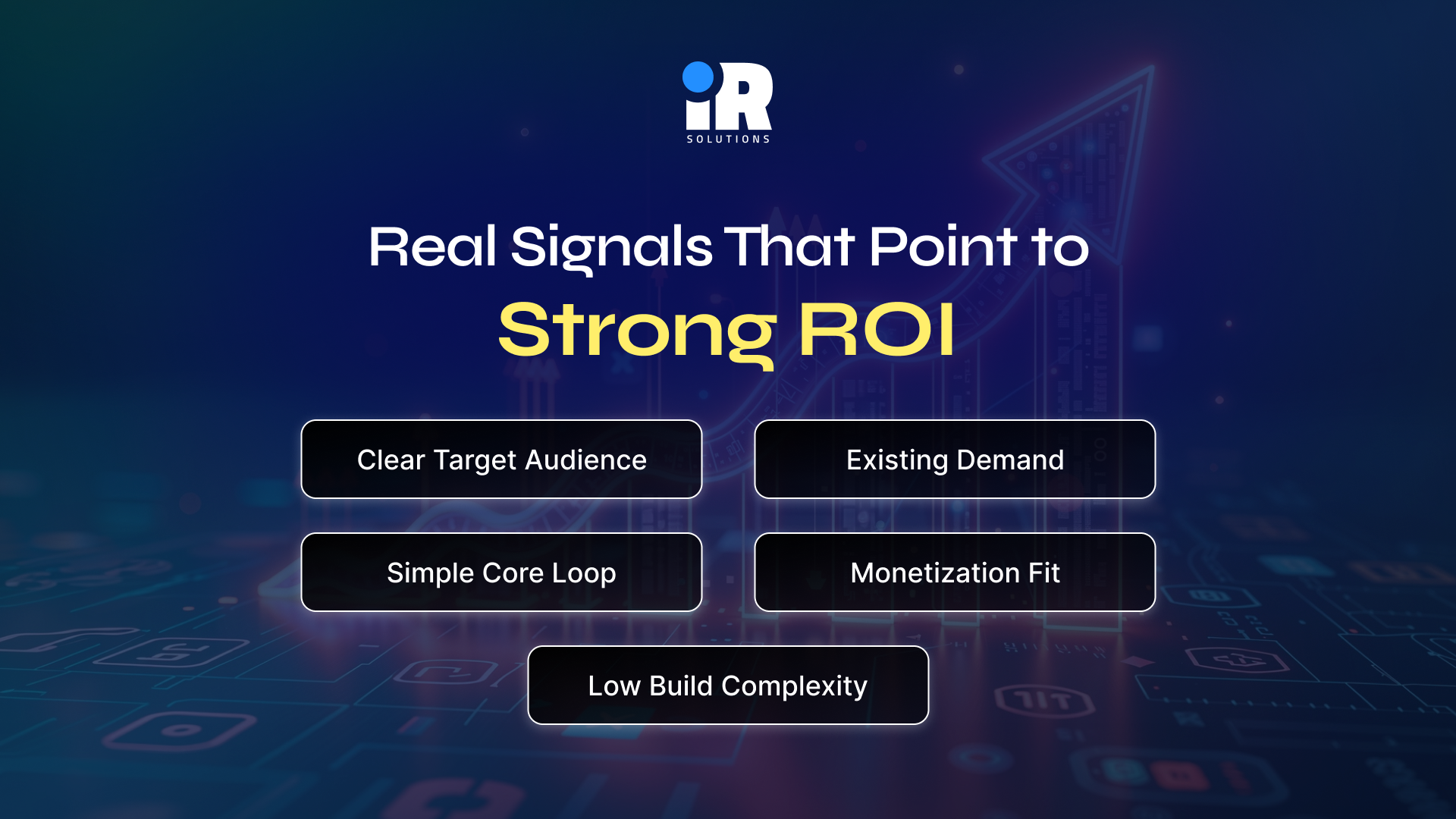
- Clear target audience: You can describe exactly who will play the game and explain why it matters most.
- Existing demand: Similar games or apps already have proven, active user bases you can point to directly.
- Simple core loop: Players understand the main gameplay action within just a few seconds of starting the game.
- Monetization fit: The game naturally supports ads, purchases, or subscriptions without feeling forced on players at every turn.
- Low build complexity: The idea does not need months of custom technical work before you can actually launch it.
If an idea checks most of these boxes, it likely has a real path to profitability. Missing a few is not necessarily a dealbreaker, but it usually means more testing is needed first. A small survey or a landing page test before full development is a cheap way to confirm real interest.
What Metrics Measure Your Game's Overall Success

Track The Metrics
Retention, session length, and conversion rate tell you if players are actually sticking around and spending. Cost per install, lifetime value, churn, and daily active users round out the picture, and checking them weekly during the first month catches problems while they're still small.
Read The Signals
A sharp drop in retention after day three usually points to a rough onboarding experience, not a broken game. Low conversion despite strong downloads is often a pricing problem, and either one is worth fixing fast rather than waiting to see if it sorts itself out.
Think Long Term
Small tweaks to your tutorial, reward timing, or purchase prompts can move revenue more than people expect. Comparing your numbers to industry benchmarks keeps expectations realistic, and treating post-launch data as an ongoing habit, not a one-time report, is usually what separates games that grow from ones that quietly fade.
What Factors Affect the Cost of Game Development?
Understanding what drives game development costs helps business owners scope their projects more effectively and have more productive conversations with development partners about where the budget is best allocated to produce the target outcome.
Scope and Complexity
The number of game mechanics, the depth of the content library, the complexity of the progression system, and the sophistication of the AI or opponent behaviour all scale development time and therefore cost proportionally. Every additional feature is a decision about whether the business outcome it serves justifies the cost it adds to the project budget.
Team Location
Development team geography affects hourly rates significantly. Studios based in North America and Western Europe command the highest rates. Eastern European and Southeast Asian teams offer comparable technical quality at significantly lower cost structures, which is why outsourcing to these regions has become standard practice for cost-conscious game development projects.
Art Style
- 2D versus 3D: Three-dimensional art takes considerably longer to produce than two-dimensional art and requires more specialised skills, which makes 2D art styles the default choice for budget-conscious game projects where visual quality still matters but cost containment is a priority.
- Vector versus pixel: Vector and pixel art styles require less production time than detailed illustrated or painterly styles and have both become legitimate aesthetic choices rather than compromise decisions for business game projects in recent years.
How Businesses Can Reduce Game Development Costs Without Compromising Quality
Strategic decisions made before development begins have more impact on the final cost of a game project than any negotiation over hourly rates once the work is underway.
Scope Management
The most effective cost reduction strategy is building a minimum viable product that delivers the core experience and measuring its performance before committing to additional features. Games that are scoped to prove a concept first and expand based on demonstrated success consistently deliver better value than those that attempt to ship a complete feature set in the initial release. Working with experienced professionals also helps keep projects on schedule and within budget.
Asset Reuse
Building games around asset libraries, modular design systems, and reusable code frameworks reduces the custom creation work that drives cost in most game projects. A development partner who builds with reusability in mind from the start produces a codebase that can be extended more cost-effectively when the business wants to add features after the initial launch.
Which Game Development Technologies Help Create Cost-Effective Solutions?
Unity and Unreal Engine
Unity remains the most widely used engine for cost-effective game development across mobile, browser, and PC platforms because its large developer community, extensive asset marketplace, and cross-platform export capability reduce both development time and ongoing support costs for business game projects. Unreal Engine is more commonly used for visually intensive projects where the higher performance ceiling justifies the steeper learning curve and typically higher development costs.
HTML5 and WebGL
Browser-based games built on HTML5 and WebGL eliminate the app store distribution overhead and work across devices without requiring installation, which reduces both distribution cost and the friction that installation requirements introduce in marketing and training contexts where the audience needs to access the experience quickly and easily.
What Types of Games Offer the Best ROI Potential for Businesses?
Training simulations: Replicate workplace scenarios, safety protocols, and complex decision environments at a fraction of the cost of live training and produce measurable competency improvements that can be tracked through the game's own analytics systems.
Casual engagement games: Simple, replayable games tied to brand loyalty programmes or marketing campaigns produce high engagement frequency from audiences who would not interact with conventional marketing content at the same rate or duration.
Educational platforms: Games built for corporate learning or consumer education produce retention advantages over text- and video-based content that translate into measurable outcomes for the business deploying them.
Gamified applications: Productivity tools, fitness applications, and financial management platforms that incorporate game mechanics like progression, rewards, and social comparison consistently produce higher usage frequency and longer retention than equivalent tools without those mechanics built into the user experience.
Businesses planning immersive virtual experiences or interactive digital environments can also benefit from working with experienced metaverse game developers, especially when long-term scalability and user engagement are key priorities.
How Game Monetization Strategies Increase Revenue Potential
A well-designed business game doesn't just pay for itself through the indirect benefits it's built for training outcomes, brand engagement, and customer insight. It can also make money on its own.
Direct Revenue Models

- In-app purchases: Things like virtual items, power-ups, cosmetic upgrades, and extra content give players something worth paying for. Even if only a slice of your active users buys in, that's revenue that keeps coming long after you've covered your development costs.
- Subscription access: Charging for premium tiers, advanced features, or exclusive modes builds recurring income you can actually plan around. And as your player base grows, that revenue tends to grow right along with it.
- Advertising integration: Rewarded video ads and banner placements within free-to-play games generate revenue from non-paying players while maintaining the free access that drives the volume of users required to make the advertising model financially viable.
Why Businesses Should Consider Outsourcing Game Development
Outsourcing game development to a specialist studio rather than attempting to build an in-house team produces faster project delivery, access to established technical expertise, and significantly lower total cost for most business game projects.
Building an in-house game development team requires recruiting specialised talent across multiple disciplines simultaneously, purchasing the tools and infrastructure the team needs to work effectively, and absorbing a learning curve while the team develops the collaborative processes that experienced studios have already refined across previous projects. An established outsourcing partner delivers all of those things from day one of the engagement without the overhead of building them internally. Choosing the right game development services partner also gives businesses access to experienced designers, developers, and project managers who can deliver high-quality games while keeping development costs under control.
The Key Steps to Building a Cost-Effective Game
A clear process keeps a project on budget and on schedule from day one. Skipping steps almost always leads to expensive rework somewhere down the line.
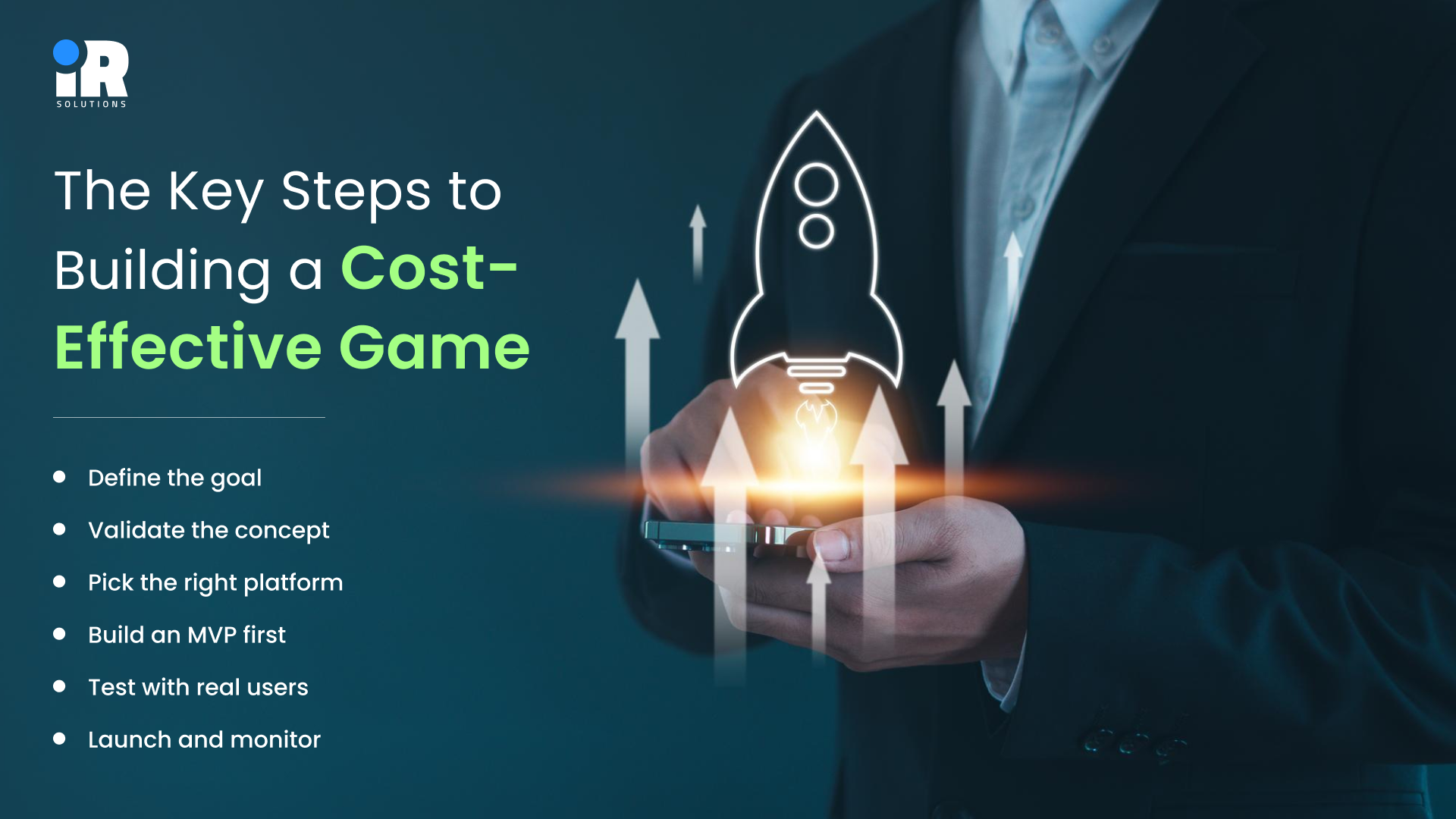
A simple roadmap that most successful projects tend to follow:
- Define the goal: Decide upfront if the game exists to support branding, generate direct revenue, or simply drive deeper user engagement with your brand.
- Validate the concept: Build a small, rough prototype and test it with a handful of real users before you commit to full-scale development.
- Pick the right platform: Choose mobile, web, or cross-platform based on where your target audience already spends most of their time.
- Build an MVP first: Launch with a lean set of core features, then expand the game gradually based on how real players actually respond.
- Test with real users: Gather early, honest feedback from actual players so you can refine gameplay and fix issues before the public release.
- Launch and monitor: Track downloads, retention, and revenue closely from the very first week, so problems get caught before they compound.
This order feels slower at first, but it protects your budget in the long run. Teams that skip straight to full development without validating anything often end up rebuilding entire sections later. A little patience early usually saves both time and money by the end.
Have an idea worth building? Connect with our team to discuss the next steps and explore the right development strategy.
How Scalable Game Development Solutions Support Long-Term Business Growth
A game built on a scalable architecture grows with the business rather than requiring a complete rebuild when audience size or feature requirements change beyond what the initial version was designed to support.
Scalable game infrastructure means adding new content, new game modes, new language versions, and new platform targets without starting the technical foundation from scratch each time the business wants to extend the experience.
That extensibility converts the initial development investment into a long-term platform rather than a single fixed product with a limited operational lifespan.
Interested in the future of gaming? Read: Is Blockchain Game Development a Long-Term Opportunity or a Trend? to see how blockchain is shaping the next generation of interactive experiences.
Conclusion
Affordable game development is a genuinely accessible route for business owners who want higher engagement, better training outcomes, stronger customer retention, and more memorable brand experiences than conventional marketing and communication tools reliably deliver. The investment is manageable when the project is properly scoped, the right development partner is chosen based on demonstrated relevant experience, and the business outcome the game is designed to serve is clearly defined before a single line of code is written. Businesses looking for an experienced technology partner can rely on IR Solutions to build scalable, high-quality game solutions that align with their goals and budget. The ROI case is consistent across the businesses that have made this investment, with those foundations in place, and the growing availability of cost-effective development partners and technologies has made one of the most accessible moments in the industry's history to do it properly for the first time.
FAQs
How long does it typically take to develop an affordable business game from start to finish?
A simple casual game or training simulation typically takes between eight and sixteen weeks to develop from initial concept to launch. Mid-complexity projects with custom art, multiple mechanics, and backend infrastructure usually require four to six months of active development time. The timeline depends heavily on how clearly the scope is defined before development begins and how quickly the business provides feedback during review cycles throughout the production process.
Can a small business with a limited budget realistically benefit from custom game development?
Yes, and the entry point is lower than most small business owners assume before speaking to a specialist development partner about their specific objectives. A focused, well-scoped casual game or gamified engagement tool built for a specific business outcome can be developed within budgets that small businesses regularly allocate to digital marketing campaigns that produce far less measurable engagement and retention than a game experience delivers across the same audience over the same period.
Do business games need to be available on both iOS and Android to be effective?
Not necessarily, and forcing cross-platform development when the target audience primarily uses one platform adds cost without proportional benefit to the business outcome. A browser-based HTML5 game works across all devices without requiring separate builds for each platform, which is often the most cost-effective approach for business games that need broad accessibility without the distribution overhead of app store submission and approval processes for each platform separately.
How do businesses measure the ROI of a game development investment?
ROI measurement depends on the specific business objective the game was built to serve rather than a single universal metric that applies equally to all game types and business contexts. Training games are measured through competency assessments and productivity improvements. Customer engagement games are measured through session frequency, retention rates, and their correlation with repeat purchase behaviour. Lead generation games are measured through completion rates and the quality of leads generated compared to conventional capture methods used previously by the same business.
What is the biggest mistake businesses make when commissioning their first game development project?
The most consistently damaging mistake is attempting to build too many features into the initial version of the game before the core mechanic has been validated with the actual target audience. Scope expansion during development is the primary driver of budget overruns and timeline extension in business game projects, and it almost always produces a product that is more complex than necessary rather than more effective at achieving the specific business outcome that justified the investment in the first place.
Is it better to work with a local game development studio or an international outsourcing partner?
The right answer depends on the specific priorities of the project rather than a universal preference for either model. Local studios offer easier communication, cultural alignment, and the ability to meet in person during key decision points in the development process. International outsourcing partners typically offer significantly lower hourly rates that allow the same budget to produce a more complete product than a local studio can deliver at an equivalent cost. Many businesses find that a hybrid approach works well, using a local project manager to coordinate with an international development team across the full production cycle.


