





Key Takeaways
- Tokenized gold converts physical gold held in audited custody into blockchain-based digital tokens that can be held, traded, and transferred fractionally without physical handling.
- Smart contracts automate ownership tracking, income distribution, compliance verification, and redemption processes across the full lifecycle of a tokenized gold product.
- Tokenized gold supports asset-backed finance through digital collateral, programmable financial products, DeFi integration, and cross-border settlement that physical gold cannot facilitate at comparable speed.
- The risks of tokenized gold include smart contract vulnerabilities, custodian counterparty risk, regulatory uncertainty, and proof-of-reserve integrity that require careful platform design to manage.
- Building a tokenized gold platform requires legal structuring, custody arrangement, blockchain selection, smart contract development, compliance integration, and independent security auditing before any investor capital is committed.
Gold has stored value reliably for thousands of years but has never been easy to own, transfer, or use as active financial collateral in the way that digital assets allow. Tokenized gold changes that by converting physical gold holdings into blockchain-based digital tokens that can be held fractionally, transferred globally in minutes, and integrated into financial products that physical gold cannot participate in at any comparable speed or accessibility. The result is an asset class that combines gold's stability with the operational flexibility of digital finance, which is why institutional and retail interest in tokenized gold has grown significantly in 2025 and 2026.
What Is Tokenized Gold?
Tokenized gold is a digital token on a blockchain that represents ownership of a specific quantity of physical gold held in an independently audited custodial facility. Each token carries a defined gold weight, typically one gram or one troy ounce, and the holder's claim on that gold is legally recognised through the structure of the issuing entity rather than through direct physical possession of the metal itself.
The token is the ownership record. The blockchain is the ledger that records every transfer and balance change permanently. The physical gold in custody is the reserve that gives each token its underlying value and makes the instrument genuinely asset-backed rather than purely synthetic in nature.
How Does Tokenized Gold Work?
The tokenized gold lifecycle moves through a defined sequence that connects the physical gold in custody to the digital token in the investor's wallet at every stage of the process.
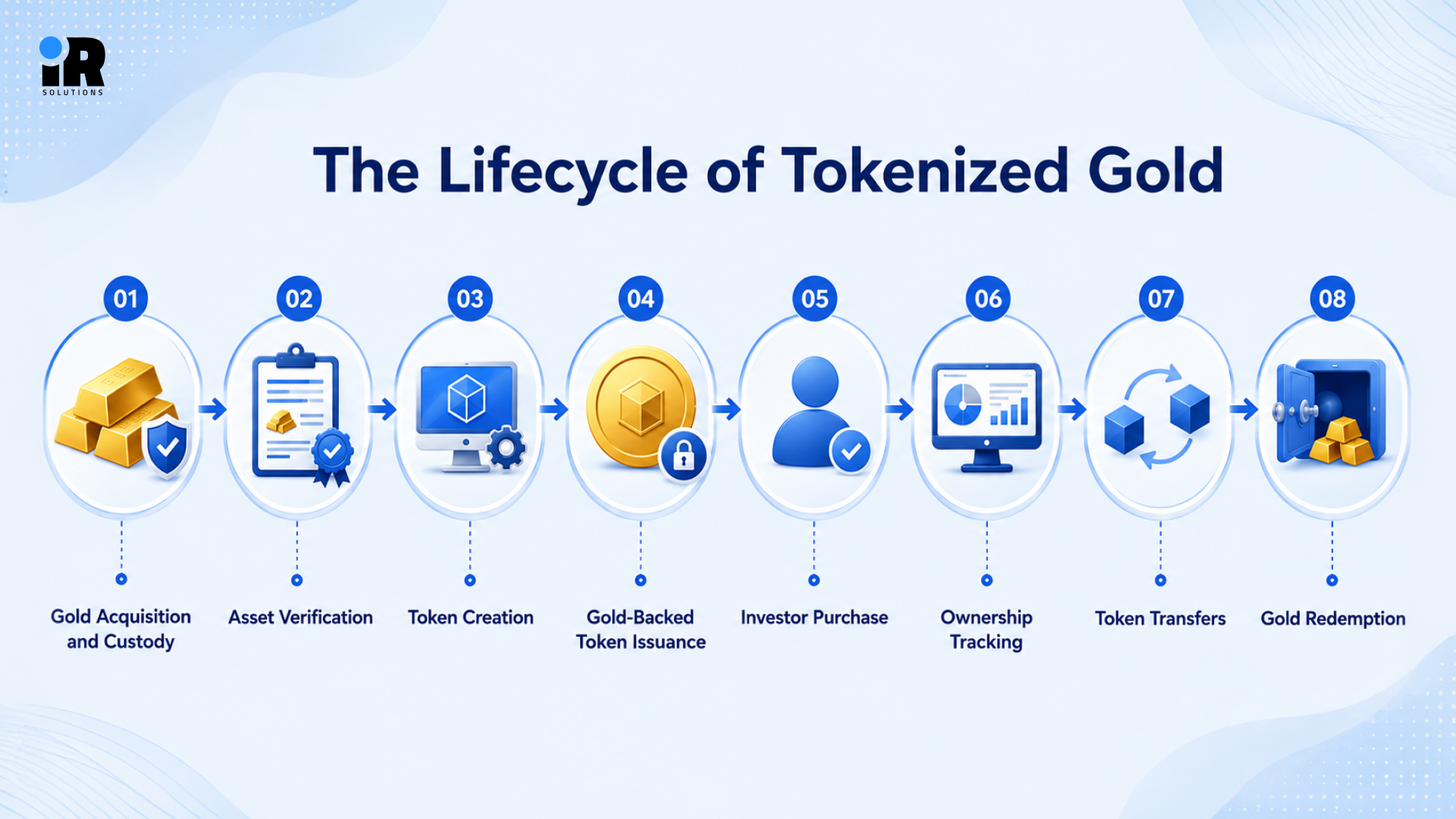
Gold Acquisition and Custody
The issuer acquires physical gold meeting the purity and weight standards defined in the offering documentation and deposits it with a regulated custodian that provides secure storage, insurance coverage, and periodic audit access to verify the holdings independently.
Asset Verification
An independent auditor confirms the quantity, purity, and location of the physical gold in custody before any tokens are created, establishing the verified reserve baseline against which the token supply will be measured throughout the product's operational life.
Token Creation
Smart contracts create the defined number of tokens on the chosen blockchain network, with each token's weight denomination, compliance parameters, and transfer restrictions encoded in the contract before any tokens are distributed to investor wallets.
Gold-Backed Token Issuance
Tokens are issued to verified investors through the platform's onboarding process, with each issued token corresponding to a specific quantity of physical gold confirmed to be in custody at the time of issuance.
Investor Purchase
Investors purchase tokens through the platform using fiat currency or stablecoins, with the purchase price reflecting the current gold spot price plus the platform's fee structure for custody and management services.
Ownership Tracking
The blockchain maintains a real-time record of every token holder's balance and every transfer event, providing an immutable ownership history that all authorised parties can verify without requiring a centralised administrator to confirm the current state of the register.
Token Transfers
Transfers between verified wallets execute on-chain with the compliance engine checking eligibility and restrictions before any ownership change is recorded, ensuring that every secondary market transaction meets the issuer's defined compliance parameters.
Gold Redemption
Token holders who wish to redeem their tokens for physical gold submit a redemption request through the platform, which triggers the smart contract to verify the token balance, process the redemption against the custody account, and arrange the physical delivery or sale of the corresponding gold quantity.
Gold Tokenization Market Size and Growth
The tokenized gold market has grown significantly as institutional confidence in digital asset infrastructure has increased and the operational advantages of blockchain-based gold ownership have become more visible to investors who previously held physical gold or gold ETFs as their primary investment vehicle. Trading activity for tokenized gold increased significantly as institutional interest in blockchain-based gold products continued to grow, with sector value climbing sharply alongside rising institutional adoption.
PAX Gold and Tether Gold are the largest tokenized gold products by market capitalisation as of 2026, with the tokenized gold category holding in the $5–6 billion range through the year, up from roughly $1.6 billion in early 2025. Institutional adoption has accelerated as regulated custodians, compliance infrastructure, and secondary market liquidity have matured to a point where the risk profile of tokenized gold meets the requirements of institutional investment mandates.
The broader RWA tokenization market, which includes tokenized gold as one of its most established categories, is tracking toward the multi-trillion-dollar projections that major research institutions have published for the end of the decade, with gold representing one of the asset classes best positioned to benefit from the structural shift toward blockchain-based ownership records.
Types of Tokenized Gold
Different tokenized gold structures serve different investor needs and are built on different legal and technical foundations that affect how the token functions in practice.
Gold-Backed Tokens
Gold-backed tokens maintain a one-to-one relationship between each token and a specific weight of physical gold held in custody, giving holders direct economic exposure to gold price movements without requiring physical possession or storage of the metal itself.
Fractional Gold Tokens
Fractional tokens divide a single gold unit into smaller denominations that allow investors to hold gold exposure at investment levels well below the cost of a full gram or ounce, making direct gold ownership accessible to retail investors who could not meet the minimum commitment that physical gold investment typically requires.
Redeemable Gold Tokens
Redeemable tokens give holders the right to claim the corresponding physical gold from the custodian upon redemption, providing a genuine connection between the digital token and the physical asset that distinguishes redeemable structures from purely synthetic gold exposure products.
Institutional Tokenized Gold
Institutional tokenized gold products are designed for qualified investors with higher minimum commitment thresholds, enhanced compliance requirements, and integration with institutional custody and reporting infrastructure that retail-facing products do not need to accommodate at the same level of depth.
How Blockchain Enables Tokenized Gold
Blockchain addresses the specific operational limitations of physical gold ownership that have historically made it difficult to use gold as an active, flexible component of a financial portfolio.
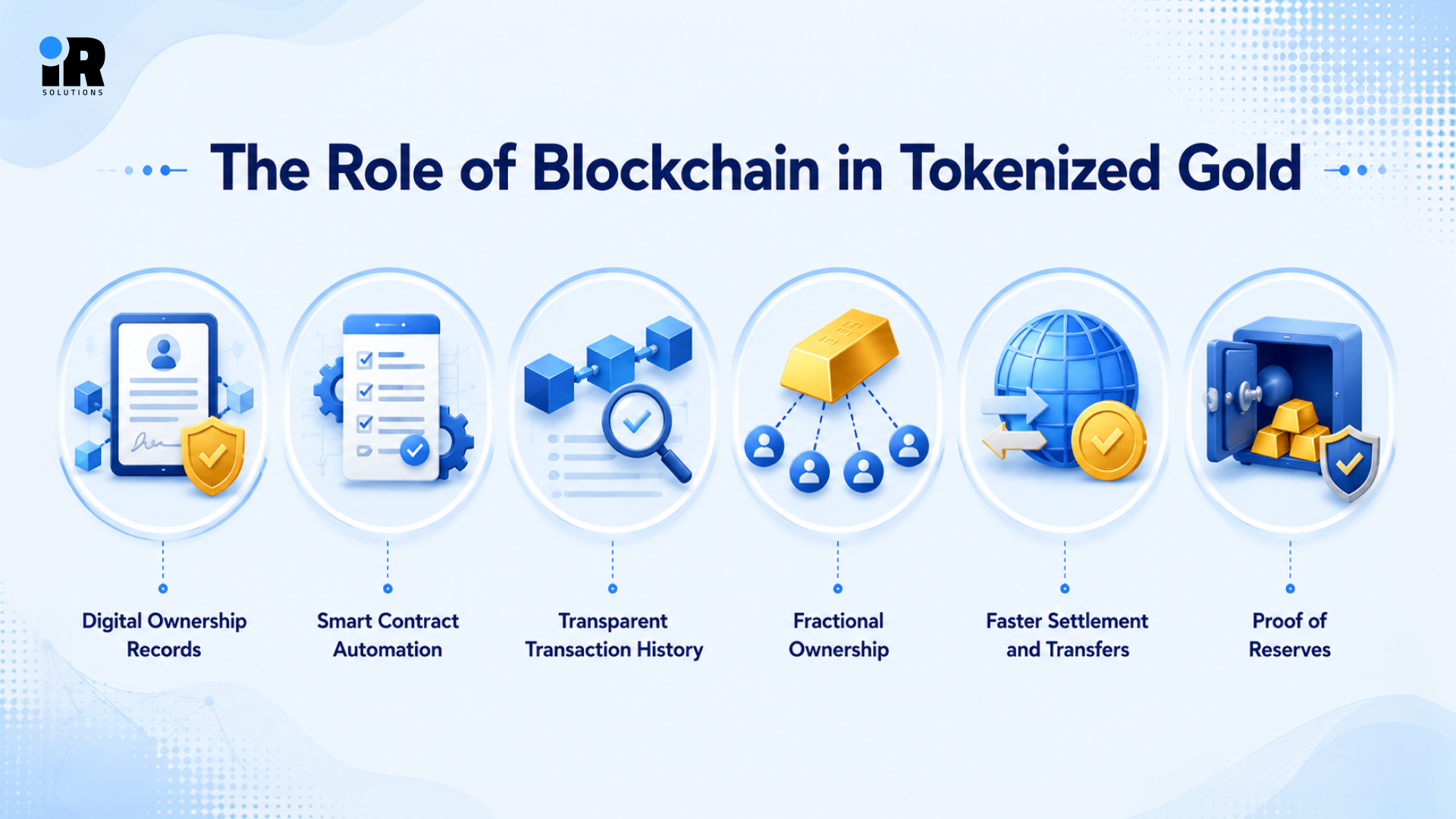
Digital Ownership Records
Permanent, tamper-resistant ownership records on the blockchain replace paper certificates and centralised registry systems, giving all authorised parties real-time access to the current state of gold token ownership without requiring a centralised administrator to confirm each balance or transfer.
Smart Contract Automation
Smart contracts automate token issuance, transfer restrictions, redemption processing, and compliance verification without manual intermediary involvement at each transaction stage, which reduces operational cost and settlement time across every function the platform performs.
Transparent Transaction History
Every transfer, redemption, and issuance event is recorded permanently on the blockchain and verifiable by all authorised parties without requiring the issuer to produce historical records from internal systems that external parties cannot independently audit.
Fractional Ownership
Blockchain allows gold to be divided into token denominations far smaller than the practical minimum for physical gold ownership, which expands the investor base for gold exposure to participants who cannot commit the capital that physical gold investment requires at any meaningful weight.
Faster Settlement and Transfers
On-chain token transfers settle in minutes rather than the days that physical gold transfers or ETF settlement processes require, which reduces counterparty risk and makes gold a more practical component of active portfolio management strategies.
Proof of Reserves
On-chain proof of reserve mechanisms connect the token supply to verified custody data through oracle systems that allow investors to confirm the reserve backing of their tokens at any time without waiting for periodic audit reports from the issuer.
Gold Custody and Asset Verification
The custody and verification infrastructure is what gives tokenized gold its credibility as an asset-backed instrument rather than simply a digital representation of an unverified claim.
Physical Gold Storage
Physical gold is stored in regulated, insured vaulting facilities that meet the purity and security standards defined in the offering documentation, with the custodian providing independent confirmation of the holdings separate from the issuer's own records.
Custodian Management
The custodian manages the physical gold on behalf of token holders, maintaining storage, insurance, and security arrangements that protect the reserve from physical loss, damage, or theft throughout the operational life of the tokenized product.
Gold Audits
Independent auditors conduct periodic physical audits of the gold holdings in custody, confirming the quantity and purity of the reserve against the current token supply and publishing audit reports that investors and regulators can review to verify the product's backing integrity.
Proof of Reserves
On-chain proof of reserve systems connect custodian confirmation data to the blockchain through oracle infrastructure, allowing investors to verify the reserve backing of their token holdings in real time rather than relying on periodic audit reports that may not reflect the current custody position accurately.
Asset-to-Token Ratio
The ratio between the total gold in custody and the total token supply is maintained at the defined level throughout the product's operational life, with any deviation triggering either token issuance or redemption to restore the intended correspondence between the physical reserve and the outstanding token supply.
Redemption Verification
Redemption requests are verified against the current custody position before processing to confirm that sufficient physical gold exists to fulfil the request without creating a reserve shortfall that would affect the backing integrity of the remaining token supply.
Token Standards for Tokenized Gold
The token standard determines what compliance capabilities the platform can enforce natively and how compatible the tokenized gold product is with the broader blockchain ecosystem that investors and DeFi protocols use.
ERC-20
ERC-20 provides the basic fungible token framework that most tokenized gold products use as their foundation, with additional compliance logic layered on top through external systems where the product's regulatory requirements exceed what standard ERC-20 can enforce natively within the token transfer mechanism.
ERC-1400
ERC-1400 adds security token capabilities including partitioned token structures and transfer restriction enforcement that allow issuers to define different classes of gold tokens with class-specific compliance rules applied at the contract level rather than through external enforcement systems.
ERC-3643
ERC-3643 is the most widely adopted standard for institutional-grade regulated token issuance and incorporates a dynamic identity registry that enforces compliance checks on every transfer against verified investor profiles in real time, making it the strongest standard for tokenized gold products targeting regulated markets with strict investor eligibility requirements.
Benefits of Tokenized Gold
The benefits of tokenized gold are most visible when compared against the specific limitations of physical gold ownership and gold ETF structures that most investors currently use for gold exposure.
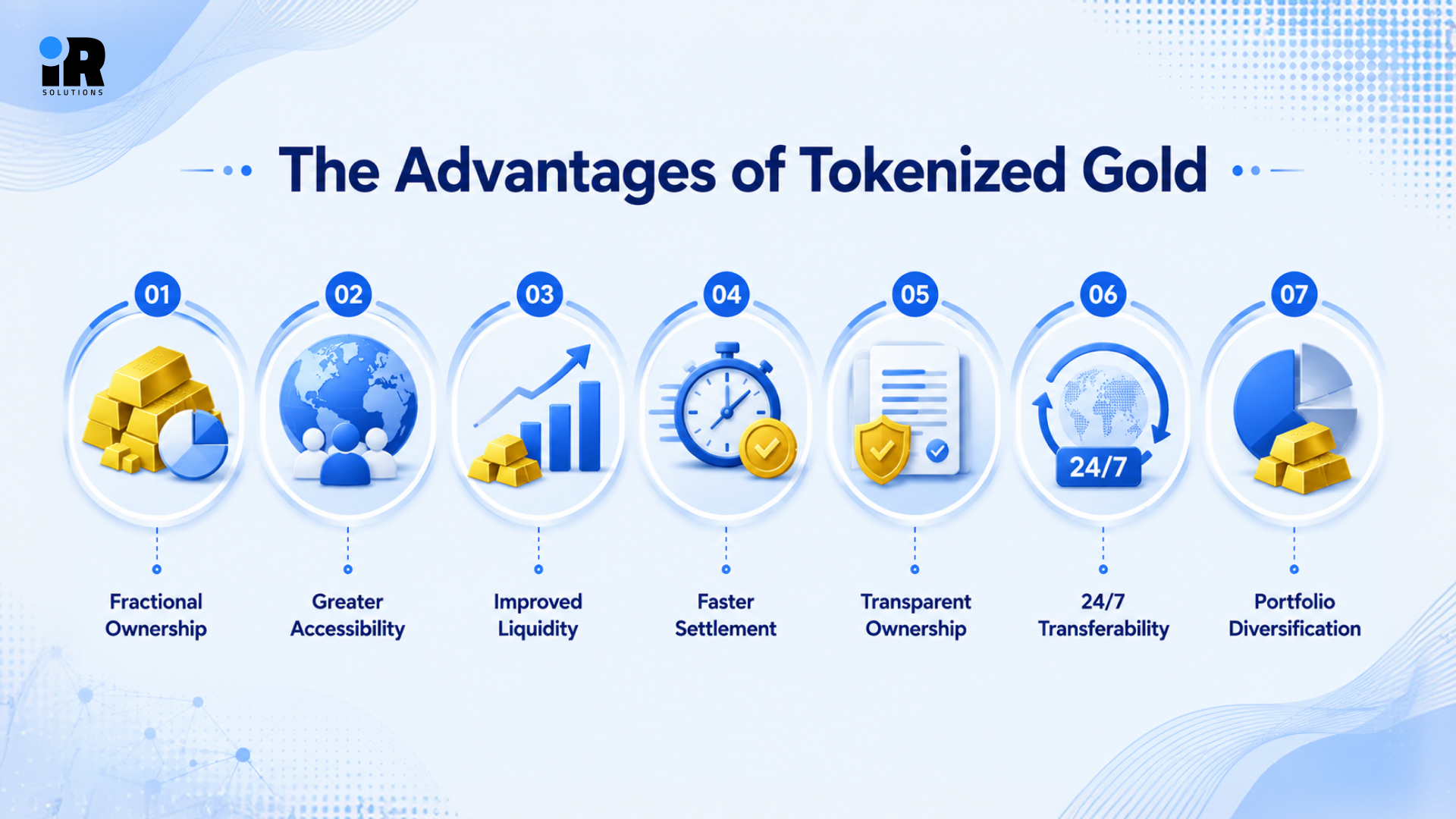
Fractional Ownership
Tokenized gold allows investors to hold gold exposure in denominations far smaller than the practical minimum for physical gold purchase, making direct gold ownership accessible to a much broader range of investors than the physical market can accommodate.
Greater Accessibility
Investors anywhere in the world with a compatible digital wallet can access tokenized gold without the storage, insurance, and physical handling requirements that restrict physical gold ownership to investors with the infrastructure to manage those practical challenges.
This shift is reshaping who can participate in gold ownership at scale, extending a historically exclusive asset class to a far wider base of investors.
Improved Liquidity
Secondary market trading allows tokenized gold holders to exit positions at any time without selling physical gold through a dealer or waiting for ETF redemption windows, providing a liquidity profile that physical gold cannot match outside exchange-traded products.
Faster Settlement
Token transfers settle on-chain in minutes rather than the days physical gold transfers or ETF settlement processes require, making tokenized gold a more practical instrument for active portfolio management and collateral deployment.
Transparent Ownership
On-chain ownership records give all authorised parties real-time visibility into the current state of the gold token register without requiring a centralised administrator to confirm balances or produce historical records from internal systems.
24/7 Transferability
Token transfers can be initiated and completed at any time without the market hour restrictions that apply to exchange-traded gold products or the logistical constraints that govern physical gold transfers between custodians or between investors.
Portfolio Diversification
Tokenized gold can be combined with other tokenized assets, stablecoins, and DeFi instruments within a single blockchain portfolio, enabling diversification strategies that would require multiple separate custodial and brokerage relationships to replicate through traditional financial channels.
Tokenized Gold vs Physical Gold vs Gold ETFs
The structural differences between tokenized gold, physical gold, and gold ETFs are most meaningful when viewed across the specific dimensions that affect how each instrument functions as a portfolio component and financial tool.
Dimension | Tokenized Gold | Physical Gold | Gold ETF |
Minimum investment | Very low, fractional | Full gram or bar | Share price |
Settlement time | Minutes | Days | T+2 standard |
Storage requirement | None | Physical storage | None |
24/7 trading | Yes | No | No |
Fractional ownership | Yes | Limited | No |
DeFi compatibility | Yes | No | No |
Proof of reserve | On-chain verifiable | Audit dependent | Fund reporting |
Redemption | Physical or cash | Physical delivery | Cash only |
Transparency | Full on-chain | Limited | Periodic reporting |
Use Cases of Tokenized Gold
Tokenized gold serves a broader range of financial functions than physical gold because the digital format allows it to participate in financial infrastructure that physical gold cannot access at comparable speed or cost.
Retail Investment
Retail investors can access gold exposure at investment levels that physical gold purchases cannot accommodate, with the ability to build a gold position gradually over time through fractional token purchases rather than committing to a full gram or ounce at each investment event.
Institutional Investment
Institutional investors can hold tokenized gold as a component of diversified digital asset portfolios, with the compliance infrastructure and custody standards that institutional mandates require built into the platform architecture from the point of initial design.
This pattern reflects why enterprises are moving toward tokenization more broadly, with gold serving as one of the clearest entry points into that shift.
Wealth Management
Wealth managers can include tokenized gold in client portfolios as a store of value and inflation hedge alongside other tokenized assets, with automated reporting and real-time valuation providing the portfolio visibility that client reporting obligations require.
Portfolio Diversification
Tokenized gold provides a digital-native store of value that can be combined with other blockchain-based assets to create diversified portfolios that include traditional safe-haven exposure without requiring separate custodial infrastructure for the gold component.
Cross-Border Payments
Tokenized gold can function as a stable, gold-backed medium of exchange for cross-border transactions where neither party wants currency exposure and where the speed and cost of bank-mediated international transfers make traditional payment methods impractical.
Collateralized Lending
Tokenized gold can be used as collateral for loans through DeFi lending protocols or traditional collateralized lending facilities, allowing holders to access liquidity against their gold position without selling it and losing the gold exposure they are seeking to maintain.
DeFi Applications
Tokenized gold can participate in DeFi liquidity pools, yield strategies, and collateral markets that physical gold cannot access at any speed or cost comparable to what blockchain-based gold tokens can achieve within the existing DeFi ecosystem infrastructure.
Treasury and Asset Management
Corporate treasury teams can hold tokenized gold as a digital store of value alongside cash and stablecoin holdings, with the ability to deploy the gold position as collateral or liquidate it quickly through secondary markets when liquidity needs arise unexpectedly.
How Tokenized Gold Supports Asset-Backed Finance
Tokenized gold extends the utility of gold as a financial instrument beyond passive holding into active participation in the financial infrastructure that asset-backed products require to function at institutional scale.
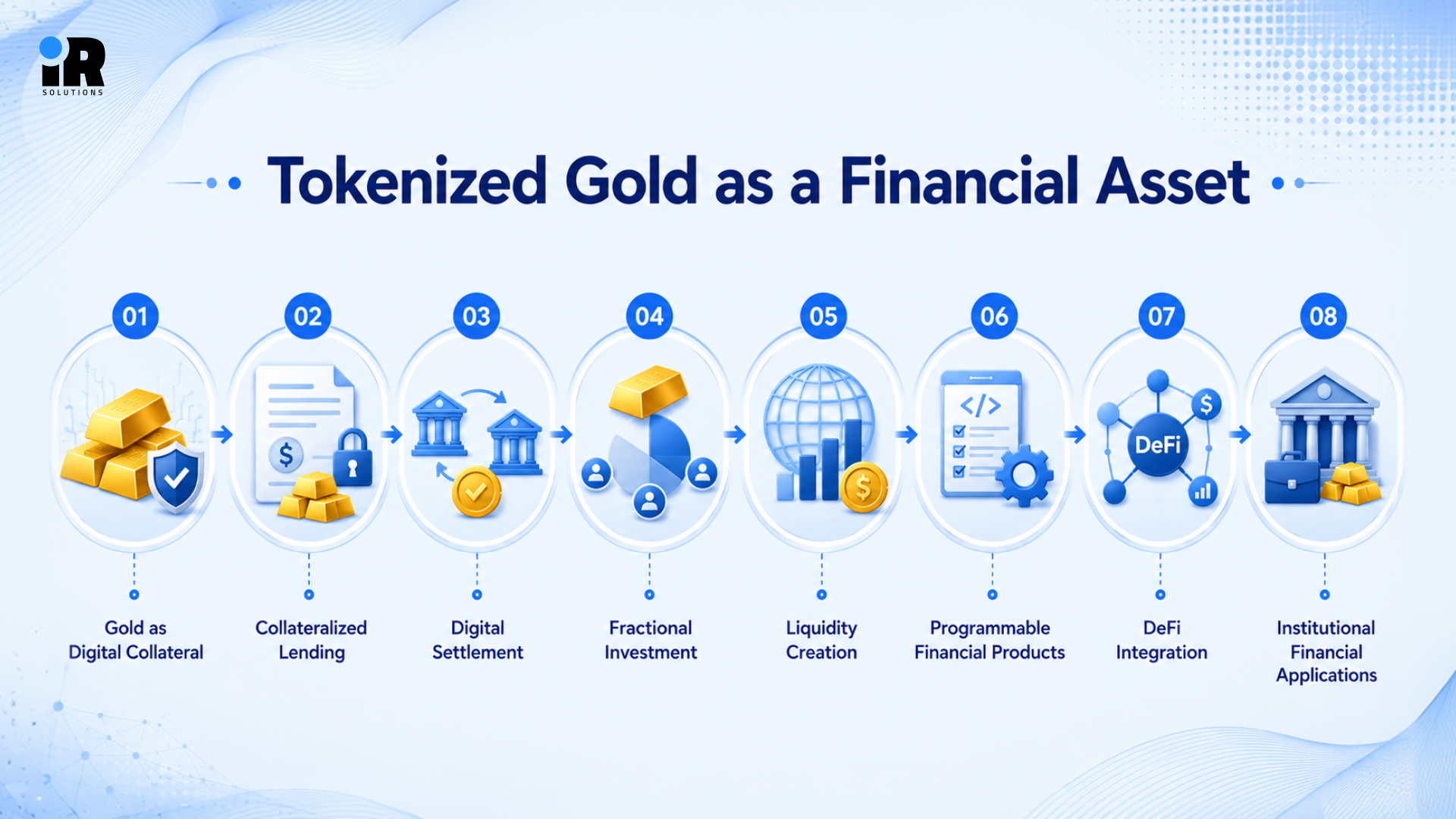
Gold as Digital Collateral
Tokenized gold can be posted as collateral for loans and financial obligations through smart contract-based collateral management systems that automatically verify the collateral value, enforce margin requirements, and liquidate positions when defined thresholds are breached without manual intervention from either party.
Collateralized Lending
Lending protocols that accept tokenized gold as collateral allow holders to borrow against their gold position at loan-to-value ratios defined by the lending protocol, providing liquidity without requiring the sale of a gold position that the holder wants to maintain for portfolio or hedging purposes.
Digital Settlement
Tokenized gold can function as a settlement instrument for financial transactions between parties who want gold-denominated settlement without the logistical complexity of physical gold delivery, settling on-chain in minutes rather than through the multi-day processes that physical settlement requires.
Fractional Investment
Asset-backed financial products structured around tokenized gold can offer fractional participation to investors who could not commit to the minimum sizes that traditional gold-backed financial instruments require, broadening the investor base and improving capital formation efficiency.
Liquidity Creation
Secondary market trading of tokenized gold creates liquidity for a traditionally illiquid asset class, with market makers and automated market makers on DeFi platforms providing continuous buy and sell liquidity that physical gold markets cannot match outside of exchange-traded instruments.
Programmable Financial Products
Smart contracts can create programmable financial products structured around tokenized gold, including automatic rebalancing, conditional payments, and yield-generating strategies that physical gold cannot support within any comparable automated framework.
DeFi Integration
Tokenized gold integrates with DeFi protocols including lending platforms, decentralised exchanges, and yield optimisation systems, allowing gold holders to generate returns on their gold exposure that physical gold ownership has never been able to produce without selling the underlying metal.
Institutional Financial Applications
Institutional investors can use tokenized gold in structured products, fund vehicles, and financial instruments that require a regulated, audited gold reserve as the underlying asset, with the compliance infrastructure and proof of reserve verification built into the platform architecture rather than provided separately.
Risks and Challenges of Tokenized Gold
The risks of tokenized gold are real and worth understanding clearly before committing capital to any specific tokenized gold product.
Smart Contract Risk
Vulnerabilities in the smart contract code governing token issuance, transfers, and redemptions can expose investor capital to exploitation or loss that is difficult or impossible to reverse once the vulnerability has been exploited on-chain.
Custodian and Counterparty Risk
The physical gold backing tokenized products depends on the financial stability and operational reliability of the custodian holding it, and custodian failure could affect the integrity of the reserve backing investor token holdings regardless of the blockchain infrastructure's own security.
Regulatory Uncertainty
The regulatory treatment of tokenized gold varies across jurisdictions and continues to evolve, with some markets classifying tokenized gold as a security or commodity that requires specific regulatory approvals that not all platforms have obtained across all markets where they distribute tokens.
Liquidity Risk
Secondary market liquidity for tokenized gold varies significantly between products and platforms, and investors in less liquid tokenized gold products may face significant price impact or extended exit timelines when they want to liquidate positions quickly.
Redemption Limitations
Physical gold redemption may involve minimum weight requirements, delivery logistics, and processing timelines that make it impractical for small token holders who expect to redeem their tokens for physical gold but cannot practically manage the delivery or storage of the metal they are entitled to claim.
Asset Backing and Proof of Reserves
The integrity of the gold reserve backing each token depends on the frequency, independence, and accuracy of the audit process, and any gap between the audit cycle and actual custody changes creates a window during which investors cannot verify that their tokens are fully backed.
What Does It Take to Build a Tokenized Gold Platform?
Building a tokenized gold platform requires the same foundational elements as any RWA tokenization project but with gold-specific custody arrangements, proof of reserve infrastructure, and redemption logistics that generic tokenization platforms do not address by default.
The build starts with legal structuring, where the entity holding the physical gold and issuing tokens to investors is established, and the legal connection between the custody arrangement and the token holder's rights is documented and verified by qualified legal counsel. A custody arrangement with a regulated vaulting facility follows, covering storage standards, insurance, audit access, and the data feeds that proof-of-reserve systems will use to connect custody verification to the blockchain in real time.
Blockchain selection, smart contract development, compliance integration, and independent security auditing complete the technical build before any investor capital is exposed to the platform. The cost of building a production-ready tokenized gold platform varies significantly depending on the legal structure, jurisdiction, custody arrangements, compliance infrastructure, blockchain architecture, security requirements, and integrations required.
Conclusion
Tokenized gold combines the stability and historical credibility of physical gold with the operational flexibility of blockchain-based digital assets in a way that expands what gold can do as a financial instrument beyond passive value storage. The ability to hold gold fractionally, transfer it globally in minutes, use it as programmable collateral, and integrate it into DeFi protocols makes tokenized gold a more active participant in financial markets than physical gold has ever been able to become within traditional infrastructure. The risks of smart contract vulnerabilities, custodian counterparty exposure, and regulatory uncertainty are real and require careful platform design to manage properly. For issuers and investors who understand those risks and engage with tokenized gold through well-structured, independently audited platforms, the combination of gold's stability and blockchain's operational efficiency represents one of the clearest expressions of what asset-backed digital finance can deliver at production scale.
Frequently Asked Questions
What is tokenized gold?
Tokenized gold is a blockchain-based digital token that represents ownership of a specific quantity of physical gold held in an independently audited custodial facility, giving holders digital exposure to gold prices without requiring physical possession or storage of the metal.
How does tokenized gold work?
Physical gold is acquired and deposited with a regulated custodian, independently verified by an auditor, and then represented as digital tokens on a blockchain where each token corresponds to a defined gold weight that the holder can transfer, hold fractionally, or redeem for physical delivery.
Does physical gold back tokenized gold?
Yes. Each tokenized gold product maintains a defined ratio between the total token supply and the physical gold held in custody, with independent audits and on-chain proof-of-reserve systems providing verifiable confirmation of the reserve backing at regular intervals.
What are the benefits of tokenized gold?
Tokenized gold offers fractional ownership, greater accessibility, improved liquidity, faster settlement, transparent on-chain ownership records, 24/7 transferability, and compatibility with DeFi protocols that physical gold and traditional gold ETFs cannot provide at comparable cost or speed.
How is tokenized gold different from physical gold?
Tokenized gold can be held fractionally, transferred globally in minutes, used as digital collateral in DeFi protocols, and verified against on-chain proof-of-reserve data, while physical gold requires storage, insurance, physical delivery logistics, and cannot participate directly in digital financial infrastructure.
Is tokenized gold regulated?
Regulatory treatment varies by jurisdiction and product structure. Some tokenized gold products are structured as commodity tokens while others are classified as securities, with compliance requirements varying significantly by market and requiring jurisdiction-specific legal structuring before distribution to investors in regulated markets.
How can tokenized gold be redeemed?
Token holders submit a redemption request through the platform, which triggers the smart contract to verify the token balance and process the redemption against the custody account, with the corresponding physical gold either delivered to the holder or sold with the proceeds distributed in the holder's preferred currency.
What blockchain is used for tokenized gold?
Ethereum is the most widely used blockchain for institutional-grade tokenized gold products due to its compliance tooling, ecosystem depth, and DeFi integration capabilities. Polygon offers lower transaction costs while maintaining Ethereum compatibility for platforms expecting high transaction volumes from retail investor bases.


