


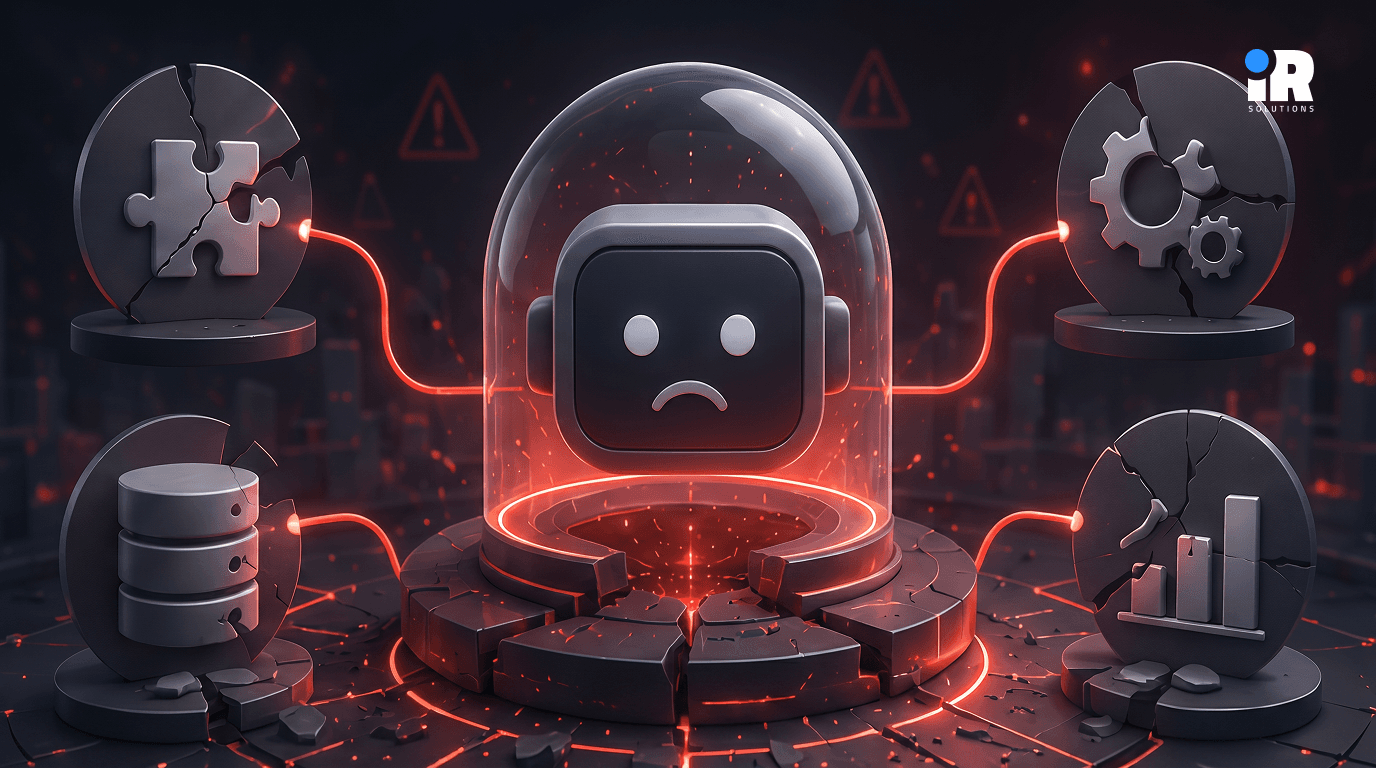

Eight months of development, a full team committed to the project, and the chatbot still cannot answer a basic customer question without breaking. That happens more than most companies want to admit, and the causes are rarely a mystery once you look closely at them. Chatbot projects collapse due to poor data decisions, shifting goalposts, messy integrations, and rollouts that treat real users as an afterthought. If you want to build something that actually works from the start, IR Solution’s AI services give your project the structure, technical foundation, and implementation strategy it needs.
This blog walks through every major mistake driving chatbot project failure today, so you know exactly what to avoid before the damage is done.
Why AI Chatbot Projects Fail More Often Than Expected
AI chatbot seems like a contained, manageable project with a clear start and end point. In reality, it is a layered system where poor decisions made early compound into expensive problems much later in the build. The technology itself is rarely what breaks things, but it gets blamed the most because it is the most visible part of the project. What actually breaks chatbot projects is how teams plan them, scope them, resource them, and hand them off after launch.
Mistake 1: Building on Poor or Insufficient Training Data
Training data is the foundation everything else sits on, and weak foundations do not hold weight for long. If the data going into the model is thin, outdated, mislabeled, or missing key scenarios, the chatbot will perform poorly no matter how clean the code is. Teams often rush past data preparation because it feels like setup work rather than real development, but that decision comes back hard once the model starts producing confident, wrong answers at scale. Many organizations choose to hire AI developers to improve data quality, model performance, and evaluation before chatbot development moves into production.

What Goes Wrong
- Volume issues: Teams underestimate how many varied examples a model needs to handle the full range of real user inputs.
- Quality gaps: Duplicate records, irrelevant training examples, and stale content all introduce noise that degrades model accuracy over time.
- Coverage blind spots: Data tends to reflect the easy, common scenarios while skipping the edge cases that real users actually run into most often.
- Labeling errors: Misclassified intents teach the model the wrong relationships, and those errors multiply across every downstream conversation the bot has.
Mistake 2: Saying Yes to Every New Feature Request
The chatbot project starts with a clear, manageable focus and then quietly expands as different stakeholders add requests after the build has already begun. Order tracking joins the original support brief, then returns processing, then product recommendations, until the original single-use-case chatbot has become a five-system integration project running on the same timeline and team that was scoped for something far smaller. Most stakeholders do not realize that adding one new intent can require a full model retraining run, updated integration mapping, and another quality testing cycle that pushes every other deadline back.
- Requirement bloat: Every stakeholder meeting adds features to the list without removing anything already committed to the backlog.
- No defined MVP: The team never agreed in writing on what the first working version needs to do, and what it does not.
- Shifting priorities: Business goals change mid-build and pull development in a new direction without any formal assessment of the cost.
- Timeline slippage: Delivery dates keep moving forward, and nobody can give an honest, specific reason for each delay when asked directly.
Lock It Down Early
Write the scope before development starts, get sign-off from every stakeholder, and treat that document like a contract rather than a starting suggestion. Build a change request process that requires an impact assessment before any new feature enters the backlog, because that friction alone filters out most low-priority additions before they consume real development time.
Choosing the right development partner is just as important as meeting compliance requirements. Learn what to evaluate in our blog on Custom AI Development Services: What Businesses Should Look For Before Hiring.
Mistake 3: Underestimating Integration Complexity
Chatbots connect to CRMs, ticketing systems, payment platforms, and multiple APIs simultaneously, and every one of those connections is a place where things break in ways development environments rarely expose before launch.
- The chatbot was built expecting the backend API to return data in a specific format, and production data does not match that assumption.
- Token expiration or permission errors cut live conversations short mid-session without warning the user.
- Slow backend responses make the chatbot feel unresponsive even when the bot logic itself is working correctly.
- Older internal platforms often lack the documentation or endpoints that modern chatbot frameworks need to connect cleanly.
- Nobody planned what the bot should do when an API call fails, so users hit silent errors or blank replies during real conversations.
Businesses working with complex integrations often hire AI chatbot experts to audit existing chatbot architectures, resolve integration issues, and improve reliability before deployment.
Mistake 4: Building Without Real User Input
Teams build chatbots around what they think users need, and that assumption tends to be off in at least two or three important ways. The tone feels wrong for the brand, the conversation flow makes sense to a developer but confuses a real customer, and the use cases built are not the ones users run into most often.
When users hit a wall twice, they stop trying, they go back to email, pick up the phone, or just submit a support ticket the way they always did before the chatbot existed. At that point, the business is running two systems, the old support channel and an expensive bot nobody opens, which is worse than the original problem the project was trying to solve.
The fix is straightforward, but it gets skipped because it takes time before the build starts. Talk to real users, pull actual support transcripts, and map the conversations they already have with your team before a single flow gets designed. That input shapes the intent structure, the vocabulary, and the tone in ways that internal assumptions never will.
Ready to build your blockchain solution? Schedule a free call with our team and discuss the best approach for your project.
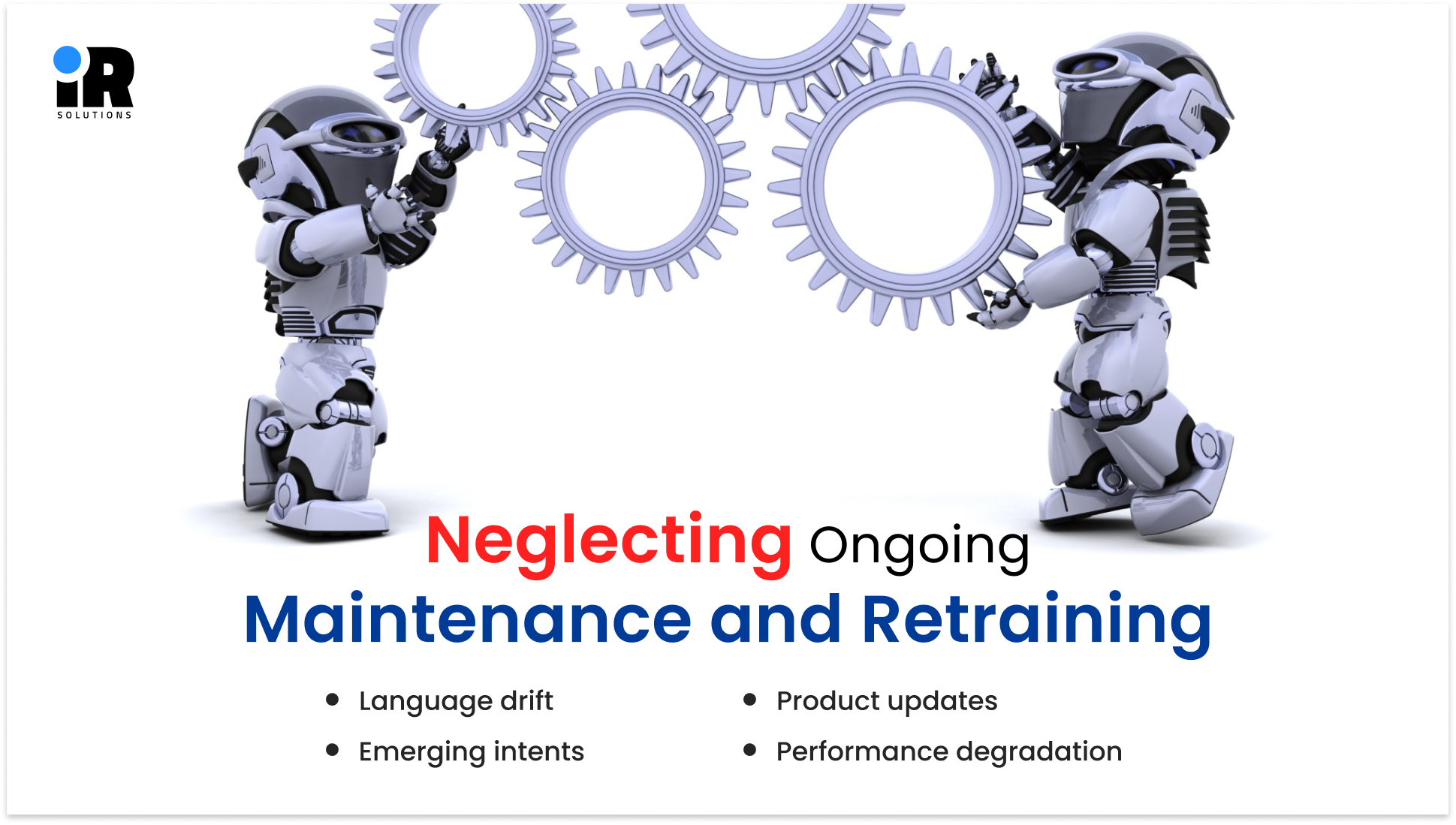
Mistake 5: Neglecting Ongoing Maintenance and Retraining
Many teams celebrate the go-live date as the end of the chatbot project, and that framing causes real problems within a few months of deployment. Language evolves, product lines change, policies get updated, and user behavior shifts over time in ways that make a model trained six months ago feel noticeably stale compared to the conversations users are trying to have right now. Chatbots are not install-and-forget systems, and teams that treat them as such discover that lesson through a slow, steady decline in performance metrics that nobody catches until users are already complaining.
What Breaks Over Time
- Language drift: Users start phrasing questions differently over time, using newer terminology that the original training data never included or anticipated at all.
- Product updates: New features, pricing changes, policy revisions, and updated processes need to be reflected in the bot's knowledge base, or it will give users outdated and incorrect information.
- Emerging intents: Users start asking about topics or scenarios the chatbot was never designed or trained to handle, and it falls back to a dead end instead of helping them.
- Performance degradation: Without active monitoring, accuracy scores drop slowly, and nobody triggers a review until the fallback rate is already causing real operational problems for the business.
The Maintenance Gap in Practice
A chatbot that performed well at launch can feel noticeably behind six months later if nobody has reviewed its performance data or updated the knowledge base. Small declines in match rate accumulate quietly until users stop trusting the bot and default back to human support instead.
Building a Maintenance Schedule
Set a monthly review schedule and assign a named owner for chatbot performance, because tasks without an owner consistently fall off the calendar. Track intent match rates, fallback rates, and satisfaction scores, and set thresholds that trigger a retraining run before the drop becomes a user-facing problem.
Mistake 6: Ignoring Security and Compliance Requirements
Security gets pushed to the end of most chatbot projects, and by then, the architecture is already set, and changes are expensive. Every chatbot that handles user data, connects to backend systems, or sits on a public-facing surface needs security built in from the start, not patched on after launch.

- Data Exposure: Chatbots handle personal and financial data without proper access controls, leaving sensitive information vulnerable to leaks.
- Prompt Injection: Malicious inputs can manipulate the bot into bypassing its own rules and revealing restricted information to unauthorized users.
- Compliance Gaps: Regulated industries require specific data handling and consent standards that the chatbot must meet before going live.
- Third-Party Risk: Every external API the chatbot connects to introduces a vendor that your team did not vet for security before integrating.
Mistake 7: Skipping the User Adoption Strategy
Building a good chatbot and actually getting people to use it are two separate battles, and most teams only plan for the first one. The assumption is that once the bot works, adoption follows naturally. It rarely does. A chatbot that sits unused does not cut support costs, does not justify the budget, and does not impress anyone outside of a controlled demo room. Adoption is a behavior change problem, and that kind of problem does not fix itself with a launch email and a footer link.
- No change management: Employees who had no say in the chatbot decision have zero reason to trust it. Nobody told them why it exists or how it makes their day easier, so they ignore it.
- Poor discoverability: One announcement email gets buried by lunch, if users do not know the tool exists or cannot find it quickly, the adoption rate will reflect that.
- Trust deficit: A bad first or second interaction sticks, users talk, especially inside companies, and a reputation for giving wrong answers spreads faster than any onboarding campaign can counter.
- No feedback loop: When users hit a dead end, they need somewhere to report it. Without that, the team keeps shipping a broken experience because nobody is telling them where it breaks.
The Business Impact of AI Chatbot Projects Done Right
Every common mistake of chatbot development represents a real cost, whether that is budget burned on retraining, timeline lost to scope changes, users lost to poor adoption, or legal exposure from security gaps left unaddressed. Businesses that approach AI chatbot development with the right structure from the beginning avoid most of these costs and ship products that deliver measurable value within the first quarter of deployment. The difference between a chatbot that works and one that fails is rarely the technology itself, it is the discipline around planning, data, integration testing, and post-launch ownership that determines the outcome.
We have helped companies across industries build AI chatbots that handle real production load without falling apart, and our process starts with a discovery phase that catches the common failure patterns before any code is written.
Many chatbot implementation challenges can be avoided by documenting requirements early. Read: How Businesses Define AI Chatbot Requirements Before Development to understand what should be included before development starts.
Conclusion
Successful AI chatbot projects begin with clear planning, reliable data, and realistic expectations from every stakeholder involved. Avoiding common development mistakes saves valuable time, reduces costs, and improves long-term chatbot performance significantly overall. Strong integrations, continuous testing, and regular maintenance keep chatbot experiences reliable as business needs continue evolving. User feedback, security planning, and ongoing retraining ensure chatbots remain accurate, relevant, and trusted over time consistently. Businesses investing in experienced AI development teams reduce project risks while achieving better customer experiences and outcomes. IR Solutions provides end-to-end AI chatbot development services, helping businesses build secure, scalable, and high-performing chatbot solutions from strategy through deployment. Planning carefully before development starts remains the simplest way to avoid failures and build chatbots successfully.
Frequently Asked Questions
Why do most AI chatbot projects fail before they even reach users?
Most projects fail because of poor planning, weak data, and a scope that keeps growing without anyone putting the brakes on. By the time the bot reaches users, the damage from those early decisions is already done.
How much training data does a chatbot actually need to perform well?
There is no magic number, but the data needs to cover real user inputs, edge cases, and varied phrasing, not just the clean, common scenarios your team imagines. Thin or mislabeled data produces a bot that sounds confident while getting things wrong.
What is the fastest way to kill a chatbot project mid-build?
Say yes to every feature request that comes out of stakeholder meetings without assessing the real cost of each addition. One new intent can trigger a full retraining run, new integration work, and another testing cycle that pushes every deadline back.
How do integration failures show up during a live chatbot deployment?
They show up as blank replies, mid-conversation dropouts, and slow responses that make the bot feel broken even when the logic is fine. Most of these stem from assumptions made during development that production data and real APIs do not actually match.
What happens when real users are left out of the chatbot design process?
The tone feels off, the flows confuse people, and the use cases built are rarely the ones users run into most. After two frustrating interactions, most users go back to email or phone and never open the bot again
Why do security and compliance get skipped in chatbot projects?
They get pushed to the end because they feel like a final checklist rather than a design decision, and by then the architecture is already set. Changing it late costs more time and money than building it right from the start.
Why do well-built chatbots still struggle with user adoption?
A good chatbot and a widely used chatbot are two different things, and most project plans never address the gap between them. Without a real adoption strategy, discoverability, and a visible path to a human agent, even solid bots get ignored after the launch week ends.