



As businesses grow, the software and systems they rely on often struggle to keep pace with changing operational demands. What once seemed like an effective solution can become a source of inefficiency, forcing teams to manage manual processes, switch between disconnected platforms, and spend valuable time on repetitive tasks. These challenges not only reduce productivity but also limit a company's ability to scale efficiently. Investing in custom mobile app development solutions allows businesses to replace these limitations with technology built specifically for their workflows, goals, and users. Unlike off-the-shelf software, custom applications provide greater flexibility, seamless integrations, and automation capabilities that streamline operations. The result is a scalable technology foundation that improves performance, supports growth, and creates long-term business value.
What a Custom App Team Does Beyond Development
A custom mobile software team does far more than write code, they run the entire product lifecycle from the first strategy session through long-term post-launch maintenance. They stay invested in how the product performs after it ships, not just how it looks when it is handed over.
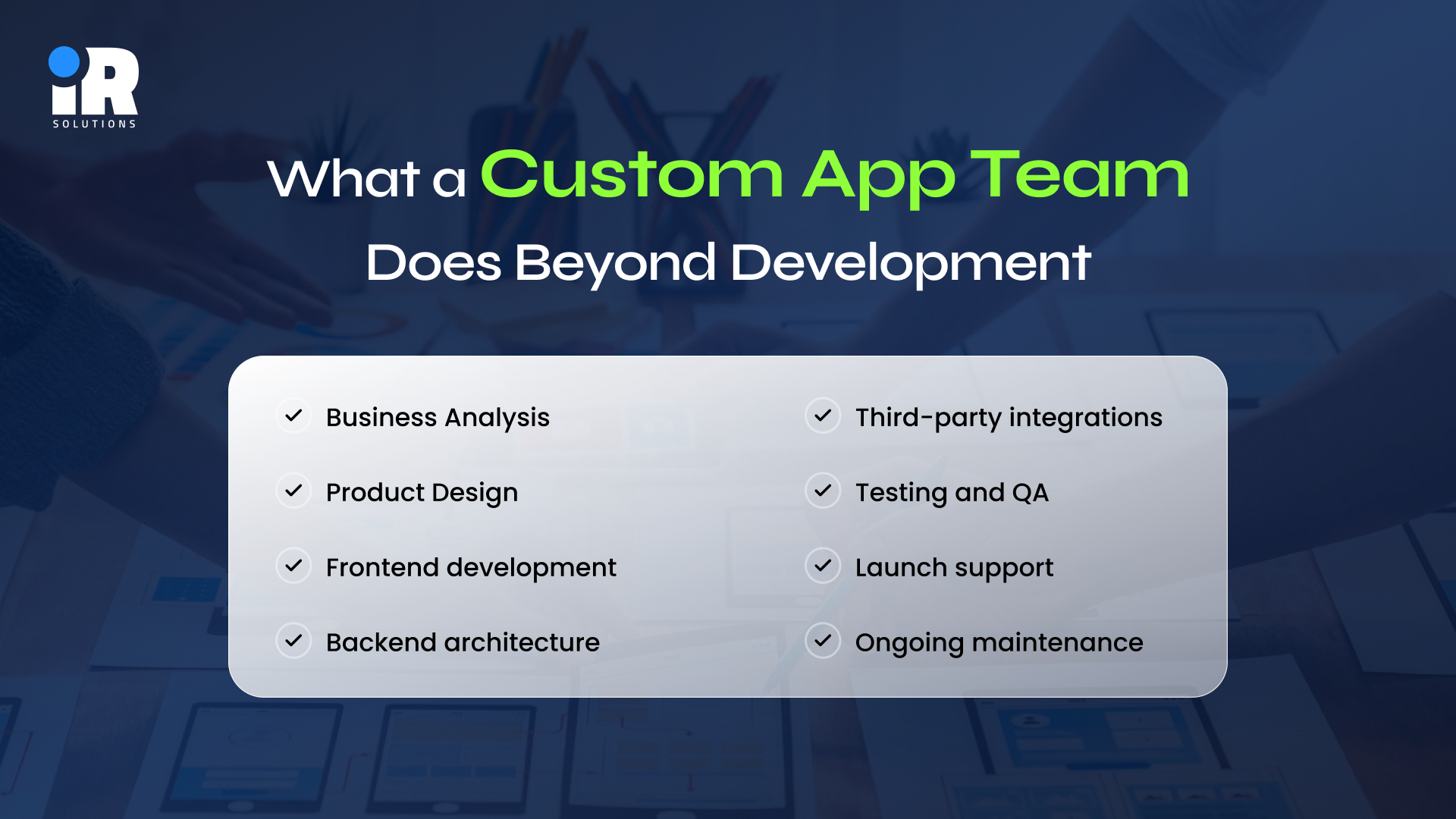
Here is what the real scope of that work looks like in practice:
- Business analysis: They spend serious time understanding the problem you are trying to solve before touching a single line of code.
- Product design: They map out user flows, wireframes, and interface logic that align with how your actual customers think and navigate.
- Frontend development: Everything your users see and interact with gets built with performance, accessibility, and usability as the priorities.
- Backend architecture: Databases, servers, APIs, and the application logic that makes everything function correctly behind the scenes.
- Third-party integrations: Payment systems, CRMs, ERPs, and logistics APIs get connected so your app works with the tools your business already depends on.
- Testing and QA: Real device testing, edge case coverage, and performance benchmarks are completed before anything goes live.
- Launch support: App store submissions, server configuration, and go-live monitoring happen so nothing breaks on the most important day.
- Ongoing maintenance: Updates, bug fixes, security patches, and new feature development continue as your product and user base grow.
This kind of engagement is not a freelancer handing you a prototype and sending an invoice. It is a long-term product partnership with shared accountability for what gets shipped.
Six Reasons Companies Choose Custom Development Over Ready-Made Tools
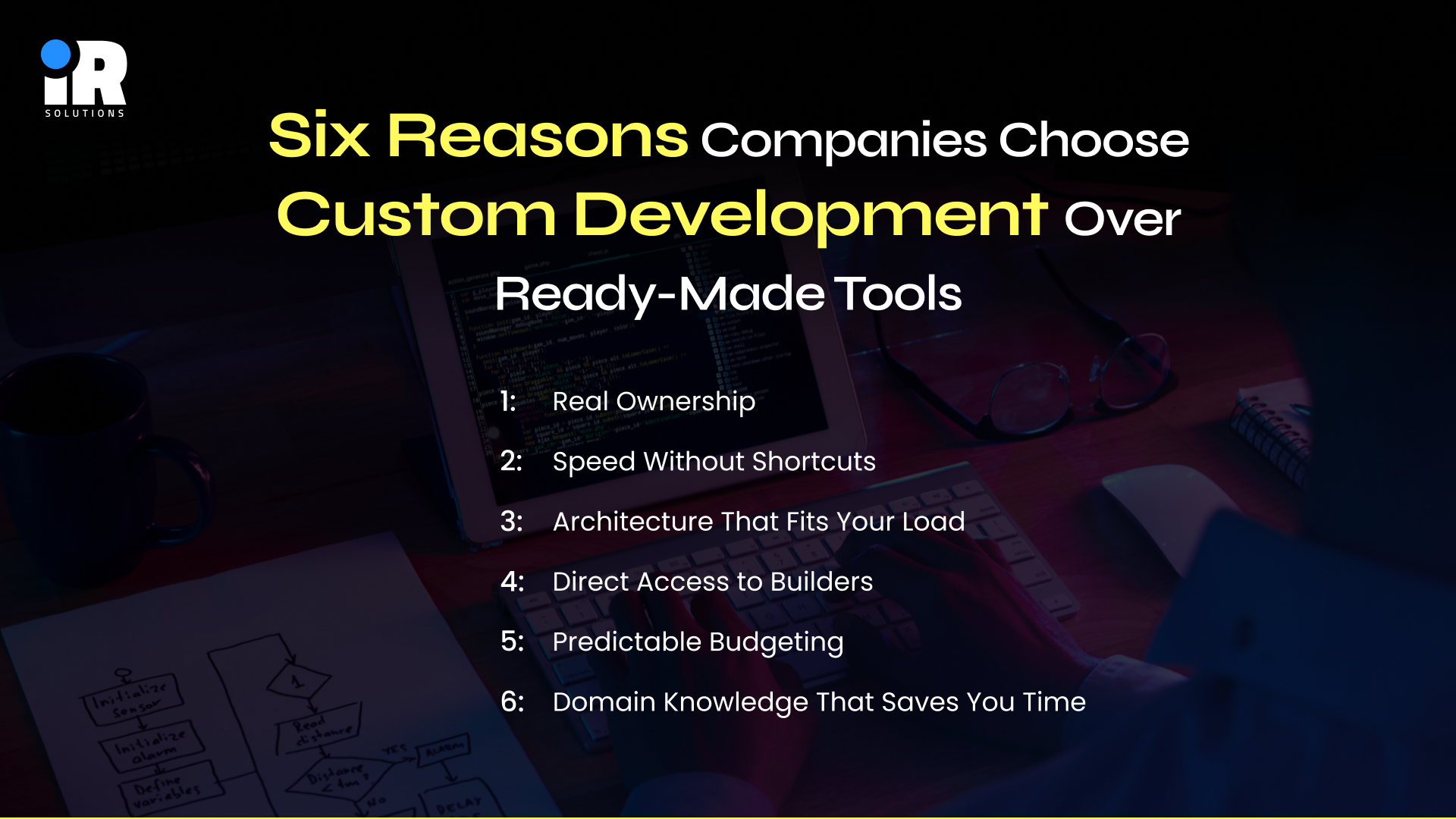
1. Real Ownership
Off-the-shelf tools belong entirely to their vendors, and your access to them depends on a subscription that can change at any time. Custom development gives you the code, the infrastructure, and complete control over what gets built or changed next.
2. Speed Without Shortcuts
A team that has already worked together for years does not waste time building trust or establishing workflow norms on your dime. They move faster because the internal process is already calibrated, and everyone knows their role from day one.
3. Architecture That Fits Your Load
Generic platforms get built to handle the most average use case across the widest possible customer base. A custom team designs your architecture specifically around your data volume, your compliance requirements, and the growth trajectory your business is actually on.
4. Direct Access to Builders
When something needs to change, or a question comes up, you talk directly to the engineers building your product, not an account manager reading from a support script with a three-day response window. Feedback gets acted on in hours, not buried in a ticketing system.
5. Predictable Budgeting
A dedicated team structure lets you plan and forecast costs with real confidence. There are no surprise overage fees, no seat-based pricing that doubles when your team grows, and no licensing jumps that catch your finance team off guard halfway through the year.
6. Domain Knowledge That Saves Your Time
Teams that have built products in your industry before come to the table with genuine context about how that space works. They already understand the compliance requirements, the common integration challenges, and the user expectations that are specific to your market.
How Complex Business Problems Get Solved With Custom Apps
Generic software is designed around the most common use cases, and most growing businesses have already moved well past what common use cases can support. A courier company with custom dispatch rules, a clinic with multi-speciality intake flows, or a retail chain running a tiered loyalty program will hit the ceiling of off-the-shelf tools faster than any vendor will admit during the sales process.
Custom mobile development teams begin from your actual reality, your data model, your compliance constraints, your user journey, and the operational edge cases your team handles every single day. They do not arrive with a pre-built template and ask your business to conform to it. That is why many businesses choose to hire mobile developers who can build around their exact workflows instead of forcing them into rigid software limitations.
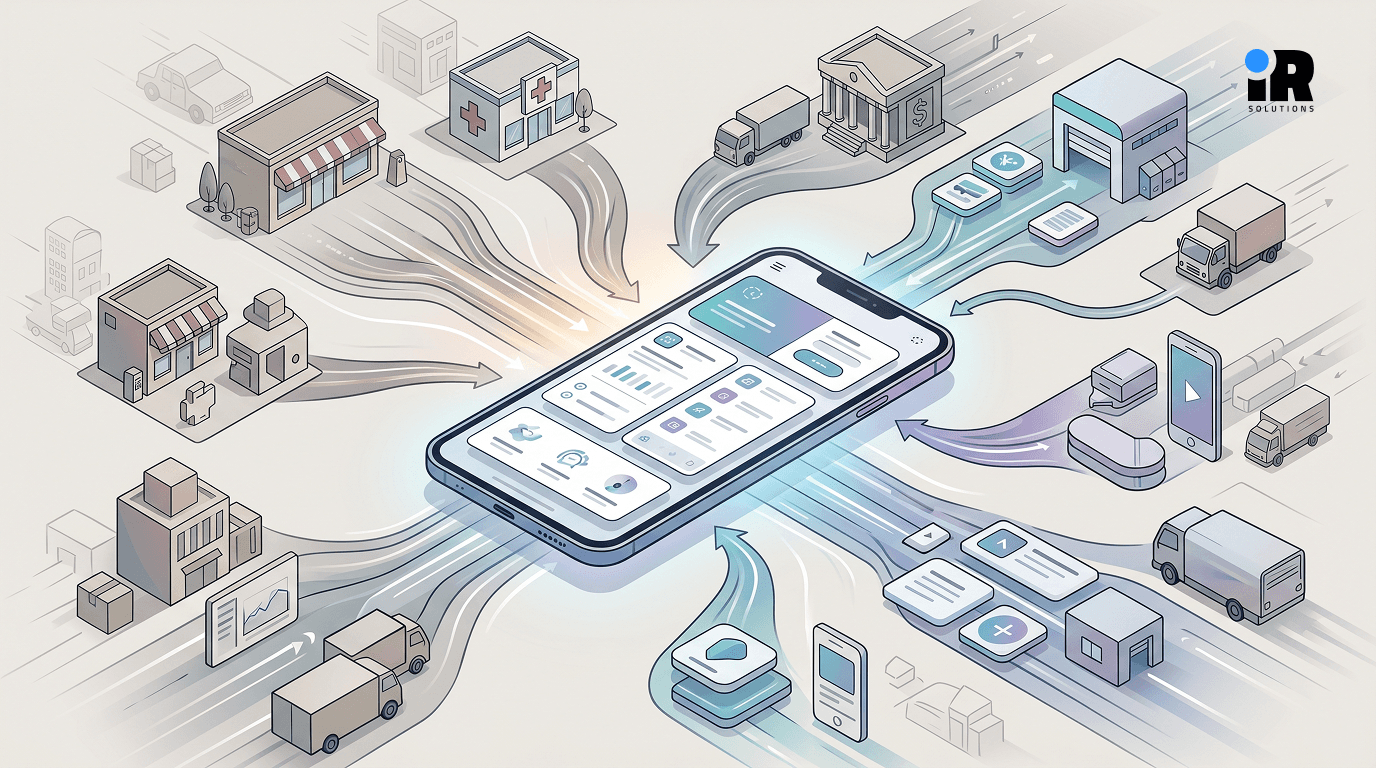
A common scenario is a business running three separate SaaS platforms, each covering a different part of the same workflow, with none of them communicating reliably with one another. The operations team ends up manually copying data between systems for hours every day just to keep records accurate. A single custom app can replace all three, integrate cleanly with existing infrastructure, and permanently return that time to the business, compounding into something significant over a full year.
This is one of the biggest benefits of custom app development for enterprise-level processes, especially for organizations managing complex workflows across multiple departments.
The Three-Year Cost Picture Nobody Talks About
The upfront cost of custom development tends to look high when you first see the proposal, and that reaction is completely understandable. The three-year picture looks considerably different when you run the numbers honestly.
What SaaS platforms actually cost over time:
- Monthly fees tied to user count that increase automatically as your team and customer base grow.
- Per-seat pricing that nobody budgets accurately for when the company doubles in size within eighteen months.
- Integration costs that pile up every time a new tool needs to connect to a platform that was not built to accommodate it.
- Developer hours spent building workarounds for platform limitations that are outside your control and never get fixed.
- Zero ownership at the end of any of it, you are renting access, not building anything that belongs to you.
What a custom mobile team costs over the same period:
- Higher investment is concentrated in the first six to twelve months, while the core product is designed and built.
- Stable and predictable operational costs once the product is live, tested, and running in production.
- No per-seat or per-user licensing fees, regardless of how significantly your team or customer base expands.
- Features built precisely to your process and your workflows, which means workarounds simply stop being necessary.
- A codebase that sits on your balance sheet as a real business asset with increasing value over time.
Run the numbers honestly over three years, and custom development wins for most businesses, the upfront cost comparison is just the wrong calculation. SaaS pricing changes, features disappear, vendors get acquired, and those hidden fees add up faster than any finance team catches them quarter to quarter.
Industries Where Custom Mobile Apps Make the Biggest Difference
Custom development delivers the clearest return in industries where generic tools consistently fall short of what the business actually requires. These are the sectors where we see the most meaningful outcomes from a purpose-built product.
Healthcare
- Telemedicine platforms with protected healthcare data management and direct EHR system integration.
- Patient intake and care coordination tools built to match the specific clinical workflows of your practice.
- Remote monitoring platforms connected to wearable or medical device data streams in real time.
Logistics
- Fleet tracking systems built with custom dispatch rules, routing logic, and driver-facing mobile interfaces.
- Inventory management across multiple warehouse locations with real-time sync and exception alerting.
- Driver-facing mobile apps designed specifically for low-connectivity environments and route variability.
Retail
- Loyalty and rewards programs with fully custom tier structures, redemption logic, and expiration rules.
- In-store mobile tools for sales associates to manage clienteling, product lookup, and inventory checks.
- Omnichannel order management systems that bridge physical store operations and digital sales channels cleanly.
Fintech
- Transaction platforms with layered authentication, fraud detection hooks, and full regulatory compliance controls.
- Portfolio and account management dashboards pulling live data feeds from multiple financial data sources.
- Lending or insurance applications with custom underwriting workflows and document verification steps.
Education
- Learning platforms with adaptive content delivery and granular progress tracking for individual students.
- Administrative dashboards that give teachers and program managers the performance data they actually need.
- Live session tools with embedded assessments, attendance tracking, and engagement measurement built in.
The growing demand for custom applications reflects a broader trend in how businesses operate today. Read more about it here: why industries are shifting to app-driven models.
Avoid the Mistakes That Cost Businesses Before They Even Start Building
A large number of companies find their way to us after a failed first attempt at custom development somewhere else. The mistakes that caused those failures are almost always the same ones repeated across different industries and team sizes.
- A vague brief handed to a development team leads directly to runaway costs, missed milestones, and a product that does not match what the business actually needed.
- Budget-level teams tend to produce budget-level results, and the cheapest proposal usually reflects something important being cut from the scope without telling you.
- Moving straight into development without validating the product idea or mapping user flows is how companies end up with a finished app that nobody actually wants to use.
- An app is not finished when it ships to the app store, and a product with no maintenance budget degrades faster than most business owners expect.
- Who owns the code repository, the design source files, and the server credentials should be settled in writing before a single sprint begins.
- Testing that only happens at the finish line catches expensive, time-consuming problems far too late for them to be fixed without significant rework.
Working through each of these questions before a project begins is most of what a thorough discovery session actually accomplishes.
If you want to walk through what this process would look like specifically for your project, schedule a call with our team.
When a Custom App Becomes a Business Necessity
Not every company is at the right stage for a custom mobile development investment, but some companies are clearly overdue for it and have not recognized the signs yet.
These are the signals worth taking seriously:
- Your team relies on multiple disconnected tools just to complete a single end-to-end workflow every day.
- Your customers are requesting features that your current platform has explicitly said it will not build.
- Someone on your team manually exports and imports data between systems on a weekly or daily basis.
- Your competitors have mobile product experiences that your current technology stack simply cannot match.
- Your product roadmap includes capabilities that no existing platform on the market currently provides.
- You are approaching a fundraising round and need a real, working product to put in front of investors.
If three or more of these are accurate descriptions of where your business sits right now, the conversation about custom development is already overdue.
Why Custom Development Is a Long-Term Business Asset
A lot of companies categorize custom development as a cost center when they are budgeting for it. That framing undersells what a well-built custom product actually is from a business perspective.
A properly built custom mobile product gives you things a SaaS subscription cannot come close to providing:
- A codebase that belongs entirely to your company and can be extended in any direction as the product evolves.
- Infrastructure that was designed specifically for your traffic patterns rather than averaged across tens of thousands of other customers.
- Data that lives entirely within your environment and can be analyzed or exported without any vendor restrictions or additional fees.
- A product that increases in actual business value as your user base grows and your feature set deepens over time.
- A real exit asset if you ever seek acquisition or additional funding, investors distinguish sharply between what you own and what you rent.
Companies that commit to custom development early tend to move faster, operate with less friction, and attract stronger technical talent because the work is more meaningful and the ownership is clearer. Those who wait usually face a harder, costlier rebuild under pressure, and the longer they delay, the more competitive ground they give up to businesses that made the call sooner.
Conclusion
Most businesses do not realize how much their outdated software is costing them until they finally stop and do the math honestly. Lost hours, manual workarounds, and tools that half-work together quietly drain more budget than any single line item shows. The companies that recognize this early and act on it do not just save money, they build a foundation that actually supports where the business is going next.
Hiring a custom mobile software development team is not just a technology choice, it is a decision about ownership, control, and what your product will actually be capable of delivering three or five years from now. Businesses looking for a reliable custom mobile app development company can benefit from the experience and long-term development approach offered by IR Solutions, which has helped businesses across multiple industries build solutions that support sustainable growth.
Frequently Asked Questions
How long does building a custom mobile app typically take?
Most projects run between three and six months, depending on complexity, integrations, and feature scope.
Is a custom development team more expensive than off-the-shelf software?
Off-the-shelf software keeps adding hidden costs over time, and by year three, custom is often the cheaper option.
Which industries benefit most from custom mobile app development?
Healthcare, logistics, fintech, retail, and education consistently see the highest measurable return on investment.
Do I own the app once the development team finishes building it?
Yes, you own the full codebase, all design assets, and every piece of associated intellectual property.
How do I know whether my business is ready for a custom mobile app?
If your current tools cannot support your workflows or your growth plans, you are ready to build.
How does the development team handle bugs and updates after the app launches?
Post-launch support covers ongoing bug fixes, performance monitoring, security updates, and new feature development.