



Your enterprise just deployed an AI chatbot to handle customer inquiries, and within weeks, it quietly became your biggest regulatory liability. Every conversation it processes could be storing sensitive user data, routing it through third-party servers outside your jurisdiction, and leaving your organization exposed to GDPR fines that reach up to 4% of global annual revenue. Finance, healthcare, and legal teams are discovering this not during planning, but during audits. The real question your board should be asking is not whether AI chatbots drive business value, they clearly do. The question is whether your chatbot infrastructure handles data the way regulators and clients actually require. IR Solutions helps organizations build AI systems that are secure, compliant, and built to last.
What Separates AI Chatbot Security from Traditional Software Security
AI chatbots differ fundamentally from traditional software user inputs that traverse multiple systems (app servers, LLM APIs, memory layers) in seconds, creating exposure points that standard perimeter security was never built to handle. This demands a new security mindset from both leadership and technical teams. In that case, businesses need to hire AI/ML developers who understand secure AI architecture, data handling, and compliance requirements. Each transition in that chain is a potential data leak that your existing controls likely overlook.
Here is what makes AI chatbot security genuinely different from what your team may already have in place:
- Unstructured data collection means users can type anything, including sensitive personal information that your system was never designed to receive.
- Third-party LLM processing means user inputs may be sent to external AI providers whose data handling practices differ from your own policies.
- Persistent session logging means that conversation records accumulate over time and often contain personally identifiable information that nobody actively reviews.
- Prompt injection vulnerabilities allow attackers to craft inputs that override the chatbot's behavior and extract internal configuration or sensitive data.
- Output unpredictability means the chatbot may generate responses that inadvertently reference confidential business information from its training context.
Any enterprise operating at scale needs to treat these risks as first-class concerns during the design phase, not as edge cases to handle after the chatbot is already serving thousands of users each week.
Businesses that want fewer delays and better chatbot outcomes often begin with a clear requirements plan like the one covered in how businesses define AI chatbot requirements before development.
Access Controls for AI Chatbots That Withstand Real Audit Scrutiny
Access control failures are among the most commonly cited findings in enterprise chatbot security audits, and they almost always come down to the same underlying problem. Permissions were granted based on convenience during development and never properly reviewed or restricted before the system went live.
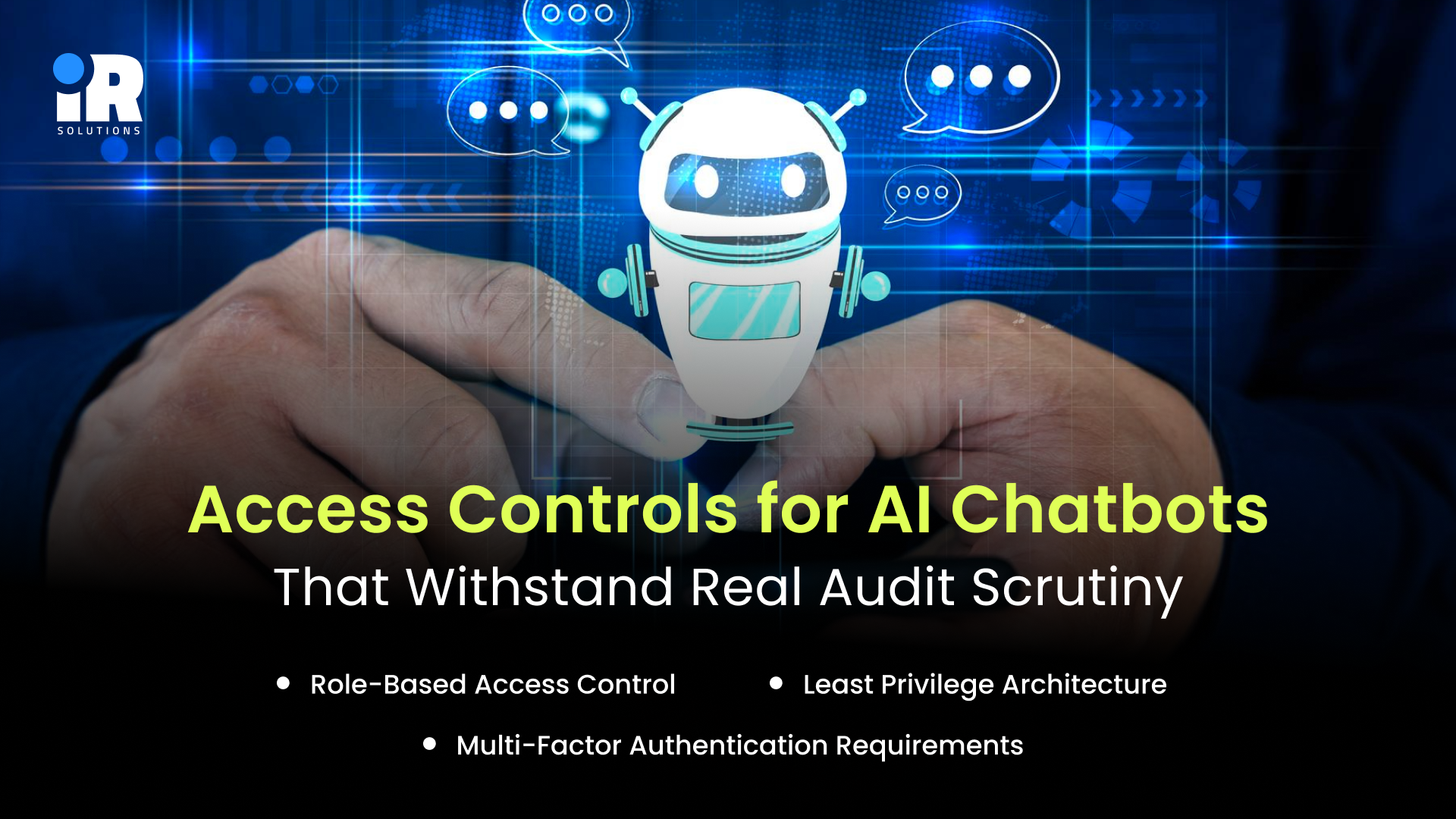
Role-Based Access Control
Most chatbot breaches happen because the wrong person had access to information they never needed. Every person touching your backend reviewing logs, managing configuration, or maintaining infrastructure should operate within a defined role with permissions your security team has approved. Developers shouldn't have a direct path into production data, analysts shouldn't trace records to individual users, and administrators shouldn't browse conversation histories. Production conversation data is your most sensitive asset; treat it that way.
Least Privilege Architecture
Broad permissions granted during development have a habit of surviving into production, and that's where exposure begins. Every component in your stack, API keys, service accounts, and database users, should carry only the access it needs for its specific job. Your LLM credentials handle inference only, your database account reads and writes but never exports or modifies schema, and your logging setup accepts writes from the application but restricts reads to security and compliance teams. If a component doesn't need a permission, it shouldn't have one.
Multi-Factor Authentication Requirements
Password-only access to systems holding conversation data isn't just poor practice, it's a compliance failure waiting to be flagged. Every administrative function, whether model configuration, log databases, or deployment pipelines, must sit behind multi-factor authentication without exception. ISO 27001 and SOC 2 treat this as a baseline requirement, and it's typically the first thing an auditor checks.
AI Chatbot Security Testing That Keeps Pace with Real Threats
Security testing for an AI chatbot isn't a launch-day checkbox, it's an ongoing program that evolves as threats do.
- Prompt Manipulation Defense: Prompt injection lets attackers override safety controls and extract sensitive system information entirely.
- Security Testing: Run structured exercises where testers craft increasingly sophisticated injection attempts regularly.
- Automated Fuzzing: Generate adversarial inputs at scale to catch inconsistent chatbot behavior before attackers do.
- Backend Testing: APIs, databases, admin panels, and deployment pipelines all need systematic penetration testing regularly.
- API Coverage: Include LLM provider API connections in your penetration testing scope without exception.
- Dependency Scanning: Automate vulnerability scanning across your supply chain and patch without waiting for release cycles.
Compliance Frameworks Your Enterprise Chatbot Must Address
Depending on your industry, geography, and the nature of the data your chatbot handles, you may need support through specialized AI/ML services that align model deployment with security and compliance requirements. Understanding how each framework applies to your chatbot specifically is essential for building a compliance posture that holds up under scrutiny.
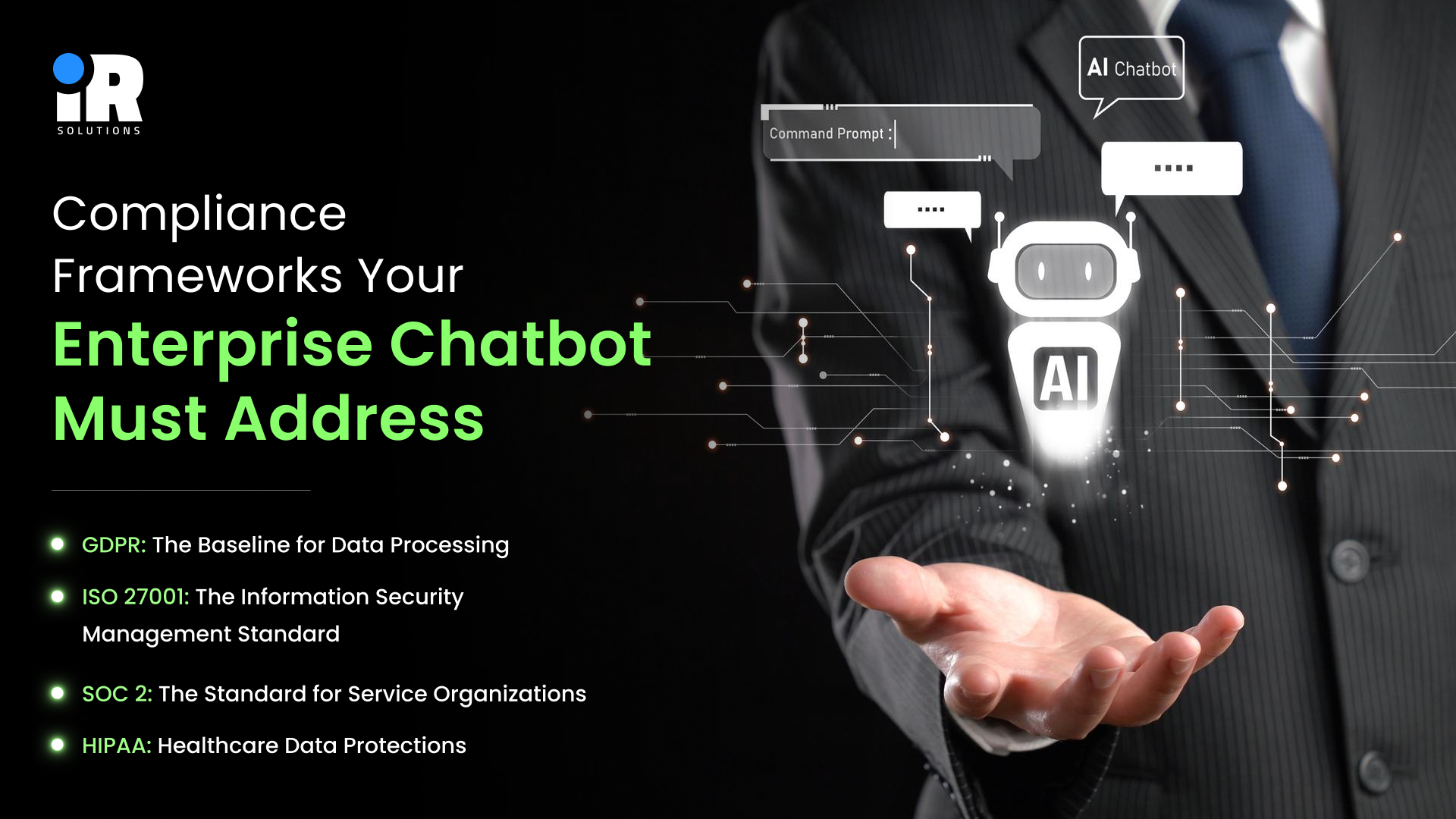
GDPR: The Baseline for Data Processing
GDPR is the framework most enterprise chatbot deployments need to address first, because its geographic reach extends to any organization handling EU citizen data, regardless of where the organization itself is located. The requirements covered earlier in this post, lawful basis documentation, data minimization, cross-border transfer controls, and individual rights fulfillment, are all GDPR obligations.
ISO 27001: The Information Security Management Standard
ISO 27001 is the global standard for information security management, and it applies directly to enterprise chatbot deployments that process sensitive organizational or personal data. It requires documented risk assessments, access control policies, incident response procedures, and regular security reviews, all verifiable by clients and auditors. For enterprises using chatbots in customer support, internal knowledge management, or operations, ISO 27001 gives security practices a structure that holds up under scrutiny.
SOC 2: The Standard for Service Organizations
If your organization provides SaaS products or managed services that include an AI chatbot component, your enterprise clients may require evidence of SOC 2 Type II compliance before they allow the chatbot to process their users' data. SOC 2 evaluates your system's security controls, availability, processing integrity, confidentiality, and privacy practices against a defined standard over an audit period typically six months to one year.
HIPAA: Healthcare Data Protections
If your organization operates in the healthcare sector and your chatbot may receive or process protected health information, patient diagnoses, treatment histories, prescription details, or insurance information, HIPAA applies and brings with it specific technical safeguards that go beyond what other frameworks require. Your chatbot vendor, your LLM provider, and any other third party that handles PHI on your behalf need to operate under a formal Business Associate Agreement.
EU AI Act: The Framework Taking Effect Now
The EU Artificial Intelligence Act classifies certain AI applications as high-risk based on the context in which they operate, and customer-facing AI chatbots in financial services, healthcare, human resources, and critical infrastructure fall into categories that carry significant compliance obligations. Organizations that have not yet conducted an AI Act impact assessment for their chatbot deployments should treat this as a priority item, because the compliance deadlines for high-risk AI systems are approaching and the remediation work required to meet them takes time.
How to Build a Compliant AI Chatbot from the Ground Up
Building a compliant chatbot is not a one-time checklist, it is a structured process that often requires businesses to hire AI chatbot experts who can align legal, security, and engineering requirements from day one.
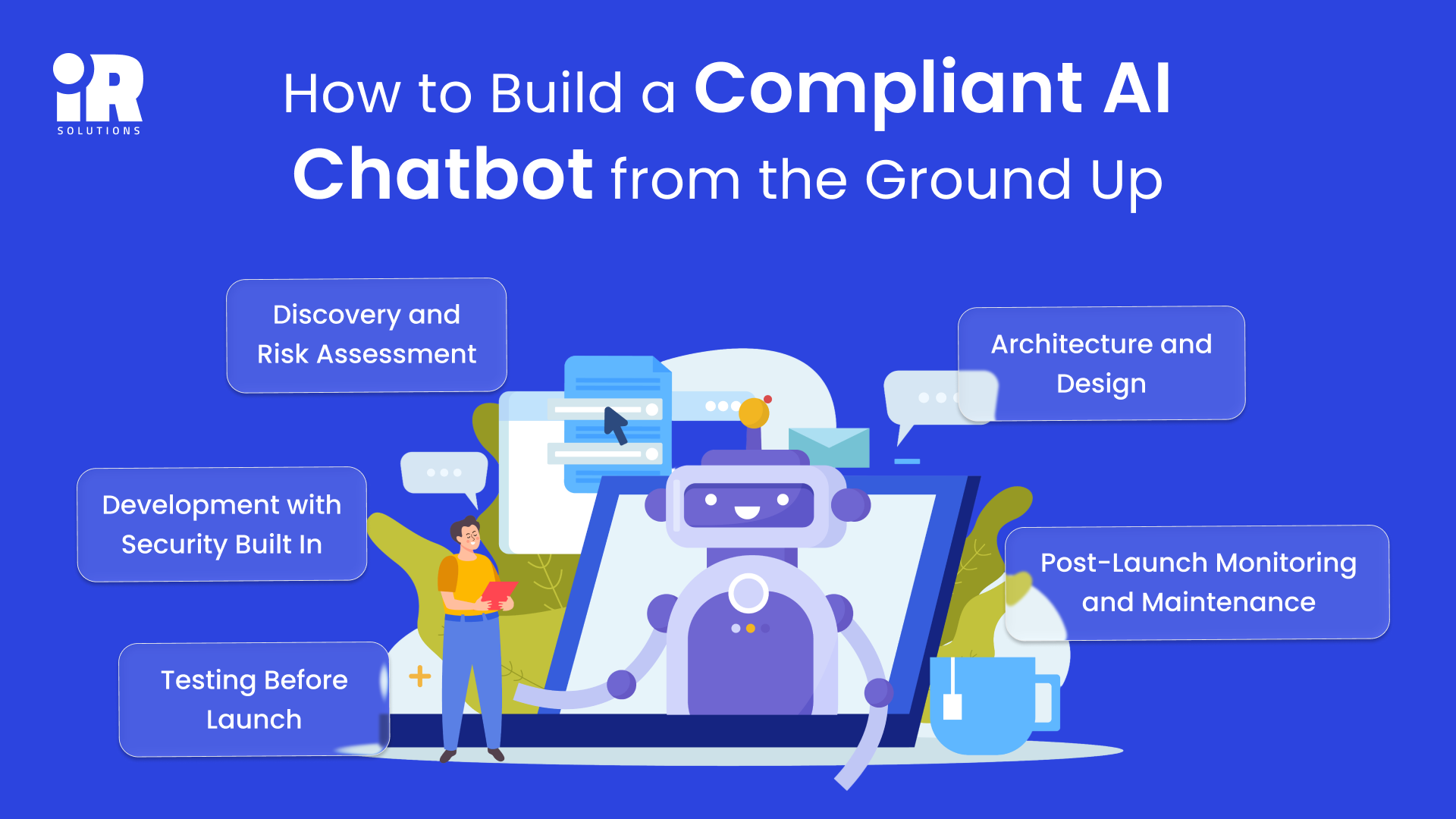
Discovery and Risk Assessment
- Map out every data type the chatbot will touch before any technical work starts.
- Identify which jurisdictions your users sit in and which compliance frameworks apply.
- Bring in your DPO, legal counsel, and security leadership, not just engineering.
- The output of this phase drives every design and implementation decision that follows.
Architecture and Design
- Treat compliance requirements from discovery as hard design constraints, not suggestions.
- Define access control roles before a single line of code is written.
- Choose your LLM provider based on its data processing terms, not just model performance.
- Build data retention and deletion architecture into the core system from the start.
Development with Security Built In
- PII detection, audit logging, encryption, and access controls belong in the foundation.
- These are not features to layer on during testing, they shape how the whole system works.
- Get these components right early, because fixing them later costs far more than building them right the first time.
Testing Before Launch
- Run prompt injection testing to catch adversarial input vulnerabilities before real users arrive.
- Penetration tests the backend infrastructure, not just the chatbot interface.
- Verify that deletion workflows and subject access requests work correctly end-to-end.
- Confirm audit log integrity controls are functioning and document every test for your compliance record.
Post-Launch Monitoring and Maintenance
- Compliance does not stop at launch, it requires a structured ongoing program.
- Monitor continuously for anomalies and run periodic security tests to catch new vulnerabilities.
- Review access controls and retention policies regularly as the system evolves.
- A strong launch-day posture can erode fast without a team actively maintaining it.
If your organization is ready to evaluate what it would take to deploy or remediate an enterprise AI chatbot with a solid compliance foundation, get a free consultation call. We will assess your current situation and give you a practical roadmap.
Conclusion
Building a secure, compliant AI chatbot is not a technical checkbox your engineering team handles once and moves on from. It is an ongoing responsibility that touches your legal obligations, your client relationships, and your organization's reputation. The risks are real, the regulatory frameworks are active, and the cost of getting it wrong shows up in audit findings and enforcement actions, not just theoretical scenarios. Every decision you make during design, development, and deployment either strengthens or weakens your compliance posture over time. IR Solutions works with enterprises to build an AI chatbot infrastructure that holds up under the scrutiny of real audits and real regulators. If your organization is ready to get this right, let's talk about what that looks like for your specific situation.
Frequently Asked Questions
What personal data does an AI chatbot typically collect?
Any text a user types, including names, contact details, and financial information shared in conversation.
Does GDPR apply directly to enterprise AI chatbots?
Yes, if the chatbot processes any data from EU citizens, GDPR applies in full regardless of where your company is based.
What exactly is prompt injection and why does it matter?
It is an attack where a crafted user input overrides the chatbot's instructions to extract or manipulate sensitive data.
How frequently should enterprise chatbot security be tested?
At a minimum annually, but also after any significant update, new integration, or reported security incident affecting the system.
What does role-based access control mean for chatbot systems?
It means each team member can only access the specific chatbot functions and data their defined role actually requires.
Are audit logs a formal GDPR requirement for chatbot deployments?
GDPR does not mandate them explicitly, but they are essential for demonstrating compliance during audits and breach investigations.
Can an enterprise AI chatbot be made fully HIPAA compliant?
Yes, with the right technical safeguards, access controls, and Business Associate Agreements with every provider handling protected health information.