




Key Takeaways
- Smart contracts are blockchain-based programs that execute predefined rules.
- They require a transaction or trigger to begin execution.
- The process includes coding, compilation, testing, deployment, execution, and state updates.
- Gas fees cover the computational work required to execute transactions.
- Oracles allow smart contracts to use external and real-world data.
- Smart contract vulnerabilities can lead to financial losses, making security testing and audits important.
- Smart contracts are used in DeFi, payments, tokenization, NFTs, supply chains, real estate, insurance, and governance.
- Once deployed, contract code is generally difficult to change unless an upgrade mechanism has been designed.
Smart contracts are programs stored on a blockchain that automatically execute predefined actions when specific conditions are met. They allow agreements and transactions to be processed through code, reducing the need for manual intervention or intermediaries. This makes them useful for applications where rules need to be applied consistently and transparently.
The process begins by defining the contract terms and converting them into code. The code is compiled, tested, and deployed on a blockchain. Once deployed, a transaction triggers the contract, causing the blockchain network to execute its functions and record the resulting state changes.
Smart contracts are used in areas such as decentralized finance, tokenization, payments, real estate, NFTs, and supply chain management. Their operation also involves important elements such as gas fees, blockchain transactions, oracles, and security audits, which can affect how reliably and efficiently a contract performs.
What Is a Smart Contract?
A smart contract is any program stored on the blockchain that automatically performs some action when certain conditions are met. It enables transactions to be completed without the need for manual approval or the involvement of intermediaries.
Smart contracts operate based on rules programmed into the contract, ensuring that transactions are predictable and transparent. They are widely used in blockchain technologies like asset tokenization, payments, and decentralized finance (DeFi).
Smart Contract Vs Traditional Contract
Aspect | Smart Contract | Traditional Contract |
Enforcement | Enforced automatically by code | Enforced by courts or third parties |
Speed | Executes instantly once triggered | Can take days or weeks to process |
Intermediaries | None required | Often requires lawyers or agents |
Transparency | Visible on a public blockchain | Usually private between parties |
Flexibility | Fixed once deployed | Can be renegotiated or amended |
Cost | Network fees only | Legal, administrative, and processing fees |
Trust model | Trust in code and network | Trust in institutions and enforcement |
How Does a Smart Contract Work?
The smart contract lifecycle looks roughly the same every time, whether it is a simple escrow payment or a complex lending protocol. This smart contract process typically covers everything from defining the terms to executing the code and recording the final result.
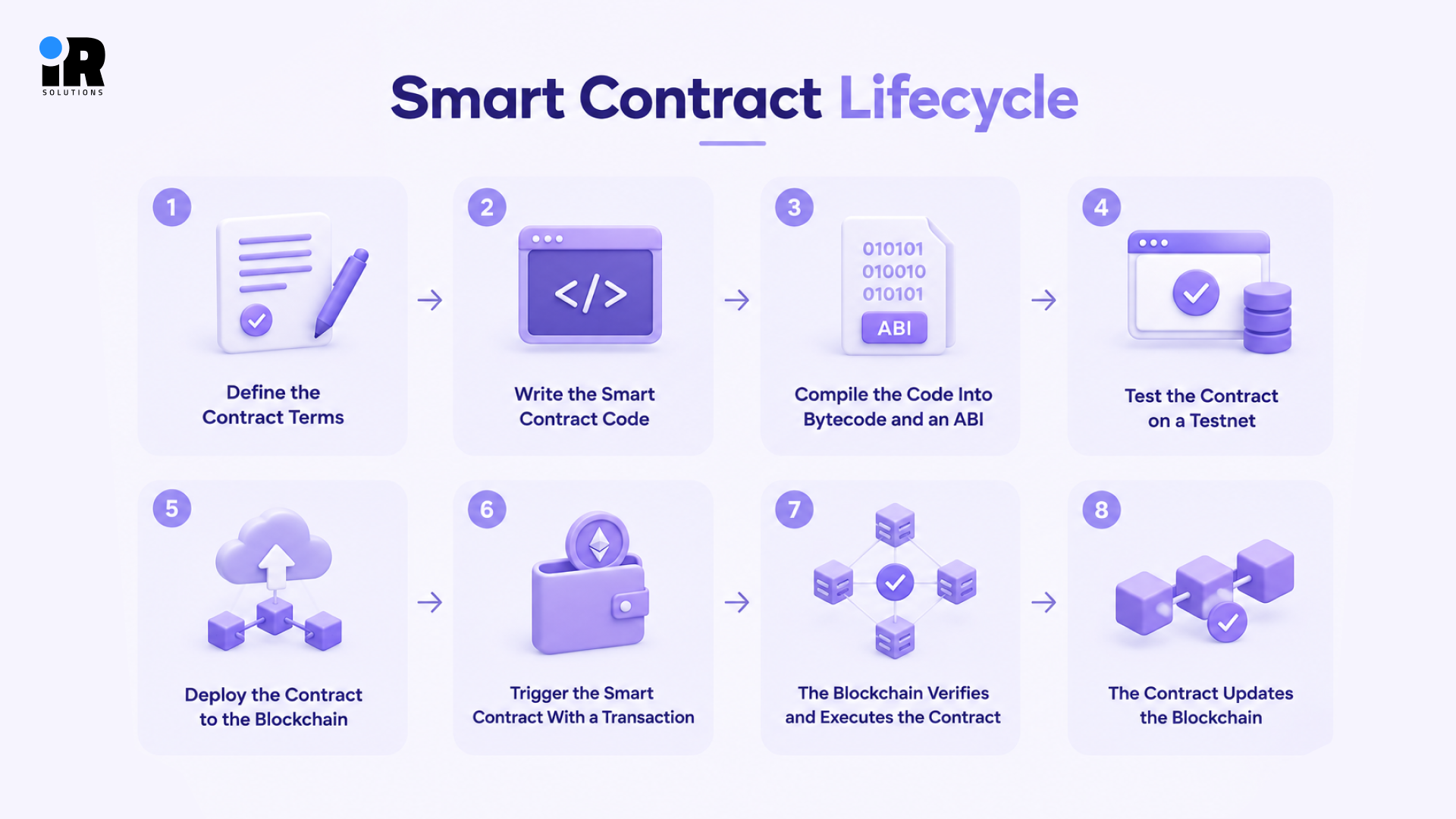
Step 1: Define the Contract Terms
Both sides agree on what should actually trigger the contract, whether that is a payment date, a delivery confirmation, or a price hitting a certain level. Vagueness here is where most problems start later.
Step 2: Write the Smart Contract Code
A smart contract developer turns those terms into code, usually in Solidity if the contract is going on Ethereum. Every condition, every action, and every possible outcome has to be spelled out here, because the contract will not improvise once it is live.
Looking to choose the right developer for your project? Explore the key skills, experience, and factors to consider in our guide to hiring smart contract developers.
Step 3: Compile the Code Into Bytecode and an ABI
The blockchain cannot read the original code as written, so it gets compiled into bytecode first. Alongside that, an ABI, short for application binary interface, tells other programs how to talk to the contract once it is deployed.
Step 4: Test the Contract on a Testnet
Before anything touches real funds, the contract runs on a testnet, a sandbox version of the blockchain built for exactly this. Developers will often push a contract through dozens of test transactions before they feel comfortable letting it near actual money.
Step 5: Deploy the Contract to the Blockchain
Once testing checks out, the contract goes live on the real blockchain, permanently. That word matters. Deployment is itself a transaction, so it comes with its own gas fee, and after this point the code is locked in.
Step 6: Trigger the Smart Contract With a Transaction
Nothing happens until someone, or another contract, sends a transaction that satisfies the conditions baked into the code. A deployed contract just sits there quietly until that trigger arrives.
Step 7: The Blockchain Verifies and Executes the Contract
Validators on the network check that the transaction is legitimate, and then the code runs exactly as written. There is no approval committee here, no manager signing off. That absence of a middleman is basically how smart contracts are executed at all.
Step 8: The Contract Updates the Blockchain
The outcome gets written permanently into the blockchain once execution finishes. Nobody can edit that record afterward, and anyone who wants to check what happened can go look it up directly.
Smart Contract Example: How an Escrow Payment Works
Escrow is probably the easiest way actually to see this in action. A buyer sends money into the contract instead of straight to the seller. It sits there, locked, until the buyer confirms the item or service actually showed up as promised. Confirm it, and the contract releases the funds to the seller automatically. If delivery never happens, the code can just as easily be written to send the money back instead. Nobody at a bank has to step in and adjudicate anything. You see this same pattern in freelance platforms, real estate deposits, and cross-border trade deals, different industries, same basic logic of holding funds hostage to a condition.
For example, a freelance platform could hold a $2,000 project payment and release it when the client approves the completed work. The same approach can be used for real estate deposits, milestone-based software projects, and cross-border trade payments.
The key benefit is that the payment rules are programmed into the contract, reducing the need for manual payment processing. However, disputes still require predefined rules, such as refunds, deadlines, or an arbitrator.
How Do Smart Contracts Access Real-World Data?
Here is the catch with blockchains: they cannot see anything happening outside themselves. No prices, no weather, no shipment tracking, none of it, unless something feeds it in. That something is an oracle. It pulls in outside data and hands it to the contract so the code has something to act on. A lending contract might lean on an oracle to check an asset's current price.
A shipping contract might use one to confirm a package actually arrived. Because the oracle is an outside source of truth, its reliability matters just as much as the contract's own code, sometimes more. Weak oracle design is a real weak point, which is why serious projects tend to pull from several oracle sources instead of trusting just one, and some add delays or averaging so a single manipulated price spike cannot immediately wreck the outcome.
What Are the Benefits and Limitations of Smart Contracts?
Smart contracts genuinely solve real problems, but they are not magic, and pretending otherwise sets people up for disappointment.
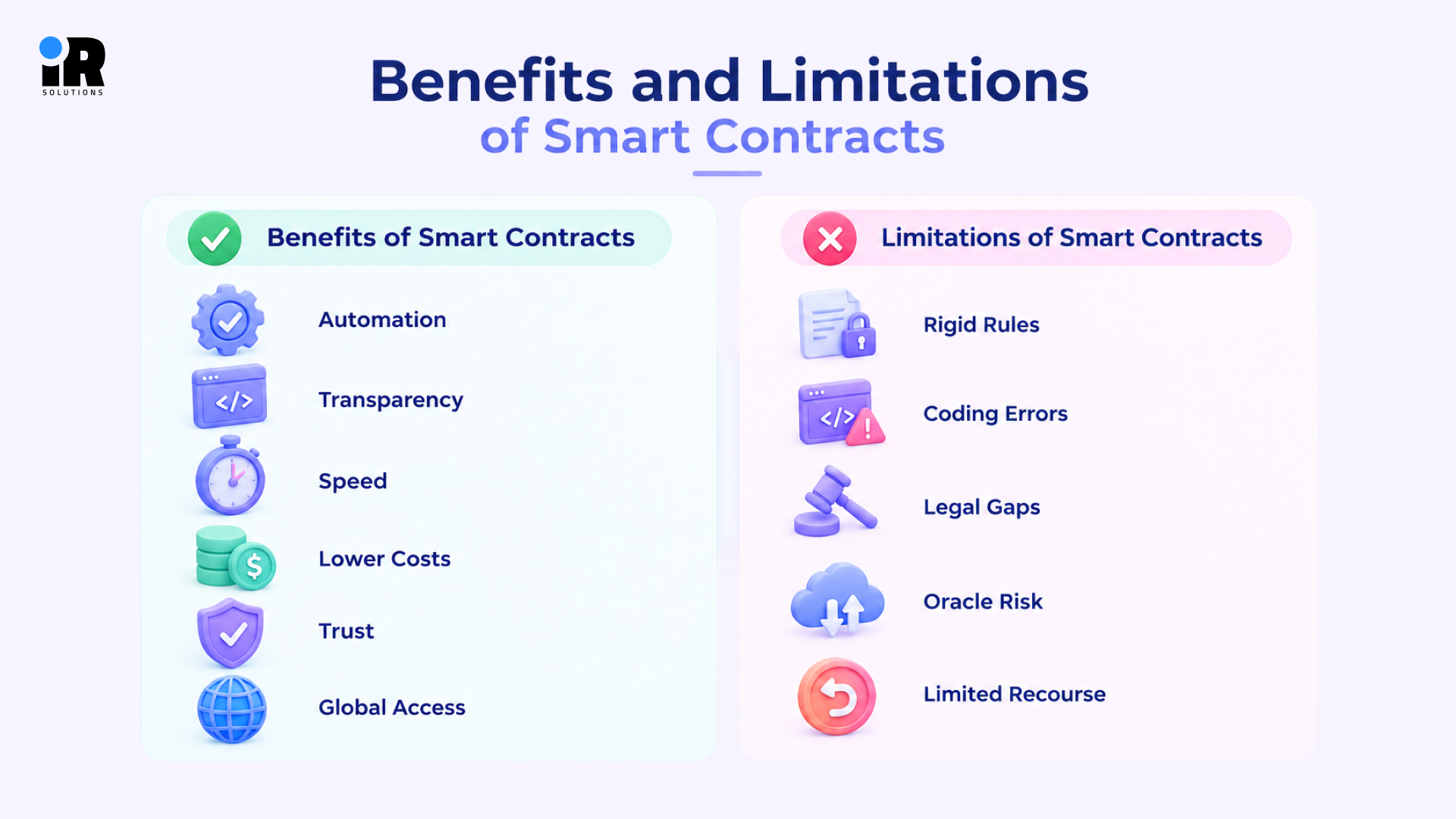
Benefits of Smart Contracts
- Automation: Once conditions are met, execution happens without anyone needing to follow up.
- Transparency: Anyone can read the contract's code and see exactly how it behaves.
- Speed: What might take days through traditional channels happens in seconds here.
- Lower Costs: Cutting out intermediaries means fewer legal and administrative fees over time.
- Trust: The code enforces the deal, so it is not down to one party's word.
- Global Access: Anyone with an internet connection can use the same contract, wherever they are.
Limitations of Smart Contracts
- Rigid Rules: A deployed contract cannot adapt to a situation its code never anticipated.
- Coding Errors: A single mistake in the code can mean real money lost, and nobody catches it until it is too late.
- Legal Gaps: Plenty of jurisdictions still have no clear stance on how smart contracts hold up in court.
- Oracle Risk: A contract is only as trustworthy as the outside data it depends on.
- Limited Recourse: Once funds move, undoing the outcome is often just not possible.
How Much Do Smart Contracts Cost to Run?
Running a smart contract requires paying gas fees, which cover the computational work needed to process transactions on the blockchain. That cost shifts with the network, how much computation the transaction actually needs, and how busy the network is at that moment.
On Ethereum, a plain ETH transfer runs about 21,000 gas, while smart contract operations typically need more than that. Deploying a contract costs even more, since its code has to get stored on the blockchain permanently. At 10 gwei and ETH sitting around $3,000, that 21,000-gas transfer works out to roughly $0.63.
Here is a simple example of how gas usage affects cost:
Transaction | Approx. Gas Used | Cost at 10 gwei, ETH = $3,000 |
ETH transfer | 21,000 | $0.63 |
Smart contract transaction | 100,000 | $3.00 |
Larger contract transaction | 200,000 | $6.00 |
These are illustrative costs, not fixed prices. Actual fees change with gas prices and the ETH market price. Costs can also be much lower on Ethereum Layer 2 networks and other blockchains such as Solana.
Developers can reduce gas costs by optimizing contract code, minimizing unnecessary storage operations, and choosing a network that suits the application's transaction volume.
What Are the Common Smart Contract Security Risks?
A smart contract is only as secure as the code someone wrote, and smart contract security has become its own entire field because of how often that code has failed.
Reentrancy Attacks
This happens when a malicious contract sneaks a call back into the original one before it has finished updating its own records. Attackers have used exactly this gap to drain funds repeatedly within a single transaction, and some of the biggest exploits in blockchain history trace back to it.
Access Control Vulnerabilities
If a contract does not properly lock down who can call certain functions, anyone might be able to call them. That kind of oversight has let unauthorized users change settings or pull out funds that were never meant to be theirs.
Oracle Manipulation and Logic Errors
Sometimes the attack targets the data feeding into the contract rather than the contract itself. Other times it is just a logic error, a small mistake in how a condition was written, sitting there waiting for someone patient enough to find it.
Why Smart Contract Audits Matter
An audit means security experts go through the code line by line before anything goes live. It costs money and time, sure, but it is nothing compared to what it costs to fix a vulnerability after funds are already gone. Most serious projects will not launch without one.
Want to avoid costly vulnerabilities before launch? Learn about the critical mistakes in smart contract development that developers should identify and fix before deployment.
Common Use Cases for Smart Contracts
These smart contract use cases keep expanding into new industries every year, which is part of why the technology has stuck around instead of fading out.
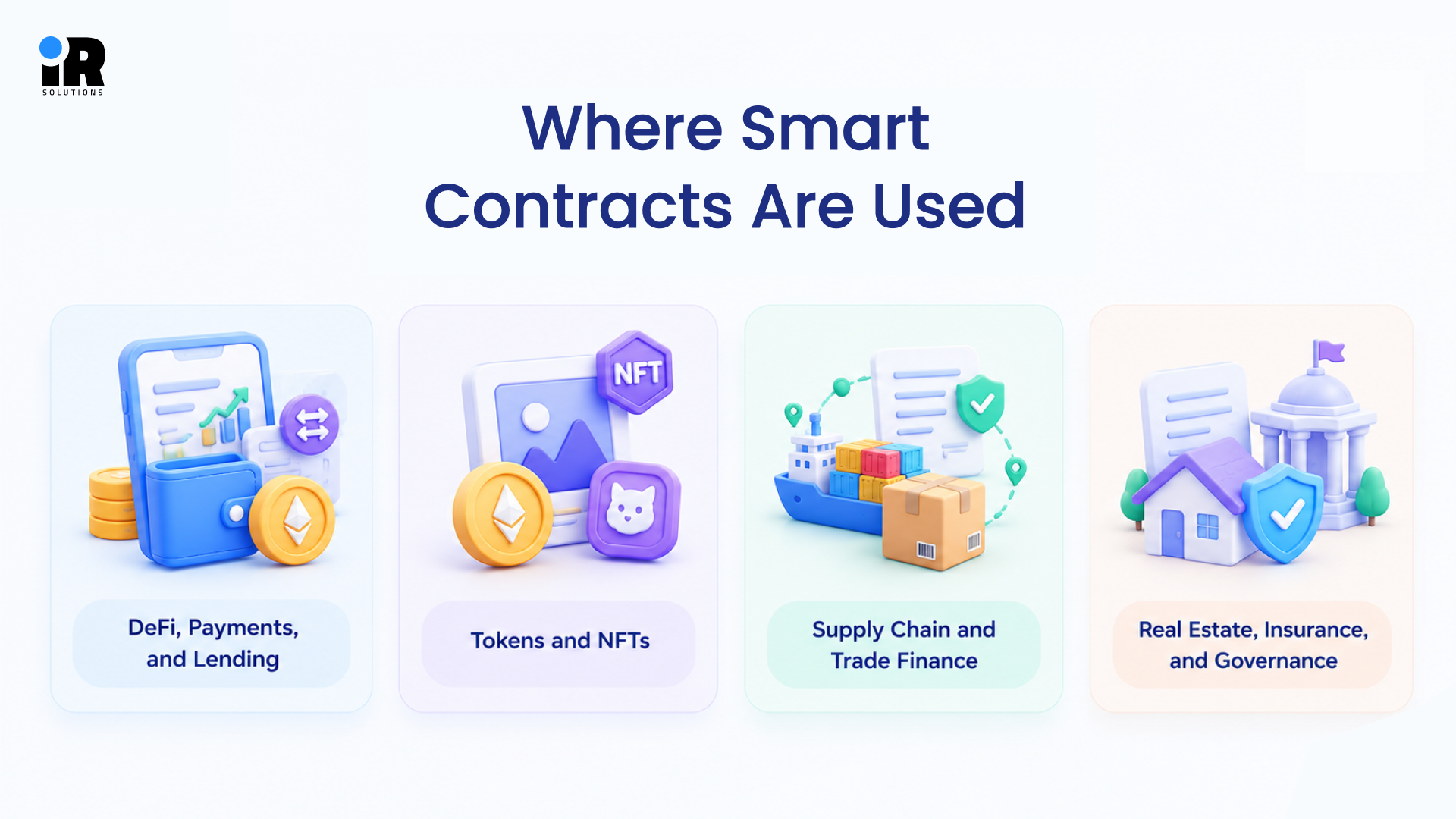
DeFi, Payments, and Lending
Decentralized finance runs almost entirely on smart contracts handling lending, borrowing, and trading without a bank anywhere in sight. Interest rates, collateral, repayments, all of it is managed by code, letting people borrow or earn yield without contacting a financial institution.
Tokens and NFTs
Both fungible tokens and NFTs rely on smart contracts to define who owns what and how that ownership can change hands. Creators can also bake royalties directly into the code, so they earn a cut every time the piece resells later.
Supply Chain and Trade Finance
A contract can release payment automatically the moment shipment tracking confirms a delivery milestone. That cuts down on disputes and speeds up payment timelines in international trade, where delays tend to be expensive for everyone involved.
Real Estate, Insurance, and Governance
Property transfers, insurance payouts, and voting systems are all starting to lean on smart contracts for automated execution. Insurance claims especially benefit here, since a verified condition can trigger a payout without weeks of manual review, and governance systems use the same logic to let token holders vote transparently.
Conclusion
Smart contracts have changed how digital agreements and transactions can be handled by turning predefined rules into blockchain-based code. They can automate execution, reduce reliance on intermediaries, improve transparency, and speed up transactions across industries such as DeFi, payments, tokenization, real estate, and supply chains. However, they also come with limitations. Coding errors, rigid rules, oracle risks, legal uncertainty, and limited recourse can create significant challenges. Once deployed, contracts are generally difficult to change, making careful development and testing essential. Security audits can help identify vulnerabilities before a contract handles real funds. As blockchain adoption grows, understanding how smart contracts work, where they provide value, and where their limitations apply will be important for businesses and developers using this technology.
Frequently Asked Questions
What Programming Languages Are Used for Smart Contracts?
Solidity dominates on Ethereum and other EVM-compatible chains. Solana developers mostly use Rust instead. Vyper is a smaller, security-focused option on Ethereum, and the choice usually comes down to the chain and the team's existing skills.
What Is an Example of a Smart Contract?
Escrow is the classic example. A buyer's funds sit locked in the contract until a condition, like delivery confirmation, is met. Once that happens, the money is released to the seller automatically, with no bank involved.
Do Smart Contracts Execute Automatically?
Smart contracts do not execute completely on their own. A transaction, another smart contract, or an automation mechanism must trigger one of its functions. Once triggered, the blockchain processes the contract according to the rules written in its code without requiring manual approval.
Who Executes a Smart Contract?
The network runs it through whatever execution environment that blockchain uses, like the Ethereum Virtual Machine. Validators check and process the transaction so everyone agrees on the outcome. No central administrator is involved.
Can a Smart Contract Be Changed After Deployment?
Once deployed, the bytecode is generally locked in for good. Some developers plan ahead with upgrade mechanisms like proxy contracts, letting the logic change later under set permissions. That flexibility adds its own governance and security risks.
How Much Does It Cost to Deploy a Smart Contract?
Cost depends on contract complexity, gas required, and current network fees. More complex contracts need more computation and cost more to store. Deploying on a Layer 2 network instead of mainnet can cut that cost significantly.
What Happens if a Smart Contract Fails?
If a smart contract transaction fails or reverts, the state changes made during that execution are generally rolled back. This means the contract returns to the state it had before the transaction was processed. However, the gas already consumed during the failed execution is normally not refunded because the network has already performed the computational work.
Which Blockchains Support Smart Contracts?
Ethereum is the best known, but far from the only one. Solana, Polygon, Avalanche, BNB Chain, and Arbitrum all support programmable contracts too. Languages, fees, and execution models vary between them, and not all are EVM-compatible.
Are Smart Contracts Legally Binding?
It depends on the jurisdiction and how the agreement is structured. Running on a blockchain doesn't automatically make something enforceable everywhere. Most businesses still pair smart contracts with a traditional legal agreement covering rights and obligations.
What Happens if the Conditions of a Smart Contract Are Not Met?
The action tied to that condition simply doesn't happen. An escrow contract, for example, keeps funds locked until the confirmation it needs arrives. What happens beyond that depends on how the contract's logic was written.
How Long Does a Smart Contract Take to Execute?
The actual computation performed by a smart contract is usually completed very quickly once the transaction is processed by the network. However, the total time a user waits depends on factors such as network congestion, gas fees, and block confirmation times. Depending on the chain, that can range from a few seconds to several minutes.


