




Key Takeaways
- Tokenized property represents defined legal or economic interests connected to real estate through blockchain-based digital tokens, enabling fractional investment and potentially faster settlement.
- Traditional property ownership can involve high capital requirements, lengthy settlement processes, fragmented records, and geographic restrictions that tokenization can help reduce.
- Smart contracts automate rental payments, dividend distribution, compliance checks, and ownership transfers without manual intermediary involvement at each transaction stage.
- Dubai is actively implementing large-scale property tokenization projects, and institutional adoption is accelerating across commercial real estate, rental apartments, and luxury assets globally.
- Tokenized property and REITs provide different forms of real estate exposure, with tokenized structures often linking investors to specific properties or property-holding entities while REITs provide exposure through shares or units in a real estate investment vehicle.
Property has always been one of the most reliable stores of wealth and one of the most difficult assets to actually access, trade, or own in any form other than outright purchase at full market value. A commercial building worth five million dollars requires a buyer who can commit that entire amount or navigate co-investment structures that have historically been available only to institutional investors with established networks. A rental apartment generating consistent income sits entirely outside the reach of an investor who has twenty thousand dollars to deploy rather than two hundred thousand. That exclusivity is not an inherent feature of real estate as an asset class. It is a consequence of the infrastructure surrounding it, and that infrastructure is changing fundamentally.
Tokenization is converting property ownership into blockchain-based digital tokens that can be held fractionally, traded globally, and settled in minutes rather than months. Dubai has already committed to large-scale property tokenization initiatives that are reshaping how one of the world's most active real estate markets operates. Institutional adoption of tokenized real-world assets is also expanding. BlackRock and Hamilton Lane have participated in tokenized fund initiatives, while dedicated real estate platforms are bringing property and property-linked interests on-chain. The model is not theoretical. It is operational, growing, and beginning to change what property ownership actually means for every category of participant in the market.
Why Traditional Property Ownership Needs to Change
The traditional property ownership model was built for a world where paper-based records, in-person transactions, and single-buyer acquisitions were the only practical options available to anyone participating in the real estate market.
That model creates specific problems that have compounded over time. High minimum investment requirements exclude the majority of potential property investors from direct ownership regardless of their financial discipline or investment intent. Settlement processes that take weeks or months to complete create counterparty risk and tie up capital in ways that no other asset class of comparable size tolerates. Geographic restrictions mean that an investor in Singapore cannot practically participate in a commercial property opportunity in Manchester without the kind of legal and banking infrastructure that most individuals and smaller institutions cannot access efficiently.
The result is a market that concentrates property ownership in a small number of participants with large capital bases and established institutional relationships, while everyone else accesses property investment indirectly through REITs, managed funds, or mortgage products that do not give them direct exposure to the assets generating the returns they are seeking.
What Does Tokenized Property Ownership Mean
Tokenized property ownership means that a real estate asset, whether a commercial building, rental apartment, or hotel property, is legally structured within an entity such as an SPV or trust, and then represented as digital tokens on a blockchain network where each token carries a defined economic and legal interest in the underlying asset.
The token is the ownership record. The blockchain is the settlement layer. Smart contracts enforce the rules governing who can hold tokens, how income is distributed, and under what conditions ownership can transfer between parties. The result is a property investment that can be held fractionally, traded on secondary markets, and managed transparently without the intermediary infrastructure that traditional property transactions require at every stage from initial acquisition through to eventual exit. This model sits at the core of modern RWA tokenization services, which extend the same framework beyond real estate to other real-world assets.
How Tokenization Changes the Property Ownership Model
Tokenization does not simply make property investing slightly more convenient. It changes the structural model of how property is owned, transferred, and managed across every dimension that the traditional approach currently handles through manual, slow, and expensive processes.
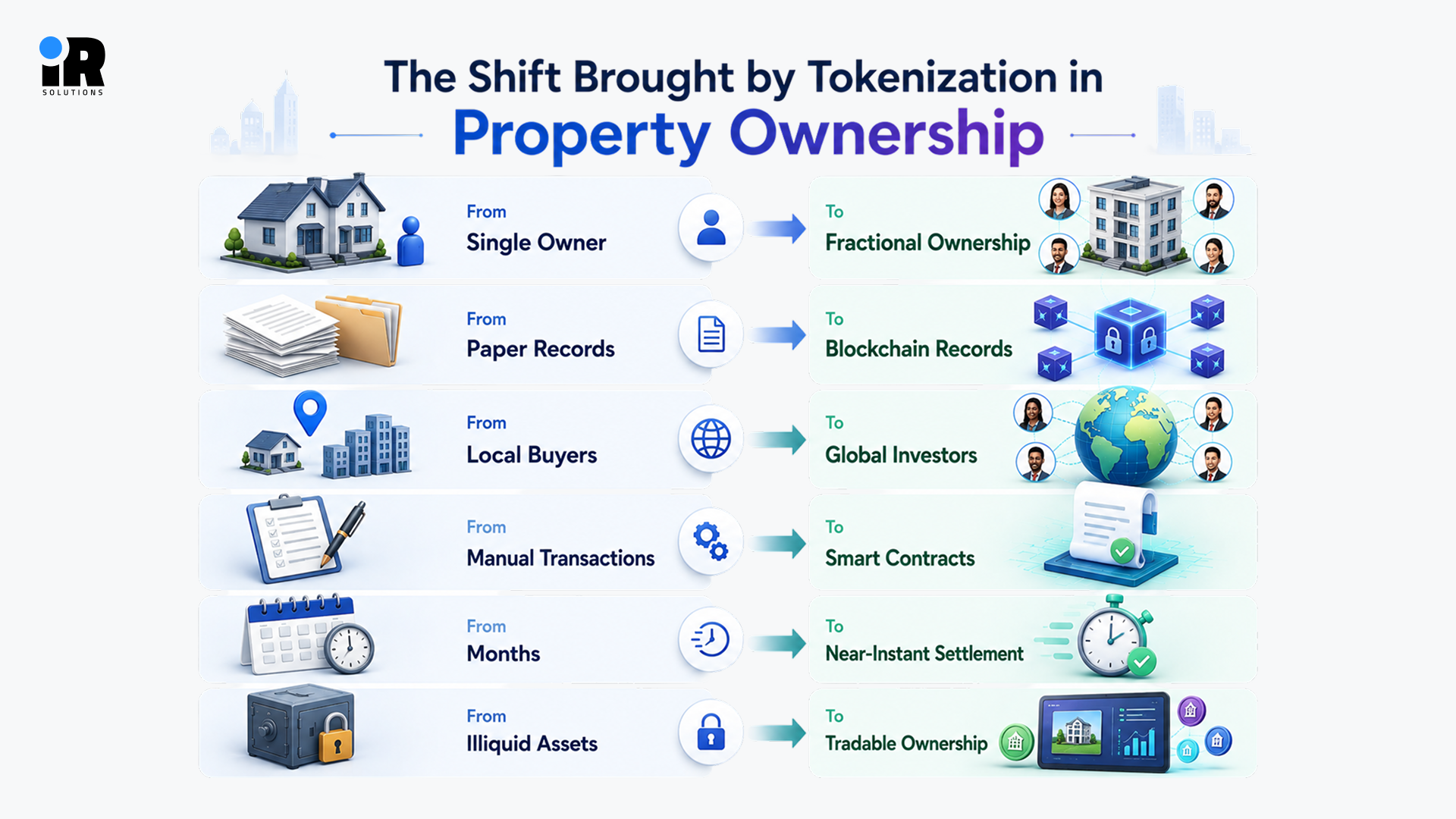
From Single Owner to Fractional Ownership
Traditional property requires one buyer or a small consortium to commit to the full asset value. Tokenization divides the asset into units that hundreds or thousands of investors can hold simultaneously, with each holding a legally recognised fractional interest proportional to the tokens they own within the total supply.
From Paper Records to Blockchain Records
Blockchain can provide an immutable record of token ownership and transfers, while legal ownership of the underlying property remains governed by the relevant legal entity, contracts, property laws, and land registry systems.
From Local Buyers to Global Investors
Traditional property transactions depend on local legal systems, local banking infrastructure, and buyers who can physically or legally participate in the market where the asset is located. Tokenized property can attract investors from any jurisdiction where the offering is legally compliant.
From Manual Transactions to Smart Contracts
Manual compliance checks, legal reviews, and transfer agent processes are replaced by smart contract logic that automatically verifies investor eligibility, enforces transfer restrictions, and executes ownership changes when predefined conditions are satisfied without any human intermediary approving each transaction.
From Months to Near-Instant Settlement
Traditional property settlement takes weeks to months depending on the jurisdiction, the complexity of the transaction, and the number of parties involved. Smart contract settlement on blockchain networks completes in minutes, eliminating the counterparty risk that exists during the extended settlement windows that traditional real estate transactions create.
From Illiquid Assets to Tradable Ownership
A property held as a single owned asset cannot be partially sold without either dividing the physical asset or engaging in complex legal restructuring. Tokenized ownership allows an investor to sell a portion of their position on a secondary market without the underlying property changing hands, which transforms a fundamentally illiquid asset into one with practical exit options at a fraction of the investment horizon that traditional property requires.
Traditional Property Ownership vs Tokenized Property Ownership
The structural differences between the two models are clearest when viewed side by side across the dimensions that matter most to investors and asset owners.
Dimension | Traditional Ownership | Tokenized Ownership |
Minimum investment | Full asset value or large consortium | Fraction of total token supply |
Settlement time | Weeks to months | Minutes |
Ownership record | Paper or centralised digital records | Immutable blockchain ledger |
Liquidity | Very low without full asset sale | Secondary market trading available |
Geographic access | Local buyers only | Global investor pool |
Income distribution | Manual payment processing | Automated smart contract distribution |
Compliance | Manual review at each transaction | Automated enforcement on every transfer |
Transparency | Limited, intermediary-confirmed | Full on-chain visibility |
Transfer process | Legal documentation and intermediaries | Smart contract execution |
Portfolio management | Single asset, high capital required | Diversified fractional positions |
Benefits of Tokenized Property Ownership
The benefits of tokenized property ownership are not incremental improvements to the traditional model. They represent structural advantages that the traditional model cannot replicate within its existing architecture.
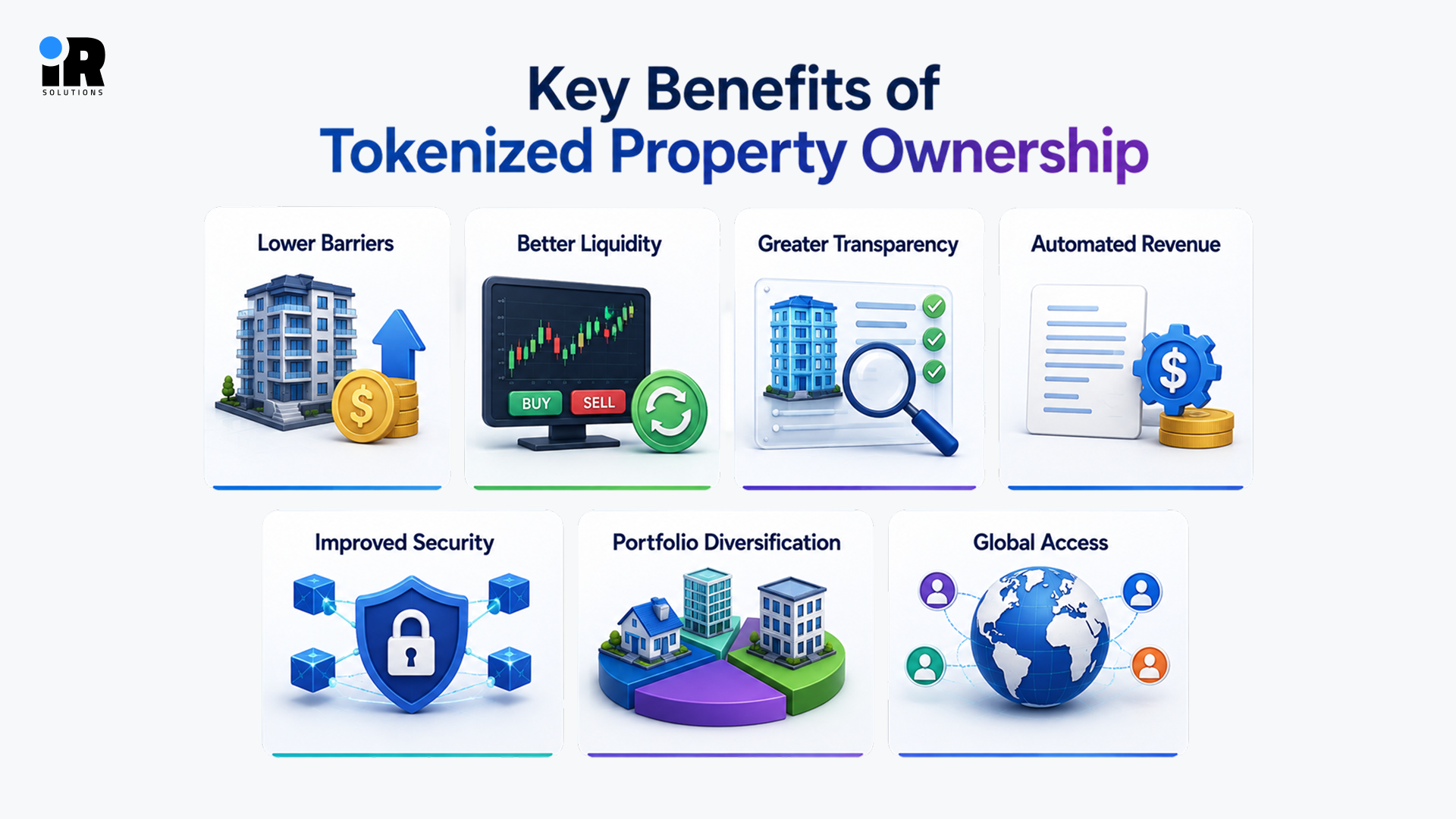
Lower Barriers
A property worth ten million dollars can be divided into tokens accessible at a few hundred dollars each, allowing investors with modest capital to participate in commercial real estate markets that previously required institutional-level commitments to enter at any meaningful ownership stake.
Better Liquidity
Secondary market trading allows investors to exit fractional positions without requiring the sale of the underlying property, which transforms the liquidity profile of an asset class that has historically required investors to lock capital for years before any exit became available.
Greater Transparency
Every ownership change, income distribution, and compliance event is recorded permanently on the blockchain and readable by all authorised parties without requiring an intermediary to confirm the current state of the ownership record or the distribution history.
Automated Revenue
Rental income, dividend distributions, and yield payments flow automatically to token holders through smart contract logic that calculates each holder's proportional entitlement and executes payment without manual reconciliation between payment periods that can introduce delays and errors.
Improved Security
Blockchain-based ownership records cannot be altered, duplicated, or lost in the way that paper-based or centralised digital records can be compromised. The immutability of the ledger provides a level of ownership security that paper title systems have never consistently delivered across different jurisdictions.
Portfolio Diversification
Fractional investment allows an investor to spread capital across multiple properties in different asset classes and geographies rather than concentrating all available capital in a single property that represents either the full investment or nothing at all.
Global Access
Token offerings can reach investors in any jurisdiction where the offering is legally structured and compliant, removing the banking and legal infrastructure barriers that have historically prevented international participation in local property markets.
Risks and Limitations of Tokenized Property Ownership
Tokenization can make property investment more accessible and programmable, but it does not remove the risks associated with real estate ownership or investment. The technology introduces new considerations around regulation, liquidity, cybersecurity, legal enforceability, and the relationship between on-chain tokens and the underlying physical asset.
Regulatory and Legal Uncertainty
The legal status of a tokenized property interest depends on how the asset and token are structured and on the regulations of the jurisdiction where the offering is made. A token may represent direct ownership, an interest in an SPV or trust, or specific economic and contractual rights rather than direct ownership of the physical property.
Issuers must therefore consider securities regulations, property laws, KYC and AML requirements, taxation, investor eligibility, and transfer restrictions before offering tokens to investors. Regulatory requirements can also differ significantly between jurisdictions, making cross-border tokenization more complex than simply placing a property on a blockchain.
Secondary-Market Liquidity Is Not Guaranteed
Tokenization can make fractional property interests technically transferable, but it does not automatically create a liquid market. Investors still need an approved marketplace, eligible buyers, sufficient trading activity, and a legal framework that permits secondary transfers.
A tokenized property may therefore remain difficult to sell if there is limited investor demand or if transfer restrictions apply. The availability of blockchain-based trading infrastructure should not be treated as a guarantee that investors can exit their positions whenever they choose.
Smart Contract and Cybersecurity Risks
Smart contracts automate important functions such as token transfers, compliance rules, and income distributions, but errors in contract code can create financial and operational risks. Vulnerabilities may allow unauthorized transactions, incorrect distributions, or other unexpected outcomes.
Security also extends beyond the smart contract itself. Wallets, custody systems, investor accounts, APIs, identity verification systems, and the tokenization platform can all become potential points of failure. Independent security audits and ongoing monitoring are therefore important components of a property tokenization platform.
Underlying Property Risk Remains
Tokenization does not change the fundamental risks of the underlying real estate investment. Property values can decline, tenants can default, occupancy can fall, maintenance costs can increase, and rental income can change with market conditions.
Investors also remain exposed to factors such as interest rates, local property demand, economic conditions, and changes in the property's operating performance. Dividing a property into digital tokens changes the investment structure, but it does not remove the financial risks associated with the asset itself.
Dependence on Off-Chain Information
A blockchain can record token transactions, but important information about the physical property remains outside the blockchain. Property valuations, rental agreements, maintenance records, insurance, tax documents, legal ownership, and tenant information may all depend on external systems and third parties.
This creates an important distinction between the transparency of token transactions and the accuracy of the information connected to the underlying property. A transparent blockchain record does not by itself guarantee that every off-chain property record is accurate or current.
Custody and Investor Protection
Token holders may depend on custodians, wallets, platforms, and other service providers to access and manage their investments. Loss of private keys, platform failures, custody problems, or inadequate investor protection mechanisms can create risks that do not exist in exactly the same form in traditional property ownership.
The strength of a tokenized property investment therefore depends not only on the blockchain network but also on the legal entity holding the asset, the custody arrangements, the platform infrastructure, and the protections available to investors.
Cross-Border Investment Restrictions
One of the potential advantages of tokenization is broader investor access, but international participation remains subject to local laws. Foreign ownership restrictions, securities regulations, tax obligations, sanctions, KYC and AML requirements, and currency controls can limit who is allowed to purchase or transfer tokenized property interests.
Tokenization can simplify parts of the digital investment process, but it does not remove the legal requirements associated with investing across borders.
Who Benefits from Tokenized Property
Tokenization creates value for multiple participants across the property investment ecosystem rather than benefiting only the asset issuer or only the investor at the expense of the other.
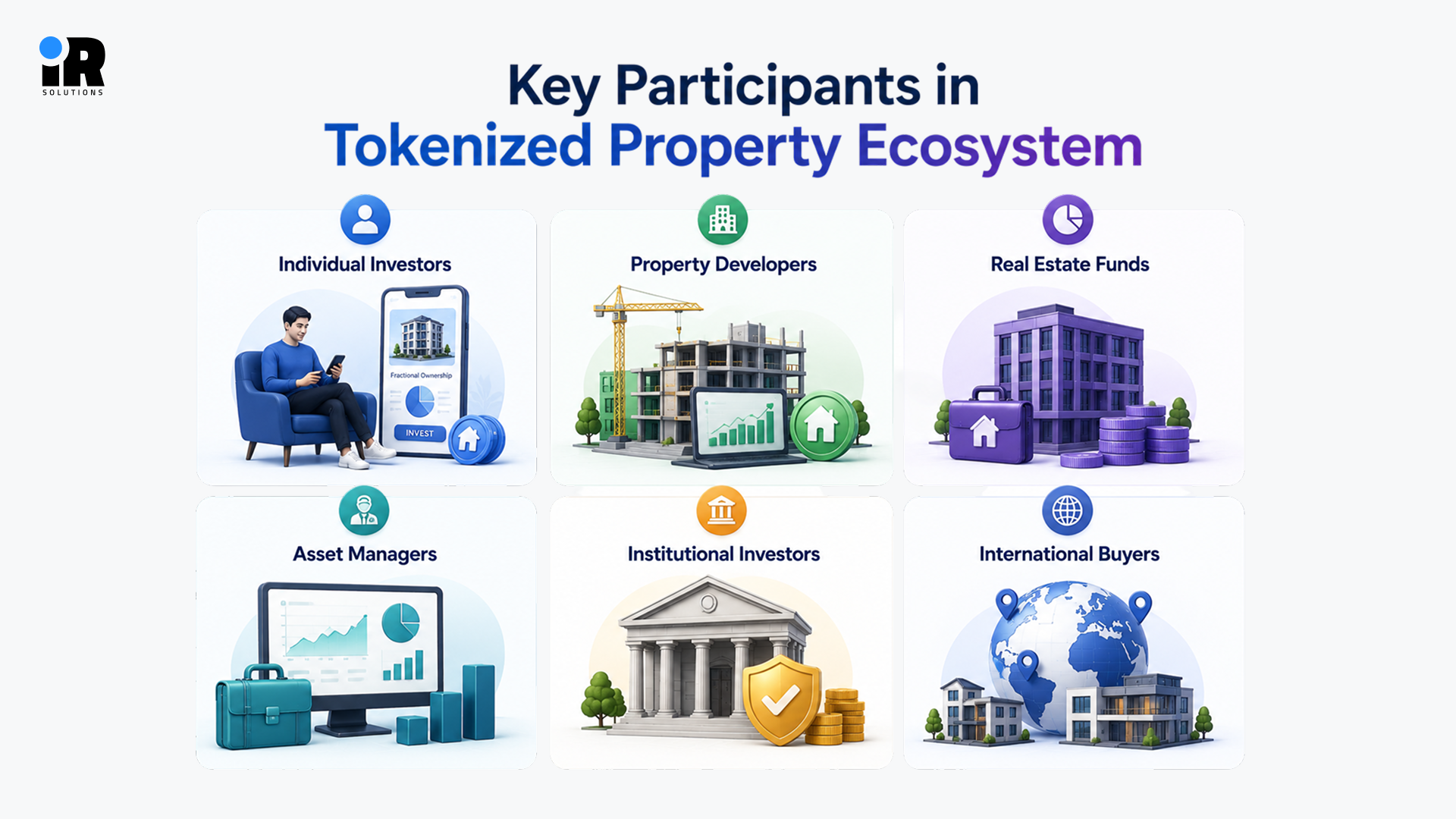
Individual Investors
Access to commercial and residential property markets at genuinely accessible entry points without the minimum capital requirements that have historically excluded retail participants from direct property ownership outside of listed property funds.
Property Developers
Access to a global pool of fractional investors for project financing without the dependence on a small number of large institutional funders whose appetite and timeline constraints can determine whether a development project proceeds or stalls during the capital raising phase.
Real Estate Funds
The ability to offer improved secondary market liquidity to fund investors who have historically been locked into defined redemption windows that do not align with individual liquidity needs or changing investment priorities over the fund's lifetime.
Asset Managers
Automated compliance, distribution, and reporting infrastructure that reduces the operational overhead of managing large investor bases without proportional increases in administrative headcount or manual processing costs per investor.
Institutional Investors
More liquid, more transparent exposure to specific property assets with on-chain proof of reserve and automated compliance checks that reduce the due diligence burden compared to traditional private market property investment structures.
International Buyers
The ability to participate in property markets in other countries without navigating local legal purchasing processes, currency conversion infrastructure, or the banking relationships that cross-border property investment currently requires in most jurisdictions.
Real-World Examples of Property Tokenization
Property tokenization has moved beyond pilot projects into production deployments with real investor capital and verifiable performance records across multiple asset classes and geographies.
Dubai is one of the most active markets for property tokenization globally. The Dubai Land Department launched its real estate tokenization pilot in 2025 and moved into Phase II in February 2026, enabling secondary-market resale of tokenized property interests through approved platforms. As detailed in this analysis of Dubai's real estate tokenisation project, the initiative is targeting AED 60 billion in tokenized real estate by 2033, making Dubai one of the clearest examples of tokenization moving from pilot projects toward regulated market activity.
Commercial buildings are being tokenized to allow institutional investors fractional access to office and retail assets without the full acquisition commitment that traditional commercial property purchase requires. Rental apartment portfolios are being tokenized on platforms including RealT, which distributes rental income to token holders in stablecoin payments on a weekly basis. Luxury villas and high-value residential properties in markets including Monaco and New York have been tokenized to offer fractional access to trophy assets that would otherwise require the full acquisition price from a single buyer. Student housing and hotel properties are being tokenized for their predictable income streams, and industrial and logistics facilities with long-term lease agreements are being tokenized for their income certainty that suits fixed-return token structures.
How Smart Contracts Support Modern Property Ownership
Smart contracts are the operational infrastructure that makes tokenized property ownership function as a genuinely new model rather than simply a different recording system for the same traditional process. Building this infrastructure correctly requires experienced smart contract developers who understand both the legal and technical requirements of property-linked tokens
The role smart contracts play extends across every significant function in the property ownership lifecycle. Rental payment collection and distribution to token holders happens automatically when income arrives in the treasury contract, with each holder's proportional entitlement calculated and paid without manual reconciliation between payment periods. Dividend distribution from property appreciation or refinancing events follows the same automated logic. Compliance verification runs for every transfer attempt, checking investor identity, jurisdictional eligibility, and holding-period restrictions before any ownership change is executed.
Investor onboarding connects KYC and AML verification systems to the token contract so that only verified investors can receive or transfer tokens at any point during the asset's operational life. Ownership transfers settle atomically, meaning the exchange of tokens and payment occurs in a single transaction that either completes entirely or reverts entirely without a settlement window during which counterparty risk exists.
For a detailed breakdown of exactly what smart contracts do at each stage of an RWA transaction, our guide on why smart contracts are essential for RWA tokenization covers every function from issuance through to redemption.
Property Tokenization vs REITs
Both property tokenization and REITs provide exposure to real estate without requiring investors to purchase an entire property, but the structural differences between them matter considerably for investors evaluating which model better serves their specific needs.
Dimension | Tokenized Property | REIT |
Ownership | Direct fractional ownership of specific asset | Share in a fund holding multiple assets |
Transparency | Full on-chain visibility of specific asset | Periodic fund reporting only |
Liquidity | Secondary market token trading | Listed exchange trading |
Asset selection | Investor chooses specific property | Fund manager selects portfolio |
Income | Automated smart contract distribution | Declared dividend payments |
Minimum investment | Low, determined by token price | Share price of listed REIT |
Governance | Token holder voting rights on specific asset | Fund manager decisions |
Settlement | Minutes on blockchain | Standard exchange settlement |
The most significant difference is not liquidity or minimum investment but direct asset exposure. A REIT investor holds a share in a diversified fund managed by a third party. A tokenized property investor holds a direct fractional interest in a specific identified asset with full transparency into that asset's performance and governance.
Is Tokenized Property Ownership the Future of Real Estate
The evidence from current market activity suggests that tokenized property ownership is not a future possibility but an accelerating present reality that is beginning to change how property is owned, financed, and managed in the markets where adoption is furthest advanced.
The question is not whether tokenization will change property ownership models but how quickly the regulatory frameworks, technical infrastructure, and investor familiarity required to scale the model will develop across markets that are still in the early stages of adoption. Dubai's commitment at a government level, institutional participation from major asset managers, and the growth of distributed tokenized value tracked by RWA.xyz all point toward a property market where tokenization is a standard financing and ownership option rather than an alternative available only to early adopters with specific technical knowledge.
How Businesses Can Build a Property Tokenization Platform
Building a property tokenization platform requires the same foundational elements that any RWA tokenization project requires, but with asset-specific legal structuring, income distribution logic, and compliance requirements that reflect the specific characteristics of real estate as an asset class.
The build process starts with asset selection and legal structuring, where an SPV or trust is created to hold the property and issue tokens to investors. The token economics are then defined, covering total supply, per-token price, income distribution schedule, and the rights attached to each token class. Blockchain selection follows, with Ethereum, Polygon, and Avalanche the most commonly used networks for institutional-grade property tokenization.
Smart contract development encodes the ownership logic, income distribution schedule, compliance transfer restrictions, and governance mechanisms before independent security audits confirm that the contract code functions as the legal documentation requires. Investor onboarding infrastructure, secondary market arrangements, and ongoing asset management tools complete the platform before it opens to investors.
The cost of building a property tokenization platform typically ranges from $75,000 to $300,000 or more depending on the legal structure, blockchain infrastructure, and compliance requirements of the specific asset and target investor audience.
For a full breakdown of what drives that cost, see our guide on RWA tokenization platform pricing.
Conclusion
Tokenization is not making marginal improvements to how real estate is owned and traded. It is changing the structural model of property ownership by making fractional investment practical, settlement near-instant, ownership records transparent and immutable, and global investor access available without the banking and legal infrastructure that traditional cross-border property investment has always required. The evidence from Dubai, from institutional asset managers, and from platforms distributing rental income to token holders weekly confirms that this is not a theoretical shift. The property ownership model is changing, and the enterprises and investors that understand how tokenization works and engage with it early are the ones best positioned to benefit from a market transformation that is already underway.
Frequently Asked Questions
Can real estate ownership be tokenized?
Yes. Any property with verifiable ownership, a clear legal title, and a measurable income stream or capital value can be tokenized through a properly structured legal entity that holds the property and issues tokens representing fractional ownership interests to investors.
Is tokenized property legally recognized?
In jurisdictions with established tokenization frameworks including the UAE, EU member states under MiCA, Singapore, and the United States under applicable securities exemptions, tokenized property interests are legally recognised when properly structured under applicable securities and property law.
How does fractional property ownership work?
A property is held within a legal entity such as an SPV, and digital tokens representing fractional ownership interests in that entity are issued to investors. Each investor's proportional share of income and capital value is determined by the proportion of total tokens they hold.
Can tokenized property generate rental income?
Yes. Rental income generated by the underlying property flows into a treasury smart contract and is distributed automatically to token holders in proportion to their holdings, without any manual reconciliation required between payment periods.
What blockchain is best for property tokenization?
Ethereum is the most widely used for institutional-grade property tokenization due to its compliance tooling, ecosystem depth, and investor familiarity. Polygon offers lower transaction costs while maintaining Ethereum compatibility for platforms expecting high transaction volumes.
Is tokenized real estate safer than traditional investing?
Tokenized real estate offers improved transparency, automated compliance, and immutable ownership records compared to traditional property investment. The underlying asset risk remains the same, but the operational and counterparty risks associated with manual settlement and paper-based records are reduced significantly.
How is tokenized property different from a REIT?
Tokenized property represents the rights defined by a specific tokenization structure, which may be linked to a particular property or property-holding entity. A REIT gives investors shares or units in a real estate investment vehicle. REITs generally offer established exchange or fund-based liquidity, while tokenized property may offer secondary trading only where a compliant marketplace exists.
Can businesses create their own property tokenization platform?
Yes. Businesses can build custom property tokenization platforms or use white-label solutions depending on their asset class, compliance requirements, and target investor audience. Custom development typically costs between $75,000 and $300,000 depending on scope and provides full ownership of the platform infrastructure without third-party platform dependency.
Can tokenized property be sold on a secondary market?
It can, provided the token structure and applicable regulations allow secondary trading and an eligible marketplace exists. Tokenization makes digital transfer technically possible, but it does not guarantee liquidity or an active market.


