




Imagine spending months building a chatbot only to watch customers abandon it within the first two messages. That is not a hypothetical, it happens when businesses choose the wrong architecture before fully understanding their options. Two dominant approaches exist in today’s chatbot landscape, and they are built on completely different foundations. Before you build anything, you need a clear framework to evaluate which approach aligns with your business goals, operational requirements, and customer expectations. “In many cases, this is exactly the stage where businesses bring in AI/ML development services to help them decide the right direction, since the architecture choice directly impacts performance, scalability, and user experience.” Rule-based systems offer control and predictability, while generative AI brings flexibility and more natural conversations. Neither is universally better. The right choice depends on your use case, business needs, and long-term goals.
What a Rule-Based Chatbot Actually Does for You
A rule-based chatbot runs on fixed instructions your team writes before the system ever speaks to a customer. Every response is pre-written, every path is pre-designed, and nothing changes unless a human goes in and updates it manually. Here is how the core mechanics work in practice:
- Keyword detection: The system scans each user message and looks for words or phrases that match your configured triggers.
- Predefined flows: Once a trigger fires, the bot follows a conversation path your team built inside the platform.
- Static answers: Every response the bot gives was typed by a human and stored in the system before launch.
- Hard stops: When a user says something outside the defined flows, the bot fails to respond meaningfully and typically dead-ends the conversation.
They are easy to launch, inexpensive to run, and very straightforward to audit, which makes them attractive to teams that need speed and compliance over conversational depth.
What a Generative AI Chatbot Does Differently
Unlike rule-based bots, a generative AI chatbot creates each response from scratch using a large language model that reads intent, context, and tone in real time. This means no two replies are identical, even when two customers ask roughly the same question. Here is what makes this architecture work at a technical level:
- Intent recognition: The model understands what the user is trying to do, even if they phrase it poorly or use unexpected words.
- Context retention: It tracks the entire conversation thread, not just the most recent message, allowing it to provide coherent multi-turn responses.
- Live generation: Every answer is produced in the moment rather than pulled from a bank of pre-written responses.
- Continuous tuning: With the right feedback setup, these models improve over time as your team reviews conversations and fine-tunes behaviour.
Many businesses rely on experienced generative AI developers to implement controls, optimization, and long-term model improvements. Tools built on GPT-4, Claude, Gemini, and custom LLM deployments all fall into this category. These systems can handle follow-up questions, shifts in emotional tone, ambiguous phrasing, and entirely unexpected inputs without breaking the conversation.
Understanding the underlying architecture is only one part of the equation. A successful deployment also depends on proper planning, integration, and governance throughout the custom AI chatbot development process.
A Direct Comparison Across the Metrics That Matter
Before you can apply any decision framework, you need to see how these two architectures compare at a feature level across the criteria that actually influence business outcomes.
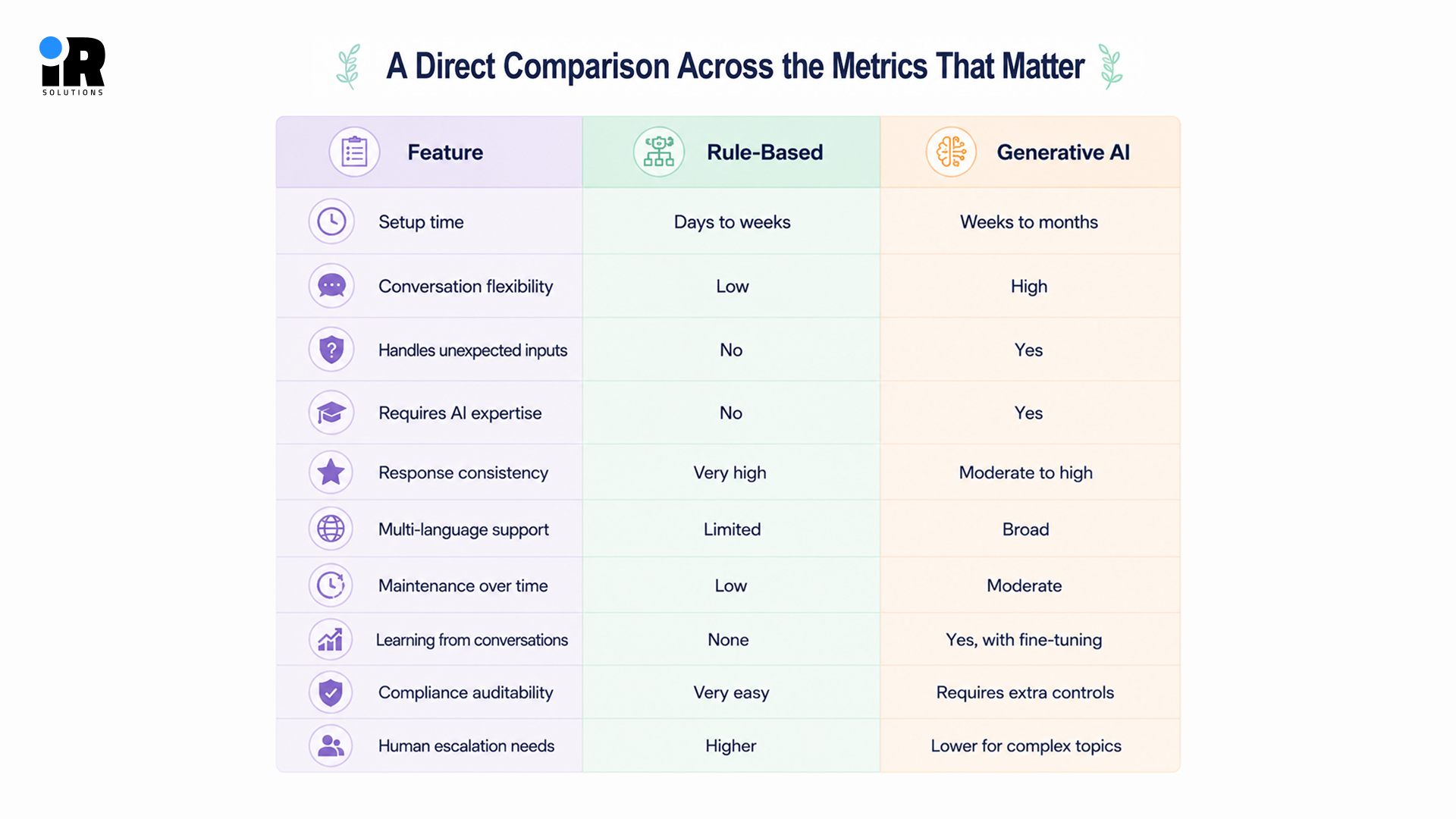
Both systems are built for different types of business needs, and better choice depends on what you want your chatbot to handle in real day-to-day use, not which one looks better on paper.
The Framework That Helps You Choose the Right Architecture Before You Build
Working through this framework honestly before you sign any contract or start any build is the most valuable thing you can do before committing to an architecture. Each criterion below is designed to surface where your business genuinely sits, not where you hope it sits after reading a vendor's marketing page. Working with AI chatbot experts can simplify architecture selection and reduce costly implementation mistakes early on.
Choosing Between Rule-Based and Generative Chatbots
Start by checking how predictable your customer questions really are. If most fall into a few clear categories, like order status or password resets, a rule-based bot handles that cheaply and well. But once customers phrase things differently or a chat needs context from earlier messages, rule-based bots break down fast. Pull up your last hundred tickets, if they're mostly repetitive, go rule-based, if they're varied and need follow-up, a generative model will serve your customers better.
- Narrow and predictable use cases like order status checks, appointment booking, and password resets all point clearly toward rule-based architecture as the smarter and more cost-effective choice.
- Open-ended and context-heavy conversations like technical troubleshooting, consultative sales support, and complex onboarding are precisely where generative AI proves its value and justifies the additional setup investment.
If your business handles thousands of simple, repetitive conversations daily, a rule-based system will likely serve you better since every response is pre-written and performance stays consistent at scale. Generative AI does heavier computational work per conversation, which means infrastructure costs and complexity grow alongside volume.
How Industry and Compliance Affect Chatbot Choice
In regulated industries like healthcare or financial services, rule-based systems give compliance teams full control since every response is reviewed and approved before it ever reaches a customer. Generative AI introduces governance challenges that require their own layer of testing and documentation, which adds real complexity to any serious compliance process.
- Healthcare, legal, and financial services businesses should give serious weight to rule-based systems for any regulated use case where a wrong answer carries direct liability.
- Retail, SaaS, hospitality, and e-commerce businesses have considerably more flexibility to deploy generative AI without heavy regulatory constraints slowing the entire process down.
Understanding Risk in Rule-Based and Generative Chatbots
Every chatbot carries risk, but the question is not whether risk exists it is which risks your business is better positioned to manage given your team, your industry, and your customer expectations.
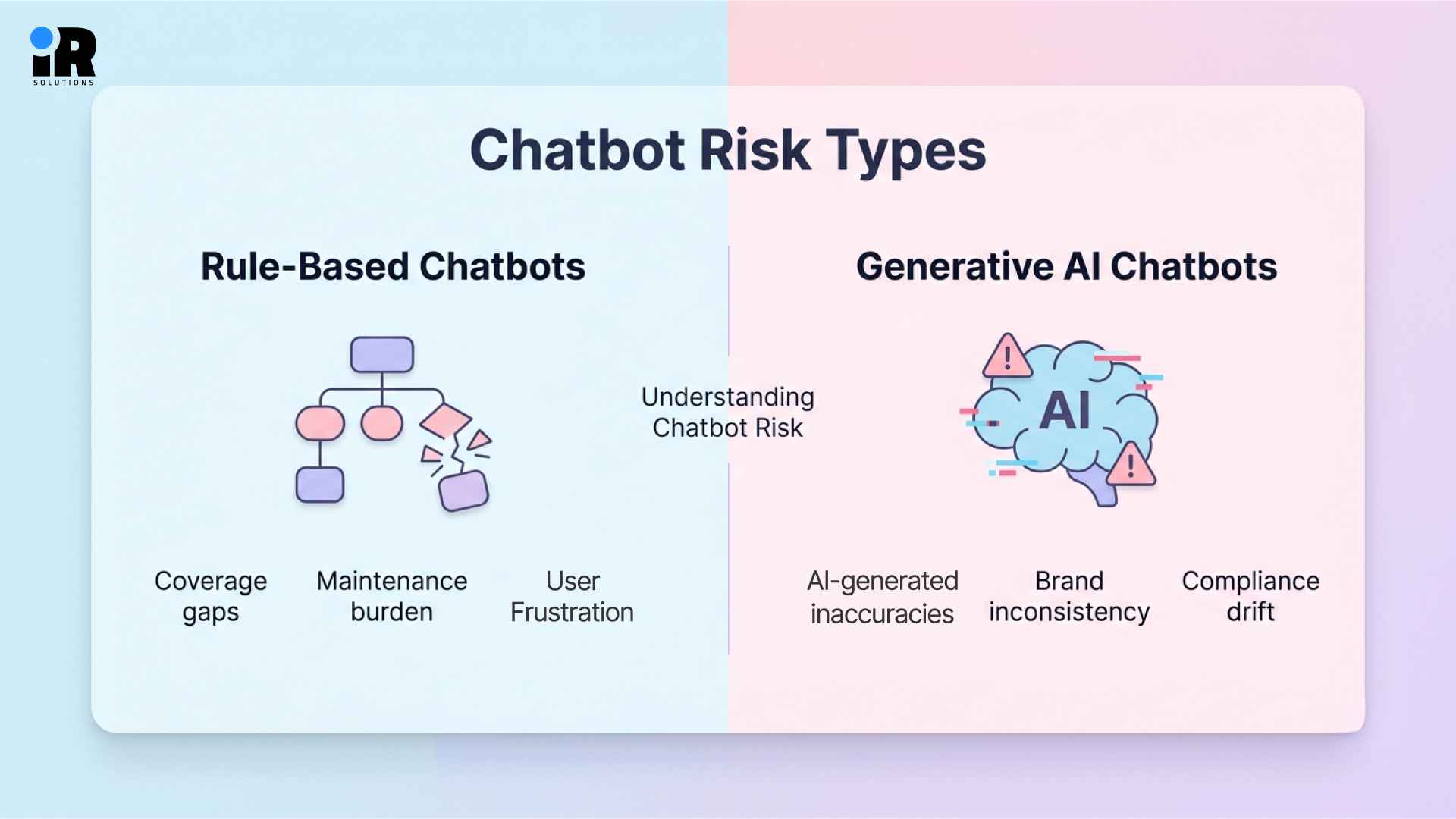
Rule-based chatbots fail in predictable ways once real customers start using them every day. Coverage gaps hit hardest when a user asks something outside your defined flows and the bot delivers nothing useful. Maintenance debt builds quietly as your products and policies change, because every update means manually revising multiple nodes across the system. User frustration leads to exits when users realise the bot cannot actually help them resolve what they came for.
Generative AI systems fail differently, and their failure modes are harder to catch before they cause damage. AI-generated inaccuracies are the biggest concern, The model confidently states something factually wrong about your product or policy, and that erodes customer trust fast. Brand voice inconsistency and compliance drift also surface over time, especially as your business evolves and the knowledge base your bot relies on starts to age.
Scalability Considerations as Your Business Grows
The chatbot architecture you choose today needs to support your business two or three years from now, not just where you are at launch. Thinking through scalability before you build prevents a costly rebuild down the road. As requirements expand, dedicated AI/ML developers help maintain performance, integrations, and future scalability.
Scaling a rule-based chatbot means manually building new flows every time your business adds a product, enters a market, or updates a policy. It starts manageable, but once you have hundreds of flows across multiple use cases, maintaining consistency without a dedicated owner becomes a real operational burden.
Generative AI scales more cleanly for businesses with growing complexity because adding a new use case typically means updating your knowledge base or prompt instructions rather than rebuilding a decision tree from the ground up every time something changes. Multi-language support works much more naturally with modern LLMs because the model handles language variation without requiring your team to build and maintain entirely separate flow sets for each language you need to support across your customer base.
Industry-Specific Guidance on Which Architecture Fits
Different industries have fundamentally different needs from a chatbot, but across almost every one of them, generative AI ends up being the stronger long-term choice, even in the spots where rule-based looks fine on the surface.
Ecommerce and Retail
Rule-based bots handle order tracking and returns, but they break the moment a question comes in slightly off-script. Generative AI handles the same queries while also picking up on intent for upsells and cart recovery. Switching starts with feeding your FAQ and policy docs into a retrieval setup, then expanding from there.
Healthcare and Wellness
Rule-based bots cover appointments and FAQs, but patients rarely phrase things exactly as scripted. Generative AI handles the same traffic while staying inside guardrails and scales into symptom guidance with proper oversight. Moving over means looping in compliance early and keeping a clear human handoff.
Financial Services
Account and rate queries get routed to rule-based bots for easy compliance sign-off, but customers want a real conversation, not a menu. Generative AI can do both, while opening the door to advisory conversations. The switch needs early compliance review and a documented escalation path before going live.
SaaS and Technology
Onboarding and basic troubleshooting look simple enough for rule-based, but they branch fast once a setup doesn't match the expected case. Generative AI handles that variation and carries it into multi-step debugging, where rule-based falls apart. Switching usually starts by piping your docs into the model through retrieval.
Hospitality and Travel
Rule-based works for booking and FAQs at high volume, but guests with flexible dates or unusual requests hit its limits fast. Generative AI manages the same traffic while handling personalised itinerary requests too. The switch starts with connecting the model to your property and booking data.
What Happens When You Outgrow Your Architecture
Switching architectures mid-journey is far more disruptive than most businesses expect when they first start evaluating chatbot options. Here are the real consequences your business faces when the architecture no longer fits your growth stage.
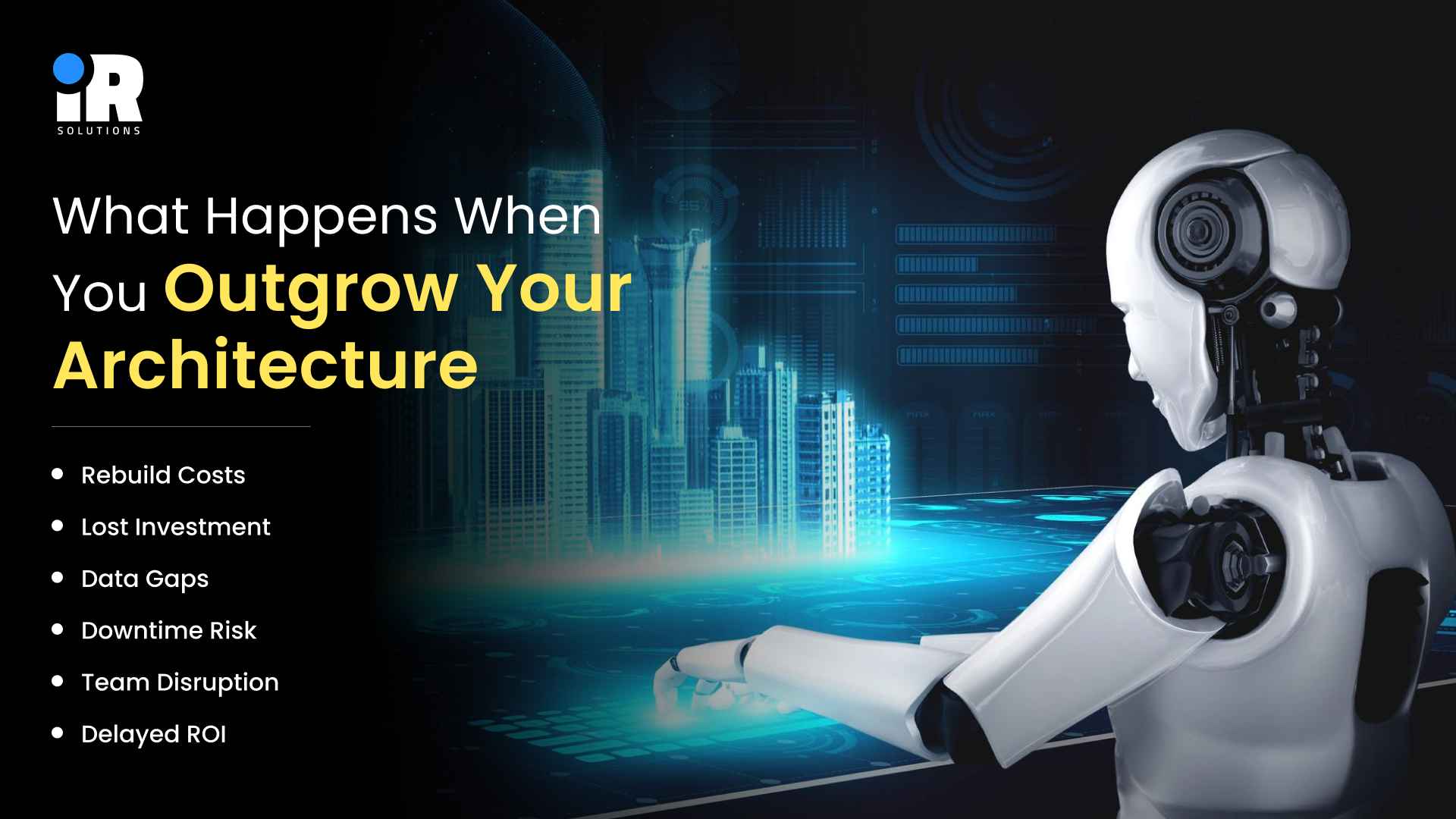
- Rebuild Costs: Migrating from rule-based to generative AI means redesigning your entire conversation strategy from scratch.
- Lost Investment: Fine-tuned models and prompt architecture do not transfer cleanly when you switch direction later.
- Data Gaps: Moving platforms often exposes missing or unstructured data your new system cannot work with.
- Downtime Risk: A chatbot migration without proper planning creates real gaps in customer support coverage.
- Team Disruption: Your team needs retraining on new tools, workflows, and governance processes after every switch.
- Delayed ROI: Switching late means months of rebuilding before your chatbot starts delivering value again.
Book a strategy session with IR Solutions and walk away with a clear recommendation grounded in your actual business context.
Why Most Chatbot Deployments Fail Before Implementation Begins
The businesses that get the most value from chatbot deployments share a common pattern in how they approach the architecture decision before a single line of configuration is written or a single flow is mapped.
- They define the exact use cases the chatbot must cover and rank them by volume and complexity before they evaluate any platform or vendor.
- They map out what a failed conversation looks like for their specific customer base and calculate the real business cost of that failure before choosing an architecture.
- They audit their integration landscape to understand what systems the chatbot needs to connect with and what data it needs access to to be genuinely useful.
- They plan for human escalation as a core part of the chatbot design from day one, because no system handles every conversation well, and a seamless handoff to a human is often what saves the customer relationship.
- They review the architecture decision at regular intervals as the business grows, rather than treating the initial choice as permanent regardless of how their needs evolve.
The businesses that struggle longest with chatbot ROI are the ones that picked a system because it impressed them in a demo without ever testing it against the real conversations their actual customers have every day.
Conclusion
The chatbot your business deploys today will shape how thousands of customers experience your brand tomorrow. That is not a decision worth rushing or leaving to a vendor demo. Rule-based systems deliver the control, speed, and auditability that regulated and high-volume environments genuinely need to operate without risk. Generative AI delivers the depth, flexibility, and conversational quality that complex customer journeys demand to produce real business outcomes. The gap between the two is not just technical, it is strategic. Getting the architecture right from the start means your chatbot grows with your business instead of holding it back. The wrong choice costs you time, money, and customer trust. The right one compounds in your favour every single day it runs. Working with a specialized AI development company ensures the architecture aligns with both your operational needs and long-term growth strategy.
Frequently Asked Questions
Which chatbot architecture is better for a growing business?
It depends on your conversation complexity and use case depth, not your company size alone.
Can a generative AI chatbot replace my human support team?
No, it reduces repetitive volume significantly but still requires human agents for escalations, edge cases, and oversight.
How long does deploying a rule-based chatbot typically take?
Most teams have a working version live within one to two weeks, depending on how many flows they need to build.
Is generative AI chatbot data safe for sensitive business information?
It depends entirely on your vendor's data handling policies, your configuration setup, and whether the model is trained on your data.
What does a hybrid chatbot architecture really look like in practice?
It integrates simple, high-volume flows with generative AI for open-ended, complex conversations in the same experience.
Which architecture is better suited to support multiple languages at scale?
Generative AI can be used to deal with language variation natively, without your team having to create and maintain multiple flows to support each one.
If my business requirements change considerably, can I change the architecture later?
Yes, but changing will be a considerable redesign effort, data preparation, and budget, and should be done early.
Which system handles emotionally frustrated customers more effectively overall?
Generative AI recognizes conversational intent and adapts responses in real time beyond what can be replicated using a rule-based system.