





Key Takeaways
- US smart contract developers earn around $125,000–$129,000 annually.
- Freelance rates typically range from $60–$120 per hour.
- Senior developers can earn $180,000–$250,000+ annually.
- Specialization can significantly affect compensation.
- Region remains a major factor in developer pay.
- Equity and token grants can increase total compensation.
Smart contract developers in the United States earn around $125,000–$129,000 per year on average, equivalent to roughly $60–$65 per hour for full-time employees. Freelance rates tell a different story, since experienced freelancers on platforms like Upwork often charge $60–120 an hour, and specialists in security or DeFi protocols can exceed $200 an hour.
No single number is correct because pay depends on region, experience level, specialization, and whether someone works as an employee or a freelancer. For a current market benchmark, Web3.career salary data reports an average smart contract developer salary of around $125,000 per year.
Smart Contract Developer Salary and Hourly Rate at a Glance
Before diving into regional and experience-based detail, here is the answer most readers are looking for right away.
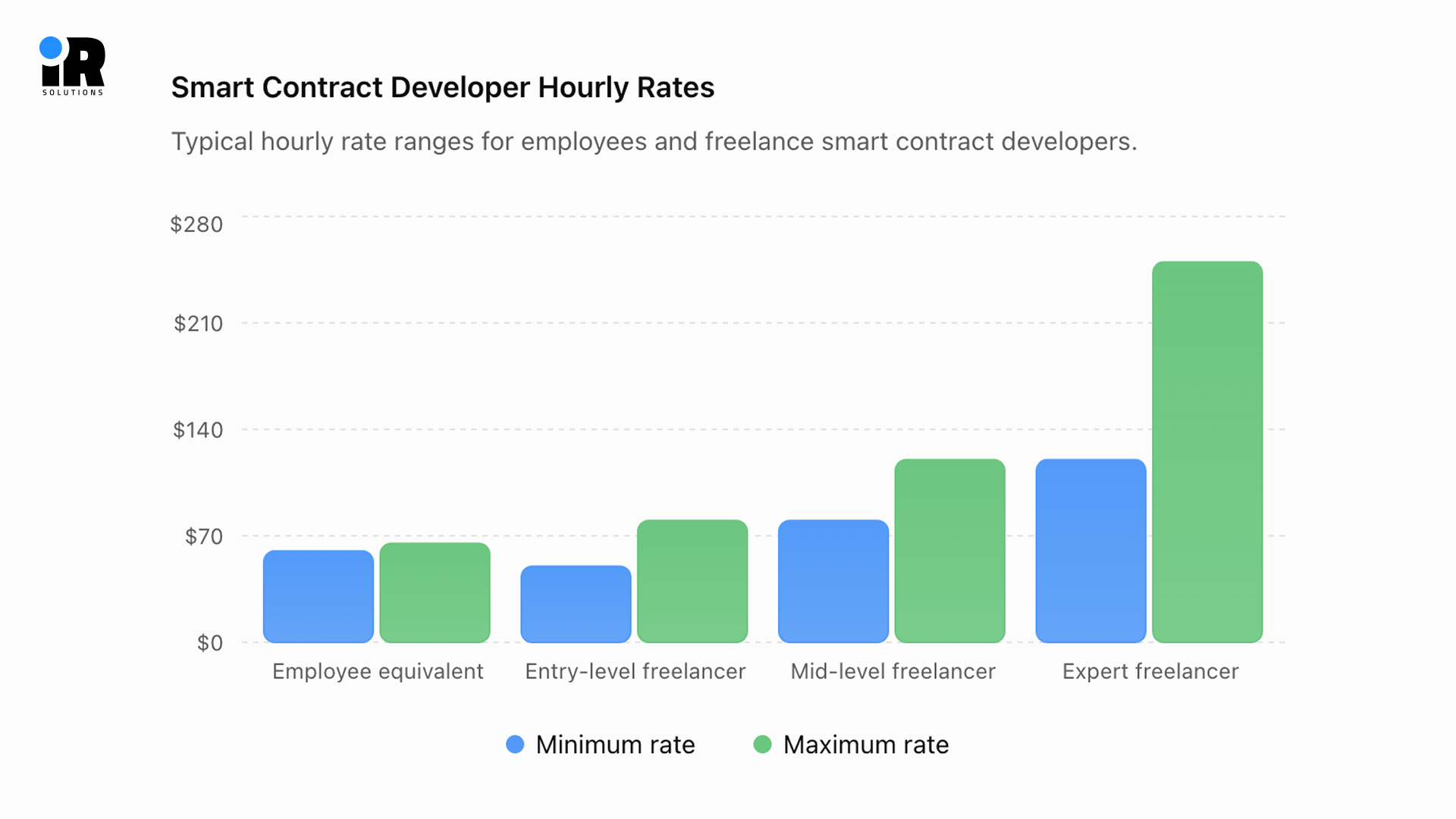
Hourly rates vary by experience and hiring model, with expert freelance developers commanding the highest rates.
How We Calculated These Salary and Hourly Rate Ranges
The salary and hourly rate estimates in this guide combine data from Web3 job boards, recruiting platforms, freelance marketplaces, and regional compensation benchmarks. These sources measure different parts of the market, including salaried employees, advertised roles, and independent contractors. For that reason, the figures should be treated as market benchmarks rather than fixed rates. Actual compensation can vary significantly based on location, experience, specialization, employer, and hiring model.
Smart Contract Developer Salary by Region
Regional pay gaps in smart contract development remain significant even though remote hiring has narrowed some of the older geographic divides.
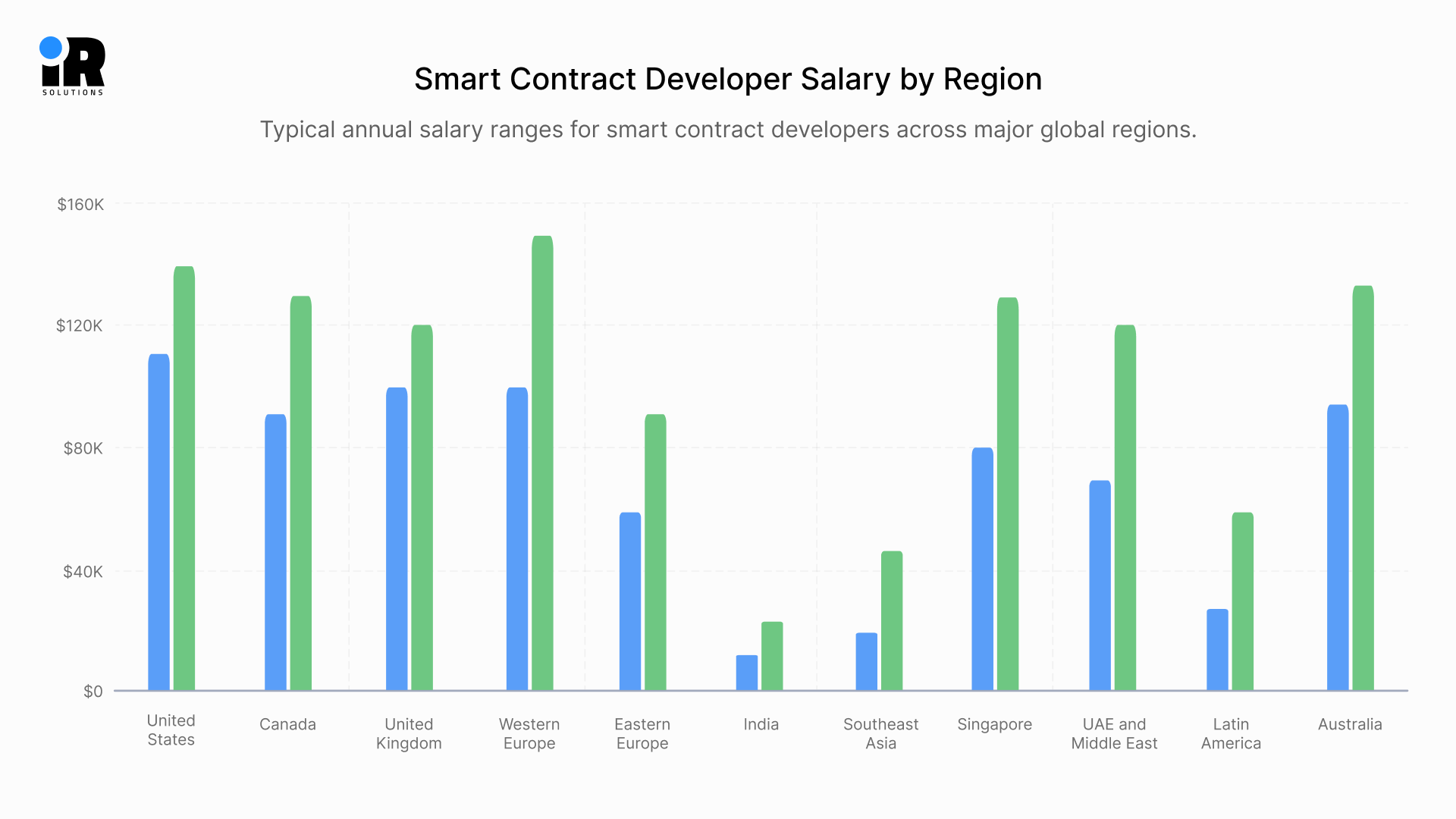
Typical annual salary ranges for smart contract developers vary significantly by region, reflecting differences in local markets, demand, experience, and hiring models.
United States
The United States remains the most competitive market for smart contract talent because most funded Web3 protocols are headquartered or incorporated there. National averages sit between $112,000–138,000 annually, depending on which dataset is used. Startups and DeFi protocols often pay above this range once token allocations are included.
Canada
Canadian smart contract developers typically earn slightly below their US counterparts, mostly due to currency conversion and a smaller concentration of crypto native employers. Toronto and Vancouver host the largest blockchain hiring hubs. Many Canadian developers work remotely for US-based protocols to close this gap.
United Kingdom
London anchors the UK blockchain scene, with salaries generally landing near $100,000– 120,000 annually for experienced developers. Fintech regulation experience adds value here, since UK-based protocols often deal with stricter compliance requirements than US counterparts.
Western Europe
Germany, Switzerland, and the Netherlands offer some of the strongest salaries outside the US, often reaching $150,000 for senior smart contract engineers. Switzerland's Crypto Valley cluster near Zug continues to pay a premium for security-focused developers. Local employment costs also run higher due to strong labor protections.
Eastern Europe
Countries like Poland, Ukraine, and Romania remain a major outsourcing hub for blockchain development work. Salaries typically fall between $60,000–90,000, considerably lower than Western Europe despite comparable technical skill levels. Many Eastern European developers work as contractors for Western clients at higher effective rates.
India
India offers some of the lowest local salaries globally for smart contract roles, generally between $15,000–24,000 annually based on domestic hiring data. However, Indian developers working remotely for US or European protocols routinely earn far more than local averages. This gap makes India one of the clearest examples of remote pay arbitrage in Web3.
Southeast Asia
Vietnam, the Philippines, and Indonesia have growing blockchain developer communities with salaries generally between $20,000–45,000 a year. Singapore sits apart from the rest of the region due to its status as a regional crypto hub. Local cost of living keeps salaries lower even as remote opportunities expand.
Singapore
Singapore functions as Asia's primary Web3 headquarters location, with many exchanges and funds basing regional teams there. Salaries for experienced smart contract developers can reach $130,000 annually, closer to Western levels than the rest of Southeast Asia. Strong regulatory clarity has attracted several major crypto employers to the city.
UAE and Middle East
Dubai has emerged as a significant blockchain hiring center thanks to favorable crypto regulation and tax advantages for both companies and individuals. Salaries for smart contract developers commonly range from $70,000–120,000 annually. Many roles here also include relocation packages that add meaningfully to total compensation.
Latin America
Brazil, Argentina, and Mexico host an increasingly active blockchain developer community, with salaries between $30,000–60,000 a year. Currency volatility in several Latin American countries pushes many developers toward dollar-denominated freelance contracts instead. This shift has made the region attractive for US companies seeking cost-effective remote talent.
Australia and Oceania
Australian smart contract salaries generally land between $95,000–135,000 annually, comparable to mid-tier US metro markets. Sydney and Melbourne host most of the country's blockchain startups and exchanges. Time zone alignment with parts of Asia also makes Australian developers attractive for regional protocol teams.
Smart Contract Developer Salary in the United States by Location
City-level pay varies noticeably across the US, largely driven by local cost of living and concentration of funded blockchain companies.
US Location | Typical Salary | Compared With US Average |
San Francisco / Bay Area | $150,000–$200,000 | Well above average |
New York | $127,000–$141,000 | Above average |
Seattle | $120,000–$150,000 | Above average |
Los Angeles | $115,000–$145,000 | Slightly above average |
Austin | $110,000–$140,000 | Near average |
Miami | $105,000–$135,000 | Near average |
Remote US | $100,000–$150,000 | Varies by employer location |
San Francisco Smart Contract Developer Salary
San Francisco and the wider Bay Area continue to command the highest smart contract salaries in the country, frequently reaching $200,000 for senior engineers. Venture-backed protocols headquartered here compete aggressively for scarce Solidity and Rust talent. High living costs partly explain the premium over other US cities.
New York Smart Contract Developer Salary
New York sits close behind San Francisco, with salaries commonly between $127,000–141,000 annually according to current ZipRecruiter data. The city's concentration of trading firms and institutional crypto desks drives strong demand for security-minded developers. Wall Street-adjacent employers often pay above typical startup ranges.
Seattle Smart Contract Developer Salary
Seattle benefits from its broader tech ecosystem, with smart contract salaries generally landing between $120,000–150,000 a year. Several blockchain infrastructure companies have opened engineering offices here in recent years. Proximity to established cloud and enterprise software talent supports this growth.
Austin Smart Contract Developer Salary
Austin has become a popular relocation destination for blockchain startups leaving higher-cost coastal cities. Salaries typically range from $110,000–140,000, reflecting a lower cost of living than San Francisco or New York. No state income tax also makes Austin attractive to independent contractors.
Los Angeles Smart Contract Developer Salary
Los Angeles blends entertainment industry NFT projects with a growing DeFi presence, pushing salaries between $115,000–145,000 annually. Gaming and media companies experimenting with blockchain add another layer of demand here. Competition for experienced developers remains intense across both sectors.
Smart Contract Developer Salary by Experience Level
Experience level shapes compensation more than almost any other factor in this field.
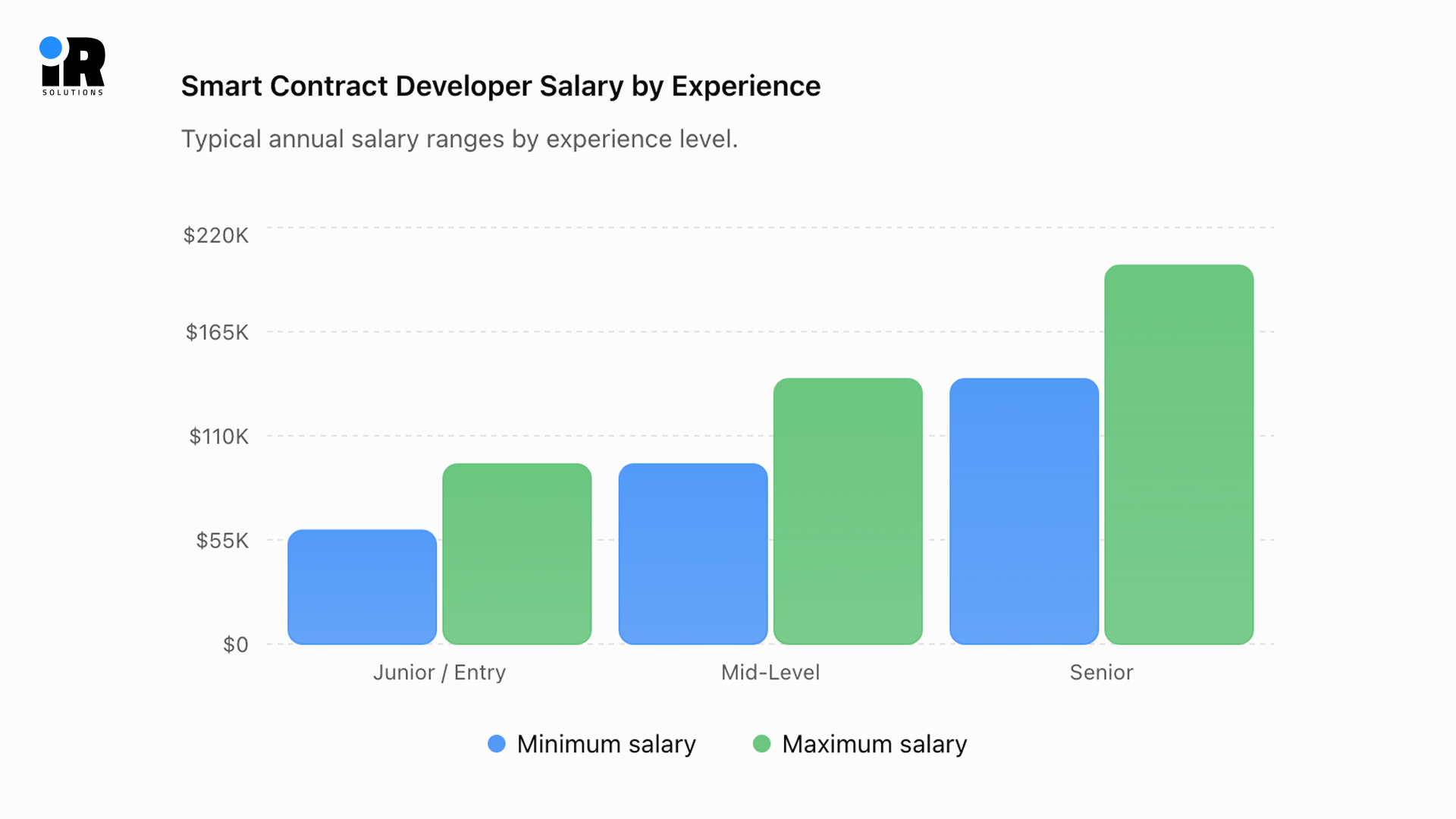
Annual compensation generally increases with experience, from entry-level to senior smart contract development roles.
Junior Smart Contract Developer Salary
Junior developers typically hold under two years of blockchain-specific experience, often transitioning from general web development backgrounds. Salaries usually start around 60,000 and climb toward $95,000 as skills solidify. Employers at this level prioritize fundamentals in Solidity, testing frameworks, and basic security awareness.
Mid-Level Smart Contract Developer Salary
Mid-level developers generally have two to five years of production experience and have shipped contracts to live mainnets. Annual pay in this bracket ranges from $95,000–140,000, depending on region and specialization. Familiarity with gas optimization and common vulnerability patterns becomes essential at this stage.
Senior Smart Contract Developer Salary
Senior developers command significantly higher pay due to their ability to design secure, audited systems independently. Salaries commonly fall between $140,000–200,000, with token or equity compensation frequently added on top. According to a broader blockchain engineering dataset from CryptoRecruit, senior blockchain developers in the US earn between $180,000–250,000, though this figure covers blockchain engineering roles more broadly rather than smart contract specialists exclusively.
Lead and Protocol Engineer Salary
Lead and protocol engineers sit at the top of the compensation ladder, often overseeing entire smart contract architectures for major protocols. Base salaries frequently exceed $200,000, and total compensation including tokens can go considerably higher. These roles typically require years of mainnet experience and a strong public audit track record.
Smart Contract Developer Freelance and Contract Hourly Rates
Freelance pricing operates on its own logic, separate from traditional salary benchmarks, and deserves close attention on its own.
Experience / Role | Typical Freelance Rate |
Entry-Level Smart Contract Developer | $50–$80 per hour |
Mid-Level Developer | $80–$120 per hour |
Expert Developer | $120–$250 per hour |
Specialized Security or Protocol Developer | Often above $150 per hour |
Upwork's published data confirms the first three bands closely, showing a median smart contract developer rate near $80 an hour, with typical contracts ranging between $60–120. These numbers reflect what clients actually pay, not theoretical salary conversions.
Entry-Level Smart Contract Developer Hourly Rate
New freelancers typically price themselves between $50–80 an hour while building a portfolio and client reviews. Many undercut this range initially to win early contracts and establish trust. Rates usually climb quickly once a developer completes several successful, audited deployments.
Mid-Level Smart Contract Developer Hourly Rate
Mid-level freelancers with several completed projects and repeat clients typically charge between $80–120 an hour. This band represents the largest share of active freelance smart contract work on major platforms. Specialization in a specific chain, such as Ethereum or Solana, tends to push rates toward the higher end.
Senior Smart Contract Developer Hourly Rate
Senior freelancers regularly charge upward of $120 an hour, with some specialists exceeding $250 for complex or high-stakes engagements. Clients hiring at this level usually need production-grade contracts handling real financial value. Fast turnaround and proven audit history justify the premium pricing here.
Smart Contract Auditor and Security Engineer Rates
Security-focused freelancers often earn some of the highest rates in the entire field, frequently exceeding $150 an hour. Demand for auditors has grown sharply following several high-profile exploits across DeFi protocols in recent years. Reputation and past audit reports matter more than years of experience alone.
Protocol Engineer Rates
Freelance protocol engineers who design core contract architecture for new chains or major upgrades command similarly high rates. Projects at this level are usually structured around milestones rather than simple hourly billing. Total project value can run into six figures for complex multi-chain deployments.
Smart Contract Developer Rates by Specialization
Specialization changes compensation almost as much as experience level does, since some skill sets remain far scarcer than others.
Specialization | Typical Annual Salary | Why It Can Command Higher Pay |
Solidity / EVM | $125,000–$150,000 | Large EVM ecosystem and strong demand |
Solana / Rust | $130,000–$170,000 | Smaller specialized talent pool |
DeFi Protocol Development | $140,000–$190,000 | Complex financial logic |
Smart Contract Security | $130,000–$200,000 | High security responsibility |
ZK / Cryptography | $150,000–$220,000 | Scarce specialist expertise |
Cross-Chain / Bridges | $140,000–$200,000 | Complex infrastructure and security requirements |
Solidity Developer Salary and Rates
Solidity remains the most widely used smart contract language, since it powers Ethereum and every major EVM-compatible chain. Web3.career currently reports an average Solidity developer salary near $150,000 annually, alongside a 78-dollar hourly equivalent. That figure sits noticeably above the broader smart contract developer average of roughly $125,000 and $65 an hour.
Rust and Solana Developer Rates
Rust developers working on Solana or similar high-performance chains draw from a considerably smaller talent pool than Solidity engineers. This scarcity pushes salaries and freelance rates above typical EVM benchmarks in most comparisons. Companies building on newer chains often compete aggressively for a limited number of qualified Rust engineers.
DeFi Smart Contract Developer Rates
DeFi specialists handle complex financial mechanisms like lending pools, automated market makers, and yield strategies within their contracts. This complexity, combined with the financial risk involved, pushes pay above general smart contract development work. Errors here can directly cause user fund losses, which raises the stakes considerably.
Smart Contract Security and Auditor Rates
Security specialists sit near the top of the pay scale because a single overlooked vulnerability can cost millions of dollars. Demand has grown steadily as protocols increasingly require independent audits before launching new contracts. Certifications and a public history of discovered vulnerabilities both influence rates significantly.
ZK and Protocol Engineer Rates
Zero-knowledge cryptography represents one of the most technically demanding specializations within blockchain development today. Very few engineers hold deep expertise here, which keeps salaries and freelance rates unusually high across the board. Protocols working on privacy or scaling solutions often pay the steepest premiums for this skill set.
Full-Time Salary vs. Freelance Smart Contract Developer Rates
Comparing these two hiring models directly helps explain why headline numbers so often confuse readers.
Hiring Model | How Developers Are Paid | Typical Cost Structure | Best Fit |
Full Time | Salary plus benefits | Annual | Long-term product work |
Freelancer | Hourly or project-based | Hourly | Clearly defined tasks |
Contractor | Hourly or monthly | Variable | Flexible development needs |
Dedicated Developer | Monthly retainer | Predictable | Ongoing continuous work |
Development Company | Hourly or project-based | Project based | Complex production builds |
A developer earning the equivalent of $65 an hour as a full-time employee will not necessarily charge $65 an hour as a freelancer. Freelance rates need to cover taxes, benefits, equipment, and periods without billable work, which employees receive through their employer instead. Upwork's median marketplace rate of roughly $80, sitting within its broader $60–20 range, illustrates exactly why these two figures should never be treated as equivalent.
The right hiring model depends on your budget, project duration, and level of technical support required. This comparison of freelance vs agency vs in-house smart contract developers explains how the three approaches differ in cost, flexibility, and ongoing involvement.
How Remote Work Affects Smart Contract Developer Salaries
Remote hiring has reshaped compensation patterns across the entire blockchain industry, sometimes in surprising ways.
Location-based pay still exists for companies that anchor salaries to local cost of living regardless of where someone actually works. Global remote pay has grown more common among crypto native companies that pay similar rates worldwide for the same role. US companies increasingly hire international developers directly, often paying salaries well above local market rates to secure talent. Highly specialized developers, particularly in security and cryptography, tend to be far less location-sensitive than generalists.
CryptoRecruit's remote compensation data illustrates this pattern clearly, showing different remote blockchain developer ranges depending on whether the hiring company is based in the US, Europe, or Asia Pacific. Notably, this gap narrows considerably for scarce security skills, where companies pay closer to a global market rate regardless of the developer's location. This is why assuming an India-based developer earns Indian local salary levels can be a significant mistake, since a developer working remotely for a US protocol often operates in an entirely different compensation market than local peers.
What Affects Smart Contract Developer Salary and Hourly Rates?
Several distinct factors shape what any individual developer ultimately earns.
- Location matters: Geographic location still influences base pay significantly, even as remote work narrows some of the older gaps between regions.
- Experience compounds: Years of relevant experience remain one of the strongest predictors of both salary and freelance hourly rates across every region.
- Stack depth: Deep knowledge of Solidity, Rust, and specific blockchain architectures separates generalists from developers who command premium pricing.
- Security expertise: Demonstrated smart contract security expertise consistently commands some of the highest pay across both employee and freelance markets.
- Production history: Mainnet and production experience carries far more weight with employers than portfolio projects built only for testnets.
- Protocol complexity: DeFi and protocol complexity experience signals a developer can handle high-stakes financial logic without introducing costly errors.
- Audit background: Auditing experience, whether formal or informal, adds significant value since it demonstrates an ability to spot vulnerabilities before deployment.
- Hiring structure: Employment model, whether full-time, freelance, or contract-based, changes both the total compensation figure and how it gets calculated.
- Funding stage: Company funding and stage influence pay directly, since well-funded protocols can offer higher base salaries and richer benefits.
- Token upside: Token and equity compensation can substantially increase total pay beyond base salary figures, particularly at early-stage crypto companies.
How Much Does It Cost to Hire a Smart Contract Developer?
Understanding developer pay naturally leads to a related question for founders and hiring managers building out a team. If you’re planning to build a blockchain product, you can also hire smart contract developers based on your required experience, technical stack, and project scope.
Cost to Hire a Freelancer
Hiring a freelancer typically costs between $50–250 an hour depending on experience level and specialization required for the project. Short, well-defined tasks like a single contract audit often work well under this hourly model. Total project costs can still add up quickly on larger or more complex builds.
These developer rates are only one part of the overall budget. For a broader breakdown of development, audit, deployment, and maintenance expenses, see our guide to smart contract development cost.
Cost to Hire a Full-Time Smart Contract Developer
Full-time hires require an annual salary commitment, typically between $100,000–200,000 in most Western markets, plus benefits. This model suits companies building long-term products that need continuous, dedicated engineering attention. Recruiting and onboarding costs also add meaningfully to the total investment involved.
Cost to Hire a Dedicated Smart Contract Developer
Dedicated developers work through a monthly retainer arrangement, offering predictable costs without the full overhead of direct employment. This model appeals to companies needing ongoing work but wanting more flexibility than a permanent hire. Retainer costs generally scale with the developer's seniority and specialization.
Cost to Hire a Smart Contract Development Company
Smart contract development companies typically charge on an hourly or project basis, making them suitable for complex production builds that require multiple specialists. IR Solutions provides custom smart contract development through dedicated developers, staff augmentation, and full project outsourcing, covering development, testing, deployment, and ongoing support.
How to Evaluate a Smart Contract Developer Beyond Hourly Rate
Hourly rate alone rarely tells the full story about whether a developer fits a particular project's needs. Consider a candidate's mainnet deployment history, since shipping contracts to live networks demonstrates real-world reliability under pressure. Review their audit history closely, including any public reports connected to contracts they previously built or reviewed.
If you’re comparing candidates for a project, our guide on how to hire smart contract developers covers the key skills, experience, and evaluation factors to consider before making a hiring decision.
Assess general security knowledge through direct conversation about common vulnerability patterns and mitigation strategies. Look closely at code quality across any available public repositories or sample work they can share.
Ask about testing practices, since thorough test coverage often prevents costly issues after deployment. Weigh relevant protocol experience against your own project's technical requirements and complexity. For teams that prefer working with an established development team rather than evaluating individual freelancers, IR Solutions offers smart contract development with dedicated specialists, security-focused testing, and ongoing support.
Conclusion
Smart contract developer compensation varies significantly by region, experience, specialization, and hiring model. In the United States, current salary benchmarks place average annual compensation at roughly $125,000–$129,000, while experienced freelance and security specialists can charge $120–$250 or more per hour.
Remote hiring has also made location less straightforward as a compensation benchmark. Developers working for international blockchain companies may earn considerably more than local salary averages, particularly in specialized areas such as smart contract security, Rust, protocol engineering, and zero-knowledge technology.
Frequently Asked Questions
What is the average smart contract developer salary?
Smart contract developers in the United States earn around $125,000–$129,000 per year on average based on current salary benchmarks. Actual compensation varies considerably by experience, location, specialization, and employer. Web3 native job boards report averages closer to $125,000, while broader recruiting platforms show slightly different figures.
What is the average hourly rate for a smart contract developer?
Employee hourly equivalents typically range from $54–65, while freelance rates commonly fall between $60–120 an hour. These two figures measure different things and should not be compared directly.
How much does a freelance smart contract developer charge per hour?
Freelance rates generally range from $50 an hour for entry-level work up to $250 or more for expert security and protocol specialists. Upwork's marketplace median currently sits near $80 an hour.
How much does a smart contract developer earn in the USA?
US-based smart contract developers typically earn between $112,000–138,000 annually, with senior and specialized roles often exceeding 180,000. San Francisco and New York consistently pay above the national average.
How much do senior smart contract developers earn?
Senior smart contract developers typically earn between $140,000–200,000 annually, with lead and protocol engineering roles sometimes exceeding $250,000. Token and equity compensation often adds substantially more on top of base salary.
Do remote smart contract developers earn less?
It depends heavily on the hiring company's location and pay philosophy rather than the developer's own location alone. Many remote developers, particularly in India and Eastern Europe, earn well above local averages when hired by US or European employers.
Why do smart contract developer hourly rates vary so much?
Rates vary because experience level, specialization, region, and hiring model all interact to shape final pricing in different ways. A junior generalist and a senior security auditor operate in essentially different markets, even though both carry the same job title.


