



Key Takeaways
- Arc is Circle’s Layer 1 blockchain built for stablecoin-based financial applications.
- Arc uses USDC to pay transaction fees instead of a separate native token.
- Its Malachite consensus provides deterministic finality in under one second.
- Arc’s public mainnet launched on September 16, 2026, with more than 100 applications live at launch.
- Circle completed the genesis mint of 10 billion ARC tokens in September 2026, but ARC has not been publicly launched.
Arc is Circle's open Layer 1 blockchain built specifically for stablecoin-based financial activity, including payments, foreign exchange, and tokenized assets. It uses USDC as its native gas asset instead of a separate volatile token.
Arc runs on the Malachite consensus engine, delivering deterministic sub-second finality so confirmed transactions settle permanently rather than probabilistically. The network also stays fully EVM compatible, letting developers deploy existing Solidity smart contracts directly. Circle's official Arc announcement provides further details about Arc's architecture, mainnet launch, and financial use cases.
Circle designed Arc for real financial applications rather than general-purpose crypto activity, and it went live on mainnet on September 16, 2026. This guide covers Arc's technology, features, ARC token status, and developer setup.
Feature | Detail |
Built by | Circle, issuer of USDC |
Network type | Open Layer 1 blockchain |
Consensus | Malachite, deterministic BFT |
Gas asset | USDC |
Execution | EVM-compatible, Solidity-supported |
Finality | Sub-second, deterministic |
Mainnet launch | September 16, 2026 |
Native token | ARC, 10 billion tokens minted at genesis, but not publicly launched |
What Is Arc Blockchain?
Arc is a Layer 1 blockchain built by Circle for financial applications that use stablecoins. It is designed to support payments, foreign exchange, stablecoin transfers, and tokenized assets. Unlike general-purpose blockchains, Arc focuses specifically on making financial transactions faster, more predictable, and easier to settle on-chain.
Who Created Arc?
Circle built Arc, the same company that issues USDC, one of the largest stablecoins by circulating supply. This makes Arc one of the most closely watched Circle blockchain projects, since Circle first announced plans for it in August 2025, opened a public testnet that October, and reached mainnet a year later.
What Is Arc Designed For?
Arc targets real-time money movement, cross-border payments, tokenized real-world assets, and increasingly, AI agents transacting independently. Circle describes it as an economic operating system for the internet rather than a typical blockchain project.
Is Arc a Layer 1 or Layer 2?
Arc is an independent Layer 1 blockchain with its own consensus mechanism, not a scaling layer built on top of Ethereum. It processes and finalizes transactions directly, while still supporting Ethereum's Solidity smart contracts.
Why Did Circle Build Arc?
Circle built Arc to make blockchain-based financial transactions more predictable, faster, and easier for businesses and financial institutions to use.
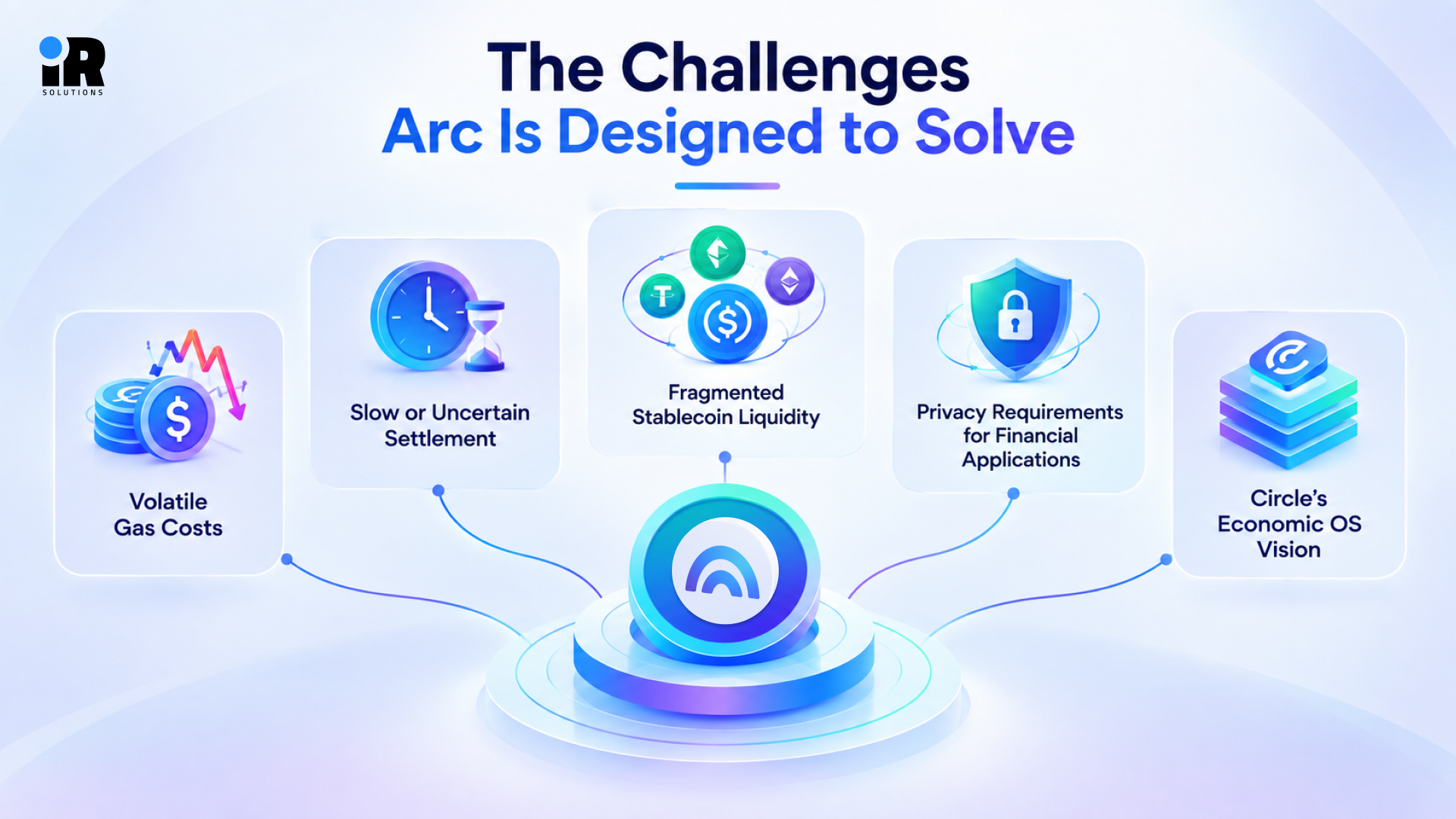
Volatile Gas Costs
Most blockchains require users to hold a separate, often volatile token just to pay transaction fees. This unpredictability makes budgeting difficult for businesses trying to forecast operating costs on-chain.
Slow or Uncertain Settlement
Many blockchains rely on probabilistic finality, where users wait for additional confirmations before trusting a transaction fully. That uncertainty does not work well for payments, foreign exchange, or capital markets activity.
Fragmented Stablecoin Liquidity
USDC already circulates across more than 30 blockchains, which can leave liquidity spread thin and harder to manage. Arc aims to unify that liquidity through native integration with Circle's existing cross-chain infrastructure.
Privacy Requirements for Financial Applications
Financial institutions often need greater privacy for sensitive transactions while still maintaining appropriate compliance, reporting, and audit controls. Arc’s roadmap includes opt-in privacy capabilities designed to protect sensitive transaction information while allowing authorized parties to retain necessary visibility. Broader privacy functionality is still being developed and rolled out following mainnet.
Circle's Economic OS Vision
Circle positions Arc as more than a blockchain, describing it as a full economic operating system for global markets. This vision includes stablecoins, tokenized assets, payments, and AI-driven economic activity all running on one shared platform.
How Does Arc Blockchain Work?
With the Arc blockchain explained at a high level already, this section covers exactly how Arc combines a dedicated consensus engine, an Ethereum-compatible execution layer, and a distinctive gas model built around USDC.
Malachite Consensus
Malachite is Arc’s consensus engine and uses a Byzantine fault-tolerant architecture designed for fast, deterministic settlement. Unlike blockchains that rely on users waiting through several confirmations, Arc can provide deterministic finality in under one second. Once a transaction reaches finality, users do not need to wait for additional blocks before treating it as settled.
EVM Compatible Execution
Arc supports Solidity smart contracts and standard Ethereum development tools such as Hardhat, Foundry, Wagmi, and Viem. Its EVM compatibility makes it easier for Ethereum developers to build on Arc using familiar languages, libraries, and workflows. Existing Solidity contracts can often be ported with limited changes, although developers should still review chain-specific dependencies, integrations, contract addresses, and execution behavior before deployment.
USDC as the Native Gas Asset
Unlike Ethereum's ETH or Solana's SOL, Arc blockchain gas is paid directly in USDC itself rather than a separate token. This removes the need for businesses to hold a separate volatile token just to transact on the network.
Validator Model
Arc currently runs on a permissioned proof-of-authority validator set rather than fully open, permissionless validation. Founding validators include major institutions such as BlackRock, DTCC, Visa, Mastercard, and Standard Chartered, with Circle planning a gradual shift toward proof of stake.
Deterministic Sub-Second Finality
Deterministic finality means a confirmed transaction is permanently settled, not just probably settled after enough time passes. Arc achieves this in under one second, which matters considerably for payments, foreign exchange, and trading workflows that depend on certainty.
Arc's Stablecoin and Cross-Chain Infrastructure
Arc connects directly into Circle's existing stablecoin and interoperability tools rather than building separate infrastructure from scratch.
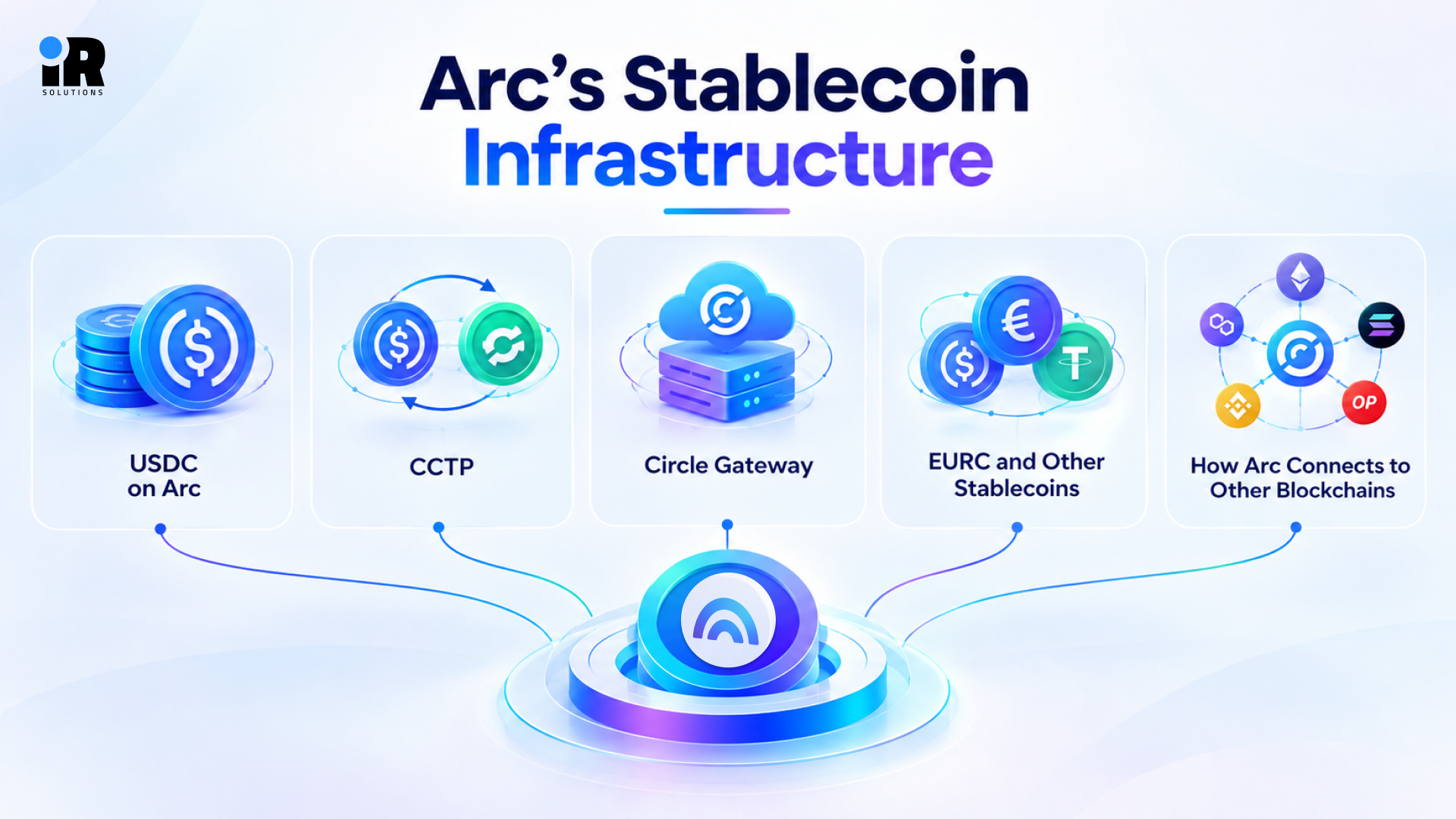
USDC on Arc
This Arc blockchain USDC integration means USDC serves as both the primary settlement asset and the native gas token across the entire network. With more than 74 billion dollars in circulation, USDC already has significant liquidity available on Arc at launch.
CCTP
The Cross Chain Transfer Protocol handles canonical USDC transfers and cross-chain messaging between Arc and other supported blockchains. CCTP has already processed more than 140 billion dollars in cumulative transfer volume across more than 20 chains.
Circle Gateway
Circle Gateway provides chain-abstracted USDC balances, letting developers access unified liquidity without manually managing transfers between networks. This means funds arriving from other chains can settle directly into a single Arc balance.
EURC and Other Stablecoins
Arc also supports EURC, Circle's euro-denominated stablecoin, alongside other stablecoin assets integrated into the network. This positions Arc as infrastructure for multi-currency stablecoin activity, not exclusively dollar-denominated transactions.
How Arc Connects to Other Blockchains
Circle describes native interoperability with more than 20 blockchains through CCTP and Gateway working together. This lets Arc function as one destination within an already active stablecoin network rather than an isolated new chain.
Key Financial Features of Arc
These Arc blockchain features focus on the needs of institutions and financial applications rather than general-purpose crypto use cases.
- Stablecoin Native Gas: Fees are paid and priced in USDC, making Arc blockchain gas costs predictable and dollar-denominated for every user.
- StableFX: Arc's built-in foreign exchange engine supports 24/7 stablecoin-to-stablecoin trading with on-chain payment versus payment settlement.
- Privacy and Confidential Transactions: Opt-in privacy lets institutions shield certain balances and transactions while still meeting their own compliance obligations.
- Tokenized Assets: Arc supports tokenized equities, commodities, and real estate, with institutions like BlackRock already testing settlement on the network.
- Real-Time Settlement: Deterministic sub-second finality supports use cases that genuinely require immediate, final settlement rather than delayed confirmation.
StableFX deserves particular attention here, since it combines request-for-quote pricing with settlement handling both legs of a currency trade simultaneously. As with any newly launched network, it is worth confirming which specific StableFX capabilities are actually live on mainnet before relying on them.
What Can You Build on Arc?
These Arc blockchain use cases connect directly to specific categories of financial applications rather than open-ended general use cases. Businesses exploring these applications can use blockchain development services to build and integrate financial solutions on EVM-compatible networks such as Arc.
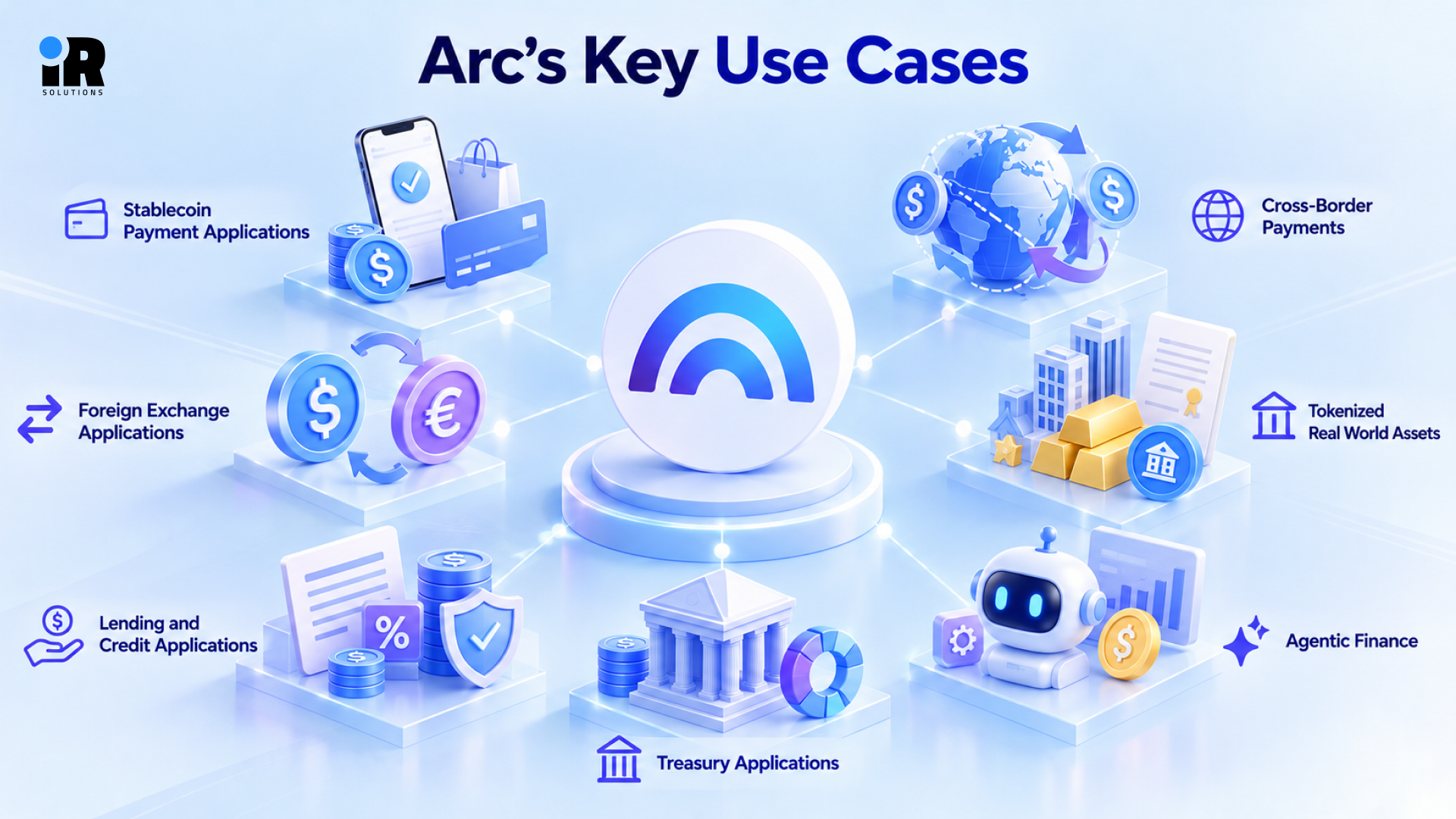
Stablecoin Payment Applications
Stablecoin payment applications can move dollar-denominated value quickly across accounts, businesses, and customers while keeping transaction costs predictable. Because USDC serves as Arc's native gas asset, applications can handle both settlement and network fees using the same stablecoin rather than requiring users to hold another volatile token.
Cross-Border Payments
Arc can support cross-border payment applications designed for faster international money movement and settlement. Businesses can use stablecoins to transfer value between different markets without relying entirely on traditional banking rails, while Arc's deterministic finality can help reduce waiting periods associated with transaction confirmation.
Foreign Exchange Applications
Applications built on StableFX can support continuous stablecoin-based foreign exchange activity beyond traditional market hours. Its design can enable currency pairs to be exchanged and settled on-chain, giving financial applications a way to combine pricing, execution, and payment-versus-payment settlement within the same blockchain environment.
Tokenized Real World Assets
Real-world assets such as real estate, commodities, and equities can be represented as digital tokens and managed through blockchain-based infrastructure. Arc's stablecoin settlement capabilities can support financial applications involving these assets, including issuance, transfers, trading, and other workflows that require programmable settlement.
If you want to understand the underlying process in more detail, our guide to how blockchain enables real-world asset tokenization explains how blockchain, smart contracts, ownership records, and automated settlement work together.
Lending and Credit Applications
Lending and credit applications can use Arc's stablecoin liquidity and fast transaction settlement to manage borrowing, repayments, collateral, and other financial workflows. Developers can build programmable lending systems where transactions and financial conditions are handled through smart contracts while using stablecoins for settlement.
Treasury Applications
Enterprises can use Arc for on-chain treasury operations, including moving funds between accounts, managing stablecoin balances, and coordinating payments across different markets. Deterministic finality can provide finance teams with faster confirmation when transferring funds, while stablecoin-based fees make transaction costs easier to understand.
Agentic Finance
AI agents can transact autonomously on Arc when they need to make payments, transfer stablecoins, or interact with financial applications. Because USDC functions as the network's gas asset, agents can operate without needing to acquire and manage a separate volatile token for transaction fees.
What Is the ARC Token?
The ARC token remains one of the more confusing parts of Arc's story, since it exists without having formally launched.
What Is ARC?
ARC is a native coordination asset described in Circle’s Arc whitepaper. It is designed to play a role in network security, staking, governance, incentives, and other network operations as Arc evolves. ARC is separate from USDC, which is used for payments, settlement, and transaction fees across the network.
ARC vs USDC
USDC is Arc's stablecoin and gas asset, used for actual payments and transaction fees across the network. ARC instead functions as a governance and staking asset, with no role in paying for everyday transactions.
What Could ARC Be Used For?
Circle has outlined roles for ARC in network security, staking rewards, and long-term governance decisions over Arc's development. As the network shifts from proof of authority toward proof of stake, ARC is expected to play a larger role.
ARC Token Supply
Circle completed the genesis mint of 10 billion ARC tokens in September 2026. The initial allocation assigns approximately 60% to ecosystem participants, 25% to Circle for validator and network-related purposes, and 15% to a long-term reserve.
The 10 billion figure represents ARC’s initial genesis supply rather than necessarily a permanent maximum supply, as Arc’s token model also allows for future network incentives and emissions.
Has the ARC Token Launched?
No, the ARC token has not been publicly launched despite the full supply already being minted. Circle's official Arc materials state plainly that completing the genesis mint is not a commitment to publicly launch ARC.
Who Is Arc Blockchain For?
Arc is designed for developers, businesses, and financial institutions building stablecoin-based financial applications.
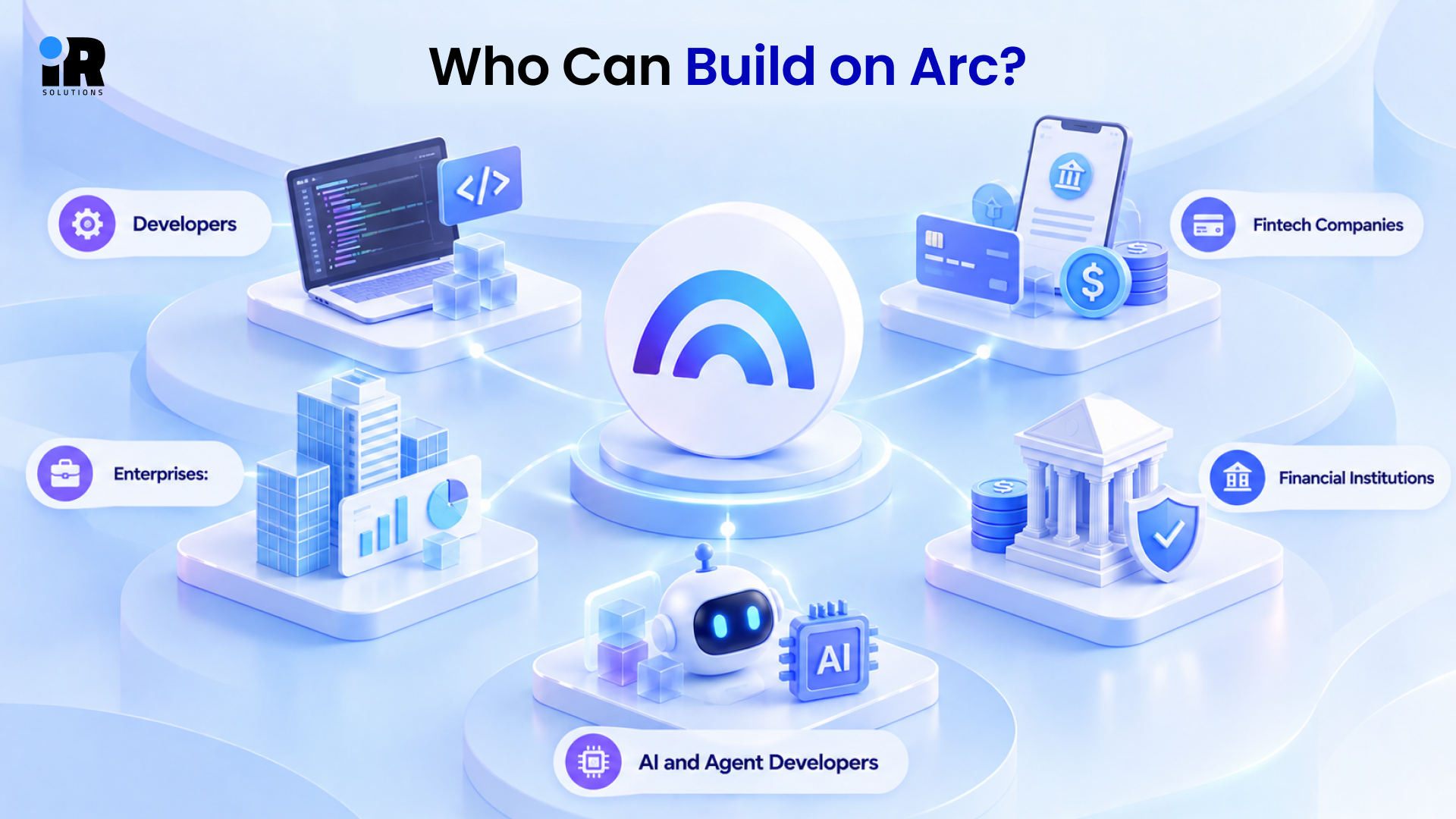
- Developers: Familiar Ethereum tooling makes it straightforward to build and deploy financial applications on Arc.
- Fintech Companies: Predictable USDC-denominated fees and fast settlement suit payment and remittance products well.
- Enterprises: Treasury and operational finance functions benefit from real-time settlement and stablecoin liquidity.
- Financial Institutions: Banks and asset managers can access tokenized assets and foreign exchange through compliant infrastructure.
- AI and Agent Developers: Autonomous agents can transact directly on Arc using USDC without holding a volatile native token.
These use cases show how Arc can support a wide range of financial applications, from stablecoin payments and treasury management to tokenized assets, foreign exchange, and AI-driven financial activity.
Arc vs Ethereum, Solana, and Plasma
Understanding how Arc differs from other major chains helps clarify exactly where it fits in the wider blockchain landscape.
Feature | Arc | Ethereum | Solana | Plasma |
Network type | Financial-focused Layer 1 | General-purpose Layer 1 | General-purpose Layer 1 | Stablecoin-focused Layer 1 |
Main focus | Stablecoin finance and payments | Broad smart contracts and DeFi | High throughput applications | USDT native payments |
Gas asset | USDC | ETH | SOL | Native token, zero-fee transfers |
EVM compatibility | Yes | Yes, native | No, uses its own VM | Yes |
Consensus | Malachite, deterministic BFT | Proof of stake | Proof of history plus proof of stake | PlasmaBFT |
Finality | Sub-second, deterministic | Minutes, probabilistic then final | Seconds | Fast, anchored to Bitcoin |
Stablecoin focus | Core design priority | Supported, not central | Supported, not central | Core design priority |
Developer environment | Solidity, familiar EVM tools | Solidity, largest ecosystem | Rust based | Solidity, EVM compatible |
How to Get Started With Arc
Getting started with Arc is simple for EVM developers. Follow these basic steps to build, test, and deploy your application.
Set Up Your Arc Development Environment
Install standard EVM tooling like Hardhat or Foundry, then configure it to point toward Arc's developer documentation and network endpoints. Arc exposes a standard Ethereum JSON RPC interface, so most existing configuration steps carry over directly.
Deploy Solidity Smart Contracts
Deploying Arc smart contracts generally requires no code changes from existing Solidity work, since the network maintains EVM compatibility throughout. Before deploying to mainnet, developers should also follow a structured smart contract testing process to identify logic, integration, and security issues early. Test thoroughly regardless, since gas costs and execution details can still differ slightly from Ethereum itself.
Test Your Contracts
Use Arc's testnet to check how your contract behaves before pushing anything to mainnet. Circle's testnet has already handled more than 700 million transactions from institutional participants during earlier development phases.
Integrate USDC
Since USDC works as both gas and the settlement asset, integrating it correctly into your application logic matters significantly. Check Circle's documentation for handling USDC balances, transfers, and fee calculations within your specific app.
Monitor Transactions
Use RPC providers or block explorers to track transaction status, confirmations, and contract state changes in real time. Given Arc's deterministic finality, monitoring tools can confirm settlement almost instantly instead of making you wait through long confirmation periods.
Move From Development to Mainnet
Once testing is done, deploy your contracts to Arc's public mainnet and check that the behavior closely matches what you saw on testnet. Keep an eye on validator and network status regularly, since Arc's validator set and consensus model are still evolving.
Arc Blockchain Mainnet and Ecosystem
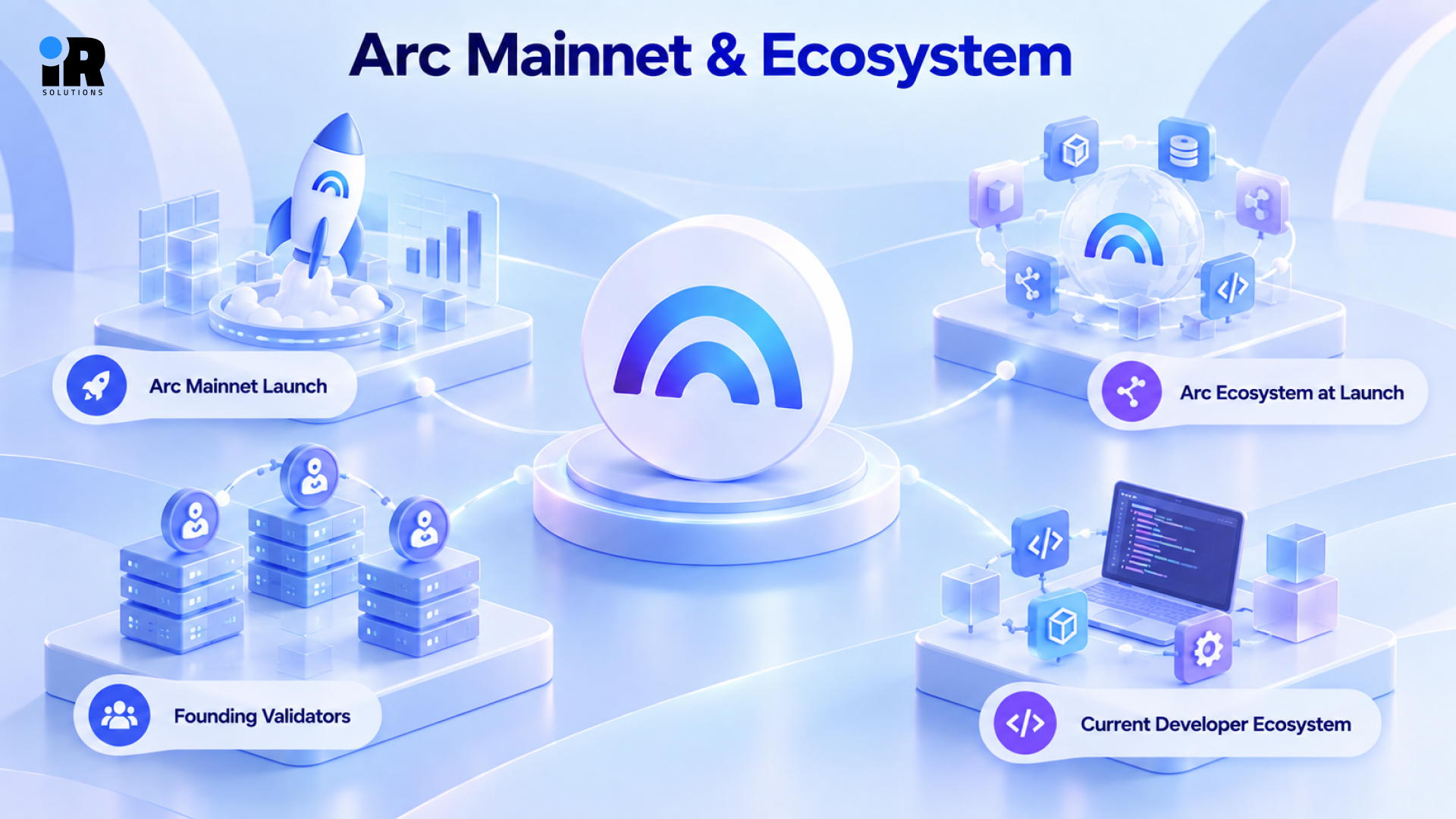
Arc's mainnet launch brought together an unusually large group of institutions for a single blockchain debut.
Arc Mainnet Launch
Circle launched Arc's public mainnet on September 16, 2026, describing it as the most significant release since USDC itself. CEO Jeremy Allaire called Arc an open, neutral, always-on economic operating system for global financial markets.
Arc Ecosystem at Launch
More than 100 applications went live on day one, spanning banks, exchanges, DeFi protocols, custody providers, and wallets. Over 100 institutional and ecosystem builders participated at launch, including BNY, HSBC, Binance, Coinbase, Aave, and Uniswap.
Founding Validators
Eleven institutions serve as founding validators alongside Circle, including BlackRock, DTCC, Galaxy, Global Payments, ICE, Mastercard, MoneyGram, SBI Group, Standard Chartered, Sumitomo Corporation, and Visa.
Current Developer Ecosystem
Circle's launch emphasized a full-stack approach, integrating Arc with Circle Payments Network, Wallets, Contracts, Mint, and Paymaster tools. Developer resources include RPC access through providers like QuickNode, along with standard Ethereum-compatible libraries and frameworks.
Conclusion
Arc is Circle’s purpose-built Layer 1 for stablecoin-based financial applications. With USDC-native gas, deterministic sub-second finality, EVM compatibility, and integrations across Circle’s ecosystem, it provides infrastructure for payments, foreign exchange, tokenized assets, and other financial use cases.
As the network and ecosystem continue to develop, Arc gives developers a familiar environment for building stablecoin-focused applications while its validator model, privacy features, and future ARC token role continue to evolve.
Frequently Asked Questions
What is Arc blockchain?
Arc is Circle's Layer 1 blockchain, built specifically for stablecoin payments, foreign exchange, and tokenized financial assets. It runs on USDC as native gas, uses Malachite consensus, and delivers sub-second finality suited for institutional-grade settlement needs.
Who created Arc blockchain?
Circle, the company behind USDC, designed and built Arc as its dedicated financial infrastructure blockchain. They announced Arc in August 2025, opened a public testnet that October, and reached full mainnet a year later.
Is Arc a Layer 1 blockchain?
Yes, Arc runs its own independent consensus mechanism called Malachite and settles transactions directly, instead of scaling an existing base chain like Ethereum. This makes it a genuine Layer 1 network, not a rollup or sidechain.
Is Arc built on Ethereum?
No, Arc is not built directly on Ethereum, though it remains fully EVM-compatible for deploying existing Solidity smart contracts. Developers can reuse familiar Ethereum tooling without needing to learn an entirely new architecture.
What is used for gas on Arc?
USDC serves as Arc's native gas asset, meaning transaction fees are paid and priced directly in dollars rather than a separate cryptocurrency. This differs from Ethereum's ETH or Solana's SOL, which both require holding a native token.
Why does Arc use USDC for gas?
Using USDC removes the volatility of holding a separate native token, making transaction costs predictable and dollar-denominated for businesses. This matters a lot for institutions trying to forecast operating expenses before committing to on-chain activity.
Is Arc EVM compatible?
Yes, Arc supports Solidity smart contracts and standard Ethereum development tools, including Hardhat, Foundry, Wagmi, and Viem directly. Existing Ethereum contracts generally deploy on Arc with little to no modification required from developers.
Is Arc mainnet live?
Yes, Arc's public mainnet launched on September 16, 2026, with more than 100 applications live from day one. Founding validators including BlackRock, Visa, and Mastercard secured the network alongside Circle at launch.
What is the ARC token?
ARC is Circle's native coordination token intended for governance, security, and staking, with its full 10 billion supply already minted. Despite this, Circle has stated clearly that the mint is not a commitment to publicly launch it.
What can you build on Arc?
Developers can build payment applications, cross-border transfer tools, foreign exchange platforms, tokenized asset systems, lending markets, and treasury tools. Arc's design also supports emerging agentic finance, where AI agents transact independently using USDC.


