





Key Takeaways
- Unit testing builds the foundation but cannot cover every state or interaction.
- Integration and fork testing validate real contract interactions and blockchain conditions.
- Fuzz and invariant testing uncover edge cases and unexpected transaction sequences.
- Test coverage highlights untested code but does not guarantee security.
- Testnet testing should follow local automated testing, not replace it.
- Testing, audits, and formal verification provide different layers of assurance.
Smart contract testing checks whether contract logic behaves correctly under expected, unexpected, and adversarial conditions before deployment. Once a contract goes live, real users and funds can interact with it immediately, making thorough testing essential in blockchain development.
This smart contract testing guide covers unit, integration, fuzz, invariant, fork, and security testing, along with testnet validation. Test coverage can highlight untested areas but does not guarantee security, so teams should combine multiple testing methods before mainnet deployment.
Understanding how contracts execute transactions, change state, and interact with other contracts makes the testing process easier to follow, so review how smart contracts work before moving into the technical testing sections.
What Is Smart Contract Testing?
Smart contract testing is the process of verifying contract behaviour before real users or funds are involved. A complete smart contract testing process verifies logic, state changes, permissions, transactions, failures, and external interactions. It also checks the security assumptions that the whole protocol design silently depends on every single day.
Functional correctness and security are two different goals that many teams wrongly treat as the same thing. A contract may work perfectly during normal use and still fail under unusual transaction sequences or malicious inputs.
Automated vs Manual Smart Contract Testing
Automated and manual testing complement each other, covering different types of smart contract issues.
- Automated testing: Automated tests are repeatable, fast, suitable for CI pipelines, and ideal for ongoing regression testing.
- Manual testing: Manual review suits business logic checks, unusual scenarios, and assumptions that automated tests quietly skip.
Why Smart Contracts Need Testing Before Deployment
Blockchain applications need deeper testing than most conventional software because of four practical constraints.
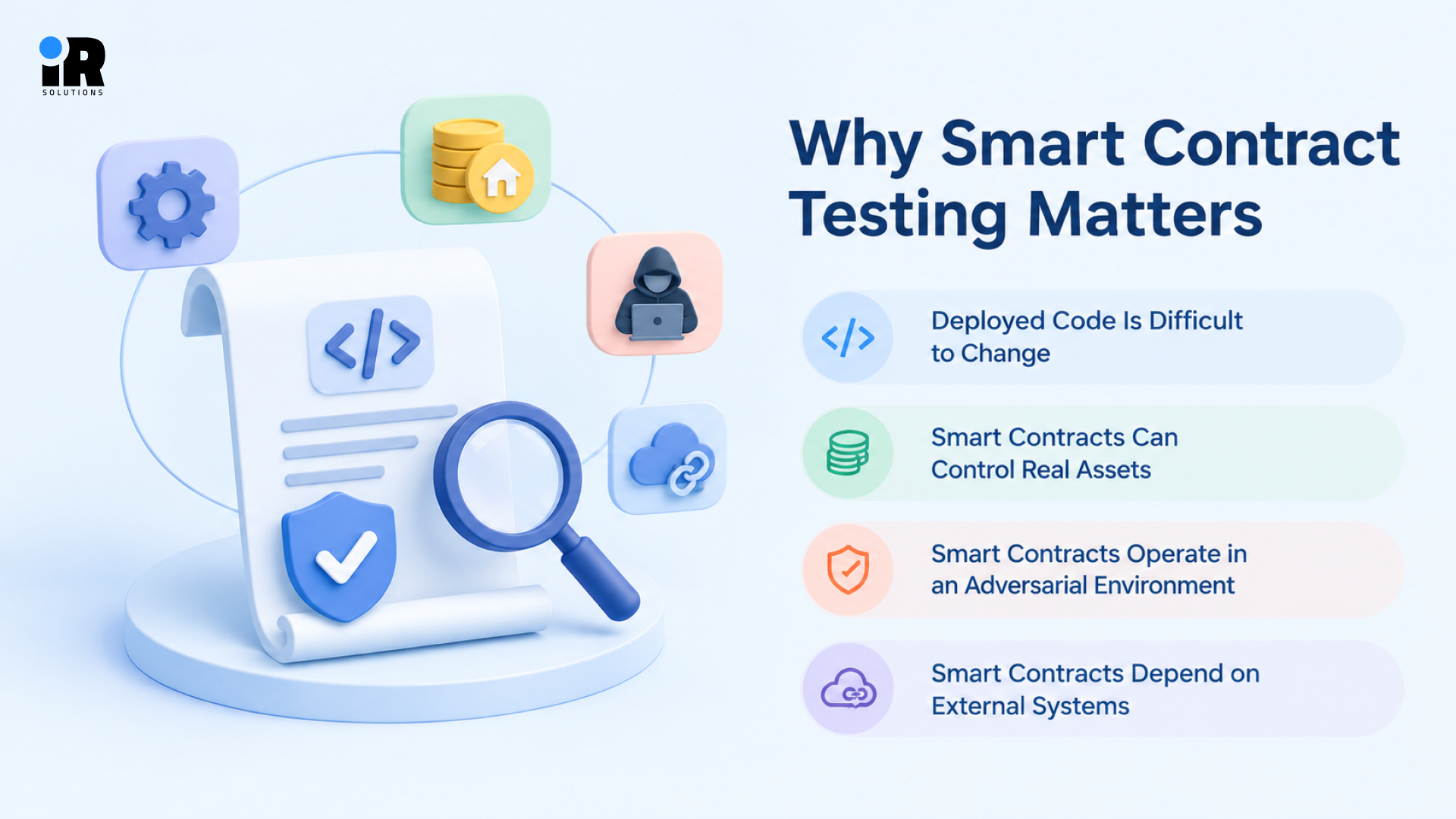
1- Deployed Code Is Difficult to Change
Deployed contract code is generally difficult to change after launch, so mistakes can remain exploitable unless the system includes an appropriate upgrade or mitigation mechanism. Upgradeable architectures exist, although they add extra technical complexity and new governance risks to your system.
2- Smart Contracts Can Control Real Assets
Contracts routinely control tokens, liquidity, collateral, NFTs, governance rights, and recurring payments for many users. A small logic bug therefore turns into a direct financial loss rather than a minor product defect.
3- Smart Contracts Operate in an Adversarial Environment
Public contracts can be called by anyone, including attackers who study the code far more carefully than users. Your tests must assume hostile inputs and strange call sequences instead of only polite, expected behaviour.
4- Smart Contracts Depend on External Systems
Most protocols rely on ERC20 tokens, DEXs, lending markets, oracle feeds, bridges, and proxy contracts. Those dependencies behave in ways your local tests cannot guess, which leads naturally into integration testing.
Important Types of Smart Contract Testing
Smart contract testing covers several methods, with each one focusing on a different part of the contract’s behavior and security.
Testing Method | What It Tests | Best Used For |
Unit Testing | Individual functions | Core business logic and failure conditions |
Integration Testing | Contract interactions | Multi-contract systems and dependencies |
Fuzz Testing | Large ranges of generated inputs | Unexpected values and edge cases |
Invariant Testing | Properties that must always remain true | Stateful protocols and DeFi |
Fork Testing | Contracts against real blockchain state | External integrations |
Static Analysis | Code without executing transactions | Known risky patterns and weaknesses |
Testnet Testing | Production-like deployment behaviour | Final pre-mainnet validation |
These methods work together to test smart contracts from different angles, helping teams identify issues before they reach production.
Step 1: Define What the Smart Contract Must Guarantee
Before writing tests, define the rules, expected behavior, and security properties the smart contract must always follow.
Document the Business Rules
Write down who can mint tokens, who can withdraw funds, and how fees are calculated. Also record who can pause the contract and what limits apply to individual user transactions.
Identify Failure Conditions
Ask what should never be allowed and which actions must always require explicit authorisation. Then ask what happens at zero, at maximum values, and when an external dependency fails completely.
Define Security Properties and Invariants
Invariants are statements that must stay true no matter which valid actions users perform. Examples include mint restrictions, withdrawal limits tied to balances, and protected state that paused functions cannot alter.
Step 2: Write Unit Tests for Core Contract Logic
Smart contract unit testing isolates individual pieces of contract behaviour and forms the foundation of most testing suites. It helps developers verify functions, state changes, access controls, failure conditions, and expected outputs independently.
Test Expected Behavior
Confirm that a valid transfer succeeds and that a deposit updates the correct balance afterwards. Also confirm that an authorised account can perform every administrative action the specification promises it can.
Test Reverts and Failure Conditions
- Unauthorised callers: Any account without the required role must fail with a clear expected revert.
- Bad inputs: Insufficient balances, invalid parameters, and duplicate operations should never pass silently through validation.
- Blocked states: Paused contracts and expired requests must reject transactions instead of changing protected internal state.
Test Boundary Values
Test zero, one, the minimum permitted amount, and the maximum permitted amount for every sensitive function. Values sitting just above and just below thresholds catch rounding and comparison mistakes very effectively.
Test State Changes and Events
Read stored values before and after each transaction to confirm the exact state change happened. Then verify that the correct event fired with the right parameters, account, and recorded value.
Test Access Control
Every critical role needs positive and negative tests covering allowed and forbidden callers. Ownership transfers, role grants, and role revocations deserve the same level of attention as core logic.
Step 3: Test Contract Interactions With Integration Tests
Smart contract integration testing answers a wider question than any single unit test can. It checks whether connected contracts work together correctly rather than testing each function in isolation.
A unit test asks whether a deposit function works on its own. Integration testing asks whether the deposit, accounting, token transfer, and withdrawal processes work correctly across connected contracts.
What Integration Testing Should Cover
Cover contract-to-contract calls, inheritance, libraries, external tokens, and oracle integrations used in production. Routers, proxy contracts, upgrade contracts, and third-party protocols belong in the same test suite.
Test Failed External Calls
- Dependency reverts: Confirm your contract handles a reverting dependency without corrupting balances or locking user funds.
- Odd returns: External functions may return unexpected data, and tokens may behave differently from the standard.
- Missing contracts: Test what happens when an external contract becomes unavailable or returns nothing at all.
Mocks rarely reproduce production behaviour perfectly, which is why these negative scenarios matter so much.
Step 4: Use Fuzz Testing to Find Unexpected Edge Cases
Smart contract fuzz testing replaces manual value selection with large volumes of generated inputs.
The framework produces many different inputs and checks whether any of them break your encoded assumptions. Developers write the property, and the tool spends its time searching for a counterexample.
What Fuzz Testing Is Good For
- Extreme numbers: Unusual amounts, tiny values, and huge values expose arithmetic boundaries inside accounting logic.
- Odd addresses: Unexpected addresses and repeated callers reveal assumptions developers never realised they had made.
- Rounding errors: Division and precision handling often break only at specific generated input combinations.
Where Fuzz Testing Stops
Testing one function with thousands of inputs is not the same as testing long transaction sequences. That gap is exactly what invariant testing was designed to close for stateful protocols.
Step 5: Use Invariant Testing for Stateful Smart Contracts
Smart contract invariant testing checks whether critical properties remain true across many valid actions performed in random order. Instead of checking one expected input and output, it tests whether the contract continues to obey its core rules as its state changes.
A fuzz test calls a deposit with hundreds of different amounts against a known starting state. An invariant test runs deposits, withdrawals, and transfers in varied sequences while checking that accounting stays correct.
Useful Smart Contract Invariants
- Accounting invariant: Total user balances must stay consistent with the protocol accounting recorded inside the contract.
- Authorisation invariant: Unauthorised accounts must never gain access to protected operations through any action sequence.
- Supply invariant: Token supply can only change through approved minting and burning paths in the code.
- Collateral invariant: Protocol liabilities must always remain inside the collateral rules the design originally defined.
Why Invariant Testing Matters for DeFi
Some bugs appear only after several completely valid transactions happen in an unusual order. Lending, staking, and automated market maker systems carry exactly that kind of hidden sequencing risk.
Step 6: Test Against Real Blockchain State With Fork Testing
Fork testing brings live network reality into your local development environment safely.
A fork creates a local copy of the blockchain state from a chosen block for testing purposes. Your tests then interact with real deployed contracts without touching or affecting the live network.
What to Test Using a Mainnet Fork
Test integrations with ERC20 tokens, DEX pools, lending protocols, oracle contracts, and protocol routers. Existing contracts in your own system also deserve fork-based checks before every upgrade.
Why Fork Testing Beats Mocks Alone
Mocks behave exactly the way the developer programmed them, which hides real integration problems. Deployed contracts carry unusual interfaces, unexpected return values, existing state, and assumptions nobody documented anywhere.
Step 7: Run Static Analysis and Security-Focused Tests
Smart contract security testing examines source code, security assumptions, and common vulnerability patterns before deployment. Static analysis is one part of this process and reviews source code and patterns without executing blockchain transactions.
Areas Security Testing Should Cover
Focus on access control, reentrancy assumptions, external calls, authorisation, input validation, and signature handling. Delegate call usage, oracle assumptions, and upgrade permissions need the same careful and repeated review.
Testing should also cover common vulnerabilities such as unsafe external calls, weak authorisation, reentrancy, and incorrect assumptions about transaction ordering. Reviewing common smart contract development mistakes can help teams identify these risks before deployment.
Step 8: Measure Smart Contract Test Coverage
Coverage tells you which parts of the code your tests exercised, but it does not show whether those tests were sufficient or whether the contract is secure.
Most tools report line coverage, branch coverage, function coverage, and statement coverage for each contract. Branch coverage usually gives the most useful signal because it exposes untested conditional paths.
Understanding the Limits of Test Coverage
A suite can execute most code while still missing edge cases and using weak assertions. It may also overlook unexpected state combinations and never test the economic assumptions behind the protocol.
Avoid fixed targets, and instead review smart contract test coverage against recognised security verification controls. Use gaps in coverage as a map of unexplored risk rather than as a score.
Step 9: Run Regression Tests Through CI/CD
Every meaningful code change should trigger the pipeline automatically before review or merge happens. A practical order is compile, unit tests, integration tests, static analysis, coverage, then fuzz tests. Longer fuzz and invariant campaigns can run separately on a schedule before major protocol releases.
Turn Every Fixed Bug Into a Regression Test
Reproduce the bug, write a failing test that captures the exact problem, and then fix the contract logic properly. Once the fix is applied, confirm that the test passes and run the wider test suite to make sure the change has not introduced new issues.
Keep the regression test permanently in the suite so future code changes cannot silently reintroduce the same bug.
Step 10: Test the Smart Contract on a Public Testnet
Smart contract testnet testing is the final validation layer after local automated testing passes. It lets teams validate deployment scripts, wallet interactions, frontend integration, permissions, contract verification, monitoring, upgrades, and full transaction flows under realistic network conditions. Ethereum Sepolia is currently the recommended default testnet for application development, while other testnets serve different purposes.
What Testnet Testing Cannot Replace
A testnet never replaces unit testing, fuzz testing, invariant testing, or static security analysis. It also cannot replace an independent audit performed by experienced external security reviewers.
Smart Contract Testing Tools
These tools cover key parts of modern Solidity development, testing, and security workflows.
Tool | Best Used For |
Foundry | Unit, fuzz, invariant and fork testing |
Hardhat | Solidity and TypeScript testing workflows |
Slither | Static analysis |
Echidna | Property-based fuzzing |
OpenZeppelin | Contract libraries and testing utilities |
Different tools support different parts of the testing workflow. Foundry smart contract testing covers unit, fuzz, invariant, and fork tests, while Hardhat smart contract testing supports Solidity projects with JavaScript and TypeScript workflows. Slither provides static analysis, Echidna handles property-based fuzzing, and OpenZeppelin offers reusable contract libraries and testing utilities.
For a deeper breakdown of frameworks and security tooling, see our guide to the top smart contract development tools.
Smart Contract Testing vs Security Audit vs Formal Verification
Each approach provides a different kind of assurance, so teams should not treat them as alternatives.
Approach | Main Purpose |
Smart Contract Testing | Verify expected and unexpected behaviour |
Security Audit | Independent review of code and system assumptions |
Formal Verification | Mathematically verify specified properties |
Bug Bounty | Allow independent researchers to find vulnerabilities |
Testing proves your assumptions hold, while an audit questions whether those assumptions were correct. Formal verification proves specific properties, and bug bounties add ongoing pressure from external researchers.
Smart Contract Testing Checklist Before Mainnet
The following smart contract testing best practices provide a practical readiness review before mainnet deployment. Use this checklist to confirm that functional, integration, security, regression, and deployment testing have been completed rather than treating testing as a simple box-ticking exercise.
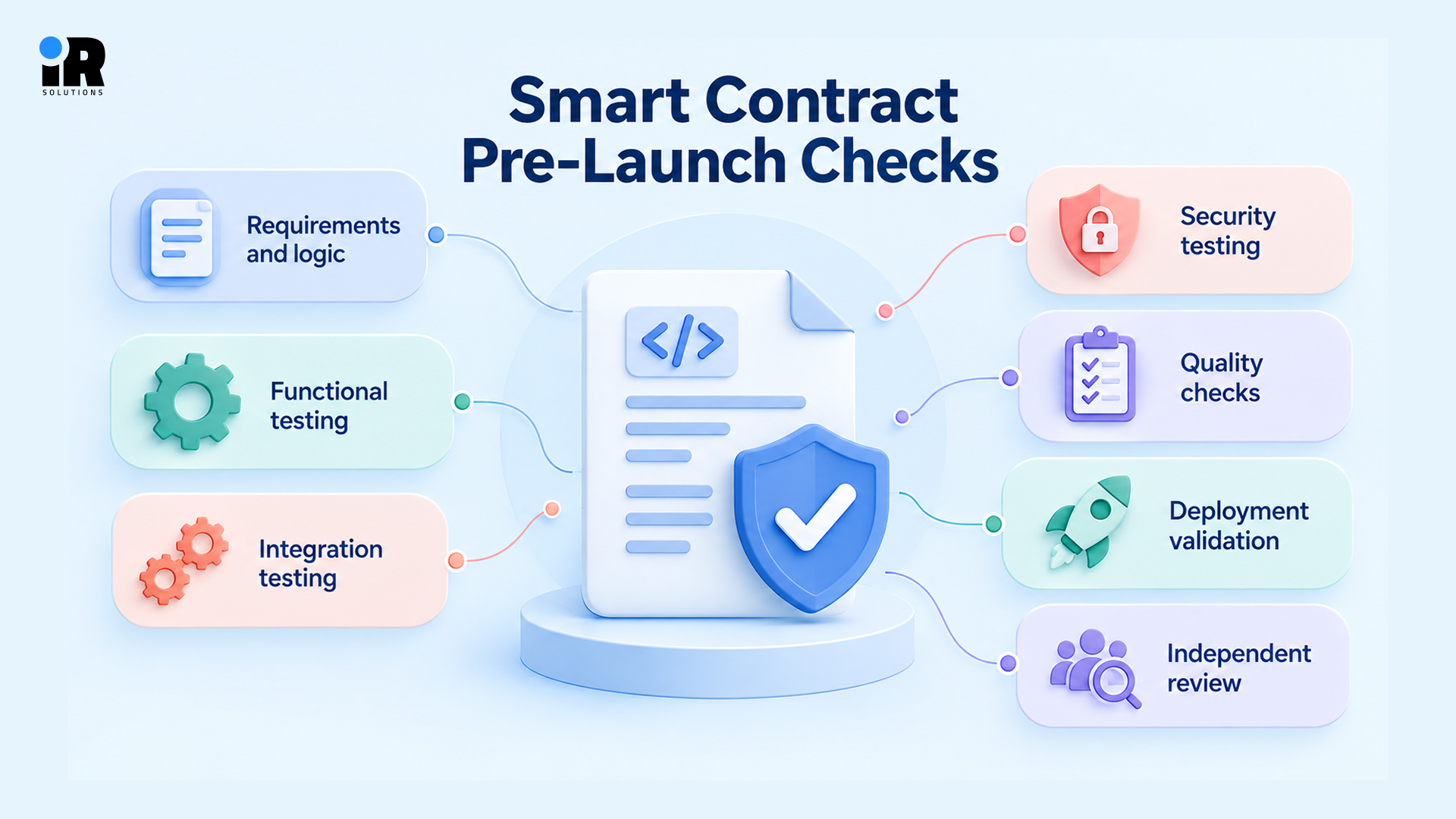
Requirements and logic
- Business rules documented
- Critical invariants defined
- Privileged roles documented
- Failure scenarios identified
Functional testing
- Unit tests passed
- Happy paths tested
- Revert paths tested
- Boundary conditions tested
- Events validated
- State changes verified
Integration testing
- Contract interactions tested
- External dependencies tested
- Realistic failure cases tested
- Fork testing completed where relevant
Security testing
- Fuzz tests completed
- Invariant tests completed
- Static analysis reviewed
- Access control tests passed
- Sensitive admin functions tested
Quality checks
- Coverage reviewed
- Regression suite passed
- CI pipeline passing
- Outstanding bugs documented
Deployment validation
- Testnet deployment completed
- Deployment scripts tested
- Roles and permissions verified
- Contract verification process tested
- Pause and emergency functions tested
Independent review
- Audit findings resolved where an audit was performed
- Critical and high severity issues closed before launch
When Is a Smart Contract Ready for Mainnet?
A contract moves closer to deployment readiness once several independent conditions are satisfied together. Functional requirements pass, failure cases are tested, and every integration behaves correctly under realistic conditions.
Fuzz and invariant testing show no unresolved critical problems, and static analysis findings have been reviewed. Testnet deployment works as expected, privileged roles are configured correctly, and deployment procedures have been rehearsed. Independent security review should also be complete whenever the contract holds meaningful user value.
Budget planning matters here too, so review smart contract development cost before committing to audit timelines. Security testing, auditing, and deployment work all carry real costs that teams should plan early.
Need Help Building and Testing Production Smart Contracts?
Production testing requires more than running a handful of unit tests. Teams need developers who understand contract architecture, integration testing, fuzzing, invariant testing, security analysis, and deployment workflows. Testing should also account for external dependencies, edge cases, access control, and real blockchain conditions before launch.
Experienced developers can support the full testing process, from writing automated tests and identifying potential issues to validating integrations and preparing contracts for mainnet. If you need specialized expertise, you can hire smart contract developers to manage testing and launch preparation from development through deployment.
Conclusion
Smart contract testing should be part of every stage of development rather than something saved for the final sprint. Unit, integration, fuzz, invariant, fork, and security testing each catch different types of issues, while testnet deployment helps validate real deployment and transaction flows. No single method can guarantee that a contract is completely secure, so teams should combine multiple layers of testing before mainnet.
Real production readiness comes from verified logic, tested integrations, reviewed security risks, and rehearsed deployment procedures. By finding and fixing issues before real users and funds interact with the contract, teams can reduce avoidable risks and approach mainnet deployment with greater confidence.
Frequently Asked Questions
What is smart contract testing?
It is the process of verifying contract logic, state, permissions, and security assumptions before deployment. The goal is to catch failures before real users and real funds interact with your code.
How do you test smart contracts before deployment?
Test smart contracts through unit, integration, fuzz, invariant, fork, and security testing before moving to a public testnet. This process verifies logic, state changes, external interactions, edge cases, and common vulnerabilities before the contract reaches mainnet.
What are the main types of smart contract testing?
The main types are unit, integration, fuzz, invariant, fork, static analysis, and testnet testing. Teams combine them because no single method covers logic, state, and external dependencies alone.
What is fuzz testing in smart contracts?
Fuzz testing generates many different inputs automatically to check whether any input breaks your stated assumptions. It finds extreme values, rounding issues, and parameter combinations that manual tests usually overlook.
What is invariant testing?
Invariant testing runs random sequences of valid actions and checks that core properties always remain true. It suits stateful protocols where bugs appear only after several transactions happen in unusual order.
What is the difference between unit testing and integration testing?
Unit testing checks one function in isolation, while integration testing checks how multiple contracts work together. Both are needed because correct functions can still fail once connected inside a larger system.
Is 100% smart contract test coverage enough?
No, because coverage only shows which lines ran, not whether assertions were meaningful or complete. A fully covered contract can still miss edge cases, weak assumptions, and economic attack scenarios.
Should developers use Foundry or Hardhat for smart contract testing?
Foundry suits fast Solidity native unit, fuzz, invariant, and fork testing inside one single toolchain. Hardhat suits teams who prefer TypeScript workflows, and many projects use both tools together.
Is testnet testing enough before mainnet?
No, testnet testing validates deployment and operations rather than deep logic, state, or security correctness. It should always follow local automated testing instead of replacing any part of it.
Can smart contract testing replace a security audit?
No, testing confirms your own assumptions while an audit independently challenges whether those assumptions were right. Strong projects use both, and add bug bounties for continuous external review after launch.


