



Ethereum is still the most widely used blockchain for building decentralised applications, smart contracts, and tokenised asset platforms. The developer ecosystem is large, the tooling is mature, and the institutional weight behind it is stronger than any competing chain. But none of that helps you if the company you hire cannot actually build on it properly. The gap between an average Ethereum team and a good one is wider than most businesses expect before they find out the hard way.
At IR Solutions, our blockchain development services have delivered production Ethereum applications across fintech, real estate tokenisation, and digital asset infrastructure for clients across multiple markets.
This blog covers the seven things that actually determine whether your Ethereum project ships or stalls.
1. Must have Real Ethereum Stack Expertise
The first thing to assess is whether the company actually covers the full Ethereum stack or just the smart contract layer. A team that knows Solidity but cannot handle frontend integration, backend infrastructure, or wallet connectivity will leave you stitching together multiple vendors for a single product and managing the gaps between them yourself.
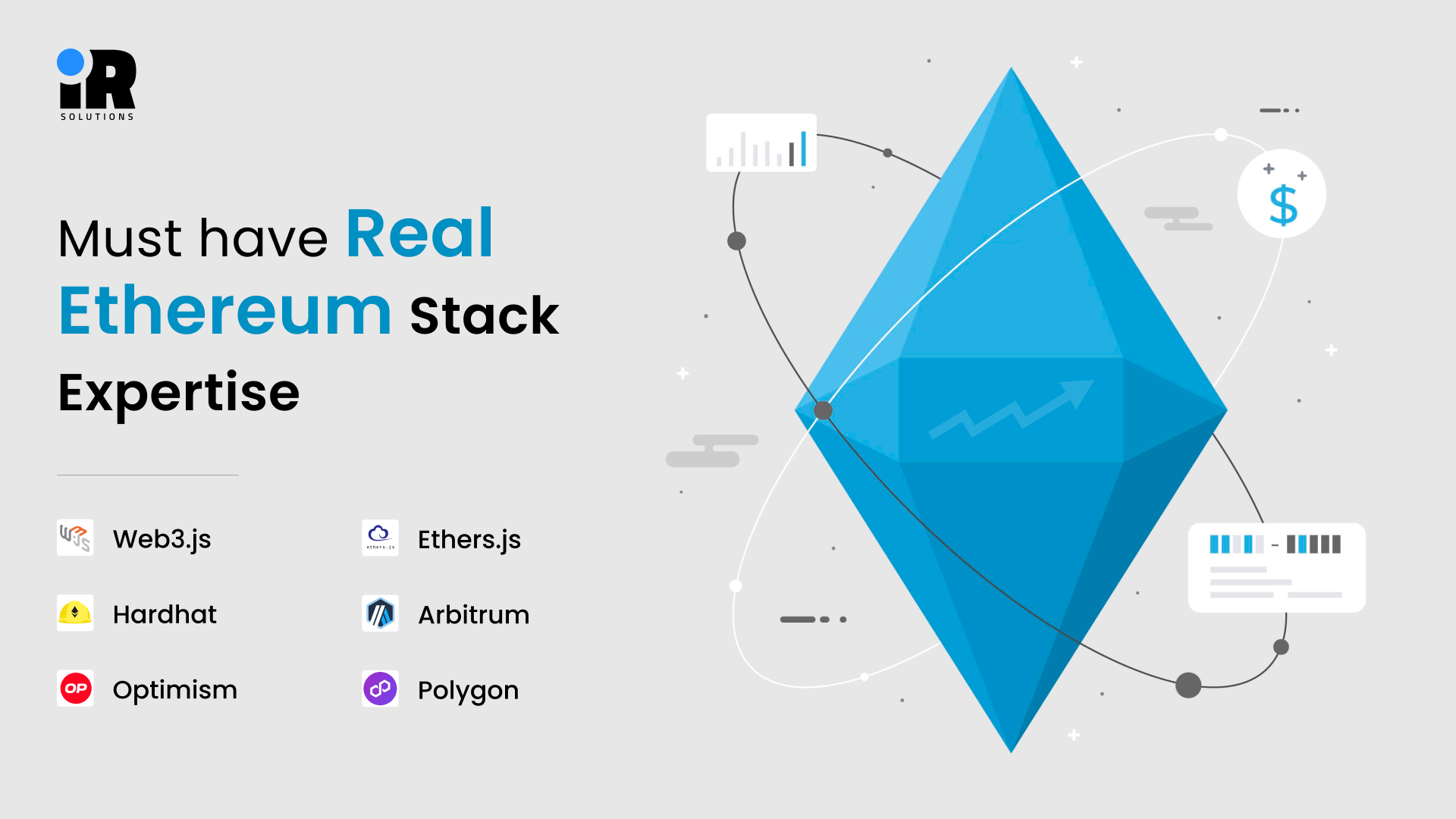
An Ethereum Development Company should be fluent in Solidity architecture, ERC token standards, Web3.js and Ethers.js, development tooling like Hardhat or Foundry, decentralised storage, and Layer 2 networks like Arbitrum, Optimism, and Polygon. A strong professional company will show you code, walk you through specific challenges from past projects, and answer technical questions with precision rather than polished generalities.
This is where businesses often decide to hire ethereum smart contract developers without checking whether the team actually understands full-stack blockchain architecture.
2. Non-Negotiable Security Standards
Audit First
Smart contract security is not a feature you add at the end of a project. It is a discipline that runs through every decision made during development, from architecture through to deployment. A company that treats independent security audits as optional is telling you something important about how they build.
Every contract handling real user funds or enforcing compliance logic should go through an independent third-party audit before mainnet deployment. This is standard practice at every serious company in the industry and non-negotiable for any application operating at scale.
What to Check?
- Ask whether the company has a documented security review process during development, not just at the end.
- Check whether they follow established standards like the Smart Contract Security Alliance guidelines consistently.
- Confirm that independent audit firms are brought in before any mainnet deployment happens on your project.
- Ask how they handle vulnerabilities discovered post-deployment and what their incident response process looks like.
3. Real Deployments Not Demo Projects
Portfolio Proof
Any company can describe what they are capable of building, but what actually matters is what they have already delivered and whether those applications are running in live production environments with real users and real economic activity behind them.
Ask for contracts deployed on a live blockchain network, not testnet demos. Testnet deployments cost nothing and don’t meaningfully demonstrate how a team performs under real-world conditions. Live blockchain deployments involve real financial value and usage, and the engineering decisions made in those environments reflect true technical judgement, reliability, and production readiness.
Read our blog on Scalable Ethereum Development Services for Modern Startups in 2026, which discusses how startups are preparing their products for large-scale adoption.
Strong Portfolio Signals
A company with real Ethereum experience should be able to show you completed projects across at least some of the following categories:
- DeFi Protocols: Lending, borrowing, or automated market maker implementations running with real liquidity on mainnet
- NFT Platforms: Minting marketplaces, royalty logic, and collection management built for real creators and collector audiences
- Asset Tokenisation: Real-world asset platforms covering commodities, real estate, or equity with compliant transfer logic
- DAO Infrastructure: On-chain governance voting and treasury management built for communities making real decisions together
- Cross-Chain Bridges: Live implementations connecting Ethereum to other networks with verifiable transaction history behind them
If a company cannot point to at least several of these from actual production deployments, treat that as a significant signal worth investigating further before proceeding.
Ready to find the right Ethereum development partner? Schedule a call with us.
4. Gas Costs as an Engineering Priority
Ethereum transactions cost money every time they execute, and those costs scale directly with the efficiency of the contract code. Poorly optimised contracts can cost users three to five times more per transaction than well-written equivalents doing the same thing.
This matters most when users transact frequently or when the platform bears gas costs on the user's behalf. An experienced Ethereum development company treats gas optimisation as a core engineering concern throughout development, not a final polish step before launch.
Storage operations are the most expensive part of contract execution, and a strong team minimises them from the architecture stage. Batch processing, proxy patterns, and call data optimisation all reduce costs across the product lifecycle.
Ask any company you are evaluating how they approach gas optimisation. The answer will tell you whether this is a team that thinks in production costs or only in functionality.
5. Compliance Built Into the Architecture
Jurisdiction Matters
Ethereum applications touching real-world assets, financial instruments, or user identity data operate inside regulatory frameworks, whether the development team thinks about them or not. A company that builds without compliance awareness creates legal exposure that becomes expensive to untangle well after the fact.
The US, EU, UAE, and Singapore each have increasingly defined frameworks for tokenised assets, digital securities, and crypto financial products. Your development partner needs to understand the jurisdictions your platform operates in and build compliance logic into the architecture from day one, rather than trying to retrofit it later when the product is already live.
How Asset Token Compliance Is Built Into the Architecture
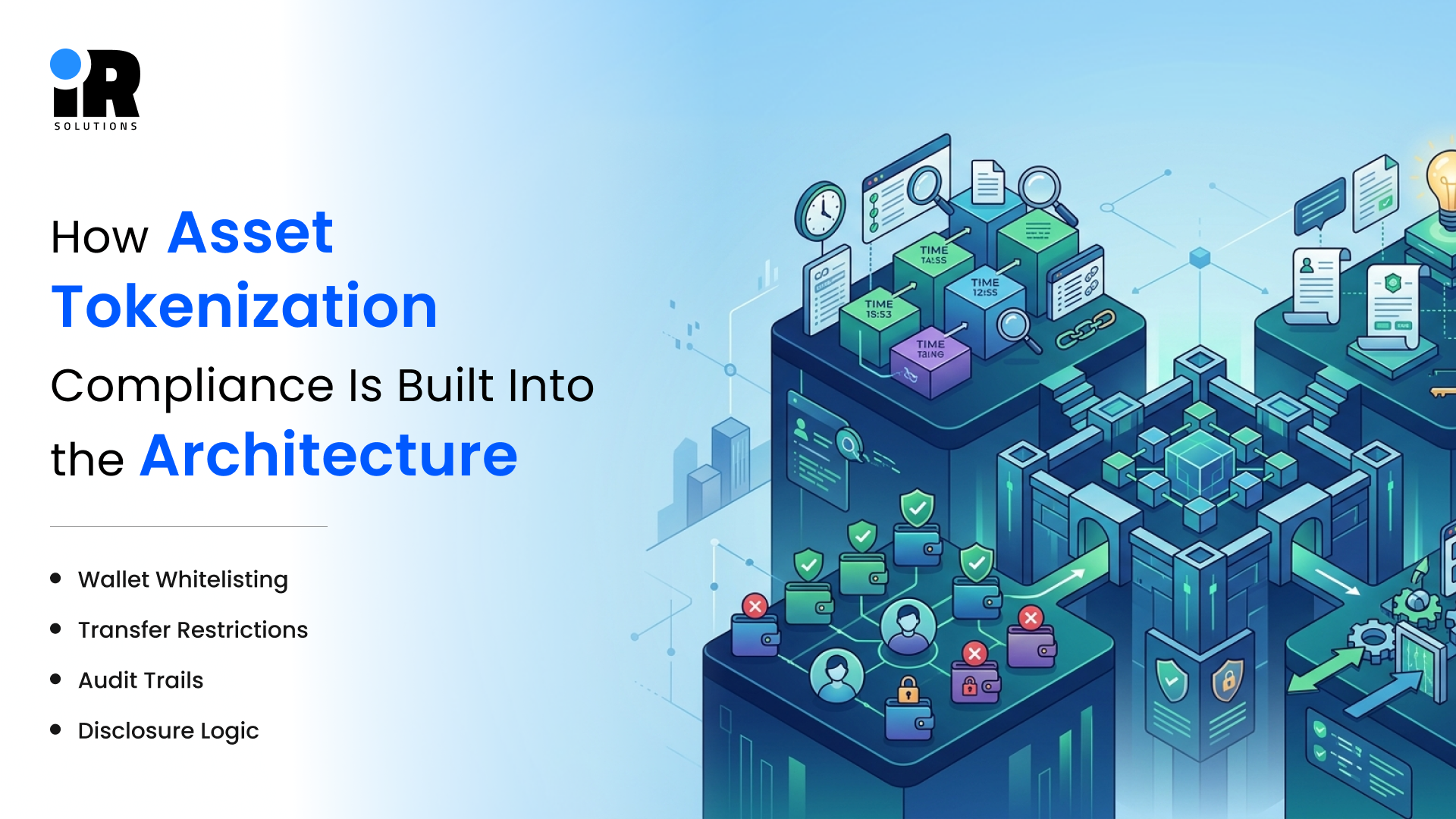
- Wallet Whitelisting: KYC and AML verification enforced at the wallet level before any transaction can execute on-chain
- Transfer Restrictions: Compliance rules baked directly into token contracts that reflect the requirements of your target market
- Audit Trails: On-chain records that regulators can access independently without requiring your manual intervention at any point
- Disclosure Logic: Jurisdiction-specific requirements that travel with the asset regardless of where it moves on-chain
Read our blog on RWA Tokenization Explained - From Physical Assets to Digital Tokens which covers how compliance architecture gets built into real-world asset tokenisation platforms from the ground up.
6. Visibility Into What Is Being Built
Daily Transparency
Technical capability does not matter much if you cannot see what is being built and cannot intervene when direction needs to change. Ethereum projects that go quiet for weeks tend to surface their biggest problems right before a planned launch date, when there is the least time and budget left to fix them.
A reliable development company runs visible, structured cycles, you should be able to check progress against a defined roadmap without having to ask repeatedly or wait for a status meeting to find out where things stand.
Signs of Transparency
- Sprint Reviews define outputs reviewed at the end of every cycle, so progress is always visible and measurable
- Direct Access, direct contact with the engineers building your product, not just account management communication layers
- Shared Tooling project management access so you can check task status without waiting for a scheduled report
- Clear Escalation a defined process when blockers arise, rather than remaining silent until the problem eventually resolves itself
- Written documentation of architecture decisions is recorded in writing, so knowledge lives outside individual engineers on the team
At IR Solutions, every engagement includes direct engineer access and defined project visibility from discovery through deployment.
7. Engagement Models That Fit Your Stage
Match the Model
A company offering only one engagement model is asking you to fit your project around their process. That works sometimes. When your requirements shift mid-build, which they usually do, it creates friction that costs time and money.
Early-stage projects work better with milestone-based billing tied to delivered functionality. Ongoing product development fits a monthly retainer with a defined team and sprint cadence. The right model also determines how fast you can scale the team up or down when the roadmap changes.
How Different Hiring Approaches Compare
Before getting into the seven considerations, it helps to understand what you are actually choosing between when you hire for Ethereum development.
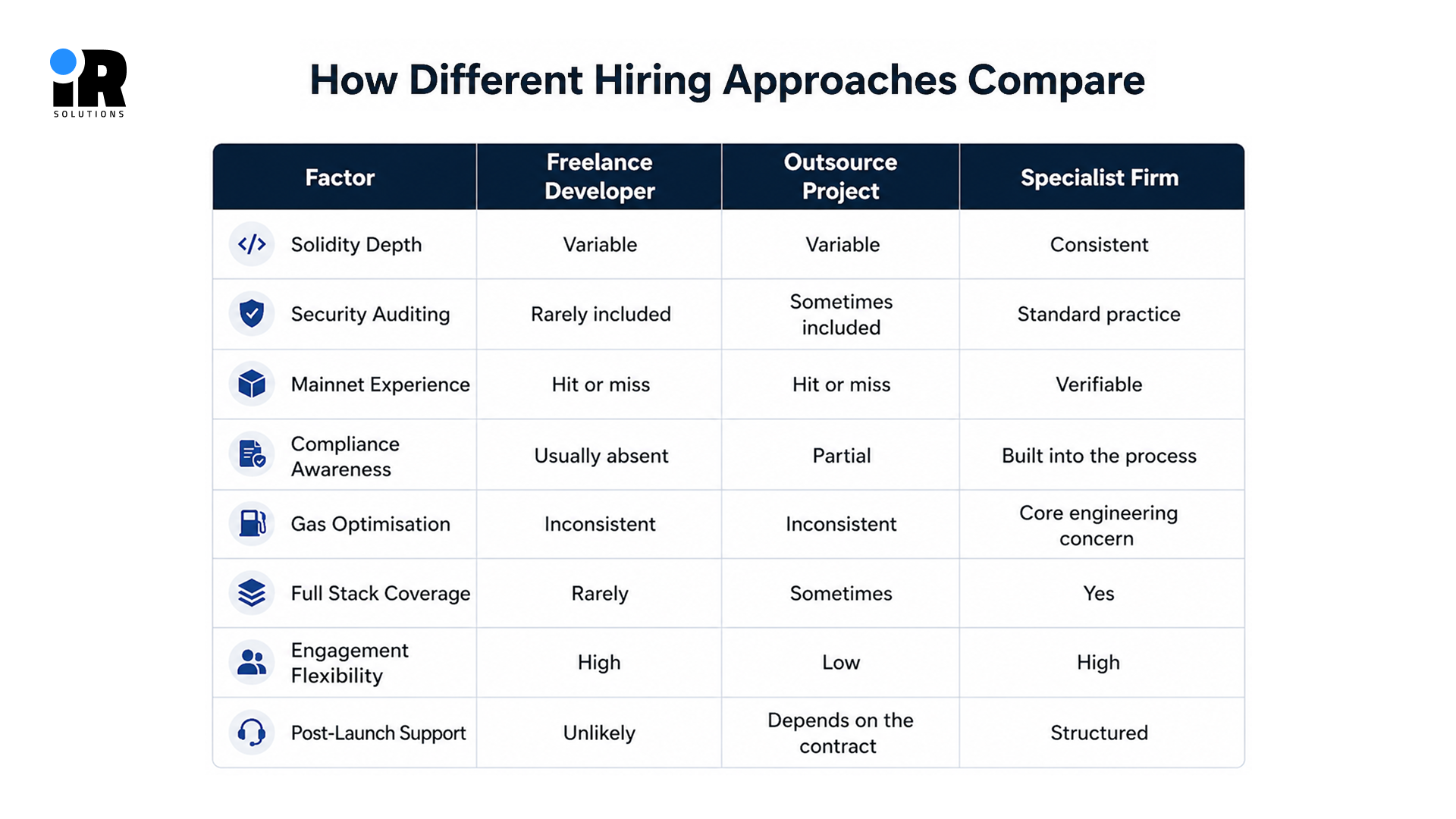
A freelancer might be the right call for a small, isolated task, for anything that handles real funds, enforces compliance logic, or needs to run reliably in production, the calculus is different.
Our staff augmentation services give businesses access to senior Ethereum developers on a flexible basis without long-term hiring commitments.
Conclusion
Hiring an Ethereum development company is a decision that shapes every technical outcome your project delivers. The seven considerations here are not a checklist to skim before signing a contract. They are the difference between a project that ships and scales and one that stalls, gets rebuilt, or creates legal and financial exposure for the business behind it. Technical depth, security standards, real deployment experience, gas optimisation, compliance awareness, transparent communication, and flexible engagement models all need to be assessed before the work starts. The right partner makes that easier, the wrong one makes every stage of the build harder than it needs to be.
Frequently Asked Questions
What is the difference between a smart contract developer and an Ethereum development company?
A smart contract developer writes contract code while a full Ethereum development company covers contracts, frontend, backend, compliance, and security as one engagement.
How do I verify that an Ethereum development company has real production experience?
Ask for mainnet contract addresses and check the transaction history directly on Etherscan to confirm live production usage behind their claimed work.
Why does smart contract security matter more than regular application security?
Smart contracts are immutable once deployed, which means vulnerabilities cannot be patched, and any funds exposed remain permanently at risk on a public ledger.
What blockchain should I choose for my Ethereum-based application?
Ethereum mainnet suits high-value applications where security and ecosystem reach matter most, while Arbitrum or Polygon suit cost-sensitive transaction-heavy use cases.
How long does it take to build and deploy an Ethereum application?
Simple token contracts deploy in two to four weeks, while complex DeFi or tokenisation platforms with full audit cycles typically need four to six months.
Can an existing application be integrated with Ethereum without rebuilding from scratch?
Yes, because Ethereum integration through APIs and wallet connectors can be added to existing applications without a full rebuild of the underlying architecture.
What ongoing support does an Ethereum application need after launch?
Post-launch support covers contract monitoring, gas optimisation as network conditions shift, security patch planning, and frontend updates as user requirements evolve.