


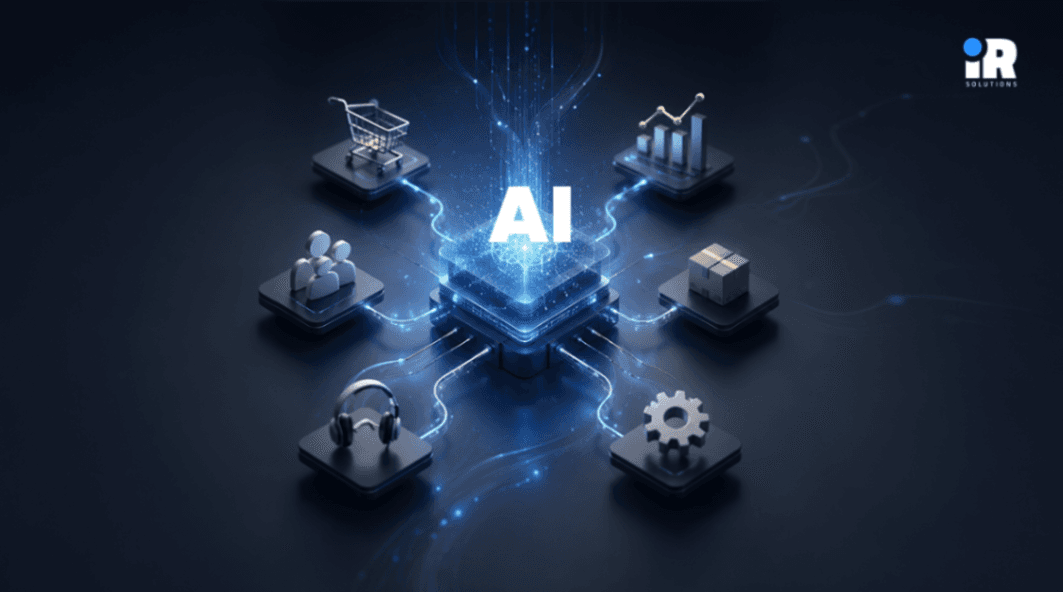

Running a business in 2026 means dealing with more complexity, tighter margins, and faster-moving competition than before. AI is no longer something only large-budget enterprise companies can access or benefit from. Companies across retail, logistics, professional services, and healthcare are embedding AI into their daily operations right now, often with the help of custom AI solution companies, to streamline processes and improve efficiency at scale. If you have been watching that shift from the sidelines, this blog gives you a grounded look at what is actually happening. From customer support to finance to hiring, AI is changing how businesses operate, scaling output without adding headcount or driving up costs.
Where AI Is Actually Changing Daily Business Work
Most media coverage of AI focuses on job replacement and full department automation. That's not what's happening inside most real businesses today, and the gap between the headlines and the reality is pretty wide.
What AI is actually handling is the work nobody enjoys doing, tasks mechanical and repetitive enough to drain good people who should be spending their time on something else entirely. That's where the value is right now, and it's where businesses seeing solid results are choosing to start. If you're ready to move beyond observation and put AI to work in your own operation, you can hire a generative AI developer to build solutions tailored to your specific workflows and business needs.
If you're evaluating AI across your business, our guide AI for Business in 2026: Use Cases, Automation, Tools & Implementation Guide covers the tools, use cases, and implementation process in detail.
AI-Powered Customer Experience Operations
This is usually where companies begin, partly because the results show up fast. Within the first month, most businesses can point to something concrete.
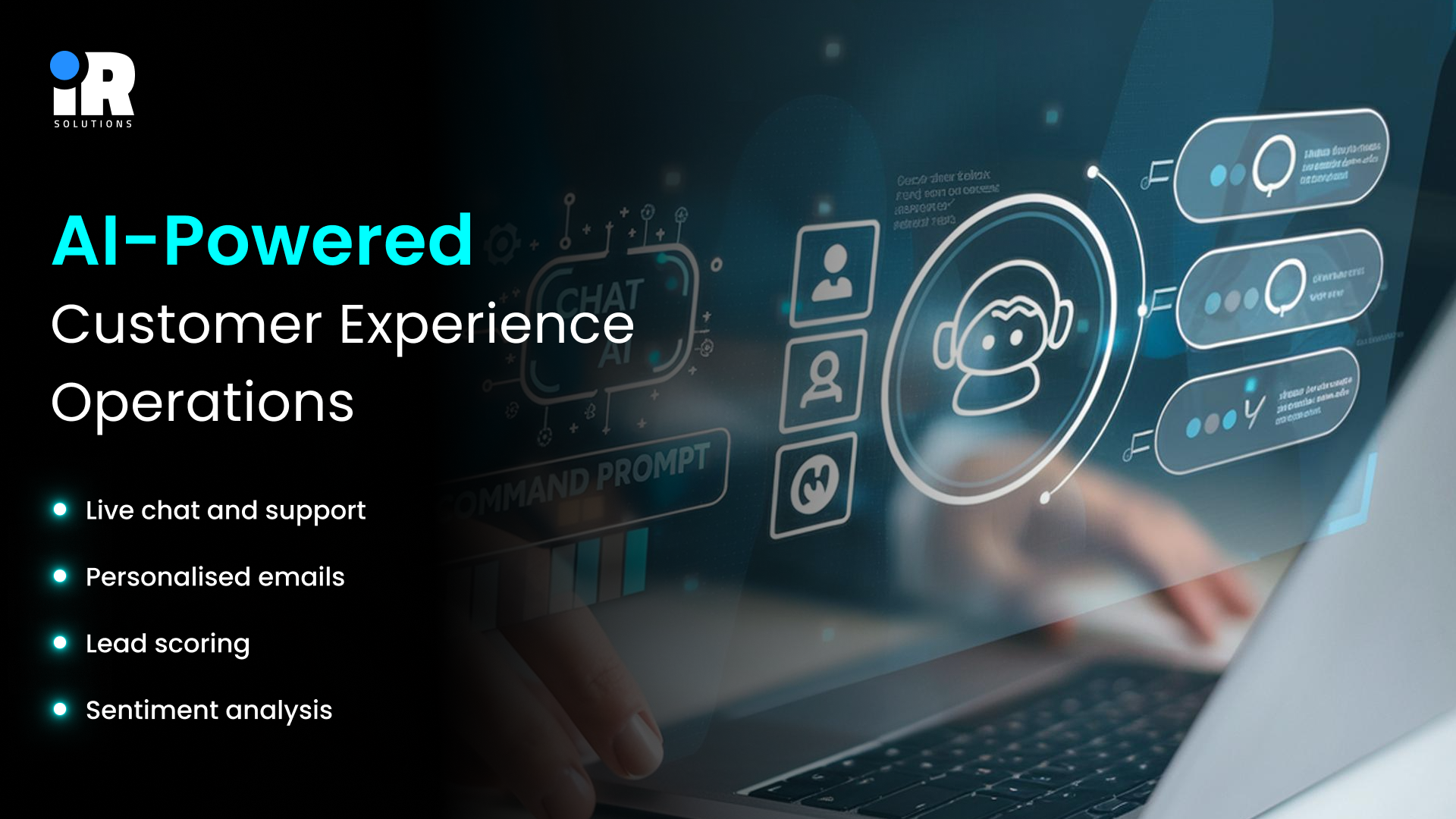
- Live chat and support: AI handles first-line queries around the clock, with no fatigue, no inconsistency, and no gaps when someone calls in sick.
- Personalised emails: Automated sequences adapt based on what users actually do, purchase history, engagement patterns, and where they drop off.
- Lead scoring: AI ranks incoming leads by how likely they are to convert, so your sales team stops burning time on the wrong list every day.
- Sentiment analysis: Customer feedback gets read in real time, and unhappy clients get flagged before the frustration builds into something harder to fix.
The goal isn't replacing customer service teams with chatbots, it's removing the repetitive, low-stakes queries so people can focus on the conversations that actually require a human on the other end. That tends to improve both how staff feel about their jobs and how clients feel about the company.
Back-Office AI Integration That Delivers Real ROI
Customer-facing AI receives most of the focus, while back-office AI is where the return on investment tends to be faster and more predictable. Once a well-configured system takes over internal processing tasks that used to need several people and multiple days, the savings don't just add up they compound.
How AI Changes Hiring and Onboarding
Hiring can quickly become a drain on resources, consuming hours that growing businesses need to focus on scaling.
- Resume screening: AI evaluates applications at scale without the subtle biases that creep in over long hiring rounds when humans are tired and working from gut feel.
- Interview scheduling: Coordinating calendars across multiple team members gets handled automatically, without anyone spending half a day chasing confirmations.
- Onboarding workflows: New hires move through structured steps with automated nudges, and HR stops manually following up on every checklist item.
What AI Does Inside Finance and Accounting
Finance is where AI tends to prove its value quickly, because the tasks it handles best are exactly the ones that drain finance professionals the most.
- Invoice processing: Data gets extracted and matched automatically, so nobody is manually cross-referencing documents at 9 pm on the last day of the month.
- Expense categorisation: Transactions get sorted correctly without anyone doing manual entry when the workload is already at capacity.
- Cash flow forecasting: Predictions come from historical patterns, seasonal trends, and live pipeline data rather than from a spreadsheet someone built and updates by hand.
- Anomaly detection: Unusual transactions get flagged early, before they turn into compliance problems or losses that are difficult to recover.
Automating the Repetitive Work Behind Revenue Teams
Sales teams lose a genuinely surprising amount of time to tasks that don't require human judgment. AI addresses most of it without disrupting the parts of the job that still need a real person.
What Sales Teams Are Automating Right Now
- Follow-up sequences: Triggered by prospect behaviour rather than relying on a rep to remember the right timing for every contact on their list.
- CRM data entry: Contact records and activity logs populate automatically from emails, calls, and meeting notes without anyone typing it all in afterward.
- Deal forecasting: Win-rate predictions come from actual historical patterns across closed deals, not from a rep's gut feeling about how a pipeline looks.
- Proposal generation: Templates pull client-specific data automatically, so the team spends less time formatting documents and more time on the relationship itself.
The result is a sales rep who spends most of the day actually selling. When someone can run twenty meaningful follow-ups in the time that previously only allowed for five, the pipeline moves without anyone working longer hours.
How Marketing Teams Are Using AI Daily
Marketing is a natural fit because so much of the daily work is repetitive and data-driven in ways no person can keep up with.
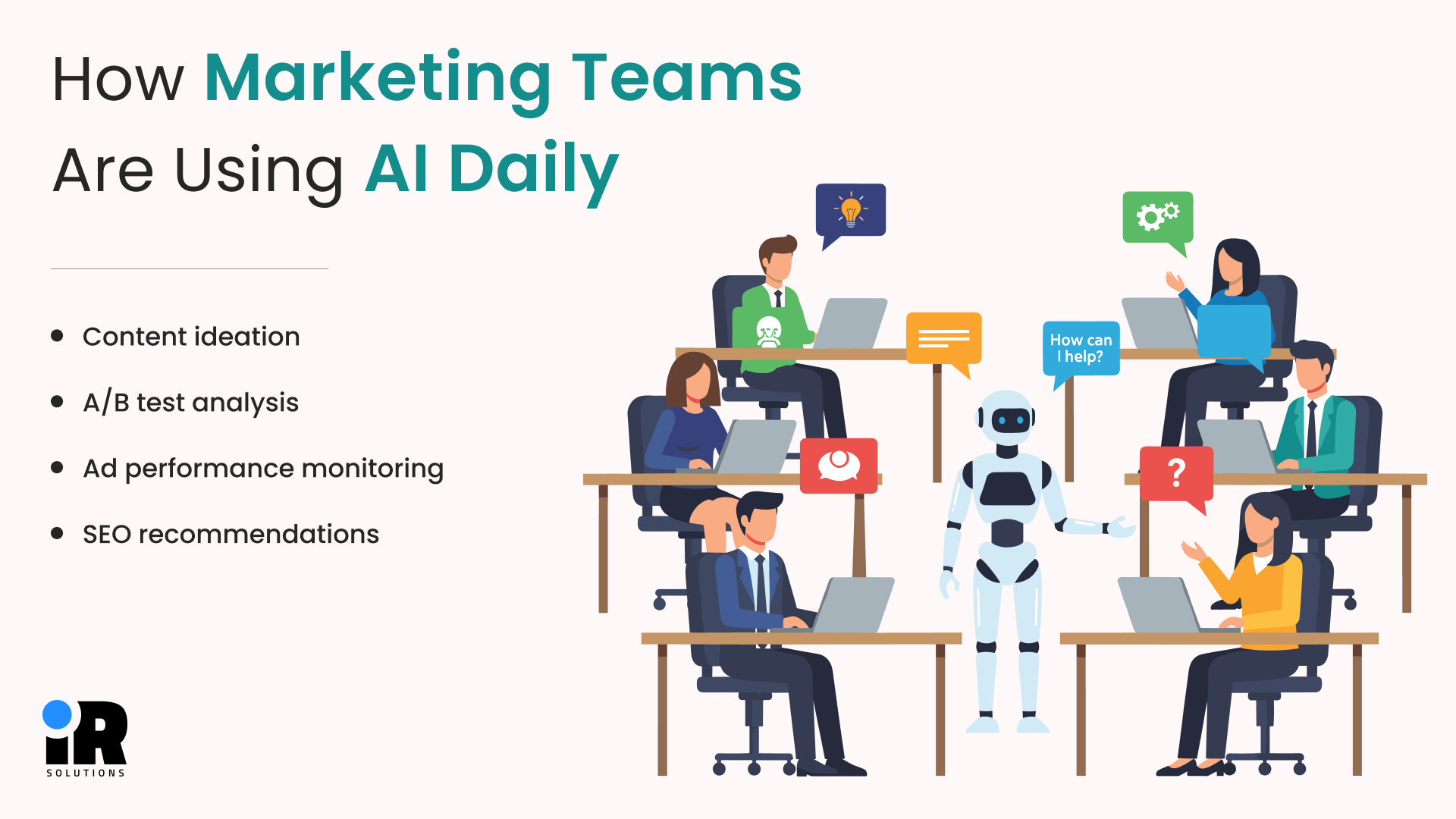
- Content ideation: AI surfaces topic opportunities based on live search trends and gaps in competitor content that would take a human analyst days to find.
- A/B test analysis: Statistical winners get identified quickly enough that budget shifts toward what's working before the weekly review meeting even happens.
- Ad performance monitoring: Underperforming creatives get paused automatically before they waste meaningful spend, without requiring someone to watch dashboards all day.
- SEO recommendations: Suggestions update as search behaviour shifts and algorithm changes open up new opportunities or close existing ones.
AI doesn't replace strategists, it clears the repetitive workload so they can spend more time on positioning, ideas, and creative direction, the parts of the job that actually need a strategic mind. Our Digital Marketing Experts combine AI-powered insight with strategic thinking to help businesses grow faster.
To see where AI delivers real advantage over conventional tools, explore When Should Businesses Choose AI Solutions Over Traditional Applications?
How AI Supports Better Business Decisions
There's a real difference between AI completing tasks and AI helping people make better decisions faster. The distinction matters.
When a logistics company brings AI into route planning, the operations manager doesn't get replaced. That manager gets significantly better information than any previous system provided. Routes get optimised in real time using live traffic, weather, and order priorities. The manager reviews, adjusts where needed, and approves. Decisions improve without removing the decision-maker from the process.
The same pattern plays out across industries, retailers using AI for inventory forecasting give buyers data-backed signals instead of gut feel. Healthcare providers using AI for appointment scheduling free up staff from coordination work. Legal teams using AI for document review shift their focus from reading large stacks of contracts to advisory and strategy work.
AI Applications Across Business Sectors
Retail and Ecommerce
- Dynamic pricing adjusts automatically based on demand signals, competitor changes, and real-time stock levels without manual input from pricing teams.
- Recommendation engines increase average order value by surfacing relevant products based on each customer's actual browsing and purchase history.
- Return prediction models flag high-risk orders before dispatch so operations teams can step in early and reduce costly reverse logistics.
Professional Services
- Automated client intake and document collection remove the email back-and-forth that delays the start of every new engagement.
- AI-assisted contract and proposal drafting gets reviewed by humans before anything goes out, cutting preparation time without removing quality control.
- Time-tracking and billing analysis surface scope creep early, before the invoice stage, when it's already an awkward conversation.
Healthcare and Wellness
- Appointment reminders reduce no-show rates without requiring a receptionist to call every patient manually each day.
- Patient triage tools route queries to the right department without making patients repeat their situation at every stage of contact.
- Clinical documentation gets drafted from voice notes after consultations, saving physicians time they can redirect toward patient care.
Manufacturing and Logistics
- Predictive maintenance alerts fire before equipment fails, reducing unplanned downtime and the ripple costs that follow unexpected stoppages.
- Supply chain monitoring tracks disruption signals across supplier networks and flags risks before they become delivery failures downstream.
- Computer vision quality control catches defects faster and more consistently than manual inspection under variable factory conditions.
In each case, AI handles pattern recognition and routine processing while people retain ownership of judgment, relationships, and exceptions. That division is where efficiency gains tend to last.
Common AI Integration Mistakes to Avoid
Treating It as a One-Time Purchase
AI tools need ongoing monitoring, tuning, and updating as business conditions change. Walking away after initial setup produces results that plateau quickly. Companies seeing sustained gains treat AI as an ongoing operational process, not a software purchase that's done once go-live happens.
Skipping the Workflow Audit
Automating a broken process produces broken results faster and costs more than doing nothing. Map the existing workflow before touching any tool. Find where friction actually lives, then decide if AI addresses that friction or just adds complexity around a problem the process itself still needs to fix.
Underestimating Change Management
Your team needs to trust the tools they use every day. That requires proper training, clear communication, and a rollout pace that gives people time to adjust. Businesses that push AI onto teams that were never consulted about the change rarely see adoption hold past the first quarter.
Ignoring Data Quality
AI is only as reliable as the data it runs on. A CRM full of duplicate records and missing fields produces unreliable insights regardless of how capable the tool is. Data hygiene is unglamorous, but skipping it guarantees underperformance from day one.
A Practical Starting Point for Your Business
You don't need a large budget, a dedicated tech team, or a high appetite for risk. You need a deliberate approach and an honest starting point.
Step 1: Find your highest-friction process. Where does work slow down? Where do errors cluster? Where does your team spend time on tasks that feel purely mechanical?
Step 2: Research tools built for that specific problem. Purpose-built solutions consistently outperform generic AI tools stretched across too many use cases.
Step 3: Run a focused pilot on one workflow. Sixty to ninety days with a clear baseline gives you real data to make decisions from, not vendor promises.
Step 4: Assign internal ownership from day one. Someone on your team should own the integration as an operational responsibility, not just a technology project that ends at go-live.
Step 5: Bring in experienced support where your bandwidth runs out. Working with people who've done this across industries shortens the learning curve and avoids the kind of trial and error that costs real money.
If you want to map out where AI fits in your specific operation, book a free consultation call and we'll work through it with you directly.
Many of these same AI applications are helping startups scale efficiently see: How AI for Startups Can Build Faster, Smarter & Leaner with AI.
Conclusion
AI is no longer an experimental layer sitting atop business operations. It's becoming part of how work actually gets done across teams, systems, and daily decisions. The real shift isn't about replacing people. It's about removing repetitive, low-value tasks that slow them down and limit what they can actually accomplish.
When AI handles processing, pattern recognition, and routine execution, teams get back time for judgment, creativity, and strategy. The businesses seeing the strongest results aren't the ones doing the most automation. They're the ones applying it thoughtfully to real friction points. As adoption grows, the advantage will belong to companies that treat AI as an ongoing operational capability rather than a one-off tool purchase. Many businesses now choose to hire AI developers to build and integrate custom solutions that actually fit their specific workflows. The opportunity is to start small, stay focused, and scale what proves measurable value.
Frequently Asked Questions
Do smaller businesses genuinely benefit from AI integration, or is it only for large enterprises?
Smaller businesses benefit significantly. Most AI tools today are subscription-based and built to deliver measurable ROI without needing a large internal technology team.
What types of business processes are the strongest starting points for AI integration?
Repetitive, data-heavy tasks like lead scoring, invoice processing, appointment scheduling, and customer support routing tend to produce strong early results consistently.
Does AI integration require a dedicated internal technical team to manage ongoing performance?
Not necessarily. Many platforms are built for operationally-minded people without technical backgrounds, particularly when supported by a good implementation partner.
What are the most common reasons AI integration projects fail to deliver expected results?
Poor data quality, insufficient change management with the team, and automating broken processes rather than fixing them first account for most failures.
How should a business measure whether its AI integration is actually working over time?
Set baseline metrics before integration begins, track the same indicators after ninety days, and compare them directly against pre-integration numbers.
Can AI tools connect to legacy software systems not originally designed for modern integration?
In many cases, yes, because API layers and middleware platforms bridge AI tools with older systems without requiring a full infrastructure rebuild.
How do you find the right AI tools for your specific business situation and workflow needs?
Start with your most painful workflow, find tools built specifically for that problem, and work with a partner who has real implementation experience in your industry.