


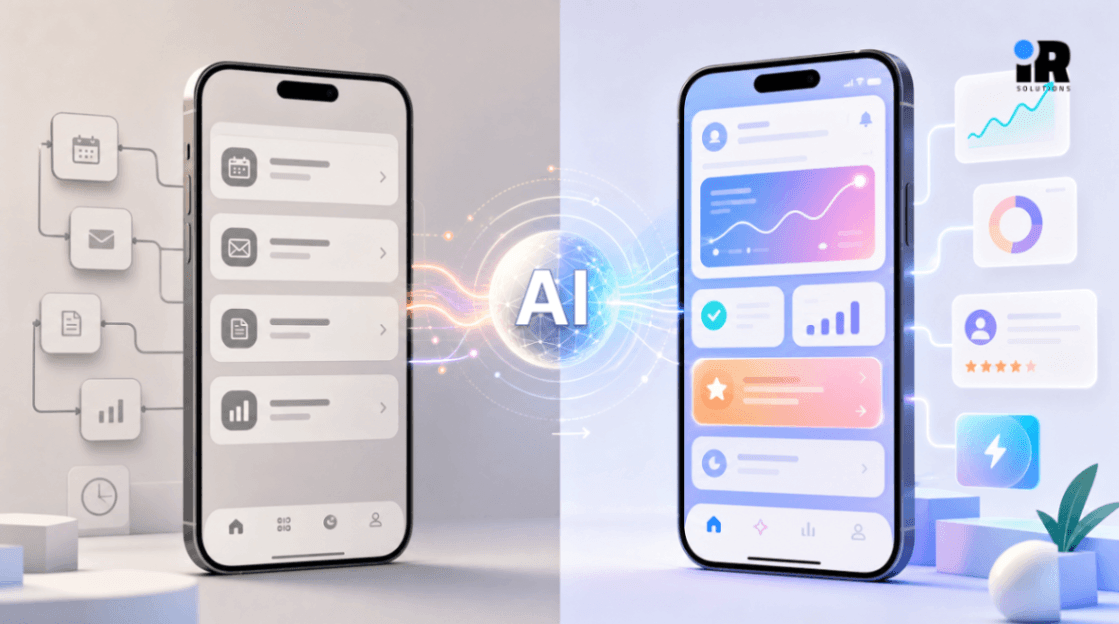

Every growing business eventually hits a wall with its existing software, the tools that worked fine two years ago start slowing things down, more manual work, more errors, more time spent patching gaps the system was never built to handle. Traditional applications follow fixed rules and do exactly what they were programmed to do, nothing beyond that. When business decisions get complex and data volumes grow, those rules stop being enough. That is where AI software development changes the game entirely, choosing the right moment to make that move is what separates businesses that grow efficiently from those that grind.
What Actually Separates AI from Traditional Software
Before getting into timing or strategy, the distinction needs to be clear because it is often misunderstood. In modern systems, companies are increasingly leveraging AI to move beyond static rule-based logic and enable adaptive decision-making.
Traditional software works on instructions a developer writes, rules, conditions, and logic. The software follows them, if the situation falls outside the written rules, the software either fails or throws an error. It does not guess, and it does not learn from new data over time.
AI software works on patterns, instead of being told what to do in every situation, the system is trained on historical data and learns which response fits which input. Over time, with more data, the predictions get sharper. The model handles edge cases it has never seen explicitly because it learned the underlying pattern, not a specific rule. That difference sounds small on paper, in practice, it changes what is possible entirely.
A traditional billing system will charge the right amount when the rules are set correctly. An AI-powered billing system can flag unusual invoices, predict late payers, adjust follow-up sequences based on customer history, and surface anomalies before they become write-offs, in the same domain, completely different capability ceiling.
See how AI for Business in 2026: Use Cases, Automation, Tools & Implementation Guide breaks down real use cases and implementation.
The Case for Traditional Applications - When They Still Win
There is a version of this conversation where every business is pushed to adopt AI as fast as possible, that version is wrong and often expensive. Traditional software remains the right call in situations where the process is predictable and the output is deterministic. Pushing AI into a stable, well-defined workflow creates complexity and cost without delivering any meaningful return.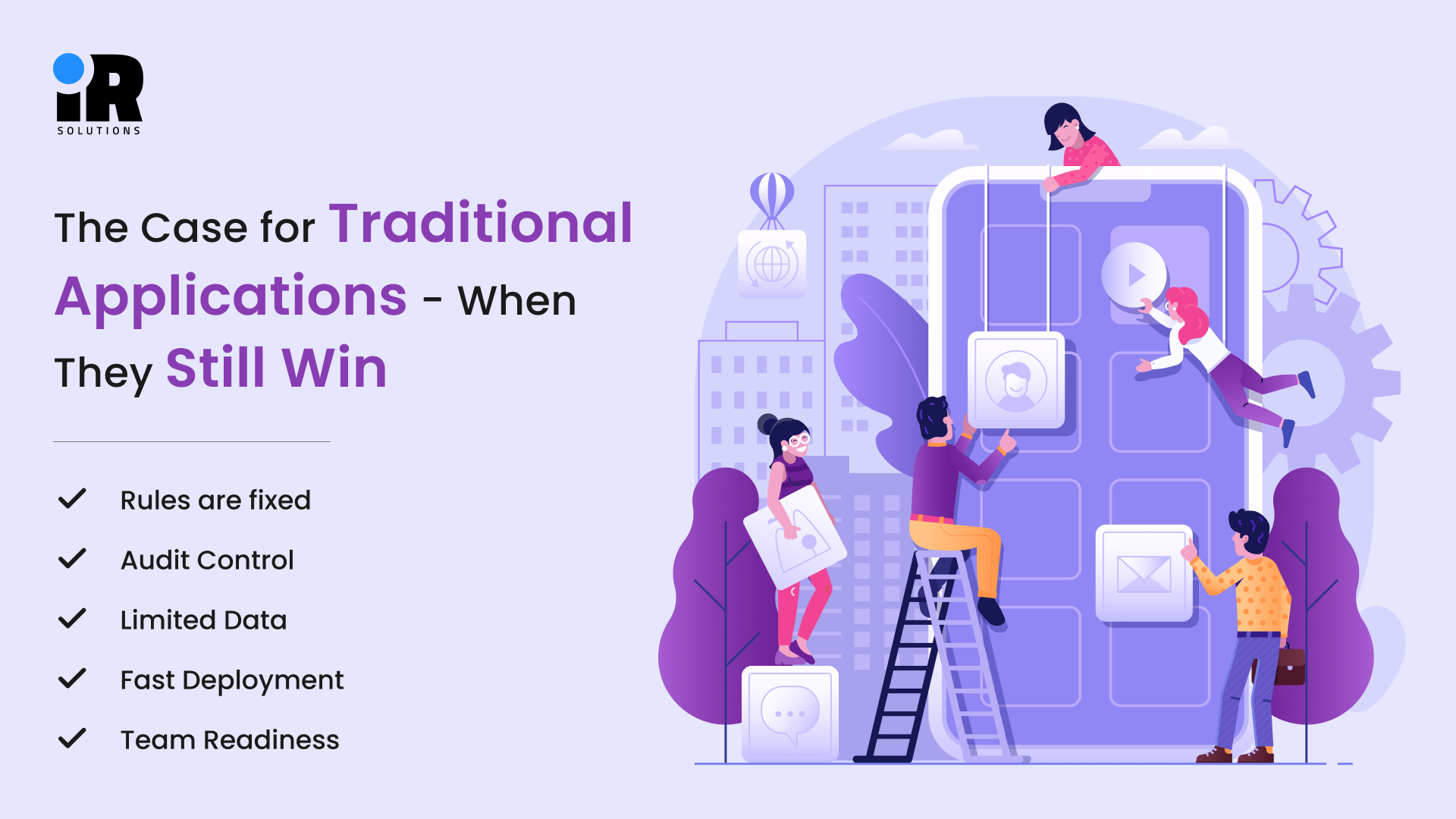
- Rules are fixed: Payroll calculations, regulatory filings, and invoice generation follow defined logic that changes rarely. Rule-based systems handle this cleanly with zero need for learning.
- Audit Control: Some regulated industries need every decision to be fully traceable and reproducible. Traditional software gives the same output for the same input, every single time. AI decisions are harder to audit without deliberate explainability design.
- Limited Data: AI models need meaningful data to train on. A business that launched six months ago with a few hundred transactions does not have enough signal to build a reliable model. Starting with traditional software and collecting data first is the smarter path.
- Fast Deployment: Off-the-shelf software can go live in days. Building, training, validating, and integrating a machine learning model takes weeks to months. For a small, contained problem, that timeline rarely makes sense.
- Team Readiness: An AI system deployed into a team that does not understand it gets ignored or misused. Organizational readiness is as important as technical readiness.
Choosing traditional software when it fits the situation is not a failure of ambition. It is a good business decision. What matters is recognizing when that situation changes.
Clear Signals That a Business Has Outgrown Rule-Based Software
Some businesses feel the ceiling long before they can name it. Work keeps getting done, but it feels harder than it should. Teams grow, but output does not improve proportionally. Decisions that should be fast take days because everything needs manual review first.
Volume Overload
When the number of decisions or transactions grows faster than headcount can handle, rule-based software tends to break down quietly. More exceptions appear, and manual replacements become routine. The team spends the majority of its time handling cases that fall outside the rules, which means the rules are no longer doing the work they were designed to do. AI handles volume without degrading. It processes ten thousand records with the same accuracy as ten, and it does not call in sick or quit for a better offer.
Decisions That Require Context
Traditional software cannot weigh competing signals simultaneously. It evaluates a condition and returns a result. If a customer service query involves purchase history, tone, product type, previous complaint status, and regional context, a rule-based system will fail because it can only check the conditions it was explicitly programmed to check.
AI can hold multiple inputs together and produce a response that reflects all of them. This is not speculation, it is pattern recognition trained on real examples of how similar situations played out before.
Personalization at Scale
Rule-based personalization means customer segments, where you split your user base into groups and show each group different content. That works up to a point, and then it plateaus.
Real personalization requires learning what a specific individual tends to respond to, which changes over time, differs by channel, and depends on where they are in their journey, machine learning enables this, rule sets do not. Retail and ecommerce, EdTech, and healthcare platforms all hit this ceiling eventually. Once personalization is a competitive factor, AI stops being optional.
Unstructured Inputs
Text, images, audio, and video, traditional software cannot make sense of any of these without a person in the middle. Contracts need to be read. Support tickets need to be categorized. Photos need to be labeled, calls need to be transcribed, and reviewed.
AI handles all of these natively, natural language processing, computer vision, and speech recognition have matured to the point where they outperform manual review on speed and consistency for the vast majority of common business tasks.
Where AI Produces Measurable, Verifiable Business Results
AI can improve many things in theory, in practice, the impact concentrates in a handful of specific areas where the conditions of data richness, decision volume, and variability align well.
Customer Support and Service Automation
The economics of support do not scale well with headcount alone. Query volume grows. Customers expect responses at all hours. And most incoming questions cover the same twenty topics expressed in slightly different ways by different people.
- AI-powered support changes the math entirely.
- Around-the-clock coverage without off-hours staffing costs.
- Consistent, accurate responses regardless of who is handling the queue.
- Intelligent escalation that routes genuinely complex issues to a skilled human agent.
- Sentiment detection that flags frustrated customers before situations escalate.
- Automatic ticket classification that prioritizes issues by urgency without manual evaluation.
Businesses that implement AI in support see first-response times drop from hours to seconds. Customer satisfaction scores tend to follow, resolution speed matters more to customers than which system resolved the issue.
Predictive Analytics and Demand Forecasting
Most businesses make operational decisions based on what happened last quarter. AI can project what is likely to happen next quarter, and with enough historical data, those projections are accurate enough to act on with confidence.
- Demand forecasting reduces both overstock costs and lost sales by anticipating what customers will want before stockouts happen.
- Customer loss prediction surfaces customers who are likely to leave before they actually do, giving retention teams a window to intervene with the right offer at the right time.
- Maintenance prediction identifies equipment showing early signs of failure, enabling scheduled maintenance before an emergency breakdown stops production.
- Workforce forecasting projects hiring needs based on business growth patterns, reducing the lag between expansion and team capacity that often slows scaling companies down.
The return on predictive analytics is not abstract, it shows up in inventory costs, customer loss rate, and production uptime. A CFO can see these numbers clearly on a balance sheet, which makes the business case straightforward to build.
Fraud Detection and Risk Management
Traditional fraud prevention sets thresholds. If a transaction exceeds a certain dollar amount, it gets flagged. If a card is used in two countries within the same hour, it gets blocked. These rules are easy to understand and also easy to work around once someone knows the boundaries.
Fraud tactics are not static and continue evolving as attackers change strategies over time. Malicious participants learn which thresholds to stay under, and rule-based systems have fixed limits that are eventually understood and exploited.
AI models learn what fraudulent behavior looks like across hundreds of behavioral signals, including device fingerprinting, session timing, transaction sequences, navigation patterns, and more. They detect anomalies that no fixed threshold would catch and continuously update as fraud tactics evolve.
Banks and fintech companies using AI-based risk scoring detect more fraud while producing fewer false positives. Fewer false positives reduce friction for legitimate customers, which directly improves user experience and retention.
Intelligent Document Processing
Invoices, contracts, insurance claims, medical records, and legal filings, business runs on documents, and reading them takes time. Companies processing hundreds or thousands of documents per day face a bottleneck that directly affects turnaround time, headcount cost, and error rate.
AI handles document processing at scale and with high accuracy.
- Smart Extraction: Field extraction pulls specific data from any document format without manual data entry.
- Auto Classification: Document classification routes each document to the right workflow automatically.
- Error Detection: Inconsistency detection flags missing fields or mismatched data before a document moves forward.
- Instant Summaries: Summarization generates structured summaries of long contracts or reports in seconds rather than hours.
What previously took a team of specialists hours can be handled in minutes with higher accuracy. The cost savings in labor alone often justify the investment within the first year, with additional savings coming from error reduction and faster cycle times.
Recommendation and Personalization Engines
Every time a platform surfaces the right product, piece of content, or next step at the right moment, conversion goes up. Recommendation engines power that moment, and they require machine learning to function at a meaningful scale.
Whether the application is product recommendations in e-commerce, adaptive course sequencing in EdTech, or content prioritization in media, the engine needs to learn what each user responds to. Learning at individual resolution, across large user bases, requires AI. Rule-based segmentation gets you part of the way there and then stops.
And for a broader look at how AI is reshaping daily operations across industries, the guide on Will AI Automation Redefine Business Growth in the Coming Years? is a practical starting point.
Why AI Projects Fail - and How to Prevent It
A significant number of AI projects deliver disappointing results, not because the technology does not work, but because something in the implementation went wrong. In many cases, this happens when businesses do not properly 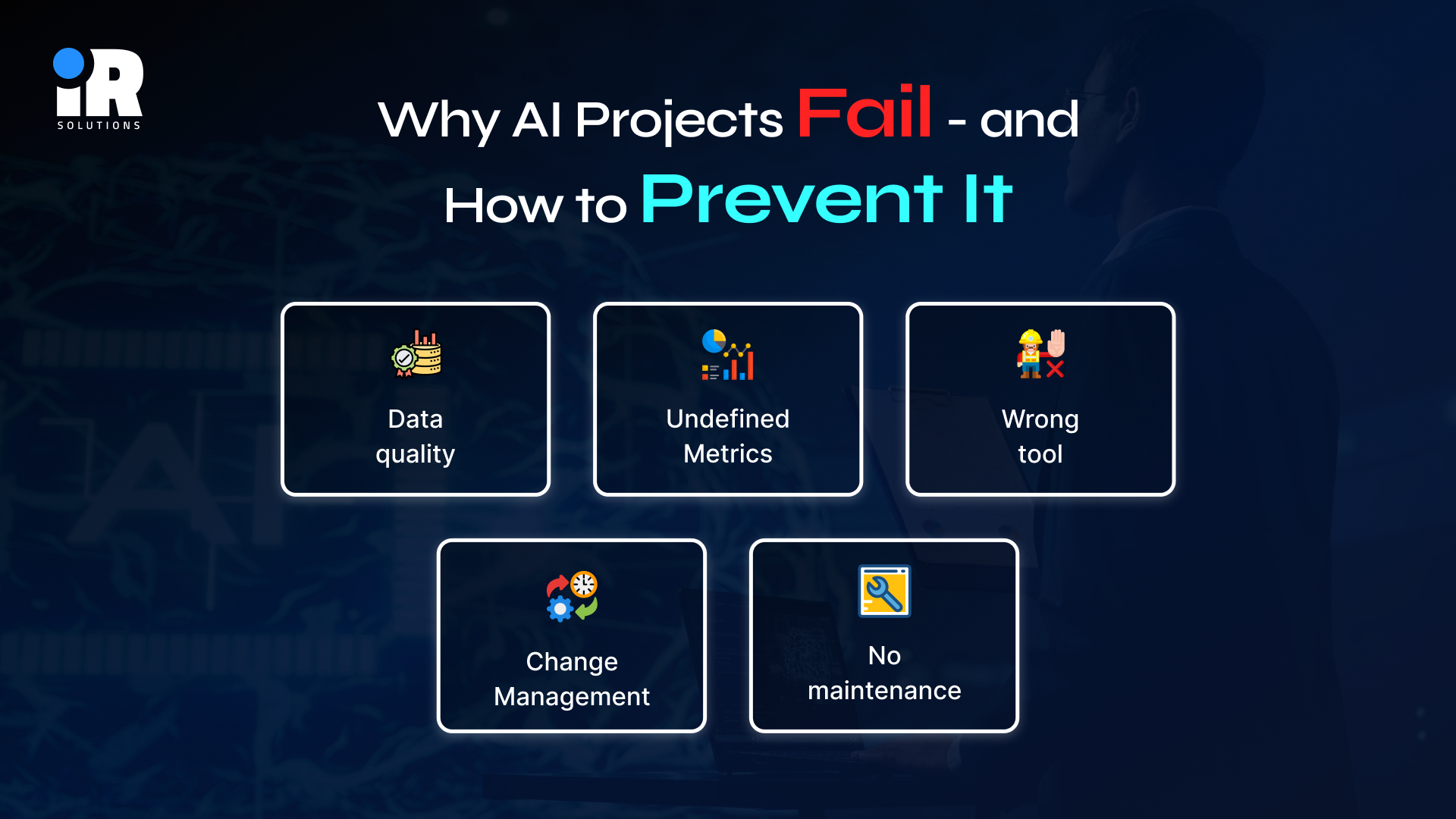 hire ai developer at the right stage, leading to gaps in data handling and system alignment.
Working with a development partner that has deployed AI across multiple industries, in production environments, significantly reduces all of these risks. This is where experienced AI development services become critical, because they ensure models are not just built but properly integrated, monitored, and maintained in real business environments. The most common points of failure:
- Data quality: A model trained on incomplete, inconsistent, or biased data produces outputs that erode trust fast. Data audit and preparation are the foundation, not a preliminary step that can be skipped.
- Undefined Metrics: "We want to use AI" is not a goal. "We want to reduce manual invoice processing time by 60% within six months" is a goal. Without a clear target, there is no way to evaluate whether the project worked.
- Wrong tool: Not every business problem needs a large language model or a deep neural network. Sometimes a lightweight gradient boosting model on structured data outperforms a far more complex system at a fraction of the cost and build time.
- Change management: A well-built AI system deployed into a team that does not understand it gets ignored or worked around. Training, transparency about how the model works, and a clear path for disagreements are all part of a successful rollout.
- No maintenance: Data patterns drift over time, customer behavior shifts, markets change, and fraud tactics evolve. A model that was accurate at launch degrades without periodic retraining, building in monitoring and retraining from day one is not optional, it is what keeps the system useful.
Working with a development partner that has deployed AI across multiple industries, in production environments, significantly reduces all of these risks.
For businesses exploring practical AI applications, this overview: Which top 5 AI automation tools help businesses increase efficiency? covers specific tools and use cases worth knowing about.
A Practical Framework for Making the Decision
Rather than a checklist that covers every possible scenario, here is a clear mental model for making the call.
- Outcome First: Start with the business outcome before choosing technology or assuming AI is required. Define improvements like faster support, lower churn, or fewer processing errors clearly upfront.
- Data Audit: Review existing data quality and availability before building any AI solution or system. AI performance depends on structured historical data, interaction logs, and reliable operational records.
- Cost Analysis: Measure current costs from manual work, churn, fraud, and inefficiencies before investing in AI. Compare AI investment against ongoing operational losses to understand the true business value clearly.
- Proof Testing: Run a small pilot with clear metrics before committing to full AI implementation. Validate results using real data instead of supplier promises or theoretical performance claims.
If your business is at that decision point and you want an honest assessment of what AI can realistically do, schedule a free consultation with AI experts. The conversation starts with the business problem, not a product pitch.
Conclusion
The AI versus traditional software question is not really a technology debate, it is a business fit question. Traditional applications remain the right choice for stable, predictable workflows where simplicity and auditability matter most. AI earns its place when volume grows beyond what rules can handle, when decisions require contextual judgment, when personalization needs to reach an individual level, or when unstructured data sits at the center of the process. The difference between businesses that make this transition at the right time and those that wait too long tends to show up clearly within a few years in market position, in operating cost, and in how much their teams enjoy coming to work. AI First Development Company helps businesses make that decision well, then builds and deploys the solution that fits, not the one that is easiest to sell.
Frequently Asked Questions
What is the main difference between AI software and traditional software?
Traditional software follows fixed, pre-written rules, while AI software learns from data and adapts its outputs over time based on patterns rather than instructions.
How do I know if my business has enough data to benefit from AI?
If your business has at least one to two years of transaction or interaction data, that is usually enough to begin exploring AI though a data audit will give a clearer picture.
Is AI development more expensive than building a traditional application?
Upfront costs are typically higher, but the long-term return often outpaces traditional software as the model improves, labor costs reduce, and accuracy increases with more data.
Can a small business realistically benefit from AI, or is it only viable for enterprises?
Smaller businesses can benefit, particularly in customer support automation, document processing, and basic forecasting, though data availability remains the primary gating factor.
What happens when an AI model starts producing inaccurate results over time?
Data patterns drift as markets and behavior change a well-designed deployment includes monitoring, drift detection, and a regular retraining schedule that prevents accuracy from quietly declining.
Do I need to replace my existing software to add AI capabilities?
Not always AI functionality can often be layered on top of existing systems through API connections rather than requiring a complete platform replacement.
How long does it take to deploy an AI solution for a business problem?
A focused, well-scoped AI integration typically takes between six weeks and six months, depending on data readiness, integration complexity, and the scope of the problem being solved.
What is the most common reason AI projects fail to deliver results?
Poor data quality is the leading cause, followed closely by the absence of a defined success metric and insufficient attention to team adoption and change management.