



Every hour your team spends on data entry, manual approvals, and repetitive follow-ups is an hour your competitors spend on growth. That is the real cost of staying manual, and it quietly compounds over time until it starts to affect what actually matters, delivery speed, customer experience, and margins. AI workflow automation removes that burden entirely by handling high-volume work faster and more accurately than any manual process ever could. Teams running on automated workflows stop reacting to constant issues and start focusing on work that actually moves the needle. Businesses that invest in AI and ML development services move faster, avoid costly mistakes, and scale without the overstaffing that erodes margins.
What AI Handles That Traditional Automation Never Could
AI workflow automation handles tasks that once required human input at every step. Unlike rule-based tools, it reads context, adjusts to new information, and keeps improving with every run.
- Adaptive Logic: Standard tools fail when conditions shift, while AI recalibrates based on real-time data.
- Smart Triggers: AI detects when action is needed and moves without waiting for anyone to intervene.
- Learning Output: The system grows more accurate and efficient as more data flows through it.
Businesses are applying AI automation across a wide range of operational areas, including:
- Customer support ticketing, query handling, and escalation routing.
- Invoice processing, payment matching, and approval workflows.
- Data entry, scheduled reporting, and real-time dashboard updates.
- Employee onboarding, document collection, and HR process management.
- Sales pipeline tracking, lead scoring, and automated follow-up sequences.
The goal is not to trim minutes off one task, it is to eliminate the daily grind, so the team can focus on decisions and relationships that actually need a human.
To see how businesses are implementing AI at scale, read AI for Business in 2026: Use Cases, Automation, Tools & Implementation Guide.
Primary Areas Where AI Streamlines Business Operations
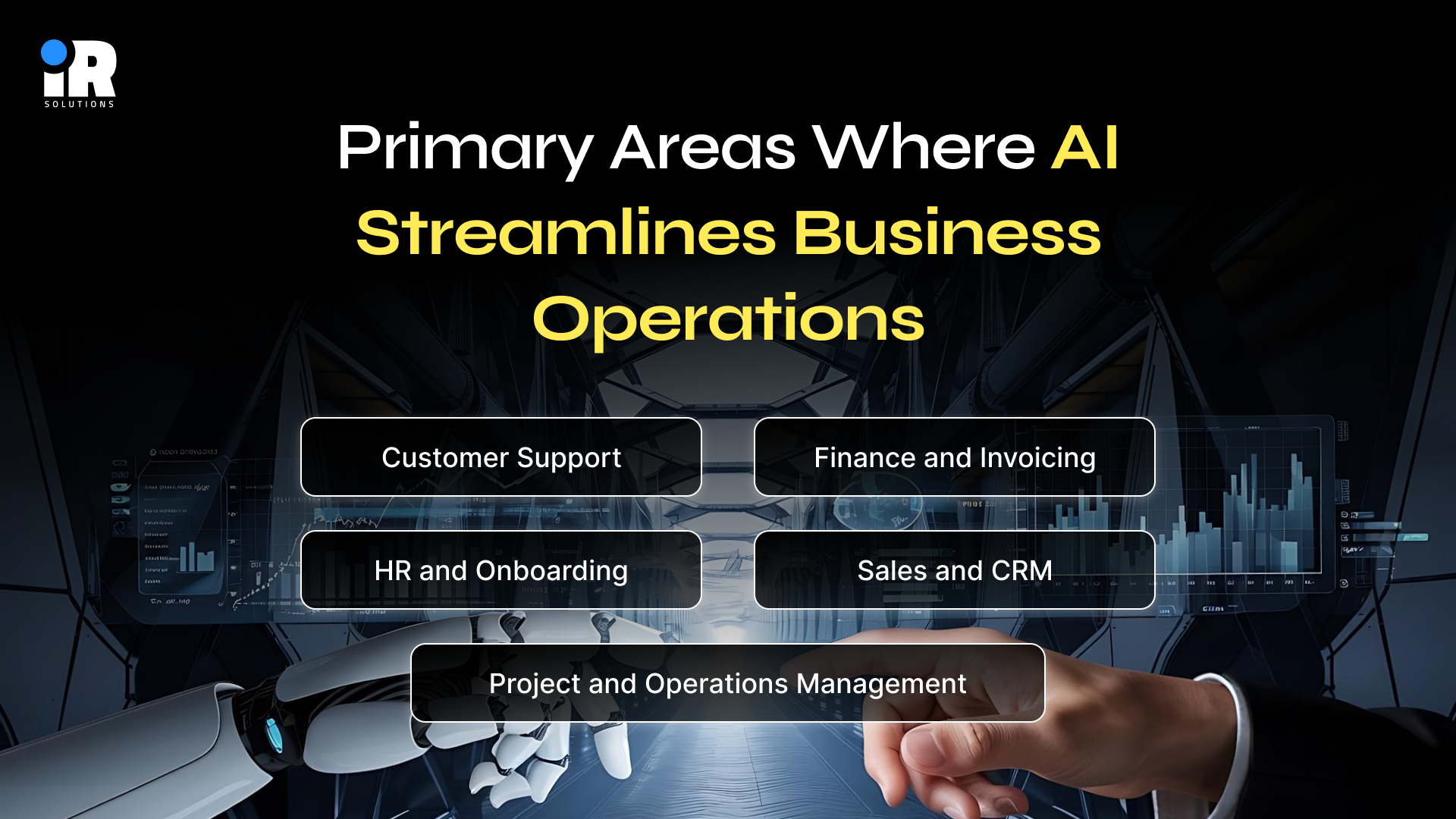
Customer Support
Customers do not care what time it is when they have a problem, they want an answer right then. Chatbots and smart ticketing systems take care of the routine stuff around the clock, so your agents are only pulled in when something genuinely needs a human. By the time a complex issue reaches a person, all the context is already there waiting. Nobody is asking the customer to repeat themselves. Response times get shorter, and the support experience improves without putting a single extra person on the payroll.
- 24/7 Coverage: Queries get handled on weekends, late nights, and during peak hours when your team simply cannot keep up with the volume.
- Smart Routing: Tickets go straight to the right department without anyone having to manually sort through them and decide where each one belongs.
- Consistent Replies: Every customer gets the same accurate, on-brand answer no matter who is logged in or what time the message came through.
How businesses are improving support efficiency with AI is outlined in AI in Customer Service - How Intelligent Automation is Transforming Support Teams.
Finance and Invoicing
Processing invoices by hand becomes slow and unreliable the moment transaction volume picks up beyond what a small team can comfortably manage. AI reads documents, extracts the relevant data, cross-references records across systems, and flags anything unusual for human review without anyone having to manually touch each line.
- Faster Approvals: Invoice cycles that previously took two to three days now close within a few hours with AI handling the routing.
- Fraud Detection: Unusual patterns in transaction data get flagged early before they grow into serious financial or compliance problems.
- Audit-Ready Logs: Every action is recorded with a timestamp automatically, which makes regulatory reviews significantly cleaner and faster.
HR and Onboarding
Hiring and onboarding involve dozens of repetitive, time-sensitive steps that drain HR bandwidth week after week across every single new hire cycle. Document collection, background check triggers, training assignments, and status notifications all run on their own when AI is managing the workflow behind the scenes.
- Faster Starts: New hires move through onboarding in days rather than weeks, which shortens the time before they start contributing meaningfully.
- Consistent Process: Every employee gets the same structured onboarding experience regardless of which HR team member is handling the hire.
- Lower Admin Overhead: HR teams redirect their time toward retention, culture, and performance rather than chasing paperwork and signatures.
Sales and CRM
AI tools embedded inside CRM platforms keep records up to date, score leads based on actual engagement behavior, and fire off follow-up sequences without a sales rep having to manually trigger anything. Sales teams spend their hours on actual selling conversations instead of maintaining dashboards and updating records.
- Lead Prioritization: AI ranks prospects by conversion likelihood so reps put their energy toward the opportunities most likely to close.
- Automated Follow-Ups: Outreach sequences go out at precisely the right time based on real buyer signals and engagement patterns.
- Pipeline Accuracy: CRM data stays current and clean without relying on every rep to consistently update their own records.
Project and Operations Management
AI tracks project milestones, flags blockers before they turn into real delays, reassigns tasks based on who actually has capacity, and delivers status updates to stakeholders without a project manager having to chase anyone for an update. Decision-making replaces status reporting as the primary job.
- Live Visibility: Stakeholders can see exactly where a project stands without needing to schedule a meeting or send a follow-up email.
- Smart Assignment: Work automatically goes to the right person based on current workload and availability rather than last assignment history.
- Early Warnings: Risks and delays surface early enough that teams can address them before they turn into project-level problems.
How AI Workflow Automation Drives Business Growth
Getting repetitive tasks off your team's plate is valuable, but it is honestly just the beginning of what this shift produces. The more significant outcome is what becomes possible when your people are no longer spending their best hours on work that a system could handle.
When routine operations move to automation, things start to shift across the business in ways that compound quickly:
- Product teams ship faster because they stop getting pulled away from building to handle operational fires.
- Customer teams respond with better quality because they carry full context and no manual backlog holding them back.
- Leadership sees cleaner data to work from because AI delivers structured reports instead of fragmented spreadsheets from five different sources.
- Revenue cycles shorten because approvals, follow-ups, and processing no longer wait on someone becoming available to take the next step.
The result is an operation that runs more predictably, costs less to manage, and does not require proportional hiring every time volume grows. That difference compounds into a real competitive gap in margins, speed, and capacity over time.
What to Look for in an AI Automation Partner
The technology matters, but the team behind it matters more. A poorly planned AI system does not just fail to deliver, it actively creates new friction and new problems that can take months to unwind. Picking the wrong partner is a much more expensive mistake than most businesses realize until they are already deep into a project that is not working.
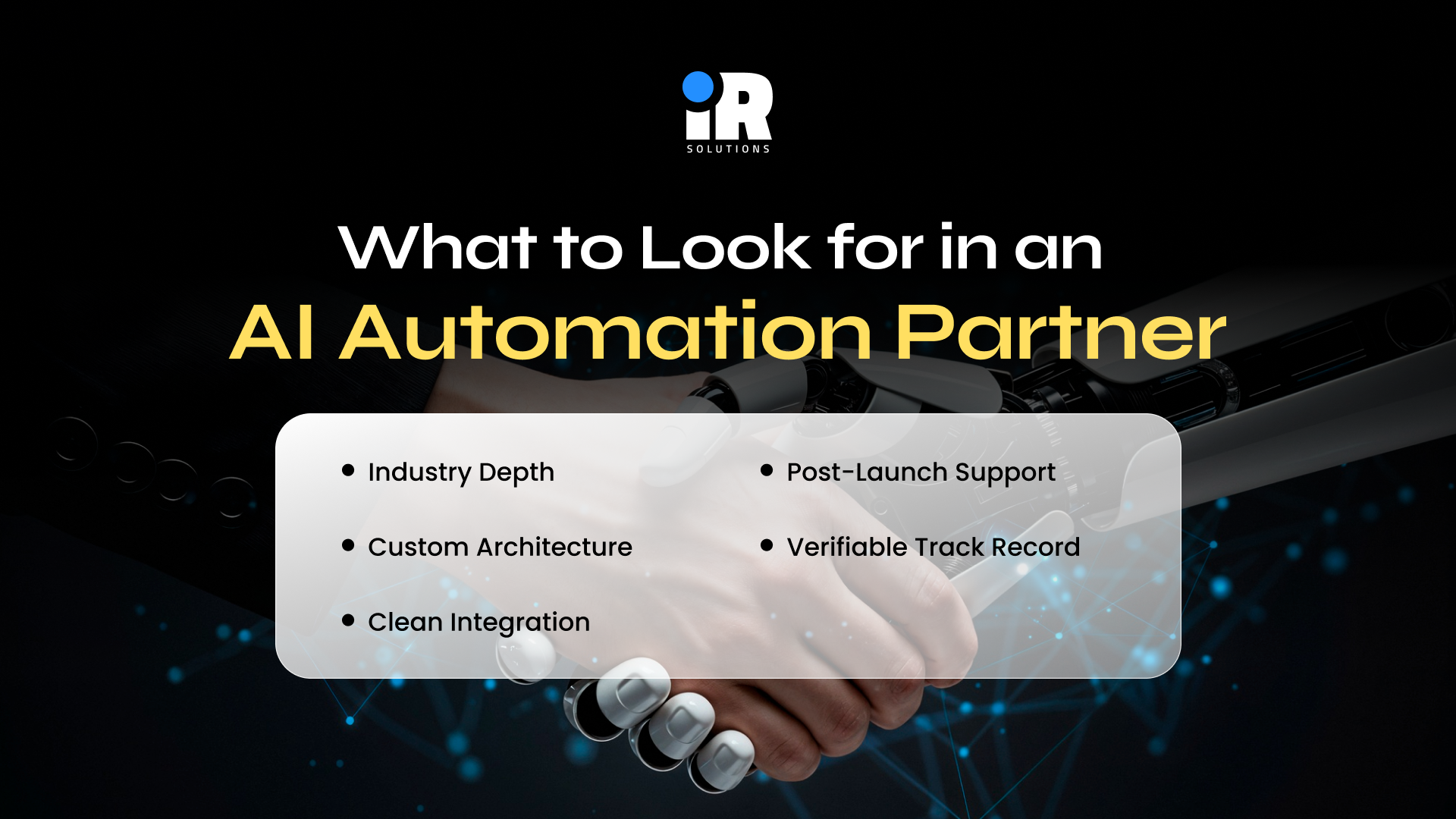
- Industry Depth: Generic AI solutions do not account for the specific ways your business runs or the compliance requirements your industry carries.
- Custom Architecture: Off-the-shelf tools need heavy workarounds for anything beyond simple workflows, and they rarely hold up as complexity grows.
- Clean Integration: New AI systems have to connect with your existing tools without breaking the parts of your stack that are already working well.
- Post-Launch Support: The first version of any AI workflow is never the final version ongoing monitoring and refinement are what make results last.
- Verifiable Track Record: Push for specific outcomes from real past clients, not marketing decks with polished graphics and vague claims.
When choosing between solutions, hire AI/ML developers who have a proven process, not just a polished pitch.
How AI Workflow Systems Get Built and Deployed
Building AI workflows that hold up in production starts with understanding how a business actually runs today, not assumptions carried in from other projects, not a template from a previous client, and not a toolkit in search of something to do. The projects that fail almost always fail for the same reason a supplier sold a product and then tried to reshape the business around it. The process that actually produces results works the other way around entirely.
Initial Process Mapping
Every existing workflow gets mapped in detail before any development work begins. The highest-friction points get identified, success metrics get defined clearly, and the scope gets set based on actual business priorities. Time spent getting this right is never wasted it is what separates a system that runs smoothly from one that creates new problems within three months of going live.
Solution Design
A custom AI architecture gets designed specifically around the existing tech stack rather than replacing it. There is no tearing out systems that work and starting over. Every integration point, data flow, and decision logic gets mapped to the way work actually moves through the business from one stage to the next.
Development and Integration
The system gets built and tested against real workflow conditions, not just clean, controlled scenarios that look good in demos but fall apart on edge cases that come up every week in actual operations. Data security, load performance, and scalability get baked in from the start rather than treated as afterthoughts.
Deployment and Refinement
Once the system goes live, performance monitoring begins immediately. Refinements happen based on real usage data as it accumulates. AI systems improve as they process more of the specific patterns in the business they are running inside, which means the value continues growing well past the initial deployment date.
Ready to build smarter workflows for your business? Book a free strategy session with our team today.
Industries That Benefit Most from AI Workflow Automation
AI workflow automation is not a technology reserved for software companies or enterprise-scale businesses with large budgets. Some of the most dramatic operational improvements happen in industries that have been running on paper-based or semi-manual processes for years without anyone seriously questioning whether there is a better way.
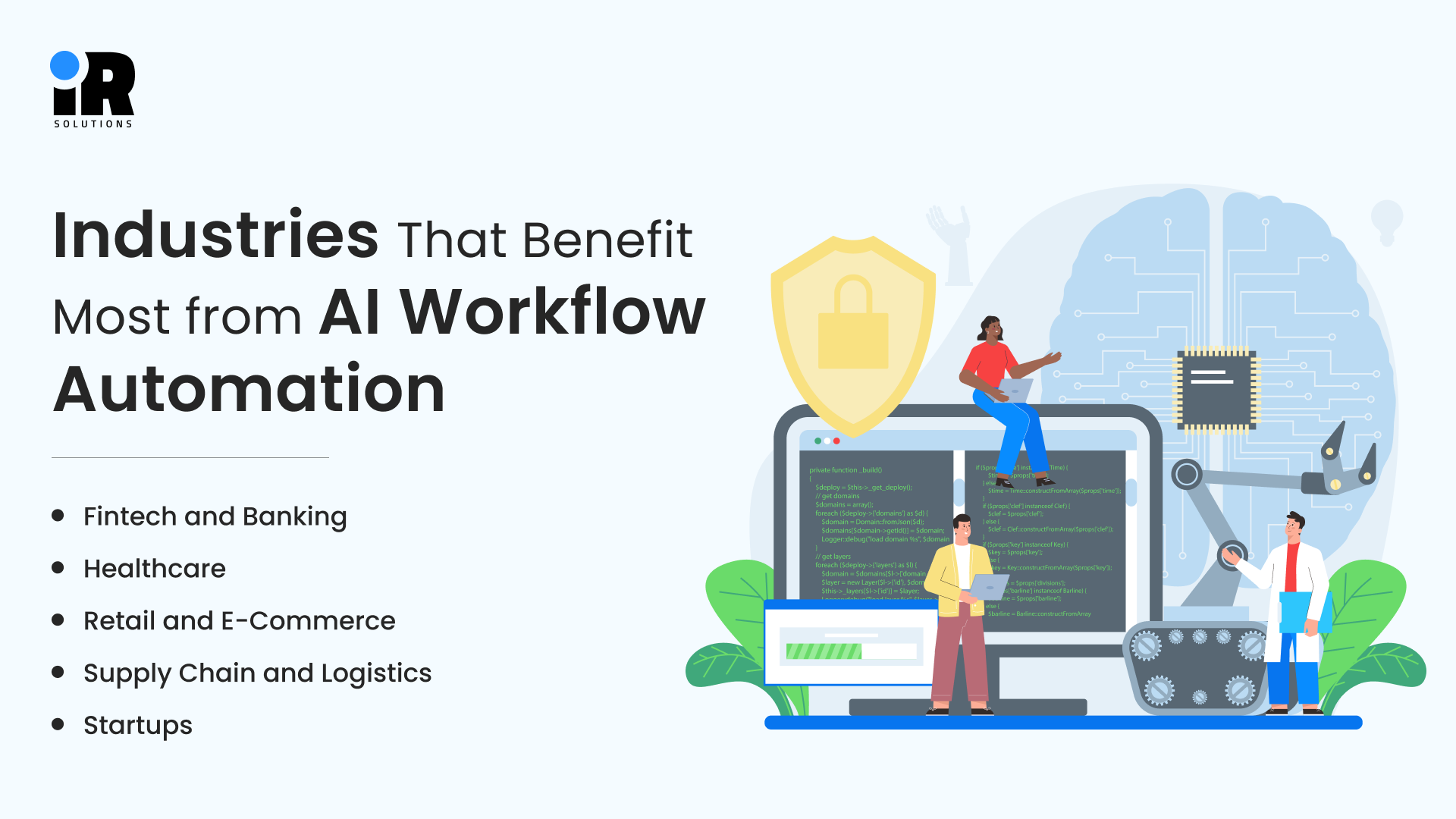
- Fintech and Banking: Loan processing, fraud monitoring, compliance checks, and customer onboarding all move faster and with fewer errors when AI is running the workflows underneath them.
- Healthcare: Patient intake, appointment scheduling, insurance verification, billing, and clinical documentation all carry high volumes of repetitive administrative work that AI handles efficiently without clinical staff involvement.
- Retail and E-Commerce: Inventory, orders, returns, and customer queues run more smoothly when AI handles the repetitive decision points your team keeps revisiting daily.
- Supply Chain and Logistics: Route optimization, vendor updates, and delay alerts shift from reactive scrambling to proactive management once AI is in the loop.
- Startups: Small teams accomplish significantly more when the operational overhead that normally requires extra hires runs automatically in the background instead.
AI workflow automation is already reshaping industries. Discover the industries we work with and understand where your business stands in this transformation.
Real Results Businesses See After AI Automation
The numbers businesses report after deploying well-built AI workflows are not exaggerated projections, they are what actually happens when the right system meets the right workflow:
- Processing times on high-volume tasks were cut by 60 to 80 percent within the first couple of months of going live.
- Customer response times are dropping from several hours down to a matter of minutes across all support channels.
- Error rates in data-heavy processes fall by over 90 percent once AI replaces manual entry and review steps.
- Employee satisfaction is rising noticeably as teams move away from spending their days on work nobody finds meaningful.
- Operational costs are decreasing while output volume climbs, which shifts the economics of growing the business significantly.
These outcomes come from systems built around your specific workflows, not generic tools. Smart businesses start with the highest-friction processes, measure the results, and expand from there.
Conclusion
The businesses pulling ahead right now are not grinding harder than everyone else. They are running leaner operations where repetitive, manual work happens automatically in the background while their teams focus on strategy, relationships, and growth. That is what AI workflow automation actually delivers when it is built and deployed properly, not a future investment but a live, working system that changes how much your team can accomplish every day without adding more people or more hours. The gap between businesses running smart automation and those still doing everything manually is already meaningful, and it widens each month. If you are ready to close that gap, work with a Custom AI development company that fits your workflows and gives you a clear starting point.
Frequently Asked Questions
How does AI automation differ from standard workflow software tools?
Standard workflow software breaks down when conditions change. AI reads context, handles variation, and keeps working accurately as your processes evolve.
What is a realistic timeline for seeing ROI after going live?
Six to eight weeks is when most businesses start noticing real efficiency gains. The full return usually lands somewhere between three and six months.
Can AI automation work in compliance-heavy industries like finance or healthcare?
It actually tends to do better than manual processes in those environments. Every action gets logged automatically, and the data handling is built into the system from day one.
Is custom AI automation a realistic option for smaller companies and startups?
It is often where the strongest early returns appear, smaller teams feel the impact faster because automation removes a larger share of their daily burden.
How do AI workflows connect with the tools a business already runs on?
AI systems integrate with CRMs, ERPs, accounting tools, and custom databases. Integration is built in from day one, not solved after the fact.