





Key Takeaways
- Arc is a Layer 1 blockchain designed for financial applications, with USDC used to pay network gas fees.
- On-chain transfers are designed for deterministic sub-second finality, but fiat funding and payouts can take longer.
- Circle Payments Network (CPN), StableFX, CCTP, and Gateway support different payment needs; not every transfer requires them.
- Total payment costs can include network gas, foreign exchange, funding, provider, and payout fees.
- Arc supports programmable stablecoin payments through smart contracts for escrow, payment splits, automated payouts, and conditional transfers.
- Businesses must consider wallet security, regulatory compliance, stablecoin liquidity, and reconciliation when building reliable payment applications on Arc.
Arc stablecoin payments allow businesses to transfer digital currencies such as USDC using a blockchain designed for fast settlement and dollar-denominated fees. The network uses USDC for gas and is designed for deterministic sub-second finality, so an application can identify when its on-chain transfer has finalized.
For example, a US business can send USDC to an overseas supplier using Arc. The blockchain handles the token transfer; payment providers may still handle funding, currency conversion, compliance and local bank payouts. Those additional steps can take longer than blockchain settlement.
The Arc blockchain provides the underlying execution and settlement infrastructure. Arc's public mainnet launched on September 16, 2026, with integrations across Circle's payment ecosystem, including Circle Payments Network (CPN) and StableFX. See Circle's Arc mainnet announcement for launch details.
This guide explains how stablecoin payments on Arc work, what infrastructure is needed, the costs involved, and when Arc is a sensible choice for a payment product.
How a Stablecoin Payment Works on Arc
Here is the full journey of stablecoin payments on Arc, from funding the wallet to closing the books.
1. The Payer Gets USDC or Another Supported Stablecoin
The payer may already hold USDC or obtain it through an eligible service such as Circle Mint, an exchange or an on-ramp. Eligibility, supported jurisdictions and funding methods depend on the provider.
2. The Payment Is Created
An app first sets the amount, the stablecoin, the destination address, the blockchain and an optional invoice reference. The payer might use a consumer wallet, embedded wallet, merchant checkout, enterprise API or a payment provider.
3. The Payer Signs the Transaction
A wallet signs the transaction with the relevant private key. A valid signature proves authorization by that key, but not necessarily the lawful owner's intent if a key is compromised. The application or payment provider must perform appropriate business and compliance checks.
4. USDC Covers the Payment and Network Gas
On many networks, users need a separate native token to cover gas. Arc USDC gas lets a wallet use USDC to cover both its transfer and the network fee, provided the balance is sufficient for both. Arc also exposes USDC through an ERC-20-compatible interface.
5. Arc Executes and Finalizes the Payment
The signed transaction is broadcast through an Arc RPC endpoint. The network executes it and validators reach consensus on the resulting state. Arc is designed for deterministic finality in under one second, allowing applications to treat finalized transfers as settled under its consensus guarantees. However, FX conversion, compliance review and local bank payout can require more time.
6. The Recipient Receives the Stablecoin
After a supported token transfer finalizes, the recipient controls the tokens at the receiving wallet. Holding or moving the stablecoin is separate from converting it to local fiat or receiving money in a bank account, which requires eligible providers and available payment rails.
7. The Payment Is Reconciled
The business records the transaction hash, payer, recipient, amount, network fee, status, timestamp and internal invoice reference. This step matters because finance teams need clean records long after the blockchain has finished its own work.
Example: Recording a 1,000 USDC Supplier Payment
Suppose a business sends 1,000 USDC to a supplier's Arc wallet. Its application records the transaction and matches it to an invoice once finality is confirmed.
Record field | Illustrative value |
Invoice reference | INV-2026-1042 |
Blockchain and asset | Arc / USDC |
Transfer amount | 1,000 USDC |
Sender and recipient | Verified wallet addresses |
Transaction hash | Captured from the submitted transfer |
Network fee | Read from the transaction receipt |
Payment status | Finalized |
Reconciliation status | Matched to invoice |
These are illustrative fields, not an actual Arc transaction. A production application should also account for payment references, idempotent processing, provider charges and any offchain payout records.
Arc Stablecoin Payment Flow
The diagram below shows Arc as the on-chain settlement rail, with other payment services supporting the workflow when needed.
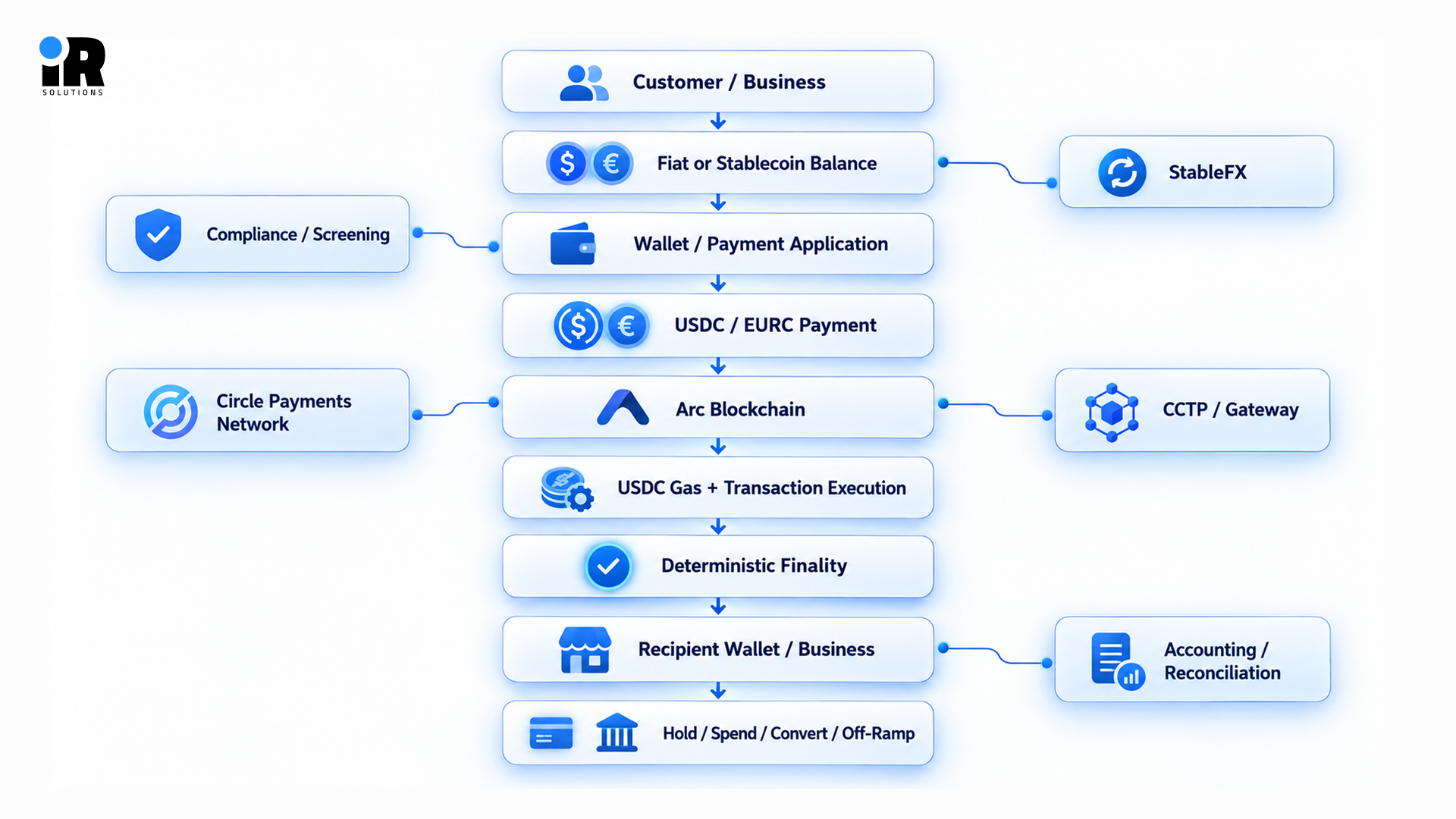
Arc is the on-chain settlement rail. Wallets and optional payment services handle funding, compliance, currency exchange, institutional coordination and financial records.
Why Arc Is Built for Stablecoin Payments
Several design choices make Arc blockchain stablecoin payments simpler for both users and the teams building them.
USDC-Native Gas
Gas is paid in USDC, so there is no separate volatile token and network costs stay in dollars. Fee smoothing also limits sudden cost jumps, which makes treasury planning and accounting far easier for finance teams.
Deterministic Sub-Second Finality
Being included in a block is not the same as being finally settled, and payment teams notice the difference. Arc gives a clear settlement point in under a second, so apps can safely mark on-chain payments as finalized.
EVM Compatibility
Developers can use Solidity, Foundry, Hardhat, viem, ethers.js and familiar wallet patterns without learning a new language. Teams curious about tooling, RPC setup and wallets can explore Arc blockchain development in much more practical depth.
Stablecoin Liquidity
Arc's ecosystem includes USDC, EURC and regional stablecoins connected to Circle's wider payment and FX infrastructure. Circle's September 2026 launch announcement identified multiple local currency stablecoins as active or onboarding, including currencies such as AUD, BRL, CAD, CHF, GBP, JPY, KRW and MXN.
Being named in the ecosystem does not guarantee that every token or trading pair is available to every participant; verify live token deployment, liquidity and eligibility. See Circle's launch announcement.
Circle Infrastructure Integration
Arc connects with USDC, EURC, CPN, StableFX, Circle Wallets, CCTP, Gateway and wider Circle developer tools. Still, not every product needs every piece, and a simple wallet app may only ever use USDC and Arc.
Terminology Used Across Arc Payment Workflows
For teams comparing options, Circle Arc payments and Circle stablecoin payments describe Circle-linked payment architectures, whereas Arc blockchain payments and USDC payments on Arc emphasize the underlying transfer network.
Arc payment infrastructure and broader stablecoin payment infrastructure encompass wallets, APIs, compliance, liquidity and records.
Commercial use cases include stablecoin B2B payments and stablecoin cross-border payments, where Arc can provide on-chain settlement without replacing every banking step.
The Core Components of an Arc Payment Stack
An Arc payment stack combines blockchain settlement with the wallets, payment services, compliance tools, and accounting systems a business needs.
Component | Role in the payment |
USDC / EURC | Payment and settlement asset |
Arc | Blockchain execution and final settlement |
Wallet | Holds funds and signs transactions |
Smart contracts | Add programmable payment rules |
CPN | Coordinates eligible institutional payment flows |
StableFX | Converts supported stablecoins and currencies |
CCTP | Moves native USDC across supported chains |
Gateway | Helps apps access cross-chain USDC liquidity |
On/off-ramp | Connects stablecoins with bank and fiat rails |
Compliance tools | Screening, KYC/KYB, AML and monitoring |
Accounting layer | Reconciliation and financial records |
Which Components Does an Arc Payment Application Need?
A simple wallet-to-wallet transfer needs fewer integrations than a cross-border payout to a bank account.
Payment requirement | Relevant infrastructure |
Transfer USDC between Arc wallets | Arc, USDC and compatible wallets |
Coordinate eligible institutional flows | Circle Payments Network (CPN) |
Convert supported stablecoin currencies | StableFX |
Move native USDC between supported chains | CCTP |
Access supported cross-chain liquidity | Circle Gateway |
Convert to fiat and pay a bank account | Eligible on/off-ramp or payout provider |
Match payments to business records | Reconciliation and accounting layer |
Circle Payments Network Arc integrations are relevant for institutionally coordinated flows, but a direct wallet transfer does not automatically require CPN. The same distinction applies to CPN Arc, StableFX Arc and liquidity tools: choose each service only for an actual product requirement.
Where Circle Payments Network Fits
Arc handles on-chain settlement, while Circle Payments Network coordinates eligible institutional payment workflows. Understanding this distinction helps businesses choose the integrations they actually need.
Arc Is the Settlement Layer
Arc executes blockchain transactions and finalizes them, which makes it the place where value actually changes hands. It does not verify customers or arrange local payouts, because those jobs sit with institutions and payment providers.
CPN Coordinates the Payment Participants
Circle describes CPN as a network linking banks, PSPs, VASPs and enterprises for stablecoin-powered global money movement. In a CPN Arc setup, settlement becomes one piece inside a wider coordinated flow between regulated institutions.
Originating and Beneficiary Institutions
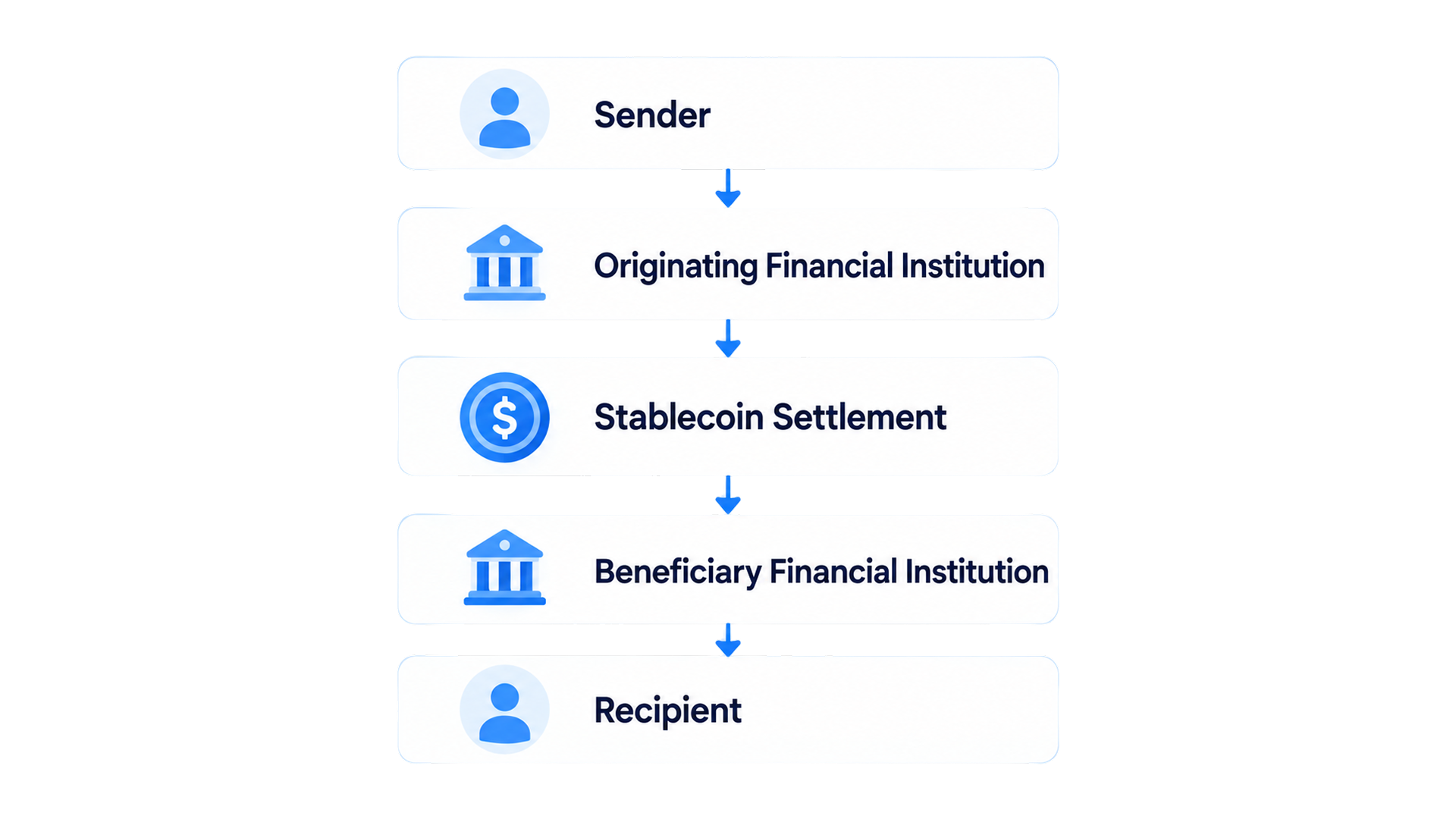
The originating institution verifies the customer and converts local money into stablecoins before settlement begins on Arc. The beneficiary institution receives those stablecoins, converts them into local currency and completes the final payout to the recipient.
When You Don't Need CPN
A simple app sending USDC between two Arc wallets does not need CPN to complete the payment. CPN matters when a business needs coordinated institutional, cross-border and fiat-connected flows across several regulated partners at scale.
How Cross-Border Stablecoin Payments Work on Arc
Arc can provide the on-chain settlement stage of cross-border payments, while funding, currency conversion, and local payouts may rely on separate providers.
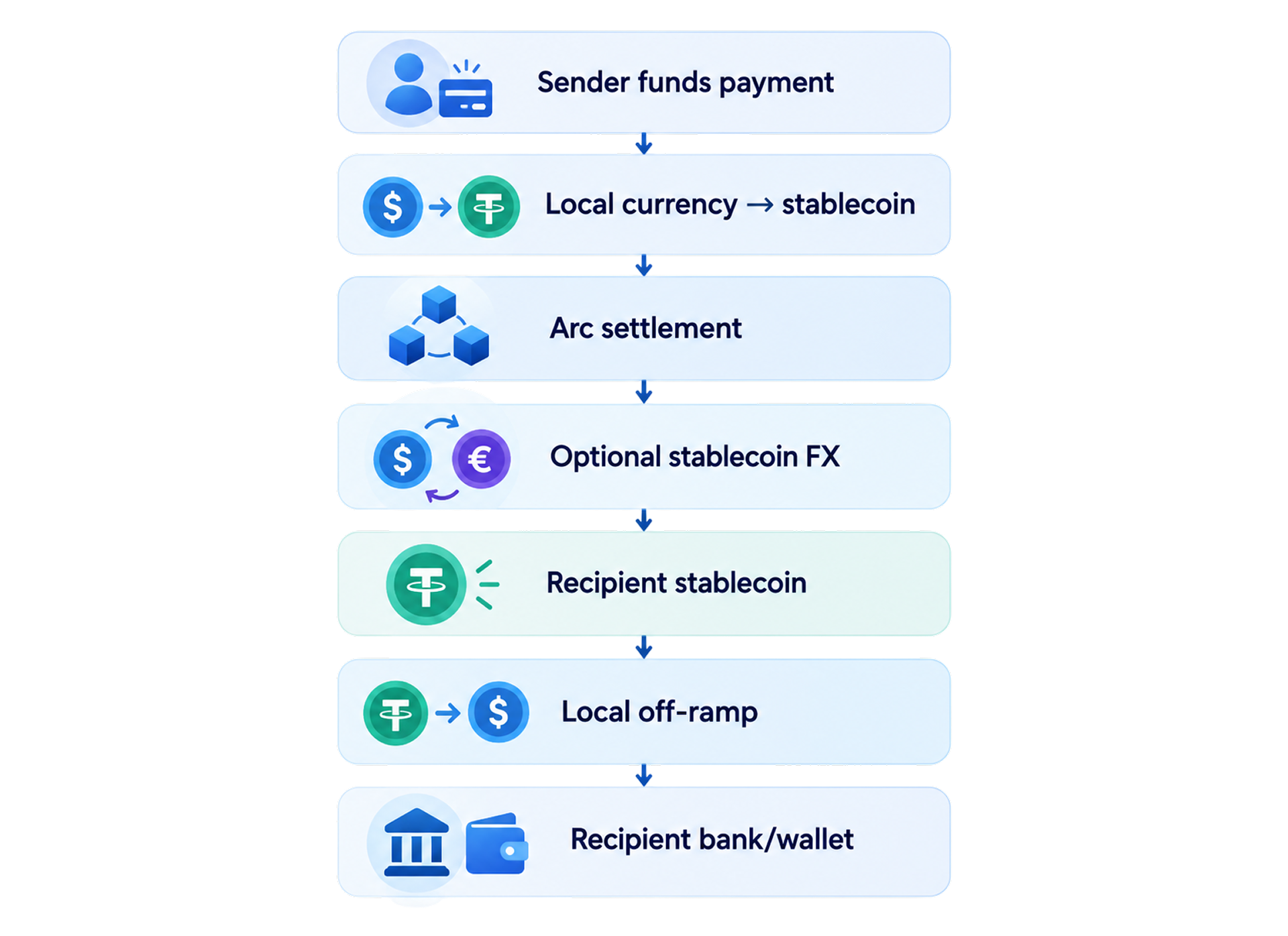
Funding
Fiat usually enters through a regulated on-ramp or payment institution that turns local currency into a stablecoin. This step often still involves a bank, because the money has to leave the traditional banking system first.
Stablecoin Settlement
The payment then moves over Arc instead of passing through a long chain of correspondent bank ledgers. This stablecoin settlement on Arc reduces waiting time, although banks may still appear at the funding and payout ends.
Currency Conversion
When the payer and recipient use different currencies, supported stablecoin FX can convert value during the payment flow. For example, a business could send USDC while the supplier receives a euro or peso stablecoin instead.
Local Payout
The beneficiary can keep the stablecoin, hold it as a wallet balance or cash out into local fiat. A cash out normally runs through an off-ramp or payment provider that sends funds to a local bank.
Example: A $10,000 Cross-Border Business Payment on Arc
This example follows a cross-border payment from USDC funding and Arc settlement through currency conversion, local payout and invoice reconciliation.
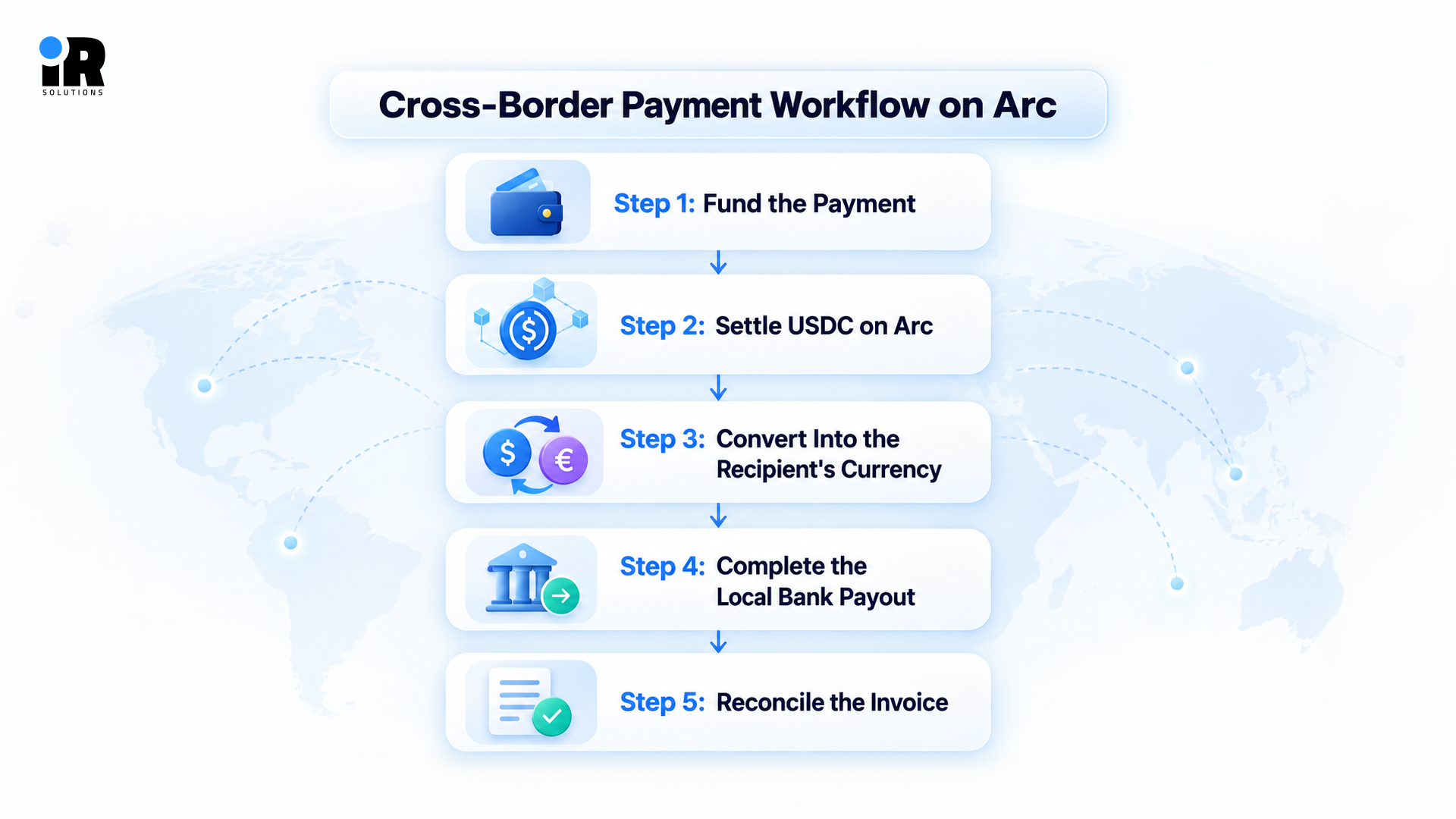
Step 1: Fund the Payment
The payer obtains 10,000 USDC from an eligible provider or uses an existing balance. It needs enough additional USDC to pay network gas and must validate the intended recipient and chain.
Step 2: Settle USDC on Arc
A wallet signs and submits the transfer. Arc finalizes the on-chain transaction according to its consensus guarantees. This stage provides USDC settlement on Arc, not a guarantee of immediate fiat receipt.
Step 3: Convert Into the Recipient's Currency
A qualified provider arranges the currency conversion. Eligible participants may use a supported StableFX pair, such as USDC and EURC, or another provider's FX service. Available pairs, liquidity, exchange rates, spreads and access conditions vary.
Step 4: Complete the Local Bank Payout
The off-ramp or payment provider arranges the euro payout through a supported banking partner or local payment rail. The time required depends on compliance checks, provider processing and banking hours, even after the Arc transaction has finalized.
Step 5: Reconcile the Invoice
The businesses match the blockchain transaction hash with the invoice ID, USDC amount, network fee, FX rate, provider fees and final fiat payout. An end-to-end payment status model should distinguish between submitted, finalized on-chain, converted and paid out.
How StableFX Fits Into Arc Payments
StableFX operates on Arc and supports 24/7 stablecoin FX for eligible participants. Available conversions depend on supported currency pairs, liquidity, and participant access.
Stablecoin-to-Stablecoin FX
StableFX lets approved participants trade between supported fiat-backed stablecoins, such as swapping USDC into EURC directly on Arc. Because both sides are stablecoins, the whole conversion stays on-chain from the very first quote through final settlement.
Request-for-Quote Pricing
Pricing follows a simple request-for-quote model where a participant asks for a price and receives one. Once a participant accepts a quote, the trade follows the required funding and settlement process. Settlement timing depends on the transaction workflow and whether the counterparties are ready to complete it.
Payment-versus-Payment Settlement
Both sides of the currency exchange settle together, or neither side settles, which protects each party equally. This design reduces principal settlement risk, where one party pays but never receives the other currency in return.
24/7 Currency Conversion
Traditional FX often waits for banking hours, weekdays and settlement windows in different time zones around the world. StableFX runs around the clock, but it is permissioned for eligible institutions and is not a consumer swap.
Moving Stablecoin Liquidity Across Blockchains
Payments rarely live on one chain forever, so moving USDC between networks is part of daily operations.
CCTP
CCTP burns USDC on the source chain, sends a signed attestation message and mints fresh USDC on the destination chain. This keeps the USDC native on both sides, so there are no wrapped tokens to track or redeem.
Circle Gateway
Circle Gateway provides unified access to USDC balances across supported chains, while CCTP transfers native USDC between supported blockchains through burning and minting. The appropriate option depends on the application's cross-chain transfer and liquidity requirements.
Why This Matters for Payments
A customer may hold USDC on one network while the merchant prefers to settle everything on Arc. Interoperability closes that gap, so USDC settlement on Arc works even when funds start on a completely different chain.
Adding Smart Contracts to Arc Payment Flows
Smart contracts can add conditions and automated rules to stablecoin transfers, enabling payment workflows that go beyond sending tokens from one wallet to another.
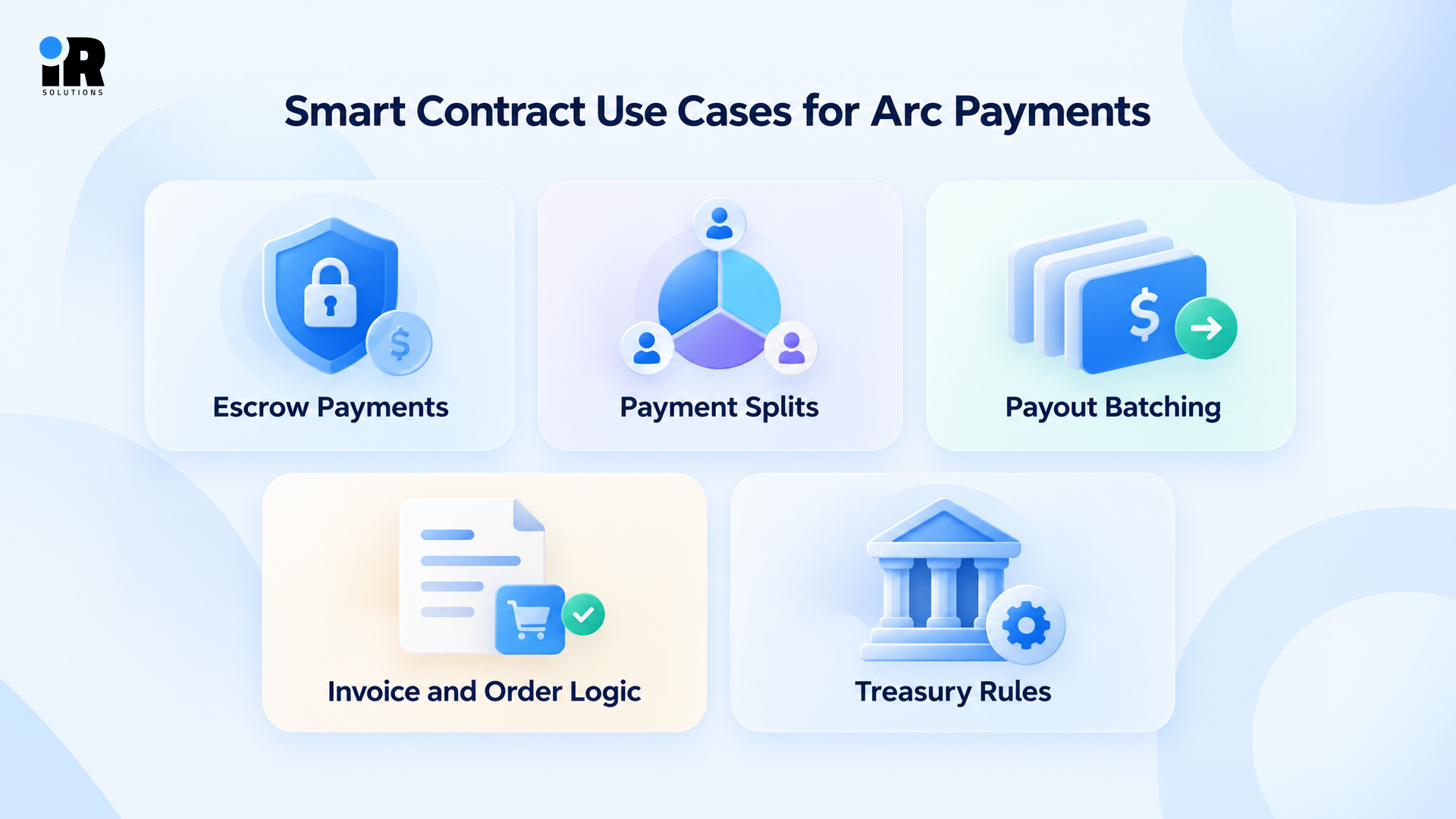
Escrow Payments
An escrow contract holds funds until agreed conditions are met, such as a delivery confirmation or approved milestone. Both sides can see the rules upfront, which builds trust between buyers and sellers who have never met.
Payment Splits
One incoming payment can be split automatically between a merchant, a marketplace, an affiliate and a service provider. Each party receives its share in the same transaction, so nobody waits for a manual transfer later.
Payout Batching
Businesses can pay many recipients in one controlled workflow, which suits contractor runs and creator earnings very well. Batching also cuts repeated manual work and gives finance teams one clear record for each payout cycle.
Invoice and Order Logic
Smart contracts can enforce payment conditions associated with an invoice, order, subscription or service milestone. Updating an external invoice database usually requires an application to monitor on-chain events, verify finality and process updates safely. Idempotent event handling and reconciliation help prevent incorrect or duplicate status changes.
Treasury Rules
Smart contracts can enforce spending limits, approval roles and payment conditions for shared company treasury wallets. If you plan to deploy smart contracts on Arc, remember that a direct wallet transfer needs no contract at all.
Stablecoin Payment Use Cases on Arc
Stablecoin settlement can support different business workflows, from supplier payments and merchant checkout to payroll, treasury transfers, and automated transactions.
Cross-Border B2B Payments
Stablecoin B2B payments help companies pay suppliers, vendors and partners abroad without waiting days for bank settlement. The on-chain transfer can finalize within seconds, while currency conversion and bank payouts may take longer. This can improve supplier relationships and cash flow planning when the full payment infrastructure is in place.
Merchant Payments
Stablecoin merchant payments let customers pay in USDC using a compatible wallet or checkout. After verifying finality, the merchant can update an order and issue a receipt. Production checkouts must also handle underpayments, duplicate submissions, expired orders, refunds, customer support and any fiat conversion. This makes stablecoin merchant payments a full product workflow rather than just a token transfer.
Global Payouts
Stablecoin payouts suit contractors, creators, sellers and gig workers who live in many different countries around the world. Platforms can send funds quickly, and workers choose whether to hold USDC or cash out into local money.
Remittances
Families can send money home as stablecoins, which move across borders before any optional conversion into local currency. The recipient can then keep the digital dollars or withdraw cash through a trusted local payout partner.
Payroll
Distributed teams can receive salaries in stablecoins where this is lawful and suitable for each employee's location. Employers still need local tax, labor and reporting advice before moving any part of their regular payroll on-chain.
Treasury Transfers
Companies can move stablecoin balances between entities, accounts and regions at any hour, including weekends and holidays. This gives treasury teams faster access to working capital, since they no longer wait on bank cutoff times for on-chain transfers.
Machine-to-Machine Payments
Arc is also used for agentic and device payment experiments, where tiny amounts move between software or machines. TLAY, for example, is building USDC micropayments on Arc that rely on fast finality and USDC gas.
What Stablecoin Payments on Arc Cost
Stablecoin settlement can support different business workflows, from supplier payments and merchant checkout to payroll, treasury transfers, and automated transactions.
- Network Fee: Arc charges its network fee in USDC, and fee smoothing helps limit sudden changes in the dollar-denominated cost.
- Stablecoin Conversion: Turning fiat into stablecoins, or back again, can carry a separate fee from the issuer or provider.
- FX Spread: When currencies differ, the quote includes a spread or trading fee that changes the final received amount.
- Provider Fee: Gateways, PSPs and orchestration platforms usually charge for their service, often as a percentage or flat fee.
- Ramp Fees: On-ramps and off-ramps may charge when money moves between bank accounts and stablecoin wallets in either direction.
- Cross-Chain Costs: Moving liquidity between networks through CCTP or Gateway can add its own costs and timing considerations.
Example: The Total Cost of a $10,000 Payment
These amounts are hypothetical, not Arc fee measurements or binding provider quotes. They assume the provider charges each item separately; actual fees may be bundled.
Cost component | Illustrative fee |
Arc network transaction fee | $0.01 |
Stablecoin funding fee | $10.00 |
FX conversion cost | $20.00 |
Payment provider charge | $5.00 |
Local payout fee | $8.00 |
Total | $43.01 |
That would equal approximately 0.43% of the $10,000 amount. The example shows why the net amount received, rather than the blockchain fee alone, is the more useful figure to compare.
Compliance and Payment Operations
Businesses handling stablecoin payments must account for regulatory obligations and operational processes beyond blockchain settlement, including customer verification, transaction monitoring, and financial records.
KYC and KYB
Depending on the product and jurisdiction, businesses may need to verify customers through KYC and companies through KYB. These checks happen in the application or provider layer, because the blockchain itself does not know identities.
AML and Sanctions Screening
Blockchain settlement does not automatically perform every required AML or sanctions check on the people involved in payments. Teams should screen wallet addresses and counterparties before sending funds, and again whenever their risk signals change.
Travel Rule Requirements
Circle says CPN workflows can include Travel Rule handling, screening and monitoring for stablecoin payments between institutions. That support belongs to CPN, so an independent app on Arc must still plan its own compliance approach.
Transaction Monitoring
Good monitoring watches wallet risk, unusual payment activity, large movements and repeated failures in close to real time. Early alerts help teams pause suspicious activity before small problems grow into serious losses or regulatory issues.
Reconciliation
Finance teams must match each blockchain transaction with invoice IDs, customers, ledger entries, fees and any refunds. Those records also feed tax and reporting systems, so clean data from day one saves painful cleanup later.
Refunds and Payment Errors
Blockchain transfers do not work like card chargebacks, so a settled payment cannot simply be pulled back later. A refund is usually a new transaction that sends funds back, a point Stripe's stablecoin guide also highlights.
Security Risks in Arc Stablecoin Payments
Businesses handling stablecoin payments must account for regulatory obligations and operational processes beyond blockchain settlement, including customer verification, transaction monitoring, and financial records.
Wallet and Key Security
A stolen signing key can authorize payments that look completely valid on-chain, even though they are fraudulent. Use hardware security modules, multisig approvals or managed key services, and limit who can sign large business payments.
Wrong Address or Network
Sending funds to the wrong address or wrong network can make a payment very hard or impossible to recover. Address checks, saved contacts and small test payments help prevent costly mistakes before larger amounts move.
Smart Contract Risk
When payment logic lives in a contract, one bug can lock funds or send them to the wrong place. Careful smart contract testing and an outside audit should come before any contract handles real customer money.
Integration Risk
Many problems come from integration issues like API errors, duplicate requests, wrong payment status or failed webhooks. Duplicate protection, retry logic and daily reconciliation checks catch these errors before they confuse customers or finance teams.
Cross-Chain Risk
Cross-chain flows add extra infrastructure, messaging and timing assumptions that a single chain payment simply does not have. Teams should track each transfer until it is fully minted and settled on the chosen destination chain.
Stablecoin and Counterparty Risk
Stablecoins carry issuer, reserve and redemption risks that are separate from how the Arc network itself operates. Businesses should understand who issues each stablecoin they accept and how holders can redeem it for regular fiat money.
What About Payment Privacy on Arc?
Many businesses want to keep certain payment details away from public view on a transparent blockchain. These usually include counterparties, balances, invoice details, transaction amounts and overall treasury positions held by the company.
Arc has designed broader opt-in privacy, but this network-wide feature was still in development at the September 2026 launch. Arc's roadmap includes opt-in privacy infrastructure intended to support confidential financial workflows while preserving appropriate auditability.
So for now, treat Arc payments as visible on-chain and plan any confidentiality needs at the application level.
Arc Stablecoin Payments vs a Generic EVM Payment Flow
Arc shares familiar EVM development patterns with other compatible networks, but its USDC gas model, finality design, and payment ecosystem create important differences.
Requirement | Typical EVM Chain | Arc |
Payment asset | USDC or another stablecoin | USDC and supported stablecoins |
Gas | Separate native token often required | USDC |
Finality | Network dependent | Deterministic sub-second |
Solidity/EVM | Often supported | Supported |
Cross-chain USDC | Depends on network | CCTP and Gateway in the ecosystem |
Institutional payment network | Separate infrastructure | CPN integration |
Stablecoin FX | Separate venue or provider | StableFX on Arc |
Privacy | Chain or app-dependent | Broader privacy on the roadmap |
When Should Businesses Choose Arc for Stablecoin Payments?
Arc may suit businesses that need stablecoin settlement, but the right network depends on supported assets, payment corridors, liquidity, costs, and operational requirements.
Business requirement | Why Arc may fit | What to check |
Cross-border supplier invoices | Fast on-chain USDC transfer | Regional off-ramps, FX costs, supplier preferences |
Merchant checkout | Direct stablecoin payment settlement | Wallet adoption, refunds, amount matching |
Global contractor payouts | Stablecoin payouts across supported wallets | Recipient access, regulations, cash-out routes |
Treasury movement | Stablecoin settlement on Arc at any hour | Custody, authorization controls, liquidity |
Conditional business transfers | Stablecoin payment smart contracts | Audits, contract risks, operational complexity |
When Another Network May Be Better
Choose a different settlement route when customers already use other networks, required stablecoins are more liquid elsewhere, wallet integration is limited, or local banking providers offer a stronger end-to-end experience on another stack.
Compare reliability, actual costs, security, available payment corridors and regulatory requirements before building.
Building a Stablecoin Payment Application on Arc
Strong stablecoin payment infrastructure usually follows a layered build, though each product shapes the exact stack differently.
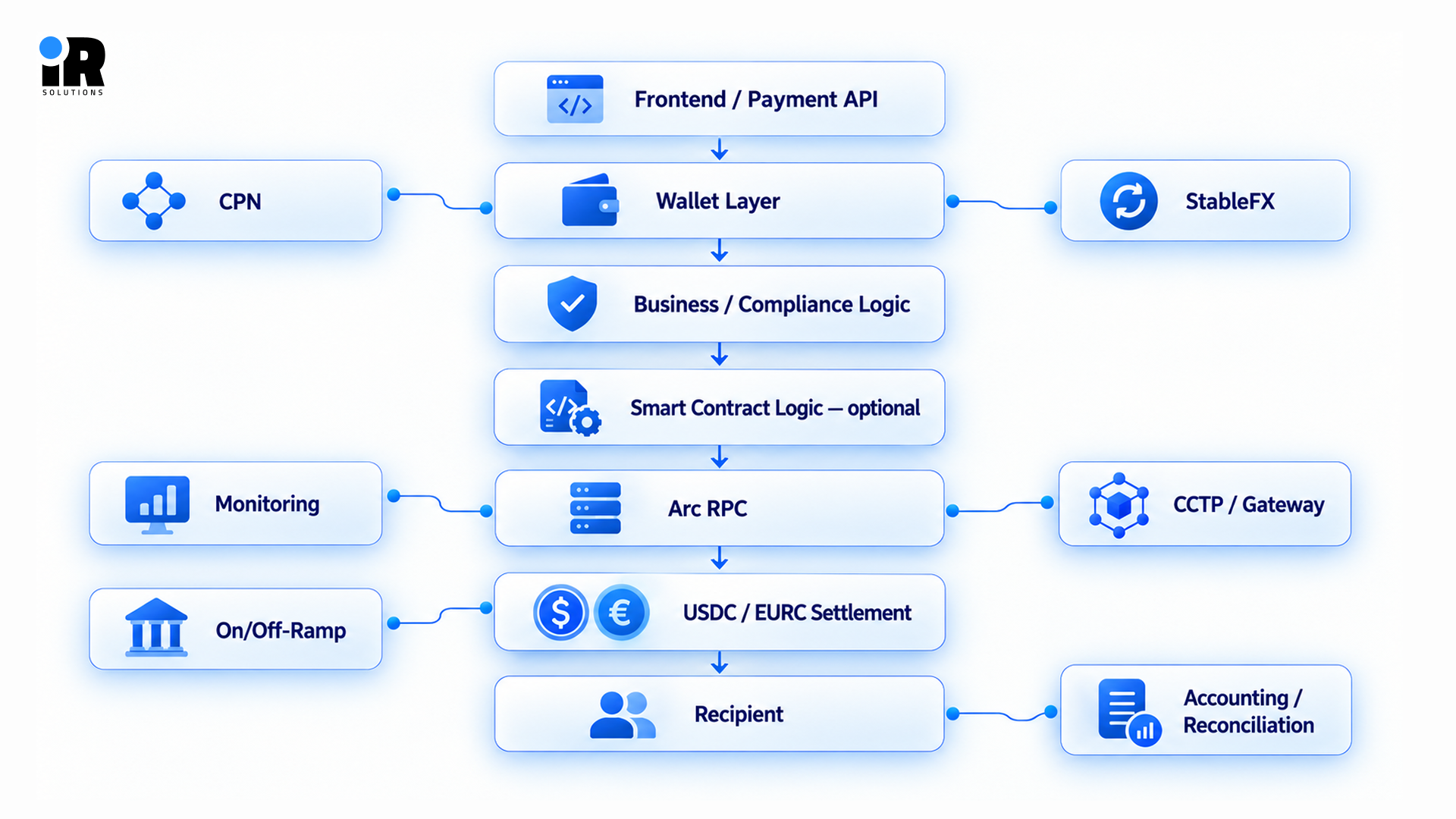
A simple wallet transfer app needs far less infrastructure than a cross-border PSP serving many countries and currencies. The wallet layer, business logic and Arc RPC form the base, while contracts and integrations depend on scope.
Engineers mapping RPC providers, SDKs and testnets can study the full Arc blockchain development stack before writing code. If your team wants experienced help shipping a payment product, our blockchain development services cover design, contracts and integrations.
Implementation Checklist for Arc Stablecoin Payments
- Configure the network: Confirm mainnet chain settings, a dependable Arc RPC endpoint, token addresses and wallet compatibility against current documentation.
- Secure payment authorization: Select a custodial, embedded or self-custody model; validate recipient addresses and use spending limits or multi-party approval where appropriate.
- Process transfers safely: Check token balances and fees, prepare transactions, monitor finality and make retries idempotent to avoid duplicate payments.
- Maintain financial records: Map transaction hashes and receipts to payment references, invoices, fee entries and reconciliation statuses.
- Add only necessary integrations: Evaluate CPN, StableFX, CCTP, Gateway and supported fiat ramps according to users, currencies and liquidity needs.
- Test failure cases: Cover insufficient funds, incorrect network selection, RPC timeouts, event-processing failures, refunds and delayed payout-provider responses.
Stablecoin Payment Examples on Arc
The following examples illustrate institutional payment infrastructure and emerging stablecoin payment use cases on Arc. Their individual deployment and product statuses should be verified before publication.
Circle Payments Network
CPN is integrated into Arc for cross-border settlement, connecting regulated institutions that move stablecoins for their customers. It shows how Circle stablecoin payments can run real institutional workflows on top of one shared settlement layer.
Pulsar
Pulsar is live on Arc mainnet and is building a cross-border stablecoin money app focused on payments. The team also plans broader financial features, which shows how payment apps can grow beyond simple money transfers.
TLAY
TLAY is exploring machine-to-machine USDC payments, where devices pay each other very small amounts for data or services. Sub-second finality and USDC gas matter here, because fees and delays could easily outweigh such tiny payment values.
Conclusion
Arc offers a stablecoin-native execution and settlement layer designed for fast finality and USDC-denominated network fees. For a business, the important question is how that settlement layer connects with the rest of the workflow: wallets, custody, liquidity, conversion, provider access, compliance and accounting.
Before choosing Arc for stablecoin payments, map the complete transaction journey and compare final recipient costs, payout time and operational risk. Start with the smallest viable set of integrations, then add institutional coordination or FX services only where needed.
If you're evaluating a payment product, our blockchain development services can help with architecture, wallet integration and smart contract implementation.
Frequently Asked Questions
What are Arc stablecoin payments?
Arc stablecoin payments are transfers of USDC or other supported stablecoins that settle on Arc, Circle's Layer 1 blockchain. They use USDC for gas, are designed for final settlement in under a second and connect with Circle payment tools.
How do stablecoin payments work on Arc?
The payer funds a wallet, creates the payment and signs it, then Arc executes and finalizes the transaction. The recipient receives stablecoins after on-chain finality, and the business records the payment for reconciliation and reporting.
Which stablecoins can be used on Arc?
Arc's ecosystem includes USDC and EURC, alongside regional stablecoins associated with StableFX. Availability depends on individual token deployments, supported trading pairs, liquidity and participant eligibility.
Does Arc use USDC for gas?
Yes, Arc uses USDC as its native gas asset, so network fees are paid in dollars instead of volatile tokens. The same balance also works through an ERC-20 interface, and fee smoothing helps keep costs steadier.
Do users need ETH to send USDC on Arc?
No, users do not need ETH or another separate gas token to send USDC on Arc. The wallet needs sufficient USDC to cover both the payment amount and the network fee.
How fast do payments settle on Arc?
Arc is designed to deliver deterministic sub-second transaction finality through its consensus system. Applications can treat a finalized on-chain transfer as settled under the network's consensus guarantees. Fiat conversion and bank payouts may require additional time.
What is Circle Payments Network, and how does it work with Arc?
Circle Payments Network connects banks, PSPs, VASPs and enterprises so they can move money globally using stablecoins. CPN coordinates participating institutions and payment workflows, while Arc can provide the on-chain settlement layer.
What is StableFX on Arc?
StableFX is a permissioned FX venue on Arc where eligible institutions convert between supported stablecoins at any hour. It uses request-for-quote pricing and payment-versus-payment settlement, so both sides of a completed exchange settle together.
Can businesses accept USDC payments on Arc?
Yes, businesses can accept USDC payments on Arc through wallets, merchant checkouts, payment providers or their own APIs. They should still plan for compliance checks, reconciliation, refunds and any conversion into local currency they need.
Can Arc be used for cross-border payments?
Yes, Arc is designed for stablecoin cross-border payments such as remittances, supplier payments and global payouts to workers. Banks or regulated providers may still handle fiat funding and local payout at either end of the payment.


