




Imagine losing a sale not because of pricing or competition, but simply because your customer could not understand you. That happens to thousands of businesses every single day across global markets, and most of them never find out why the customer left. Businesses that communicate in a customer's native language often see higher conversion rates, stronger retention, and improved customer satisfaction. IR Solutions helps businesses remove language as a barrier to growth through AI-powered multilingual systems built around real business requirements.
This blog covers how multilingual AI assistants work, what makes them succeed or fail in production, and how your company can deploy one without wasting months on the wrong approach.
Why Language Barriers Are Silently Draining Your Revenue
Most companies underestimate how much revenue language barriers are quietly costing them every month. Forty percent of online shoppers will never purchase from a website that is not in their native language, regardless of how strong the product actually is. When customers cannot communicate clearly with your support team, resolution times stretch out, and frustration builds on both sides of the conversation fast. Agents spend more energy decoding the problem than solving it, which slows your entire queue and chips away at customer trust with every delayed reply.
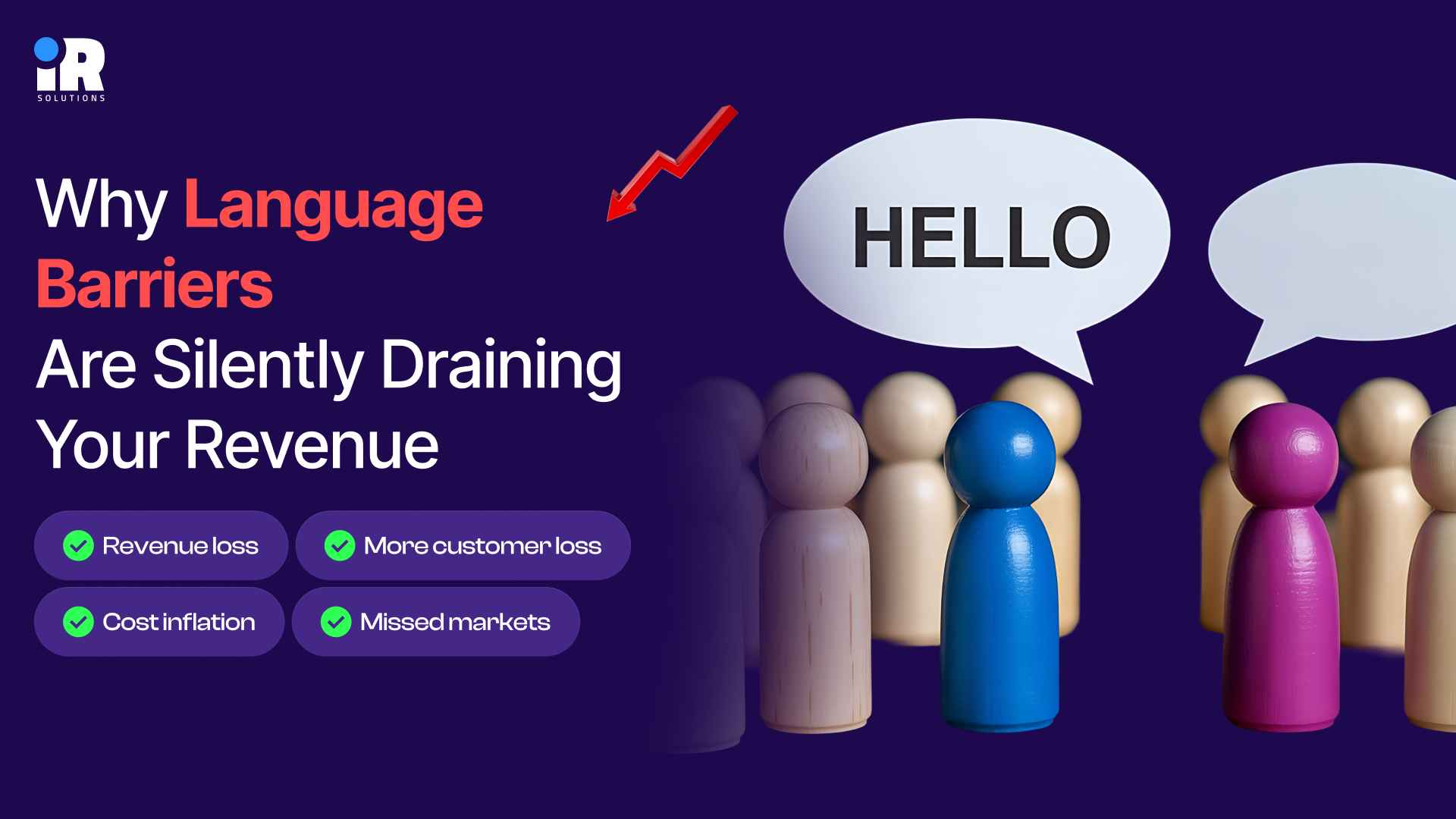
- Revenue loss: Companies without native-language support lose an estimated 40% of potential international customers before the first interaction even begins.
- More customer loss: Accent-related and language-related miscommunication drops customer satisfaction scores from 79% to 58% in contact center environments.
- Cost inflation: A human multilingual agent costs between $15 and $30 per hour, and that cost multiplies directly as you enter each new market.
- Missed markets: High-growth regions like Southeast Asia, LATAM, and the Middle East are largely underserved because companies cannot scale language coverage fast enough.
Traditional hiring models cannot keep pace with global expansion because adding each new language multiplies your support costs directly. AI-powered multilingual support brings that per-interaction cost can reduce support costs substantially compared with human-only multilingual support operations. Businesses looking to reduce support costs further often work with AI chatbot development experts to automate customer interactions.
How Multilingual AI Assistants Work Under the Hood
Understanding the mechanics behind multilingual AI helps you ask the right questions when evaluating any solution for your business, especially in custom chatbot development projects. The technology involves several layers working together in real time, and each layer has to perform reliably for the whole system to hold up under production conditions.
Detection and Processing
- Language gets flagged almost instantly, before the customer even finishes typing their first sentence.
- Real conversations mix languages mid-sentence, and decent systems just roll with that switch.
- It's not only about spotting the language but also about reading tone, slang, and how someone actually talks.
Translation Architecture
- One core language handles all the thinking behind the scenes, keeping answers consistent across the board.
- Sensitive stuff like order numbers and emails gets shielded before translation touches it at all.
- Low-confidence translations get double-checked automatically, so shaky wording doesn't quietly turn into a wrong answer.
Context Preservation
- Long chats are where most AI tools start losing the plot, literally and figuratively.
- A tiny early misstep can snowball into the AI forgetting what the customer even asked.
- Pulling fresh info as the chat goes keeps things grounded instead of drifting off track.
To go deeper into how business-specific AI assistants are designed and deployed, read: Custom AI Chatbot Development Complete Guide to Building Business-Specific AI Assistants.
Selecting the Right Language Model for Your Target Markets
No single AI language model outperforms all others across every language pair, and choosing the wrong one for your specific markets is a mistake that shows up in your customer satisfaction scores within weeks of going live, particularly in custom AI chatbot development services implementations.
Model Comparison
- GPT-4 and Claude: These models are among the strongest options for fluency, contextual understanding, and multilingual conversational performance across major business languages.
- Google Translate and DeepL: Both remain highly competitive for many European language pairs and can offer a lower-cost translation layer than frontier LLMs for high-volume multilingual applications.
- NLLB and specialized models: Meta's No Language Left Behind model and similar specialized systems provide meaningfully better coverage for low-resource languages like Swahili, Tagalog, Tamil, and Amharic, where mainstream models tend to underperform.
Many production environments use multiple models, routing specific language pairs to different systems based on quality, latency, and cost requirements. Implementing this effectively often requires experienced AI/ML engineers who can optimize model selection, orchestration, and performance across markets.
Common Multilingual AI Obstacles Every Business Should Know
Most multilingual AI problems do not appear during testing they show up at volume, in languages your QA team does not speak well enough to catch before customers do.
Entity Corruption
Translation engines process everything as natural language, which means structured data like order IDs and product codes often get rewritten into something unrecognizable during translation. Masking all identifiers before any translation call is the simplest way to prevent this from becoming a persistent backend matching problem.
Script-Specific Processing
Languages like Chinese, Japanese, and Korean do not use spaces to mark word boundaries, so standard text segmentation tools break on them in ways that feed incoherent fragments into your retrieval pipeline. Using script-specific segmentation libraries from the start saves significant debugging time once you are in production.
Low-Resource Language Gaps
Many languages spoken across Africa, South Asia, and Southeast Asia have limited training data available, which pushes mainstream AI models toward lower accuracy rates in those markets. Transfer learning from related languages and hybrid model architectures are the most practical ways to close that gap without waiting for the models to catch up. Advanced language handling often requires NLP engineers who specialize in linguistic modeling and multilingual systems.
Context Drift in Extended Sessions
Long support conversations push earlier messages out of the AI's active context window, causing it to lose track of what was already established and ask customers to repeat themselves. Active session summarization and explicit state tracking are standard approaches to keeping the conversation coherent from the first message to the last.
A Step-by-Step Framework for Building Your Multilingual System
Deploying multilingual AI successfully requires following a sequence that most companies try to shortcut, and the shortcuts are almost always what cause the expensive rework later on.
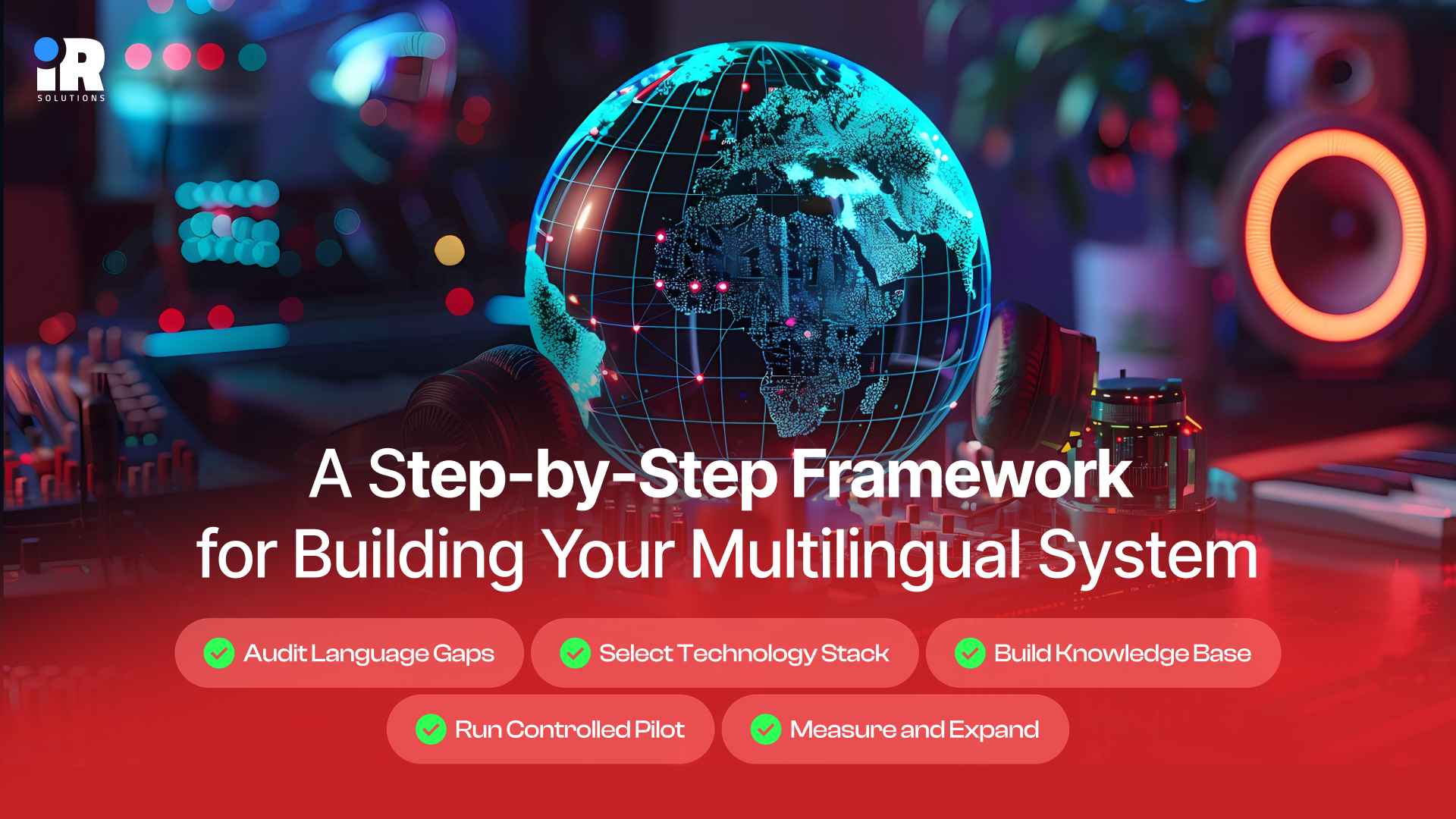
Audit Language Gaps
Before selecting any technology, pull your support ticket data and segment it by customer language or country of origin. Identify where response times are longest and churn rates are highest relative to markets where your language coverage is weak. The two or three language pairs with the highest combination of volume and pain become your first deployment targets.
Select Technology Stack
Evaluate platforms against your actual production requirements, language pair accuracy, CRM and help desk integration, latency benchmarks, and compliance certifications relevant to your industry. The goal is a stack that performs reliably in your target markets, not one that looks impressive in a demo.
Build Knowledge Base
Your multilingual AI will only perform as well as the information it has access to, so a disorganized knowledge base produces disorganized responses across every language you support. Build a structured repository in your base language covering product documentation, troubleshooting procedures, company policies, and approved language for sensitive topics. The more organized this foundation is before deployment, the less time you spend fixing inconsistent responses after you go live.
Run Controlled Pilot
Start with your highest-impact language pair and limit the pilot to lower-stakes interactions like order status, FAQ responses, and basic account inquiries before expanding. Run it with real customers from the target market rather than internal testers who already know what the system is supposed to say. Collect feedback from both customers and monitoring agents, and use that input to fix gaps before you scale.
Measure and Expand
Analyze pilot results by individual language rather than in aggregate so you can see exactly where performance is strong and where it needs work. Use that data to retrain models, refine the knowledge base, and adjust routing logic before adding more languages to the system. Companies that treat this as an ongoing program rather than a one-time deployment consistently outperform those that launch and stop paying attention.
How to Split Customer Support Between AI and Human Agents
The goal of multilingual AI is not to replace your support team but to free them from repetitive, low-complexity interactions so they can focus on the work that actually requires human thinking. Getting this balance right from the start determines whether your deployment saves money or quietly creates new problems you have to fix later.
- Simple queries like order status and FAQs should always go straight to AI first.
- Legal inquiries, safety concerns, and enterprise account issues must always reach a human agent.
- When agents take over, AI should keep providing real-time translation and context summaries actively.
- Well-configured systems handle 65–80% of routine queries without ever needing human escalation at all.
- Agents who understand AI limitations make smarter escalation decisions and give better improvement feedback.
To see how AI is improving response times and support efficiency, check How AI Assistants Are Transforming Customer Support Workflows.
Factors That Show Whether Your Deployment Is Succeeding
Tracking overall customer satisfaction is not sufficient when you are running a multilingual operation, because aggregate metrics can mask significant performance gaps between language markets that require very different responses from your team.
Customer-Facing Performance Metrics
Track satisfaction scores, net promoter scores, and first contact resolution rates separately for each language market you support. A system that performs at 90% satisfaction in English but 65% in Arabic is not a multilingual success, it is an English success with multilingual branding, and your Arabic-speaking customers know the difference. First contact resolution by language tells you whether the AI is actually solving problems or just pushing them to the next interaction.
Operational Health Metrics
- Containment rate by language: What percentage of queries in each language are resolved without human escalation, and how does that compare across your supported markets.
- Translation accuracy by language pair: Automated accuracy metrics give you a baseline, but human review of a sample of interactions each week is necessary to catch the nuanced errors that scoring algorithms miss.
- After-hours resolution rate by region: AI should be delivering consistent service quality regardless of what time it is in your customers' time zones, and any significant drop in after-hours resolution rates points to a configuration problem worth investigating.
Business Impact Metrics
Calculate cost per resolved interaction by language and benchmark it against what you were spending before the AI deployment, accounting for both direct costs and the time your agents were spending on lower-value tasks. Track customer lifetime value by language segment over a rolling 12-month window, because the revenue impact of getting native-language support right shows up in retention and repeat purchase rates rather than in first-purchase conversion. Market expansion velocity is harder to quantify, but worth tracking how quickly your team can enter a new language market once the AI infrastructure is in place tells you a lot about the operational advantage you are building.
Emerging Capabilities That Will Matter for Your Business
The pace of improvement in multilingual AI is not slowing down, and the capabilities arriving over the next two to three years will expand what is possible for businesses investing in this space today.
Real-Time Voice Translation at Scale
Live voice-to-voice translation now enables cross-language phone conversations with latency low enough to sustain a natural conversation pace. An English-speaking agent can handle a call from a German customer in real time, with the AI translating in both directions simultaneously. By 2027, this will be a standard capability in enterprise contact center platforms rather than the specialized deployment it is today.
Emotionally Aware Cross-Language Responses
AI systems can now detect emotional state from text patterns and vocal characteristics across multiple languages, adjusting response style based on whether a customer appears frustrated, confused, or simply making a routine inquiry. A customer who is visibly distressed in French receives a response calibrated differently from a calm customer asking a routine question in Mandarin, without any manual intervention required from your team.
From Reactive to Predictive Multilingual Engagement
Predictive AI is beginning to shift multilingual support from a reactive model where you wait for customers to contact you with problems toward a proactive one where the system identifies patterns that suggest a customer is about to have an issue and reaches out first, in their language. This is already showing results in pilot deployments and will become increasingly standard as the underlying models improve.
Full Agentic Workflows Across Systems
Beyond answering questions, the next generation of multilingual AI agents will execute complete support workflows autonomously across your backend systems. A single customer interaction can trigger language detection, issue identification, identity verification, backend system updates, resolution execution, and a follow-up message all in the customer's native language, without a human agent involved at any point in the chain.
Conclusion
At some point, business growth is no longer just about having a strong product but about how clearly and consistently a company can communicate with its customers across different regions. When language becomes a barrier, even strong products start losing opportunities they should have converted. Multilingual AI helps remove that gap by enabling real-time, scalable communication that feels natural to every customer, regardless of language or location.
Building such systems requires more than just tools. It needs the right architecture, model selection, and deployment strategy so the system performs reliably in real-world conditions. For businesses ready to make this shift, AI/ML services handle the complex aspects of designing and scaling intelligent systems built for real automation and multilingual complexity.
Frequently Asked Questions
How many languages can multilingual AI assistants support simultaneously?
Most enterprise-grade systems support 50-100+ languages, though accuracy varies significantly by language.
What accuracy level can businesses realistically expect from AI translation?
Well-configured production systems typically achieve 95% or higher accuracy on mainstream language pairs.
Does deploying multilingual AI require a large in-house technical team?
Managed deployment platforms handle infrastructure, so your team focuses on configuration and business logic.
Can AI assistants accurately handle regional dialects within the same language?
Modern models distinguish major dialects and adapt vocabulary and tone based on regional signals.
How long does a proper multilingual AI deployment typically take?
A focused pilot covering one or two language pairs usually takes between four and six weeks end-to-end.
Is sensitive customer data protected when it passes through AI translation systems?
Enterprise providers offer end-to-end encryption, GDPR compliance, and data residency controls by default.
What happens automatically when the AI cannot resolve a customer query?
The system escalates to a human agent and passes along the full translated conversation context.
How should businesses calculate the ROI of their multilingual AI investment?
Compare cost per resolved interaction, track CSAT by language market, and measure revenue changes by region.