




Most startups run on tight budgets, small teams, and very little margin for error. Competing with established companies feels impossible when you're working with a fraction of their resources. That's exactly where artificial intelligence changes the math entirely, AI tools today are affordable, accessible, and built for teams that move fast. From automating tasks that take up hours every day to making product decisions backed by real data, AI gives early-stage companies an edge that used to cost millions. This blog covers where AI fits inside a startup, what mistakes to avoid, how to build the right way, and how our team helps businesses move from idea to product faster than they expected.
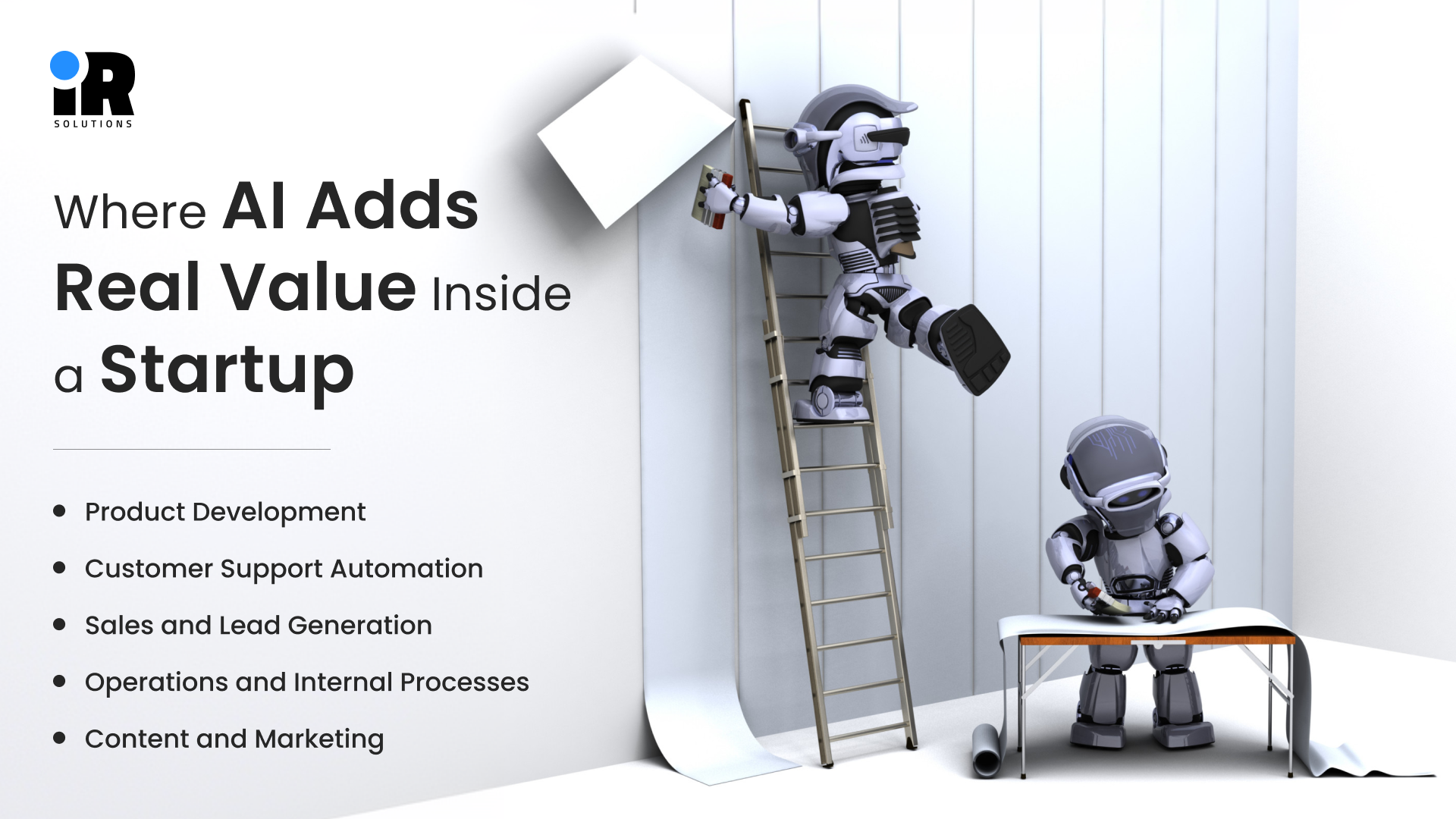
Where AI Adds Real Value Inside a Startup
Not every corner of your business needs an AI solution on day one, adding AI at everything is one of the fastest ways to burn budget and confuse your team. The founders who get results from AI are the ones who pick their spots deliberately. Here's where the clearest value tends to show up in early-stage companies.
Product Development
AI compresses the product development cycle in ways that matter to lean teams. From drafting user stories and generating test cases to identifying feature gaps by analyzing competitor products, AI tools reduce the friction between an idea and a working build.
Some teams use AI to run synthetic user research before they've signed a single customer. Others use it to auto-generate API documentation, write boilerplate code, or catch bugs before they reach staging. The time saved isn't marginal on some sprints, it cuts delivery time nearly in half.
Customer Support Automation
Support is one of the highest-cost functions for early-stage startups, and one of the easiest to automate intelligently. Most customers at the early stage ask the same ten to fifteen questions. An AI-powered support system handles that volume around the clock without fatigue and without adding a single hire.
This isn't about removing the human element from customer relationships. It's about making sure your team isn't spending four hours a day answering the same question about billing cycles or password resets. When AI handles the repetitive tier of support, your people can focus on conversations that actually require human judgment.
The more interactions the system processes, the better it gets. Training it on your existing support history takes less time than most teams expect, and the reduction in support load is immediate once the system goes live.
Sales and Lead Generation
AI changes how sales work at the early stage in four concrete ways:
- Lead Scoring: AI ranks leads by their likelihood to convert, based on behavioral signals and firmographic data.
- Personalized Outreach: Email sequences get written, tested, and optimized faster than any manual A/B test cycle allows.
- Follow-Up Timing: AI identifies the right moment to reach out based on how a prospect engages with your product.
- Pipeline Forecasting: Revenue predictions shift from gut-based estimates to data-driven projections that investors trust.
Startups that implement AI in their sales process early tend to run smaller sales teams that close more deals, because everyone is spending time on leads that are actually ready to buy.
Operations and Internal Processes
Internal tasks eat more founder time than anyone wants to admit. Scheduling, reporting, document processing, invoice handling, and supplier communication are none of these tasks particularly exciting, but they collectively consume hours every week.
AI tools that automate these workflows don't make the headlines, they don't get featured in pitch decks. But they give back time that compounds over months, and they reduce the operational mistakes that happen when a tired team moves too fast to double-check anything.
For startups using DevOps development services, automation is embedded into the infrastructure from the start so that operational overhead stays manageable even as the product scales.
Content and Marketing
Content production is a major resource drain for startups that need to build an audience without a full marketing team. AI tools now assist with drafting blog posts, social content, ad copy, email newsletters, and SEO briefs in a fraction of the time it used to take.
Social media is no longer just about reach, see how it’s becoming a branding-first space in: How Social Media Is Becoming a Branding Game, Not a Marketing Channel.
The Build vs. Buy Decision Every Startup Faces
The right call depends on three things: what your data looks like, how differentiated the AI capability needs to be, and what your budget actually supports. Getting it wrong early is one of the most expensive mistakes a startup can make.
When off-the-shelf tools make sense:
- The use case is generic chatbots, text summarization, image tagging, and sentiment analysis.
- You need something to live in days rather than months.
- The AI feature is a nice-to-have, not core to what makes your product worth buying.
- The budget is tight, and you're still validating whether the feature matters to users at all.
When custom AI development makes more sense:
- Your product's value is tied directly to a proprietary data advantage.
- Generic models return inconsistent or inaccurate results in your specific domain.
- The AI capability is what separates your product from every competitor in the market.
- You're in a regulated industry where model behavior needs to be fully auditable.
Most startups land somewhere in the middle: off-the-shelf for fast, generic use cases. Custom builds for the features that define the product, getting that balance right from the start saves a lot of expensive rework down the road.
The Biggest Mistakes Startups Make with AI
Getting into AI without a clear plan leads to wasted engineering sprints, confused teams, and tools that nobody ends up using. The mistakes below come up consistently when we work with founders who've already tried to ship AI features and hit a wall.
No Clear Problem Statement
This is the most common mistake we see. Startups add AI because it looks good in a pitch deck or because a competitor mentioned it in a press release. Without a specific, measurable problem to solve, the AI just adds complexity to your product without improving anything users actually care about. Define the outcome you want first, then decide if AI is the right tool to get there.
Underestimating Data Requirements
AI models perform at the quality level of the data they're trained on. Startups frequently assume they can point a model at their existing database and get useful results immediately. The reality is that most early-stage companies have messy, inconsistent, and incomplete data. Cleaning and structuring your data before model development is not optional; it is the foundation on which everything else is built.
Overbuilding Before Validating
Spending six months training custom models before a single user has tested the feature.
Trying to replicate the capabilities of large foundation models as a seed-stage company.
Building AI functionality that was never requested in actual customer conversations.
Designing for massive scale before the core feature has proven it works at all.
Skipping the Integration Work
An AI model that works in a notebook is not a product, getting it into your actual application with proper API design, data pipelines, authentication, and error handling is its own engineering project. Teams that treat integration as an afterthought ship AI features that break in production, or never get used because they're too buried in the interface to find.
If that sounds familiar, book a free strategy call and we’ll see what AI setup works best for you.
AI Applications Broken Down by Startup Type
Different startup types have different AI priorities. A SaaS company and a fintech startup face completely different technical and compliance requirements, even if both want to add AI to their product. Here's how the use cases tend to break down by category.
- SaaS companies get the most value from onboarding personalization, support automation, and predictive churn modeling.
- E-commerce teams move revenue fastest with product recommendations, dynamic pricing, and demand forecasting.
- Fintech startups rely on AI for fraud detection, credit risk scoring, and real-time transaction monitoring.
- Health-tech AI is most commonly applied to clinical documentation, symptom triage, and compliance-heavy workflow automation.
- Logistics startups use AI primarily for route optimization, demand forecasting, and supplier risk monitoring.
Learn how AI is transforming businesses in detail in our guide: AI for Business in 2026: Use Cases, Automation, Tools & Implementation Guide.
What a Sustainable AI Product Actually Requires
A lot of startups ship an AI feature quickly and then watch it quietly degrade over time. The model returns worse results with each passing week. Users stop trusting it and disengage. The feature gets buried in the navigation, and eventually, nobody on the team mentions it again. This happens because the team treated the launch as the finish line instead of the starting point.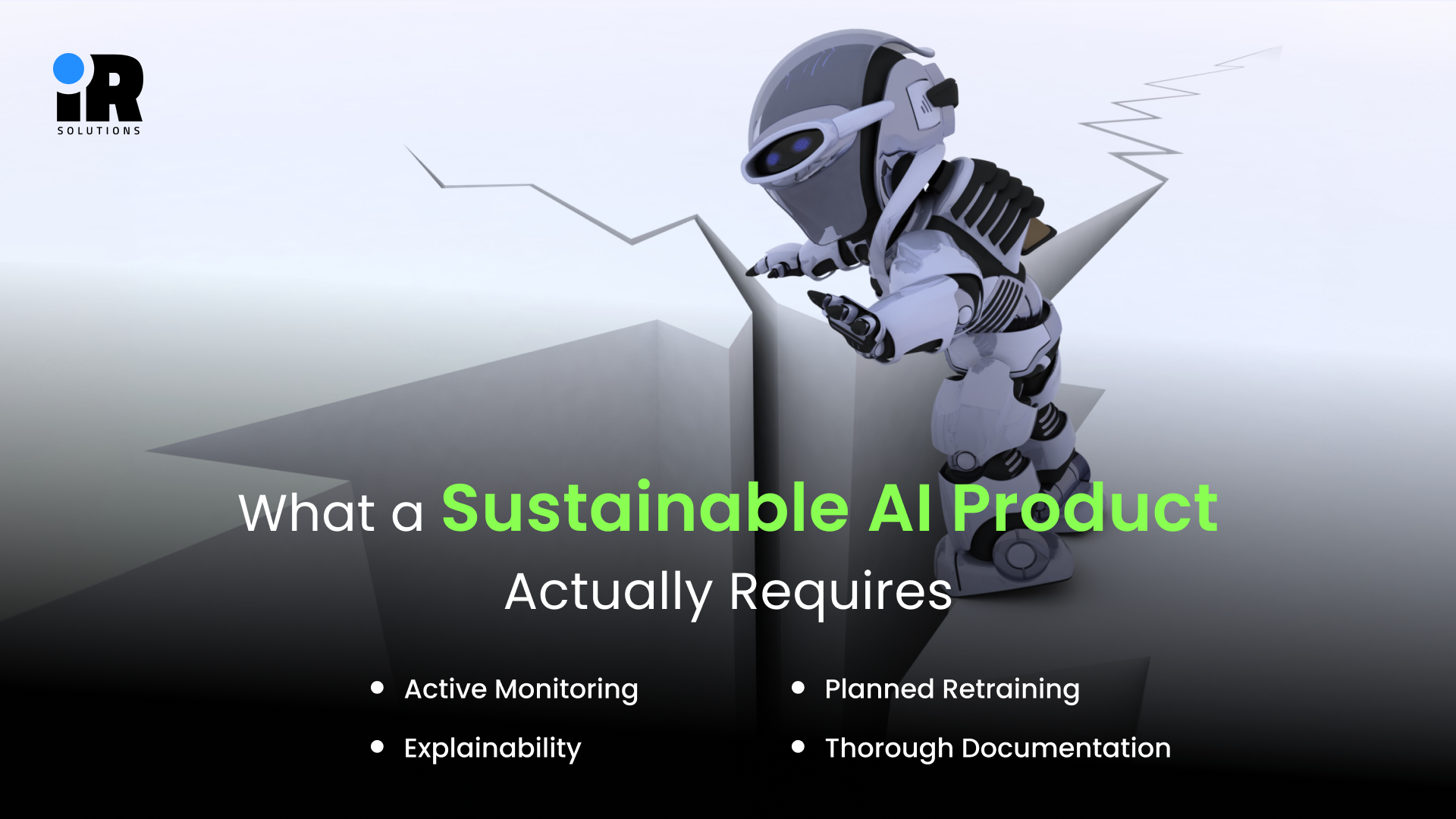
- Active Monitoring: Model performance in production needs to be tracked continuously across all key metrics, not just tested at launch. Set up dashboards that flag automatically when output quality drops below a clearly defined threshold. Know exactly what "good" looks like before you deploy so you can recognize when performance has drifted from it.
- Planned Retraining: User behavior changes over time in ways that directly affect how well your model performs in production. Markets shift, and a model trained on data from eighteen months ago makes predictions based on conditions that no longer exist. Build retraining cycles into your product roadmap before launch and decide in advance how frequently the model gets updated and what data pipeline feeds it each time.
- Explainability: At some point during a customer complaint, an investor due diligence call, or a regulatory audit, someone will ask why the AI made a specific decision. If your team cannot answer that question clearly and confidently, you have a serious and potentially costly problem on your hands. Build explainability into your AI products from the design stage, not as a rushed afterthought when someone demands it under pressure.
- Thorough Documentation: Every AI component in your codebase should be documented with the same rigor and discipline applied to any other production system you maintain. What data does it consume, what outputs does it produce, and what are its known failure modes under stress? This documentation becomes the foundation for onboarding new engineers and for debugging confidently when something breaks in production at 2 am.
How Startups Build Scalable Products with AI
We've worked with startups across fintech, health tech, SaaS, e-commerce, and logistics at multiple stages of growth. The pattern we encounter most often is a founder with a product vision and a real market opportunity who needs custom AI solutions that are designed around their specific business goals, data, and workflows rather than generic implementations.
Working with our team typically follows this structure:
- Discovery: We map your business goals to specific AI use cases before any technical decisions are made.
- Architecture: We design infrastructure that supports your current needs and scales cleanly as the product grows.
- Development: Our team builds, trains, and integrates the AI components directly into your product workflow.
- Post-Launch Support: We stay on after deployment to monitor performance, run retraining cycles, and improve the system continuously.
For startups that already have an internal engineering team but need senior AI expertise for specific sprints, our staff augmentation service brings in the right people without the overhead of a permanent hire on the payroll.
Conclusion
AI is no longer a competitive advantage reserved for companies with deep pockets and large engineering teams. In 2026, startups that move deliberately with AI choosing the right problems, building on clean data, and treating deployment as the beginning rather than the end are the ones pulling ahead of competitors who are still figuring out where to start.
The mistakes are avoidable and the use cases are proven. What separates the startups that get real results from the ones that waste six months on a feature nobody uses is having the right technical partner from the beginning. Startups that want to move from idea to a working AI product without costly delays or wrong turns partner with an AI Software Development company that has already navigated that path across multiple industries and product types.
Frequently Asked Questions
What does AI for startups mean in practical terms?
It means using machine learning, automation, and data-driven systems to help small teams build faster, cut operational costs, and ship smarter products.
Do I need a large dataset before adding AI to my product?
Not always, off-the-shelf AI APIs work without proprietary data, though custom model performance improves significantly with clean, structured, domain-specific data.
How early should a startup start thinking about AI?
AI-driven automation in support, sales, and operations can add value very early, even before a startup has reached its first revenue milestone.
What is the difference between using AI tools and building custom AI?
AI tools are pre-built APIs or platforms you integrate quickly, while custom AI involves training models on your own data for higher accuracy and competitive differentiation.
How long does it take to build a custom AI feature into a product?
Simple integrations typically take two to four weeks, while custom model development and full deployment usually run between two and five months, depending on complexity.
Can a startup afford AI development on a tight budget?
Yes working with a development partner is usually more cost-effective at the early stage than hiring a full in-house AI team before the product has proven itself.
What industries see the fastest return from AI at the startup stage?
Fintech, e-commerce, SaaS, health tech, and logistics consistently deliver the clearest and fastest ROI on AI investment for early-stage companies.
How do we keep AI models accurate after they go live?
Through planned retraining cycles, production monitoring dashboards, clean data pipelines, and regular performance audits are built into the product roadmap from day one.
What should a startup's very first AI project look like?
Pick one measurable problem, establish a baseline metric, build a focused solution, test with real users fast, and iterate before expanding the scope any further.
How does IR Solutions approach AI development for startups?
We start with your business outcome every build is mapped to a specific product goal before a single line of code gets written, so nothing gets built without a clear reason.