




Seven out of ten AI projects fail not because the technology doesn't work, but because the business hired the wrong team to build it. Hiring the wrong AI development team is one of the most expensive mistakes a growing business can make today. You pay upfront, wait months, and then receive a product that doesn't fit your operations or your team. We’ve seen what separates successful AI projects from costly ones across industries, and the difference almost always comes down to how well you evaluate before you hire. Every business deserves an AI solution that was actually built for its problems, not repurposed from someone else's project. To avoid these costly mistakes, many businesses choose to hire experienced AI ML developers who understand both the technical and operational side of building real-world AI systems.
Why Off-the-Shelf AI Tools Often Fall Short for Businesses
Generic AI tools are built for the widest possible audience, so they rarely fit a specific business's data, workflows, and goals at the same time. When that happens, you end up adjusting your operations to match the tool, and that always costs more than building the right thing from the start.
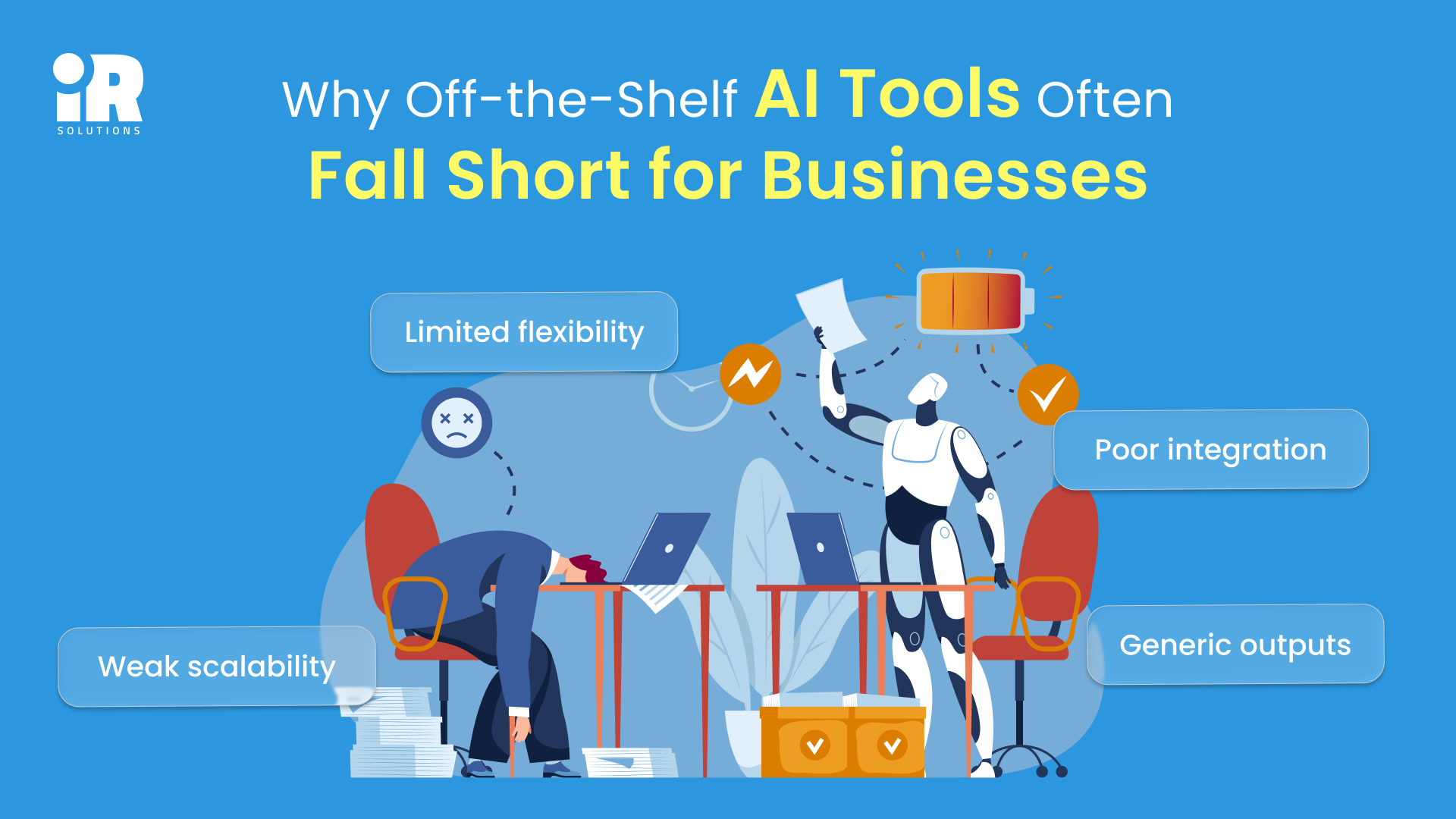
Here's where off-the-shelf AI solutions consistently fall apart for businesses that need real performance:
- Limited flexibility: You cannot easily train these tools on your own proprietary datasets without significant workarounds and added cost.
- Poor integration: They rarely connect cleanly with your existing software stack, and every workaround creates a new point of failure.
- Weak scalability: As your data volumes and team size grow, most generic tools hit performance ceilings that require expensive upgrades.
- Generic outputs: Results are tuned for average use cases across industries, so they never quite match the specifics of your business operations.
Generic tools look affordable until your team starts working around them that hidden cost shows up everywhere except the invoice.
What to Actually Check Before Choosing an AI Development Team
Technical Expertise
Ask to see real documentation, architecture diagrams, and model performance metrics, not just polished case studies.
- The provider should be able to build, fine-tune, or deploy language models matched specifically to your industry's data and terminology.
- Hands-on experience is required for setting up pipelines to deploy, monitor, version, and retrain models after the initial launch.
- Knowledge of how to clean, label, and structure messy, inconsistent real-world business data before any model gets trained is essential.
Industry Experience
A team that has built AI for e-commerce thinks very differently from one that has worked in healthcare or financial services.
- Prior work on a problem that closely resembles the one your business is actually trying to solve is non-negotiable.
- A deep understanding of your industry's specific regulatory requirements and the data handling constraints your team operates under is essential.
- The ability to connect you directly with a past client from a similar industry for a real, unscripted conversation should be expected.
Different industries require different AI strategies, which is why real-world use cases like how startups apply AI to scale faster in 2026 offer a useful reference point when evaluating a team's experience.
Transparency and Communication
If a team can't explain their process clearly before the contract is signed, that will not change once the project is underway.
- A detailed project timeline with real deliverables and measurable milestones should be defined at every stage.
- Honest pushback is essential when your requirements are vague, underdefined, or technically unrealistic.
- A written commitment to documenting the architecture, data pipelines, and all key model decisions throughout the build is non-negotiable.
Scalability Planning
A system that works on day one but falls apart when your data triples is not a solution, it's a future problem.
- A concrete retraining plan that keeps the model accurate as your data patterns shift over weeks and months must be in place.
- The system should be designed from the ground up for horizontal scaling without requiring costly rewrites down the line.
- Clear steps for maintaining performance during high-traffic or high-data-volume periods must be explicitly defined and documented.
Red Flags to Watch Out For When Evaluating AI Solution Providers
Choosing the wrong AI outsourcing company does not just waste budget it sets your operations back and makes the next attempt harder to justify. Before you sign anything, know what to watch for.
- No Discovery Process: Any company that skips a genuine discovery phase does not understand your problem well enough to build the right solution for it.
- Overpromised Timelines: A company that promises a complex, production-ready AI system in a matter of weeks is cutting corners you will pay for later.
- Vague Pricing: Contracts without clear scope boundaries almost always lead to budget overruns, scope disputes, and strained relationships mid-project.
- Limited Support: AI systems need ongoing maintenance and retraining a company that disappears after delivery is a direct liability to your operations.
- Generic Presentations: If they show you the same pre-built demo they show every prospective client, they are not actually customizing anything for your business.
Trust what you observe during the sales process, because that behavior is usually a preview of how they work once the contract is signed and the money is transferred.
How Custom AI Development Drives Real Business Growth
When a custom AI system is built correctly and deployed well, it becomes a direct driver of revenue, efficiency gains, and competitive positioning in your market.
Operational Efficiency
Automating repetitive, time-consuming internal tasks frees your team to concentrate on higher-value work that actually moves the business forward. Document processing, customer query routing, data classification, and inventory forecasting are common starting points that consistently deliver measurable returns on investment. Beyond individual task automation, the compounding effect across an entire team is where the real efficiency gains accumulate over weeks and months of consistent use. These improvements are typically delivered through structured AI and ML service implementations tailored to business workflows, not generic automation tools.
Better Decision-Making
AI models trained directly on your historical business data give you predictive insights that your competitors working from generic tools simply do not have access to. That advantage translates into smarter pricing decisions, faster procurement cycles, better hiring outcomes, and fewer costly errors in day-to-day operations.
Customer Experience Improvements
Custom recommendation engines, intelligent chatbots, and personalization systems built specifically for your user base make your product feel individually tailored to each customer who interacts with it. That level of relevance drives higher retention rates, more repeat purchases, stronger referrals, and measurably lower churn over time.
Cost Reduction
Catching operational errors early, reducing the time your team spends on manual review processes, and optimizing logistics decisions with AI-powered forecasting all cut your operating costs in ways that show up directly on the balance sheet. Many businesses recover the full cost of their custom AI investment within the first year of deployment. The businesses that see the fastest payback are usually the ones that identified a specific, high-frequency problem to solve first rather than trying to automate everything at once.
What a Proven AI Development Workflow Looks Like
Most suppliers make the process sound simpler than it is to close the deal faster. Knowing what each stage should look like gives you the clarity to spot who is cutting corners before you've committed your budget.
Discovery Phase
The team spends dedicated time learning your business operations, your data environment, and your actual goals before a single line of code gets written. This phase should end with a documented problem statement, agreed success metrics, and a defined scope that both sides have signed off on.
Data Audit and Preparation
The quality of any AI model is directly limited by the quality of the data it was trained on. A serious team audits your existing datasets, identifies gaps that need to be filled, and designs a proper data pipeline before model development begins, not halfway through it.
Model Development and Testing
The core development work involves selecting the right architecture for your use case, training iteratively on your actual business data, and running structured testing cycles with documented performance metrics. Your team should be actively involved in reviewing outputs throughout this stage, not just at the very end.
Integration and Deployment
The finished model needs to connect cleanly and reliably with your existing business systems and tools. A capable team handles API integration, any required front-end development, and production deployment in a way that doesn't disrupt your ongoing operations during the transition.
Monitoring and Iteration
A model going live is not the finish line, ongoing monitoring and retraining are equally critical. Teams that ignore post-launch maintenance are the ones whose clients return months later with expensive, avoidable problems.
For a broader understanding of how AI evolves across business systems, you can also review a complete AI automation implementation framework for 2026.
Book a free strategy call with our team to understand the right AI investment for your business, including where to start, budget, and realistic outcomes.
Critical Mistakes Businesses Make When Investing in AI Development
Even well-run companies make these errors, recognizing them before you start a project is worth far more than trying to fix them once the development work is already underway.
- No Clear Business Goal: Investing in AI without a defined objective often leads to wasted resources and unclear outcomes.
- Poor Data Quality: AI is only as good as the data it learns from, making data accuracy critical.
- Unrealistic ROI Expectations: Expecting immediate results can cause businesses to abandon valuable AI initiatives too soon.
- Ignoring Security & Compliance: Failing to protect sensitive data can create legal, financial, and reputational risks.
- Lack of Human Oversight: AI should support decision-making, not replace human judgment entirely.
- No Plan for Integration & Scaling: AI delivers the most value when it integrates smoothly with existing systems and can grow with the business.
Conclusion
Investing in custom AI development is one of the most consequential decisions a business can make for its long-term competitive positioning. But the outcome depends almost entirely on who you hire to build it and how thoroughly you evaluate them before making that commitment. The businesses that get the most from AI are the ones that asked the hard questions early, chose partners who were honest about what's realistic, and treated their AI systems as capabilities to grow over time rather than one-time purchases to set and forget.
Building a strong AI system takes time, clean data, and a development team that genuinely understands your business operations from the inside out. If you cut corners on any one of those three things, the results will reflect that in ways that are expensive and slow to correct. The right time to start having that direct, practical conversation about where AI fits into your growth plan and what it will realistically take to get there is before you sign anything. If you’re planning your next step in custom AI adoption, working with an experienced AI development partner can help you move from planning to execution with clarity.
Frequently Asked Questions
How long does custom AI development usually take?
Most projects run between three and six months, depending on complexity and your existing data readiness.
What industries benefit most from custom AI solutions?
Retail, logistics, healthcare, financial services, and customer support operations consistently see the strongest measurable returns.
How much does custom AI development typically cost?
Costs vary significantly by scope, so a proper discovery call is the most reliable way to get accurate numbers.
Do we need a large dataset before we can start?
Not always, do certain model types perform well with smaller datasets, as long as the data is clean and well-structured.
Can a custom AI model connect with our current software?
Yes, any serious development team treats API and system integration as a core part of the work, not an afterthought.
What happens when the AI model produces wrong outputs?
Wrong outputs happen, what matters is whether your team has a monitoring setup and a retraining plan ready when they do.
Is custom AI worth it compared to a SaaS tool?
If your business runs on unique workflows and data nobody else has, a custom build tends to pay for itself faster than most expect.