


Hiring the wrong kind of blockchain talent is one of the most expensive mistakes a growing company can make today. Some businesses build internal teams and spend months recruiting before writing a single line of production code. Others outsource the entire build and end up with a system nobody on their team fully understands or can maintain. Neither outcome is inevitable, but both are common when this decision is made without a clear framework from the start. Blockchain developers help businesses think through exactly this question before committing to a direction that is difficult to reverse later.
Why This Decision Shapes Everything That Comes After
The choice between in-house and outsourced blockchain development is not just a hiring decision, it is a structural one. It determines how quickly you can build, how much control you keep over the codebase, and what your ongoing maintenance costs look like for years after launch. Most businesses treat this as a budget question and then discover it was always a strategy question wearing a cost spreadsheet. The team structure you choose shapes your timelines, your IP ownership, your ability to pivot, and how exposed you are when something breaks in production at a critical moment. Getting this right at the start is much cheaper than correcting it six months into a build that went the wrong direction entirely.
Take a look at Blockchain Development Guide 2026: Use Cases, Costs, Technologies & How to Get Started before planning your next step.
What Building an In-House Team Actually Looks Like
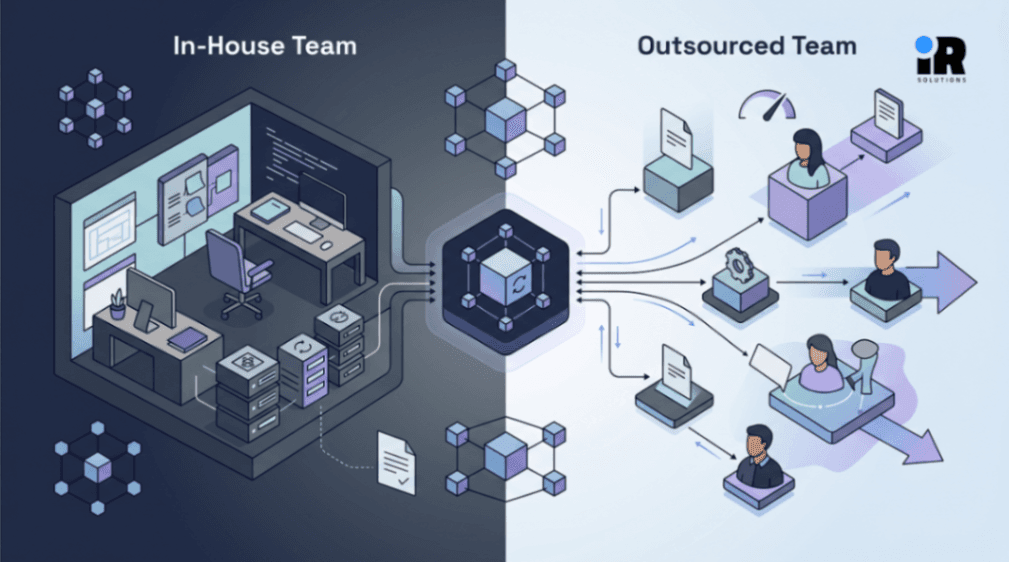
An in-house blockchain team means you hire developers, architects, and security specialists who work for your company full-time on a permanent basis. They sit inside your organization, learn your systems over time, and build their institutional knowledge around your specific product and business model. The appeal is obvious you own the relationship, the knowledge stays inside the company, and you are not dependent on a third-party vendor to make changes to your own infrastructure.
The reality is that building this team takes longer than most businesses expect when they first begin the recruiting process. Senior blockchain developers with real enterprise experience are genuinely hard to find, and they command salaries that reflect how scarce that experience currently is across the market. You are also taking on payroll, benefits, tooling licenses, training budgets, and management overhead well before a single feature reaches production. For companies where blockchain is the core product and the long-term plan involves continuous daily development on it, this investment eventually makes financial sense. For most other businesses at the growth stage, the question is whether the control justifies the cost of getting there and sustaining it.
There is also the knowledge concentration risk that comes with small internal teams. If your lead blockchain architect leaves the company, you are left with a team that may not have the depth to maintain a complex production system without significant external help at a critical moment. This is a common scenario that businesses discover the hard way after investing heavily in internal hiring over a twelve to eighteen-month period.
The Estimated Cost of Building an In-House Blockchain Development Team
The sticker price of an in-house team is the salary line, but that is only part of what you actually spend when you count everything honestly. Here is where the real budget goes when you commit to building internally from scratch.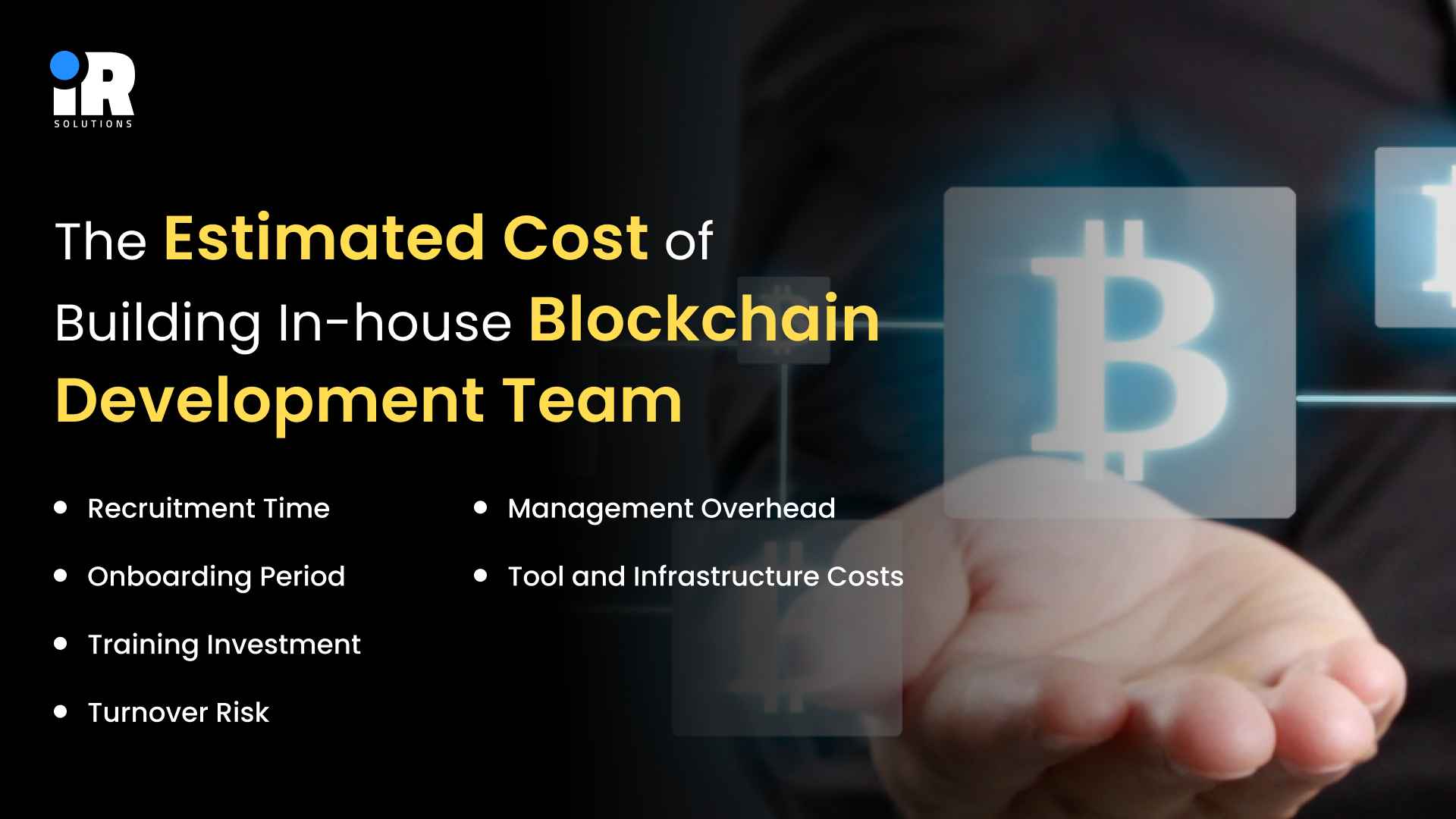
Recruitment Time: Finding senior blockchain engineers typically takes three to six months in the current market. That timeline extends further when you need specialists in a specific protocol or compliance area relevant to your industry vertical.
Onboarding Period: Even experienced hires take two to three months to understand your systems, stack, and business logic well enough to contribute meaningfully to a live project build.
Training Investment: Blockchain technology moves fast, and keeping an internal team current requires a dedicated budget for conferences, certifications, and continued education that compounds every year.
Turnover Risk: Blockchain developers are in high demand across the market, and losing a key hire mid-project can derail a build more severely than a delayed start date would have.
Management Overhead: Running a technical team requires engineering leadership that either already exists in your organization or needs to be hired separately before the development team can work effectively.
Tool and Infrastructure Costs: Developer tooling, staging environments, monitoring systems, and security software all carry recurring costs that sit on top of the personnel budget line.
What Outsourcing a Blockchain Team Actually Looks Like
Outsourcing blockchain development means contracting a blockchain specialized company or development partner to build your system, with varying degrees of ongoing involvement after the initial launch. The model ranges from a fully managed build-and-hand-off arrangement to a long-term partnership where the external team continues to own development, optimization, and maintenance on your behalf indefinitely.
The main advantage is speed, an agency with existing blockchain infrastructure, tooling, and a trained team can start delivering in weeks rather than months. In many cases, businesses looking for outsource blockchain development services choose this path specifically to avoid long hiring cycles and immediately access experienced engineers. They bring experience from previous client projects that most internal hires simply do not have, because they have solved similar technical problems before on different codebases across different industries. Compliance frameworks, security audit processes, and integration patterns are already established you are not paying for the learning curve that comes with building these things from scratch internally over an extended period.
The tradeoff that businesses most often underestimate is knowledge portability. When an outsourced team builds your system, the deepest understanding of how it works lives outside your organization. That is manageable when the relationship is healthy, and communication is consistently strong, but it becomes a real liability when you want to switch partners, bring development in-house later, or respond quickly to a production incident without waiting for a third party to act on your behalf in a time-sensitive situation.
The quality of the documentation produced during development is what determines whether your knowledge portability problem is small or large. Blockcain development copmanines that produce clean, thorough documentation throughout the build leave their clients in a much stronger position than those who treat documentation as something to complete right before project handoff at the very end.
The Most Common Outsourcing Mistakes Businesses Make
Not every outsourcing arrangement delivers what was promised at the proposal stage. These are the situations where the model tends to break down for businesses that did not see the warning signs early enough.
Vendor Dependency: If your development partner is the only team that fully understands the codebase, you are negotiating contract renewals from a weaker position than you realize at the start.
Communication Gaps: Time zone differences, unclear documentation, and inconsistent status updates are more common in outsourced arrangements than most agencies volunteer during the sales process.
Scope Creep Risk: Fixed-price contracts can create incentives for vendors to deliver the minimum viable interpretation of the spec rather than what your business actually needs to operate properly.
IP Ambiguity: Ownership of smart contract code, custom architecture, and proprietary workflows needs to be defined in the contract before work starts, not negotiated after delivery has already happened.
Quality Variance: The team that wins the contract is not always the team that does the work, and talent quality inside agencies varies more than their sales presentations typically suggest to prospective clients.
Poor Handoff: When the engagement ends, many agencies deliver the code without the context that makes it maintainable, which leaves the client technically holding an asset they cannot fully operate on their own.
You can also read What are Resource Augmentation Services, and How Can They Help You Grow? to see how businesses scale teams without long hiring cycles.
In-House vs Outsourced - A Direct Comparison
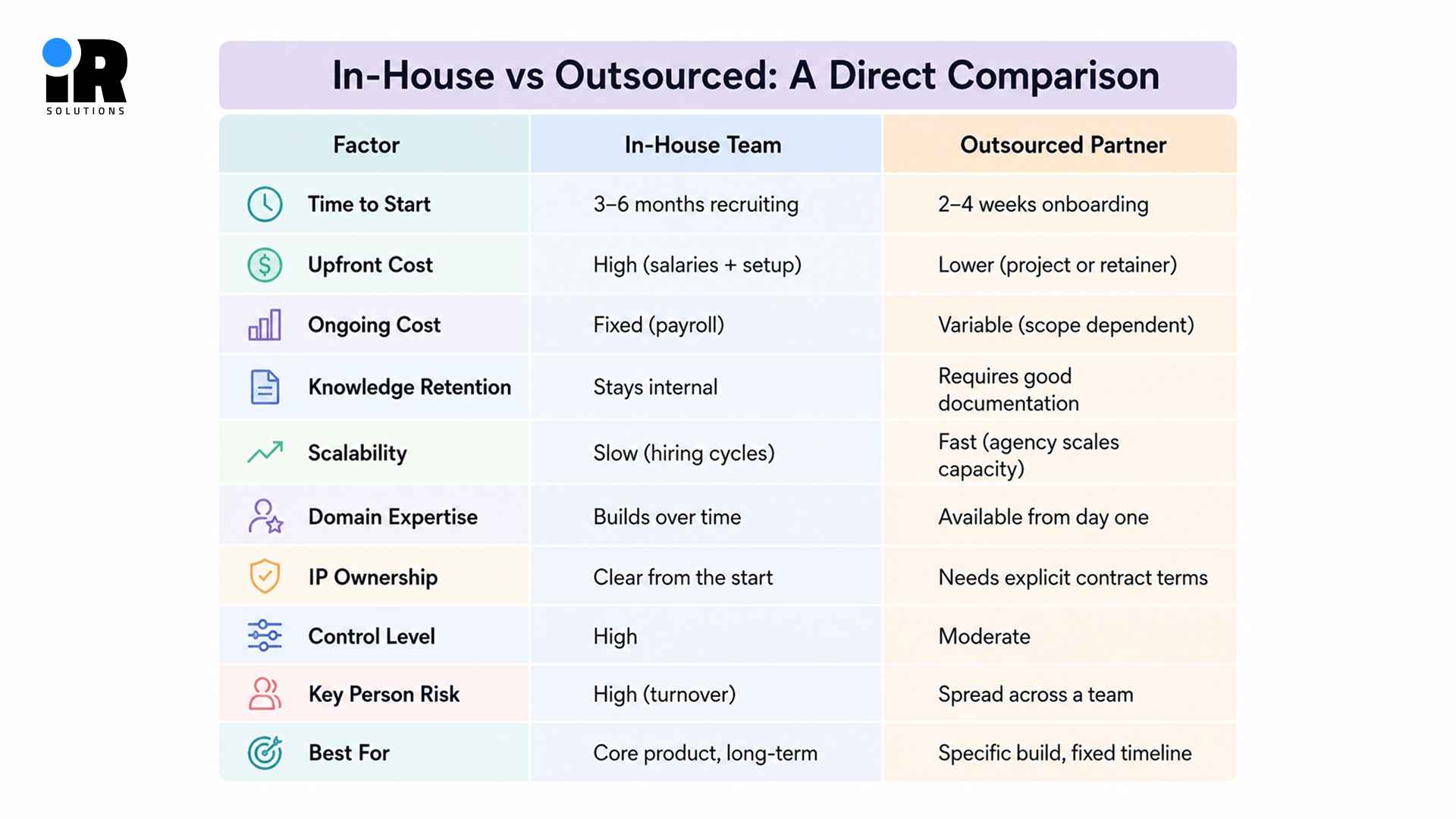
Neither column wins outright across every row for every business type at every stage of growth. The table is a starting point, not a verdict.
When Building In-House Blockchain Team Actually Makes Sense
In-house teams are the right call in specific situations, and pushing a business toward outsourcing when these conditions apply usually creates more problems over time than it solves in the short term.
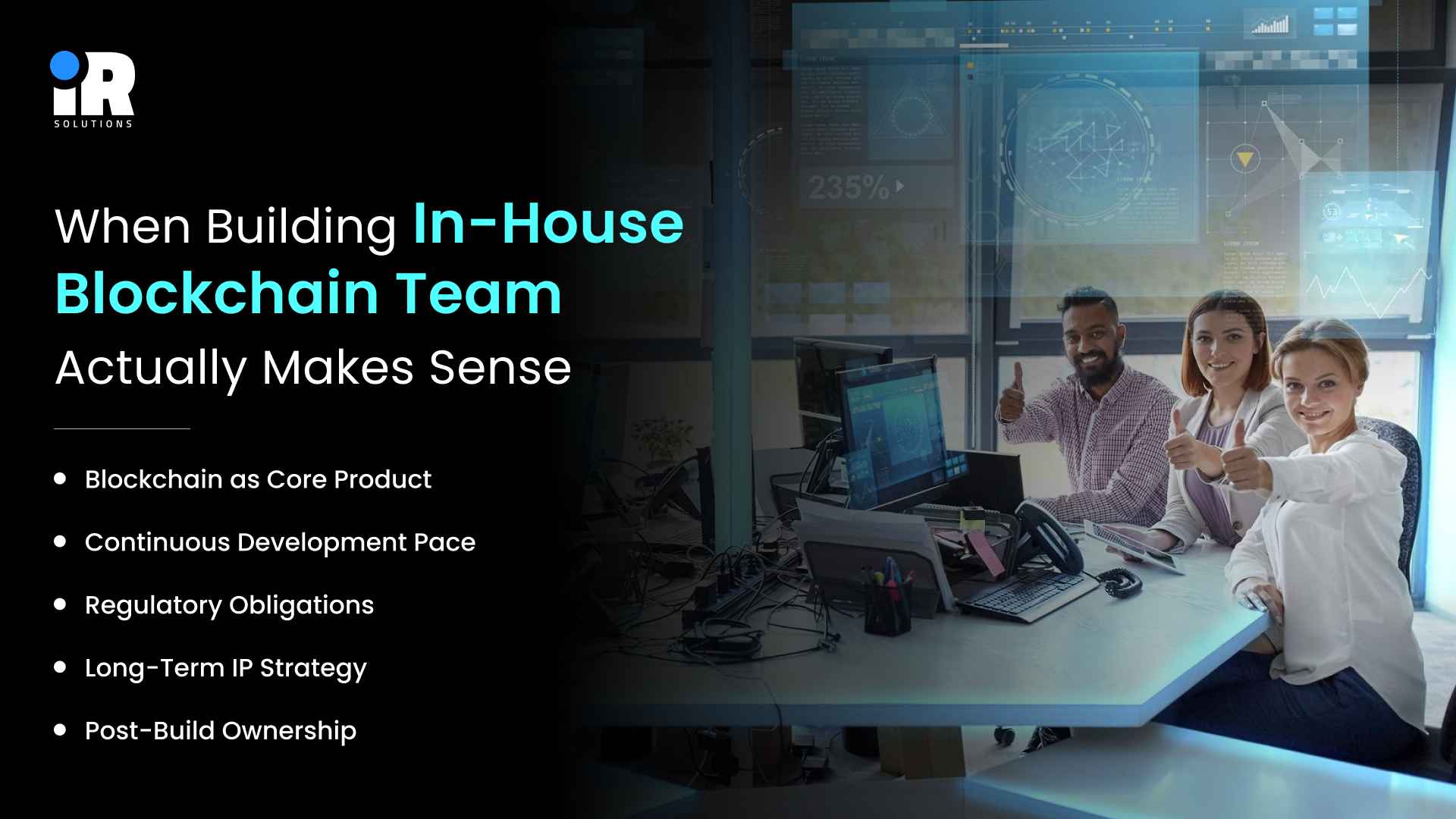
Blockchain as Core Product: If your entire business model runs on a proprietary blockchain network, an internal team is not optional. It is how you protect the thing your company is actually built on.
Continuous Development Pace: Products that require daily or weekly changes to smart contracts and infrastructure need a team that can move without briefing an external partner on every iteration of a fast-moving build.
Regulatory Obligations: Some regulated industries require that people with access to production systems be direct employees of the organization, which makes outsourcing arrangements legally complicated from the outset.
Long-Term IP Strategy: If proprietary blockchain architecture is a competitive advantage your business plans to protect or license, keeping that knowledge entirely internal is a sensible long-term defensive move.
Post-Build Ownership: Many companies outsource the initial build and then hire internally to take over maintenance and iteration once the system is live and the architecture is clearly established and documented.
When Outsourcing a Blockchain Developer Is the Smarter Business Decision
Most early-stage and mid-market businesses get more value from outsourcing their blockchain development than they initially assume when they start comparing options side by side. The conditions that favor outsourcing are more common than the conditions that favor building internally, especially at the stage where most companies are actually making this decision in practice.
Speed matters most when you are validating a product concept or trying to hit a market window before a competitor gets there first. An outsourced blockchain developer with existing blockchain infrastructure can compress your timeline from a full year of recruiting and building to three to five months of focused development with a team that has done this before on similar projects. That timeline difference is often the margin between capturing a market opportunity and watching someone else take it while you are still interviewing candidates.
Budget constraints also favor outsourcing for most businesses below a certain revenue threshold. Paying for a full internal team on a salary basis before any revenue flows from the blockchain product is a risk that many companies cannot absorb without burning through most of their available runway. A project-based outsourcing arrangement can deliver the same output at a fraction of the all-in cost over the first twelve months of development.
The path that works best for most growing businesses is to outsource the initial architecture and build, invest in documentation and knowledge transfer throughout the project, and then either extend the partnership or hire internally once the system is generating enough revenue to justify the fixed cost of a permanent internal team.
The Questions Worth Asking Before You Decide
Before committing to either direction, these are the questions that tend to surface the real answer, the one that was sitting underneath the surface of the debate all along.
- How quickly do you need this built, and does your runway support the recruiting timeline that in-house hiring actually requires in the current market for this kind of talent?
- Have you counted the full in-house cost, including recruitment, onboarding, tooling, and turnover risk, or just the headline salary numbers you found on a tech job board?
- Is blockchain the product your company sells, or is it infrastructure that supports a product built around something else entirely and would still function with a different tech stack?
- Who owns the system after launch, and does your plan for that period match the team structure you are choosing right now, before development even begins?
- If you outsource, what level of documentation and knowledge transfer is written contractually into the engagement so you are not stuck with that vendor indefinitely?
- What happens to the codebase, the architecture documentation, and the deployment infrastructure if the relationship ends earlier than either party planned for?
Working through these questions with an experienced advisor before signing anything saves most businesses from structural decisions they regret six months into a build. Book a free consultation with our team and walk through your specific situation before committing to a model that takes months to reverse.
Conclusion
The in-house versus outsourced decision is not universal it depends on where your business is, what you are building, and how fast you need to move. Most companies at the early and mid-market stage get more value from a well-run outsourcing arrangement than from spending six months recruiting before writing a line of code. The ones that regret outsourcing usually picked the wrong partner, not the wrong model. IR Solutions provides end-to-end blockchain development for businesses that want an outsourced partner operating with the transparency and accountability of an internal team. We handle architecture, smart contracts, integrations, security audits, and ongoing maintenance with documentation and knowledge transfer built into every engagement from the first day of work through final delivery.
Frequently Asked Questions
Is in-house blockchain development always more expensive?
Over the first twelve months, yes, recruiting, onboarding, and full-time salaries cost more than a comparable outsourced project. The cost equation flips in year two or three if development is continuous and the team is stable.
How long does outsourced blockchain development take?
A scoped project with a specialist agency typically starts within two to four weeks. Full delivery timelines range from three months for a basic MVP to twelve months for a complex enterprise platform with compliance requirements.
What happens to my code if I switch vendors?
That depends entirely on what your contract says before work starts. Always insist on full IP ownership, thorough documentation, and a clear offboarding clause before signing any outsourced development agreement.
Can I outsource now and hire in-house later?
Yes, and this is actually the most common growth path for scaling businesses. Outsource the initial build, then hire internally to take over maintenance once the system generates consistent enough revenue to justify the overhead.
How do I protect IP with an outsourced team?
Require a clear IP assignment clause in the contract and ensure all custom code, smart contracts, and architecture documentation are transferred to you at defined milestones throughout the engagement.
What minimum team size works for in-house blockchain?
At a minimum, you need a blockchain architect, a smart contract developer, and a security specialist. That is three senior hires before you have a team capable of running a production system without external support.
Is outsourcing suitable for regulated industries?
Yes, with the right partner. We have built compliant blockchain systems for finance and healthcare clients where regulatory requirements govern data handling, access controls, and audit trail standards throughout the entire project.