




Pick the wrong automation strategy, and you will spend money building something that slows you down. Businesses waste months on systems that cannot handle growth, break when processes change, or produce results nobody trusts. The divide between traditional automation and AI automation is not just technical, it changes what your business can actually do at scale.
Getting this decision right is one of the more practical things a growing company can sort out early. This blog walks through what each approach actually does, where each one earns its place, and what a smart strategy looks like when you put both together. AI and ML development services that are built around real business workflows make that transition far smoother than most teams expect.
What Is Traditional Automation and How Does It Work?
Traditional automation runs on rules that a developer writes in advance. Someone defines a trigger, maps a response, and the system repeats that exact sequence every time it runs. Nothing about the output changes unless a developer goes back in and changes the rule. There is no judgment happening, no adaptation, and no awareness of anything outside the defined parameters. If the input falls outside what the rules expect, the system produces the wrong result or stops working entirely.
This has been the backbone of business operations since enterprise software first showed up. Payroll processing, scheduled email sends, batch data transfers, invoice generation: all of it runs on this model. For a long time, that was enough. Workflows were stable, data was structured, and the same inputs reliably produced the same outputs week after week.
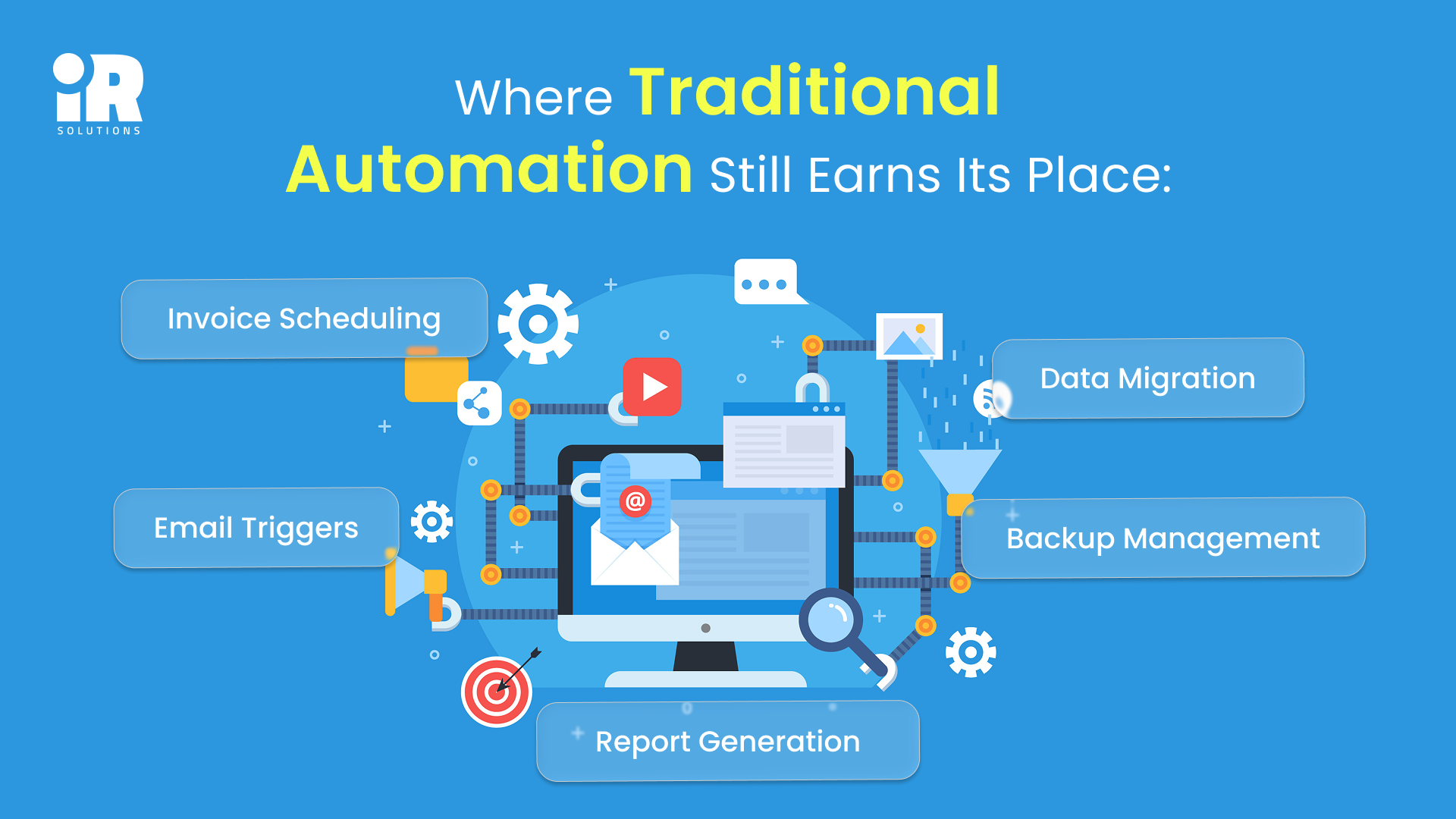
- Invoice Scheduling: Generating and sending invoices on a fixed billing cycle without any manual input.
- Data Migration: Moving structured records from one system to another on a defined schedule.
- Email Triggers: Sending confirmation or follow-up messages when a user completes a defined action.
- Report Generation: Pulling a fixed data set weekly and formatting it into a standard business report.
- Backup Management: Running scheduled backups of files and databases at set overnight intervals automatically.
The honest strength of this approach is that it is predictable and cheap to run. If a process never changes, a rule-based system handles it without drama. Auditing is clean because every decision traces back to a written rule. Maintenance stays manageable as long as the underlying workflow does not shift.
The trouble starts when the business grows with new product lines, new markets, and shifting customer behaviour any of these forces changes the workflow, and every change means someone has to update the rules manually. That work piles up faster than most teams expect.
What Is AI Automation and Why Is It Different
AI automation does not wait for a matching rule, it reads incoming data, finds patterns, and decides what to do based on what it has learned from past examples. That sounds simple, but the practical difference is significant. A customer complaint that comes in as a free-form email does not fit neatly into a trigger-response structure. It has tone, context, prior history, and sometimes ambiguity. A rule-based system either ignores it or misroutes it. An AI system reads the intent, checks relevant context, and either resolves it or routes it correctly to the right person.
Businesses building these systems often work with an AI agent developer to handle the complexity of connecting models to live business workflows. The same logic applies across dozens of business workflows: document processing, demand forecasting, fraud detection, lead scoring, inventory management. Anywhere the inputs vary, AI automation handles it better than a fixed rule ever could. It runs on machine learning models, natural language processing, and computer vision. These technologies let it work with data that has no consistent structure: written documents, spoken audio, scanned forms, images, and behavioural signals from users.
What separates AI automation from traditional rule-based systems:
- Learns Continuously: The model improves with every new interaction and data point it processes over time.
- Handles Exceptions: It manages edge cases that would cause a rule-based system to break or stall completely.
- Reads Unstructured Data: It interprets natural language, scanned documents, images, and spoken input without manual formatting.
- Adjusts Its Outputs: Predictions and decisions shift as new data comes in, with no reprogramming required at all.
- Finds Hidden Patterns: It spots correlations across large data sets that no manual process would catch reliably.
For businesses where variability is the norm rather than the exception, this matters a lot. A system that adjusts is worth considerably more than one that breaks and waits for a developer.
To understand the practical outcomes of AI automation in business, read How Businesses Use AI Automation to Reduce Costs and Increase Efficiency.
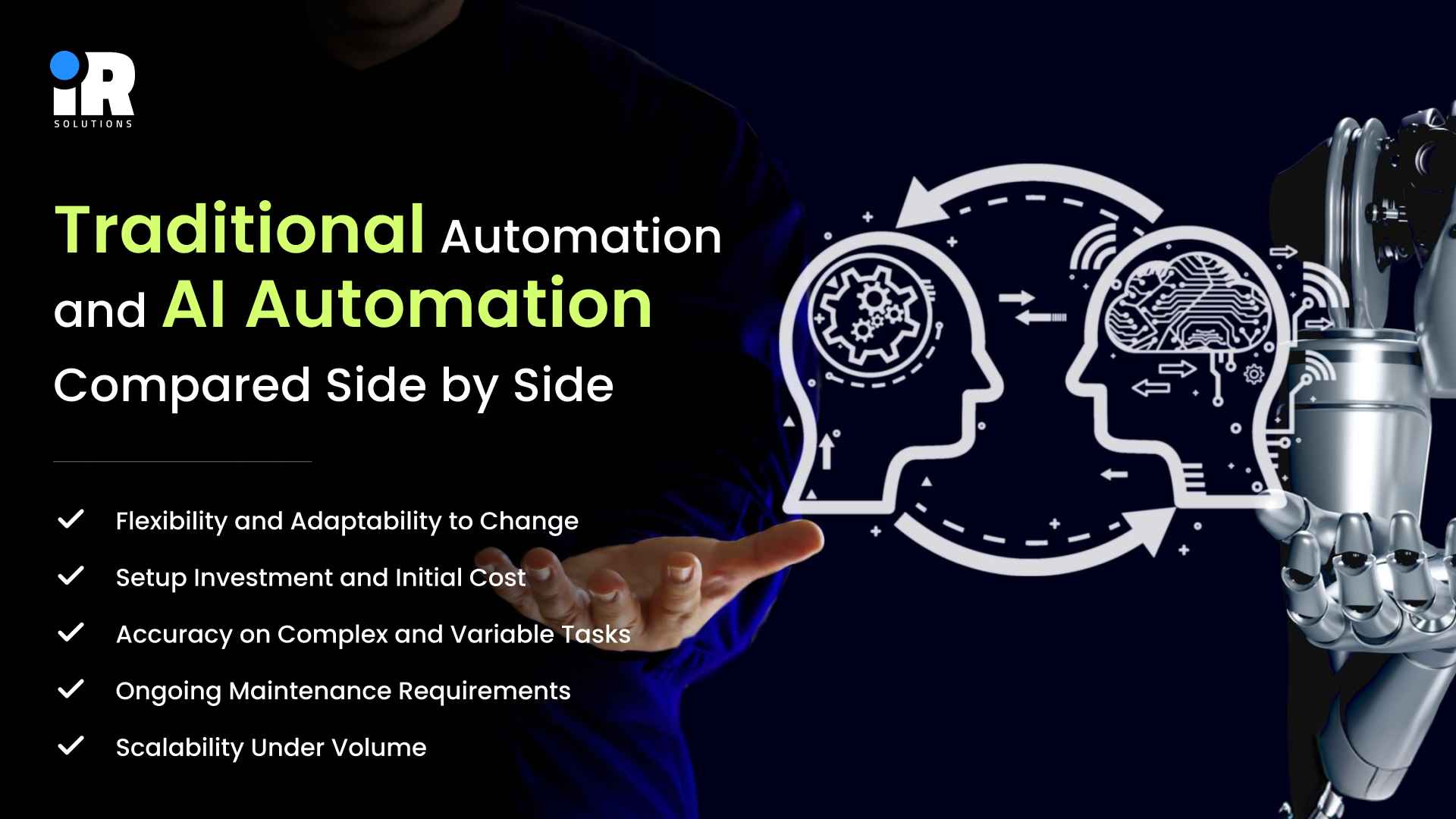
Traditional Automation and AI Automation Compared Side by Side
These two approaches look similar on the surface but perform very differently in practice.
Flexibility and Adaptability to Change
Traditional automation requires a developer every time a process changes. Add a product type, update a pricing structure, change an approval step each one means manual rule updates across every affected workflow.
AI automation handles change through retraining, adding new examples, update the training data, and the system adjusts its outputs without anyone rewriting core logic. For businesses that operate in fast-moving markets, that difference shows up in how quickly they can respond to changes without accumulating technical debt.
Setup Investment and Initial Cost
Traditional automation costs less to set up and gets into production faster. The logic is straightforward to define, the tooling is well-established, and a developer can have a basic workflow running within days.
AI automation takes longer and costs more upfront, clean training data, model architecture decisions, validation testing, and integration work all add time and cost before the first workflow goes live. That investment starts returning value faster than most teams expect once the system is processing real volume, but the initial bar is higher.
Accuracy on Complex and Variable Tasks
Both approaches work accurately when the inputs are consistent and structured. The difference shows up with messy data. Scanned documents with inconsistent formatting, emails written in varying tones and languages, voice recordings from different speakers, traditional automation fails on these reliably.
AI automation was specifically built to handle this, it does not need clean formatting to produce a correct output. It reads intent rather than structure, and accuracy improves as it processes more examples from your actual business data.
Ongoing Maintenance Requirements
Traditional automation accumulates maintenance debt as the business grows. Every rule change, workflow addition, and exception case requires developer time to update. For a small operation with stable processes, this is manageable. For a growing business, it becomes a bottleneck.
AI automation requires periodic retraining and performance monitoring rather than rule updates. Data distributions shift over time, and models need refreshing to stay accurate. That work happens on a maintenance schedule rather than in response to every workflow change, which is generally less disruptive to the team.
Scalability Under Volume
Traditional automation scales in a straight line double the volume, and you roughly double the infrastructure and maintenance effort.
AI automation scales differently, as a trained model handles ten thousand transactions with roughly the same operational cost as ten. Once the model is in production and stable, scaling is mostly an infrastructure question rather than a development one.
When Traditional Automation Is Still the Right Call
Not every business process needs intelligence, some need consistency, a clean audit trail, and low operational overhead far more than adaptability.
- The task runs identically every time with zero variation in input, output, or process steps.
- Compliance requirements demand a fully traceable decision trail that links every output to a written rule.
- The AI development budget cannot be justified by the complexity or value of the workflow involved.
- Payroll, database maintenance, form routing, and fixed-cycle reporting gain nothing useful from AI.
- The workflow needs no judgment or pattern recognition, so adding AI only adds unnecessary cost.
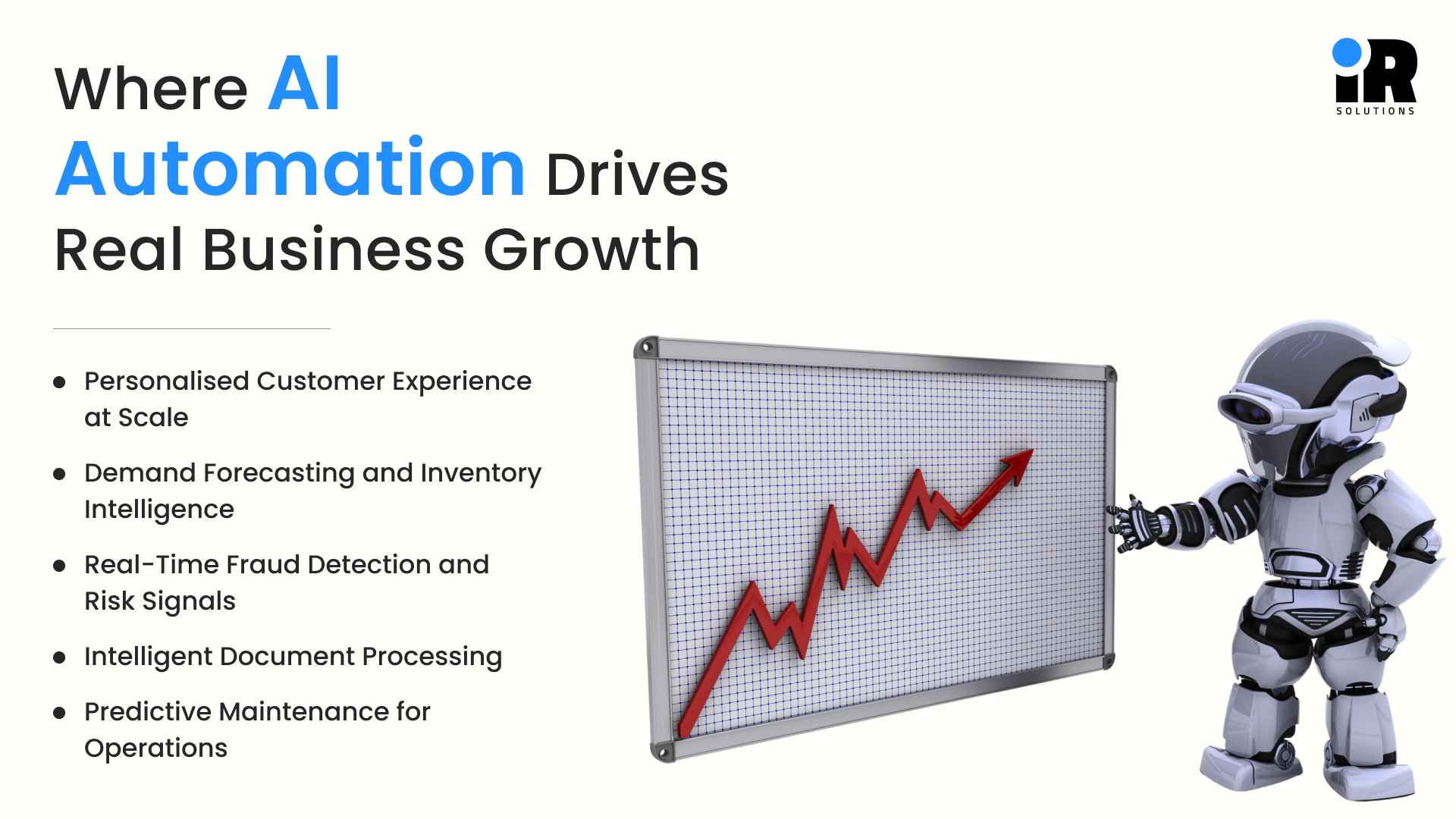
Where AI Automation Drives Real Business Growth
The workflows where AI automation earns its cost are the ones where data is messy, inputs vary, and the right decision shifts depending on context.
Personalised Customer Experience at Scale
AI-powered systems handle customer interactions with a level of personalisation that rule-based systems cannot produce. Every customer gets a response shaped by their specific context: purchase history, past interactions, stated preferences, and the content of their current message.
That matters because customers who receive relevant responses stay longer, buy more often, and require fewer repeat contacts. Traditional automation can send a transactional email. AI automation can predict what the customer needs before they ask for it and surface it at the right moment. Many businesses implement this through a chatbot developer who builds conversational systems trained on real customer data.
Demand Forecasting and Inventory Intelligence
Retailers, logistics companies, and manufacturers generate more sales and inventory data than any team can manually analyse. AI automation reads that data, detects seasonal shifts and purchasing patterns, and produces forecasts that update in real time as conditions change.
The practical difference is lead time, traditional reporting tells you what happened last month. AI forecasting tells you what is likely to happen next month with enough time to adjust procurement, staffing, and pricing before the situation develops. If you are running an e-commerce operation, the connection between demand forecasting and inventory management is directly relevant.
Real-Time Fraud Detection and Risk Signals
Fraud patterns evolve quickly and deliberately, a static rule set that catches today's fraud patterns will miss next month's because bad actors specifically learn to route around known detection logic.
AI models trained on transaction data catch anomalies in real time by reading combinations of signals rather than individual rule violations. They update their understanding as new patterns emerge without waiting for a developer to add a new rule. For any business handling high transaction volumes, this is one of the clearest ROI cases for AI automation. If your business operates in financial services, the connection to payments and risk is direct.
Intelligent Document Processing
Legal teams, healthcare operations, insurers, and financial institutions process thousands of documents weekly. Contracts, patient intake forms, loan applications, and compliance filings all contain critical information buried in unstructured text.
AI automation extracts the relevant data, classifies it correctly, and routes it to the right destination without manual review. A contract gets scanned, and the key dates, parties, and obligations are pulled out and filed correctly. A loan application is processed, and missing information is flagged before a human reviewer ever opens the file. The time savings are significant. So is the reduction in errors that accumulates in any high-volume manual document workflow over time.
Predictive Maintenance for Operations
Manufacturing plants, logistics networks, and connected facilities produce continuous streams of operational data. Traditional systems send an alert after a threshold is crossed. AI systems read the pattern of data leading up to a threshold and predict a failure 24 or 48 hours before it happens.
That shift from reactive to predictive changes the economics of maintenance significantly. Unplanned downtime is far more expensive than scheduled maintenance, and AI automation makes scheduled maintenance possible for equipment that previously failed without warning.
The Hybrid Approach - Running Both Together Effectively
The most practical approach for most businesses is not choosing between the two, but using both where they fit best. Traditional automation handles structured, rule-based tasks, while AI manages dynamic decision-making and optimisation. Together, they complement each other without overlap or conflict.
- Layer One (Rules) handles all structured, deterministic tasks that follow a fixed and auditable path.
- Layer Two (AI) handles data interpretation, pattern recognition, and decisions where inputs vary each time.
- Layer Three (Integration) both layers share data through APIs and pipelines that keep them in sync.
Designing this hybrid setup from the start is critical, as adding AI later to rigid rule-based systems often leads to fragile, unreliable integrations.
Teams that plan for both early and hire dedicated developers with systems integration experience can build cleaner, scalable systems with less technical debt.
Choosing the Right Partner to Build and Scale Automation
Knowing which workflows need which type of automation is the start. Actually building it well requires a team that understands both the technical side and the business context it operates in.
The technical work covers model selection, data pipeline design, API integration, infrastructure configuration, and ongoing performance monitoring. The business side covers workflow mapping, exception handling, compliance requirements, and making sure the teams who use the system daily can actually work with what gets built.
Bringing in a development partner with real experience in AI systems and automation architecture cuts through a lot of the trial and error that slows internal teams down. AI and ML development services tailored to a specific use case produce better outcomes than generic platforms that ask your workflows to conform to their structure.
When the priority is scaling a team rather than building from scratch, hiring AI and ML developers on demand fills the gap quickly. Vetted developers with automation experience can be placed and contributing within 48 hours, which is relevant when project timelines are already set.
Book a strategy call to review your workflows and identify the right automation approach for your stage of growth.
We cover this in more detail in AI for Business in 2026: Use Cases, Automation, Tools & Implementation Guide.
Conclusion
Automation done right is not about picking the newest technology. It is about understanding which approach fits each part of your operation and building around that clarity. Traditional automation keeps predictable processes running cleanly and cost-effectively, while AI automation handles the areas where judgment, pattern recognition, and adaptability create real business value.
The businesses that grow consistently are not the ones chasing tools, but the ones using both approaches deliberately and with purpose. Getting the strategy right before the first line of code is written changes everything that follows.
When you are ready to move from strategy to execution, working with experts who have implemented these systems across fintech, healthcare, logistics, and e-commerce can help ensure the foundation is built right from the start and avoid costly rebuilds later.
Frequently Asked Questions
Can small businesses benefit from AI automation right now?
Yes, particularly for customer service, lead qualification, and data-heavy workflows with variable or unpredictable inputs.
Do I need to replace existing automation systems to add AI?
No, most businesses run a hybrid setup where both types operate alongside each other without conflict or rebuilding.
Which industries see the strongest results from AI automation?
Fintech, healthcare, logistics, e-commerce, and real estate consistently report the most measurable operational impact.
How long does a typical AI automation project take to complete?
A focused implementation for a single workflow usually runs eight to sixteen weeks from initial audit to full deployment.
What data is required before starting an AI automation project?
Clean, structured historical data directly tied to the workflow being automated is the minimum baseline requirement.
How does AI automation improve customer-facing business operations?
It personalises responses, cuts resolution time, and handles edge cases that rule-based systems cannot address at all.
What is the biggest risk of picking the wrong automation approach?
Systems that break under growth pressure, wasted development budget, and operational gaps that competitors quietly exploit.
How do I figure out which automation type fits my business?
A structured workflow audit with an experienced technical team produces a clear map for each process and decision.