


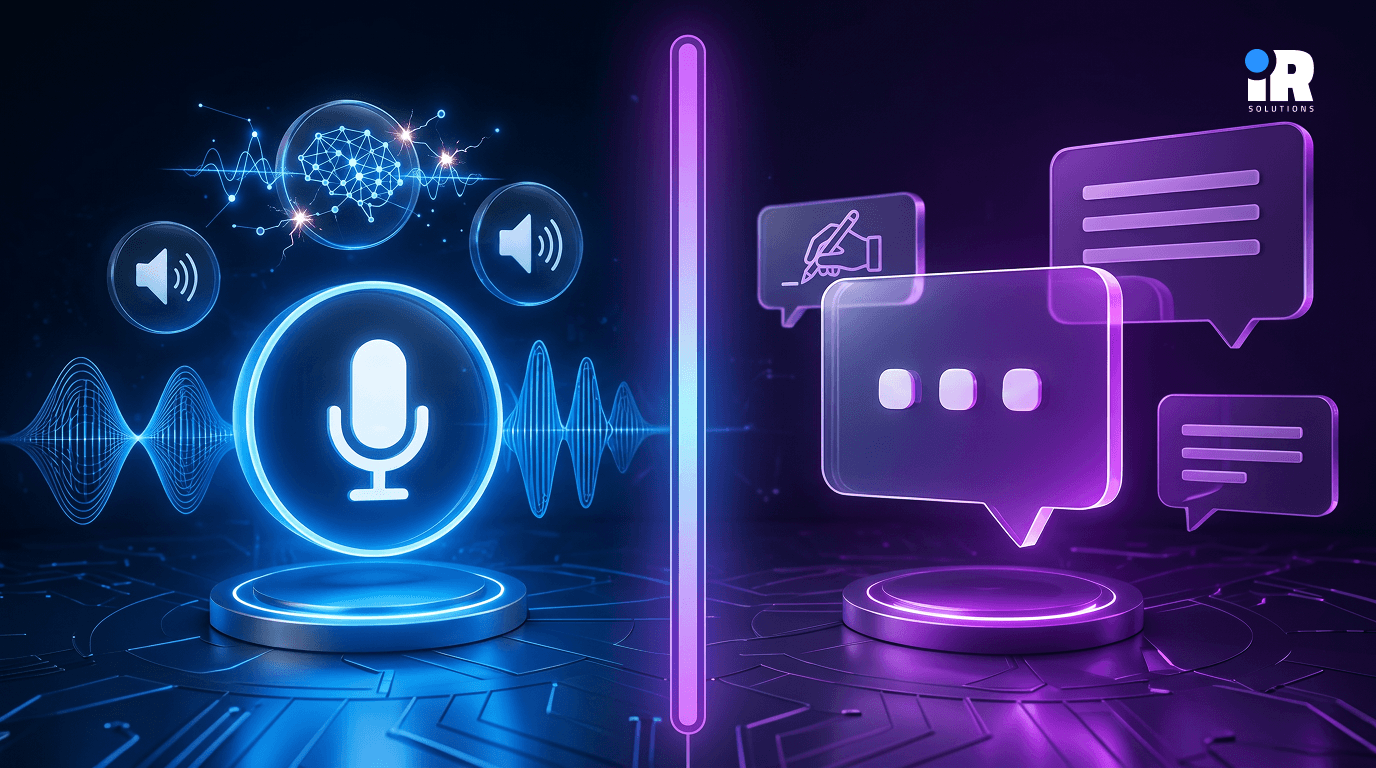

Every customer wants a fast answer, but not every customer wants it the same way. Some would rather explain a problem over the phone, while others expect to resolve it through a quick message without ever speaking to anyone. Businesses that treat voice and text as interchangeable often end up with frustrated customers, longer response times, and AI tools that never deliver the expected return. The real question isn't whether you should use AI, it's whether voice AI, text-based AI, or a combination of both fits the way your customers naturally communicate. The differences, strengths, implementation requirements, and real-world business use cases outlined here help you choose the best solution for your business goals.
What Are Voice AI and Text-Based AI Assistants?
Most people have used both without ever thinking about the difference. It matters once you're the one paying for it.
Voice AI Defined
Voice AI takes spoken words, turns them into data, figures out what the caller wants, and answers back in synthesized speech. It runs inside phone systems, IVR setups, smart speakers, and voice apps. No live agent is required for most of the conversation.
- Real-time speech: Replies to spoken questions in under two seconds on a decent setup.
- Phone integration: Connects to call center systems you likely already use.
- Voice biometrics: Identifies callers by voice for an extra layer of security.
Text-Based AI Defined
Text-based AI is the kind that works entirely through written words you type a message in a chat window, a messaging app, or an email, and it writes something back. This is basically what comes to mind for most people when they hear the word "chatbot," even though the better tools today go well beyond just spitting out canned responses.
- Chat platforms: Work across WhatsApp, Slack, website chat, and SMS.
- Email automation: Sorts and answers support emails without a human reading every one.
- Knowledge base: Pulls answers straight from your internal docs as needed.
If you're deciding how AI chatbots fit into your business strategy, Custom AI Chatbot Development Guide for Business Growth covers planning, implementation, and long-term success in greater detail.
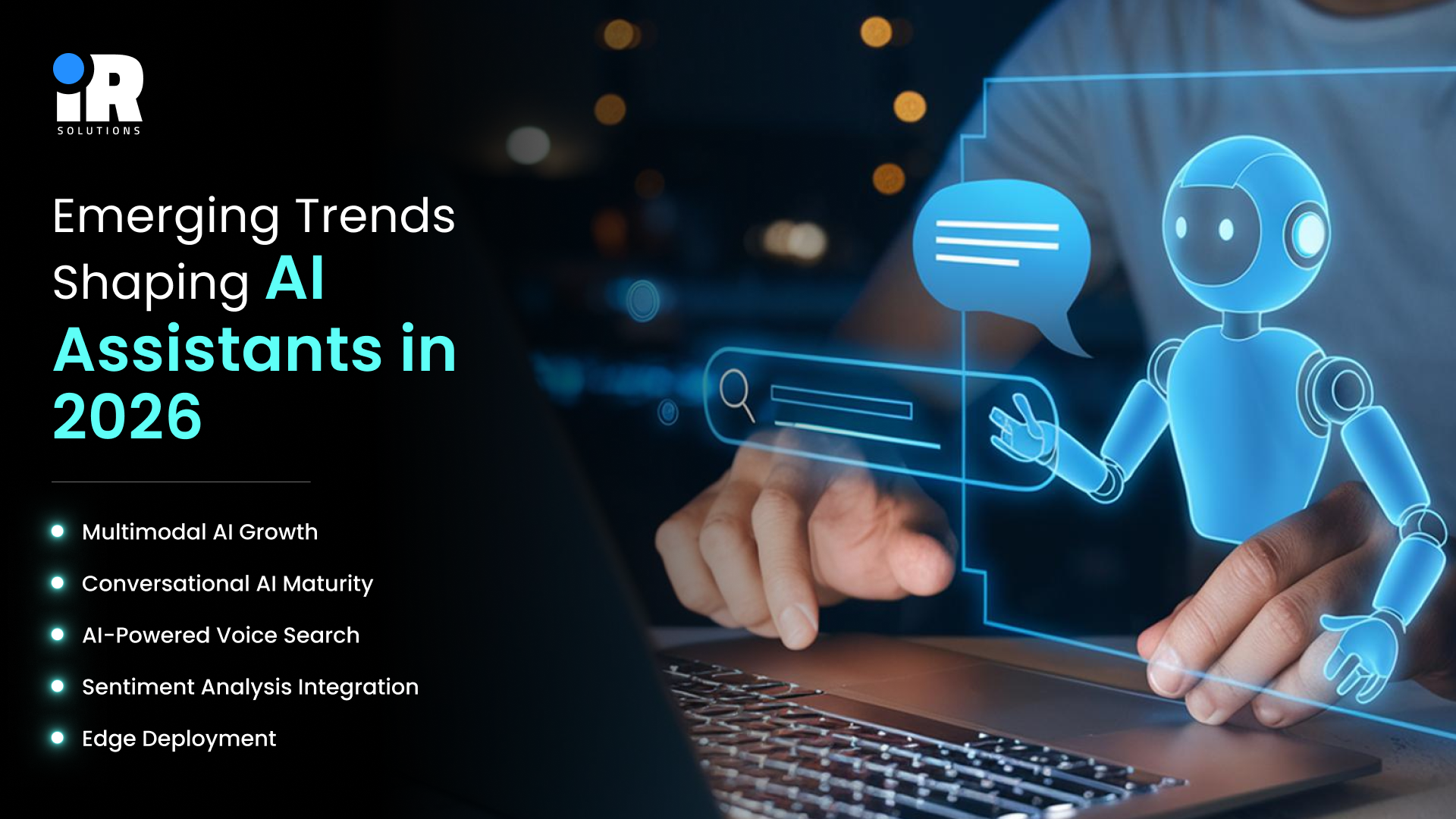
Emerging Trends Shaping AI Assistants in 2026
This space has shifted more in the past two years than in the decade before it. A few trends actually matter if you're making a buying decision right now.
Multimodal AI Growth
Customers no longer stay in one channel, someone might start a website chat, then call to finish the conversation, and a good system carries the context across both. Companies still running separate, disconnected voice and text tools are starting to feel that gap.
Conversational AI Maturity
Older chatbots fell apart the moment a question didn't match the script. That's mostly behind us now. Current models handle interruptions, follow-ups, and topic changes without losing the thread, which is the difference between a useful assistant and an annoying one.
AI-Powered Voice Search
A growing share of search traffic now comes through voice, especially on mobile. Businesses that haven't adjusted their content for conversational, question-style queries are quietly losing visibility. Voice AI and voice search optimization tend to reinforce each other when built around the same intent data.
Sentiment Analysis Integration
Voice AI can now pick up frustration in someone's tone, not just the words they're using. Text AI does something similar by reading phrasing and word choice. Both feed that signal into your CRM, which means your team can catch a problem before it shows up as a cancellation.
Edge Deployment
Cloud processing works fine until latency becomes an issue or a compliance team starts asking where the data actually lives. Edge deployment moves processing closer to the device. For voice AI specifically, that means faster replies and tighter control over sensitive call recordings.
Talk to us if you want help figuring out which fits your business.
User Preferences - What Customers Actually Want
None of this matters if customers won't use it, preference patterns are fairly consistent once you understand who you're serving.
When Customers Prefer Voice AI
- Older customers who are comfortable on the phone but not in a chat window.
- Anything urgent, where typing feels slower than just saying the problem out loud.
- Accessibility needs that make typing difficult.
- Sensitive topics, billing disputes, and medical concerns where people want a real conversation, not a text exchange.
When Customers Prefer Text-Based AI
- Public or quiet settings where talking out loud isn't an option.
- Anything where having a written record matters later.
- Technical issues involving screenshots, order numbers, or long reference codes.
- Younger customers default to messaging for nearly everything.
The Hybrid Reality
Almost no business can cover its full customer base with a single channel. A property manager might rely on voice AI for late-night maintenance calls and text AI for lease questions during the day. A clinic might use text AI for booking and voice AI for follow-up calls after a visit. IR Solutions builds hybrid setups around how your customers actually reach out, instead of forcing them into one channel because it was easier to build.
Personalization Expectations
Nothing annoys a customer faster than repeating information they already gave last week. People now expect the AI to remember, pull up account history, and adjust tone based on context. That kind of personalization needs real CRM integration, it's not something most off-the-shelf tools handle out of the box.
Companies serving customers worldwide need AI solutions built for multiple languages, time zones, and regulations. Learn how custom AI chatbot development for global businesses helps organizations scale confidently across international markets.
Implementation Effort: Voice AI vs Text-Based AI
Beyond the technology itself, what matters most is how much work it takes to actually stand each one up and keep it running well.
Getting Voice AI Off the Ground
Voice AI takes more lifting upfront. You're dealing with telephony infrastructure, a speech recognition layer, and call flows that need to be mapped out carefully before anything goes live. Custom voice personas and detailed intent mapping stretch the timeline further, especially if your phone system needs upgrading first.
Getting Text AI Off the Ground
Text AI is usually the quicker build, most platforms plug into a website or messaging app with far less infrastructure work, which is part of why so many businesses use them as their first real AI deployment. The simpler the use case, the faster it gets to production. Businesses looking to accelerate deployment often choose to hire an AI chatbot developer who can build, integrate, and optimize conversational AI without lengthy in-house development.
What Keeps Each One Running Well
Voice AI:
- Needs regular updates to call flows as customer questions and business needs shift.
- Audio quality and accent handling require ongoing attention, especially across diverse customer bases.
- Call volume spikes can strain a system that wasn't built with scale in mind.
Text-Based AI:
- Conversation flows need periodic review so the bot doesn't loop customers in circles.
- Knowledge base connections have to stay current, or answers start drifting out of date.
- Message volume can scale fairly smoothly if the underlying architecture was built for it.
Where Businesses Tend to Get Tripped Up
- Training data: Both types need solid, well-structured data behind them. Messy data produces messy answers, no matter how polished the platform looks.
- Integration work: Connecting AI to your CRM or ticketing system almost always takes longer than the initial project plan assumes.
- Ongoing tuning: Customer language shifts, products change, policies get updated. Systems that don't get touched regularly start drifting out of accuracy.
Technical Requirements: What Your Business Needs to Prepare
Buying the platform is the easy part, being ready to actually run it is where most projects either succeed or quietly stall out.
Infrastructure for Voice AI
- Telephony setup: Voice AI plugs into your phone system through SIP trunks or cloud telephony.
- Audio quality: Background noise and poor compression both hurt transcription accuracy and call reliability.
- Latency requirements: People notice delays past roughly 300 milliseconds, so responses need to feel instant.
- Compliance setup: Recording voice data triggers GDPR, HIPAA, or sector-specific rules depending on your industry.
Infrastructure for Text-Based AI
- CRM connections: A chatbot with no customer data access can only answer the basics reliably.
- API integrations: Booking tools, payment gateways, and shipping trackers all need API work to function.
- Conversation design: A poorly mapped conversation sends customers in circles, asking the same question repeatedly.
- Scalability: A setup handling 200 chats a day won't survive 20,000 without real infrastructure.
What Both Types Share
- Clean, structured data for training and ongoing tuning.
- Regular QA checks as customer language shifts.
- Clear handoff paths to a human when the AI hits a wall.
- Solid security: encryption, access controls, audit logs.
Maintaining high-performing AI systems also requires experienced machine learning expertise, which is why many businesses hire AI developers to improve model accuracy and long-term performance.
Business Applications Where Each Type Wins
Both types are flexible, but each one clearly outperforms the other in specific situations.
How Businesses Use Voice AI in Daily Operations
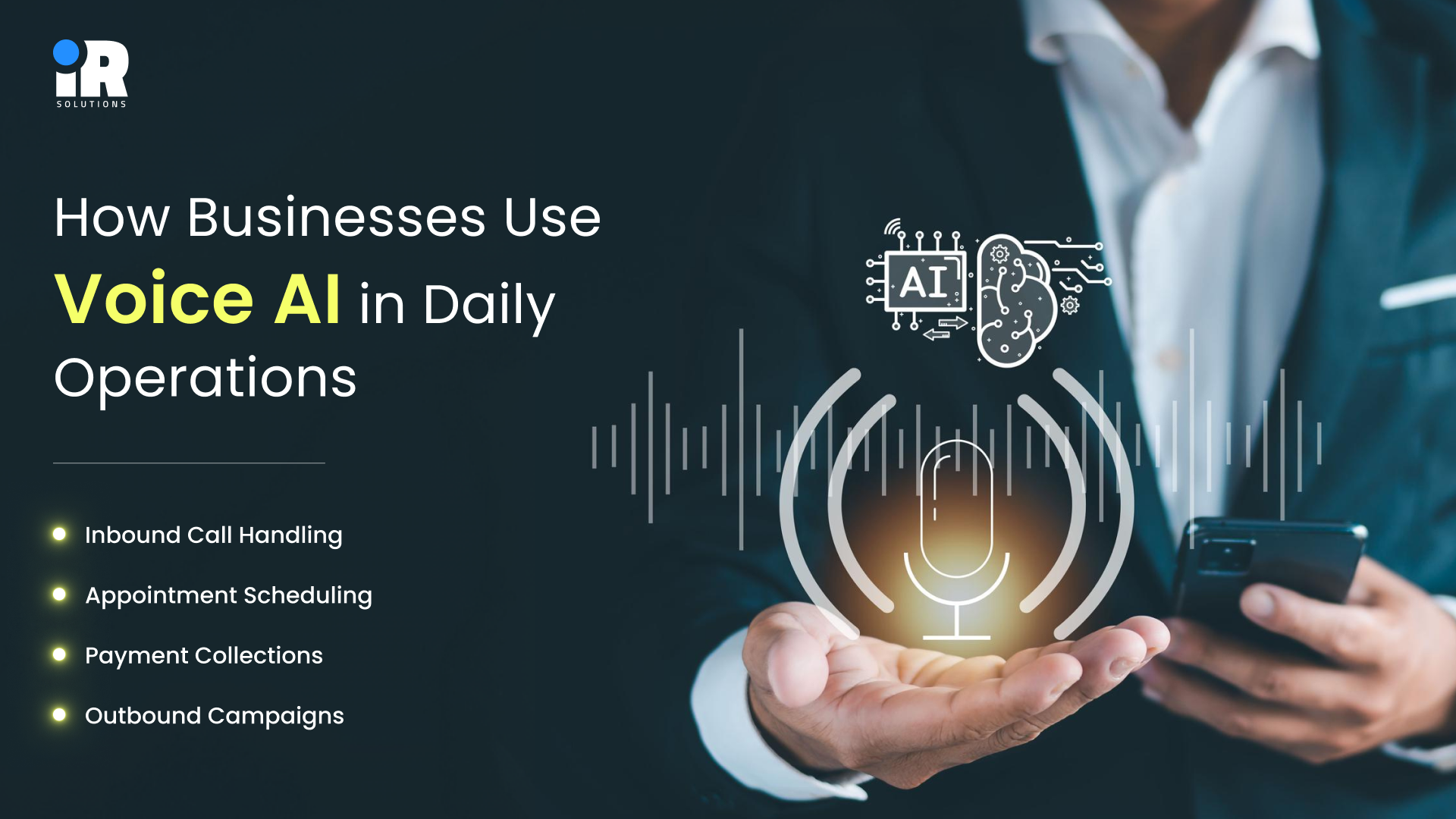
Inbound Call Handling
Voice AI picks up, figures out the intent within seconds, and either resolves the issue or routes the caller to the right agent with context already attached. Handle times drop, and hold queues shrink during busy periods.
Appointment Scheduling
Clinics, law offices, and service businesses use voice AI to book, confirm, and reschedule appointments around the clock, no receptionist needed, and no double-bookings when it's tied directly into the calendar.
Payment Collections
Voice AI sends payment reminders and processes phone payments inside PCI-compliant setups, confirming transaction details without sending the customer off to log into a separate portal.
Outbound Campaigns
Lead qualification calls, satisfaction surveys, and renewal reminders voice AI runs these at a volume no human team could match, transferring warm leads to a live agent the moment one shows interest.
Top Text-Based AI Business Use Cases for Businesses
Website Chat Support
Text AI on your site fields product questions, nudges visitors toward a purchase, and captures lead info at 2 AM without pulling a sales rep off an active deal.
Internal Help Desks
IT and HR teams use text AI to handle the repetitive stuff password resets, policy questions, onboarding steps, so staff aren't answering the same five questions every single day.
E-Commerce Support
Order tracking, returns, product comparisons, and checkout issues all run through text AI for online retailers, plugged directly into Shopify, WooCommerce, or Magento, so the answers stay current.
Lead Nurture Sequences
Marketing teams build text AI into SMS and email flows to qualify leads, handle common objections, and book demos automatically after someone clicks through a campaign instead of letting that lead go cold.
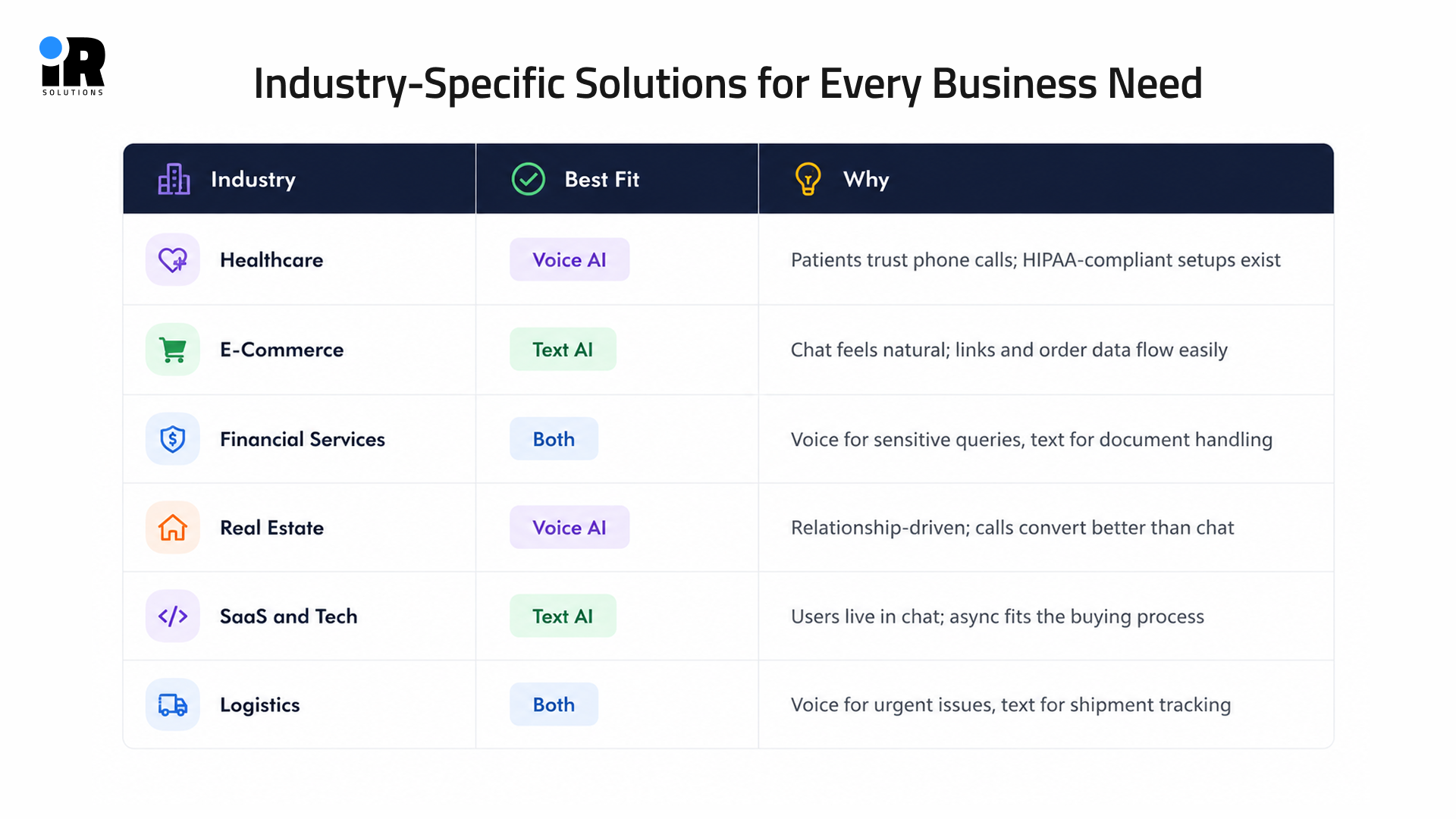
Industry-Specific Solutions for Every Business Need
Conclusion
Voice AI and text-based AI aren't really competing for the same job, they show up for customers in different moments, through different channels, and covering both usually beats picking a side. Voice AI makes the most sense for businesses that live on the phone and need to scale service without scaling headcount to match. Text AI makes sense for businesses running digitally, where speed and lower upfront cost matter more than a live conversation. Once you look honestly at where your customers actually reach out, the choice tends to get a lot less complicated than it first seems. If you're ready to implement a voice AI, text AI, or hybrid solution, IR Solutions can help you build an AI assistant tailored to your business goals and customer needs.
Frequently Asked Questions
What is the main difference between voice AI and text AI?
Voice AI handles spoken phone calls, while text AI manages written conversations across chat, email, and messaging apps.
Which AI type costs less for a small business to start?
Text-based AI is usually cheaper to set up and run, especially for businesses just starting to test AI tools.
Can voice AI and text AI work together in one system?
Yes, most modern platforms support both channels together, and many businesses run a hybrid setup for better coverage.
How long does deploying a voice AI system typically take?
Most standard deployments take between four and twelve weeks, depending on call volume and integration complexity involved.
Is voice AI compliant with HIPAA and GDPR data regulations?
It can be, but compliance depends entirely on proper setup, consent handling, and a thorough legal review beforehand.
Which industries get the most value from voice AI?
Healthcare, real estate, financial services, and any business handling a high volume of inbound phone calls daily.
How well does voice AI handle regional accents and dialects?
Well-trained voice AI now reaches over 90% accuracy across most common accents, though heavy noise can still affect results.
Will text AI eliminate the need for live chat agents?
No, it handles the routine, repetitive queries so human agents can focus on complex or sensitive customer issues instead.