




Key Takeaways
- Arc is an EVM-compatible Layer 1 built for finance, so RWA teams can use Solidity and Ethereum tools.
- Gas fees paid in USDC keep transaction and settlement costs in familiar dollar terms for issuers.
- Deterministic finality in under a second reduces settlement uncertainty for issuance, trading and redemptions of tokenized assets.
- RWA smart contracts can enforce transfer rules and eligibility, but legal duties still sit outside the chain.
- Arc links tokenized assets with Circle tools such as USDC, Wallets, Contracts, CCTP and Gateway.
- A full RWA platform still needs legal structuring, custody, identity checks, data feeds, security and servicing.
- Tokenized funds from BlackRock, Circle and Janus Henderson already operate within the Arc ecosystem today.
Real-world asset tokenization brings assets such as funds, bonds, credit and real estate onto blockchain networks as programmable digital tokens. But tokenizing an asset involves more than creating a smart contract. Legal ownership, investor eligibility, custody, asset data, settlement and redemption all need to work together.
Our real-world asset tokenization article explores this broader process, while our Arc blockchain overview explains the network's architecture and core capabilities. These foundations help clarify where Arc fits within a complete RWA tokenization system.
Arc provides an EVM-compatible environment with USDC gas, deterministic finality in under a second and access to Circle's financial infrastructure. These features make it suitable for RWA issuance, transfers, settlement and lifecycle management, while compliance, custody and legal responsibilities remain partly off-chain.
What an RWA Platform Needs Beyond a Token Contract
A production RWA platform combines legal, technical and operational layers that work together throughout the asset lifecycle. The table below shows the role each layer plays.
Layer | Purpose |
Legal structure | Defines what rights the token represents |
Asset custody | Establishes control over the underlying asset |
Identity and compliance | Determines who can hold or transfer tokens |
Token contracts | Represent and manage ownership rights on-chain |
Data and oracles | Connect real-world asset information to contracts |
Settlement | Coordinates the asset and payment legs |
Investor access | Wallets, portals and account infrastructure |
Servicing | Income, corporate actions, redemptions and maturity |
Secondary markets | Controlled transfer and liquidity |
Why Arc Fits Real-World Asset Tokenization
Arc blockchain for tokenized assets combines familiar EVM development with USDC-based fees, fast finality and stablecoin infrastructure, giving RWA platforms a practical foundation for issuance and settlement.
USDC Native Transaction Fees
Arc transaction fees are paid in USDC, so issuers never need to hold a separate volatile gas token. Costs stay in dollars, which keeps treasury planning and accounting simpler, though fees can still change over time.
Deterministic Finality in Under a Second
Once an Arc transaction reaches deterministic finality, the transfer is settled without waiting for repeated block confirmations. This certainty matters for issuance, trading, settlement, collateral movements and redemptions where timing affects real money and legal obligations.
EVM and Solidity Compatibility
RWA teams can write contracts in Solidity and use Foundry, Hardhat, OpenZeppelin, viem or ethers.js on Arc. Existing EVM patterns carry over, and our breakdown of the Arc blockchain development stack shows how each tool fits together.
Stablecoin Settlement
Arc keeps tokenized assets and USDC in one programmable environment, so a buyer's payment and the asset can move together. That supports delivery-versus-payment-style workflows, where compliance checks run before both legs settle at once.
Cross-Chain Liquidity
Circle's CCTP, Gateway and Arc interoperability tools such as Bridge Kit connect Arc apps with USDC on other networks. Investors on supported chains can bring stablecoin liquidity to Arc without the asset token leaving its home.
RWA Tokenization Architecture on Arc
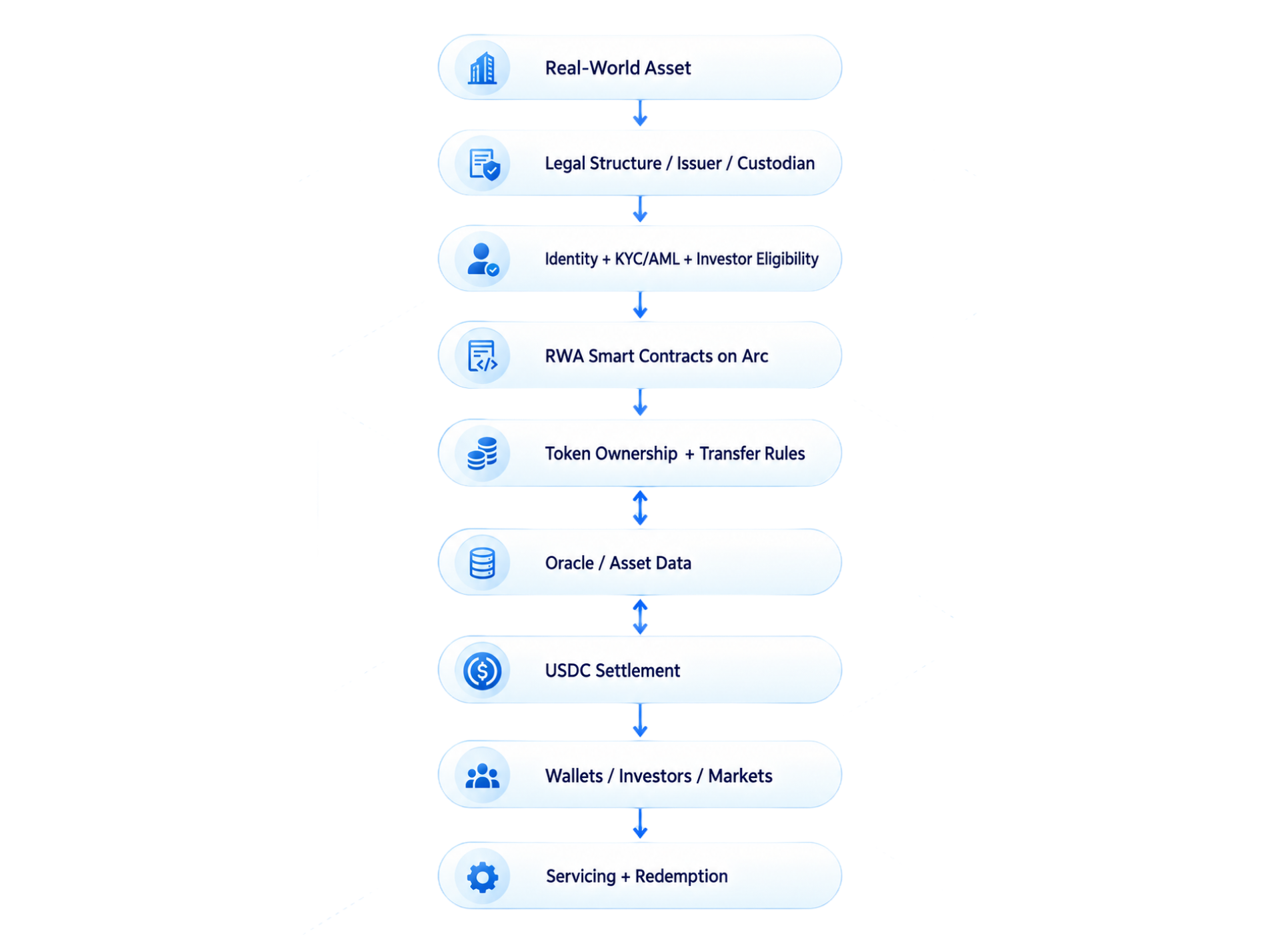
Arc asset tokenization connects the underlying asset, legal structure, compliance, smart contracts, data, settlement and investor access across a single lifecycle. The flow below shows how these components interact.
How Each Layer Works
- Arc EVM: It runs the RWA smart contracts that hold ownership records, transfer rules and lifecycle logic for each asset.
- USDC: It acts as the gas token and the payment leg for issuance, trading, distributions and redemptions.
- Circle Wallets: They give investors and platforms wallet infrastructure without forcing every user to manage private keys alone.
- Circle Contracts: It offers ready templates that help teams deploy and manage token contracts through APIs instead of raw code.
- Cross Chain: CCTP and Gateway move USDC between Arc and other supported networks for funding, trading and payouts.
Choose How the Asset Will Be Represented On Chain
The right token structure depends on the asset's legal rights, ownership model and transfer requirements. Common approaches include fungible, unique, multi-asset and permissioned designs.
Fungible Assets
Fund shares, bonds, private credit units, fractional interests and commodity units often suit fungible token designs on Arc. An ERC-20 style structure can work well when every unit carries exactly the same rights as the next.
Unique Assets
Some assets are one of a kind, such as a specific commercial building, artwork or individual ownership certificate. ERC-721 or similar standards suit these cases because each token can carry its own identity, history and metadata.
Multi-Asset Structures
ERC-1155 lets one contract system manage several token types, such as different share classes or fund series. This can reduce deployment overhead when an issuer runs many related financial products under one shared set of rules.
Permissioned Tokens
Regulated assets often use permissioned designs like ERC-3643, where identity registries and compliance modules control who holds tokens. The right choice among RWA token standards depends on the asset, jurisdiction, investors, transfer restrictions, legal structure and trading model.
Build Compliance Into the Token Flow
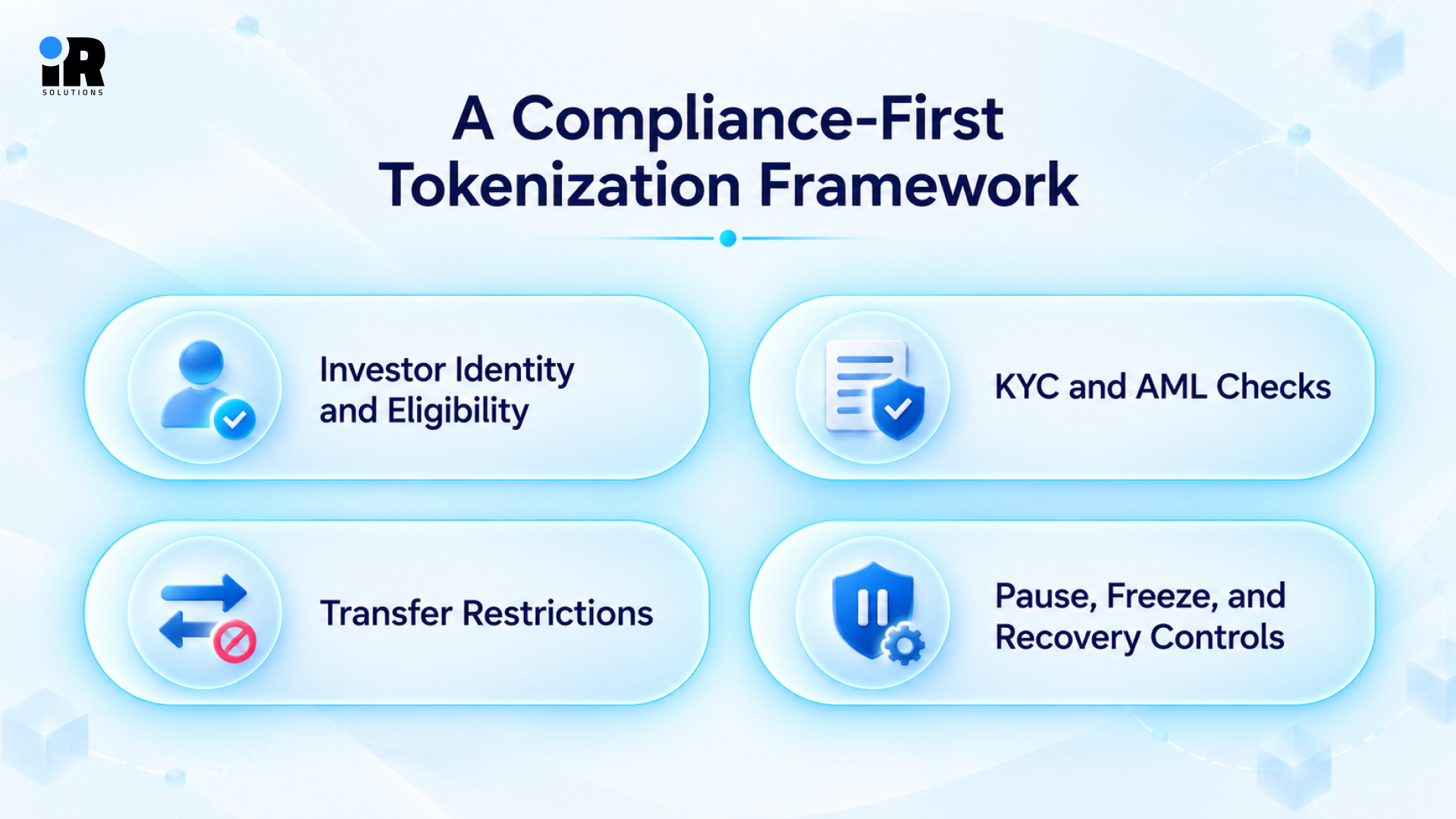
RWA compliance smart contracts connect investor identity and eligibility with on-chain rules that control who can receive, hold or transfer a token.
Investor Identity and Eligibility
The chain of trust runs from a real investor to a verified identity, then to a wallet and eligibility. A wallet address alone does not prove who owns it or whether that person may legally hold the asset.
KYC and AML Checks
A typical flow sends the investor to an identity provider, which returns an eligibility status after KYC and AML review. That status feeds a compliance registry, and the token contract reads the registry before allowing any transfer.
Transfer Restrictions
Contracts can enforce rules on eligible investors, allowed jurisdictions, holding periods, investor limits and approved transfer windows. Issuers can also add asset-specific restrictions, such as lockups tied to an offering or to a fund's terms.
Pause, Freeze, and Recovery Controls
Regulated tokens may need paused transfers, frozen addresses, token recovery, forced transfers and other administrative controls. These controls enforce configured rules, but only legal counsel and regulated providers can confirm those rules meet the law.
Permissioned token standards can combine identity verification with on-chain transfer controls. ERC-3643 documentation explains how its identity registry and compliance modules support controlled token transfers.
Connect the Token to the Real-World Asset
Before an RWA token can represent real economic value, the underlying asset, legal claim, custody arrangement and supporting data must be clearly connected.
Establish the Legal Claim
A token might represent direct ownership, a beneficial interest, a fund interest, a debt claim or a contractual economic right. The exact relationship depends on how lawyers structure the asset, so define it before writing any code.
Define Asset Custody
Someone must control the underlying asset, whether that is a custodian, trustee, SPV, fund or licensed institution. Investors need to know who holds it, how it is protected and what happens if that party fails.
Connect Asset Data On Chain
Many RWA smart contracts need outside data such as NAV, valuations, interest rates, maturity dates or collateral status. Others depend on inventory or reserve figures and income distribution amounts to calculate what each holder receives.
Choose the Data and Oracle Model
Data can come from issuer updates, administrator feeds, oracle networks, attestations, APIs or a hybrid of these sources. Whatever you choose, the token can only be as reliable as the information linking it to the asset.
Issue the Tokenized Asset on Arc
Issuance should move from contract deployment and permissions to compliance checks and final minting, with each step tied to the underlying asset and offering.
Deploy the Smart Contracts
Arc smart contracts for RWA can manage issuance, minting, transfers, compliance, burning, redemption, distributions and role permissions. Our walkthrough on how to deploy smart contracts on Arc covers RPC setup, Foundry, Hardhat and USDC gas payments.
Configure Roles and Permissions
Define clear roles for the issuer, minter, compliance administrator, pauser, upgrader, treasury and governance before the launch. Separating these powers limits damage if one key is lost, and it makes every sensitive action easier to audit.
Connect Identity and Compliance Systems
Eligibility checks must work before any distribution begins, otherwise, tokens could reach wallets that should never hold them. Test the link between your identity provider, compliance registry and token contract with real approval and rejection cases.
Mint the Initial Supply
Mint tokens only after the legal documents are signed, the asset is in custody and the offering is approved. Minting early creates tokens with no backing, which can break investor trust and cause serious legal trouble.
Tokenizing Assets With Circle Contracts
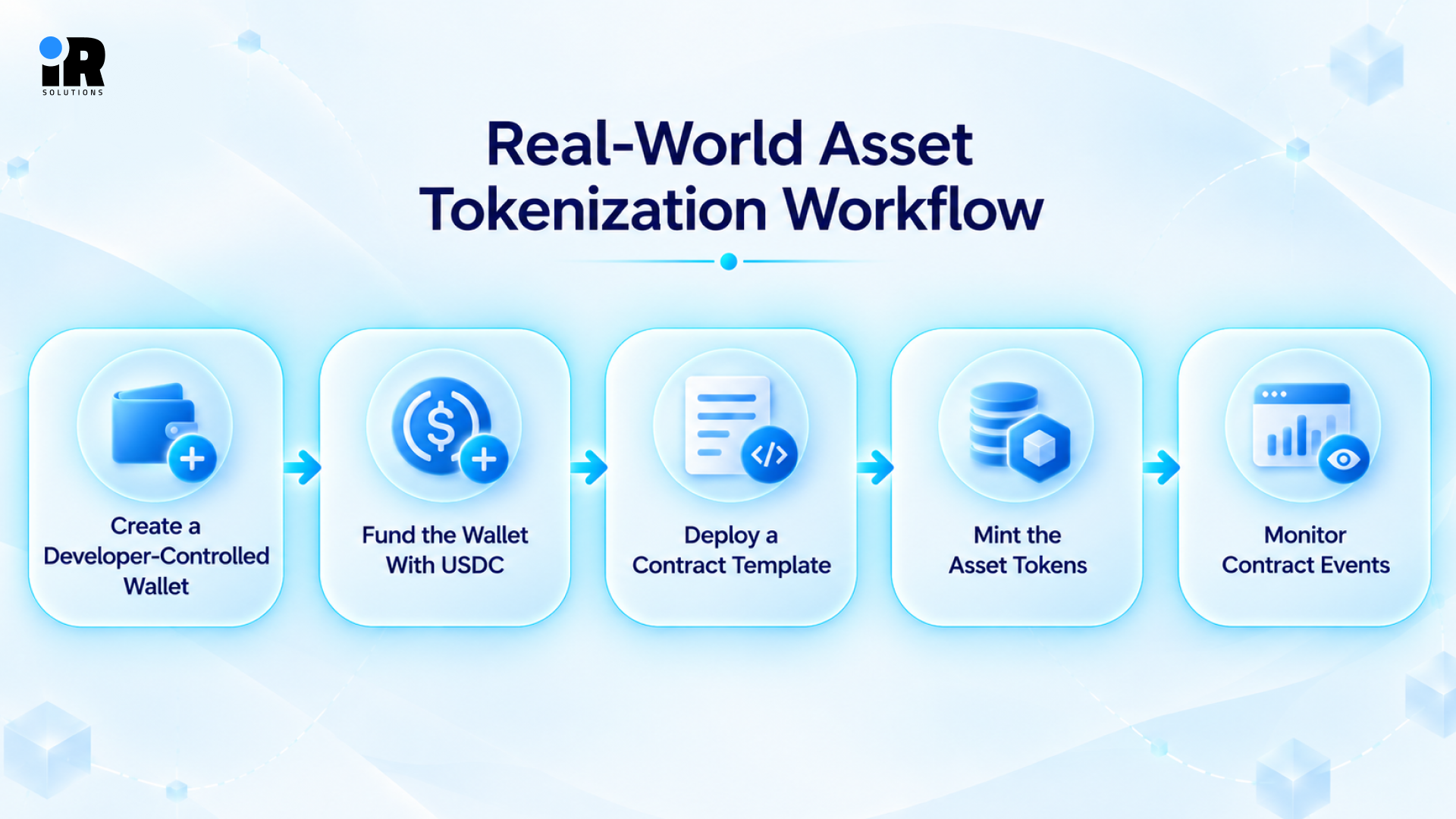
Circle Arc tokenization can simplify token deployment and management on Arc for projects that do not require highly customized contract logic. Complex compliance, governance and servicing requirements may still call for custom Solidity development.
Create a Developer Controlled Wallet
Start by creating a developer-controlled wallet through Circle Wallets, which your platform manages on behalf of the issuer. This wallet will deploy the contract, hold admin permissions and sign minting transactions during the token setup.
Fund the Wallet With USDC
Because Arc uses USDC for gas, the wallet needs a USDC balance before it can deploy or mint anything. On testnet, you can use a faucet, while mainnet funding comes from your normal treasury or exchange setup.
Deploy a Contract Template
Circle Contracts offers prebuilt templates, including token templates, that you can deploy on Arc through a simple API call. You set the name, symbol and admin roles, and the platform handles compilation and deployment for you.
Mint the Asset Tokens
Once the contract is live, the wallet calls the mint function to issue tokens to approved investor wallet addresses. Each mint should match a confirmed subscription, so the on-chain supply always mirrors the real investment records.
Monitor Contract Events
Circle lets you subscribe to contract events, so your backend sees every mint, transfer and burn as it happens. These events feed investor dashboards, reconciliation reports and compliance logs without manual checks on the chain.
Settle RWA Transactions With USDC
USDC settlement for tokenized assets can support key RWA transactions, from initial issuance and secondary trades to income distributions and redemptions.
Primary Issuance
In a primary issuance workflow, an eligible investor can transfer USDC as the subscription payment and receive asset tokens after the required checks and approvals are completed. Keeping the payment and token movement within the same blockchain environment can reduce technical settlement delays, although final issuance may still depend on legal, compliance, custody or administrator approval.
Secondary Transfers
In a secondary transaction, the token contract can check whether the buyer is eligible before allowing the asset transfer. Where the architecture supports atomic or coordinated settlement, the asset token and USDC payment can move within the same workflow. This can reduce principal settlement risk compared with processes in which the asset and payment legs settle independently.
Income and Distributions
Smart contracts and off-chain servicing systems can work together to pay interest, coupons, dividends, rent and other distributions. Paying in USDC lets holders receive income directly in their wallets without waiting on slow bank transfers.
Redemption
A typical redemption moves from request to eligibility and asset checks, then a token burn and final settlement. The exact legal transfer and payment process still depends on the asset and the terms of the offering.
Example: Tokenizing a Private Credit Fund on Arc
A private credit fund could use Arc to represent investor interests as tokens.
The investor first completes KYC and eligibility checks. Once approved, they subscribe using USDC, and the platform issues the corresponding fund tokens to their wallet. Asset data such as NAV or interest can be updated through trusted external systems, while distributions may be paid in USDC.
When an investor redeems, the tokens are burned or retired and settlement is completed according to the fund's terms.
Arc handles the blockchain execution and settlement layer, while the issuer and its service providers remain responsible for legal rights, compliance, custody, asset data and servicing.
Manage the Asset After Issuance
After issuance, the platform must continue updating asset data, distributing income, handling corporate actions, maintaining eligibility and processing redemptions.
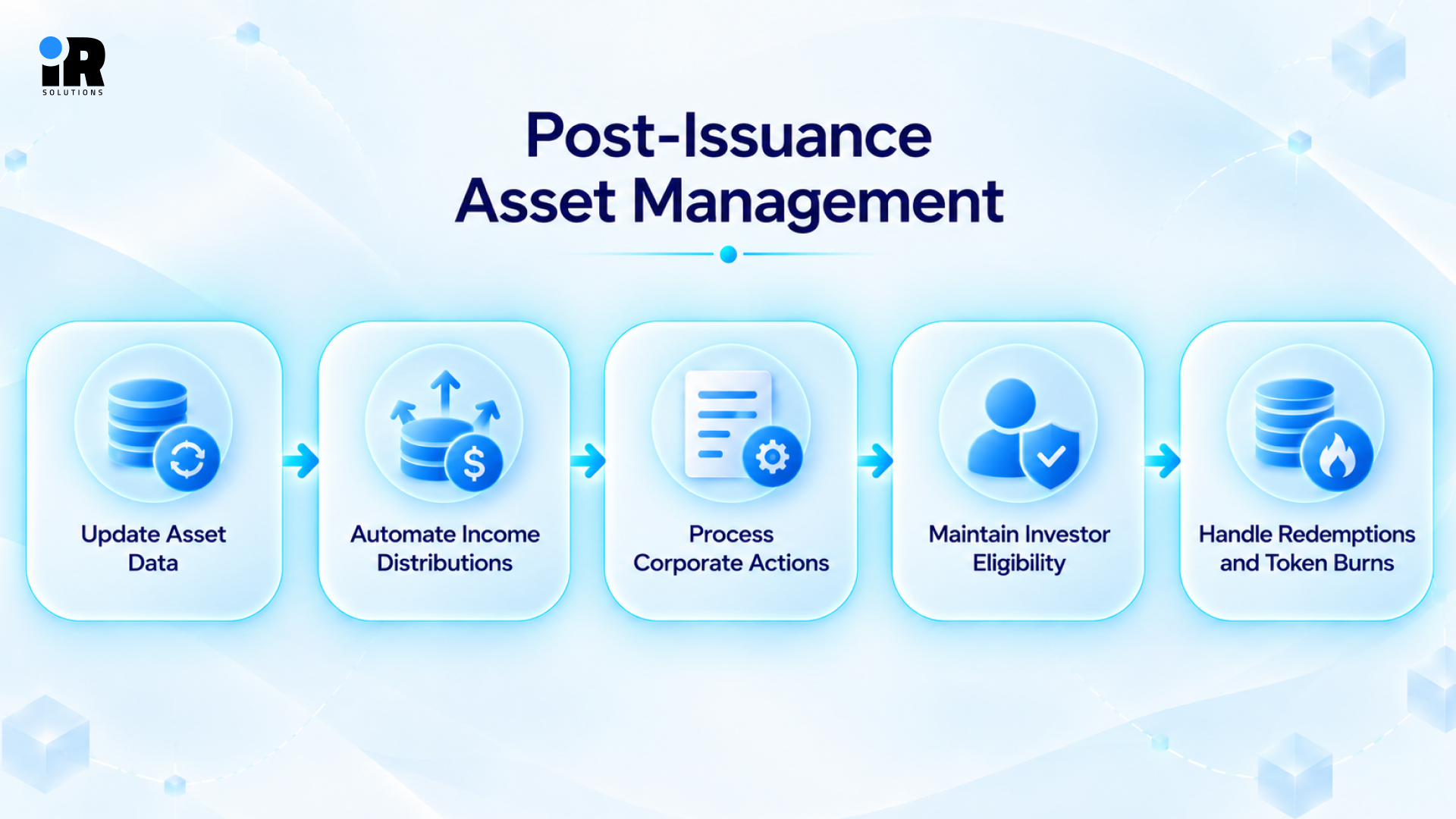
Update Asset Data
Values such as NAV, valuation, maturity, interest and collateral position need regular updates to stay accurate on-chain. Set a clear schedule and owner for each update, so investors always know how fresh the numbers are.
Automate Income Distributions
Contracts can calculate each holder's share from a snapshot and send USDC payouts to every wallet on a fixed schedule. Automation cuts manual errors, but the servicing team should still review totals before every large distribution runs.
Process Corporate Actions
Corporate actions can include cash distributions, holder voting, redemptions, maturity events, and splits or restructuring where they are relevant. Each action needs clear rules in the contract and a matching record in the issuer's back office systems.
Maintain Investor Eligibility
Compliance status can change after issuance when an investor moves country, loses accreditation or fails a periodic review. Your registry should update quickly, so the token contract blocks any new transfers that are no longer allowed.
Handle Redemptions and Token Burns
When investors redeem, the matching tokens must be burned, so circulating supply never exceeds the underlying legal claims. Regular reconciliation between on-chain supply and custody records catches gaps before they turn into real investor problems.
Create Secondary Liquidity Without Losing Issuer Controls
Secondary markets can provide liquidity for tokenized assets, but trading must remain subject to eligibility, transfer restrictions and issuer controls. Arc can support these workflows while USDC provides the settlement asset.
Controlled Token Transfers
Compliance logic inside the token decides where and to whom it may move, even after it leaves the issuer. This keeps transfer rules active across every venue instead of relying on each platform to enforce them.
On-Chain Trading
Where legally and technically allowed, Arc tokenized assets may connect with exchanges, lending markets and collateral systems. Each integration should respect the token's restrictions, so only approved wallets can trade the asset or post it as collateral.
Stablecoin Settlement for Trades
USDC gives every trading venue on Arc a common payment leg, so buyers and sellers settle in dollars. A shared settlement asset also makes it easier to move between markets without converting through volatile tokens.
Cross-Chain Access
CCTP and Gateway can bring USDC liquidity from other networks into Arc applications when investors want to buy. The asset token itself does not need to travel freely across every chain for this to work.
Tokenized Assets Already Live on Arc
Arc's growing RWA ecosystem includes tokenized funds and lending products from established financial firms. The examples below show how the network is being used for different types of tokenized financial assets.
BlackRock BUIDL
BUIDL is a tokenized fund product from BlackRock, tokenized by Securitize, a firm focused on tokenized digital securities. Its presence on Arc shows that large asset managers are willing to place Arc tokenized funds beside USDC.
Circle USYC
USYC is Circle's tokenized money market fund asset, and it runs within the same Arc environment as USDC. Having both assets on one network makes it simpler to move between cash and a tokenized fund position.
Janus Henderson JAAA and JTRSY
Janus Henderson's JAAA and JTRSY are also available on Arc as additional tokenized fund products for eligible investors. Together with BUIDL and USYC, they give Arc RWA activity a base of recognized institutional fund products.
RWA Backed Lending
RWA-backed lending provides an example of tokenized assets being used beyond initial issuance. On-chain lending structures can potentially use tokenized real-world assets as collateral while USDC provides the lending or settlement asset. These applications still need to account for asset valuation, collateral controls, investor eligibility and the legal enforceability of the underlying asset claim.
Which Real-World Assets Can Be Tokenized on Arc?
Different asset classes require different token structures, data sources, servicing models and transfer controls. The following examples show where Arc can fit across common RWA categories.
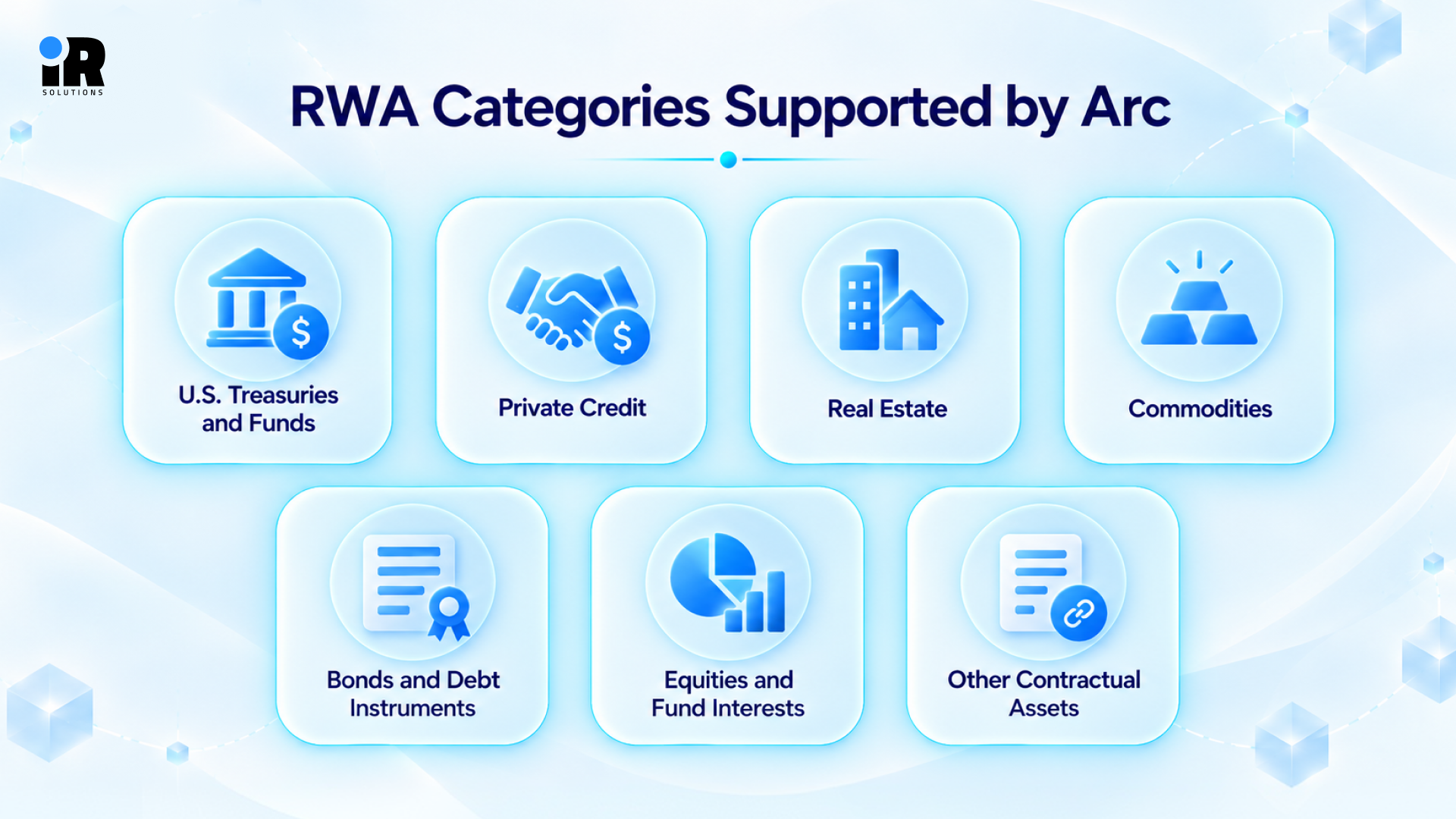
U.S. Treasuries and Funds
Treasury bills and money market funds are popular because their value is easy to track through daily NAV data. They usually use fungible tokens, eligibility checks and regular USDC distributions or yield accrual inside the token price.
Private Credit
Private credit tokens represent loan pools or credit funds, and they depend heavily on borrower data and repayment reporting. Transfer limits are often strict because these products are usually offered only to qualified or professional investors.
Real Estate
Real estate tokens often represent shares in an SPV that owns the property, rather than the building itself. Valuations update less often, and rent distributions depend on property managers sharing accurate income and expense data.
Commodities
Commodity tokens such as gold or other metals need proof that reserves exist and that a trusted custodian holds them. Regular audits or reserve attestations connect the token supply to the physical inventory sitting in the vault.
Bonds and Debt Instruments
Tokenized bonds need contract logic for coupons, maturity dates and principal repayment, plus accurate interest rate data. The token must stop trading or be redeemed at maturity, so lifecycle events need careful testing before launch.
Equities and Fund Interests
Equity and fund interest tokens may need voting rights, dividend logic and strict rules about who can hold them. Securities law usually applies here, so permissioned designs and close work with legal advisers are common.
Other Contractual Assets
Invoices, royalties, carbon credits and similar contractual rights can also be tokenized when the claim is clearly defined. The key test is whether a court would recognize the token holder's right to the underlying economic value.
Security Risks in an Arc RWA Platform
RWA security extends beyond the token contract to the data, custody, administrative keys and external systems that support the asset throughout its lifecycle.
Smart Contract Risk
Common contract risks include weak access control, loose mint or burn authority, unsafe upgrades, accounting bugs, and redemption errors. Thorough smart contract testing and an independent audit should happen before any real investor money touches the system.
Oracle and Data Risk
Incorrect off-chain data can make perfectly written contract logic produce the wrong financial outcome for every holder. Use multiple sources, sanity checks and alerts, so a single bad price or NAV update cannot cause damage.
Custody Risk
The token is only as sound as its custody, so the underlying asset must stay properly controlled. Check the custodian's licensing, insurance, segregation of assets and reporting before you trust them with investor value.
Admin and Key Risk
High-privilege roles such as minter, pauser and upgrader can cause serious harm if a single key is compromised. Protect them with multisig wallets, hardware security modules, time locks and clear approval steps for sensitive actions.
Integration Risk
Every outside connection adds risk, including oracles, identity providers, stablecoins, custody systems, bridges and external APIs you rely on. Map each dependency, test what happens when it fails, and plan a clear fallback before your platform goes live.
Legal and Ownership Risk
A technically correct token cannot fix an unclear legal claim, and investors may lose rights in a dispute. Get legal opinions on ownership, insolvency and enforcement before launch, and keep token terms consistent with offering documents.
Privacy and Institutional Requirements
Institutional RWA platforms may need to protect sensitive investor, transaction and financial information while maintaining sufficient auditability. Arc's roadmap includes opt-in privacy capabilities, while applications can use off-chain systems and access controls for data that should not be exposed publicly.
Applications can still use their own access control, identity and off-chain privacy architecture to protect sensitive data. For example, detailed investor records can stay in a secure database while the chain holds only necessary references.
When Does Arc Make Sense for an RWA Project?
Arc can be a strong option for RWA projects that are designed around stablecoin settlement and EVM-compatible development.
It may be particularly relevant when:
- USDC is expected to be the primary subscription, trading or redemption asset.
- The development team already works with Solidity and EVM tooling.
- Fast settlement finality is operationally important.
- The platform requires programmable transfer restrictions or lifecycle controls.
- The application expects to integrate with relevant Circle infrastructure.
- Investors may bring USDC liquidity from other supported networks.
However, blockchain features should not determine the infrastructure choice on their own. Issuers should also evaluate regulatory requirements, custody arrangements, privacy needs, liquidity, interoperability, operational resilience and vendor dependence before selecting a network for a production RWA platform.
Building an RWA Tokenization Platform on Arc
Building an RWA platform on Arc requires more than smart contracts. The architecture must connect legal rights, compliance, tokenization, settlement, investor access, servicing and ongoing reporting.
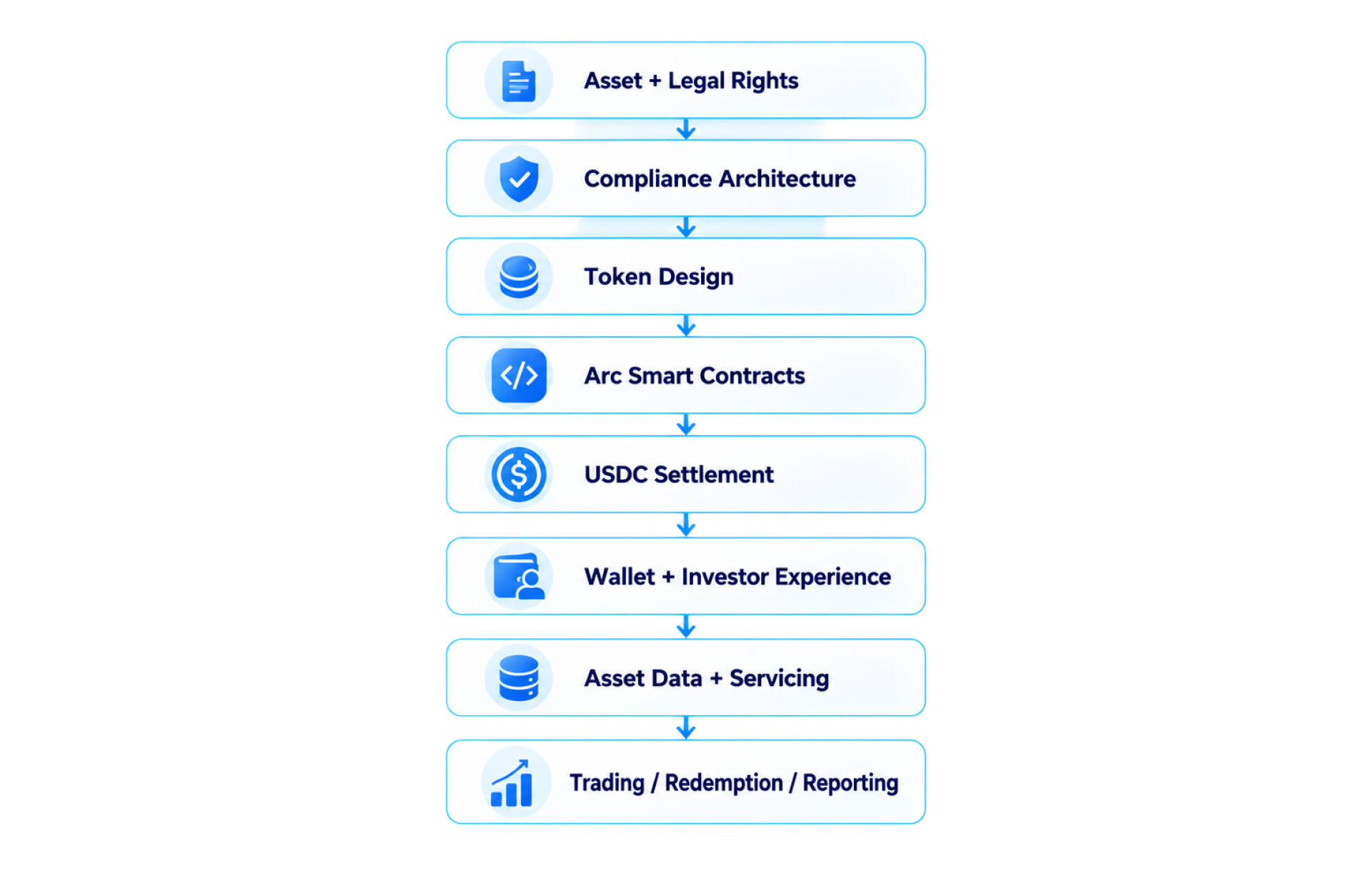
Core Components of an RWA Platform
- Blockchain Architecture: Architects design how contracts, wallets and settlement flows fit together across Arc and every connected system.
- Smart Contracts: Developers write and test the token, compliance and servicing logic that runs on the Arc network.
- Compliance Integrations: Identity and KYC providers must connect cleanly to registries so eligibility updates reach the contracts quickly.
- Backend APIs: Backend services link investor portals, custody records and payment events to what happens on-chain.
- Wallet Experience: Investors need simple onboarding, clear balances and easy redemption requests inside a trusted wallet interface.
- Security Reviews: Audits, key management and access reviews protect both investor funds and the issuer's reputation over time.
- Data Oracles: Reliable feeds keep NAV, valuations and reserve figures accurate so contract outcomes match the real asset.
- Deployment Monitoring: Live monitoring catches failed transactions, unusual transfers and stale data before they reach investors or regulators.
If you want one team to handle these layers together, our RWA tokenization services cover design through launch.
Arc RWA Tokenization Architecture Example
The following example brings the major RWA components together, showing how legal ownership, compliance, token contracts, asset data, USDC settlement and investor services connect in a single workflow.
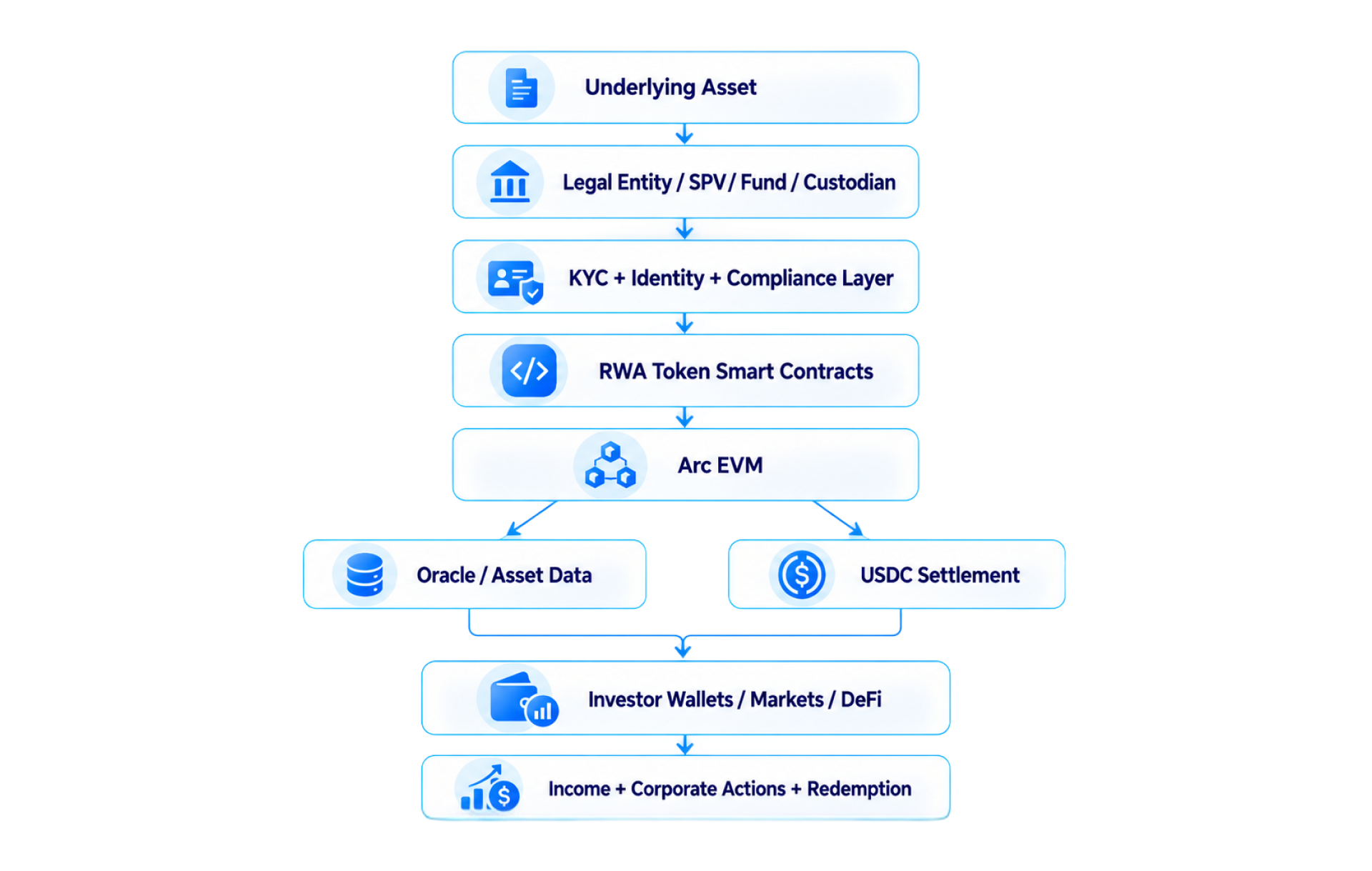
Supporting Circle Infrastructure
Circle Wallets provides wallet infrastructure for investors and platform operations, while Circle Contracts simplifies token contract deployment and management. CCTP enables USDC transfers between Arc and supported networks, and Gateway helps applications access USDC liquidity across multiple chains. These services support the RWA platform without replacing its core legal, compliance, custody or smart contract layers.
Arc vs a Generic EVM Chain for RWA Tokenization
Arc blockchain tokenization keeps standard EVM development but changes gas, settlement, finality and the surrounding ecosystem.
Requirement | Generic EVM Approach | Arc Approach |
Smart contracts | Solidity/EVM | Solidity/EVM |
Gas | Usually volatile native token | USDC |
Settlement asset | Add stablecoin separately | USDC integrated into network economics |
Finality | Depends on network | Deterministic, under one second |
Circle infrastructure | External integrations | Deep Circle ecosystem integration |
Cross-chain USDC | CCTP where supported | CCTP/Gateway integrated into Arc ecosystem |
Institutional privacy | Chain/app dependent | Broader Arc privacy model on roadmap |
RWA ecosystem | Varies | Tokenized funds and institutional RWA participants already present |
Conclusion
RWA tokenization on Arc gives issuers a strong execution and settlement layer, but the token is only one part. A production platform still needs legal rights, custody, compliance, token contracts, trusted data, settlement, servicing, security and redemption. As an Arc blockchain for tokenized assets, the network combines familiar EVM development with USDC execution, deterministic finality and Circle's wider financial tools. In the end, the right chain depends on your asset, investors, compliance needs and operating model, not features alone.
Frequently Asked Questions
Can real-world assets be tokenized on Arc?
Yes, real-world assets can be tokenized on Arc using Solidity contracts, USDC settlement and Circle's developer tools. You still need a legal structure, custody arrangement and compliance process that support the token outside the chain.
Why is Arc suitable for RWA tokenization?
Arc pairs EVM compatibility with USDC gas, built-in stablecoin settlement and deterministic finality in under a second. These features reduce settlement uncertainty and keep costs in dollars, which suits regulated financial products and institutional issuers.
Which real-world assets can be tokenized on Arc?
Treasuries, money market funds, private credit, real estate, commodities, bonds, equities and contractual rights can all be tokenized. Each class needs its own legal structure, data source, token model, servicing process and set of transfer restrictions.
What token standards can be used for RWAs on Arc?
Because Arc is EVM compatible, teams can use ERC-20, ERC-721, ERC-1155 and permissioned standards such as ERC-3643 for regulated assets. The best fit depends on the asset, jurisdiction, investor type, legal structure and planned secondary market model.
Does Arc support ERC-3643?
Arc runs standard EVM contracts, so ERC-3643-style permissioned tokens with identity registries and compliance modules can be deployed. Teams should still test the full implementation on Arc and confirm that their chosen tooling works as expected.
How does USDC settlement work for tokenized assets on Arc?
A buyer pays in USDC, the contract checks eligibility, and the asset token transfers once all conditions are met. Both legs settle on the same network, which supports delivery-versus-payment style workflows with fast finality.
Does Arc provide KYC and AML for RWA tokens?
No, Arc does not perform KYC or AML checks itself, so issuers connect to external identity providers and compliance registries. Token contracts then read eligibility status from those systems before allowing any mint, transfer or redemption to proceed.
Can Circle Contracts tokenize real-world assets on Arc?
Circle Contracts can deploy token templates and mint asset tokens on Arc, which suits simpler issuance and early prototypes. It does not create a compliant security alone, so legal structuring and compliance work are still required.
Are tokenized funds already live on Arc?
Yes, products such as BlackRock BUIDL, Circle USYC and Janus Henderson JAAA and JTRSY are available on Arc. Bitwise also launched a PAPY-USDC vault that supports USDC lending against overcollateralized tokenized real-world assets on the network.
Can RWA tokens on Arc be used in DeFi?
Yes, where legally and technically appropriate, RWA tokens can connect with exchanges, lending markets and collateral systems on Arc. Transfer restrictions still apply, so only eligible wallets can interact with those protocols when using the asset.
Is Arc's privacy functionality live for institutional RWAs?
Arc's roadmap includes opt-in privacy capabilities for confidential financial workflows that still keep transactions auditable for oversight. Until those features arrive, applications can protect sensitive data with their own access controls and off-chain systems.
What are the biggest risks when tokenizing assets on Arc?
The biggest risks include smart contract bugs, bad oracle data, weak custody, compromised admin keys and fragile integrations. Unclear legal ownership is equally serious, because a well-built token cannot repair a poorly defined claim.


