




Many businesses approach AI expecting quick wins, but quickly discover that implementation is far more complex than anticipated. What looks effective in a controlled demo often breaks down when exposed to real data, existing workflows, and legacy infrastructure. The real challenge is rarely the AI model itself, but the readiness of the organization adopting it. Issues such as inconsistent data, unclear success metrics, weak integration planning, and limited internal expertise often slow or derail progress. To avoid these setbacks, companies need a structured approach that aligns business goals with technical execution from the beginning. This is where working with experienced partners offering AI & ML Development Services becomes important, ensuring that strategy, data readiness, and system integration are handled correctly so AI delivers consistent and scalable business value.
Poor Data Quality and Infrastructure Readiness
The assumption that existing data is AI-ready is where the first serious wall appears. Scattered records, missing fields, and unstructured documents expose years of inconsistent collection the moment a model tries to use them. That gap between "we have data" and "we have usable AI data" is where the first real costs quietly begin.
What poor data readiness looks like in real businesses:
- Duplicate records sit unreconciled across CRM, ERP, and finance tools for years without anyone fixing them.
- Missing fields in customer or transaction databases that make reliable pattern recognition completely impossible.
- Unstructured information locked inside documents and emails with no extraction pipeline feeding it into usable formats.
- Siloed legacy systems store data in formats that modern AI tools and APIs simply cannot read or process.
A structured data audit before selecting any AI partner is the real starting point. Map every data source, its owner, format, and completeness before touching a tool. Businesses that clean data first consistently outperform those that skip it.
Why AI Projects Fail Without Clear Business Objectives
One of the most common reasons AI initiatives fail is the absence of a clearly defined business objective. Many companies adopt AI under competitive pressure or to modernize without first identifying the specific problem they need to solve. Without clarity, projects lose direction and fail to deliver measurable business value.

- Testing Loop: Multiple AI experiments run simultaneously without a clear direction, evaluation process, or path to deployment.
- Missing Ownership: No individual or team is accountable for driving the initiative, measuring progress, and achieving results.
- Priority Misalignment: Leadership, operations, and IT teams pursue different goals, creating confusion and slowing decision-making.
- Metric Gaps: Success criteria are not established before implementation, making it difficult to evaluate the business impact.
- Budget Waste: Resources are spent on promising demonstrations and tools that never translate into operational value.
A detailed guide on real-world implementation is covered in AI for Business in 2026: Use Cases, Automation, Tools & Implementation Guide.
Security, Privacy, and Compliance Challenges in AI Systems
Every AI system that accesses your data creates an exposure point that procurement likely never flagged. Customer records, financials, and employee data flow through these tools in ways nobody mapped during selection. Get the compliance piece wrong under GDPR, CCPA, or sector rules, and it stops being a tech problem fast, it becomes a legal and reputational issue that sticks.
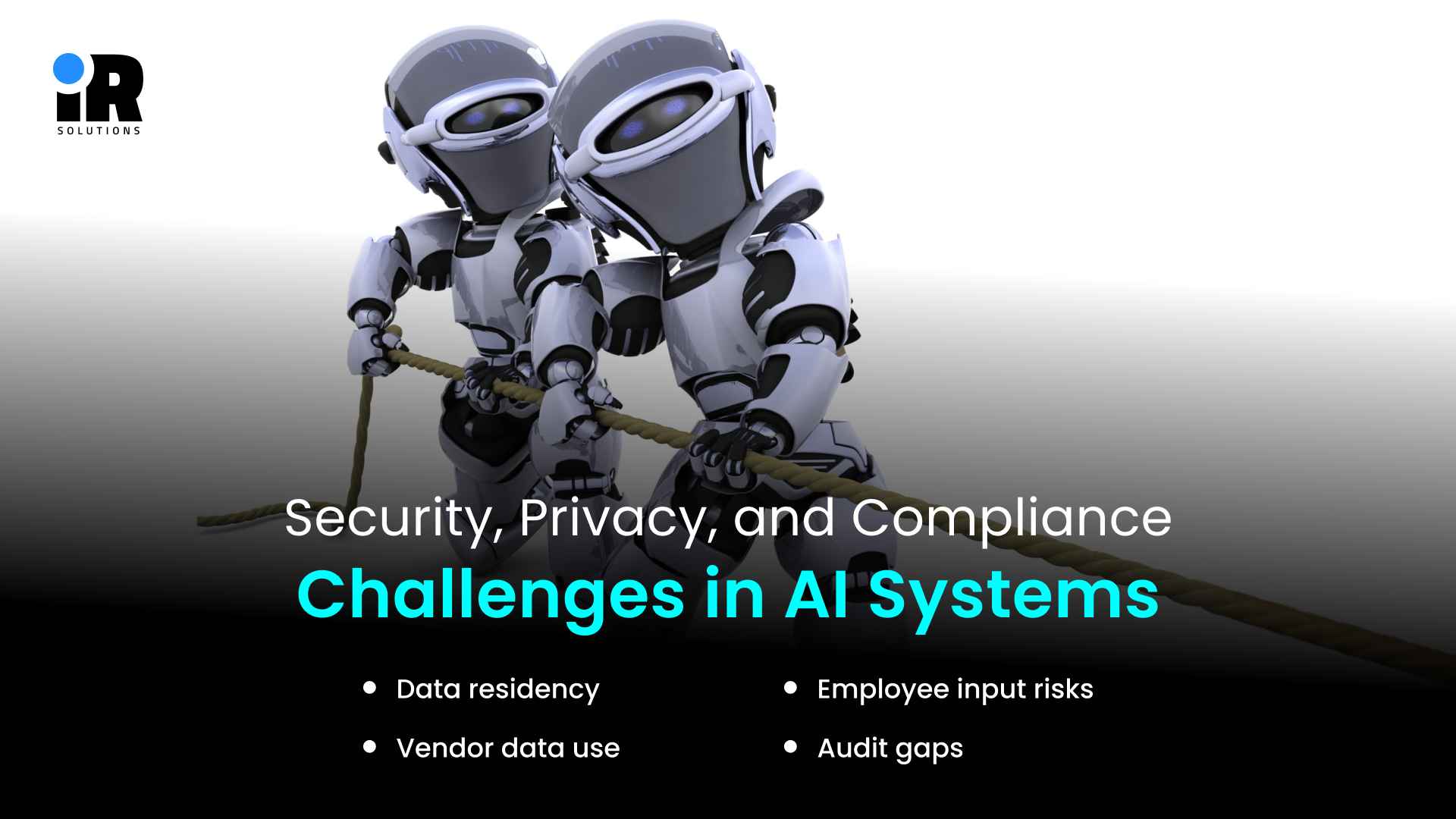
- Data residency: Where the service provider physically stores and processes your data, which affects regulatory compliance.
- Employee input risks: Staff feeding regulated or confidential information into public AI tools without understanding the consequences.
- Data usage policy: Whether the provider trains models on your data and what the contract actually says about that.
- Audit gaps: The inability to explain to a regulator exactly how a specific AI-driven decision was reached.
Every deployment should define data classification before go-live, enforce clear user guidelines, review provider contracts for data handling terms, and establish governance early to avoid costly compliance risks.
The Hidden Complexity of Integrating AI With Existing Technology
Tech stacks built over years of small decisions rarely play nicely with something new dropped in the middle. AI tools need to pull data, push outputs, and trigger actions across systems that were never designed to talk to each other. When the integration layer isn't planned properly, the AI tool just becomes another siloed app that nobody fully trusts.
- Legacy systems with no modern API access and documentation that hasn't been updated in years.
- Data formats require significant transformation before the AI tool can interpret them accurately.
- Workflow gaps where human handoffs between systems eliminate the efficiency gains the tool promised.
- Duplicate data entry is emerging because the integration is only partial, and neither system fully trusts the other.
- Get the integration scope agreed before any contract is signed, or the gaps will show up as cost overruns later.
To understand how AI is transforming different industries, check Top AI Use Cases for Businesses in 2026 - Real-World Applications Across Industries.
AI Talent Gaps and Their Impact on Implementation
Businesses do not need a team of machine learning engineers to use AI productively. They do need people who understand the tools well enough to configure them correctly and interrogate the outputs critically. That baseline of AI literacy is rarer than it should be, and the market for people who have it is genuinely competitive right now.
The skill gap shows up in practical ways that affect the quality and safety of deployments every day. Models get configured by people who do not fully understand the parameters they are adjusting. Outputs get accepted at face value without the critical review that catches errors before they reach customers or business decisions. Security settings get misconfigured because the person managing them did not have the depth to know what they were doing at the time.
Where the talent gap creates concrete risk in AI deployments:
- Thin Ownership: No internal lead with enough technical depth to drive the initiative credibly from within.
- Growing Dependency: Reliance grows over time as nobody internally builds the knowledge to take real ownership.
- Unvalidated Results: Unchecked AI results flow into operational decisions without anyone validating the logic behind them.
- Late IT: Security and access settings get misconfigured because IT was brought in far too late.
Upskilling your existing team is almost always faster and more cost-effective than hiring from outside. When needed, hire AI/ML developers through outsourcing models to fill specific expertise gaps, while ensuring strong knowledge transfer so internal capability continues to grow over time.
Choosing the Wrong AI Partner or Tool
The AI solutions market is louder than it has ever been, and most of it is noise. Every demo runs perfectly with clean data and an experienced consultant at the wheel, the gap between that and your actual environment only shows up after the contract is signed. Businesses end up spending months trying to force the wrong tool to work instead of stopping and making the right call.
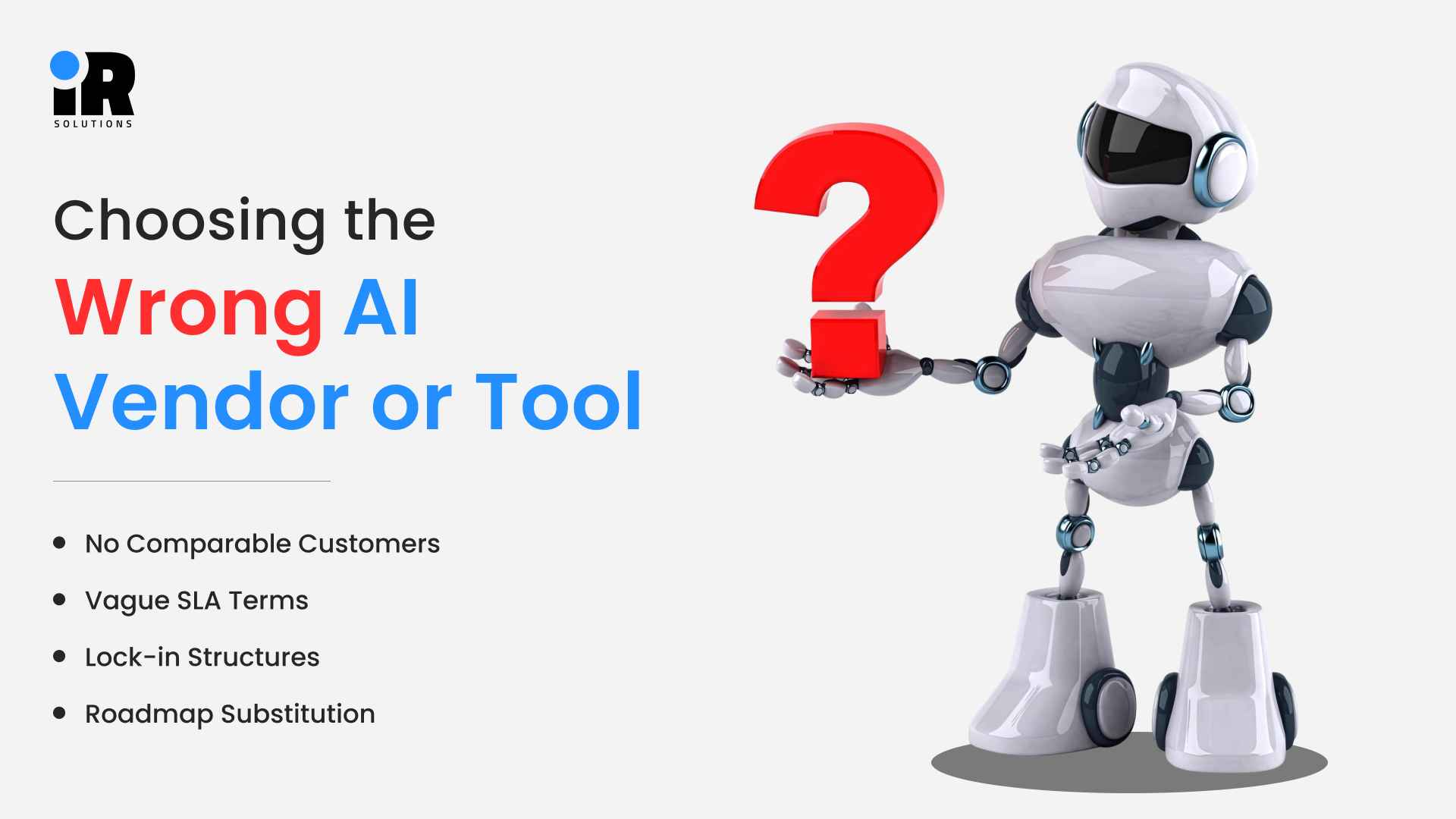
- No Comparable Customers: The AI Solution can't point to businesses of similar size or industry using the tool successfully.
- Vague SLA Terms: Performance, uptime, and support response commitments aren't clearly defined or enforceable.
- Lock-in Structures: Contract terms make switching to an AI Solution prohibitively expensive if performance disappoints.
- Roadmap Substitution: The AI tool is selling features that don't exist yet, rather than showing what works today.
Don't rely on solution-managed demos and a procurement checklist alone. Talk to reference customers you find yourself, run a proof of concept on your own real data, and get legal to review data rights and termination clauses before anything is signed. It adds time upfront but saves far more on the other side.
Why AI Projects Often Cost More and Deliver Returns Later Than Expected
The license fee on the pricing page is never the actual number you'll end up paying. Infrastructure upgrades, integration work, staff training, and ongoing maintenance all stack up faster than anyone budgets for initially. Total cost of ownership regularly lands two to three times what the original software estimate put on paper.
Smaller businesses carry this risk harder because there's less financial cushion for projects that run over time or over budget. Finance teams want returns within a single fiscal period, but most real AI benefits take months or years to actually show up. Boards lose confidence when the numbers don't land on schedule and pull funding before the tool has delivered anything meaningful.
A phased pilot consistently beats a full budget commitment when internal evidence is still thin on the ground. Pick one repetitive, well-documented process, set a clear baseline around time and error rate, then run the tool in that area for ninety days straight. Those results build a far stronger internal case than any sales presentation ever realistically could.
Conclusion
AI adoption delivers value when businesses address challenges with structured planning and early preparation consistently. Data readiness and governance form the foundation for scalable AI implementation across organizations successfully over time. Clear business objectives keep AI projects focused, measurable, and aligned with organizational goals moving forward. Human factors and change management decide whether AI tools are adopted or rejected internally successfully. Security compliance and privacy must be prioritized to avoid legal, financial, and reputational risks altogether. Integration complexity and talent gaps often slow execution and reduce expected AI impact significantly overall. Choosing the right partner, like IR Solutions, that manages cost directly influences long-term AI success and business outcomes significantly. With structured execution, businesses can turn AI adoption challenges into opportunities effectively and sustainably.
Frequently Asked Questions
What is the most common challenge businesses face when adopting AI for the first time?
Poor data quality consistently comes up first because no AI tool performs reliably when the underlying data is incomplete or inconsistently structured across systems.
Do businesses need an in-house AI team before starting an implementation?
Many successful deployments begin with an external partner who builds internal capability progressively throughout the engagement rather than replacing it.
How should a business calculate ROI on an AI project before committing to it?
Define a clear measurable baseline before deployment and track the same metric post-deployment over a consistent period of at least ninety days for honest comparison.
What are some of the best industries to invest in AI right now?
Nearly all businesses in sectors from retail and financial services to logistics and healthcare operations and customer service report the highest returns in their near-term AI deployments.
Can small and mid-sized businesses use AI or is it only a tool for large businesses?
With smaller businesses, you can begin by deploying specific tools that solve a specific pain point, instead of having to build enterprise infrastructure or a large technology team.
What steps are you taking to address employee fears around AI taking their place in the business?
Resistance can be minimized and long-term adoption rates maximized through the use of fully collaborative communication before deployment, inclusion of staff in the selection process, and structured retraining.
What should businesses prioritise when evaluating AI providers in a crowded market?
Similar independent customer references, straightforward SLA pledges, unambiguous data management provisions and commitment to execute a genuine proof of concept before going to a commercial contract.
What measures do businesses take to ensure the compliance of their AI deployment with data protection regulations?
To be compliant, scoping should be done before deployment, and partner contracts should be checked with legal counsel for data rights and breach notification requirements.
Do AI tools fit in with the older systems not built for integration?
Yes, in most cases, but in order to know the true integration complexity, the technical scope must be done before partner selection so before signing contracts the true costs and timelines to the integration must be understood.