




You spend real time writing emails, building lists, and planning sequences, and somehow still end up unsure whether any of it actually moved the needle. That gap between effort and clarity is where most email programs quietly bleed money. The channel itself is not the issue. Email still returns more per dollar spent than almost anything else in digital marketing. The issue is running it without a proper measurement system.
Businesses that track the right numbers consistently outperform those that just hit send and hope. If you want campaigns that tie directly to revenue rather than just opens and clicks, with experienced digital marketing experts who know how to turn campaign data into business growth changes that drive outcomes faster than any new tool will.
Why Email Marketing ROI Matters for Business Growth
Here is the blunt version, if you cannot show what your email program returns, you cannot defend its budget. And if you cannot defend the budget, you cannot grow the program. ROI tracking is not just about impressing leadership it is what tells you whether to keep doing what you are doing or change direction before you waste another quarter on something that is not working. When you actually measure email ROI consistently, a few things shift for the better:

- Budget confidence: You know which campaigns earn their keep and which ones quietly drain spend without producing anything measurable.
- Faster iteration: You catch problems after one or two sends rather than six months in, when the damage is already done.
- Sharper forecasting: Past campaign data gives you a realistic basis for projecting what a future campaign will return before you commit budget to it.
- Easier growth conversations: Numbers that connect email activity to revenue make it a lot easier to argue for more resources when you need them.
Businesses that skip this step often produce emails that look good on the surface, with solid design and decent copy, but have no idea whether any of it actually converts.
Key Email Marketing Metrics You Must Track
Before anything else, you need to know which numbers tell the actual story of your campaign performance. Not every metric matters equally, and tracking everything with the same level of attention creates noise rather than clarity.
Open Rate
Open rate shows what percentage of your recipients opened the email after it landed in their inbox. It reflects two things directly, how strong your subject line is and whether you are sending at a time when your audience is actually paying attention. Industry averages typically fall between 20% and 30%, though that varies by sector. If yours sits consistently below that range, the subject line or send schedule usually needs attention before anything else in the email does.
Click-Through Rate (CTR)
CTR tells you what percentage of people who opened the email actually clicked something inside it. A solid CTR means your content felt worth engaging with and your call-to-action landed where it needed to. The benchmark to aim for is roughly 2% to 5%, depending on your industry. If opens are fine but clicks are low, the problem is usually inside the email body, the offer, the layout, or the CTA itself.
Conversion Rate
This is the one that ties directly to money, as the conversion rate tells you how many people completed the specific action the campaign was designed to drive a purchase, a form fill, a booking, or a download. Everything else in email marketing is in service of this number. Dedicated email marketing automation platforms make it easier to track this per campaign, per flow, and per audience segment without piecing data together manually. A campaign that generates strong opens and clicks but weak conversions almost always has a landing page problem rather than an email problem.
Bounce Rate
A bounce means your email never made it to the inbox. Two types matter here:
- Hard bounce: The address does not exist or is permanently blocked, remove these from your list immediately after every send.
- Soft bounce: A temporary failure, full inbox, server issue, these may resolve on the next attempt, but patterns of soft bounces from the same address are worth watching.
A growing bounce rate quietly damages your sender reputation with email providers, which means more of your future sends end up in spam, often before you notice why your open rates are declining.
Maintaining a strong sender reputation is essential because poor deliverability can prevent even high-performing campaigns from reaching subscribers. Our email deliverability guide explains the practical steps required to improve inbox placement and avoid spam folders.
Unsubscribe Rate
Some churn is normal, people change jobs, lose interest, and clean out their subscriptions. What you want to watch for is a spike that follows a specific send, which usually means something about that campaign broke the implicit agreement between you and your subscribers. Too frequent, off-topic, or tone-deaf messaging tends to trigger the unsubscribe reflex, when you see a spike, go back to that email first.
Return on Investment (ROI)
This is the number that answers the core question, Is this program worth running? Calculate it by comparing revenue directly attributed to your email campaigns against what it cost you to produce and send them. Every other metric feeds into understanding and improving this one. It is also the number your stakeholders actually care about when budget season comes around.
Best Tools to Track Email Campaign Performance
The right tools save you from trying to stitch together a picture of performance from five different places. You do not need the most expensive stack, you need one that gives you clean, consistent data you can actually act on.
Email Service Tools
Platforms like Mailchimp and HubSpot offer built-in analytics dashboards. They track open rates, CTR, bounce rates, and unsubscribes automatically. For brands using Klaviyo, proper flow configuration, segmentation logic, and revenue attribution can significantly improve reporting accuracy and campaign performance, which is why many growing ecommerce businesses choose to work with a Klaviyo expert to optimise their setup.
A/B Testing Tools
Litmus and Email on Acid let you test your emails across major devices and email clients before sending, as well as run structured split tests on subject lines, CTAs, content blocks, and design layouts. The value of A/B testing is that it replaces opinion with evidence. I think the shorter subject line will perform better" becomes something you can actually verify rather than guess at.
Google Postmaster Tools
This free tool from Google gives you visibility into your sending reputation and deliverability performance with Gmail, which covers a significant chunk of most business email lists. If your emails are drifting toward spam folders, Postmaster Tools will tell you before the drop in open rates makes it obvious. Catching that early saves campaigns that would otherwise quietly fail without explanation.
CRM Integrations
Connecting your email platform to a CRM like Salesforce or HubSpot CRM gives you the full picture of how email activity maps to customer behavior over time. For businesses with longer sales cycles or multiple decision-makers, this connection is where email ROI becomes genuinely legible, you can see the path from first open to closed deal rather than just measuring isolated campaign metrics.
For businesses that want a proper tool stack built and configured without doing it step by step, getting dedicated support to handle the setup means you get clean data from day one rather than retrofitting tracking six months in.
Want better email ROI? Schedule a free strategy session with our experts and discover how to improve your campaigns, automation, and conversions.
How to Analyze Email Campaign Results Effectively
Data you collect but never properly read is just clutter. The analysis step is where you turn numbers into decisions, and it requires a bit more discipline than just checking the dashboard after every send.
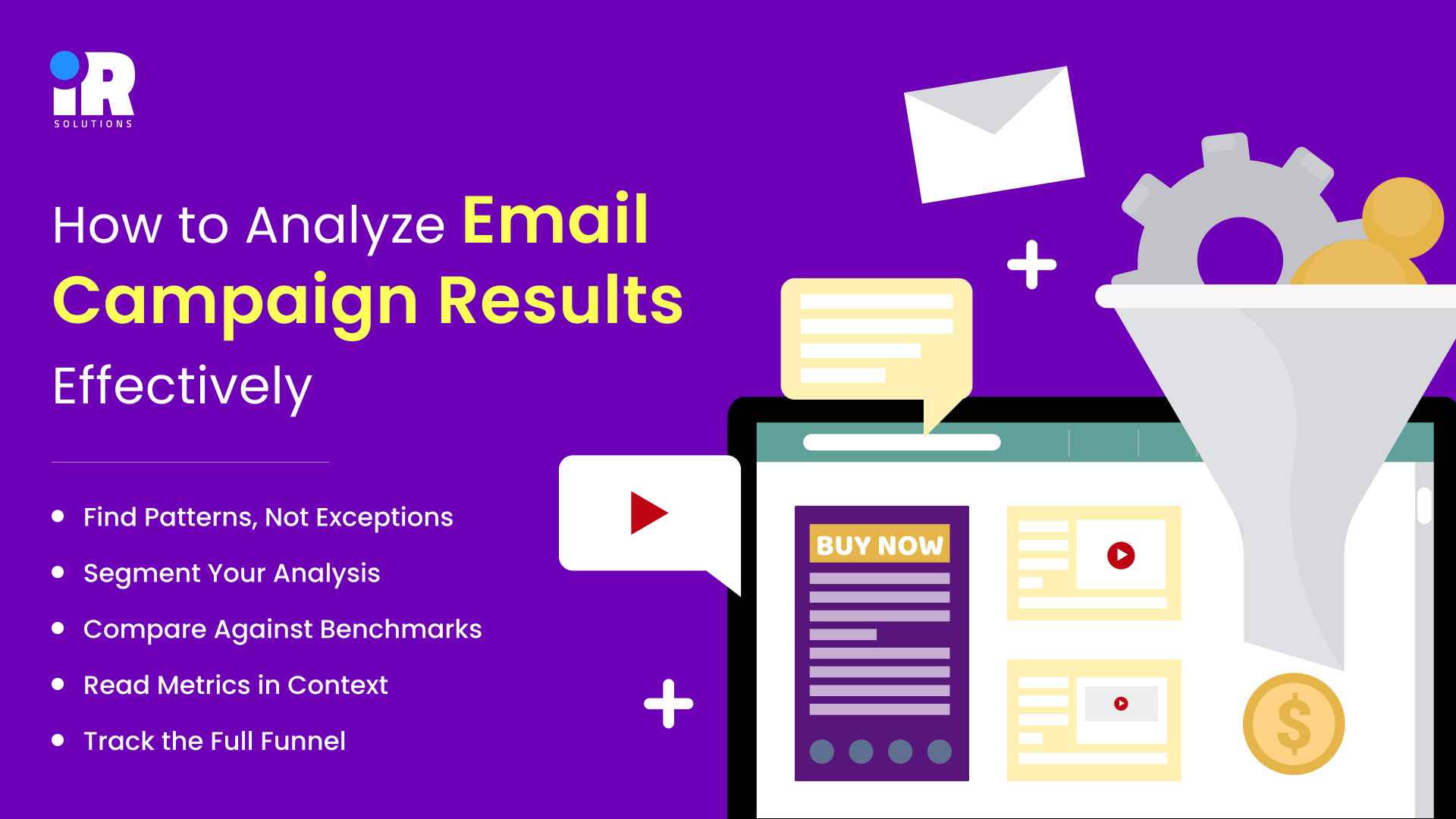
Find Patterns, Not Exceptions
One unusually strong campaign does not tell you anything reliable, while one unusually bad one does not either. What you are looking for are patterns that hold across five, ten, and fifteen campaigns over time. If emails sent on Wednesday mornings consistently outperform Thursday afternoons by a meaningful margin, that pattern is worth acting on, a single data point is not
Segment Your Analysis
Aggregate numbers hide a lot, a campaign that looks average overall might be performing extremely well with one audience segment and terribly with another. Break your results down by device type, location, engagement history, purchase behavior, or whatever segmentation your list supports. The gaps between segments are usually where the most useful optimization insights live.
Compare Against Benchmarks
Your metrics only mean something relative to a reference point. Compare your open rates and CTR against industry averages for your sector to understand where you actually stand. Then compare against your own historical performance to see whether you are moving in the right direction over time. Both comparisons together give you an honest read on where to focus improvement efforts.
Read Metrics in Context
A 1.8% CTR on a long-form educational newsletter is a different result than a 1.8% CTR on a promotional campaign with a revenue target attached to it. Always read performance against what a specific campaign was trying to accomplish. Applying the wrong benchmark to a metric leads to fixing things that are not actually broken while missing the things that are.
Track the Full Funnel
Email performance does not stop at the click, follow the path all the way through from click to landing page, landing page to form or checkout, checkout to completed purchase. An email with strong CTR and weak conversion almost always reveals a disconnect between the promise in the email and the experience on the landing page. You only see that when you track the full sequence, not just the email portion of it.
Proven Strategies to Improve Email Marketing ROI
Once you understand what your data is saying, the next step is acting on it. These are the strategies that actually move ROI rather than just improving surface-level engagement numbers.
Personalization and Segmentation
Generic emails produce generic results, when you segment your list by behavior, purchase history, geography, or engagement level and tailor your messaging to each group, relevance goes up, and so does conversion. Dynamic content that changes based on who is reading the email, their location, past purchases, and stage in the customer lifecycle takes this further. The more the email feels like it was written for that specific person, the more likely they are to act on it. Businesses often work with email marketing experts to implement these strategies more effectively.
If you want a deeper look at how automation, lifecycle flows, and customer segmentation directly influence revenue growth, read our blog on Klaviyo email automation ROI strategies, which explains the process in detail.
Optimize Send Timing
Timing is not everything, but it matters more than most people account for. Use your own historical data to identify when your specific audience tends to engage, and build your send schedule around that rather than around when it is convenient for you to send. Most email platforms now include send-time optimization features that handle this at the individual subscriber level automatically, turn that on if you have not already.
Effective Subject Lines
The subject line is the only part of your email that most people will read. It decides whether the email gets opened or archived without a second thought. Use A/B testing data rather than instinct to understand what language, structure, and framing consistently resonate with your audience. Short and specific usually outperform clever and vague. Questions, numbers, and specificity tend to do better than general statements about value.
Email Landing Alignment
One of the most common and expensive conversion killers in email marketing is the mismatch between what the email promises and what the landing page delivers. If your email offers 20% off and the landing page shows a homepage with no mention of the promotion, the subscriber leaves. Review every email and its corresponding landing page as a pair. The transition from email to landing page should feel like one continuous conversation, not a jarring redirect. This is where conversion rate optimization work pays for itself. Small fixes to landing page clarity and flow directly lift the revenue your emails generate.
Clean Your Email List Regularly
Sending to a list full of inactive or invalid addresses hurts deliverability, throws off your metrics, and wastes money on contacts who will never convert. Remove hard bounces after every send. Run re-engagement sequences for subscribers who have gone quiet for 90 days or more, and remove those who do not respond. A list of 8,000 engaged subscribers will consistently outperform a list of 25,000 people who barely remember signing up.
Connect Email to Your Other Channels
Email works better when it is part of a coordinated approach rather than something that runs independently of everything else. If someone sees a consistent message across your email, social media, and paid ads, the repetition builds familiarity and trust in a way that a single-channel push cannot. Pairing your campaigns with strong content marketing keeps that message relevant and gives subscribers something worth clicking through to. This is especially true for promotional campaigns, coordinating the timing across channels amplifies the reach without proportionally increasing the cost.
Set a Regular Review Process
Reviewing metrics once a quarter is not enough if you are sending weekly. A monthly review of key performance indicators lets you catch problems early and adjust before they compound. A quarterly deep dive is for looking at trends across the full period, evaluating segmentation performance, and reassessing your strategy against what your business is trying to accomplish in the next 90 days. Both are worth scheduling in advance and actually sticking to.
Turn your email marketing into a revenue-driven system. Book a free call with our team to review your current setup and growth opportunities.
How to Measure Email Marketing ROI Step by Step
The actual ROI calculation is straightforward once you have the right inputs. The challenge is getting those inputs accurately, which is why the setup matters as much as the formula.
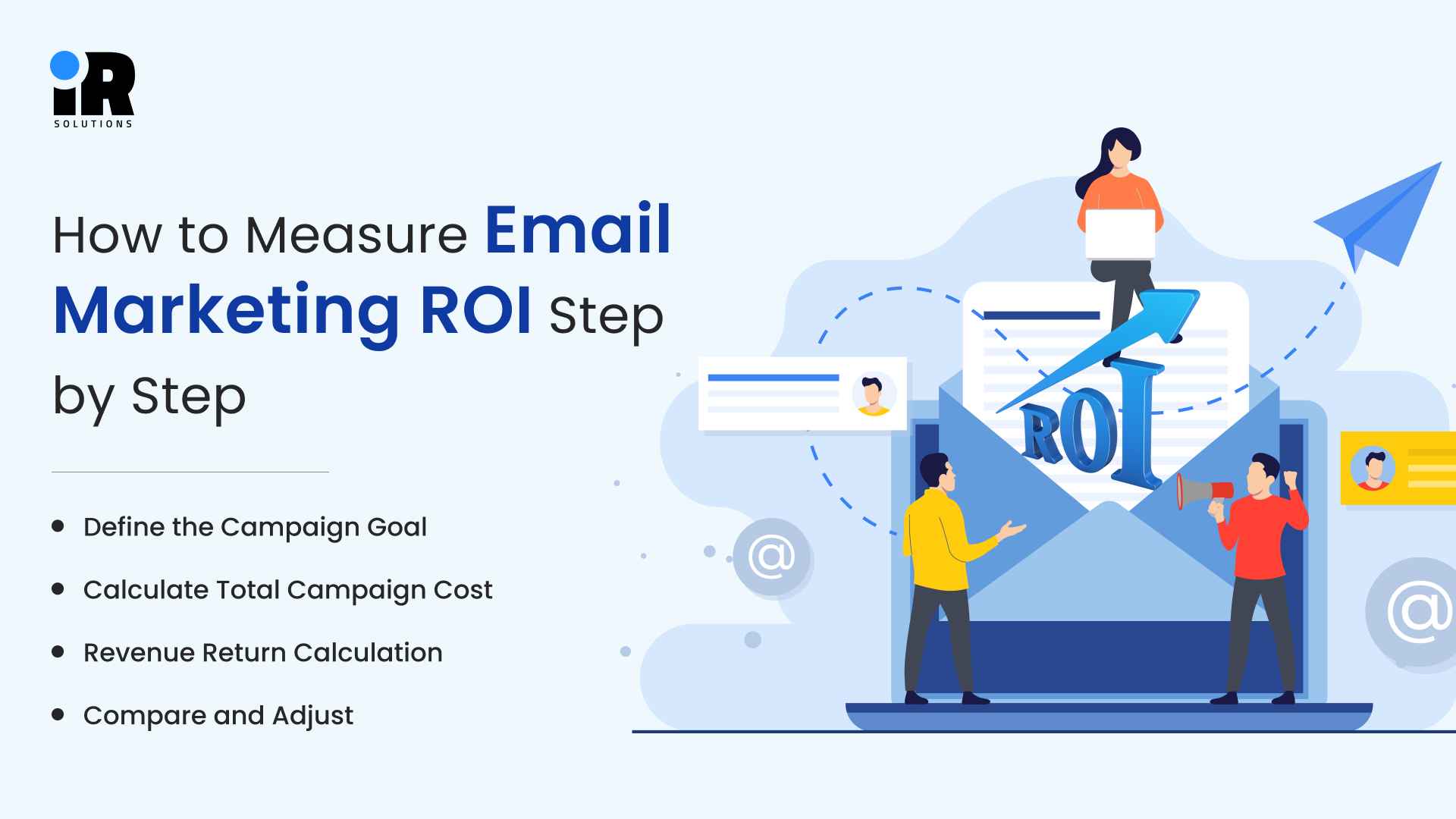
- Define the Campaign Goal: Before a single email goes out, decide what success looks like for this specific campaign. Revenue from a product launch, leads from a content offer, registrations for an event, and bookings from a service announcement each requires a different measurement approach. Without a defined goal, ROI has nothing to measure against at the end.
- Calculate Total Campaign Cost: This includes everything, such as platform fees, design costs, copywriting, any paid tools used in the process, and an honest estimate of internal time. Most businesses undercount this because they forget to include the hours spent by internal team members who could have been doing something else. A thorough cost figure is what makes the ROI number trustworthy.
- Revenue Return Calculation: That gives you a percentage you can compare across campaigns and benchmark against your broader marketing investment. Most businesses that do this calculation properly discover that their best-performing email campaigns significantly outperform their paid channels and that their worst-performing ones are costing more than anyone realized.
- Compare and Adjust: Stack your result against previous campaigns and sector benchmarks. Use the comparison to identify the highest-leverage thing to improve in your next campaign. ROI compounds when you build each campaign on what you learned from the last one rather than starting fresh every time.
How to Measure Promotional Campaign Success
Promotional campaigns need their own measurement framework because the goal is different and because the funnel is usually broader than a standard email program. Metrics worth tracking across a promotional campaign:
- Impressions and reach: Total exposure across all channels how many people entered the top of the funnel.
- CTR: How effectively email copy and creative drove clicks from inbox to the next destination.
- Conversion Rate (CVR): The percentage of people who completed the target action, purchase, sign-up, or redemption.
- Promo code redemptions: Unique codes attribute conversions to a specific campaign, including offline purchases that would otherwise go untracked.
- Customer Lifetime Value (CLV): Tracking CLV by acquisition campaign reveals whether a promotion drove long-term value or just short-term ROI.
Tracking the full funnel in promotional campaigns turns raw data into meaningful insights. Single metrics rarely tell the whole story, the real picture emerges when you see how they work together.
Email Marketing Errors That Silently Drain ROI
These are the mistakes that do not announce themselves loudly, they just quietly erode performance over time until the numbers are noticeably worse than they used to be.
- Sending the same email to your entire list treats people at very different buying stages and with different interests as if they are identical, which your metrics will quickly reflect.
- More than half of emails are opened on mobile, and if an email breaks on smaller screens, conversions are lost before the CTA is even seen.
- Every decision made without testing is a guess, and without comparison data, you learn very little about what actually works.
- If the reader cannot immediately understand the next step, they usually take none, as a single clear CTA consistently outperforms multiple vague ones.
- When subscribers cannot predict when your emails will arrive, they lose the habit of opening them, while consistency builds familiarity and improves engagement.
- A list that hasn’t been cleaned in months accumulates inactive contacts, invalid addresses, and spam traps that can slowly damage sender reputation over time.
The fastest ROI improvements often come from fixing these rather than adding something new. Address the basics before chasing advanced tactics.
Conclusion
The difference between email marketing that grows a business and email marketing that just keeps the lights on usually comes down to how seriously you treat the data behind it. Campaigns that drive consistent ROI are not necessarily smarter or more creative, they are more deliberate. They start with a clear goal, track the right things, and use what they learn to make the next send better than the last one. That approach compounds over time in a way that one-off campaigns never will.
Whether you are building an email program from scratch, trying to understand why an existing one has plateaued, or looking to connect your email performance to broader business outcomes, working with a team that lives inside digital marketing every day saves a significant amount of time, budget, and guessing. That is where partnering with an email marketing company focused on ROI-driven automation becomes especially valuable, because when email marketing connects to the right tech infrastructure and systems behind it, the results start to compound in ways a standalone campaign never could.
Frequently Asked Questions
How do I calculate my email marketing ROI?
Subtract the total campaign cost from revenue generated, divide by the cost, then multiply by 100. Include all costs creative, platform fees, and labour for an accurate figure.
What open rate should campaigns aim for?
Between 20% and 30% is a reasonable benchmark across most sectors, though well-segmented lists often outperform this range.
Why is my email click-through rate low?
Usually weak content, a buried CTA, or a mismatch between the offer and audience. Test one variable at a time before concluding.
How often should marketing emails go out?
Once or twice a week works for most businesses, but consistency matters more than frequency.
What causes a sudden spike in unsubscribes?
Irrelevant content, too-frequent sends, or an off-tone email a spike is worth investigating rather than dismissing as normal churn.
Should email lists be cleaned regularly?
Yes, removing inactive and invalid addresses protects deliverability and keeps performance data accurate. Most marketers do this every three to six months.
Which tools best measure email campaign performance?
Mailchimp, HubSpot, Google Analytics, and Litmus cover most needs what matters is that your email platform and analytics tools are properly connected.