


Key Takeaways
- Testing replaces assumptions with real customer behavior, so you stop guessing what shoppers actually want.
- Start with the weakest part of your email funnel instead of testing random elements for fun.
- Change one meaningful variable at a time and keep everything else the same in both versions.
- Choose your winning metric before the test starts, so the result can't be bent later.
- Judge revenue tests by conversions and revenue, because opens alone rarely tell you the full story.
- Record every result so future campaigns can build on what earlier tests already taught your team.
A subject line gets plenty of opens, but barely anyone clicks. A discount brings in orders, but cuts into profit. These are common problems ecommerce brands face, and A/B testing can help identify what needs to change.
Ecommerce email A/B testing helps you make better decisions using real customer data. By comparing two versions of an email, you can find out which subject lines, offers, designs, and send times get better results. You do not need a large budget or a data team to get started.
This guide covers practical email A/B testing ideas for ecommerce campaigns and automated flows, along with steps to run tests and measure results. You will learn how to test one change at a time and use the findings to improve future emails.
If you want to improve your automated campaigns too, read our guide on 6 Key Email Marketing Flows for Ecommerce Growth.
What Does A/B Testing Mean?
A/B testing means comparing two versions of an email or automated flow to see which performs better. For example, Version A might say Shop Our New Collection, while Version B says See What's New This Week. Each version should go to comparable groups of people, under similar conditions, so the comparison stays fair.
A/B testing helps ecommerce brands make decisions based on customer behavior rather than assumptions. Stores can test subject lines, preview text, sender names, copy, images, buttons, offers, recommendations, timing, and flow structure.
A/B Testing vs Random Email Changes
Random changes rely on guesswork, while A/B testing helps you compare results and understand what works. Here is how they differ.
Comparison | Random Email Changes | A/B Testing |
Approach | Change an email element and hope for better results. | Compare two versions to find which performs better. |
Goal | Make changes without a clear reason. | Test a specific idea about customer behavior. |
Example | Change the email design and check sales afterward. | Add customer ratings beside the main button to test whether they increase purchases. |
Results | Hard to tell which change affected performance. | Use performance data to identify the stronger version. |
Next Steps | Make more changes based on assumptions. | Apply the findings to improve future campaigns. |
Why Testing Matters for Ecommerce Email Marketing
Testing tells you what your shoppers really want, so you stop spending time on emails that fall flat. It turns every send into a small lesson, and those lessons add up to better results over time. Here are four reasons to make testing part of your email marketing strategy.
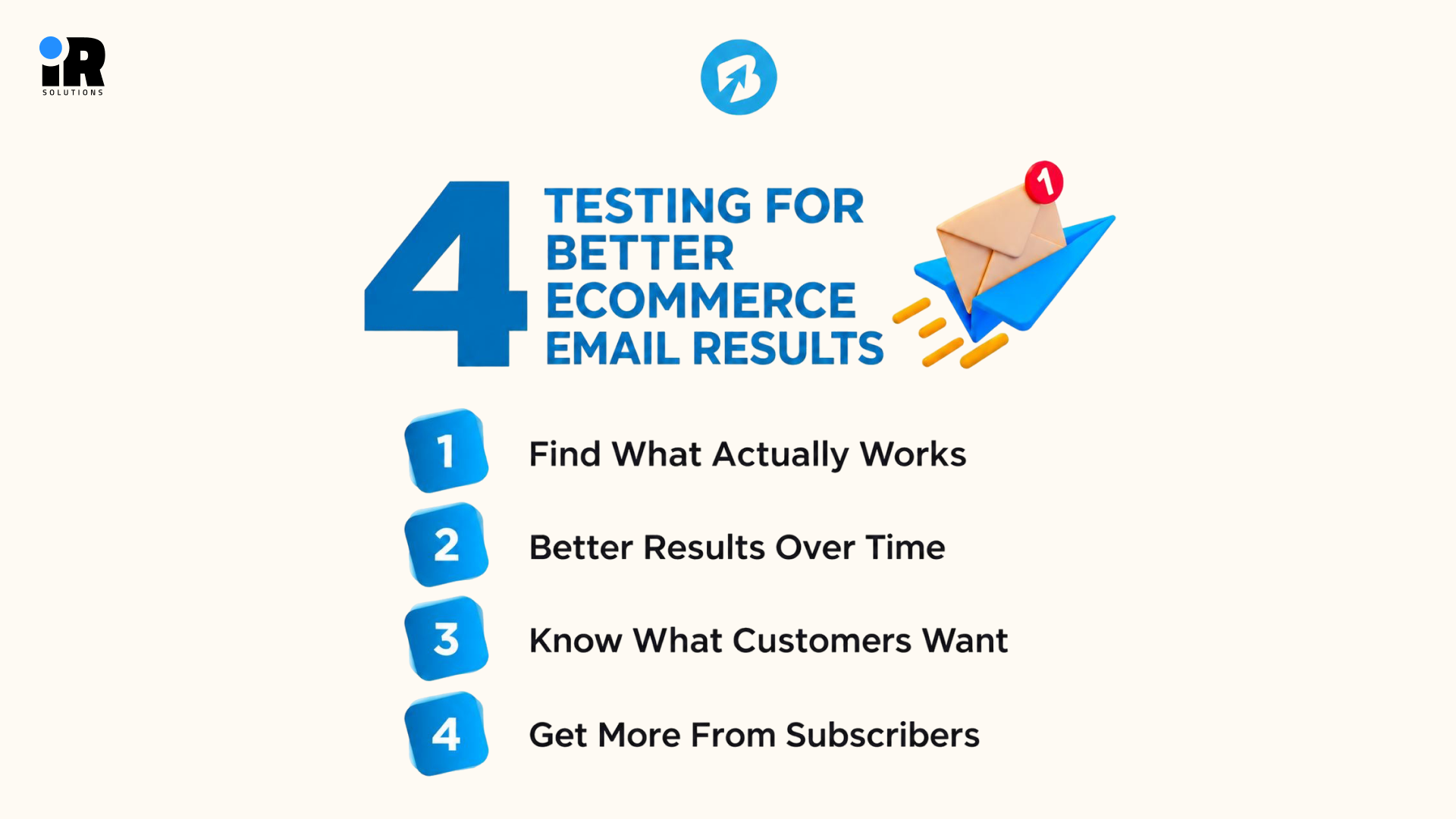
Find What Actually Works
Most email choices start as opinions, and opinions are a risky thing to build sales on. Personal taste, competitor emails, design trends, and general best practices can all send you the wrong way. Your own customers are the only ones who can tell you what works for your store.
Better Results Over Time
Gains come slowly, but each lesson you keep makes your next campaign a little stronger than before. Testing can help promotional campaigns, welcome emails, browse abandonment, cart recovery, post-purchase emails, win-back messages, and VIP emails. No one can promise a fixed percentage gain, so treat every result as a lesson, not a guarantee.
Know What Customers Want
A well-planned test can help you understand which messages, offers, and products your shoppers respond to. You may find that people like direct messages more than curious ones, or product photos more than lifestyle shots. You may also learn if they want discounts or benefits, short or long copy, and personal or general picks.
Get More From Subscribers
Your current list already holds plenty of value, and better emails help you collect more of it. Stronger emails bring more revenue from people you already reach, which is the heart of ecommerce email optimization. You get there without sending more emails each week, so your subscribers don't feel buried in your messages.
How to Plan an Email A/B Test
Good planning saves time and helps you avoid misleading results. Before you start, decide what you want to improve, which email element to test, and how you will measure success. This gives you a clear direction and makes it easier to tell whether the change actually worked.
Start With a Clear Problem
Do not begin by asking what you can test; begin by asking what isn't performing well. Common problems include low inbox engagement, weak clicks after good opens, few orders after good clicks, and poor cart recovery.
Define the Goal
A clear goal tells you which number to watch when the results finally come in. Your goal might be more clicks, more placed orders, higher revenue per recipient, or more recovered carts.
Write a Testable Hypothesis
A clear hypothesis gives your test a purpose and helps you understand the result. State what you want to change, what you expect to happen, and why you think it will work. Use this simple format: If we change X, we expect Y to improve because of Z.
Create a Control and a Variation
Every test needs one version you already use and one version with a single change. If you test button copy, the control might say Shop Now, and the variation might say View the Collection.
Change One Meaningful Variable at a Time
Too many changes at once make the final result impossible to explain or repeat later. If Version B changes the subject, images, button, discount, and copy, you will not know what worked.
Use Comparable Audience Groups
People behave differently, so an uneven split can skew your results without you noticing. Avoid comparing new subscribers with repeat buyers, VIPs with first-time shoppers, or different countries with each other.
Keep Test Conditions Consistent
Both versions must run under very similar conditions, or the comparison stops being fair to either. Keep the testing period, audience type, promotion, inventory availability, email frequency, and other campaign activity consistent.
Choose the Winning Metric Before the Test Starts
The metric must match your hypothesis, and you must pick it before you see any numbers.
Test | Primary Metric |
Subject line | Opens / downstream engagement |
Preview text | Opens / clicks |
CTA | Clicks/conversions |
Email copy | Clicks/conversions |
Product recommendation | Orders/revenue |
Offer | Conversion/revenue per recipient |
Flow timing | Conversion/flow revenue |
Post-purchase content | Repeat purchase |
Give the Test Enough Data
Small audiences can produce misleading results, especially when you are measuring purchases. Before starting, check whether your audience is large enough to detect a meaningful difference. Use your platform's statistical significance tools where available, and avoid declaring a winner before enough data has been collected. If the result is inconclusive, record it and test again when you have more volume.
What Should You A/B Test First?
Most guides give a long list of ideas, but your own weak spot should decide the order. Use the table below to match each performance problem with the test most likely to help.
Performance Problem | Test First |
Low opens | Subject line, preview text, sender |
Good opens, weak clicks | CTA, copy, creative |
Good clicks, weak purchases | Offer, product relevance, proof |
Weak welcome conversions | Offer, product selection, message |
Weak cart recovery | Timing, objection handling, incentive |
Weak repeat purchases | Recommendations, post-purchase timing |
High unsubscribes | Frequency, relevance, promotion level |
Test the bottleneck, not whatever seems most interesting on the day you plan your campaign.
Ecommerce A/B Testing Ideas for Subject Lines and Inbox Messaging
Subject lines, preview text, and sender names all influence how an email appears in someone's inbox. Testing these elements can help you understand which messages attract attention and encourage engagement. Start with one element and compare the results before making further changes.
Short vs Longer Subject Lines
Length changes how much of your message people can read on a small phone screen. Never assume one length always wins, because your audience may respond differently from other brands' customers.
Direct vs Curiosity-Based Subject Lines
A direct line states the offer, while a curious line makes people want to open. A higher open rate is not automatically better if purchases fall at the same time.
Personalized vs Generic Subject Lines
Personal touches can feel warm, but they only help when they feel genuinely useful to readers. Also test personalization based on category interest, purchase history, or customer type, not just first names.
Urgency vs Neutral Messaging
Urgency can push people to act, but it can also wear out trust very quickly. Only use urgency when it is genuine, because shoppers quickly notice fake deadlines and stop believing you.
Emoji vs No Emoji
Emojis can help your email stand out, or they can make a brand look less serious. Treat emojis as something to test with your audience, not as a best practice that works everywhere.
Preview Text Variations
Preview text is a second headline that many brands leave blank or fill with filler. Test offer against benefit, product details against a button prompt, urgency against context, and short against descriptive text.
Brand Sender vs Personal Sender
Sender names can influence whether subscribers recognize and trust an email. Test your store name against a recognizable team member's name, such as "Your Store" versus "Sarah from Your Store." Keep the sender identity genuine so subscribers know who is contacting them.
Ecommerce A/B Tests for Email Copy
A/B testing email content shows you how much explanation your shoppers want before they buy. Small wording choices can change how people feel about a product, so copy deserves its own tests.
Short Copy vs Detailed Copy
Some customers want quick facts, while others need more explanation before they feel ready to purchase. Test a short version against a detailed one and see which gets more clicks and orders.
Product-First vs Benefit-First Messaging
The way you describe a product can change how customers respond to your email. Test whether customers pay more attention to the product itself or the benefits it offers them.
Example:
- A: Our New Running Shoes Are Here
- B: Run Longer With More Everyday Comfort
Educational vs Promotional Copy
Teaching your customers something useful can build trust faster than pushing a sale every time. This test matters most in welcome emails, post-purchase emails, and campaigns for high-consideration products that need explaining.
Direct vs Conversational Tone
Your brand voice affects how people feel, so it deserves a fair test like anything else. Test a straight-to-the-point tone against a friendly, chatty one, while keeping the offer completely unchanged.
Social Proof vs No Social Proof
Shoppers trust other shoppers, so proof can calm their doubts right when they are deciding. Try a product rating, a review quote, a customer photo, or the total number of reviews. Keep the rest of the email consistent, and read our email copywriting guide for stronger wording.
Ecommerce A/B Testing for Email CTAs
Smart email CTA testing helps you find the words and spots that move shoppers toward checkout. Small changes to a button can change who clicks, so each idea below deserves a fair test.
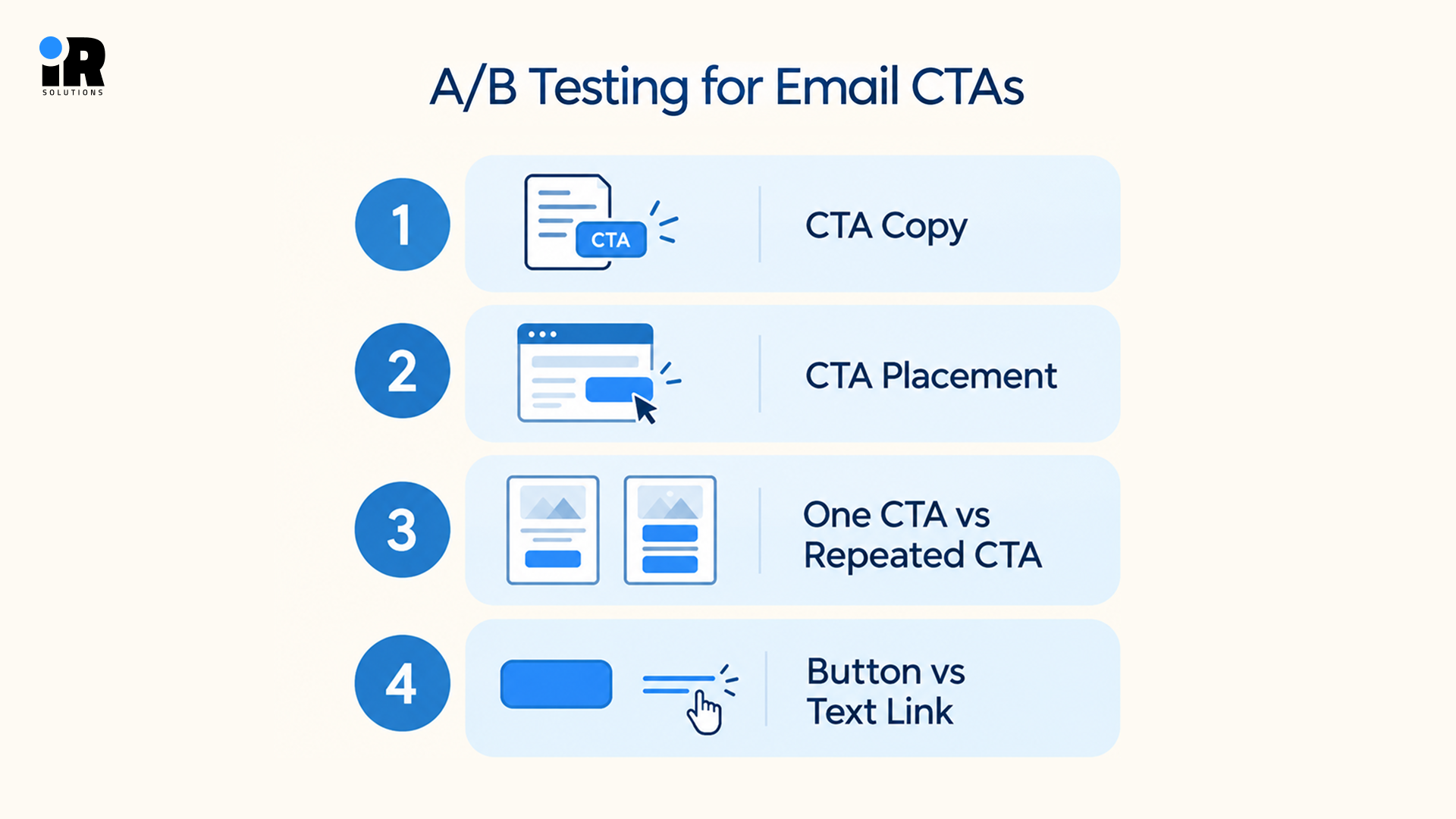
CTA Copy
Button words set clear expectations, so even a small wording change can affect who clicks. Try Shop Now against View the Collection, Complete Checkout against Return to Your Cart, or Buy Again against Restock Now.
CTA Placement
Where the button appears can decide whether people see it before they lose interest. Test a button near the top, after product benefits, and after social proof to compare the results.
One CTA vs Repeated CTA
Repeating a button can help in long emails, but only if the action stays the same. This means repeating the same primary action, not adding several competing actions that confuse the reader.
Button vs Text Link
A plain link can feel more personal, while a bold button is easier to spot quickly. This test is especially useful for founder-style emails, plain-text emails, and other content-heavy campaigns that tell stories.
A/B Testing Email Design for Ecommerce
A good-looking email should also be easy to read and act on. Test different layouts to see which ones help shoppers understand your message, explore products, and make purchases. Look at clicks and conversions together to understand how the design affects performance.
Product Image vs Lifestyle Image
Studio photos show the item clearly, while lifestyle photos show how it fits into real life. Send both to similar groups, and let real orders pick the winner, not your design taste.
One Hero Product vs Multiple Products
One hero product keeps the choice simple, while several products suit shoppers who like to browse. Try it in product launches, welcome emails, and promotions, where focus or variety could change the result.
Minimal Design vs Image-Heavy Design
Simple layouts load fast and feel personal, while image-heavy layouts show off your products better. You can use the same idea to test plain-text style emails against fully designed HTML ones.
Short Layout vs Longer Storytelling Layout
Some products sell in seconds, while others need a story before shoppers feel sure enough to buy. Keep the offer, audience, button, and product the same, so layout length is the only change.
Social Proof Near CTA vs Lower in the Email
Reviews may help shoppers feel more confident before clicking through to a product. Test placing reviews near the main CTA against placing them lower in the email to see which position encourages more action.
Mobile-First Layout Variations
Many shoppers read emails on their phones, so mobile changes can matter more than desktop ones. Try a shorter layout, a larger button, or fewer product blocks, and skip tiny cosmetic tweaks that waste testing volume.
Ecommerce A/B Tests for Discounts and Offers
The offer you put in an email changes two things at once: how many people buy and how much money you keep from each sale. A discount that lifts orders by 10% but cuts your margin in half is not a win. That is why offer tests deserve more care than subject line or button tests. Each test below should be judged on revenue per email sent and profit per email sent, and not on the order count alone.
Discount vs No Discount
A discount can bring back shoppers who were on the fence, but you pay for it on every order, including the ones that would have happened anyway. Send one group a plain cart reminder and the other group the same email with a discount added. Then check if the extra orders earn more than the margin you gave up.
Example:
- Version A: You left something in your cart. Your items are still waiting.
- Version B: You left something in your cart. Use code SAVE10 for 10% off today.
If Version B brings 12% more orders but your profit per email drops, the plain reminder wins.
Percentage Discount vs Fixed Discount
Percentage and fixed discounts can feel different to shoppers, even when the savings are equal. To make a fair comparison, test both offers within a similar cart-value range. For example, on a $100 order, 20% off and $20 off provide the same savings. However, their values change for larger or smaller orders, so compare the results by cart size and profit.
Example:
- Version A: Take 20% off your order. Ends tonight.
- Version B: Take $20 off your order. Ends tonight.
Run the test on one cart size range at a time, because the winner may change when the order is $40 or $250.
Discount vs Free Shipping
Many people leave at checkout because the shipping cost surprises them. If that is your problem, free shipping can beat a discount that costs you the same. Match the value of the two offers first, then see which one gets more people to finish.
Example:
- Version A: Get $8 off your order with code SAVE8.
- Version B: Your order ships free. No code needed.
Check your exit data first. If shoppers drop off right when shipping is added, Version B has a good chance.
Immediate vs Delayed Incentive
Offering money off in the very first email can win quick orders, but it can also teach people to wait for a coupon. Try holding the offer back until the second or third email and compare both groups. Look beyond the first week and watch whether the early-discount group buys less at full price later.
Example:
- Version A: Email 1 at 1 hour: Here is 10% off to finish your order.
- Version B: Email 1 at 1 hour: Your cart is saved." Email 2 at 24 hours: "Here is 10% off to finish your order.
If both groups achieve similar purchase rates, compare how many shoppers used the discount, how much revenue each group generated, and the profit left after incentives. Delaying the offer may protect margin if more customers purchase before receiving a discount.
Offer-Led vs Product-Value Messaging
If you can sell the product without a discount, you protect your margin over the long run. This test shows whether your customers care more about the price cut or about the reasons to own the product. Keep the layout the same and change only the message.
Example:
- Version A: Save 15% today on the items in your cart.
- Version B: Why customers keep buying this product: it lasts for years and comes with a 2-year warranty.
Version B can include real review lines and a short reason to buy, with no code at all. If it performs close to Version A, you can use fewer discounts.
Ecommerce A/B Tests for Personalization and Product Selection
Shoppers decide fast. If your email shows something they care about, they click, and if it doesn't, they move on. These tests show which product picks earn the most revenue per recipient.
Personalized Products vs Best Sellers
Best sellers feel safe because many people already bought them, while picks based on a shopper's own behavior feel made for them. Send one group each type and compare revenue per recipient.
Recently Viewed vs Related Products
Some shoppers just need a small reminder of the product they left. Others want new ideas. Show one group the exact item they viewed and the other group similar items to see which brings more orders.
Category-Specific vs General Content
A shopper who loves running may skip an email full of random products. Send one group items from their favorite category and the other group your usual new arrivals.
First-Time vs Repeat Customer Messaging
First-time and repeat customers often need different messages. Within each customer group, compare your usual email against a version written for that audience. For example, test product education for first-time buyers and personalized recommendations for repeat customers.
Purchase History vs General Recommendations
What someone bought before is a strong clue about what they may need next. Compare picks based on past orders with general ones in repeat-customer and post-purchase emails.
Ecommerce A/B Testing Ideas for Send Timing
Advice about the "best time to send" is the same for everyone, but your shoppers are not. Testing send times shows you what your own audience does.
Morning vs Evening
Some people check email on the way to work, and others wait until the day is over. Send the same email to one group in the morning and another in the evening, then see which one earns more orders.
Weekday vs Weekend
Shopping habits often change when the workweek ends. Many people have more time to browse on weekends, but others stay away from their inbox. Test both and let your own data decide.
Immediate vs Delayed Follow-Up
A quick follow-up can feel helpful to one shopper and pushy to another. Send one group a reminder soon after they leave and the other group a bit later. Keep everything else the same, so only the timing changes.
Short vs Longer Flow Delay
The gap between emails in a flow can change how many shoppers come back. Try a shorter wait before your second cart email against a longer one, and compare it with your current gap. For practical starting points, read our guide on abandoned cart email timing.
A/B Testing Ecommerce Email Automation
Automated email flows keep sending messages based on what customers do, so even a small improvement can make a difference over time.
Unlike one-time campaigns, automated flows reach new shoppers continuously. This makes them useful for testing changes over time, provided enough customers enter each version. Focus on one part of the flow and compare the results before changing the rest.
Welcome Flow Tests
Your welcome flow meets every new subscriber first, so it has the biggest chance to shape habits.
- Offer First: Test an offer-first opening against a value-first opening that explains why your brand deserves attention.
- Product Mix: Compare best sellers with category-specific products, and compare a short sequence with a longer one.
Browse Abandonment Tests
These shoppers showed interest but left, so your message needs to feel helpful, not pushy.
- Product Count: Compare one product with several suggestions to see whether focus or choice brings more shoppers back.
- Proof Type: Test product images against lifestyle images, and reviews against product benefits, using the same delay.
Cart and Checkout Recovery Tests
Cart emails reach people closest to buying, so they often deserve your most careful testing.
- Reminder Style: Compare a simple reminder with a message that answers common doubts about price, fit, or delivery.
- Incentive Timing: Test a discount against no discount, and test an immediate incentive against a delayed one.
Post-Purchase Tests
The sale is not the end, because the next order starts with what you send now.
- Education First: Test product education against cross-sell, and test different timing for the cross-sell message that follows.
- Review Requests: Test review-request timing, and compare asking for a review with introducing your loyalty program instead.
Win-Back Tests
Inactive customers already know you, so the right nudge can bring them back quite cheaply.
- New Products: Compare newly launched products with personalized recommendations, and compare having an offer against having no offer.
- Inactivity Rules: Try free shipping against a discount, and test different inactivity thresholds instead of copying one universal period.
VIP and Loyalty Tests
Your best customers deserve thoughtful messages, and testing shows you what they truly value most.
- Early Access: Compare discounts with early access, and compare an exclusive product with a simple loyalty reward.
- Recognition Tone: Test referral messages against loyalty benefits, and recognition against promotional messaging for your most loyal customers.
How to Read Your Test Results Correctly
Running a test is only useful when you interpret the results correctly. A higher click rate does not always mean more sales, and an early lead does not guarantee a winner. Check whether the difference is meaningful before deciding what to change.
Match the Result to the Goal
Each kind of test has its own scoreboard, and mixing them up leads to wrong conclusions.
Judge subject tests by inbox engagement, button tests by clicks and conversions, offer tests by orders and revenue. Good email conversion testing always ties the final result back to the goal you set at the start.
Don't Declare a Winner Too Early
Early numbers swing wildly, and a lead after only a few hours rarely holds up. Wait until you have enough recipients, clicks, purchases, and time before you call the result meaningful.
Be Careful With Open Rate
Open rates look simple, but they hide problems that can easily mislead even careful marketers.
Apple Mail Privacy Protection can record opens even when someone has not actively read an email, making open rates less reliable for evaluating performance. You can still review opens when testing subject lines, but check clicks and purchases before making broader decisions. For sales-focused tests, prioritize placed orders, conversion rate, and revenue per recipient.
According to Klaviyo's explanation of Apple Mail Privacy Protection, automatic tracking-pixel loading can inflate reported email opens, even when recipients have not actively read the message.
Compare Segment Responses
An overall winner can hide smaller groups that actually prefer the version that lost the test. Version A might win overall while Version B performs better among repeat buyers or VIP customers.
Consider the Trade-Offs
One headline number rarely tells the whole story of what a change did to your business. Version B might bring more orders, but it could also lower average order value and raise unsubscribes. Weigh revenue, margin, customer value, and unsubscribes together before you decide which version deserves to win.
Record What You Learned
Test | Hypothesis | Primary Metric | Result | Next Step |
Subject line | A direct offer will increase clicks | Click rate | Inconclusive | Test again with more recipients |
CTA wording | Specific wording will encourage clicks | Click rate | Version B performed better | Validate in another campaign |
Product selection | Personalized recommendations will increase orders | Placed order rate | Version A performed better | Test with another customer segment |
Note: These are illustrative results, not actual campaign data.
How to Prioritize Your Email Tests
You cannot test everything at once, so choose the experiments that deserve your limited attention. Ranking your ideas takes a few minutes, and it keeps your team focused on what pays.
Find the Biggest Gap
Start with the problem affecting performance the most. Once you understand the results and make a change, move to the next area that needs attention.
Estimate Business Impact
Run ecommerce email experiments where money moves, such as cart recovery, before polishing small design details. A cart email can matter far more than a tiny design change on one campaign.
Check Your Volume
Email split testing needs enough volume, because small audiences rarely give clear and reliable answers. High-volume campaigns, welcome flows, and cart flows make stronger testing environments than tiny audience segments.
Use a Simple Rule
Use this formula: high impact plus enough traffic plus easy to isolate equals test first. If a test fails any of those three parts, move it further down your list.
Common Testing Mistakes to Avoid
Even a good test idea can produce misleading results if it is poorly planned. These are some common mistakes to avoid.
- Define the Problem: Testing without a clear problem wastes effort, so never test just because the platform offers a button.
- No Hypothesis: A winner without a reason gives you very little insight that you can reuse later.
- Too Many: Changing too many variables means you will never know what actually caused the final result.
- Mixed Audiences: Audience differences may shape the result more than the email change you wanted to measure.
- Shifting Conditions: Avoid comparing versions that were sent under very different circumstances, because the comparison stops being fair.
- Outside Factors: Send day, sale periods, stock levels, holidays, other campaigns, and audience changes can all influence the outcome.
- Small Samples: Tiny audiences and early endings can both produce misleading winners, so wait for enough meaningful behavior.
- Wrong Metric: Never judge a revenue experiment by opens, because opens do not pay your bills at month end.
- Tiny Details: Button corners, small font changes, and spacing tweaks matter less than offer, audience, relevance, button copy, and timing.
- Copycat Tests: What worked for another store is only a hypothesis for yours, so verify it with your own audience.
- One Test: Customer preferences, products, offers, and market conditions change, so one test never settles the question forever.
A Simple Testing Framework You Can Repeat
This simple framework helps you A/B test email campaigns in a steady, repeatable way every month.
Follow this path: problem, hypothesis, variable, control and variation, test, measure, learn, apply, and test again.
- Problem: Find where performance is weak, and let that gap guide everything else you plan next.
- Hypothesis: Explain what you believe could improve the result, and write down exactly why you believe it.
- Variable: Choose one meaningful change that is large enough to matter and simple enough to isolate.
- Two Versions: Keep the original as your control, and create exactly one altered version as your variation.
- Test: Randomly divide the eligible audience, keep conditions consistent, and run both versions at the same time.
- Measure: Focus on your chosen primary metric, but also review secondary results such as revenue, unsubscribes, and profit to catch any unwanted effects.
- Learn: Study what the result says about customer behavior, rather than only noting which version won.
- Apply: Use the lesson in future emails where it fits, and skip it where it clearly does not.
- Test Again: Move on to the next meaningful question, because good testing is a habit, not a single project.
Conclusion
Ecommerce email A/B testing helps you understand what encourages your customers to click, buy, and return. You don't need to test everything at once. Start with a problem that affects your results, try one meaningful change, and give the test enough data before making a decision.
Keep track of what works and what doesn't. Over time, those findings can help you build stronger campaigns and automated flows without relying on guesswork. If you need help planning and improving your email campaigns, explore the email marketing experts at IR Solutions.
Frequently Asked Questions
What is A/B testing in ecommerce email marketing?
It means sending two versions of an email to similar groups to see which one works better. A clear metric, like clicks or orders, decides the winner, so there is no guessing involved.
What should ecommerce brands A/B test?
You can test subject lines, preview text, sender names, copy, buttons, design, offers, recommendations, timing, and flow structure. Pick the area linked to your biggest problem, rather than trying to test everything at once.
What should I A/B test first?
Start with your biggest weak spot, because fixing it usually brings the largest gain for your business. If opens are low, test subject lines, and if carts are lost, test your reminders.
How many variables should I test at once?
For a standard A/B test, change one meaningful thing at a time so the result stays clear. If you change many things together, you will never know which one made the real difference.
What is a control in email A/B testing?
The control is the version you already use, and it is the baseline for your test. The variation is the same email with just one change, and it is tested directly against the control.
How long should an email A/B test run?
There is no set timeframe, because the right length depends on your audience, send volume, customer action, and metric. A longer buying cycle needs a longer test, while quick impulse buys may show results sooner.
How many subscribers do I need for A/B testing?
You need enough recipients and conversions to make the difference meaningful, not one fixed list size. Use the statistical tools in your email platform, instead of trusting one universal number you read online.
Should I choose the winner based on open rate?
Only when the test is about inbox behavior, and even then you should read opens with care. Privacy features can inflate opens, so clicks and orders are usually safer numbers to trust.
Can ecommerce email flows be A/B tested?
Yes, depending on your platform, you can test flow emails, offers, content, timing, delays, and sequence structure. Start with one email or one delay, since flows keep earning long after the test ends.
What is the best metric for testing ecommerce emails?
There is no single best metric, so choose the one that matches the goal of your test. That could be clicks, orders, revenue per recipient, or repeat purchases, depending on what you want to learn.
How often should ecommerce brands run A/B tests?
Run a test whenever you have a real question, enough data, and a clear business reason to try it. Many stores keep one test running at a time, so each result stays easy to read.