


Key Takeaways
- Email turns existing leads into qualified prospects and paying customers over time.
- Educational emails build trust during the long decision cycles that come with money choices.
- Automated follow-ups reduce lead loss and keep prospects moving toward the next step.
- Onboarding emails help new customers activate accounts and start using what they signed up for.
- Renewals, retention, and relevant cross-selling raise the value of every customer you already have.
- Tracking consultations, applications, new clients, retention, and revenue, not only opens and clicks.
Financial services companies spend time and money attracting leads through ads, search engines, and referrals. But not everyone is ready to open an account, apply for a loan, or book a consultation right away. Financial decisions often take time, and without regular follow-ups, interested prospects may eventually turn to another provider.
Email marketing helps financial advisers, lenders, insurers, and fintech companies stay connected with potential customers. By sharing useful information, answering common questions, and sending timely reminders, businesses can build trust and help people make informed decisions without putting pressure on them.
Email also helps businesses maintain relationships with existing customers. From onboarding and service updates to renewal reminders and personalized offers, the right messages can improve customer engagement and encourage long-term loyalty.
In this guide, we'll cover practical financial services email marketing strategies, campaign examples, automation, compliance considerations, and ways to measure leads, conversions, retention, and revenue.
Before you start, read the FTC guide to commercial email rules so your first send stays clean. Every section below aims to win you more clients and keep the ones you already have. Let us start with what this kind of email actually looks like in daily practice.
What Is Financial Email Marketing?
Financial email marketing means using email to stay in touch with prospects and customers throughout their relationship with a financial business. It helps businesses share useful information, follow up with leads, and keep clients informed.
Banks, financial advisers, insurers, mortgage lenders, and fintech firms use email for lead generation, client education, consultation bookings, application reminders, onboarding, renewals, and customer retention. It can also help them reconnect with inactive clients and recommend relevant services.
Each email serves a purpose, such as getting an application completed, booking a consultation, or renewing a policy. To learn more about planning effective emails, read our guide to email marketing campaigns.
How Email Marketing Helps Financial Services Grow
Email marketing enables financial services firms to generate qualified leads, increase conversions, and maintain customer relationships. It’s not just about getting new clients, but also about onboarding, renewals, and long-term retention.
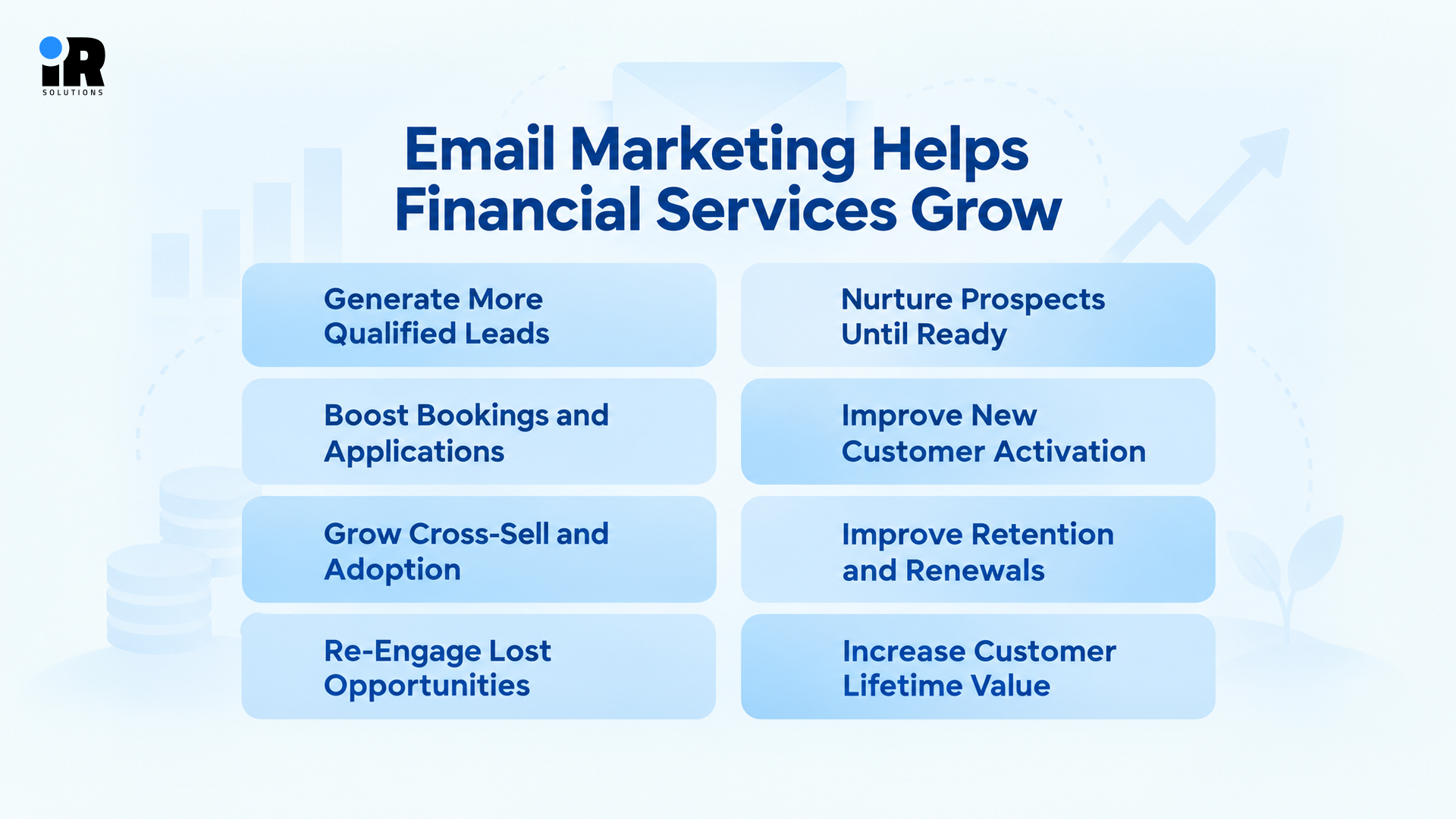
Generate More Qualified Leads
Email can help you generate leads after someone downloads a guide, uses a calculator, attends a webinar, or requests information. The same thing when they complete a consultation form or sign up for market insights. A missed follow-up can mean lost customer interest, forgotten business, or a search for other financial service providers. A simple path looks something like this: guide download, follow-up emails, consultation, qualified lead.
Nurture Prospects Until Ready
Financial decisions often require careful research and comparison, so prospects may take weeks or months before they're ready to speak with an adviser or apply for a service. Good nurture emails answer simple questions: what the service does, who it suits, and what happens next. They also explain which problems the service solves and what a person should weigh before deciding. The goal is to guide each prospect gently toward a real conversation or a completed application form.
Boost Bookings and Applications
Some prospects are already close to taking the next step because they requested a quote or booked a consultation. Others have started an application, asked about a specific service, or requested more information from your team. A timely email reminds them of what to do next and clears up any confusion that may cause delays. The goal is to get them to book a consultation, complete an application, open an account, or contact an adviser.
Improve New Customer Activation
Winning a customer is one thing, but getting that person to actually use the service is another. Activation might mean finishing account setup, verifying details, activating a card, or making a first deposit. It can also mean setting up a key feature, scheduling an onboarding call, or exploring the service. Onboarding emails guide each step, which reduces early drop-off and keeps new customers from going quiet.
Grow Cross-Sell and Adoption
Existing customers sometimes have a real need for another service, and email helps them discover it. Thoughtful financial services cross-selling matches the offer to the person, never the other way around. A banking customer may want a savings product, while a mortgage client may need relevant protection cover. A business customer might need extra finance, and a fintech user may value another helpful feature. Promote only what fits, because pushing unrelated products quickly damages the trust you worked hard to earn.
Improve Retention and Renewals
Email keeps the relationship warm through annual reviews, renewal reminders, service updates, and maturity notices. Helpful education, friendly account check-ins, and relevant support content also remind clients why they chose you. Strong financial services customer retention protects revenue you already earned, and it costs far less than finding new clients.
Re-Engage Lost Opportunities
Some leads stop replying, some applications stall, and some customers simply go quiet for months. Email lets you reconnect with former prospects, inactive customers, and clients who never booked a review. Try angles such as still interested, has your situation changed, finish your application, or book a review. A short note with new information worth reading often restarts a conversation that seemed finished.
Increase Customer Lifetime Value
Every benefit above adds up to one result: customers who stay longer and become worth more. More conversions, better activation, stronger retention, relevant cross-sell, and re-engagement each raise the value of a client. No email program can promise guaranteed revenue, but a steady one makes growth far more likely. Track it carefully, and you can show your leadership team exactly what email contributes to the business.
How Email Moves Customers Through the Financial Services Sales Funnel
Email marketing supports customers at different stages of their financial journey, from their first inquiry to becoming long-term clients. Each stage calls for a different approach, whether that's answering questions, encouraging applications, or maintaining relationships after a purchase. Here's how email fits into each step.
Stage | Email Marketing Approach |
Lead | Confirm inquiries and deliver requested resources |
Educate | Explain financial products, services, and common questions |
Nurture | Share helpful insights and address concerns |
Convert | Encourage consultation bookings or completed applications |
Activate | Guide new customers through setup and first use |
Retain | Send useful updates, reviews, and renewal reminders |
Grow | Introduce relevant services based on customer needs |
Financial Services Email Campaigns That Support Sales and Revenue
These financial services email examples cover every stage, from the first hello to a renewed client. Each campaign has one clear job, such as winning a booking, finishing a form, or keeping a client. Pick the ones that fit your goals today, and add more as your list grows.
Welcome Email Campaigns
Your goal is to turn new subscribers into engaged prospects after a signup, download, or registration. Try this sample flow: welcome, deliver the resource, introduce your company, then suggest one useful next step. Keep the first message short and warm, and avoid pushing several products before people know who you are.
Lead Nurture Campaigns
Your goal is to move prospects steadily closer to a decision without ever making them feel pressured. A typical sequence runs welcome, problem, education, questions, service, credibility, and finally an invitation to book a consultation. Let education carry more weight than selling, and the final invitation will feel natural to the reader.
Educational Email Campaigns
Your goal is to build trust and reduce the uncertainty that keeps people from taking action. Good topics include retirement planning, mortgage basics, insurance concepts, saving, business finance, investing, and common money mistakes. Choose topics that answer the exact questions delaying decisions, rather than topics that simply sound impressive.
Consultation and Appointment Emails
Your goal is to create sales conversations and then protect them from no-shows and confusion. Strong financial advisor email marketing includes an invitation, confirmation, reminder, preparation tips, and a follow-up after the meeting. Following up within a day after the meeting keeps the momentum alive while memories are fresh. Keep each message clear and action-focused so the prospect always knows what to do next.
Application Follow-Up Emails
Your goal is to recover high-intent prospects who started the process but never finished it. This matters most for loans, mortgages, insurance quotes, account opening, credit applications, and other financial registrations. Try a gentle path, application started, reminder, missing step, offer of help, and a final nudge to complete. Never place sensitive financial details inside these emails unless there is a real and secure reason.
Onboarding and Activation Emails
Your goal is to turn new customers into active customers who use what they bought. Good fintech email marketing follows a clear order: welcome, finish setup, learn the basics, try a feature, then find support. Activation matters because customers who use a product early are far more likely to stay for years.
Newsletter Campaigns
Your goal is to stay useful and visible between the moments when people are ready to act. Share a financial insight, a short article, a market update, a client question, or an important date. Wealth management email marketing works best when each issue offers one clear takeaway and a single call to action. Avoid filling the newsletter with company promotions, because readers stop opening messages that only talk about you.
Product Education Emails
Your goal is to help customers understand your services and use them with more confidence. Cover what the service does, how to use it, which features help, and when it may be relevant. Add common questions and short answers, because customers who understand a product are more likely to value it.
Rate and Product Alerts
Your goal is to create timely interest when something changes that truly matters to the reader. Examples include interest-rate changes, new savings rates, fresh products, service changes, and relevant new opportunities. Banking email marketing earns attention when alerts reach only the customers who can actually benefit from them. Timing and relevance matter more than volume, so send fewer alerts and make each one count.
Cross-Sell Campaigns
Your goal is to increase revenue from relationships you already have, without annoying the people you serve. Build each campaign on one pattern: an existing relationship, a relevant need, and a related service. Do not send every product to every customer, because broad blasts teach people to ignore you.
Renewal and Review Campaigns
Your goal is to protect existing revenue by reaching customers before a renewal or review date. Examples include insurance renewals, annual financial reviews, product maturity, service renewals, and mortgage reviews where appropriate. A simple flow works well: reminder, explain the value, show the options, then invite a review or renewal. Offer a clear way to ask questions, because uncertain customers often delay or quietly leave.
Re-Engagement Campaigns
Your goal is to bring back the leads and clients who have gone quiet over recent months. Useful messages include still interested, has your situation changed, new resources, service updates, update your preferences, and book a review. If someone still does not respond, let them go politely so your list stays healthy.
How to Generate Financial Services Leads With Email Marketing
Strong financial services lead generation starts with offers that people genuinely want in exchange for an email address. Give people something truly useful first, and they will gladly share their email address with your team. These five ideas show you where to start and how to follow up with every new contact.
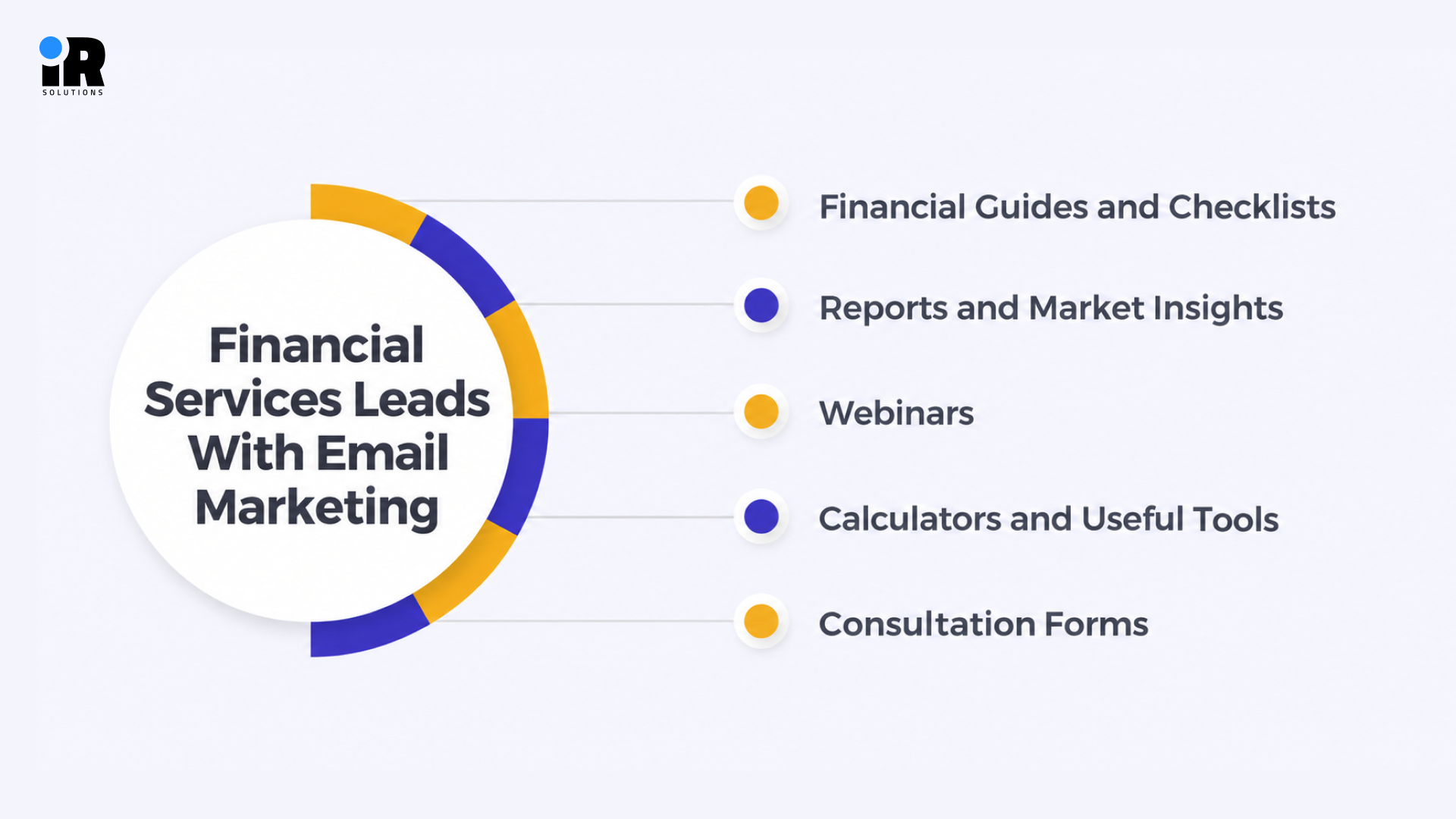
Financial Guides and Checklists
Practical guides attract people who are already thinking about a specific money decision and want help. Good examples include a retirement checklist, a mortgage preparation guide, a financial planning guide, or an insurance review checklist.
Reports and Market Insights
Offer genuinely useful information in exchange for an email signup, and be honest about what the reader receives. A concise market report or quarterly insight shows expertise without forcing anyone into a sales conversation.
Webinars
Live sessions let prospects hear your team explain complicated topics in a warm, human, and approachable way. Strong topics include retirement planning, mortgage questions, business finance, and the basics of financial planning.
Calculators and Useful Tools
Simple tools give visitors an instant answer, which makes sharing an email address feel like a fair trade. Where relevant, offer a mortgage calculator, a savings calculator, or a retirement calculator on your site.
Consultation Forms
Make it simple for high-intent prospects to request a conversation with a short form and clear wording. Remember the full path: lead source, email follow-up, nurture, and finally a consultation or application.
How to Turn Financial Services Leads Into Clients With Email
Turning a lead into a client takes time, especially when people need confidence before making financial decisions. These practices help you answer their concerns, build trust, and encourage them to take the next step.
Respond Quickly
Send an automatic reply whenever someone downloads a resource, requests a consultation, or starts an application. A quick response confirms their request and tells them what to expect next. Businesses can also use professional email marketing services to manage follow-ups and keep communication consistent.
Answer Questions
Address the concerns that delay decisions, such as costs, requirements, and what happens next. Ask your sales team about common questions, then write emails that answer them clearly.
Share Useful Advice
Offer practical advice, simple examples, and clear explanations to help prospects make informed decisions. When people receive helpful information without constant sales pressure, they have more reason to trust your business.
Show Credibility
Share relevant experience, professional credentials, client feedback, or case examples to support your claims. Keep every detail accurate and have your compliance team review it where required.
Set Clear Actions
Give readers one clear next step, such as booking a consultation or requesting a quote. Use direct wording, and read our email copywriting guide for tips on writing clear calls to action.
Send Different Emails to Different Customers
Email marketing for finance companies works better when each group receives messages that match its needs. A brand new lead and a ten-year client want very different things from the emails you send. Splitting your list into these six groups keeps every message useful and easy to act on.
New Leads
New leads need helpful education, steady trust, and a clear introduction to who you are and what you do. Their main question is whether you are trustworthy, so let your helpful content answer it first.
High-Intent Prospects
These prospects need service details, honest answers to common questions, and one clear next step. They have already shown interest, so make it easy for them to speak with a real person.
New Customers
New customers require onboarding assistance, activation prompts, and quick access to support when questions arise. Their early experience should give them the confidence to use your service and the confidence to know what to do next.
Existing Customers
Existing customers require continuous value, meaningful education, and relevant information about services that are relevant to their situation. Those messages remain useful for keeping a financial services customer engaged well beyond the close of the first sale.
Customers Near Renewal or Review
These customers need timely reminders, relevant options, and a clear renewal or review call to action. Start early, so they have time to compare choices and feel comfortable with the decision.
Inactive Customers
Inactive customers need re-engagement, a quick preference check, and updates that are actually worth opening.
How Email Automation Helps Financial Services Sales Teams
Financial services email automation handles routine follow-up quietly, so your team can focus on real conversations. It sends the right message at the right time, so no lead waits, and no client is forgotten.
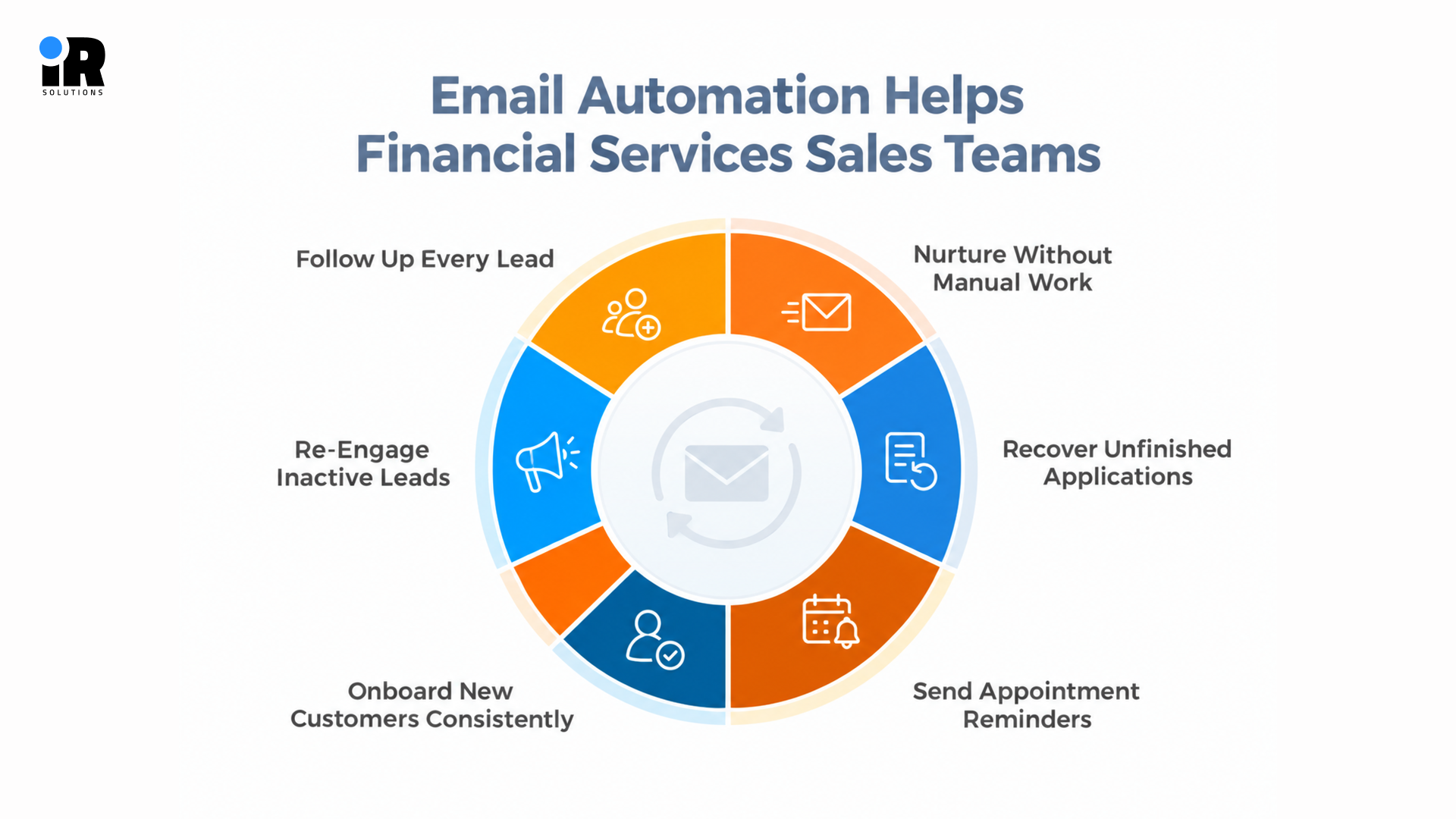
Follow Up Every Lead
Send an automatic reply as soon as someone contacts your business. This lets them know their message was received and that someone from your team will get back to them.
Nurture Without Manual Work
Some people take months to make a decision, so regular emails help keep your business in mind. Set up emails based on whether someone clicks a link, replies, or does not respond.
Recover Unfinished Applications
Remind people who start an application but don’t complete it. Tell them what they need to do and be there to help if they get stuck. No reminders after they submit the application.
Send Appointment Reminders
Send reminders before consultations and annual reviews to help clients remember their appointments. Add the date, details of the meeting and anything they need to bring. Reminding people the day before and a few hours in advance can help cut down on missed appointments.
Onboard New Customers Consistently
Send new customers the info they need to hit the ground running, from first steps to where they can get help. Customers will feel more at ease using your service, and your support staff won't have to respond to the same routine inquiries.
Re-Engage Inactive Leads
Send a friendly email asking people who have stopped opening your emails if they are still interested. Remove contacts who do not want to hear from you anymore. Your team handles financial questions that require a personal approach, and automation handles regular follow-ups.
Financial Services Email Marketing Best Practices
Financial emails need to be clear, useful, and easy to trust. These best practices help you write messages that answer customer questions, keep readers interested, and encourage them to take the next step.
- Teach First: Give real value before you ask for a consultation, and track which educational emails lead to bookings.
- Plain Words: Avoid jargon that confuses people, and explain any technical term in one simple sentence right beside it.
- One Topic: Cover one question, one service, or one next step in each email, so readers can act quickly.
- One CTA: Give the reader a single action to take, and keep the button wording specific, clear, and honest.
- Build Trust: Use a sender name customers know, your official domain, clear links, and calm language that never sounds like a scam.
- Stay Relevant: Promote only the services that match each customer's needs, because relevance shows respect and keeps people reading.
- Mobile First: Most people read on a phone, so use simple layouts, short paragraphs, and large buttons you can tap easily.
- Test and Improve: Compare subject lines, email content, sending frequency, and calls to action. Use engagement and conversion data to improve future campaigns.
How Email Can Increase Revenue in Financial Services
Email marketing can contribute to revenue by improving lead conversion, application completion, customer activation, and renewals. To understand its financial impact, businesses need to connect campaign activity with actual customer actions and outcomes.
Convert More Existing Leads
You already spend money on SEO, paid ads, referrals, events, and partnerships to bring leads in. Email keeps those leads moving through the funnel instead of letting them vanish after one visit. Improving conversion rates among existing leads can help businesses get more value from their acquisition spending without relying entirely on new leads.
Recover Incomplete Applications
Prospects who started an application but never finished it are some of your warmest opportunities. A friendly reminder with a direct link back to the form can rescue sales that looked lost. Even a modest recovery rate can add meaningful revenue when you multiply it across many applications each month.
Activate More New Customers
Help each new customer finish setup and begin using the service within the first few days. Active customers stay longer, spend more, and recommend you to friends, so activation pays back quickly. Track the share of new customers who complete setup, and improve the emails that sit behind drop-offs.
Increase Relevant Cross-Sell
Suggest useful extra products and services if the situation of an existing customer suggests a real need. It is easier to sell more to someone who already trusts you than to convince a stranger from scratch. Let's start with your closest matches, and only expand after you get positive results from them.
Improve Retention and Renewals
Keep your customers engaged with timely reminders about reviews, maturities and renewals before those important dates quietly arrive. Every renewal you retain is revenue retained without paying again to find a new customer. Remembered customers are far more likely to renew, refer friends and stay for years.
Re-Engage Dormant Customers
Bring existing contacts back to life instead of always paying to acquire brand new ones. A short message with a fresh reason to reply often costs very little and returns plenty. Offer a simple way to update preferences, so the right people stay and the rest leave kindly.
Make Marketing Spend Work Harder
Smart financial services marketing strategies treat a lead as an asset to nurture, not a name to forget. One lead acquired once can receive many relevant email interactions over months, and each one adds a chance to convert. More conversions, higher activation, better retention, and relevant cross-sell together create greater value from every customer you win.
Metrics That Connect Email Marketing to Revenue
Numbers show whether your emails are bringing in real business, so track the ones tied to revenue. The table below lists twelve useful metrics and explains what each one tells you about your results. Review them every month, and you will quickly see which emails deserve more of your time.
Metric | What It Shows |
Click-through rate | Interest in email content and offers |
Conversion rate | Percentage completing the desired action |
Qualified leads | Prospects meeting sales criteria |
Consultation bookings | Leads taking the next step |
Application completion rate | Percentage of started applications completed |
Customer activation rate | New customers successfully using the service |
Renewal rate | Percentage of eligible customers renewing |
Cross-sell conversions | Customers purchasing additional services |
Unsubscribe rate | Potential issues with relevance or frequency |
Bounce rate | Email delivery and list-quality problems |
Revenue attributed to email | Measurable commercial contribution |
Don't Measure Success by Open Rate Alone
Open rates show curiosity, but they cannot tell you whether a single person became a paying client. Focus instead on qualified leads, consultations, applications, customers, renewals, retention, and the revenue linked to each.
Keep Financial Services Email Marketing Compliant
Email marketing for financial services is more than accurate copy and an unsubscribe link. Before running marketing campaigns, businesses should consider relevant marketing laws, privacy rules, industry regulations, and internal approval processes.
Commercial marketing emails in the United States are subject to the CAN-SPAM Act and, in the case of regulated financial firms, other requirements may also apply under applicable SEC, FINRA or other rules. Regulations differ in other countries, so check the regulations relevant to your business and audience.
- Permission: Do not add anyone to a list without permission for marketing, and record when permission was granted.
- Accuracy: All claims must be factual. Do not guarantee any financial results to any reader of your messages.
- Disclosures: Make sure to include required disclosures where applicable and review testimonials and performance claims very carefully.
- Privacy: Never share sensitive financial information and always provide an unsubscribe option in every marketing email.
- Local Rules: Rules differ by type of business and location, so follow the rules that apply to your firm and jurisdiction.
- Approval: If your organization requires internal or compliance approval before a campaign goes live, leverage it.
- Recordkeeping: Maintain campaign approvals, relevant correspondence, and supporting records as required by applicable regulation.
- Sensitive Information: Account numbers, financial details, or any other confidential information should not be part of standard marketing emails.
- Security: Customers should be able to take sensitive actions through approved systems and secure channels.
- Marketing Preferences: Follow applicable consent, opt-out, and suppression requirements.
- Treat compliance as part of good service, because honest emails also build stronger customer trust.
Conclusion
Email marketing gives financial services companies a practical way to stay connected with prospects, improve customer experiences, and support long-term growth. The strongest results come from relevant messages, timely follow-ups, and campaigns built around real customer needs.
Start with essential emails such as welcome messages, lead nurturing, application reminders, and onboarding sequences. As your program grows, use segmentation and automation to make communication more relevant.
Track consultations, completed applications, customer retention, and revenue to understand what works. Regular testing and improvement will help you build an email marketing program that supports both customer relationships and business goals.
Frequently Asked Questions
How does email marketing help financial services companies?
It nurtures leads, lifts conversions, activates customers, improves retention, supports cross-selling, and raises revenue over time. Each of these results comes from sending the right message to the right person at the right moment.
Can email marketing generate leads for financial services?
Yes, because useful resources, webinars, tools, and consultation forms collect interested prospects who can then be nurtured by email. Email works best as the follow-up step that turns those new contacts into real, booked conversations.
How does email marketing increase financial services revenue?
Revenue grows through better conversion, stronger activation, higher retention, relevant cross-sell, and successful re-engagement of quiet contacts. No result is guaranteed, but a consistent program steadily improves each of these areas over several months.
What emails should financial services companies send?
Start with welcome, nurture, educational, consultation, and application follow-up emails to move prospects toward a decision. Then add onboarding, newsletter, cross-sell, renewal, and re-engagement emails to support customers after they join.
How can financial services firms nurture leads through email?
Follow this order: education, answered questions, growing trust, a relevant service, and then one clear next step. Patience matters a great deal, because people who feel rushed rarely become loyal and happy clients.
Can financial services email follow-up be automated?
Yes, follow-up, onboarding, reminders, and nurture sequences can all run on autopilot in the background. Important conversations with customers still need to be personal and handled by real advisors or salespeople.
How often should financial services companies send marketing emails?
There is no standard frequency. Customize your schedule for the relevance, customer stage, and value of the message. Keep an eye on the unsubscribe and reply rates, and make any necessary adjustments when readers express a desire for more or less.
What financial services email metrics matter most?
Concentrate on qualified leads, consultations, applications, customers, renewals, retention, add-on services, and revenue over simple opens and clicks. These are the numbers that tell you if your emails are really helping your whole business grow steadily.
Is email marketing in finance regulated?
Yes, but the rules depend on what type of financial business you have, the products you offer, your registration status, and your jurisdiction. Before you start a new campaign, check with your compliance team or legal adviser.