



Key Takeaways
- Outsource the skills you lack, but keep ownership of your data and accounts.
- You can outsource one task, a few skills, or the whole email channel.
- Slipping campaigns, stale automations, and one overloaded marketer signal it may be time.
- Compare scope, not just price, because proposals rarely include the same work.
- Freelancers suit narrow tasks, agencies suit many skills, and hybrid fills gaps.
- A clear handoff, a baseline, and regular reporting prove whether outsourcing worked.
Your email list may be the best asset you own, yet it could be earning far less than it should.
Email marketing often starts as a small task, but managing campaigns, automations, segmentation, and reporting can quickly become too much for one person. That's when businesses start looking to outsource email marketing. The challenge is deciding which tasks to hand over while keeping control of customer data, brand messaging, and performance.
Outsourcing can mean handing over one small task or almost the whole email program, depending on your needs. This guide shows when outsourcing makes sense, what you can hand off, and which model fits you best. You will also see costs, provider checks, handoff steps, and the numbers that prove the move worked.
If you want to understand the skills first, read what an email marketing specialist actually does.
What Does It Mean to Outsource Email Marketing?
To outsource email marketing means hiring an outside expert, freelancer, or agency to run part of your email program. Email marketing outsourcing is flexible, so you can hand over one task or the whole channel. The provider handles the work in that scope, while your business keeps ownership of goals and customers. Think of it as renting skills for a set period, not giving away the keys to your business.
Full-Service vs Partial Email Marketing Outsourcing
The two approaches look different in daily work, and choosing between them shapes your whole budget.
With full-service outsourcing, an outside team manages strategy, design, campaigns, automation, and reporting. It can work well for businesses without an internal email marketing team or those needing support across several areas.
Partial outsourcing keeps some skills inside your company and buys only the specialist help you are missing. It suits teams that own strategy but need help with execution, technical work, or limited weekly hours. Common examples include deliverability, Klaviyo setup, automation, copywriting, design, campaign execution, analytics, and strategy support.
Outsourcing Scope | External Team Handles | Internal Team Handles |
Full service | Strategy, execution, optimization | Brand input, approvals |
Execution support | Build, design, scheduling | Strategy, planning |
Specialist support | Deliverability, automation, analytics | Rest of the email program |
Hybrid | Agreed shared responsibilities | Internal ownership, coordination |
This table shows clearly why outsourcing never has to mean giving away your entire email channel.
What Parts of Email Marketing Can You Outsource?
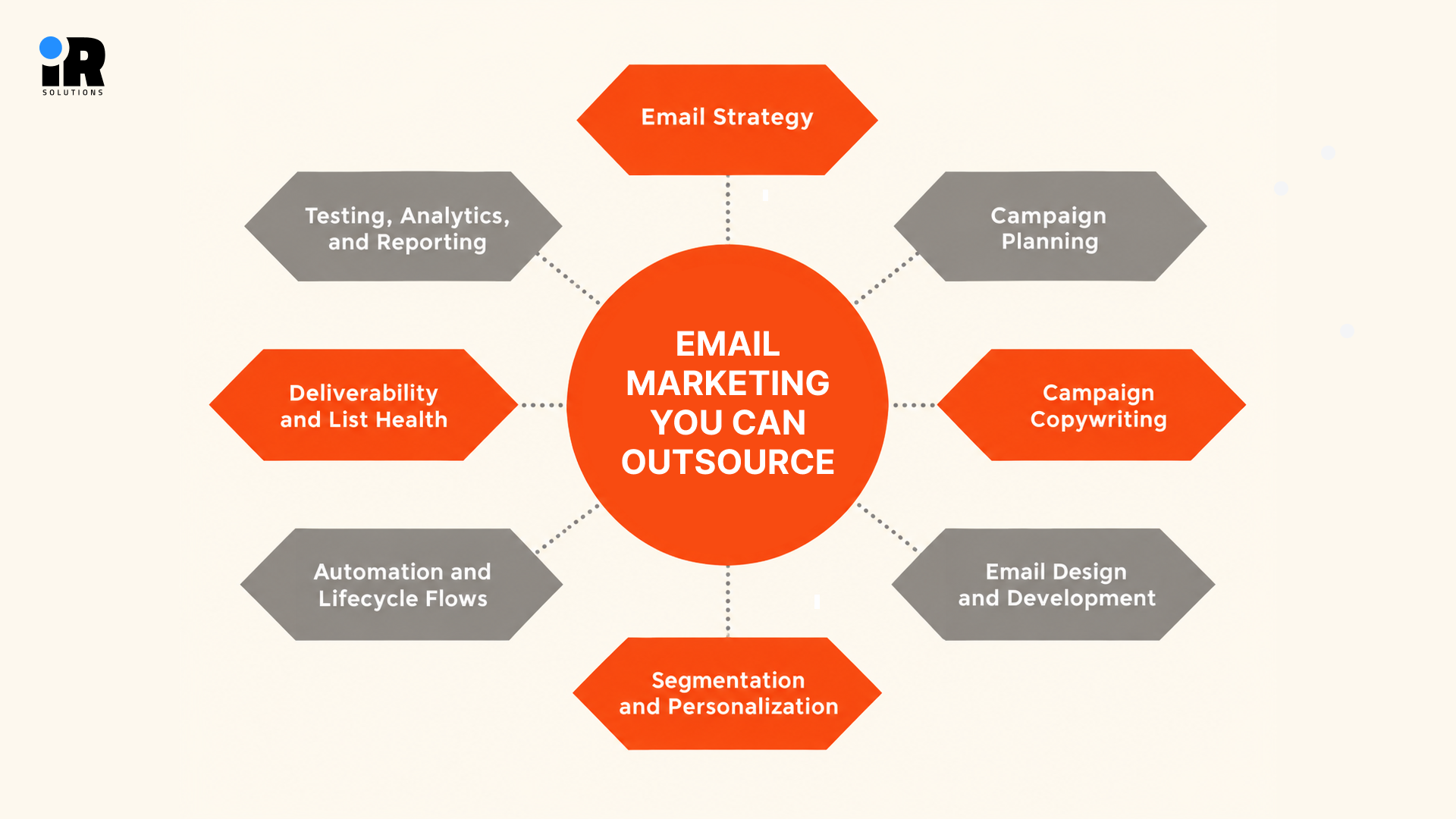
Email marketing covers several tasks, from writing campaigns and setting up automations to managing lists and tracking results. Outsourcing lets you hand off the tasks you need help with while keeping the rest of your marketing in-house.
Email Strategy and Campaign Planning
An outside expert can set your goals, lifecycle plan, campaign calendar, audience strategy, and testing roadmap. Many brands start here, because a clear plan gives every later task a real purpose.
Campaign Copywriting
A writer can handle subject lines, preview text, body copy, calls to action, and promotional messages for every send. Your team is close to the product, so an outsider often hears the customer more clearly.
For a deeper look at the craft, read our guide on email copywriting that converts.
Email Design and Development
Providers can build email templates, reusable modules, and mobile-friendly HTML, then test each email across major inboxes and devices. A broken layout on one popular phone can quietly cost you clicks, sales, and trust.
Segmentation and Personalization
A partner can build segments from lifecycle stage, engagement, purchase history, behavior, and customer value, then set personalization rules. Sending the same message to everyone is the fastest way to teach subscribers to ignore you.
Automation and Lifecycle Flows
Experts can set up welcome, lead nurture, cart recovery, post-purchase, win-back, and replenishment flows that keep earning without constant effort. These flows reach people the moment they show interest, which makes them your hardest-working emails.
Our email marketing automation guide breaks down the main types of automated emails and how they work.
Deliverability and List Health
Specialists handle email authentication, list hygiene, suppression, spam complaints, and sender reputation. They also monitor delivery issues and help resolve problems before they affect more campaigns.
You can find more detail in our complete email deliverability guide on reaching the inbox.
Testing, Analytics, and Reporting
Outside partners can run A/B tests, set up conversion tracking, handle attribution, produce reports, and suggest the next improvement. Each test should answer one clear question, and the answer should shape your next campaign.
When Does It Make Sense to Outsource Email Marketing?
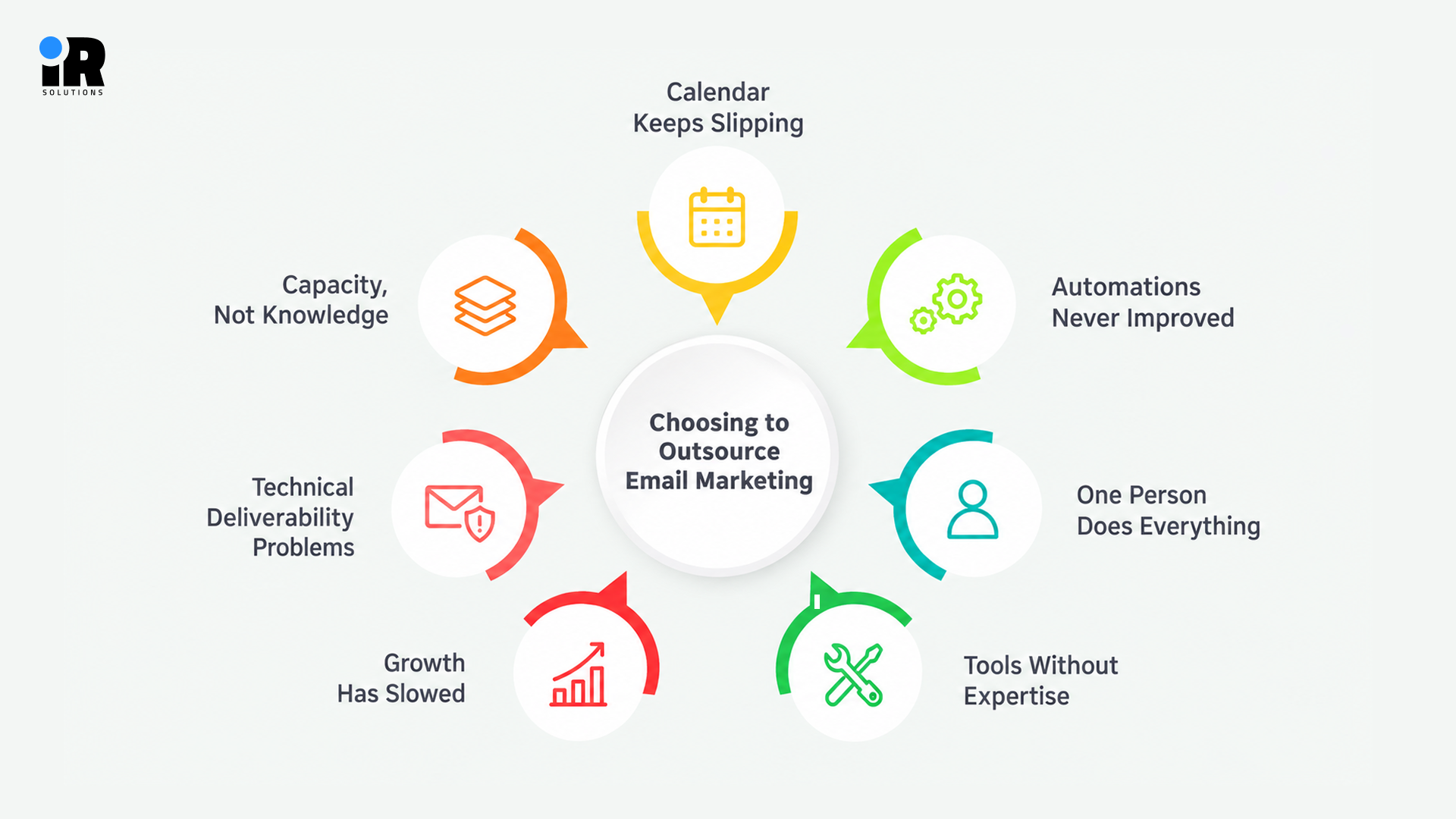
The right time to outsource email marketing depends less on company size and more on your team’s workload, skills, and the complexity of your campaigns. If email tasks keep taking up more time than expected or results are slipping, these seven signs can help you decide whether outside support makes sense.
Calendar Keeps Slipping
Missed sends are the clearest sign that email lacks enough dedicated hands and time on your team. Campaigns go out unevenly, seasonal chances pass by, and newsletters vanish whenever the team gets busy. Steady sending builds the habit that makes subscribers open your emails, so gaps cost more than they seem.
Automations Never Improved
Automations can become outdated as products, offers, and customer behavior change. Without regular reviews, old links, irrelevant messages, and missed testing opportunities can reduce their effectiveness. Reviewing important flows every quarter is a useful starting point.
One Person Does Everything
Email marketing involves several skills, including strategy, copywriting, design, automation, deliverability, and analytics. One marketer can manage many of these tasks, but handling everything becomes harder as the program grows. Outside specialists can help fill the gaps without requiring several full-time hires.
Tools Without Expertise
Many brands pay for Klaviyo, ActiveCampaign, HubSpot, or Mailchimp but only send newsletters, basic lists, and simple broadcasts. Paying for a strong tool does not automatically give you a strong and profitable email program. The tool is only an engine, and without a skilled driver it never leaves the driveway.
Growth Has Slowed
Flat results are a warning, but they call for an audit before any big decision. Revenue stops growing, engagement slips, segments stop improving, tests teach you very little, and automations add less than they should. Hiring help will not fix this automatically, so find the real cause before you spend any money. An audit shows whether the issue sits in the offer, the list, the creative, or the setup.
Technical Deliverability Problems
Spam placement and blocklists need technical skill that most generalists have never had to learn. Authentication errors, rising complaints, blocklisting, and sudden engagement drops are good reasons to bring in specialist email marketing support services. A generalist may guess at fixes, while a specialist reads the signals and repairs the actual cause.
Capacity, Not Knowledge
A knowledge gap sounds like "we don't know what to do," while a capacity gap says "nobody has time." Capacity gaps often suit execution help, while knowledge gaps usually call for a strategy-led email marketing partner. Naming the gap honestly keeps you from buying strategy when you only need extra hands.
When Should You Keep Email Marketing In-House?
Keeping email marketing in-house gives your team direct control over campaigns, messaging, customer data, and day-to-day decisions. It can be a practical choice when your team has the right skills and enough time to manage the work.
Your Email Setup Is Simple
If you send occasional newsletters with light segmentation and few automations, one capable marketer may be enough. Paying an agency too early can easily cost you more than the small problem it solves.
Constant Internal Coordination
When email must stay close to product, sales, legal, operations, and customer service, in-house ownership handles daily changes more smoothly. Outside partners can still help, but every handoff adds a little delay to each campaign you send.
You Already Have Specialists
If you already cover strategy, copy, design, automation, analytics, and deliverability, outsourcing everything would repeat skills you own. A small, targeted add-on for one missing skill would make much more sense in that situation.
Success Is Undefined
Outsourcing works poorly when goals are unclear, the customer offer is fuzzy, or nobody owns the business outcome. Constant, unstructured approvals make things worse, because an agency cannot fix missing direction on its own. None of these cases is a failure, and a smaller program can grow into outside help later.
Email Marketing Agency vs Freelancer vs In-House vs Hybrid
Agency, freelancer, in-house, or hybrid, each model fits a different need, so compare all four before you decide. The email marketing agency vs in-house question is only one option among four, so here is the full comparison.
Model | Best For | Main Advantage | Main Limitation |
Freelancer | Narrow tasks, specialist execution | Flexible, focused expertise | Capacity, dependency |
Agency | Multi-discipline email program | Team of specialists | Needs onboarding, coordination |
In-house | Continuous internal ownership | Deep brand and business context | Hiring, management overhead |
Hybrid | Existing team with specialist gaps | Context plus expertise | Responsibilities must be clear |
Use this table as a starting point, then match each model to your skill gaps and weekly time.
When a Freelancer Makes Sense
Freelancers work well when the job is narrow and clear, such as copywriting, template design, or one Klaviyo build. They also work well for audits, campaign execution, and extra capacity during your busy periods.
The email marketing freelancer vs agency choice mostly depends on how many skills you need. A freelancer can handle specific tasks well, but may not cover all your email marketing needs.
When an Email Marketing Agency Makes Sense
Agencies fit best when your email program needs several different skills working together under one shared plan. If you hire an email marketing agency, expect strategy, campaigns, flows, design, copy, deliverability, and analytics from one team.
Many agencies sell managed email marketing as a monthly service with clear deliverables and regular reviews. The email marketing agency vs freelancer decision usually comes down to scope, budget, and how much coordination you can offer.
When an In-House Team Makes Sense
Building in-house works when email needs daily attention and enough work exists for dedicated roles. It also suits companies where close coordination with other teams is very important to the business.
Hiring brings recruitment time, salary costs, training needs, and the risk of losing a key person. You also need the skills to manage those specialists well once they join your growing team.
When a Hybrid Model Works Best
Hybrid setups keep your business context while filling the specialist gaps your team cannot cover on its own. An internal marketing manager working with an outside agency is one common example of this setup.
Another common split pairs an internal strategist with outside help for design and build work. Other teams keep campaigns in-house and hand automation and deliverability work to outside experts who handle the technical side.
What Should You Keep Under Your Control When You Outsource?
You can hand off the daily work, but five things should always stay under your own control. Outsourcing the work should never mean giving away ownership of your list, accounts, brand, strategy, or numbers.
Your Email List and Customer Data
Your subscribers are your business asset, so they must never depend on a vendor relationship. You should own the subscriber database, consent records, exports, and account data at all times. If a partner holds the only copy, you are exposed the moment the relationship sours.
Your Email Marketing Platform Account
Account ownership decides how easily you can leave, so settle it before the first campaign. Best practice is simple. Your business owns the master platform account, while the provider receives role-based access only. Never let a partner create a setup where recovering your data becomes difficult after the contract ends.
Brand Guidelines and Approval Rights
Clear rules protect your reputation, and they also keep campaigns moving without constant back-and-forth. Define what requires approval, who approves it, how fast they respond, and which brand and legal limits apply. Fast, clear approvals keep campaigns on schedule and protect your reputation at the same time.
Business Strategy and Customer Knowledge
Partners can sharpen your strategy, yet only you know the true state of your business. Your partner can help shape email strategy, but you remain the source of truth for products, offers, customer reality, business priorities, and claims. No agency knows your customers, margins, or promises better than the people who run the business.
Performance Visibility
You cannot manage what you cannot see, so demand direct access to the real numbers. Insist on dashboards, campaign reports, flow results, revenue and conversion tracking, and testing results. Do not accept a monthly PDF as the only source of performance truth. Direct access lets you check numbers yourself and ask better questions during every review call.
Benefits of Outsourcing Email Marketing
These email marketing outsourcing benefits are real when scope is clear, so here are the gains worth expecting.
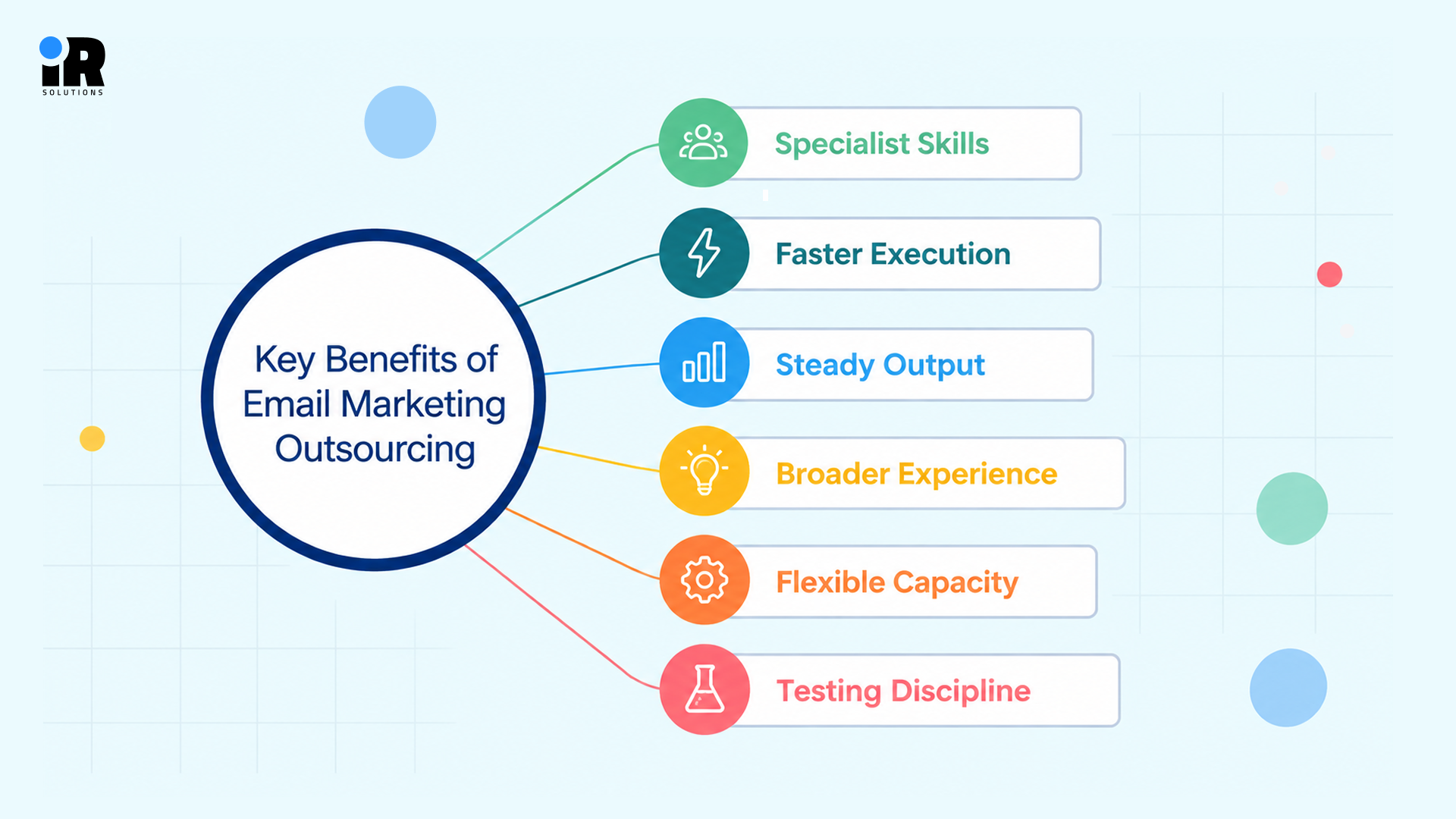
- Specialist Skills: Get several experts instead of one busy generalist covering every discipline.
- Faster Execution: Experienced teams already have routines for planning, QA, design, and delivery.
- Steady Output: Campaigns keep going out even when your team is busy elsewhere.
- Broader Experience: Specialists see patterns across many accounts, but results are never guaranteed.
- Flexible Capacity: Add support for launches, Black Friday, or migrations without permanent headcount.
- Testing Discipline: When testing is in scope, teams test often and record results.
Risks and Disadvantages of Outsourcing Email Marketing
Outsourcing email marketing can save time, but choosing the wrong partner may create problems with communication, quality, and account access. Here are the main risks to consider.
- Limited Transparency: Unclear deliverables, reporting, or subcontracting can make it difficult to track progress.
- Partner Dependency: Poor documentation and restricted account access can make switching providers difficult.
- Brand Inconsistency: Outside teams need time to understand your products, customers, and brand voice.
- Communication Delays: Slow feedback and unclear approval processes can delay campaigns.
- Unexpected Costs: Additional revisions, automation work, or integrations may increase the agreed budget.
How Much Does It Cost to Outsource Email Marketing?
The cost of outsourcing email marketing depends on the provider, services, and amount of work involved. Freelancers may charge around $15–$85 per hour, while full-service email marketing agencies commonly charge $2,500–$10,000 or more per month.
Smaller projects, such as template design or automation setup, may cost less than ongoing campaign management. These are general market estimates, so compare what each provider includes before making a decision.
What Determines Outsourced Email Marketing Cost?
Several factors push the price up or down, and knowing them helps you compare offers fairly. Campaign volume, flow complexity, list size, copy, design, segmentation, SMS, and reporting all affect the final outsourced email marketing cost. Deliverability, platform work, strategy, and integrations can add further to the email marketing outsourcing cost.
Project, Hourly, or Retainer Pricing
Each pricing style suits a different kind of need, so match the model to your goal.
- Project Fees: Project pricing fits audits, migrations, and flow setups that have a clear start and finish.
- Hourly Rates: Hourly work suits flexible specialist tasks where the amount of effort is hard to predict.
- Monthly Retainers: Retainers cover ongoing management and suit teams that want steady campaigns, flows, testing, and reporting.
Ask every provider to explain which model they prefer and exactly why it fits your goals.
Compare Scope, Not Just Monthly Fees
A $1,500 proposal and a $5,000 proposal rarely include anywhere near the same amount of work.
Compare campaigns per month, number of flows, revisions, strategy, design, copy, reporting, testing, deliverability, and platform fees line by line. Cheaper proposals often leave out design, testing, or reporting, which then appear later as surprise extras.
For detailed budget ranges and level breakdowns, see our guide to email marketing agency pricing.
How to Calculate Whether Outsourcing Is Worth It
Outsourcing is worth considering when the time and money saved outweigh what you would spend on outside help. A simple cost comparison can show whether outsourcing will actually improve your email marketing without adding unnecessary expense.
- Current Cost: Add internal hours, platform fees, contractors, design, and management time to see what email truly costs today.
- Outsourced Cost: Add the retainer or project fee, platform fees, and the internal time you spend coordinating the partner.
- Performance Gap: Compare revenue, leads, retained customers, or conversions before and after, using whichever goal matters most to you.
- Opportunity Cost: Ask what your internal team stops doing because email keeps eating up their limited weekly hours.
Compare the added profit and time savings against the extra cost of outsourcing. To estimate ROI, subtract your total outsourcing-related costs from the financial benefits gained, then divide the result by those costs and multiply by 100.
For example, if outsourcing costs $2,000 and creates $3,000 in additional gross profit and measurable savings, the estimated ROI is 50%.
How to Choose the Right Email Marketing Partner
The right email marketing partner should fit your goals, working style, and day-to-day needs. Look for someone who communicates clearly, understands your audience, and can take responsibility for the work without constant follow-up.
Start With the Problem You Need Solved
Do not begin by searching for the best agency, because the right fit depends on your gap. Define whether you face a strategy gap, capacity gap, technical gap, creative gap, or deliverability gap. You may also want full-channel ownership. A clear problem statement makes every provider conversation shorter and sharper.
Look for Relevant Platform Experience
Tool skill matters, but proof of real work matters far more than a badge on a website. Look for hands-on experience with Klaviyo, Mailchimp, ActiveCampaign, or HubSpot. Platform certification alone is not enough, so ask what they have actually built and request examples.
Ask What Is Done In-House vs Subcontracted
Knowing who does the work protects quality, so ask for names and roles early. You need to know who handles strategy, copy, design, development, QA, and deliverability. Hidden subcontracting is not always bad, but it should never be a surprise.
Ask How They Approach Your Customer Data
Data handling shows maturity, and weak answers here usually predict weak results later. Good providers discuss segmentation, lifecycle, consent, data hygiene, purchase and behavior data, and suppression. They should talk about more than design and send frequency.
Ask How They Measure Success
The metrics a provider values tell you what they will actually work toward for you. A weak answer says open rates went up. A better answer mentions campaign conversion, flow revenue, qualified leads, repeat purchase, revenue per recipient, or lifecycle progression, depending on your goal.
Review Their Reporting Process
Good reporting builds trust, so understand exactly what you will receive and how often. Ask how often they report, which metrics they use, and who explains the results. Also ask whether recommendations are included and how tests are documented.
Clarify Ownership Before Signing
Confirm ownership of accounts, customer data, templates, campaigns, automation workflows, and reports before signing. Your agreement should also define deliverables, revisions, payment terms, termination notice, and how the provider will hand everything back when the contract ends.
How to Hand Off Email Marketing Without Losing Control
A clear handoff helps you outsource email marketing without losing track of your campaigns, data, or brand voice. Set expectations, share the right information, and keep communication open so the transition stays smooth from the start.
Audit the Existing Program
You cannot hand over what you have not mapped, so begin with a full and honest review. Document active campaigns, flows, segments, templates, lists, integrations, deliverability, and current KPIs before anything changes. This record also becomes the starting point for every future decision.
Establish the Performance Baseline
Without a starting line, you cannot prove that the new partnership improved anything at all. Record your existing revenue, conversions, clicks, list growth, automated revenue, unsubscribe rate, and complaints. Save these figures somewhere safe, and share them with your new partner.
Provide Controlled Platform Access
Safe access protects your data, and it also protects your partner from avoidable mistakes. Use individual user accounts and appropriate permissions rather than sharing passwords. This also creates a clear activity record, which helps if anything unexpected happens later.
Share Brand and Business Documentation
Informed partners make fewer mistakes, so give them everything they need on day one. Include your voice, audience, products, offers, claims, exclusions, and legal requirements. The more context you share early, the fewer corrections you will make later.
Agree on Approval and Communication Workflows
A written workflow removes confusion, and it keeps campaigns moving even during very busy weeks. Agree on the path of draft, review, revision, QA, approval, and send. Name responsible owners and set firm deadlines for every step.
Build a 30/60/90-Day Priority Plan
A 30/60/90-day plan helps both teams stay organized. Start with an audit, account access, and urgent fixes during the first 30 days. Focus on priority campaigns and automations over the next 30 days. Use the final 30 days to test, review results, and improve what is already running. Adjust the timeline based on your existing setup and workload.
How to Measure an Outsourced Email Marketing Partner
Measuring an outsourced email marketing partner goes beyond tracking how many campaigns they send. Look at the results across different areas and review them together each quarter to get a clear picture of how the program is performing.
Delivery KPIs
Track campaigns sent on schedule, flows launched, and tests completed to see if the work is happening as promised.
Channel KPIs
Watch click rate, conversion, revenue per recipient, lead generation, repeat purchase, and reactivation to see how your audience responds.
List Health KPIs
Monitor unsubscribes, bounces, spam complaints, and engaged audience growth, because a healthy list protects every future send.
Business KPIs
Depending on your goal, measure revenue, pipeline, customer lifetime value, retention, or sales opportunities created. Use our email ROI guide as the full performance framework instead of rebuilding one yourself.
Conclusion
Outsourcing works best when you know exactly what you need help with and what you want to keep. Outsource the skills you lack, but never the ownership of your data, accounts, brand, and goals. That keeps your emails moving without making you dependent on any one freelancer or agency.
To pick the right model, look at your skill gaps, your team's free time, and your program's complexity. Then decide how much control you want and which business goal the work should move. Start small if you are unsure, because a short audit often shows where help matters most.
If you need support with strategy, campaigns, automation, segmentation, copy, design, deliverability, and reporting, IR Solutions can help. Our team can work alongside your staff or manage the whole email channel from start to finish. Talk to our team and hire email marketing experts who protect your data, your brand, and your results.
Frequently Asked Questions
What does it mean to outsource email marketing?
It means hiring an outside specialist, freelancer, or agency to handle some or all of your email program. You can delegate one task like copywriting or hand over strategy, execution, and reporting together. Your business should still own the goals, the customer data, the account, and the final approvals.
Is it worth outsourcing email marketing?
It is worth it when the value created exceeds the fees and the time you spend coordinating. Compare your current cost, the outsourced cost, the performance difference, and the opportunity cost before deciding. If email is simple and your team has capacity, keeping it in-house may be smarter.
When should you outsource email marketing?
Consider it when campaigns slip, automations go stale, one person carries every discipline, or deliverability turns technical. Flat performance is also a trigger, but run an audit first to find the real cause. Company size matters far less than your capacity, skills, program complexity, and the level of internal ownership.
How much does it cost to outsource email marketing?
Costs range from low hourly freelancer rates to monthly agency retainers that often reach thousands of dollars. Scope drives the price, including campaign volume, flows, design, copy, segmentation, reporting, and deliverability work. Compare what each proposal actually includes rather than looking only at the monthly figure at the top.
What email marketing tasks can you outsource?
You can outsource strategy, copywriting, design, segmentation, automation, deliverability, testing, analytics, and reporting, either separately or together. Most businesses start with the area causing the most pain and expand later if it works. Always keep ownership of your data, platform account, brand approvals, and core business strategy yourself.
Is it better to hire an email marketing agency or freelancer?
Choose a freelancer for narrow, well-defined tasks and an agency when you need several disciplines working together. A freelancer offers flexibility and focused skill, but limited capacity and personal dependency can become real problems. An agency gives you a full team, though it needs proper onboarding and steady coordination from you.
Is an agency cheaper than hiring an in-house email marketer?
Sometimes it is, because one retainer can cover several skills that would need multiple salaried hires. A single in-house email marketing specialist rarely covers strategy, design, automation, deliverability, and analytics equally well. Still, a busy program with daily internal coordination needs may cost less when it is staffed internally.
Can you outsource only email automation or copywriting?
Yes, partial outsourcing is common, and many businesses buy only the specialist skill they are missing. Automation builds, copywriting, design, deliverability fixes, and analytics setup are all easy to buy separately. This keeps strategy and approvals inside your company while still closing the skill gaps that hold you back.
Who should own the email marketing account when you outsource?
Your business should own the master platform account, subscriber data, consent records, and all exports. The provider should receive role-based access through individual user logins, never through shared passwords sent by email. This setup makes it far easier to recover your data and workflows whenever the engagement finally ends.
How do you choose an email marketing agency?
Start by defining your gap, then check platform experience, team structure, data approach, and success metrics. Ask who does the work, how results are reported, and what you own when the contract ends. Avoid anyone who guarantees revenue, wants to own your account, or reports only opens and clicks.
How long does it take to hand email marketing over to an agency?
The timeline depends on your account setup, existing automations, integrations, and approval process. A simple handoff may take days, while a complex program may need several weeks. A 30/60/90-day plan can guide the work after onboarding, but the handoff itself does not need to take 90 days.
Can an outsourced agency manage Klaviyo, Mailchimp, or ActiveCampaign?
Yes, many agencies manage Klaviyo, Mailchimp, ActiveCampaign, and HubSpot accounts through role-based access that you control. Certifications can help, but practical experience matters more. So ask to see flows, templates, and results they have built personally. Confirm that their platform experience matches your exact stack before you sign any agreement with them.