

Key Takeaways
- An email marketing specialist manages campaigns, automation, segmentation, and reporting for a company's email channel.
- Core responsibilities include strategy, copywriting, A/B testing, list hygiene, and performance analysis.
- Technical skills matter, but analytical thinking and strong writing separate average specialists from great ones.
- Most specialists work across platforms like Klaviyo, Mailchimp, HubSpot, and ActiveCampaign.
- U.S. salary benchmarks for 2026 range from roughly $52,500 to $75,000 depending on experience and role.
- The difference between a capable specialist and a basic campaign sender is expertise in automation, deliverability, and revenue attribution.
Anyone can send an email. Getting that email to bring clicks, leads, and sales takes real skill.
That is the job of an email marketing specialist.
An email marketing specialist plans and manages the emails a business sends to its audience. But the role goes far beyond writing a message and hitting send. It includes understanding customer behavior, creating campaigns, building email sequences, segmenting audiences, testing subject lines and content, improving deliverability, and tracking results.
A good specialist also knows that every subscriber should not receive the same message. A new subscriber may need a welcome series, while an existing customer may respond better to a product recommendation, special offer, or reminder. Sending the right message at the right time can make a big difference to results.
This is why businesses need people who understand both the creative and technical sides of email marketing. Strong writing matters, but so do data, timing, automation, and knowing what customers actually want to receive.
In this guide, we cover what an email marketing specialist does, their main responsibilities, the skills employers look for, salary ranges in 2026, and what to consider when hiring one. We will also look at what you need to build a career in this field.
What Is an Email Marketing Specialist?
An email marketing specialist manages the emails a business sends to its customers or subscribers. Their work usually includes writing and scheduling campaigns, setting up automated emails, managing contact lists, testing different emails, and checking how well each campaign performs. Indeed explains the role as a mix of managing campaigns, contact lists, sign-ups, and understanding the audience.
The exact work can change depending on the business. An ecommerce specialist focuses on abandoned carts, repeat purchases, and customer retention, while a B2B specialist may spend more time on leads and follow-up emails. The goals may be different, but the main job stays the same: sending useful emails to the right people and improving results over time.
What Does an Email Marketing Specialist Do?
The role is bigger than most people realise. A specialist does not just send emails. They plan campaigns, build automated flows, manage the subscriber list, write copy, run tests, and track results. It is a hands-on job that touches several different skills at once.
Develop the Email Marketing Strategy
Before any email gets written, a specialist works out what the channel needs to achieve. That means setting goals, deciding who gets which messages, how often to send, and how email fits into the wider marketing plan. They also think about the customer lifecycle, so emails go out at the right time rather than on a random schedule. Skipping this step is why so many businesses send more and get less.
Plan and Execute Email Campaigns
A specialist runs newsletters, promotions, product launches, seasonal sends, and re-engagement campaigns. Each one has a different goal and a different tone. A promotional email needs urgency. A re-engagement email needs to feel personal. They also manage timing and work with design and content teams to get each campaign out on time and looking right.
Build Automated Email Flows
Automation is one of the most valuable things a specialist can do. These are emails that send themselves based on what a subscriber has done. A welcome series goes out when someone signs up. An abandoned cart email fires when a shopper leaves without buying. A win-back flow reaches customers who have gone quiet. Getting these sequences right takes time and testing, but once they run well, they generate revenue without ongoing manual work. Effective email automation helps businesses keep these customer journeys running consistently.
Segment Email Subscribers
Sending the same email to everyone on a list is a quick way to lose subscribers. A specialist splits the list into smaller groups based on purchase history, engagement, customer value, and product interest. This makes emails more relevant to the reader and keeps deliverability strong by reducing sends to people unlikely to engage. Klaviyo segmentation gives ecommerce teams more ways to group subscribers based on customer behavior.
Write and Optimise Email Copy
The subject line gets the open. The first sentence keeps the reader going. The CTA drives the click. A specialist either writes the copy or works closely with a copywriter to make sure every part of the email does its job. Subject lines, preview text, body copy, and CTAs all need to work together. Weak copy in any one of those spots hurts the whole email.
Manage Email Deliverability and List Health
Most businesses only think about deliverability when emails start landing in spam. A specialist stays on top of it before that happens. They monitor sender reputation, remove hard bounces quickly, process unsubscribes properly, and clean the list regularly to remove subscribers who stopped engaging. Keeping spam complaint rates below 0.1% is a basic standard. Falling above it damages the sender's standing with inbox providers.
Run A/B Tests
A specialist tests to learn, not just to tick a box. They run experiments on subject lines, send times, CTAs, and email content to find what their specific audience responds to. The results of each test inform the next decision. Over time, this compounds into meaningfully better performance.
Track Email Marketing Performance
A specialist watches more than open rates. They track clicks, conversions, revenue, unsubscribes, bounces, and list growth. Open rate still gets reported but carries less weight now because of how privacy features have affected its accuracy. The KPIs section below covers the metrics that actually matter.
Key Email Marketing KPIs a Specialist Should Track
Open rate gets talked about a lot, but it has become less reliable since Apple's Mail Privacy Protection launched. A specialist understands which metrics actually indicate whether the channel is working.
Metric | What It Shows |
Delivery rate | Whether emails are successfully reaching recipients |
Click-through rate | How effectively the email drives engagement |
Conversion rate | Whether email activity produces the desired action |
Revenue per recipient | Revenue efficiency across campaigns and flows |
Unsubscribe rate | Audience dissatisfaction or content fatigue |
Bounce rate | List quality and delivery problems |
Spam complaint rate | Sender reputation risk |
Flow revenue | Revenue generated specifically through automation |
List growth rate | How quickly the email audience is expanding |
A specialist needs to understand not just what each metric means but what a good benchmark looks like in their specific industry. An unsubscribe rate that is fine for a high-frequency ecommerce brand may signal a problem for a lower-cadence B2B sender.
Essential Email Marketing Specialist Skills
A skilled specialist brings two things to the role the technical ability to build and run a proper email program, and the people skills to work well with a team, explain their results, and solve problems without being told what to look for.
Technical Skills
The technical side of the role covers everything from writing copy to managing list health. These are the skills that make the day-to-day work possible.
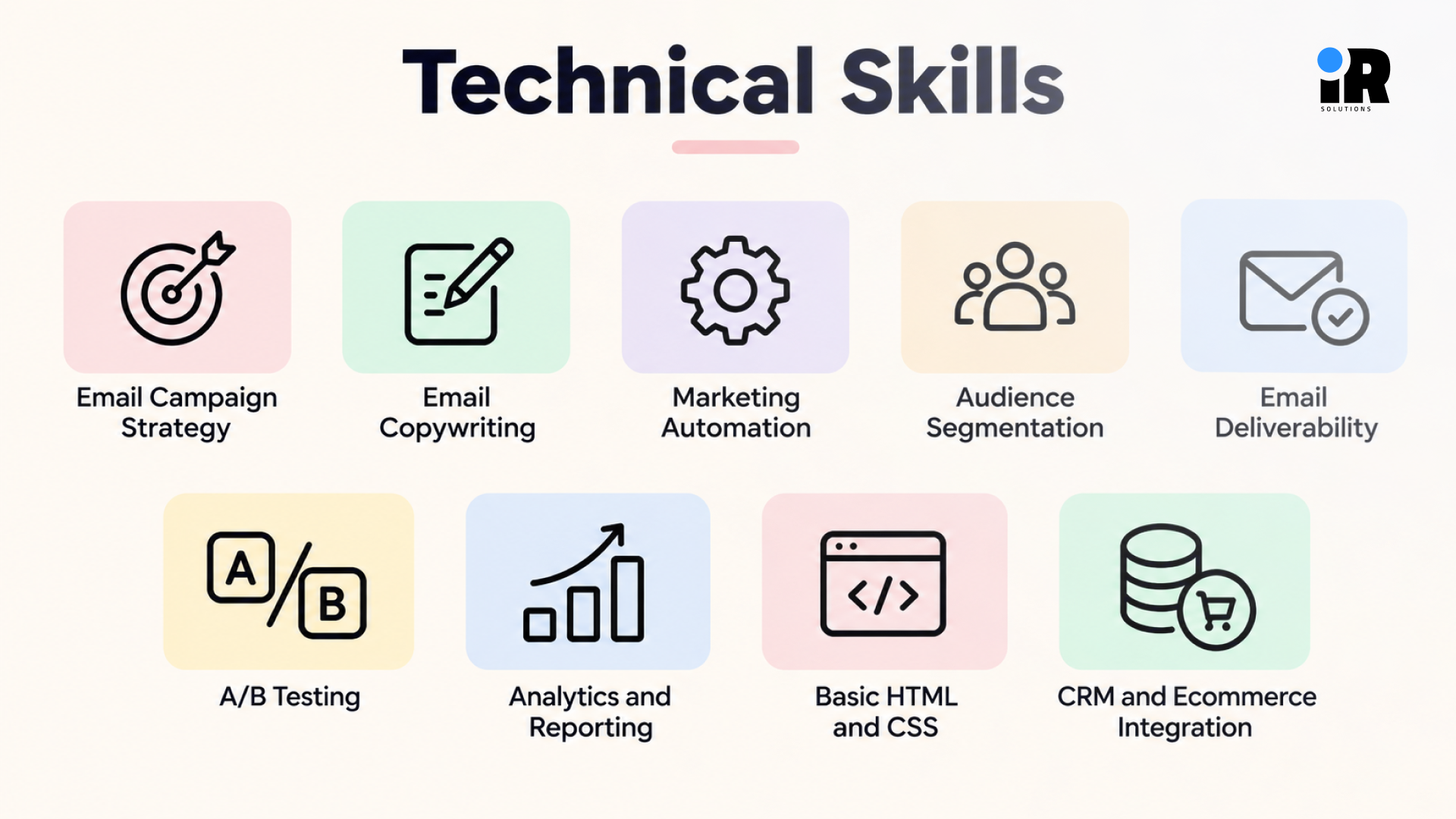
Email Campaign Strategy
A specialist needs to understand how each campaign connects to a business goal. Without that, sending emails is just activity with no direction.
Email Copywriting
Subject lines, body copy, CTAs, and nurture sequences are all part of the job. Even when a copywriter is involved, a specialist needs to brief them clearly and review the output.
Marketing Automation
Building triggered flows takes logical thinking and a solid understanding of the customer journey. This is one of the skills that creates the most long-term value.
Audience Segmentation
Splitting a list based on behaviour, purchase history, and engagement helps messages reach the right people. Sending the same email to everyone stops working once a list grows past a certain size.
Email Deliverability
Sender reputation, list hygiene, and authentication basics all affect whether emails reach the inbox. Many people claim email experience but struggle to answer basic deliverability questions.
A/B Testing
Testing is only useful when there is a clear hypothesis going in. Running experiments without a reason produces results that are hard to act on.
Analytics and Reporting
Pulling data from a dashboard is easy. Knowing what the data means and what to do next is the actual skill.
Basic HTML and CSS
A specialist does not need to code. But enough HTML knowledge to fix a broken layout or edit a template without waiting for a developer is genuinely useful.
CRM and Ecommerce Integration
For ecommerce roles, understanding how the email platform connects with Shopify or a CRM saves a lot of time. Most data problems start before the email is even built.
Soft Skills
Technical skills get a specialist into the role. Soft skills are what actually determine how far they go, and in email marketing, that gap shows up fast.
- Being able to write clearly and concisely across briefs, reports, and stakeholder updates.
- Reading data accurately without jumping to conclusions the numbers don't actually support.
- Catching errors broken links, wrong segments, bad personalisation before they hit inboxes.
- Bringing a fresh angle to campaigns that would otherwise start feeling like copies of each other.
- Staying on top of multiple campaigns, flows, and tests running at the same time.
- Working out why a campaign underperformed and knowing what to adjust before the next send.
- Getting things done alongside design, development, content, and commercial teams without friction.
- Thinking from the subscriber's side of the screen, not just from the sender's dashboard.
Indeed flags writing, design awareness, creativity, analytics, coding familiarity, and time management as relevant competencies for the role, and that list holds up. Those are the things that separate someone who can do the job from someone who's genuinely good at it.
What Tools Does an Email Marketing Specialist Use?
The platforms a specialist uses depend on the company's size, tech stack, and focus area. Most specialists work across a few tool categories.
Category | Examples |
Email and automation platforms | Klaviyo, Mailchimp, ActiveCampaign, HubSpot |
Ecommerce platforms | Shopify, WooCommerce |
Analytics | GA4, platform-native analytics |
Design | Figma, Canva |
A/B testing | Native ESP testing tools |
CRM and customer data | HubSpot, integrated CDP systems |
For ecommerce email specifically, Klaviyo has become the dominant platform. It connects directly with Shopify data, allows detailed segmentation based on purchase behaviour, and handles automation logic that other platforms struggle to replicate without custom workarounds. A specialist with genuine Klaviyo experience commands a premium in ecommerce hiring.
Mailchimp and ActiveCampaign remain common in SMB and B2B contexts. HubSpot shows up frequently in organisations where email is part of a broader CRM and inbound marketing setup.
Most specialists become proficient in one or two platforms deeply and can adapt to others reasonably quickly. If you are comparing two common platforms, the Klaviyo vs Mailchimp comparison breaks down their key differences. Platform skills are transferable in principle but take time to rebuild in practice.
Email Marketing Specialist Salary
Salary data for this role varies across sources because each provider uses different datasets, methodologies, and definitions of compensation. Some figures represent average salary, while others reflect starting pay or total compensation.
Here are current U.S. salary benchmarks from multiple sources as of 2026:
Source | Figure |
Salary.com | |
ZipRecruiter | |
Robert Half | |
Coursera |
These figures are not directly comparable because they measure compensation differently. Salary.com and ZipRecruiter provide salary estimates, Robert Half reports starting compensation by experience level, and Coursera cites Glassdoor's median total pay data.
Across the available benchmarks, many U.S. email marketing specialist salaries fall roughly in the mid-$50,000s to upper-$70,000s, while compensation can vary based on experience, location, industry, employer, and specialized skills. ZipRecruiter's current 25th–75th percentile range is $54,500–$78,000.
Average Email Marketing Specialist Salary
Based on current benchmarks, the working average for a U.S. email marketing specialist in 2026 is roughly $65,000 to $72,000 per year. This covers mid-level professionals with a few years of experience across campaigns, basic automation, and platform management.
Email Marketing Specialist Hourly Rate
For those working on a contract or freelance basis, Salary.com currently reports approximately $35 per hour as the average rate. The 25th to 75th percentile range sits at roughly $31 to $37 per hour. Rates for specialists with strong automation or ecommerce experience tend to run higher than these benchmarks suggest.
Salary by Experience Level
Experience has a significant effect on salary in this role. Entry-level candidates fresh from internships or first roles tend to start in the $40,000 to $55,000 range. Mid-level specialists with two to four years of experience and demonstrable results fall in the $60,000 to $75,000 range. Senior specialists with strong automation expertise, deliverability knowledge, and a track record of revenue impact can push toward $85,000 to $95,000 or above in competitive markets.
What Affects an Email Marketing Specialist's Salary?
Years of experience matter, but they are not the only thing that moves the number. Where the role is based, what the company does, and how much ownership the specialist has over revenue all play a part. Salary.com and Robert Half both point to specialised skills as the biggest driver of pay differences beyond seniority.
- Roles in cities like New York or San Francisco pay noticeably more than other markets.
- Ecommerce and fintech companies tend to offer higher salaries than nonprofits or small local businesses.
- Larger companies with bigger email programs usually pay more than startups or small teams.
- Specialists who can build and improve complex automation flows are paid a premium.
- Deliverability knowledge is rare enough that hiring teams will pay more for it.
- Being accountable for email revenue rather than just email activity increases earning potential.
- Deep experience on Klaviyo, HubSpot, or ActiveCampaign adds clear value when hiring.
- Turning campaign data into business decisions is worth more than reporting numbers.
Email Marketing Specialist vs Email Marketing Manager
These titles can sound similar, but the work is usually different. A specialist focuses more on creating and managing campaigns, while a manager handles strategy, goals, and overall direction.
Email Marketing Specialist | Email Marketing Manager |
Focuses on campaign execution | Focuses on strategy and planning |
Builds campaigns and flows | Oversees the email program |
Handles testing and segmentation | Sets goals and priorities |
Tracks and reports results | Manages budgets and overall results |
Usually an individual contributor | May manage a team or agency |
The difference depends on the company. At smaller businesses, one person may handle both roles. At larger companies, the responsibilities are usually split. Always check the job description, as titles can vary between companies.
How to Become an Email Marketing Specialist
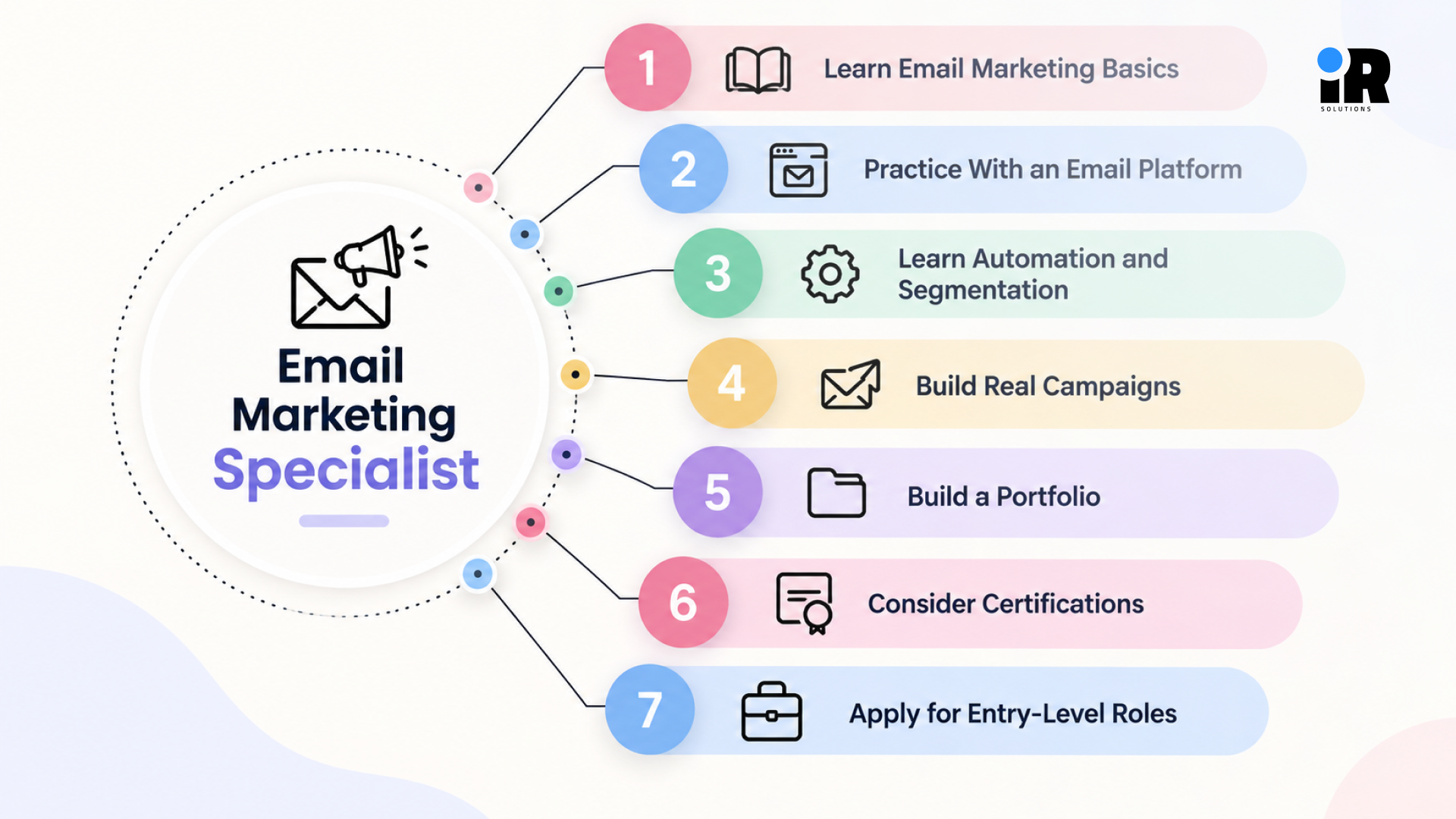
There is no single way to get into email marketing. Some people start with content or copywriting, while others move from digital marketing, CRM, or customer service. The main thing is to build useful skills and get some real experience.
Learn Email Marketing Basics
Start with the basics. Learn how email campaigns work, what deliverability means, and which numbers matter. Klaviyo and HubSpot have free guides and courses that can help you get started.
Practice With an Email Platform
Pick a platform such as Mailchimp, Klaviyo, or HubSpot and start using it. Create campaigns, build simple forms, and try setting up segments. You will learn much more by using the tools than by only reading about them.
Learn Automation and Segmentation
Learn how triggers, segments, and automated flows work. Start with simple flows such as welcome emails, abandoned carts, and post-purchase emails. Then try creating different messages for different types of customers.
Build Real Campaigns
- Try to get some hands-on experience. You can:
- Start a small newsletter and send it regularly.
- Help a small business with its email marketing.
- Take an internship or freelance project.
- Create a simple online store and practice email marketing with it.
Build a Portfolio
Show what you have actually done. Add campaigns, email flows, segments, tests, and results to your portfolio. If you have numbers, include them. For example, show how an email's click rate changed after you tested a new subject line.
Consider Certifications
Courses and certifications from platforms such as HubSpot, Klaviyo, and Google Analytics can help when you are starting. They show that you have learned the basics, but practical experience still matters more.
Apply for Entry-Level Roles
Look for jobs that give you real email marketing work. Titles can vary, so don't only search for "Email Marketing Specialist." Digital marketing, CRM, and marketing coordinator roles can also include email campaigns and automation.
When Should You Hire an Email Marketing Specialist?
Email often becomes difficult to manage when it is treated as a side task. Campaigns get delayed, automations are missed, and no one has a clear view of the results. If several of the signs below sound familiar, it may be time to bring in a specialist.
- Email takes up too much time for someone with other core responsibilities.
- Campaigns go out without a clear plan or consistent schedule.
- There is no welcome series, abandoned cart flow, or post-purchase email.
- Customer data exists, but nobody is using it to send smarter emails.
- Open rates are dropping, or emails are landing in spam folders.
- No one can say how much revenue the email channel actually generates.
- The business is growing but repeat purchase rates remain low.
If most of that list describes where things stand right now, a specialist is worth bringing in sooner rather than later. IR Solutions provides email marketing specialists who can support campaigns, automation, segmentation, and reporting.
How IR Solutions Supports Email Marketing Teams
Some businesses need a full-time internal specialist. Others get more value from bringing in experienced external support for strategy, execution, or a specific channel build.
IR Solutions provides dedicated email marketing specialists who can take on the full channel or work alongside an existing team. That covers email strategy, campaign management, automation setup and optimisation, segmentation, analytics, and ecommerce lifecycle marketing.
For businesses running on Klaviyo, the team includes specialists with deep platform experience across campaigns, flows, A/B testing, reporting, list growth, and customer lifecycle sequences.
For a wider view of available expertise, the broader digital marketing team covers email alongside other performance channels, which is useful for businesses that want email integrated with their wider acquisition and retention strategy.
Conclusion
Email is one of the few marketing channels where the right person can have a clear effect on sales. But it takes regular work. You need to know your audience, send useful emails, and pay attention to what people respond to.
An email marketing specialist needs to do more than use Klaviyo or write subject lines. They should know why a campaign worked, why people stopped opening emails, and what needs to change when results drop. These skills usually come from working on real campaigns and learning from the results.
For businesses, email can be worth the investment, but having someone who knows how to manage it matters. Poorly planned campaigns can waste time and annoy subscribers.
If you want to build a career in email marketing, start by learning the tools and working on real projects. Create campaigns, test different ideas, check the results, and keep improving. With experience, you can build the skills needed to take on bigger email marketing responsibilities.
Frequently Asked Questions
What does an email marketing specialist do?
A specialist is responsible for the email channel of a company, from campaigns to automation flows, subscriber segmentation to copywriting, deliverability tracking to A/B-testing to reporting performance.
What skills do you need to have as an email marketing specialist?
Technical skills range from email strategy to copywriting, automation, segmentation, deliverability, A/B testing, analytics, basic HTML, and knowledge of CRM integration. Soft skills include written communication, analytical thinking, attention to detail, creativity, and time management.
What is an email marketer's salary?
The U.S. salary range for 2026 consists of experienced specialists earning $75,000+, and entry-level professionals earning about $52,500. The salary averages on the major platforms range from $69k to $72k a year.
Which marketing tools do email marketing experts employ?
Most used tools are email and automation software such as Klaviyo, Mailchimp, ActiveCampaign, HubSpot, Analytics software, Design software, and e-commerce platforms such as Shopify.
What do coding skills have to do with email marketing professionals? Do email marketing professionals need coding skills?
No deep coding knowledge is needed. Basic HTML and CSS knowledge is helpful in troubleshooting template formatting problems. Most of the new email platforms are drag-and-drop, and coding is not required for them.
Is an email marketing specialist a job that requires a degree?
No degree is required. Academic qualifications are not a key factor in making most hiring decisions for this position; experience, portfolio performance, and knowledge of the platform are.
What's the difference between an email marketing person and an email marketing management person?
A specialist concentrates on execution, creating campaigns, flows, and segments and reporting on results. A manager oversees the overall email program, establishes strategy, and can be a manager for a team or outside partner.
Can you make a career in email marketing?
Yes, if the right person desires. There is still a lot of demand for skilled email marketers, particularly those with automation and deliverability knowledge. The position pays big to a candidate with strong analytical skills who loves writing and data: Specialists are always highly sought-after in ecommerce, SaaS, and B2B settings.