

Key Takeaways
- Klaviyo is the stronger choice for ecommerce brands that want deep data, advanced automation, and revenue-driven segmentation.
- Mailchimp is better for small businesses, beginners, and general marketers who want simplicity and a lower starting cost.
- Both platforms offer free plans, email campaigns, automation, and SMS marketing.
- Klaviyo connects more deeply with Shopify and other ecommerce platforms than Mailchimp does.
- Mailchimp is easier to learn, Klaviyo has a steeper learning curve but more powerful features.
- For growing ecommerce stores, Klaviyo often pays for itself through better segmentation and higher conversion rates.
- Mailchimp is the better fit when budget is tight, and your needs are straightforward.
The email marketing platform behind your campaigns can make a big difference in how effectively you reach and convert customers. Klaviyo and Mailchimp offer many of the same tools, but they support different marketing needs.
Klaviyo focuses strongly on ecommerce and customer data, making it a popular choice for online stores. Mailchimp takes a broader approach and supports small businesses, creators, and companies across different industries.
Both platforms offer email campaigns, automation, segmentation, analytics, SMS marketing, and integrations. However, their features, pricing, ease of use, and ecommerce capabilities differ.
In this guide, we compare Klaviyo vs Mailchimp across key features, pricing, ecommerce tools, and ease of use. We also look at which platform best suits ecommerce brands and small businesses.
Klaviyo vs Mailchimp: Quick Comparison
The table below gives you a quick look at the main differences between Klaviyo and Mailchimp.
Feature | Klaviyo | Mailchimp |
Best for | Ecommerce brands | Small businesses and general marketing |
Email campaigns | Yes | Yes |
Automation | Advanced | Advanced |
Segmentation | Advanced | Good |
Ecommerce data | Excellent | Good |
Personalization | Excellent | Good |
SMS marketing | Yes | Yes |
Analytics | Advanced | Good |
Integrations | 350+ | 300+ |
Ease of use | Moderate | Easier |
Free plan | Yes | Yes |
Best for Shopify | Excellent | Good |
What Is Klaviyo?
Klaviyo is an email and SMS marketing platform built for online stores. It connects to your shop, tracks what customers browse and buy, and uses that data to send the right message at the right time. It has a learning curve, but online stores that use it properly tend to see email become one of their top revenue channels.
What Is Mailchimp?
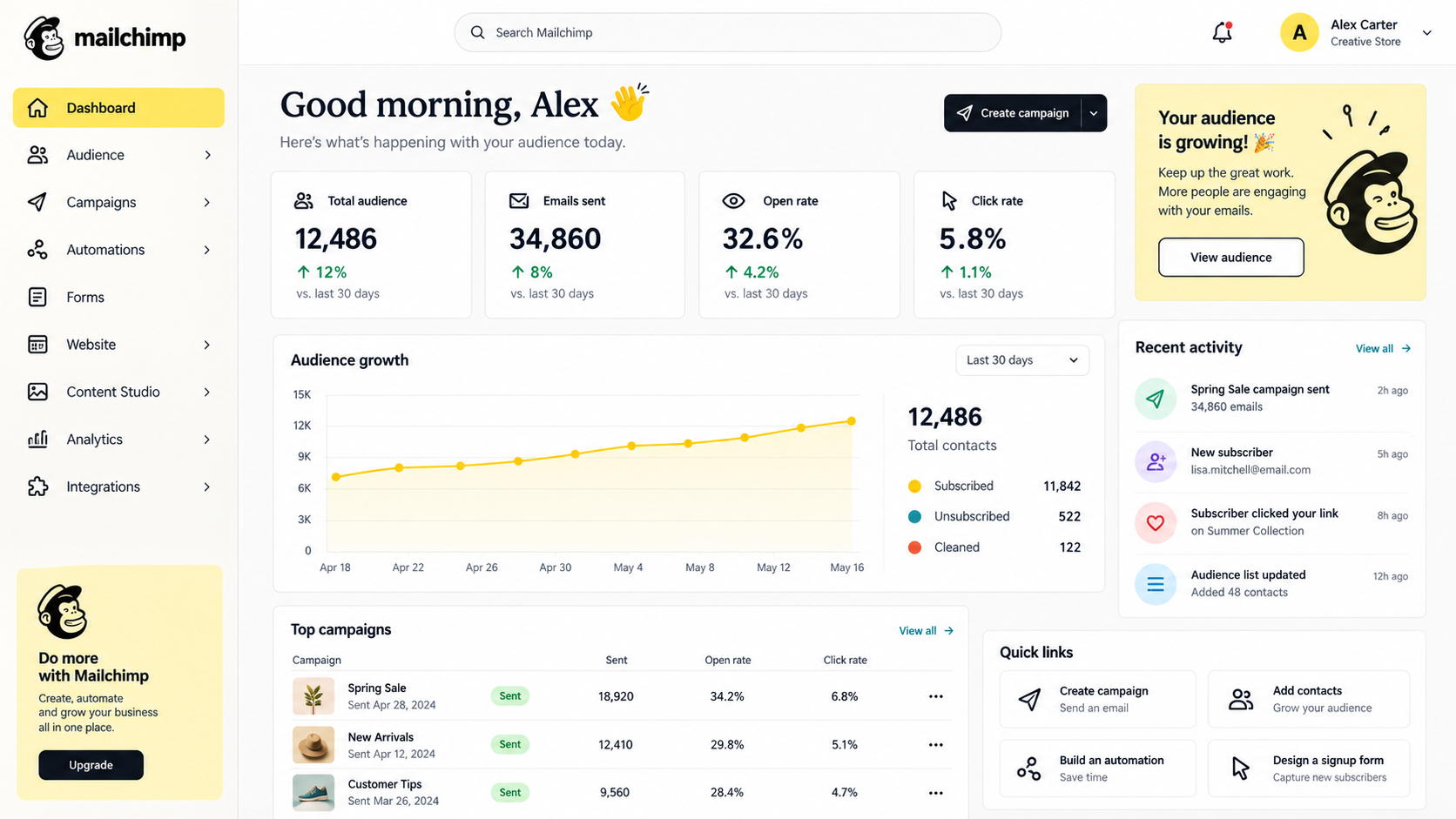
Mailchimp is a general-purpose marketing platform that has been around since 2001. It handles email, SMS, landing pages, and social ads, all from one place. It is easier to use than Klaviyo, more affordable at smaller list sizes, and works well for almost any type of business, not just online stores.
Klaviyo vs Mailchimp: Feature Comparison
Both platforms offer the core tools needed for email marketing, but they differ in automation, segmentation, ecommerce features, reporting, and ease of use. Klaviyo offers deeper features for ecommerce, while Mailchimp keeps things simpler for businesses with basic marketing needs.
1. Email Campaigns and Email Editor
Both platforms use a drag-and-drop builder, but they are not the same experience.
Klaviyo's editor gives you more control, you can integrate product data, purchase history, and personalised content blocks without editing any code. It takes a little more time to get used to, but it gives the flexibility when you need it.
Mailchimp's editor is cleaner and faster to use, especially if you are just getting started. The template library is large, the preview tools are solid, and most people can build a presentable email on their first try.
2. Marketing Automation
Klaviyo's automation reacts to what happens in your store in real time. A customer leaves without buying, and a message goes out within minutes. Someone purchases from a specific category, and a follow-up sequence starts on its own. It works off live store data, which makes the timing feel natural rather than scheduled. For more advanced flow setup and automation, you can hire a Klaviyo expert to manage your Klaviyo campaigns and customer journeys.
Mailchimp covers the main automations businesses need, including welcome emails, abandoned carts, re-engagement, birthdays, and post-purchase follow-ups. Its Customer Journey Builder is easy to use, and you can set up a basic automation in under an hour without technical skills. It is not as fast or detailed as Klaviyo, but it works well for businesses with simple needs.
3. Audience Segmentation
Klaviyo lets you build very specific audience groups based on what people bought, what they browsed, how much they spent, and whether they are likely to buy again. Those segments update on their own as the data changes, so you are always working with an accurate picture of your list.
Mailchimp covers the basics well location, purchase activity, email behaviour, and tags. You can also use pre-built segment templates that make it quick to target groups like first-time buyers or lapsed subscribers. For most small businesses, that level of segmentation is enough. It just does not go as deep into real-time or predictive data as Klaviyo does, and segments do not update automatically in the same way.
4. Personalization
Klaviyo lets you show each subscriber content based on their actual history with your store what they bought, what they looked at, and how much they have spent. You can send the same campaign to thousands of people and have it feel personal to each one.
Mailchimp handles basic personalisation like name and location through merge tags, and it has a product recommendation feature that works for simpler catalogues. It handles common marketing needs while keeping things simple and easy to use.
5. Ecommerce Features
Klaviyo is built around revenue. Every part of the platform ties back to how much money your emails are making. You can see revenue per email, revenue per flow, which customers are likely to buy again, and which ones are drifting away.
Mailchimp has strong ecommerce features like abandoned cart emails, product recommendations, and purchase-based segments. It works well for smaller stores, but its reporting does not always show the revenue behind your results. Knowing how much your emails actually generate is more useful than simply seeing open rates.
6. Analytics and Reporting
Klaviyo connects every number back to revenue. You can see how much each campaign earned, which flow is performing best this month, and how your results compare to similar businesses. It is the kind of data that helps you make real decisions, not just track basic metrics.
Mailchimp's reporting is clean and easy to read. Open rates, click rates, and revenue from campaigns it is all there without overwhelming you. For businesses that want straightforward reporting without looking into it, Mailchimp does the job well.
7. AI Features
Klaviyo uses AI to predict customer behaviour, things like lifetime value, churn risk, next purchase date, and the best time to reach each subscriber. It also suggests segments you might not have thought to create.
Mailchimp uses AI mainly for design and content. Its Creative Assistant can build a branded email template straight from your website, and it offers subject line suggestions and a content optimiser to help you improve copy before you hit send. Both are useful, just in different ways.
8. SMS Marketing
Klaviyo handles email and SMS in the same place, with the same data behind both. You can build a flow that sends an email first, then follows up with a text if the email goes unopened. It works smoothly because everything shares one data layer.
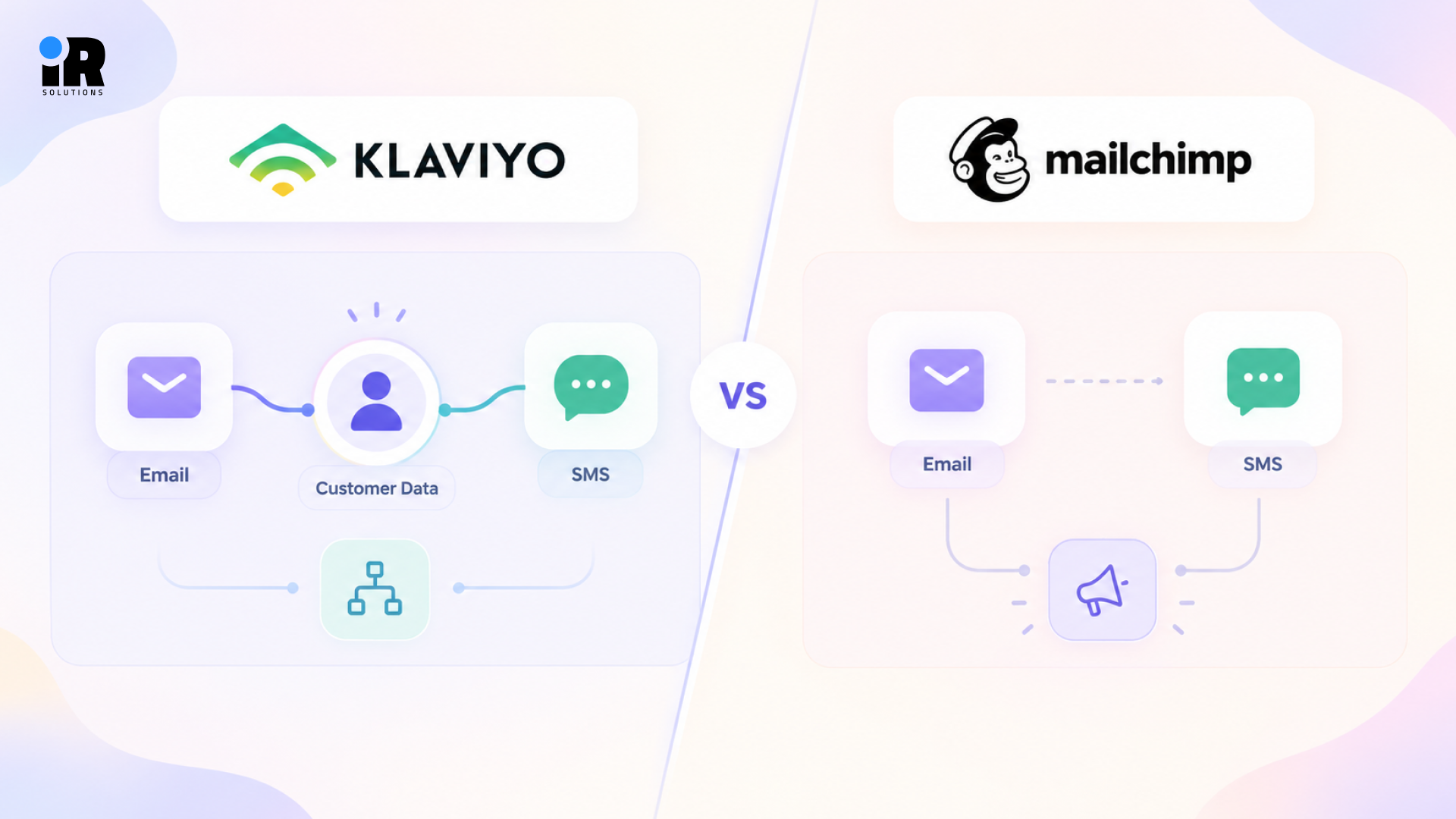
Mailchimp offers SMS as a separate add-on. It connects to your campaigns and automations, but it runs more independently than a fully unified setup. For businesses that want both channels tightly linked, this is worth factoring into your decision.
9. Integrations
Klaviyo supports a wide range of integrations, making it easier to connect customer data across different tools and platforms. Its new tech integrations framework helps streamline how new integrations are built and maintained. Klaviyo also offers a native Shopify integration that syncs store and customer data in real time, keeping segments and flows up to date.
Mailchimp connects with over 300 integration platforms across a wide range of business types. Its Shopify connection has been more complicated since 2019, when Shopify removed it from the app store. You can still connect them through a third-party tool like ShopSync, but it is an extra step that Klaviyo does not require.
10. Deliverability
Klaviyo pushes you toward sending only to engaged subscribers, which naturally protects your sender reputation over time. High-volume accounts also get access to dedicated sending infrastructure.
Learn more about keeping your emails out of spam with this Klaviyo deliverability guide.
Mailchimp has a long track record of strong inbox placement and an internal system that flags accounts showing signs of low-quality list practices. Set up DKIM, SPF, and DMARC on either platform and keep your list clean that is what actually moves the needle on deliverability, regardless of which tool you use. Both platforms do this well.
11. Ease of Use
Klaviyo takes time. The interface is packed with options, and setting up flows properly requires patience and a willingness to learn. Most people need a few sessions before they feel fully confident.
Mailchimp is much easier to get started with. The navigation makes sense, the editor is intuitive, and a beginner can send their first campaign within an hour. If your team does not have much time to invest in learning a new tool, that difference matters more than any feature gap.
Klaviyo vs Mailchimp Pricing
Pricing is often a big factor when choosing between the two platforms. Both offer free plans, but their pricing changes as your contact list grows. Klaviyo charges based on active profiles, while Mailchimp charges for all contacts, including unsubscribed ones.
Plan | Klaviyo | Mailchimp |
Free | Up to 250 active profiles, 500 emails/month | Up to 250 contacts |
Entry paid | From $20/month for up to 500 active profiles | Essentials starts at $13/month |
Mid tier | Price increases with active profile count | Standard starts at $20/month |
Growing list | Pricing increases as active profiles grow | Higher contact tiers cost more |
Large list | Pricing depends on active profile count | Premium pricing depends on contact tier |
SMS | Separate mobile messaging pricing | Separate SMS credit subscription |
Annual discount | Paid plans are billed monthly | 15% off for 12 months with 10,000+ contacts on eligible plans |
Which One Is Cheaper?
Mailchimp has the lower starting price. Its Essentials plan starts at $13/month, while Klaviyo starts at $20/month for up to 500 active profiles.
As your list grows, the difference depends on your contact count and the features you need. Klaviyo charges based on active profiles, while Mailchimp places you into pricing tiers based on the number of contacts you store.
Klaviyo can cost more, but it offers stronger ecommerce reporting and revenue attribution. Mailchimp may be a better fit if keeping your monthly costs low is the main priority.
Klaviyo or Mailchimp: Which Is Better for Ecommerce?
For ecommerce stores, the better choice depends on your business needs, budget, and growth plans. Klaviyo offers deeper ecommerce features and customer data, while Mailchimp is simpler and easier to manage.
Klaviyo for Shopify
Klaviyo connects to Shopify natively and picks up every customer action in real time product views, cart adds, purchases, refunds. You can email someone about the exact product they left behind, follow up differently based on what they bought, or automatically move them into a VIP segment the moment they hit a spend threshold. Build it once, and it runs on its own. If you need help with your store, Shopify developers at IR Solutions can help you build and optimize it for Klaviyo. Klaviyo also uses Shopify data to predict when a customer is likely to buy again, their lifetime value, and whether they are starting to drift away.
Want to increase Shopify sales with Klaviyo? Read our guide on driving more revenue for practical tips.
Mailchimp for Shopify
Since Shopify removed Mailchimp from its app store in 2019, connecting the two requires a third-party tool like ShopSync. Once connected, the core flows work fine abandoned cart, post-purchase follow-ups, product recommendations, and basic segmentation. For a newer store still building its list, that is enough. But as your catalogue and customer base grow, the shallower data access starts to limit what you can do.
Which Is Better for Ecommerce?
Klaviyo is the stronger choice, and it is not a close call. If your store is already generating sales and you want your emails to reflect that, start there.
If you are brand new with under 500 subscribers and still finding your footing, Mailchimp's free plan is a sensible starting point. Learn the basics, build your list, and move to Klaviyo when your store has enough data to make it worthwhile. The switch is straightforward, and Klaviyo is set up to help businesses coming from Mailchimp.
Klaviyo vs Mailchimp for Small Businesses
Not every business sells products online. Freelancers, consultants, local shops, nonprofits, and creators also use email marketing, but their needs are often simpler than those of an ecommerce store.
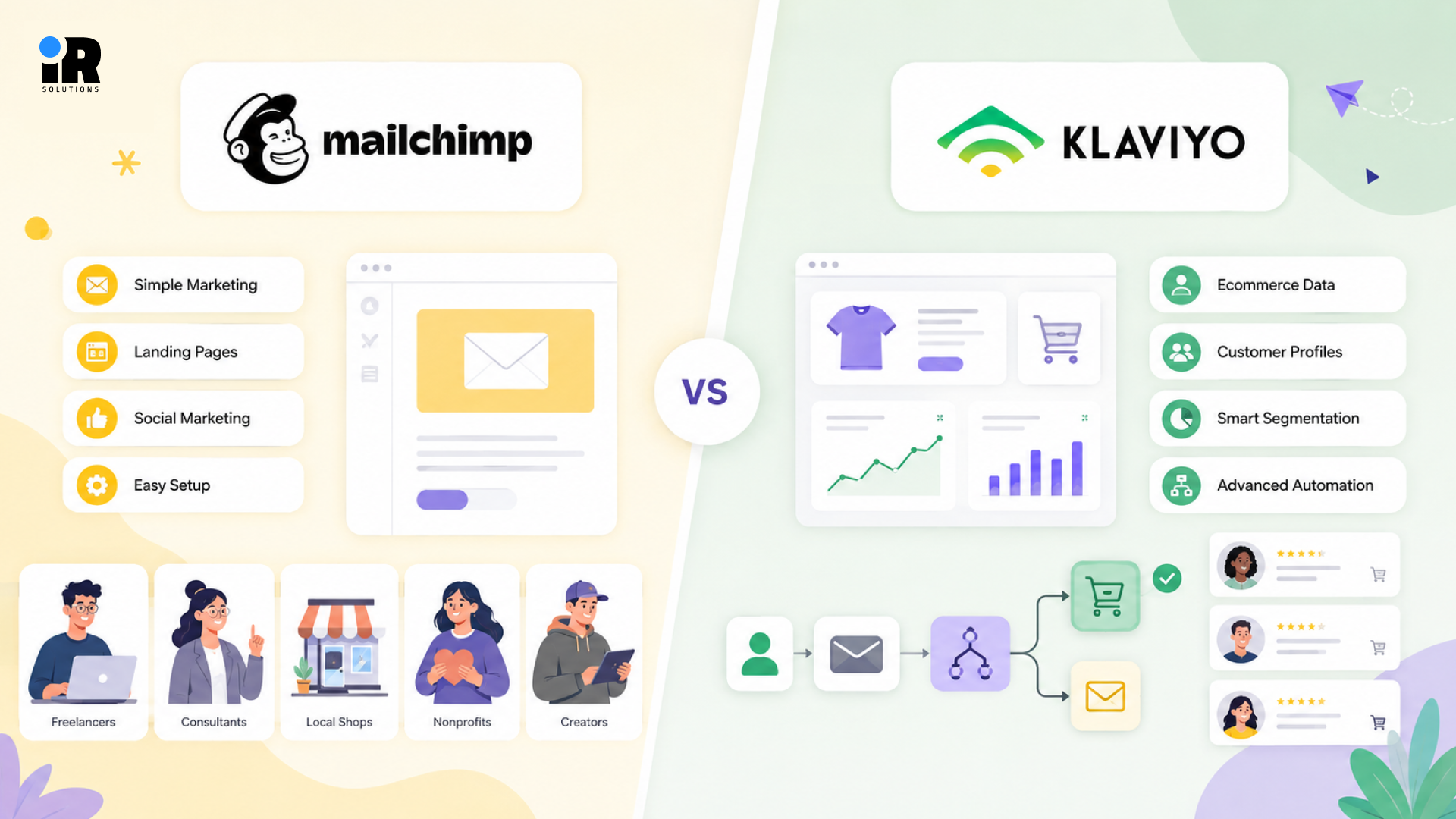
For most of these businesses, Mailchimp is the better choice. It is easy to set up and does not require much technical knowledge. Its pricing also works well for smaller email lists. Along with email marketing, you get tools for landing pages, social ads, and websites, so you can manage more of your marketing in one place.
Klaviyo can also be used by non-ecommerce businesses, but its main strength is ecommerce data. Many of its features work best when connected to an online store and customer activity. Without that data, you may end up paying for features you do not really need.
If you do not run an online store, Mailchimp is usually the more practical and affordable choice.
Klaviyo vs Mailchimp: Pros and Cons
Every platform has strengths and weaknesses. Here is an honest look at both so you can see which one suits your situation better.
Klaviyo Pros
- Connects directly to your store and pulls in real-time data from every customer action.
- Shows you exactly how much revenue each email and automation is generating.
- Builds detailed audience segments based on spending habits, behaviour, and predicted actions.
Klaviyo Cons
- Takes time to learn and is not beginner-friendly, especially for first-time users.
- Pricing grows fast as your list gets bigger, which can stretch smaller budgets.
- Most of its best features only work properly when connected to an online store.
Mailchimp Pros
- Clean and simple interface that most people can figure out within an hour.
- More affordable at smaller list sizes, with a decent free plan to get started.
- Goes beyond email with landing pages, ads, and a basic website builder included.
Mailchimp Cons
- Segmentation is basic and does not go deep into real-time or behaviour-based targeting.
- Shopify connection requires a third-party tool, which adds an extra step to the setup.
- Revenue reporting is surface-level and harder to tie directly back to individual emails.
Klaviyo vs Mailchimp: Which One Should You Choose?
The right choice depends on your business and how important email is for your sales. Both options can work well. Just choose the one that fits your business right now.
Choose Klaviyo If:
- You run an ecommerce store, particularly on Shopify, WooCommerce, or BigCommerce.
- You want to see exactly how much revenue your emails and flows generate.
- Your list is growing quickly, and you need segmentation that keeps pace with your data.
- You want email and SMS running from the same platform with the same audience data.
- You are willing to invest time upfront to learn a more powerful system.
- Abandoned cart, browse abandonment, and post-purchase flows are central to your strategy.
- You sell to repeat buyers and want to build long-term customer relationships through targeted, data-driven email sequences that grow with your store.
Choose Mailchimp If:
- You are not primarily an ecommerce business you run a service, content site, nonprofit, or agency.
- You are new to email marketing and want to start without being overwhelmed.
- Your list is small, and you want to keep costs low while you find your footing.
- You want one tool that handles email, social ads, landing pages, and basic web presence.
- Your automation needs are simple welcome series, newsletters, and the occasional promo.
- Ease of use matters more to you right now than advanced features and data depth.
Conclusion
Klaviyo and Mailchimp are both solid email marketing platforms, but they are built for different types of businesses. Klaviyo makes more sense for ecommerce brands that need detailed customer data, advanced segmentation, and stronger automation. Its deeper Shopify connection and revenue tracking can be especially useful when email plays an important role in driving sales.
Mailchimp is a better fit for small businesses, beginners, and companies with simpler marketing needs. It is easier to learn, costs less at smaller list sizes, and includes useful tools beyond email. You can get started quickly without spending time learning complex features.
The best choice really comes down to what your business needs today. If you run an online store and want to build more targeted campaigns around customer behaviour, Klaviyo is worth considering. If you want a simple and affordable platform for everyday email marketing, Mailchimp may be all you need.
Both platforms can help you build stronger customer relationships through email. The key is choosing the one that fits your goals, budget, and current stage of growth.
Frequently Asked Questions
Is Klaviyo better than Mailchimp?
Klaviyo is better than Mailchimp specifically for ecommerce businesses. It has deeper data integration, more powerful segmentation, and stronger revenue attribution. For non-ecommerce businesses and beginners, Mailchimp is often the better choice because it is simpler, more affordable at smaller list sizes, and covers a wider range of marketing tools beyond just email.
Is Klaviyo cheaper than Mailchimp?
In general, Mailchimp is more affordable at smaller list sizes. Klaviyo's pricing model depends on the number of contacts and can get costly for extensive email lists. For ecommerce brands, though, the cost will be easier to justify due to Klaviyo's direct revenue attribution. If you're sending less than 1,000 contacts per list, then Mailchimp's pricing is the cheaper one.
Which is better for Shopify, Klaviyo or Mailchimp?
Klaviyo is much better for Shopify. It comes with natively integrated purchase, browse, and customer data, which will sync in real-time from your store without the need of any third-party tools. In 2019, Mailchimp removed its built-in Shopify integration, and this now requires a workaround using ShopSync or another app. Klaviyo is the go-to provider for Shopify users who value email marketing
Is Mailchimp easier to use than Klaviyo?
Yes, Mailchimp is much simpler to use than Klaviyo. This interface is cleaner, the email editor is easy to use and most features are technically independent. A beginner can send their first campaign within an hour on Mailchimp. Klaviyo is more complex to use and has a higher learning curve, particularly for flows and segmentation.
Can I migrate from Mailchimp to Klaviyo?
Yes, it's possible to move from Mailchimp to Klaviyo, and it's quite easy. Klaviyo offers a specific import tool that imports your contacts, tags and list segments from Mailchimp. Your audience will transfer seamlessly to Klaviyo, and you'll have to create your automations again from scratch in the flow builder. A lot of ecommerce companies make this change when they expand and require more robust solutions.
Can Klaviyo and Mailchimp send SMS?
Yes, both platforms support SMS marketing. Klaviyo's SMS is deeply integrated into its email flows, allowing you to combine both channels in the same automation sequence. Mailchimp offers SMS as an add-on that works alongside its email features. Klaviyo's SMS capability is generally considered more powerful because it shares the same rich customer data that drives its email segmentation.
Which has better automation, Klaviyo or Mailchimp?
Both platforms have strong automation builders, but they excel in different areas. Klaviyo's automation is more powerful for ecommerce use cases because it triggers flows based on real-time store events like browse abandonment, specific product purchases, and customer lifetime value thresholds. Mailchimp's Customer Journey Builder handles standard sequences well and is easier to set up, making it the better choice for simpler automation needs.
Which platform has better segmentation?
Klaviyo has significantly better segmentation than Mailchimp. It allows you to build segments based on real-time purchase behaviour, browse history, predictive data, and any custom properties from your store. Segments update automatically as customer data changes. Mailchimp's segmentation covers the standard use cases well but cannot match the depth and real-time responsiveness that Klaviyo offers.
Which is better for small businesses?
Mailchimp is generally better for small businesses, especially those outside of ecommerce. It is more affordable at small list sizes, easier to use, and offers a broader set of marketing tools, including landing pages, social ads, and a basic website builder. For small ecommerce stores with ambitious growth plans, starting with Klaviyo still makes sense, but for service businesses, freelancers, and local brands, Mailchimp is the more practical choice.
Which is better for ecommerce?
Klaviyo is the better platform for ecommerce. Its entire feature set is designed around online retail connecting with store data, triggering flows based on purchase events, attributing revenue directly to email campaigns, and predicting customer behaviour. It is the platform of choice for most serious ecommerce brands and the one most often recommended by Shopify and ecommerce consultants. Mailchimp handles ecommerce reasonably well for small stores with basic needs, but it is not built with the same ecommerce-first focus.