



Key Takeaways
- Email marketing agency costs typically range from $500 to $10,000+ per month.
- Agency pricing depends on campaign volume, automation, design, segmentation, and reporting.
- Always compare proposals by scope, not just the monthly price.
- Agency fees and platform costs are usually separate expenses.
- Extra campaigns, revisions, migrations, and strategy sessions can add to your total cost.
- A clear scope helps you avoid unexpected costs and get more value from your budget.
Email marketing can be an important revenue channel for businesses, but the results depend heavily on how campaigns, automation, audience targeting, and reporting are managed. So why do so many businesses feel like they're getting nothing from it?
Usually, it comes down to what they actually paid for.
Email marketing agency pricing can range from around $500 to $10,000+ per month, depending on the level of service, campaign volume, automation, design, and strategy involved. Industry pricing data also shows that email marketing costs vary widely depending on whether you're paying for agency services, freelancers, or the platform itself.
Two agencies charging the same amount can still be doing very different work. One $2,500/month proposal covers strategy, copywriting, design, core automation flows, segmentation, and monthly reporting. Another $2,500/month proposal covers campaign scheduling and a monthly PDF with your open rates. Same price. Completely different scope.
The reason comparisons are so hard is that email pricing gets bundled across strategy, copywriting, design, automation, list management, platform fees, and reporting in ways that make apples-to-apples comparison nearly impossible. Your platform subscription Klaviyo, Mailchimp, ActiveCampaign is almost always a separate bill on top of the agency fee. So that $800/month quote? Add 300 - 600 for the platform, and the cheaper option starts to look a lot less cheap.
This guide breaks down what email marketing agencies actually charge, what drives the price up or down, what each budget level should realistically get you, and the questions worth asking before you sign anything.
How Much Does an Agency Charge for Email Marketing?
Costs can vary a lot because every business needs a different level of help. A small business sending a few emails each month will usually pay less than a larger ecommerce brand running several campaigns, automated flows, and segmentation. Before comparing agency quotes, it helps to know the common pricing ranges and what you get at each level.
Typical Monthly Costs
Email marketing agency pricing can start around $500 per month for limited support and go up to $10,000+ per month for larger and more complex programs.
Monthly Cost | Typical Services | Best For |
$500 - $1,000 | Limited campaign support, basic email management, and simple automation | Small businesses |
$15,00 - $2,500 | Regular campaigns, copywriting, design, and basic automation | Growing businesses |
$2500 - $5,000 | Strategy, campaigns, automation, segmentation, testing, and reporting | Established ecommerce brands |
$5,000 $10,000+ | Advanced automation, complex segmentation, testing, reporting, and ongoing strategy | Larger brands with complex email programs |
These are general market ranges, not fixed rates. The final price depends on the number of campaigns, audience size, automation work, design needs, reporting, and other services included in the package.
Project-Based Costs
Some businesses hire an agency for a one-time project instead of paying a monthly fee. This works well when the work has a clear start and end date.
Common project-based services include:
- A full review of your email account, campaigns, flows, deliverability, and overall setup can cost $500 - $2,000+.
- Moving from one email platform to another commonly costs $1500 - $5,000+, depending on the amount of data, templates, flows, and integrations involved.
- Building automated flows from scratch commonly cost $1500 - $10,000+, depending on the number and complexity of the flows.
- Creating branded email templates often costs $300 - $1,500+ per template, depending on the design and number of templates needed.
Hourly Rates
Some agencies and email marketing consultants charge by the hour for strategy, troubleshooting, audits, or technical work. Hourly rates commonly range from $100 to $300 per hour for specialist email marketing services.
This model can work well for account audits, strategy sessions, deliverability issues, or technical advice. If an agency charges by the hour, ask how many hours they expect the work to take and what the estimated total cost will be. This makes it easier to compare an hourly quote with a fixed project or monthly retainer.
Why Prices Vary So Much
The amount of work included strongly affects the price. A business with 2,000 subscribers and one campaign a week needs much less work than a brand with 100,000 subscribers, several weekly campaigns, multiple automation flows, and an SMS program.
List size, campaign frequency, automation complexity, copywriting, design, segmentation, testing, deliverability, integrations, and reporting can all affect the final cost. Agencies also charge more when they handle strategy and ongoing improvements instead of simply creating and sending emails.
Our Email Deliverability Guide covers common deliverability issues and what can affect inbox placement.
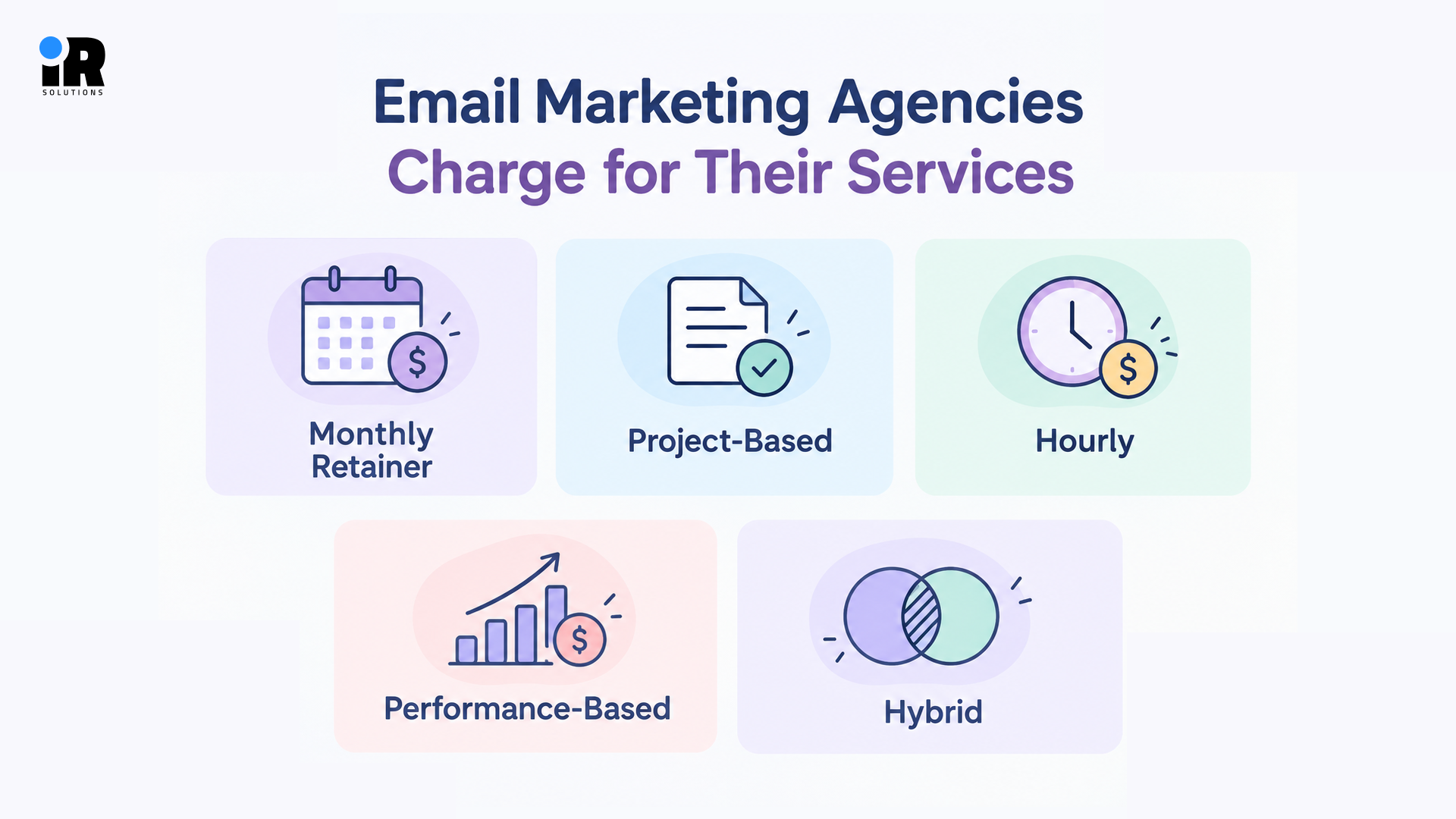
How Email Marketing Agencies Charge for Their Services
Email marketing agencies charge in different ways depending on the work involved. Knowing how each pricing model works can help you compare quotes and avoid unexpected costs.
Monthly Retainer
A retainer fee is a set of services that are paid monthly for a fixed amount of money. This is the most common option for utilizing email on an ongoing basis because it creates a foreseeable working relationship for both parties. The agency knows what they are providing, and you know what you are paying for. Ensure the retainer is well understood and specifies what services are covered, how many campaigns, and what is not covered.
Project-Based
Project pricing is a one-time cost that charges for a specific deliverable. This is standard for platform migrations, automated builds, template development, and email program audits. Projects are suitable for any business with internal capacity to keep them managed, but require expert assistance to ensure the proper configuration.
Hourly
Hourly billing gives you flexibility for work that does not fit neatly into a monthly package. Strategy sessions, technical fixes, deliverability reviews, and short consulting engagements are often billed this way. The risk is that costs can add up quickly without a clear scope, so always ask for a time estimate before authorising hourly work.
Performance-Based
Some agencies link part of their compensation to revenue generated from email. In theory, this aligns incentives. In practice, it requires careful definition of attribution before you agree to anything. Revenue from email is not always straightforward to attribute, and without a clear framework, disputes can arise. This model works better for established programs where performance benchmarks already exist.
Hybrid
Many agencies use a combination, such as a monthly retainer for ongoing management plus a project fee for one-off work, or a base retainer with a performance component added on top. Hybrid models are common for growing brands that need consistent support but also have occasional strategic projects outside the regular scope.
What Does an Agency Fee Actually Cover?
The monthly fee is only part of the picture. What you actually get can vary widely between agencies. Review the scope carefully to see what is included in these key service areas.
Email Strategy and Planning
A good agency starts with a plan rather than simply sending emails. This can include campaign calendars, promotional timing, customer lifecycle planning, and strategies based on how your audience shops.
Campaign Management
Campaign management covers more than writing an email. It may include building, testing, scheduling, audience selection, and reviewing results after the send. Check whether the agency handles the full process or only provides the copy and design.
Copywriting
Find out exactly what copywriting includes. Subject lines, preview text, body copy and calls to action should be within scope. Look to see if the agency creates the content all by itself or if they need it from you.
Design
The services designed may involve editing of the existing templates or designing a custom layout and graphics. Look for the number of revisions and see if any new templates are part of the monthly subscription or an additional charge.
Segmentation and Personalisation
Segmentation helps you send more relevant messages based on factors such as purchase history, browsing behaviour, product interest, and engagement. More detailed segmentation usually requires more ongoing strategy and management.
Reporting and Optimisation
Reports should do more than show open and click rates. They should help you understand revenue, flow performance, campaign results, and what needs to change. Ask how often reports are provided and whether the agency explains the results with you.
A Klaviyo Audit Checklist can help you review key parts of your account, including flows, campaigns, deliverability, segmentation, and reporting.
What Drives the Price Up or Down?
Email marketing costs depend on what the agency is expected to handle. List size, campaign volume, automation complexity, copywriting, design, and reporting can all affect the monthly cost. The more work included in the scope, the higher the price is likely to be. Looking at these factors helps you understand what you are paying for.
List Size
Managing a list of 1,000 subscribers is fundamentally different from managing one with 200,000. Larger lists require more careful segmentation, more robust list hygiene, higher platform costs, and more thorough deliverability management. Agencies factor list size into their pricing because scale affects nearly every part of the work.
Campaign Volume
A brand sending two campaigns a week requires significantly more production time than one sending two campaigns a month. Higher campaign volume means more copywriting, design, testing, and scheduling every single month. Most agencies cap the number of campaigns included in a monthly fee and charge for anything beyond that limit.
Automated Flows
Simple automations like a single welcome email are quick to build. Complex multi-step flows with conditional logic, dynamic content, and behavioural triggers take considerably more time to set up and maintain. The number of flows and their complexity are significant pricing factors for any ongoing retainer.
Customisation Level
A standard template applied to a brand's colours costs far less than a fully custom design built from scratch. Similarly, a personalised email that pulls in dynamic product recommendations based on browsing history requires more technical work than a static send. The more customised your emails, the higher the price.
Copywriting Requirements
Some clients provide ready-to-use copy. Others need the agency to handle everything from initial research to final subject lines. Full copywriting adds meaningful time to every campaign and is one of the clearest factors separating lower-cost packages from mid-range and full-service ones.
Segmentation Complexity
Basic segmentation might mean splitting a list into engaged and unengaged groups. Advanced segmentation creates multiple audience layers based on product categories, purchase frequency, customer lifetime value, or predicted behaviour. Each layer adds strategy and technical work to the agency's scope.
Email and SMS Together
Adding SMS to your program increases the total scope of work. SMS campaigns, automated text flows, cross-channel coordination, and compliance requirements all add time and expertise to what the agency delivers. Most agencies price SMS management separately or at a higher tier.
Reporting Depth
An agency that sends a PDF report once a month and an agency that runs monthly strategy calls, tracks revenue attribution, tests subject lines, and delivers optimisation recommendations are offering very different things. Make sure the reporting depth matches what your business actually needs to improve over time.
Agency Fee vs Platform Cost: Two Separate Bills
This is one of the most common points of confusion when comparing proposals. The agency fee and the email platform subscription are almost always two separate costs.
What the Agency Fee Covers
The agency fee pays for the people doing the work. That includes strategy, campaign creation, copywriting, design, automation management, segmentation, reporting, and account management. It does not cover the software your emails are sent through.
What the Platform Fee Covers
Platforms like Klaviyo, Mailchimp, Omnisend, ActiveCampaign, and HubSpot charge their own subscription fees. Those fees are typically based on your subscriber count or the number of emails you send per month. A large list on a platform like Klaviyo can cost several hundred to several thousand dollars per month on its own.
If you are comparing platforms before choosing one, see our Klaviyo vs Mailchimp comparison for a closer look at pricing, automation, segmentation, and other differences.
Your Total Monthly Cost
A simple way to calculate your full spend looks like this:
Agency fee + Platform fee + Additional services = Total monthly cost
Many businesses budget only for the agency fee and are surprised when the platform bill arrives separately. Build both into your planning from the start.
Other Software Costs
Depending on your setup, you may also pay for:
- SMS tools
- Analytics software
- Design tools
- Integrations
Ask your agency to list all software costs during the proposal stage so you have a complete picture before signing anything. If you need help managing campaigns, automation, segmentation, and reporting, you can also hire email marketing experts to handle these areas.
What Does Each Budget Level Get You?
The right budget will depend on the amount of work your email program requires. Depending on the size of your ecommerce store, you might only require a few campaigns and simple flows, or you might need more advanced automation, segmentation, testing, designing, deliverability, and SMS. The cost of managed email marketing can begin at $1,500 per month and scale up to $10,000 for larger programs, with more campaigns, automation, segmentation, design, reporting, and strategy.
Small Businesses
For a small business with a smaller list and a fairly simple email program, around $500 to $3,000 per month is a realistic starting range for managed Klaviyo services. This can cover core flows, several campaigns each month, basic segmentation, and regular reporting. Some smaller providers may charge less, but the scope is usually more limited.
Growing Ecommerce Brands
As the store grows, email usually needs more regular campaigns, better segmentation, additional flows, testing, and ongoing strategy. A budget of $3,000 to $5,000 per month is a common range for this level of support. Packages in this range may include email and SMS, custom design, a broader flow setup, A/B testing, and regular strategy reviews.
Established Ecommerce Businesses
Established brands often have larger subscriber lists and more revenue coming through email, so their programs tend to require more ongoing work. Around $5,000 to $8,000 per month can cover a more involved program with advanced flows, deeper segmentation, regular testing, custom campaigns, SMS management, and deliverability work. Published agency pricing also places many full-service programs in the broader $5,000 to $10,000+ range.
Large or Complex Brands
Large brands with multiple markets, high sending volumes, complex integrations, and email and SMS running together can require a dedicated team. $8,000 to $10,000+ per month is reasonable for this level of service, with some enterprise programs reaching $15,000 to $20,000 or more when the agency is handling strategy, creative, analytics, automation, and multiple channels.
What Do Different Monthly Budgets Cover?
The following examples illustrate what different budget levels can typically cover. These are practical illustrations, not fixed industry standards, since every agency structures their packages differently.
Basic Package: $500 - $1,000 Per Month
Best for: Small businesses with modest lists and low campaign frequency.
Typical inclusions:
- Campaign sends: 2–4 per month
- Design: Template-based, limited customisation
- Copywriting: Client-provided or light editing
- Automation: Basic welcome flow
- Reporting: Monthly summary report
Growth Package: $1,000 - $ 2,500 per month
Best for: Growing brands ready to invest in consistent email activity.
Typical inclusions:
- Campaign sends: 4–8 per month
- Design: Branded templates, some custom elements
- Copywriting: Full copy included
- Automation: Core flows (welcome, abandoned cart, post-purchase)
- Segmentation: Engaged vs. unengaged splits
- Reporting: Monthly reporting with performance insights
Full-Service Package: $2,500 - $5,000 Per Month
Best for: Established brands that want a complete, managed program.
Typical inclusions:
- Campaign sends: 8–16+ per month
- Design: Custom template design and ongoing creative
- Copywriting: Full copy and subject line testing
- Automation: Advanced flows with conditional logic
- Segmentation: Multi-layer audience targeting
- Reporting: Detailed monthly reporting with strategy recommendations
Advanced Program: $5,000+ Per Month
Best for: High-volume brands with large databases and complex needs.
Typical inclusions:
- Campaign sends: Unlimited or very high volume
- Design: Custom creative for every campaign
- Copywriting: Full copy with strategic messaging
- Automation: Complex lifecycle flows across email and SMS
- Segmentation: Predictive and behavioural audience targeting
- Reporting: Advanced analytics with revenue attribution and regular strategy sessions
How to Read a Proposal Without Getting Caught Out
The monthly price does not tell you everything. Before you sign the proposal, check what the agency will actually do, what is included, and which services will cost extra.
Check Campaign Count
Find out exactly how many campaigns are included each month. Ask whether promotional emails, transactional emails, and seasonal campaigns all count against the limit. Confirm the cost for additional campaigns sent beyond the agreed number.
Check Automation Scope
Ask how many flows are included, whether the package covers setup and optimisation, and whether the agency will monitor and update them as your business changes.
Check Copy and Design
Confirm who writes the emails, who designs them, how many revisions are included, and what happens if you need something outside the standard template. These details matter more than most businesses realise when a revision request arrives.
Check Reporting
Find out what metrics the agency tracks, how often you receive reports, and whether those reports include analysis and recommendations or just numbers. Good reporting should help you make decisions, not just tell you what happened.
Check Additional Fees
Look for clauses covering extra campaigns, additional revisions, platform migration, SMS, integrations, strategy sessions, or any other work that sits outside the core scope. Unexpected costs most commonly arise here.
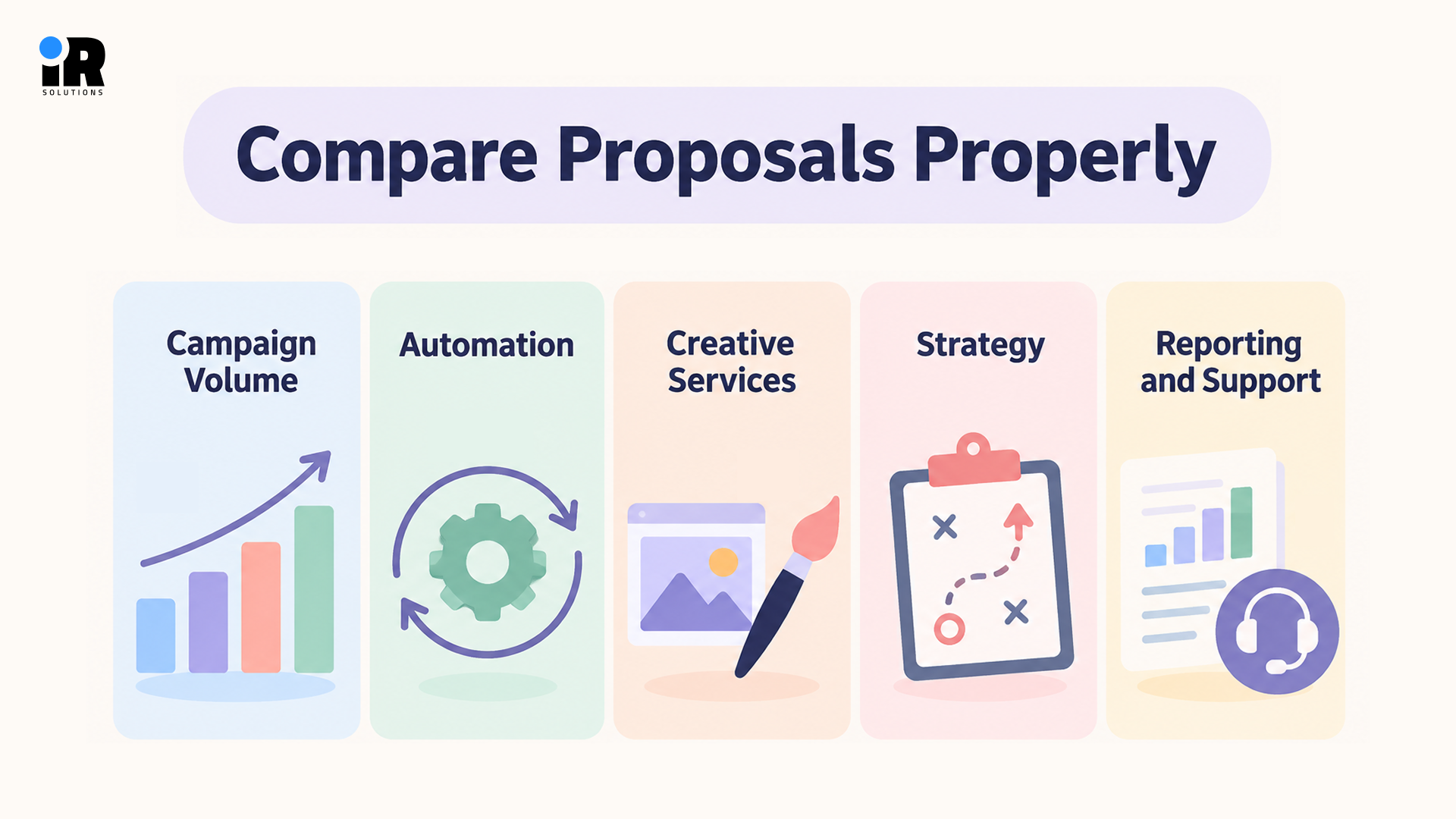
How to Compare Proposals Properly
When you have two or three proposals in front of you, the price is the easiest thing to look at and the least useful. What you actually need to compare is the scope. Here is where the real differences sit.
Campaign Volume
Check how many campaigns are included with each quote and at what frequency. A lower monthly fee that covers only two campaigns may cost more per campaign than a higher fee that includes eight.
Automation
Look at how many flows are included, whether setup and ongoing optimisation are covered, and how complex the flows are. A package that includes ten advanced flows is worth considerably more than one that covers a basic welcome series.
Creative Services
Review what copywriting and design each agency offers. An agency that writes all your emails and provides custom design is providing considerably more value than one that uses a standard template and expects you to supply the copy.
Strategy
Some agencies focus mainly on execution, while others also handle planning, testing, analysis, and recommendations. Check whether the level of strategic support matches what your email program needs.
Reporting and Support
Review how often you receive reports, whether you get regular meetings, and how accessible the team is between scheduled check-ins. Communication quality is one of the clearest indicators of how well an agency relationship will work over time.
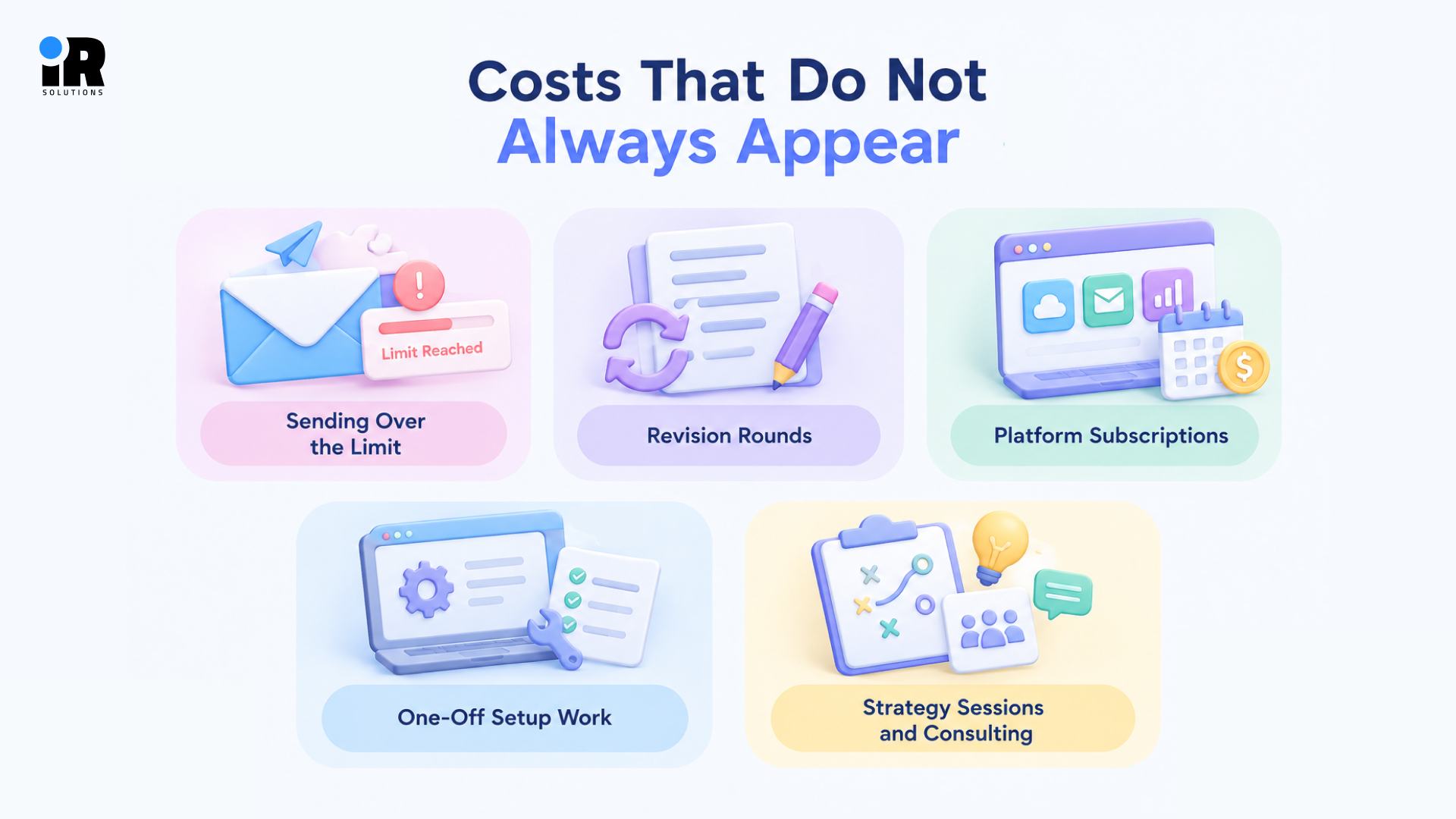
Costs That Do Not Always Appear in the Proposal
Some charges only come up once the work is underway. These are the ones businesses most commonly overlook when reviewing a quote for the first time.
Sending Over the Limit
Most packages cap the number of campaigns included in the monthly fee. Seasonal peaks, promotions, or last-minute sends that push you over that limit will usually be charged at an additional rate per campaign or per hour.
Revision Rounds
Many packages include a set number of revisions. Additional rounds of changes, new template requests, or extra copywriting beyond the agreed scope are typically billed separately. Know how many rounds are included before you start.
Platform Subscriptions
The ESP platform, SMS tool, and any additional software are rarely included in the agency fee. These costs can be high, especially at larger list sizes. Build them into your budget from day one.
One-Off Setup Work
If you are switching platforms or rebuilding your email program from the ground up, expect to pay for that work as a separate project on top of any ongoing retainer. Migration is rarely included in a standard monthly fee.
Strategy Sessions and Consulting
Meetings, additional strategy sessions, audits, or work requested outside the agreed scope are sometimes included in higher-tier packages but billed separately in others. Confirm this upfront so you are not surprised mid-contract.
When Does Hiring an Agency Actually Make Sense?
Hiring an agency makes sense when email has become too time-consuming to manage in-house, or you need skills your current team does not have. It can also help when your email program has untapped potential, but you do not have the time or experience to handle it yourself.
No In-House Expertise
Managing email well covers copywriting, design, automation, segmentation, deliverability, and strategy. Most businesses do not have specialists in all of these areas. An agency gives you access to an experienced team without the cost of building that team internally.
Underused Program
Many businesses have a platform, a subscriber list, and a few basic flows but are not using the channel anywhere near its potential. Bringing in specialists can identify what is being missed and build a program that actively drives revenue.
Time Being Lost
Campaign production, automation management, list hygiene, and reporting take significant time each month. If your internal team is spending hours on email tasks at the expense of other priorities, that is a clear signal that outside support would pay for itself.
Complex Automation Needed
Building and maintaining advanced customer journeys requires specific skills and platform knowledge. If your business needs sophisticated lifecycle flows, a team with proven automation experience will deliver better results faster than a generalist.
How to Get More From Your Email Marketing Budget
Spending more does not always mean better results. Put your budget toward the services that matter most to your business, such as important automations, regular campaigns, or better reporting. This helps you get more from your budget without paying for work you do not need.
Define Scope First
Before you agree to any package, write down exactly what you need, number of campaigns, flows required, copy and design expectations, and reporting frequency. A clearly defined scope helps prevent extra work and keeps both sides on the same page from day one.
Prioritise Key Automations
Start with the flows that have the most direct impact on revenue. Start with the flows that are most relevant to your customer journey, such as welcome, abandoned cart, and post-purchase emails. Build these properly before adding more complex automations.
Use Segmentation Thoughtfully
More segments do not automatically mean better results. Focus on meaningful audience splits that reflect real differences in customer behaviour. Useful segmentation improves performance. Unnecessary segmentation adds complexity without benefit.
Track Revenue and Conversions
Open rates and click rates tell you something, but they do not tell you everything. Connect your email activity to actual purchases, repeat orders, and customer lifetime value to understand the real business impact of your program.
Review the Account Regularly
Email programs need ongoing attention. Campaigns that performed well a year ago may need refreshing. Flows that were built during setup may need updating as your product range or customer base changes. Regular reviews keep the program performing at its best.
Conclusion
Hiring an email marketing agency is both a budget and scope decision. The cost depends on how much of your email program the agency will manage and the level of support included.
The price matters, but the scope behind it matters just as much. Check what the agency will handle, who is responsible for each task, and how performance will be reported and reviewe
Before you compare monthly fees, compare the scope behind them. How many campaigns are included? Who writes the copy? Are the automation flows built and left, or monitored and updated? Is the platform cost separate? These questions tell you far more than any headline price.
A clear scope makes it easier to compare agencies and track the work being delivered. Before signing, confirm the campaign volume, automation work, copywriting, design, reporting, platform costs, and any additional fees.
If your current email program needs more support, start by identifying the work you need help with and comparing agencies based on scope, pricing, and the services included.
Frequently Asked Questions
How much does an email marketing agency cost per month?
Monthly fees typically range from $500 to $5,000 or more, depending on the number of campaigns, automation complexity, copywriting and design requirements, and reporting level. Simpler programs cost less, and full-service programs cost considerably more.
How much does email marketing cost for a small business?
Small businesses with modest lists and low campaign frequency can usually access solid management for $500 to $1,500 per month. Costs increase as campaign volume, automation, and design requirements grow.
How much do agencies charge per hour for email work?
Hourly rates generally range from $100 to $300 per hour, depending on the type of work, level of expertise, and complexity of the project. Consulting, strategy, and technical troubleshooting are most commonly billed this way.
Does the agency fee include Klaviyo?
No. In the vast majority of cases, the management fee and the Klaviyo subscription are separate costs. Your platform subscription is billed directly by Klaviyo based on your subscriber count. The agency fee covers the people managing your program.
How much does email automation cost?
Simple setups like a basic welcome flow can cost as little as $500 to $1,000. Complex lifecycle programs with multiple conditional flows, dynamic content, and SMS integration can cost $5,000 to $10,000 or more to build properly.
Do agencies charge a monthly retainer?
Yes, most use a monthly retainer model for ongoing management. The retainer covers an agreed scope of services for a fixed monthly fee, giving both parties a predictable and structured working relationship.
What should a good agency package include?
A solid package should include campaign management, copywriting, design, automation, segmentation, reporting, and strategic input. The level of each service will vary by package, which is why comparing scope rather than price is the most useful way to evaluate proposals.
Are there hidden costs to watch for?
Yes. Common unexpected costs include extra campaigns beyond the monthly limit, additional design revisions, platform subscription fees, migration costs, SMS management, and strategy sessions outside the agreed scope. Always ask for a full breakdown before signing.