


Key Takeaways
- Send your first abandoned cart email around 1 hour after abandonment.
- Follow up with a second email at 24 hours and a third at 48 to 72 hours.
- A three-email sequence can give stores multiple opportunities to recover abandoned carts without overmessaging shoppers.
- Product type and cart value should influence how you adjust your timing.
- Never offer a discount in your first email, a reminder alone is often enough.
- For most triggered cart emails, time since abandonment is more important than optimizing for a specific hour of the day.
- Test one timing variable at a time, and only when you have enough volume.
- Measure incremental revenue, not just opens and clicks.
Around 70% of online shopping carts are abandoned before checkout is completed, representing significant lost revenue for ecommerce stores. While most store owners know abandoned cart emails can help recover these sales, timing often makes the biggest difference.
Send the first email too soon, and the shopper may still be browsing or comparing options. Wait too long, and they may have lost interest, purchased elsewhere, or forgotten about the product altogether.
For most ecommerce stores, a strong starting point is to send the first abandoned cart email about one hour after abandonment, followed by another around 24 hours later and a final message 48 to 72 hours after that. The ideal timing, however, depends on your products, buying cycle, and audience.
This guide explains when to send each message, why these intervals work, and how to adjust your timing to find the schedule that generates the best results for your store.
What Is the Best Time to Send an Abandoned Cart Email?
There is no single send time that works for every store, every shopper, and every product. But most ecommerce stores can start with a baseline that has worked well enough to build on.
Recommended Timing | Recommended Range | Primary Purpose | |
First | Around 1 hour | 30 to 120 minutes | Remind |
Second | Around 24 hours | 18 to 36 hours | Address hesitation |
Third | 48 to 72 hours | 2 to 3 days | Create urgency |
First reminder: Send it around 1 hour after abandonment
Send the first email about an hour after the shopper leaves their cart. The product is still fresh in their mind, so a simple reminder may bring them back. For lower-priced products, you can test a shorter delay, while higher-priced products may need more time.
A Klaviyo case study on Les Raffineurs found that shortening its abandoned cart email delay from 2 to 4 hours to 30 minutes to 1 hour increased its open rate from 12% to 16% to 17%.
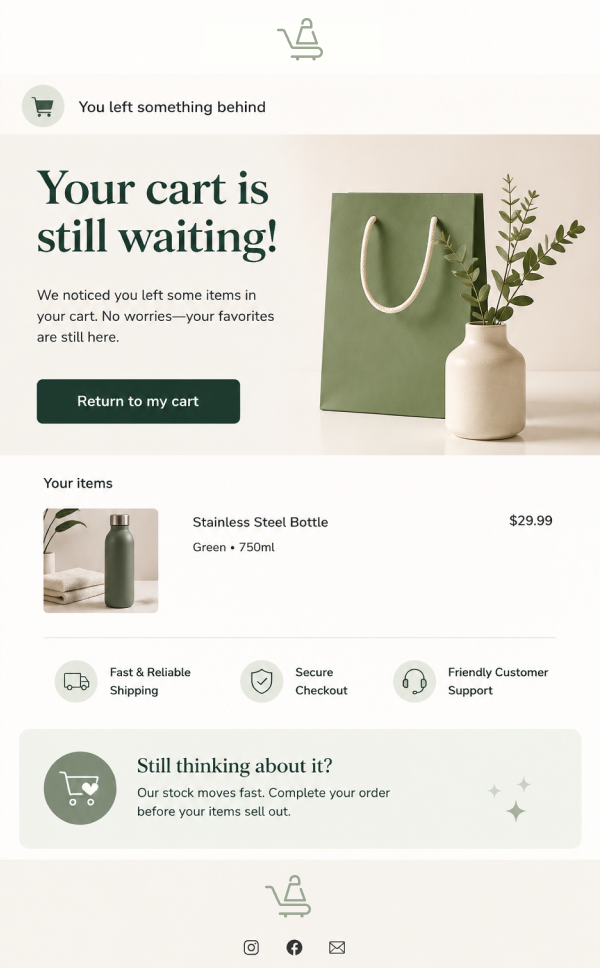 Second reminder: Follow up around 24 hours later
Give people a little breathing room before the second email lands. By this point, they may have been comparing options or just got busy and forgot. Use this one to answer questions they might have, spell out the benefits, or show what other customers are saying.
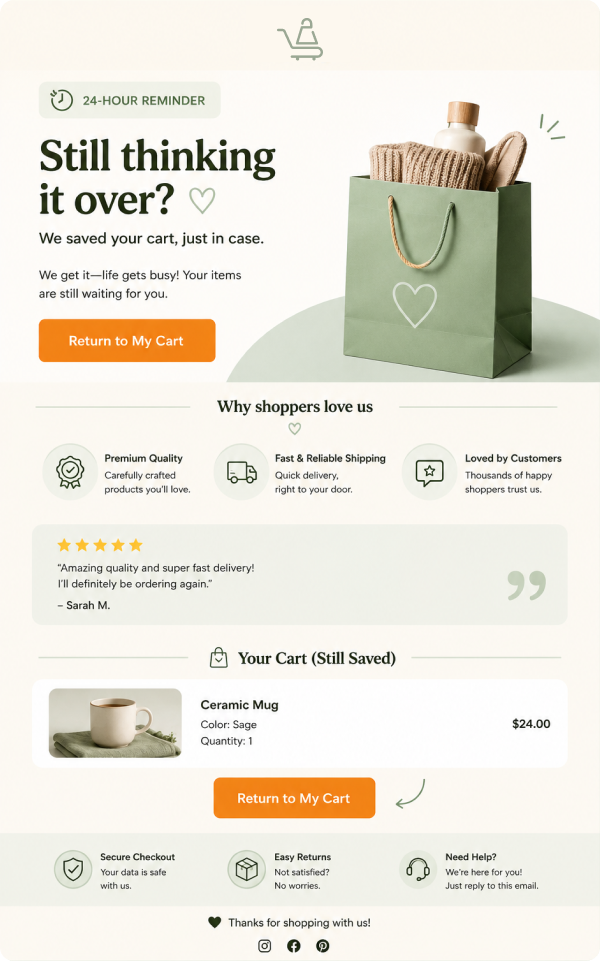
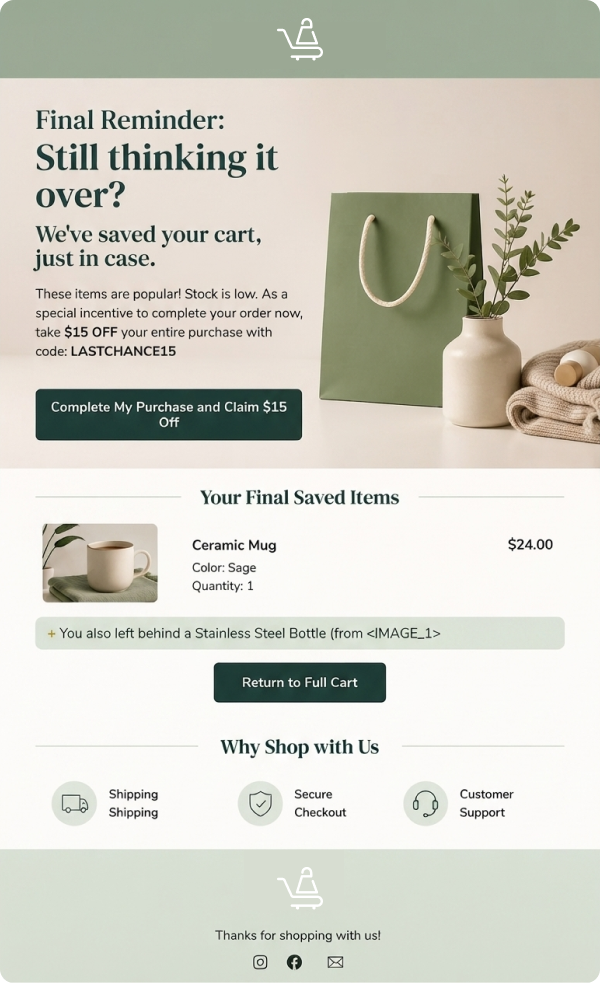
Third Reminder: Send it 48 to 72 hours after abandonment
For a three-email sequence, this is usually the last one. If it makes sense for your offer, add a small incentive or a reason to act soon. Spacing the emails out this way keeps the sequence feeling helpful rather than desperate.
Why Does Abandoned Cart Email Timing Matter?
When you send these emails has a real effect on how many people come back and actually buy. It is not just about picking a schedule it helps to understand why each email goes out when it does.
Customer Intent Is Strongest Soon After Abandonment
In the first few hours, the product is still fresh in their mind. They remember why they added it. A well-timed nudge can bring them back while that interest is still there. Wait too long, and they get distracted, move on, or simply lose interest.
Waiting Too Long Can Reduce Relevance
The further out you go, the less connected they feel to what they left behind. Later emails need to give them a new reason to come back, not just repeat what the first email already said.
Sending Too Quickly Can Feel Intrusive
An email that arrives minutes after someone leaves can feel off. They might still be finishing their purchase, or the order may not have processed yet. Waiting a short period gives shoppers time to finish their purchase before the reminder arrives. It also makes the email feel more like a helpful reminder than an immediate reaction to their activity.
Shoppers May Be Comparing Other Options
A lot of people leave carts because they are checking what else is out there other prices, other products, other deals. Wait too long, and a competitor fills that gap.
The goal is to follow up while the shopper is still considering the purchase, without making them feel pressured.
How Timing Changes Based on the Product
The one-hour, 24-hour, and 48- to 72-hour schedule is a practical starting point, not a fixed rule. Longer buying cycles may require more time between emails, and longer buying cycles may require more time between emails. The nature of the buying decision, the price point, and the research cycle all influence how quickly a shopper is likely to convert.
Product Type | Email 1 | Email 2 | Email 3 | Reason |
Low-cost / impulse | 30 to 60 min | 24 hr | 48 hr | Short decision cycle |
Everyday products | Around 1 hr | 24 hr | 48 to 72 hr | Moderate consideration |
Electronics | 1 to 2 hr | 24 to 48 hr | 3 to 4 days | More research and comparison |
High-ticket products | 2 to 4 hr | 48 hr | 5 to 7 days | Longer decision process |
B2B | Several hours | 1 to 2 days | 5 to 7 days | Longer approval process |
These are practical starting points, not universal benchmarks. Test them against your product price, buying cycle, and customer behavior.
How Many Abandoned Cart Emails Should You Send?
For most ecommerce stores, three abandoned cart emails are a good starting point. They give you several chances to bring shoppers back without sending so many messages that they become annoying. The ideal number varies by product and how quickly customers usually make a purchase decision.
When One Email Is Enough
For low-cost products that require little thought, one reminder may be enough. Sending more emails for a small purchase can do more harm than good. If the first email already brings back most of the available sales, there may be no need for another.
When Two Emails Make Sense
Two emails can work well when shoppers usually make their decision within a day or two. The second email can answer common questions, add social proof, or give shoppers another reason to complete the purchase.
Why Three Emails Are a Good Starting Point
Three emails give you enough room to remind, reassure, and give shoppers another reason to return. The first focuses on the cart, the second can address hesitation, and the third can make one final offer or reminder.
When a Longer Sequence May Be Better
Some purchases take longer to decide, especially expensive products or B2B services. In these cases, a longer sequence can make sense.
If you send more than three emails, each one should add something useful, such as product details, case studies, helpful content, or answers to common questions. Avoid sending the same reminder again and again.
Want to take cart recovery further? See how Klaviyo flows can bring shoppers back and help increase sales.
Best Practices to Follow Throughout Your Email Sequence
Keep each email focused on one clear purpose. Start with a simple cart reminder, then use later emails to answer questions, build trust, or give shoppers another reason to return.
Give each email a different purpose. Highlight product benefits first, then use reviews, shipping details, returns information, or a relevant offer in later messages. This keeps the sequence useful and gives shoppers a new reason to engage.
Keep your emails short and make the CTA easy to spot. Shoppers should be able to return to their cart and complete their purchase without searching through the email.
Test different timings, subject lines, offers, and email content to see what works best for your audience. Track metrics such as placed order rate, revenue per recipient, clicks, and unsubscribes to decide which changes are worth keeping. If you need help planning and optimizing your email strategy, you can work with email marketing experts to improve your campaigns and customer journeys.
Always remove shoppers from the abandoned cart flow once they complete their purchase. Sending more reminders after an order is placed creates a poor experience and can lead to unnecessary unsubscribes or spam complaints.
Use Discounts Strategically to Recover More Revenue From Abandoned Carts
Discounts can give shoppers an extra reason to complete their purchase, but they should not be the first solution you use. Many people abandon a cart because they are distracted, need more time, or simply forgot to finish checkout. A simple reminder may be enough to recover the sale.
Save Discounts for Shoppers Who Need an Extra Push
Do not open with a discount. Save it for a later email, after the shopper has already had one reminder and still has not bought. That is when an offer actually does something useful.
Test a small discount, free shipping, or a short-term deal and track which one brings back more buyers and more profit.
Choose the Incentive That Fits the Problem
Free shipping works best when delivery costs are putting people off. A discount works better when the price is the real issue.
Check your cart data and see why people are leaving. Pick the incentive that fixes that not just one that cuts the price and hopes for the best.
Protect Your Profit When Offering Discounts
A recovered order is not always a profitable order. Before offering a discount, consider your product cost, shipping, fulfillment expenses, and the value of the recovered sale.
Also avoid giving discounts to every shopper who abandons a cart. If people learn that abandoning their cart leads to a better offer, they may start waiting for discounts instead of buying at the original price.
Does the Time of Day Matter for Abandoned Cart Emails?
For most triggered abandoned cart emails, elapsed time is the primary timing factor. However, the time of day still matters in certain situations. Sending a reminder one hour after abandonment is usually more useful than delaying it several hours just to reach a preferred sending time.
However, there are a few situations where the time of day matters.
Overnight Sends
Avoid sending abandoned cart emails in the middle of the night. If a shopper abandons a cart at 2:00 AM, consider delaying the email until the morning.
SMS in the Recovery Sequence
If you use SMS, avoid sending messages during late-night or early-morning hours. Use the recipient's local time and follow the quiet hours that apply to your market.
B2B Purchases
Business buyers are more likely to check their inbox during working hours. If you sell to businesses, schedule emails around their normal working day and time zone.
International Stores
For customers in different countries, use their local time whenever possible. An email that arrives at 3:00 AM for the shopper is unlikely to get much attention.
Products with Planned Buying Behaviour
Some products have predictable buying patterns. If your data shows that shoppers are more active at certain times or days, use that information to adjust your email timing and improve your chances of getting a response.
How to Find the Best Abandoned Cart Email Timing for Your Store
Your ideal timing depends on your products, customers, average order value, and buying cycle. Use a baseline schedule first, then adjust it based on your own results. A Klaviyo expert can help you set up timing tests, analyze the results, and fine-tune your abandoned cart flow based on customer behavior.
The best approach is to start with a reliable baseline and then use your own data to make changes. Test different timings, compare the results, and give each test enough time to show a clear pattern.
Make Sure You Can Identify the Shopper
You cannot send an abandoned cart email if you do not have the shopper’s email address. Try to capture emails earlier in the shopping journey through account signups, newsletter forms, or checkout.
The more shoppers you can identify, the more carts you can potentially recover. Improving email capture can sometimes have a bigger impact than changing your send times.
Keep Your Baseline Consistent
Once you choose your starting schedule, keep it consistent long enough to collect useful data. Changing several delays at once makes it difficult to tell which adjustment affected your results.
Have Enough Data Before Testing
Timing tests need enough traffic to produce useful results. If your store only gets a small number of abandoned carts each month, small differences between test groups may simply be random.
In that case, stick with a proven schedule and focus on improving your email content and email capture first. Once you have enough volume, you can start testing different delays with more confidence.
Test One Timing Change at a Time
When you have enough volume, test one timing change at a time. For example:
- 30 vs. 60 minutes for the first email
- 24 vs. 36 hours for the second email
- 48 vs. 72 hours for the third email
Keep the copy, offer, design, and other settings the same. This makes it easier to see whether timing caused the difference.
Adjust Timing for Different Segments
Your shoppers may not all make buying decisions at the same speed. Consider testing different timing based on:
- Product type: Expensive products may need more consideration.
- Cart value: Higher-value carts may benefit from a longer sequence.
- Customer type: Returning shoppers may respond differently from first-time buyers.
- Buying cycle: Customers who purchase regularly may need a different approach.
Instead of using one schedule for everyone, use your data to see whether certain groups respond better to different timings.
Focus on Revenue, Not Just Opens
Open and click rates can help you understand how shoppers interact with your emails, but they are not the main goal. What matters most is whether the emails lead to profitable sales.
Track metrics such as conversion rate, revenue per recipient, incremental revenue, profit after discounts, and unsubscribe rate.
If possible, keep a small group of eligible shoppers from receiving abandoned cart emails. Comparing their results with shoppers who received the sequence can give you a better idea of how much revenue the emails actually generate.
If your email open rates are declining, learn what may be causing the drop and how to improve engagement.
Keep the Timing That Works
Once you find a timing schedule that consistently performs better, keep it in place. You do not need to change it just because another store uses a different schedule.
Review your timing when something important changes, such as your product range, checkout process, customer base, or buying behaviour. These changes can affect when shoppers are most likely to complete a purchase.
Abandoned Cart Email Timing: Practical Examples
The following examples show how abandoned cart timing can work in different ecommerce situations. They are examples, not real case studies.
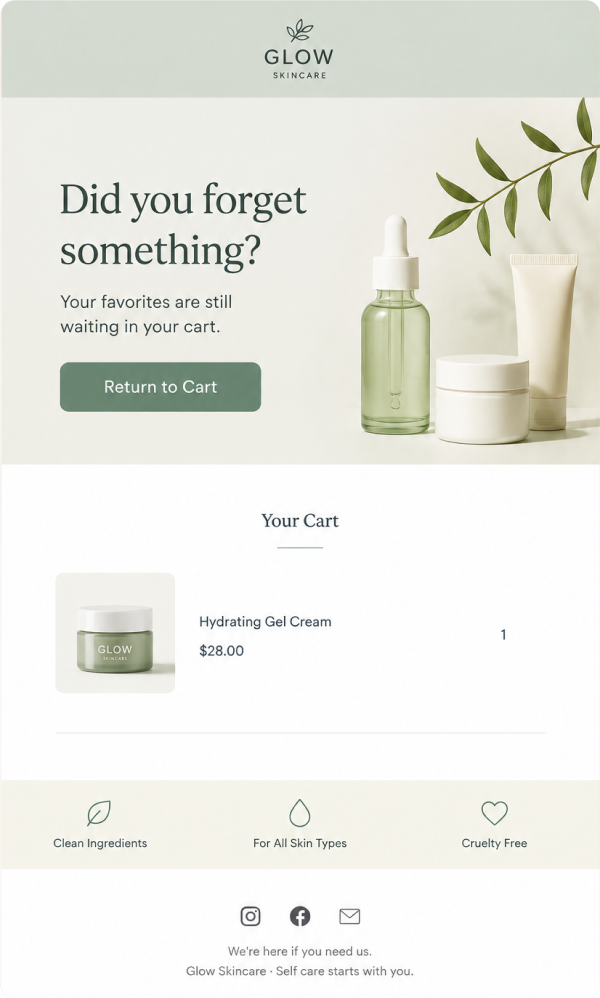
Example 1: Store That Captures Emails Early
Imagine a skincare store that asks visitors for their email when they first visit the site. If someone later adds products to their cart and leaves, the store can send a reminder after about an hour. A store that only collects emails during checkout may miss shoppers who leave before reaching that step. In this case, getting the email earlier can be just as important as choosing the right send time.
Example 2: Low-Volume Store
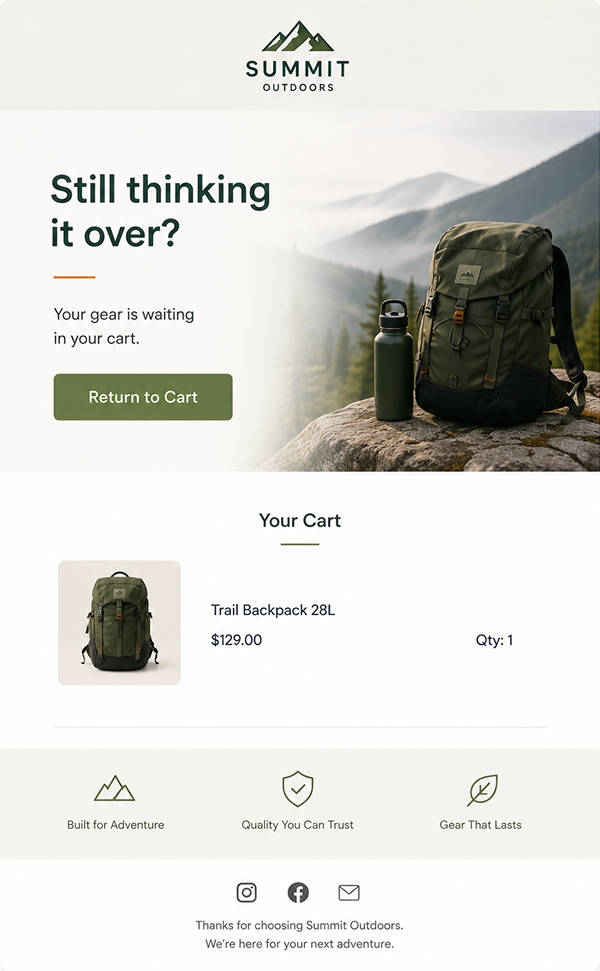
A small outdoor gear store gets around 80 abandoned carts each month. The store wants to test whether sending the first email after 45 minutes works better than waiting 90 minutes.
With only around 40 carts in each test group, the results may not be reliable enough to make a clear decision. For a store with low volume, it is better to start with a proven timing, improve the email content, and focus on capturing more email addresses.
Example 3: Store with Multiple Automated Flows
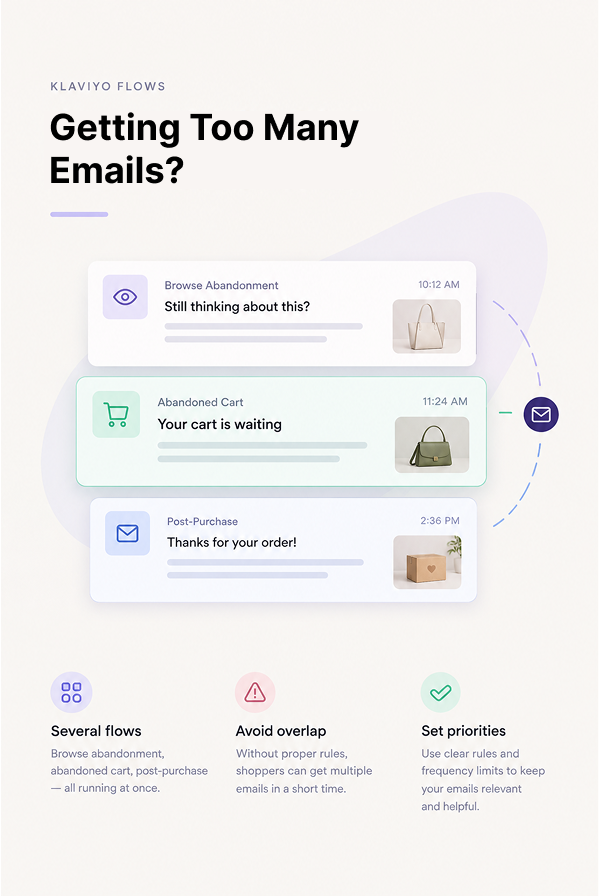
A larger store may have several automated flows running at the same time, such as browse abandonment, abandoned cart, and post-purchase emails.
Without proper rules, one shopper could receive several emails from the same store within a short period. This can feel annoying and may lead to more unsubscribes.
Set clear priorities between flows and use frequency limits. For example, an abandoned cart email can take priority over a browse abandonment email when both apply to the same shopper.
Example 4: Store Using Incentives Strategically
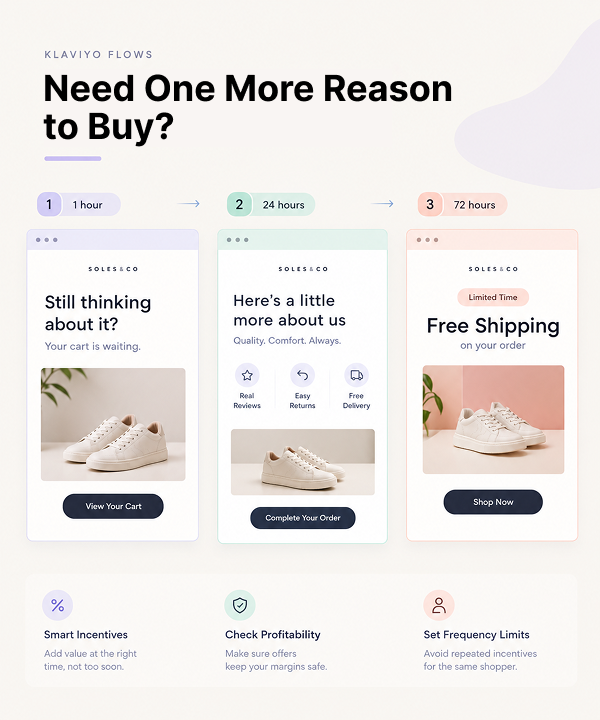
A footwear store sends three abandoned cart emails. The first is a simple reminder after one hour. The second follows after 24 hours and includes reviews, returns information, and free delivery details.
The third email arrives after 72 hours and offers free shipping for a limited time. Before adding the offer, the store checks its costs to make sure the order remains profitable.
The store also limits how often the same shopper can receive an incentive. This helps prevent people from learning to abandon their carts just to get a better deal.
Conclusion
A good abandoned cart strategy starts with timing that matches the shopper's buying cycle. A three-email sequence is a practical starting point, with the first reminder sent after about an hour and later messages spaced further apart. From there, use your own data to adjust the delays for different products, customers, and cart values.
Keep each email focused on one thing, do not repeat yourself, and hold off on discounts until later in the sequence.
Testing matters, but do not try to change everything at once. Pick one timing variable, run it long enough to get real numbers, and then decide. Look at conversion rate, revenue per recipient, and actual profit, not just who opened or clicked.
There is no need to make the sequence complicated. Start with a sensible baseline, monitor the results, and adjust when your products or buying patterns change. The goal is to reach shoppers while their purchase is still relevant without making the follow-up feel excessive.
Frequently Asked Questions
How Long Should You Wait Before Sending an Abandoned Cart Email?
One hour is a solid starting point for most stores. It gives shoppers enough time to step away while the product is still on their mind. For cheaper items, a shorter delay can work. For higher-priced ones, somewhere between 90 minutes and two hours might feel more natural.
Is One Hour Too Soon for an Abandoned Cart Email?
No. One hour works well for most stores. It gets you in front of shoppers while they are still thinking about what they left behind, without feeling pushy. Test different delays depending on what you sell and who your customers are.
Can You Send an Abandoned Cart Email If the Shopper Never Finished Checkout?
Yes, as long as you already have their email address and permission to contact them. If they never gave you an email, you cannot reach them. The fix is to capture email addresses earlier in the shopping process so you can follow up with more people who leave before they check out.
What Happens If a Customer Abandons Their Cart More Than Once?
Your email platform should pull shoppers out of the sequence once they buy and stop flows from overlapping. If they abandon again later, you can let them back into the sequence but consider sending fewer emails the second time around. Also, be careful with discounts. If someone keeps getting a deal every time they abandon, they will start doing it on purpose.
What Is the Best Time of Day to Send an Abandoned Cart Email?
For triggered emails, how long it has been since they left matters more than the clock. That said, do not send emails in the middle of the night. If a cart gets abandoned late in the evening, hold the email until morning so it lands at a time when people are actually checking their inbox.