


Key Takeaways
- Cart abandonment affects nearly 70% of ecommerce shoppers.
- Klaviyo flows generate $3.65 per recipient, reaching $28.89 for top performers.
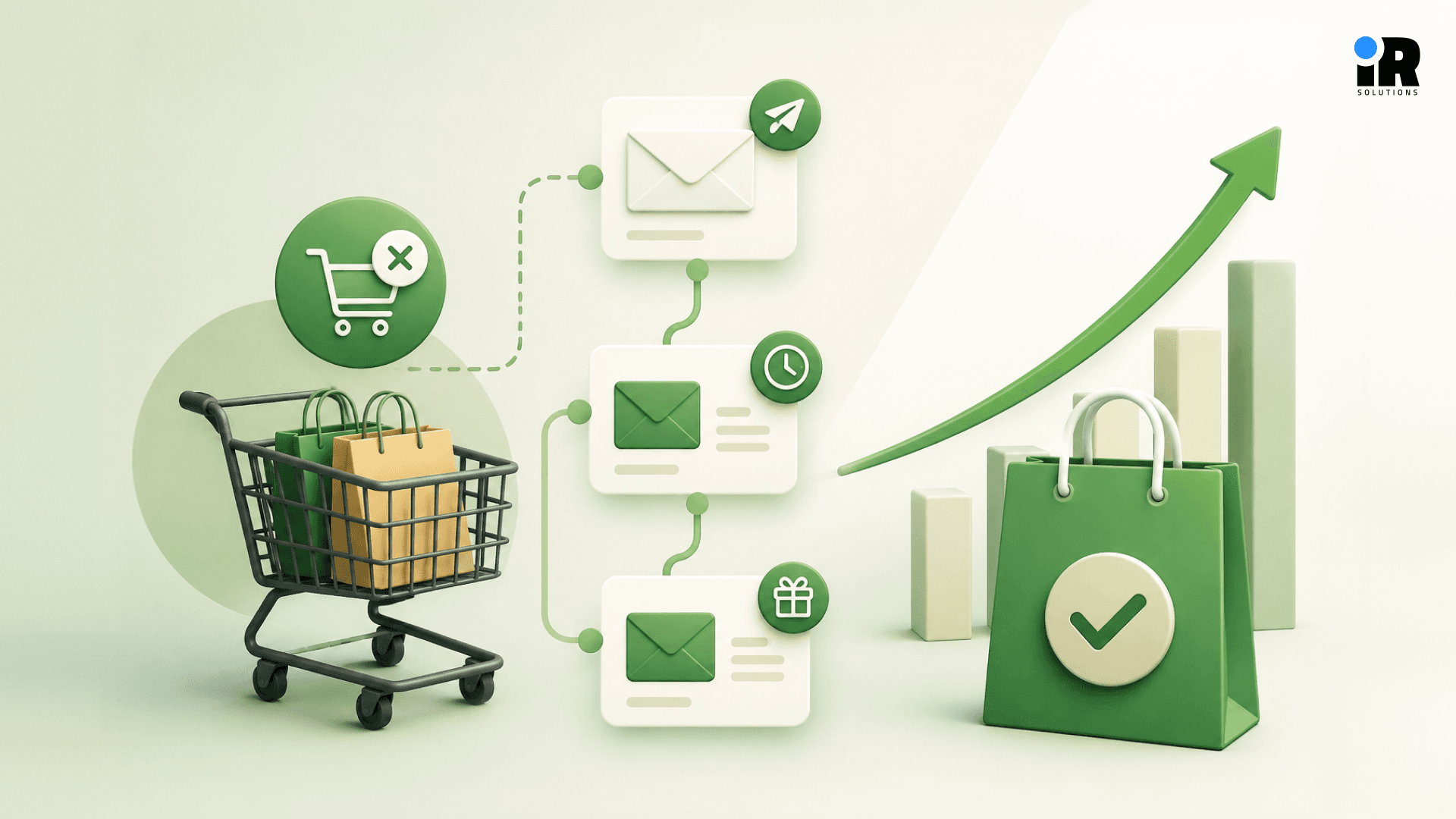
- A three-email recovery flow helps re-engage shoppers at key buying moments.
- Personalization, segmentation, and social proof improve cart recovery results.
- Track recovered revenue, conversion rate, and revenue per recipient to measure performance.
Someone fills their cart, reaches the checkout page, and then disappears. Every ecommerce store deals with this. Some shoppers get distracted. Others decide to compare prices, rethink shipping costs, or simply leave the purchase for later. Whatever the reason, an abandoned cart doesn't always mean a lost customer. More often, it means the buying process was interrupted.
We have seen many stores focus on getting more traffic while ignoring people who were already close to buying. That is usually where the quickest revenue wins are found. A simple abandoned cart flow can bring back shoppers who were already interested enough to start the checkout process.
Klaviyo makes this process automatic. Once it's connected to your store, it watches for customer actions like adding products to a cart or starting checkout. If someone leaves without placing an order, Klaviyo can trigger a series of emails with the products they viewed, a link back to their cart, and messages based on their behavior instead of sending the same email to everyone.
The opportunity is significant. Research from the Baymard Institute shows the average cart abandonment rate is 70.19% across e-commerce. Klaviyo's benchmark data also reports that abandoned cart flows generate an average of $3.65 in revenue per recipient, with the highest performing brands earning several times more by refining their timing, content, and audience segmentation.
This guide walks through the complete process, from creating your first Klaviyo abandoned cart flow to improving its performance over time. You'll learn how to configure triggers, build email sequences, personalize messages, test different recovery strategies, and measure the results so you can recover more sales from visitors who were already ready to buy.
Why Are Abandoned Carts Still Valuable Sales Opportunities?
Most businesses write off abandoned carts as lost sales. That approach is wrong, and it costs them money. A customer who added something to their cart has already done everything except pay. They found the product, compared it to alternatives, decided it was worth considering, and moved it one step closer to a purchase. That is not a cold lead, it is a warm customer who is already close to making a purchase.
Purchase Intent
Someone who abandons a cart has already shown more interest than anyone simply browsing your homepage. They chose a specific product, engaged with it closely enough to add it to their cart, and stopped just short of buying.
That behaviour separates them from every other visitor on your site and makes them far more likely to convert with the right follow-up.
Recover With Reminders
A large percentage of cart abandoners do not need an incentive to come back. They left because of distraction, a shipping question, or a need to double-check their budget.
A well-timed reminder is often enough to bring them back without discounting anything or cutting into your margins.
Customer Hesitation
Hesitation is not the same as rejection, customers hesitate over shipping costs, return policies, product size questions, or available payment options.
Recovery messages that address those specific doubts outperform generic reminders because they respond to the real reason someone paused before leaving.
Post-Cart Recovery
Recovering a cart also starts a customer relationship rather than simply closing a transaction. Someone who returns after a thoughtful recovery message is more likely to trust your brand, leave a review, and buy again.
The abandoned cart flow is a loyalty entry point as much as it is a revenue recovery tool.
How Do Klaviyo Flows Respond to Customer Intent?
Klaviyo connects directly to your ecommerce store and tracks what each known contact does on your site. When a customer adds something to their cart and exits without purchasing, Klaviyo captures that event and activates a flow. The whole sequence runs automatically, without any manual input required after the initial setup.
Real-Time Behaviour
Klaviyo captures the abandonment event as it happens and starts the flow immediately. This real-time trigger means your first message reaches customers while the purchase is still in their mind. Waiting too long to follow up can make customers lose interest. That is why sending the right message at the right time matters so much.
Product Activity
The flow knows exactly which products were left in the cart. That data populates the email automatically, so every message shows the customer their specific items rather than a generic reminder. Showing customers what they left in their cart can make them more likely to return.
Engagement Signals
Klaviyo also tracks how each subscriber interacts with your emails over time. Open rates, click behaviour, and purchase history all feed into how the flow can be adjusted. A highly engaged subscriber may respond to a direct reminder. A less active one may need a stronger reason to click through.
Automated Follow-Up
Once you set it up, the flow runs on its own. Customers who abandon their cart get added in automatically. Customers who buy get removed automatically. You do not have to check it, manage it, or manually follow up with anyone. It just works in the background while you get on with everything else.
How to Create a Klaviyo Abandoned Cart Flow
Creating an abandoned cart flow in Klaviyo is quick and easy. It only takes a few simple steps to set up an automated reminder for shoppers who leave without buying. The process follows the same workflow used in Klaviyo, so it is easy to follow and implement. Once it's ready, the flow will automatically help bring customers back to complete their purchase.
Step 1: Connect Your Ecommerce Store
The first step is to connect your online store with Klaviyo. This lets Klaviyo access important customer and shopping data, which you can later use to send more relevant and timely emails.
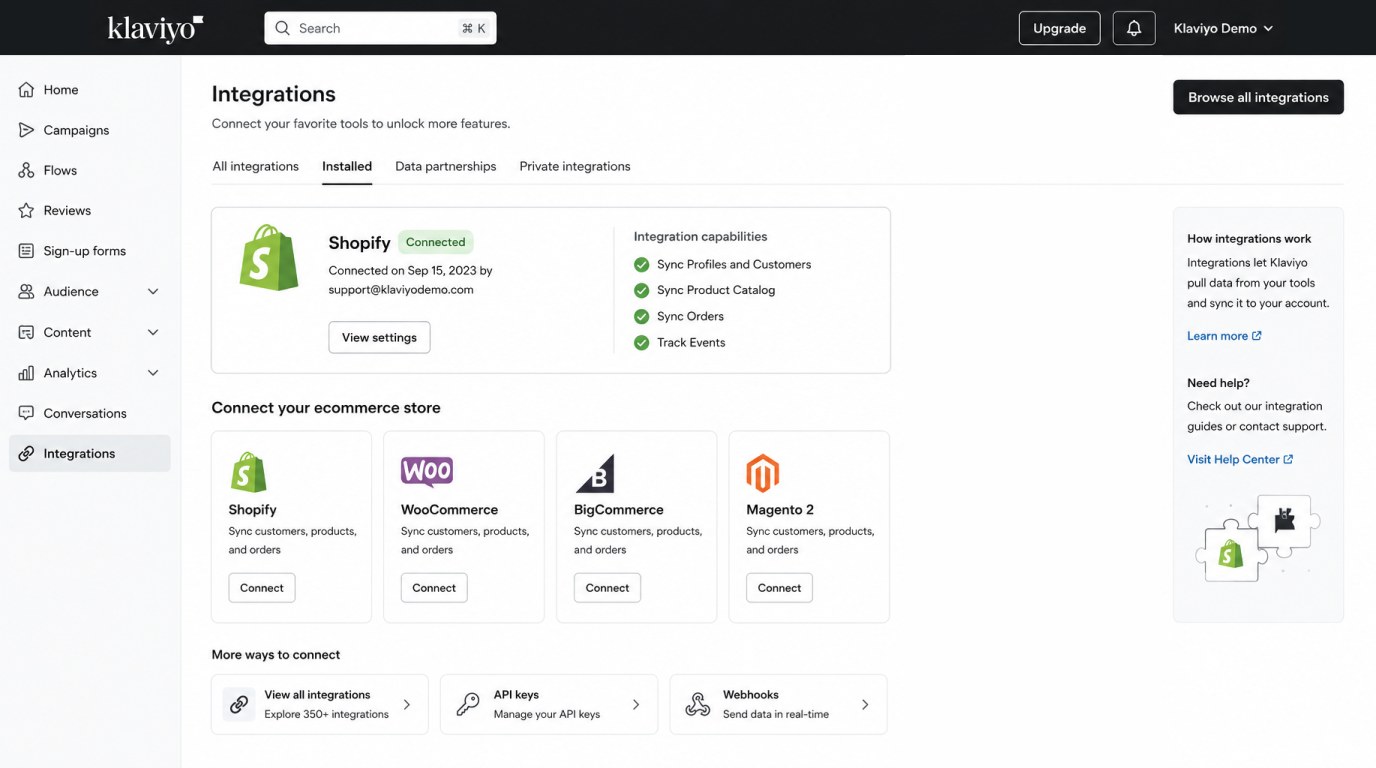
- Shopify: Connect your Shopify store to share customer and order information with Klaviyo.
- WooCommerce: Link your WooCommerce store to sync customer and purchase data.
- BigCommerce: Connect BigCommerce to bring customer, product, and order data into Klaviyo.
- Magento: Link Magento to keep your customer and store information connected.
- Sync Customer and Product Data: Automatically sync customer details, products, orders, and shopping activity.
Step 2: Enable Onsite Tracking
Turn on onsite tracking so Klaviyo can see what visitors do on your store. This helps you track actions such as product views, cart activity, and other customer behavior.
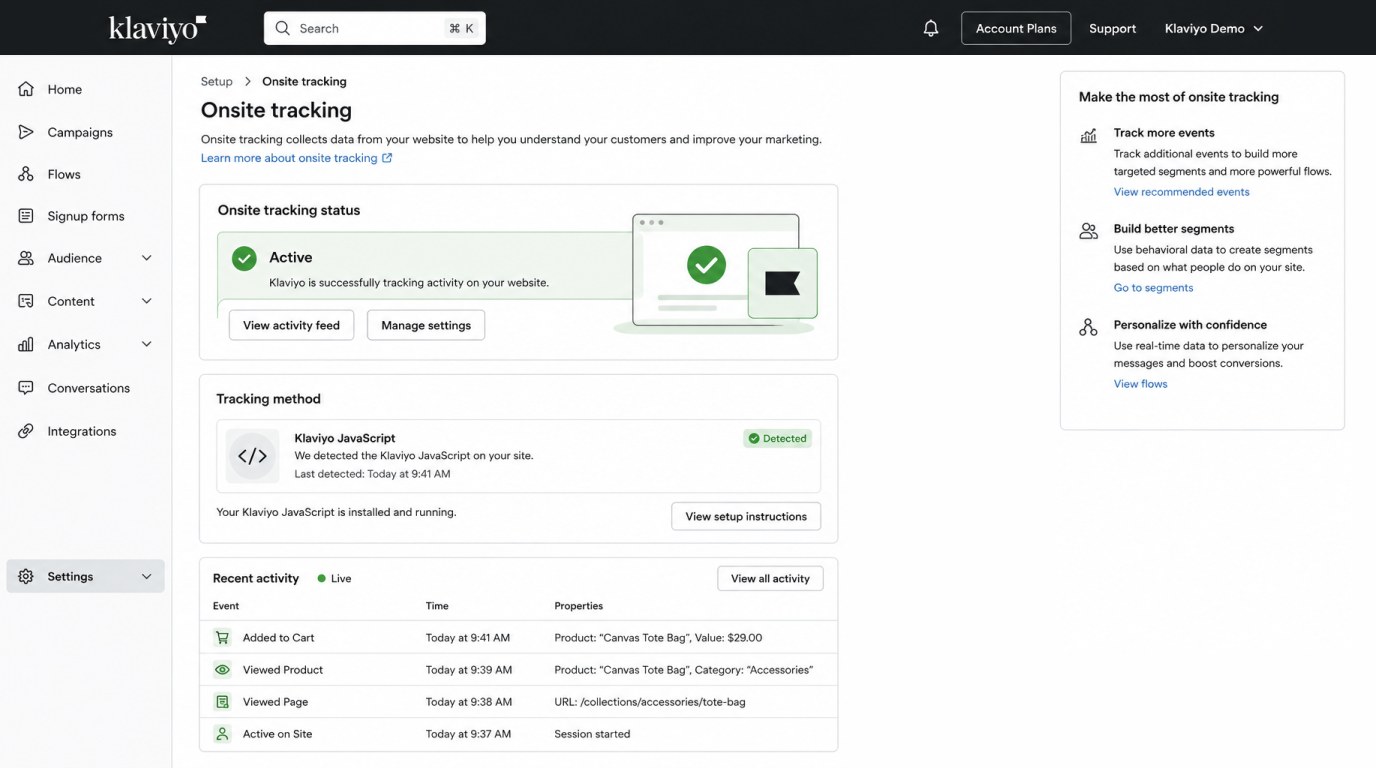
- Install Tracking: Add Klaviyo tracking to your store so customer activity can be recorded.
- Verify Events: Check that customer actions are being tracked correctly.
- Customer Activity: Track actions such as viewed products, added items, and purchases.
Step 3: Create a New Flow
Create an abandoned cart flow that automatically sends emails to customers who leave items in their cart, using a template to make setup easier.
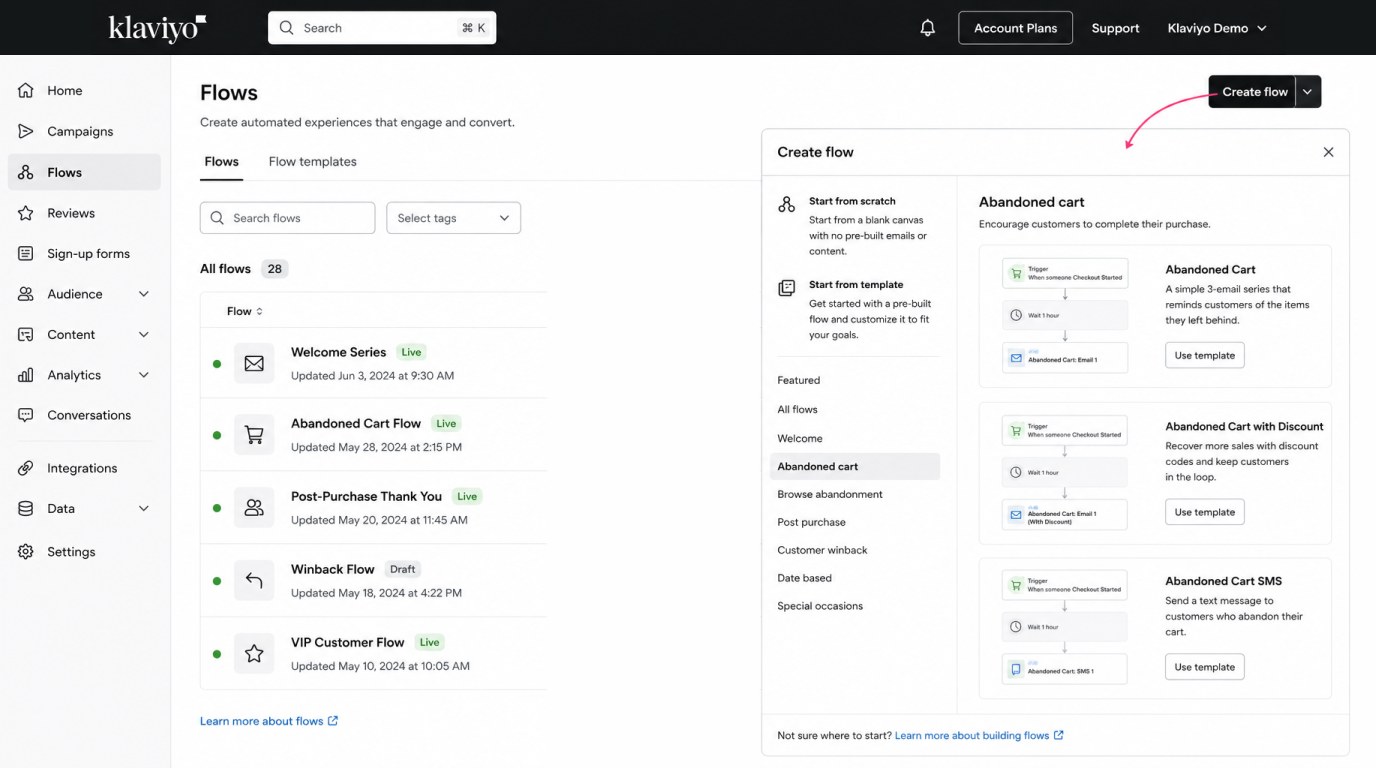
- Open Flow Library: Open the Flow Library to find ready-made flow templates for different customer actions.
- Choose Abandoned Cart Flow: Select the abandoned cart template to start building your recovery emails.
- Create From Template: Use the template as a starting point and adjust it to fit your store.
Step 4: Configure the Trigger
Set the trigger that tells Klaviyo when a customer should enter your abandoned cart flow. Choosing the right trigger helps ensure recovery emails are sent based on actual shopping activity.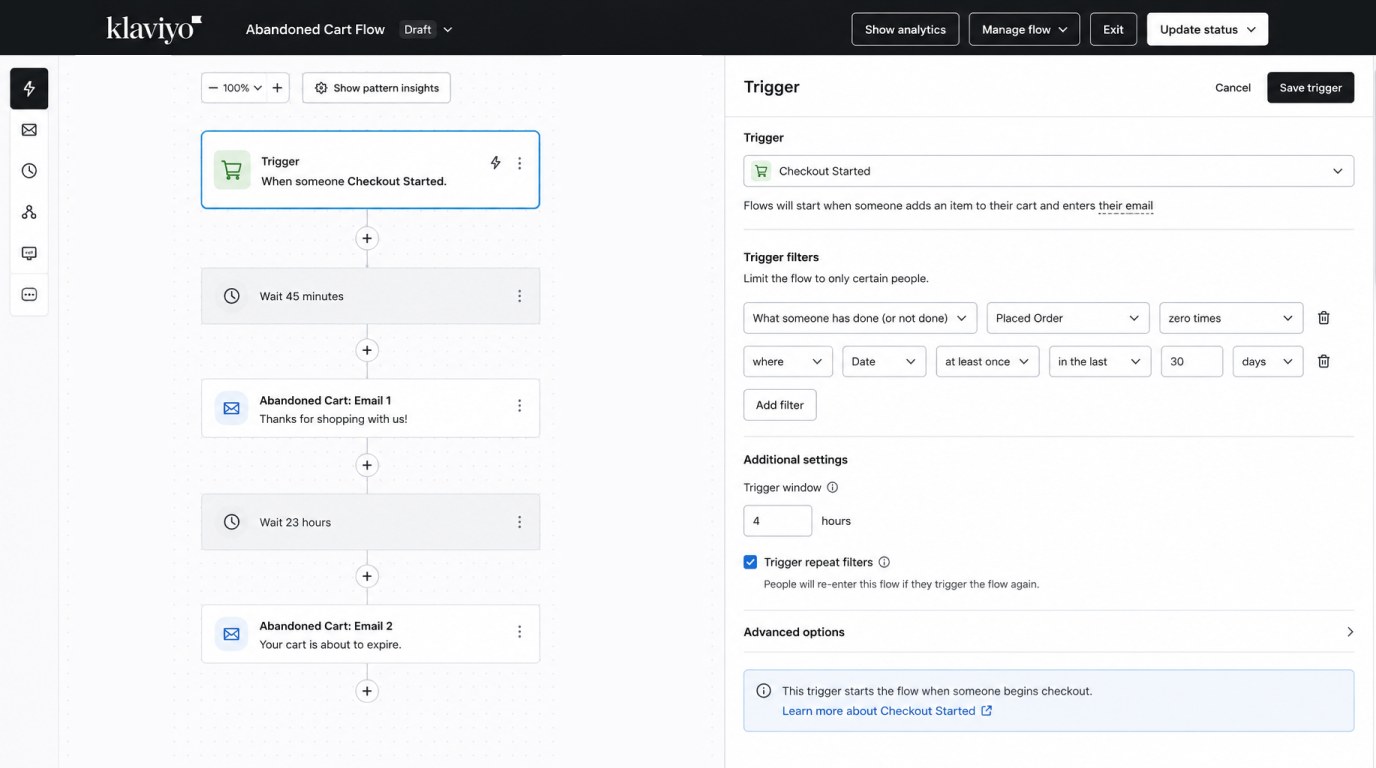
- Added to Cart: Start the flow when a customer adds a product to their cart but does not move forward with the purchase.
- Checkout Started: Use checkout activity to identify shoppers who began the checkout process but left before completing their order.
- Trigger Timing: Set the timing carefully so the first recovery email reaches customers while their interest is still fresh.
- Entry Conditions: Add conditions that control which customers can enter the flow based on their actions or customer details.
Step 5: Add Flow Filters
Add filters to keep your recovery emails relevant and prevent customers from receiving unnecessary or repeated messages.
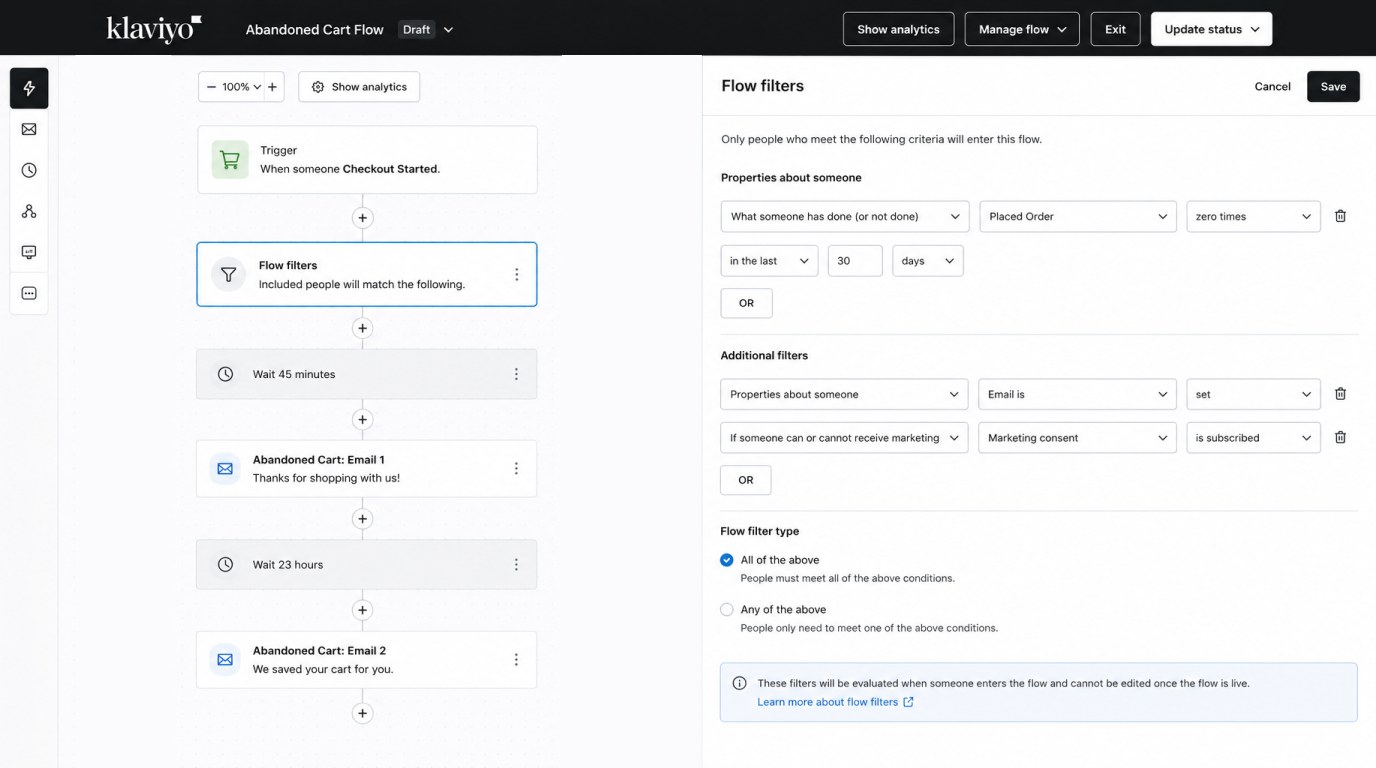
- Remove Purchasers: Stop sending recovery emails to customers who have already completed their purchase after leaving the cart.
- Smart Sending: Use Smart Sending to prevent customers from receiving too many Klaviyo emails within a short period.
- Exclude Recent Buyers: Keep customers who recently purchased out of the recovery flow when they no longer need reminders.
- Prevent Duplicate Emails: Set rules that stop the same customer from receiving multiple recovery emails for the same cart.
Step 6: Build the Recovery Sequence
Create a short email series that reminds customers about their cart and gives them more reasons to complete the purchase.
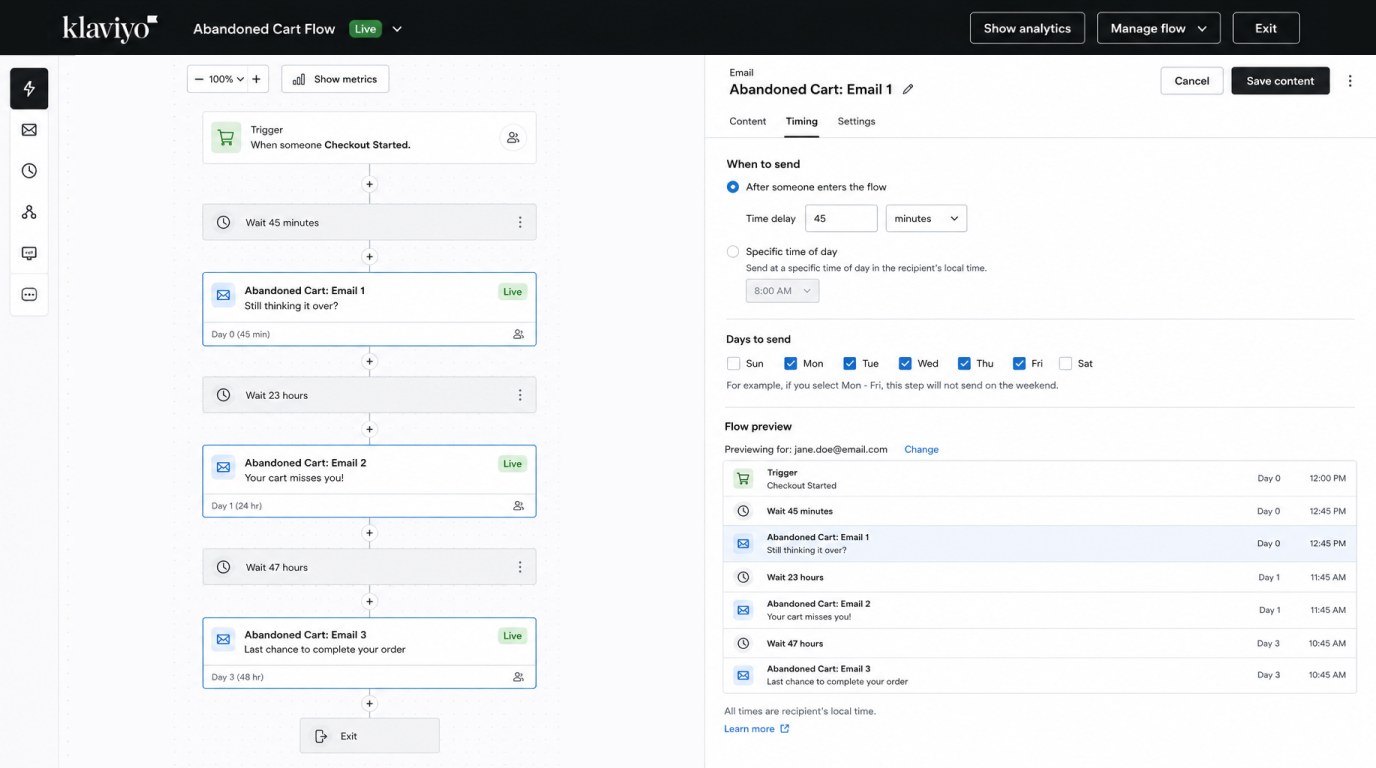
Email 1: Send a quick reminder while the customer still remembers the products they added.
- Wait 45 Minutes: Give the customer enough time before sending the first cart reminder.
- Reminder: Remind shoppers about the items they left in their cart.
Email 2: Follow up with helpful reasons and trust signals that support the purchase decision.
- Wait 24 Hours: Wait one day before sending the second recovery email.
- Benefits: Highlight the main benefits customers get from choosing the product.
- Reviews: Add customer reviews to show real experiences with the product.
- Social Proof: Show ratings, testimonials, or other proof that people trust your brand.
Email 3: Send a final message that creates urgency and gives customers one more reason to buy.
- Wait 48 Hours: Send the final email after giving customers two more days to decide.
- Urgency: Use limited stock, limited time, or another clear reason to act soon.
- Optional Discount: Add a small discount when needed to encourage the customer to complete the order.
Step 7: Personalize Every Email
Add customer and product details to each email so the message feels more useful and relevant to the shopper.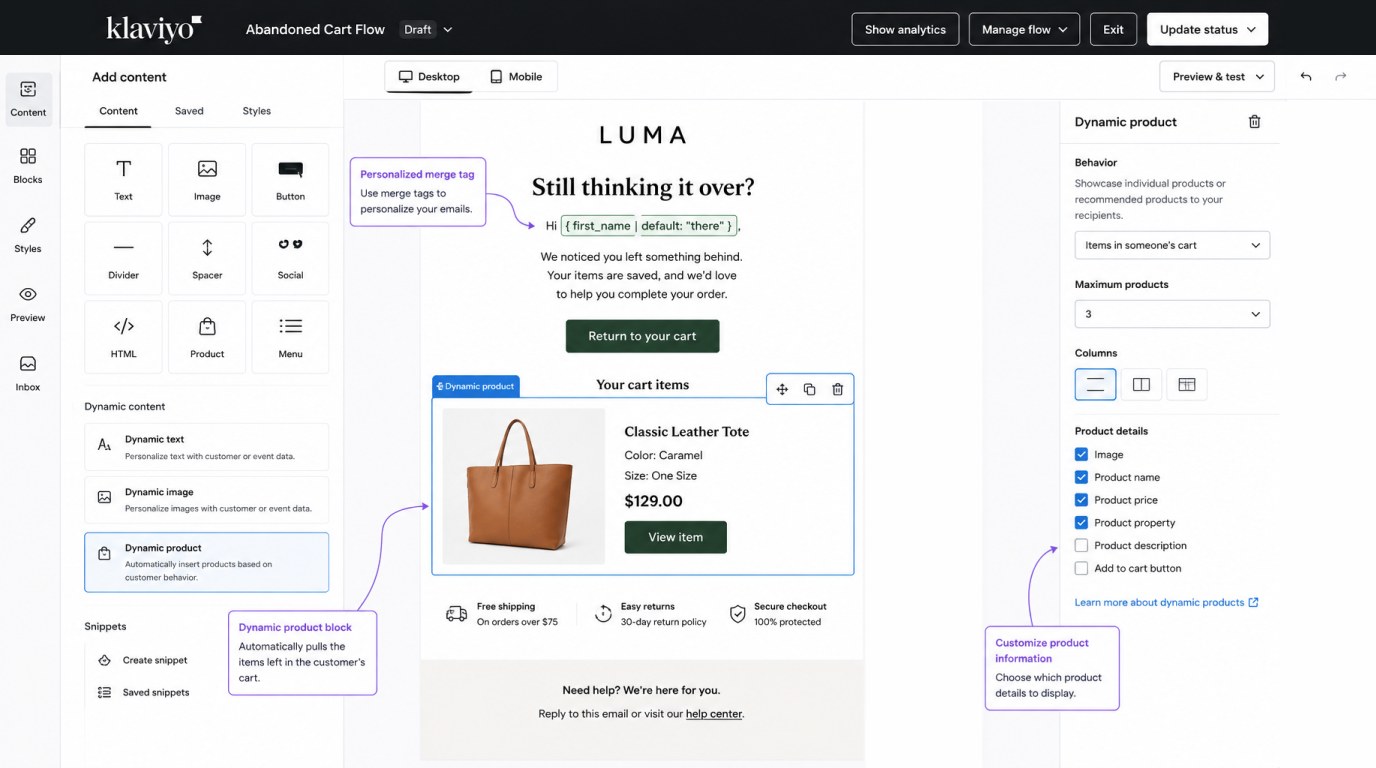
- First Name: Add the customer's first name to create a more personal and friendly email experience.
- Dynamic Product Blocks: Show the exact products each customer left behind without adding those products to every email manually.
- Images: Use clear product images to remind shoppers which items they were interested in buying.
- Prices: Display the current product prices so customers can quickly see the value of their abandoned items.
- Product Links: Add direct links that take customers back to their selected products or checkout page.
- Merge Tags: Use merge tags to automatically add customer and product information to each email.
Step 8: Add Conditional Splits
Use conditional splits to send different messages based on customer type, cart value, or previous shopping behavior.
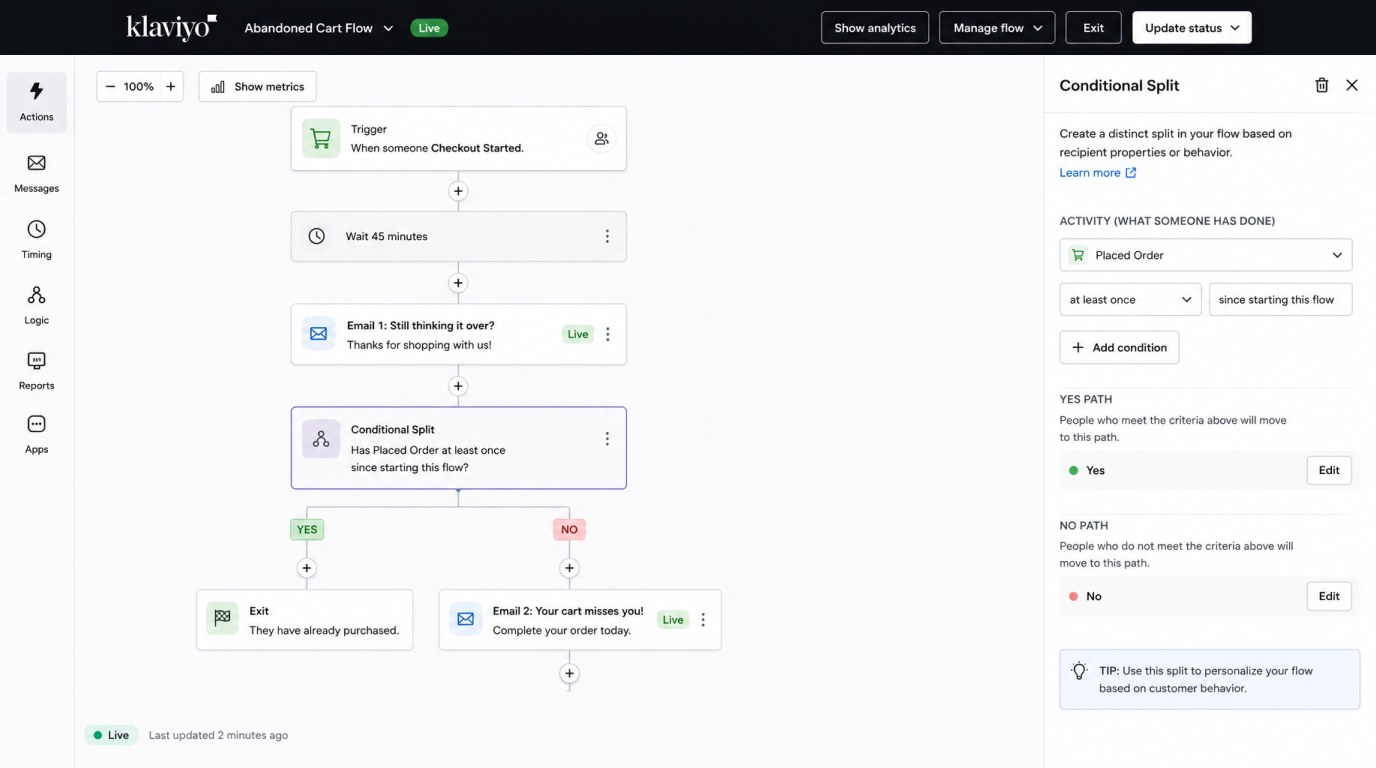
- New Customers: Send new shoppers messages that introduce your brand and make their first purchase feel easier.
- Returning Customers: Use different messaging for returning shoppers who already know your products and brand.
- High Value Carts: Create a stronger recovery approach for customers who have left several high priced products in their carts.
- VIP Customers: Give your most valuable customers more personalized recovery messages based on their relationship with your brand.
Step 9: Test the Flow
Test the complete flow before publishing it to make sure every email, link, product, and condition works properly.
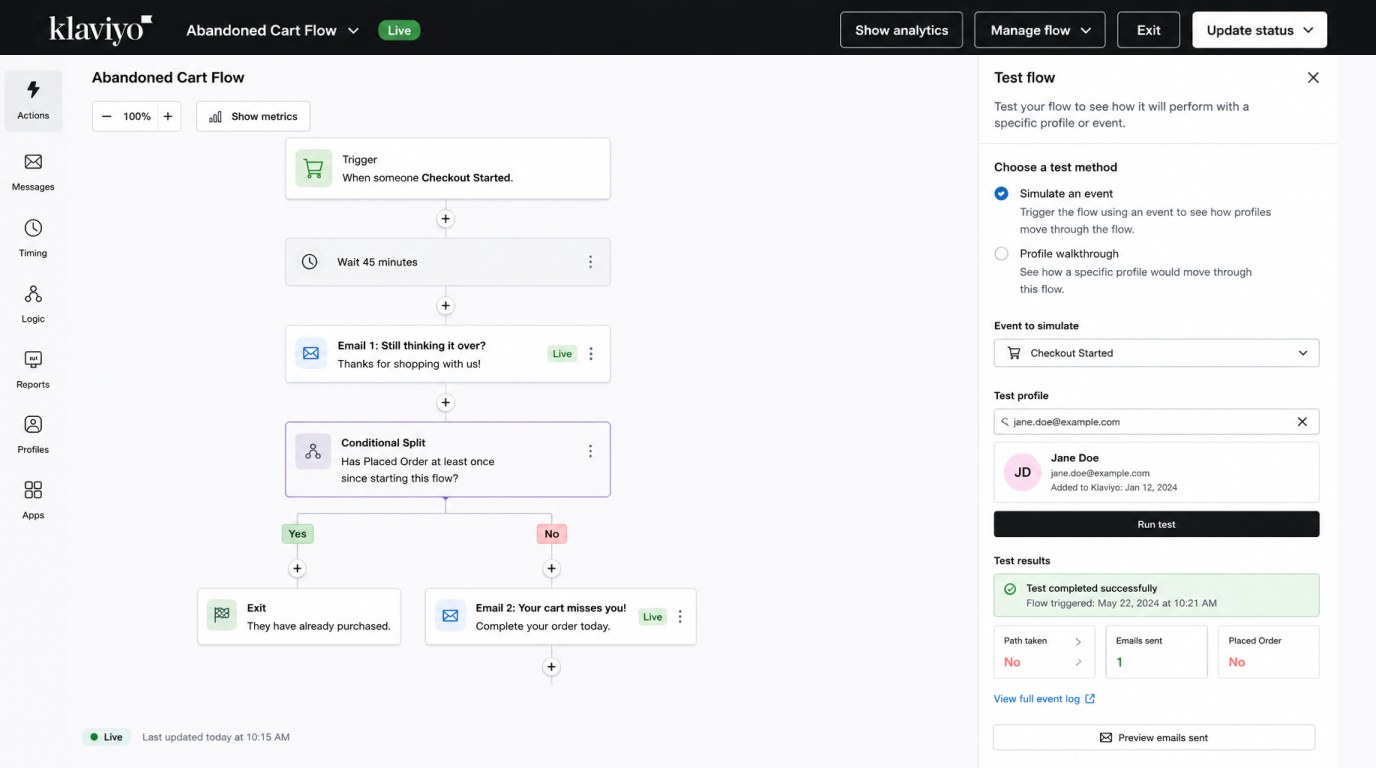
- Preview: Preview each email to make sure the layout, text, images, and product details appear correctly.
- Send Test: Send test emails to yourself or your team to check how the messages look in a real inbox.
- Test Cart: Add products to a test cart and follow the flow to make sure each step works as expected.
- Verify Links: Click every product and checkout link to confirm they take customers to the correct page.
Step 10: Publish and Monitor Performance
Publish the flow once everything works correctly, then monitor its results to see how well it recovers lost sales.
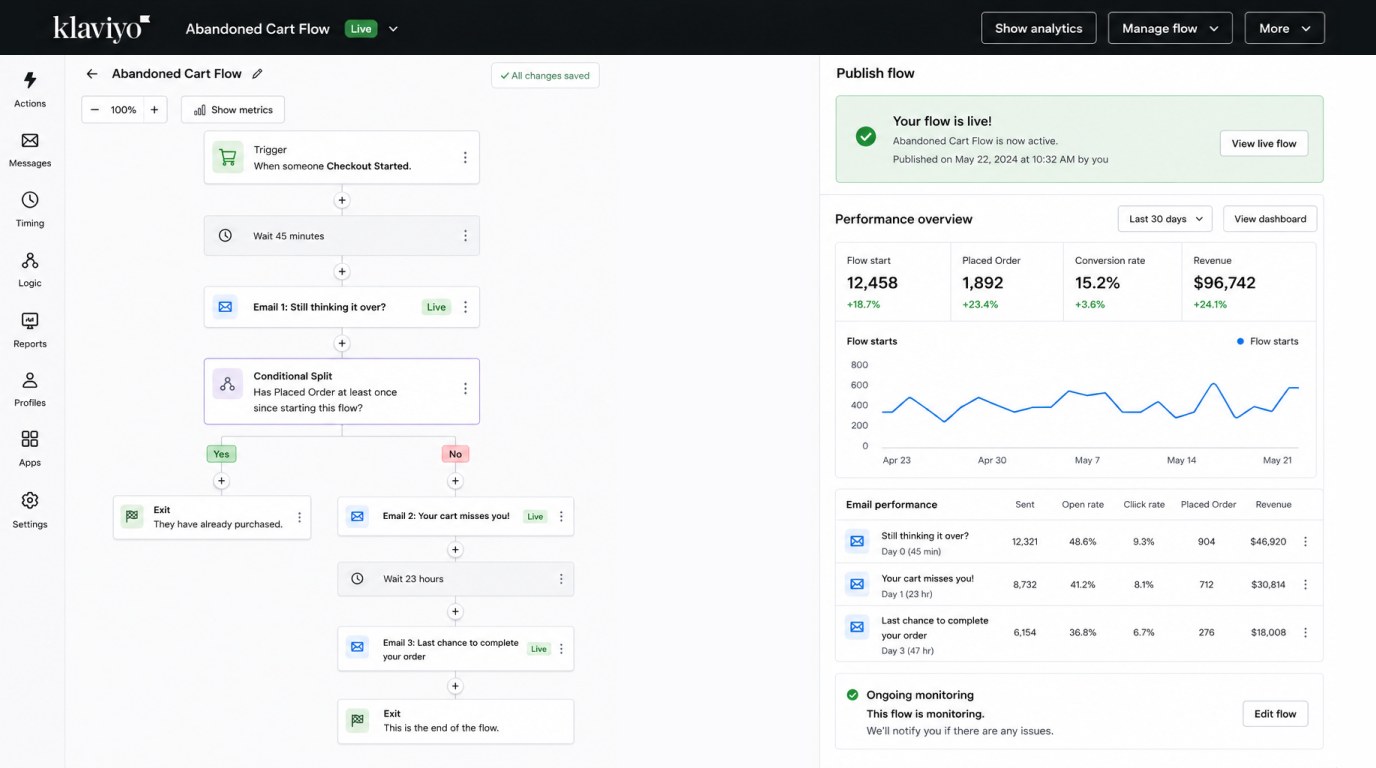
- Draft vs Live: Check whether your flow is still being edited or is active and sending emails to customers.
- Analytics: Review your flow data to understand email opens, clicks, purchases, and overall customer engagement.
- Revenue: Track how much sales revenue your abandoned cart flow generates from recovered shoppers.
- Conversion Rate: Measure how many customers who receive your recovery emails return and complete their purchase.
- Recovery Rate: Track how effectively your flow brings abandoned shoppers back to complete their orders.
What Makes Abandoned Cart Emails Effective?
Anyone can send a recovery email. The difficult part is sending one that actually gets the customer to come back and buy. There are a few things that the best-performing flows always get right, and most average ones consistently get wrong.
- Precise timing. The first email within one hour of abandonment catches shoppers while intent is still high. A follow-up at the 24-hour mark and a final message at 48 to 72 hours gives each shopper three opportunities to return without overwhelming their inbox.
- Exact products. Every email should show the specific items left in the cart, with images, names, and prices included. Generic messages break the connection to why the customer was interested in the first place and reduce the chance they click through.
- One clear action. Every email needs a single, obvious call to action that returns the customer directly to their cart. Multiple links divide attention and reduce click-through rates by giving people too many decisions to make.
- Direct checkout link. The link in the email should take the customer back to their saved cart, not to your homepage or a category page. Every extra step between the email and the checkout page increases the chance they drop off again.
- Brand consistency. Your recovery email should look and sound exactly like your store. If it feels off or unfamiliar, customers lose trust and close the tab. People only buy from brands they feel comfortable with, so keep the design, colours, and tone consistent across every email you send.
Best Klaviyo Abandoned Cart Flow Strategies
Setting up a basic recovery flow is a good start for any ecommerce store. But most stores stop there, and that is exactly where the gap in results begins to show. The difference between a flow that recovers 2% of carts and one that recovers 8% is not luck. It comes down to the specific choices made around timing, messaging, segmentation, and the offers you decide to test. These strategies are what the best-performing stores apply consistently, and they are not complicated to implement inside Klaviyo.
Personalise Messages
- Use the shopper's first name so the email feels like it was written just for them.
- Show the exact products they left behind rather than sending a generic cart reminder.
- Personalised emails get more opens, more clicks, and far more completed purchases overall.
Optimise Send Times
- The best send time varies by store, so test different delays across your sequence.
- Some audiences respond better at night, others respond first thing in the morning instead.
- Let your own click and conversion data decide the timing, not a generic recommendation.
Segment Customers
- A first-time visitor needs different reassurance than someone who has bought from you before.
- Sending the same email to everyone means none of them feel truly spoken to.
- Segment by purchase history, cart value, or engagement level for much better results.
Use Product Data
- Pull in product images, prices, and descriptions automatically using Klaviyo's dynamic content blocks.
- Every email then shows the shopper their specific items without any manual work needed.
- When people see exactly what they left behind, they are far more likely to return.
Test Incentives
- Not every shopper needs a discount, so do not assume that one fits all.
- Some people respond to urgency, others to free shipping, and others to a simple reminder.
- Run tests across your audience to find what actually changes behaviour, not what you assume.
Add Social Proof
- Reviews and star ratings answer the one question every indecisive customer silently asks themselves.
- Seeing that other people bought and loved the product makes it much easier to commit.
- Social proof works especially well for first-time buyers who have never purchased from you before.
Simplify Checkout
- If the path from email to purchase has too many steps, people drop off fast.
- Make sure your cart link goes directly to a pre-filled cart, not your homepage.
- A fast, simple mobile checkout often does more for conversions than any email change will.
When technical checkout problems affect conversions, ecommerce developers improve performance and create a smoother buying experience.
Use Multiple Channels
- Email is the foundation, but some customers will simply never open your recovery emails.
- Adding SMS to the flow reaches those customers on a completely different device entirely.
- Klaviyo lets you run both channels inside one flow without building two separate sequences.
For a more complete recovery strategy, see our guide to recovering abandoned carts with Klaviyo for practical ways to bring more shoppers back to checkout.
Which Customers Need Different Recovery Strategies?
A first-time visitor and a loyal repeat customer are not the same person. They have different concerns, different levels of trust, and different reasons for leaving without buying. Sending them the same email ignores all of that. The stores recovering the most carts treat each customer type differently, and Klaviyo makes that straightforward to set up.
First-Time Buyers
New visitors carry the most uncertainty about your brand. They have never bought from you before and have nothing to fall back on when deciding whether to trust their payment details to your store. Recovery messages for this group should focus on trust signals, including verified reviews, secure payment badges, a clear returns policy, and a straightforward way to contact support if needed.
Returning Customers
Someone who has bought from you before does not need reassurance about your brand. They already know you, and they already trust you. A simple, warm reminder that they left something behind, paired with their cart items and a direct link back to checkout, is often everything it takes to bring them back.
High-Value Carts
A cart worth £300–£500 deserves more personal attention than an automated email sequence alone can provide. Consider adding a message at this tier that acknowledges the value of what they are purchasing, offers to answer questions via live chat or email, and makes the checkout return feel supported rather than generic.
Low-Value Carts
For smaller carts, keep the recovery sequence short. A single well-timed email with a clear product image and a direct link often outperforms a three-email sequence because the effort and incentive required to recover a £15 purchase is very different from recovering a £150 one.
Engaged Customers
These are the customers who open your emails, buy regularly, and already know your brand well. They do not need to be sold to. A short, friendly message that feels personal works far better than a formal automated reminder. Talk to them like they are already a valued customer, because they are.
How Can Klaviyo Flow Logic Personalise Recovery?
Klaviyo's flow builder goes well beyond a simple linear email sequence. The platform includes logic tools that let you build branching paths based on who the shopper is, what they did, and how they responded to previous messages in the flow. For more advanced setups, working with Klaviyo experts can help you structure segmentation, triggers, and branching logic around your store's goals.
Conditional Splits
- A conditional split sends different shoppers down different paths inside the same flow.
- You can split by whether someone is a new or returning customer, or by cart value.
- Each group then gets a message written specifically for their situation, not a generic one.
Flow Filters
- Flow filters decide who stays in the sequence and who gets removed as things change.
- If someone buys after the first email, the filter pulls them out of the flow automatically.
- This stops people from receiving follow-up emails that no longer make sense for them.
Event Targeting
- Klaviyo starts a flow when a specific event happens on your site, like cart abandonment.
- Picking the right trigger means the flow fires at the right moment, not too early.
- Using the wrong event trigger can send emails before the shopper has even decided anything.
Cart Value
- Cart value lets you treat high-spend and low-spend shoppers in completely different ways.
- A customer with £200 in their cart deserves more follow-up than one with £15.
- Use cart value to decide how many emails to send and whether to include an incentive.
Purchase Exclusions
- Always remove anyone who has already purchased before they receive another recovery email.
- Someone who bought on a different device should never get a cart reminder afterwards.
- Sending recovery emails to existing buyers looks like a mistake and damages their trust in you.
Build better customer journeys with high-converting Klaviyo flows powered by effective automation and personalization strategies.
How Can One Abandoned Cart Generate More Revenue?
Most stores use abandoned cart flows just to recover the sale that was nearly lost. That is a good start, but it is only part of what the flow can do. The same email sequence that brings someone back to checkout can also introduce related products, increase the order value, and plant the seed for the next purchase. A customer who returns after a recovery email is already in a buying mindset. That is exactly the right moment to show them something else they might want.
Related Products
Including complementary product recommendations in recovery emails adds genuine value without feeling like a hard sell.
For example: If someone has a pair of trainers in their cart, showing a compatible insole or cleaning kit in the same email is helpful rather than pushy. Relevant suggestions increase the chance of a larger order.
Cross-Sell
Cross-selling introduces a different product category to a customer who is already in buying mode.
Recovery emails are a good chance to suggest a related product the customer may have missed but would likely want with their original choice.
High-Value Recovery
For carts above a meaningful value threshold, consider stepping outside the automated sequence entirely.
A short personal email from a team member, or a proactive support message offering to help with any questions, can make a real difference in conversion when the potential order value justifies the effort.
Repeat Purchases
Once a recovery flow converts a customer, they move into your post-purchase automation. That sequence builds the relationship, encourages product reviews, introduces loyalty benefits, and sets up the conditions for the next purchase.
The abandoned cart flow is the entry point to a much longer and more valuable revenue journey.
Product Recommendations
Klaviyo's recommendation engine can pull in dynamic product suggestions based on what the customer viewed, what they left in their cart, and what similar customers have purchased.
These personalised suggestions make recovery emails feel built for each shopper rather than assembled from a generic template.
Can Abandoned Cart Flows Work With Other Klaviyo Automations?
A lot of brands set up their abandoned cart flow and treat it as a standalone thing. It sends emails, recovers some sales, and that feels like enough. But the truth is, that flow works much harder when it connects to everything else running inside Klaviyo.
Your welcome flow, browse abandonment, post-purchase sequence, and win-back flow are all part of the same customer journey. When they work together, each one picks up where the last one left off, and nothing falls through the gap.
Browse Abandonment
Browse abandonment flows target customers who viewed a product but never added it to their cart. These flows run before the cart abandonment stage and warm up purchase intent before someone even reaches checkout. Running both together means you cover significantly more of the buying journey than either flow can handle alone.
Post-Purchase Flows
After a recovery email converts a customer, post-purchase flows take over. These sequences deliver order confirmations, request product reviews, suggest complementary items, and help build a long-term relationship that brings customers back for future purchases.
Welcome Flows
A new subscriber who abandons a cart during their first visit may be inside a welcome flow and a cart recovery flow at the same time. Klaviyo's flow filters let you manage this overlap carefully so customers do not receive competing or contradictory messages within the same short window of time.
Email and SMS
Combining email and SMS within a single recovery flow increases reach and adds urgency without requiring a completely separate strategy. Email works well for detailed messages with product images and longer copy. SMS works well for short, direct reminders sent between emails. Together, the two channels cover more moments in a customer's day.
Win-Back Flows
Not every shopper will come back after a cart recovery email, and that is fine. Those people do not disappear from your strategy entirely. They move into a win-back flow that reaches out weeks or months later with a reason to return. It might be a discount, a new product, or simply a reminder that you exist. The cart recovery flow and the win-back flow work as a pair, one picks up right where the other left off.
How Can You Optimise Klaviyo Flows for More Revenue?
Going live with your flow is step one, not the finish line. Most brands set up their abandoned cart sequence, see some results, and leave it running without ever looking at it again. That is where they leave money on the table. The stores getting the highest recovery rates are the ones making small, regular improvements based on what the data is actually telling them. You do not need to overhaul everything at once. You just need to keep testing, cutting what does not work, and doubling down on what does.
- Test Timing: Test different delays between emails to find what timing works best for your audience.
- Test Messaging: Try different subject lines to see which ones get more of your emails opened consistently.
- Compare Incentives: Test free shipping against a discount and see which one actually drives more completed purchases.
- Improve Clicks: If people open the email but do not click, the problem is inside the email itself.
- Remove Weak Emails: If an email in your sequence never leads to clicks or purchases, cut it completely.
- Test Segments: The same email rarely performs equally well across every type of customer you have.
Strong flow performance also depends on inbox placement, so follow our Klaviyo deliverability guide to keep recovery emails reaching subscribers consistently.
Klaviyo Abandoned Cart Metrics to Track
A lot of brands look at open rates and feel good about their flow. But open rates do not pay the bills. A customer can open your email, glance at it, and still never buy anything. The metrics that actually matter are the ones tied to revenue, how much money the flow is bringing in, how many carts it is recovering, and whether the numbers are improving over time. These are the figures worth tracking every week.
Recovered Revenue
Total revenue from orders placed after a shopper interacted with your recovery flow is the most direct measure of performance available. Track it weekly alongside the number of flow sends to understand how efficiency changes as you test different versions of the sequence over time.
Revenue Per Recipient
Revenue per recipient divides the total recovered revenue by the number of people who entered the flow. It reflects both conversion rate and order value in a single number, making it the most useful metric for comparing different versions of your flow directly against each other.
Conversion Rate
The percentage of shoppers who enter the flow and complete a purchase. A low conversion rate alongside a strong open rate usually means the issue is inside the email content or the checkout experience rather than in your subject line writing or send timing.
Recovery Rate
Your recovery rate shows what percentage of abandoned carts you are successfully converting back into purchases. Comparing this against industry benchmarks helps you understand whether your current results reflect strong performance or whether there is significant room for improvement that better flow structure could unlock.
Average Order Value
Tracking average order value for recovered carts tells you whether your cross-sell and upsell elements inside the flow are actually adding to each transaction. A rising average order value alongside a steady conversion rate means the flow is generating more revenue from the same number of shoppers entering the sequence.
What Does the Future of Klaviyo Cart Recovery Look Like?
Cart recovery is becoming more sophisticated every year. The tools available inside Klaviyo today are more capable than they were two years ago, and the direction of development points clearly toward smarter personalisation, better timing, and more tightly connected automation across multiple channels.
AI Personalisation
AI-driven content personalisation is becoming more practical and accessible inside Klaviyo's platform. Rather than choosing from a set of static templates, flows can adjust copy, product recommendations, and offers dynamically based on what the data predicts each customer is most likely to respond to at that specific moment.
Predictive Segments
Klaviyo already offers predictive analytics that identify customers likely to purchase again alongside those at risk of leaving. These predictions will increasingly shape how recovery flows are structured, allowing brands to prioritise effort and spend on the shoppers who are most likely to convert when contacted.
Smarter Timing
Send time optimisation is moving beyond time-zone scheduling toward individual-level timing based on when each specific subscriber is most likely to open and engage with an email. As this capability matures inside Klaviyo, the gap between a message landing in an inbox and a shopper actually reading it will continue to narrow.
Personalised Offers
Right now, most brands either offer a discount or they don't. Future flows will go further than that. They will look at what each shopper has bought before, what is in their cart, and how they have responded to offers in the past, then decide the right incentive for that specific person. The result is fewer wasted discounts and more profit kept on every recovered order.
Cross-Channel Automation
Email, SMS, push notifications, and on-site messaging are increasingly being managed as part of a single, connected customer experience. Brands that build their recovery strategy with cross-channel thinking now will be better positioned to reach shoppers wherever they are most likely to respond as these tools continue to develop.
Conclusion
Cart abandonment is not a dead end. It is a moment where the right message, sent at the right time, can turn hesitation into a completed purchase and a single transaction into a long-term customer relationship that pays back well beyond the original recovered sale.
Cart recovery also works best as part of a broader ecommerce strategy, digital marketing experts can align email automation with acquisition, retention, and conversion efforts.
Klaviyo flows give you the tools to respond to that moment automatically, with messages built around what each shopper actually did and what they are most likely to respond to next. The brands recovering the most abandoned revenue are not the ones offering the largest discounts.
They are the ones who understand why shoppers hesitate and deliver a message that speaks directly to that hesitation every single time.
Test your timing, refine your segments, measure what drives actual revenue rather than just opens and clicks. Build the flow, then keep improving it consistently. That is where the real returns come from.
Frequently Asked Questions
How do Klaviyo flows recover abandoned carts?
Klaviyo tracks when a known contact adds products to their cart and exits without purchasing. That event triggers an automated sequence of personalised emails showing the exact items left behind, timed to bring the shopper back to complete their checkout.
How many emails should an abandoned cart flow have?
Three emails work well for most stores. Send the first within one hour of abandonment, the second at around 24 hours, and the third between 48 and 72 hours after the cart was left behind. Adjust based on your audience's engagement data over time.
When should the first cart recovery email be sent?
Within one hour of abandonment. This is when purchase intent is highest and the shopper is most likely to return to complete the purchase. Waiting longer than a few hours lets that intent cool down significantly.
Should abandoned cart emails offer discounts?
Not necessarily in the first email. Start without incentives to understand your natural recovery rate, then test discounts in the second or third email for shoppers who did not respond to the initial reminder message.
How does Klaviyo personalise abandoned cart messages?
Klaviyo uses behavioural data including the specific products left in the cart, previous purchase history, and engagement signals to tailor the content, timing, and offer in each recovery message without any manual work required per send.
Can Klaviyo combine email and SMS for cart recovery?
Yes. Klaviyo supports both channels within the same flow. Adding SMS between email sends reaches shoppers on a different device at a different moment and improves the overall chance of recovering the abandoned purchase.
How can Klaviyo flows increase ecommerce revenue beyond the original cart?
Recovery emails can include cross-sell recommendations, upsell suggestions, and links to related products. Recovered shoppers also enter post-purchase sequences that build loyalty and increase the likelihood of future purchases from the same customer.
Which metrics matter most for cart recovery?
Focus on recovered revenue, revenue per recipient, conversion rate, and incremental revenue. These metrics show real business impact rather than surface-level engagement numbers like open rates and click rates alone.