


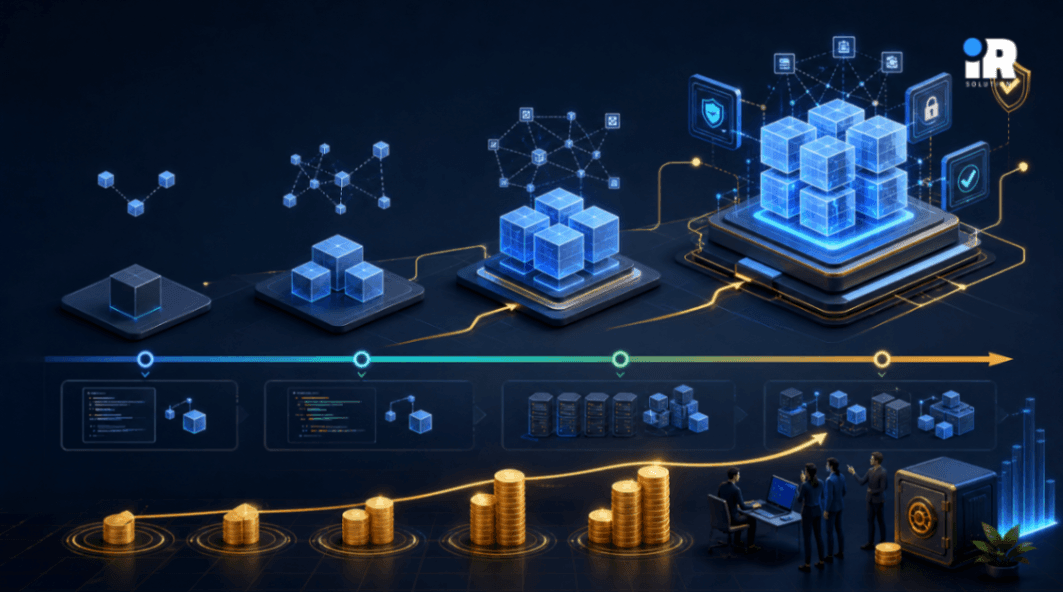

Most businesses already know that their customer service operations are under pressure from every side. Response times are rising, support teams are stretched thin, and customers always expect immediate answers. AI-powered customer service is not a future trend that businesses can safely sit back and wait for. It is already running inside the daily support operations of businesses across every major industry. The question is not whether AI belongs in customer service, because that debate is already settled. The real question now is how you implement it without breaking what your customers already trust. AI Chatbot Development helps businesses design smart, scalable support systems.
Breaking Down What AI in Customer Service Actually Means
Most businesses use this phrase without really knowing what it covers. It goes well beyond a chatbot answering the same five questions repeatedly. AI in customer service includes natural language processing, sentiment analysis, predictive routing, and live agent assistance. These systems learn from real conversations and get sharper as they process more data over time. The goal isn't to replace your support staff and call it a cost win. It's to handle repetitive queries automatically so your team focuses on genuinely complex work. Done right, agents move faster, customers leave happier, and support costs become more predictable.
The difference between a tool and a system is where most decisions go wrong. A tool is a chatbot you plug in, configure once, and mostly forget about afterward. A system is built on your own data, actively maintained, and gets better the longer you run it. Companies that treat AI customer service like a software purchase almost always walk away disappointed. Companies that treat it as something they own and develop over time get compounding returns. Knowing which one you're signing up for, before you start, is the most honest first step
Why Businesses Are Moving Fast on AI
Customer expectations have changed faster than most support teams have been able to keep up with. A Salesforce study found that 83% of customers now expect an immediate response to any query they send. Waiting on hold for five minutes no longer feels acceptable to any customer in any industry or market. The businesses adopting AI in support are pulling ahead of those still relying on fully manual workflows today. Here is what is actively pushing most business decision-makers toward AI-powered customer support systems right now:
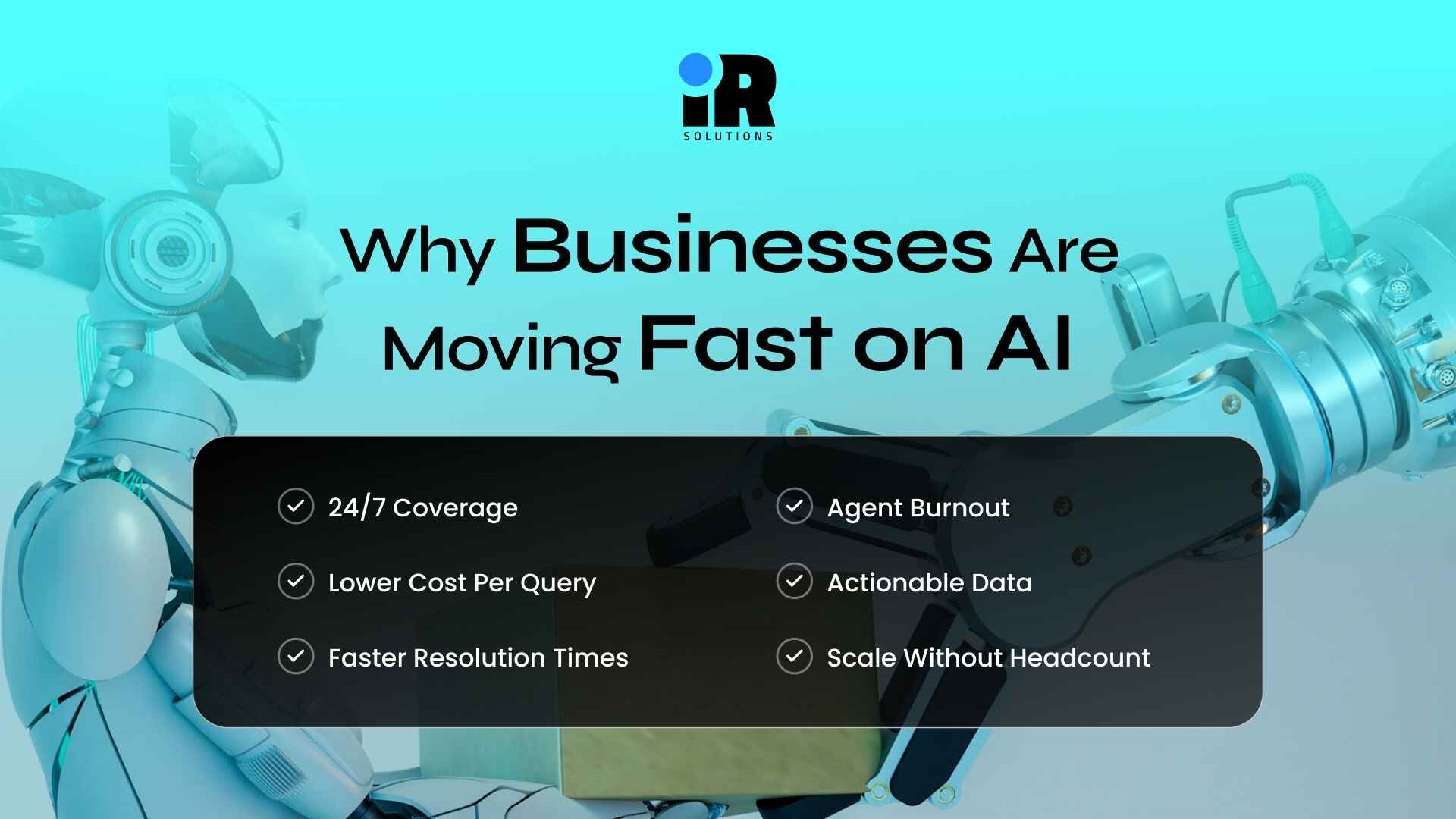
- 24/7 Coverage: AI handles customer queries at 3 AM with no shift allowance, overtime cost, or additional staffing required.
- Lower Cost Per Query: Automated resolution of routine tickets brings the per-interaction cost down significantly compared to fully human-handled tickets.
- Faster Resolution Times: Chatbots and AI triage systems respond in under a second, which manual workflows simply cannot match.
- Agent Burnout: Repetitive queries burn agents out faster, and AI removes that entire category of work from their plate.
- Actionable Data: Every AI-handled conversation produces usable data about customer intent, frustration points, and product gaps that businesses can act on.
- Scale Without Headcount: Growing from 10,000 to 100,000 customers does not require growing your support headcount at the same pace.
Get a complete overview of AI applications and implementation in AI for Business in 2026: Use Cases, Automation, Tools & Implementation Guide.
The math on this gets hard to ignore once you run the numbers against your actual support costs. An AI system that deflects 60% of inbound volume also cuts 60% of per-ticket labor cost. That number compounds as your customer base grows and your ticket volume scales alongside it. Early movers are not just saving money, they are building a structural cost advantage over slower competitors.
Core AI Technologies Powering Customer Support
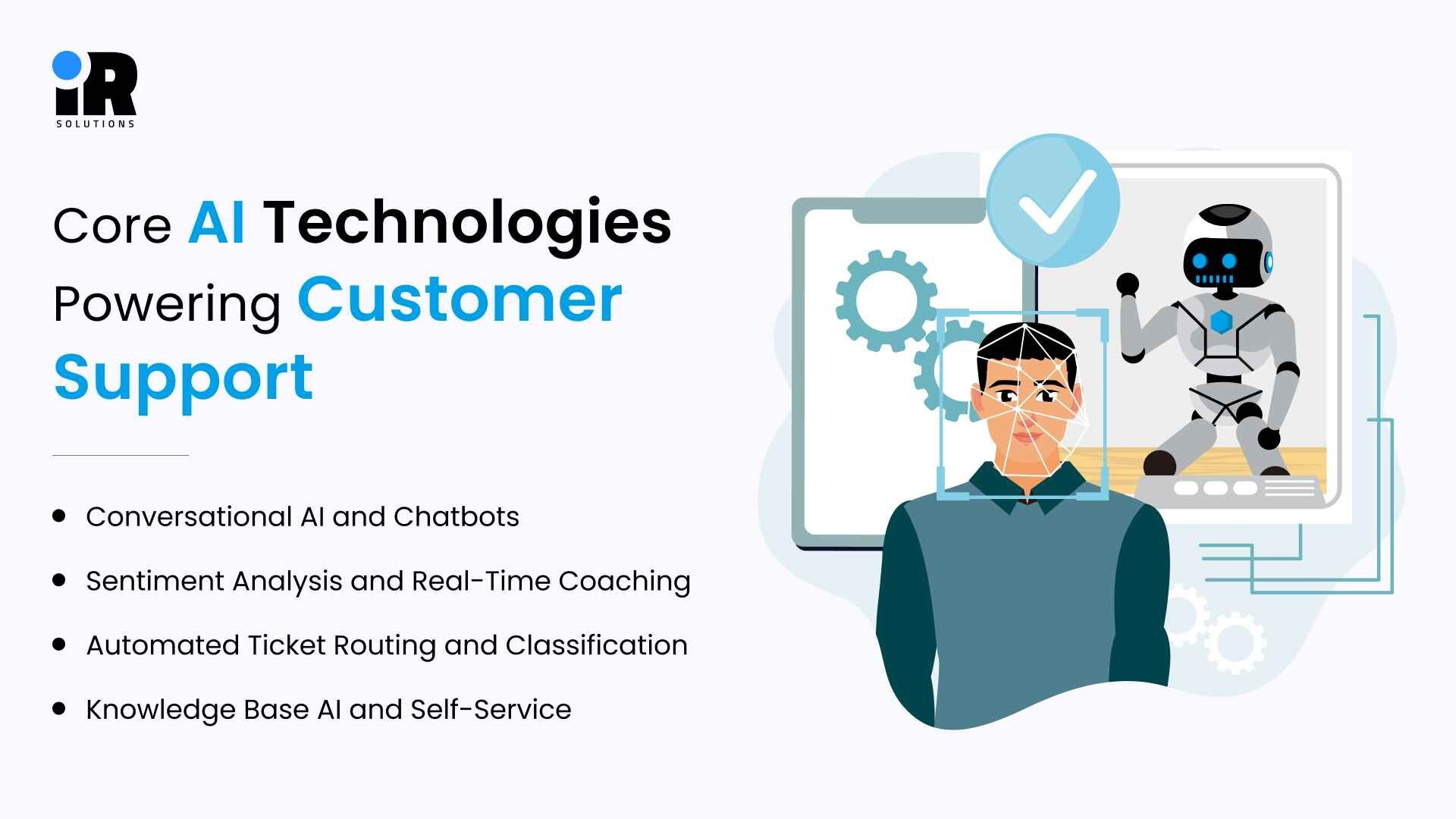
Conversational AI and Chatbots
The chatbot of today is nothing like the frustrating, scripted bots businesses experimented with several years ago. Modern conversational AI understands context, tracks conversation history, and handles multi-step queries without losing the thread at all. These systems can handle billing disputes, order tracking, and account changes without any direct agent involvement whatsoever. They escalate to a human when the conversation gets too complex or when the customer specifically asks for someone. A well-built chatbot handles 60 to 80% of your inbound volume before a single agent touches their keyboard. A poorly trained chatbot leaves customers raging, while a well-trained one gets them answers quickly and cleanly.
Sentiment Analysis and Real-Time Coaching
AI can read the emotional tone of a customer message in real time and flag it for immediate action. If a customer is typing with frustration signals, the system alerts the agent before the conversation escalates any further. It can also suggest response phrasing mid-conversation based on what has worked in similar past interactions before. Some systems score every conversation automatically and flag the ones that need supervisor review or quality intervention. This kind of real-time intelligence is something no manual QA team can provide at any meaningful scale or volume. Support teams using sentiment-aware AI consistently show better first-contact resolution rates compared to those working without it.
Automated Ticket Routing and Classification
When a support ticket lands in your queue, someone has to decide where it goes and how urgent it is. Doing that manually across hundreds of tickets a day introduces delays, inconsistency, and occasional expensive misrouting. AI classification systems read the ticket content, identify the category and urgency, and route it to the right team instantly. They also auto-tag tickets, so your reporting and trend analysis become far more accurate without any manual tagging effort. Support managers stop spending hours reclassifying tickets and start spending that time on the issues that actually matter. When misrouting drops, resolution times drop, and your team looks more competent to the customers on the other end.
Knowledge Base AI and Self-Service
Customers who find their own answers stay on your platform longer and generate fewer support tickets overall. AI-powered knowledge bases surface the right article based on how the customer described their problem in plain language. They also identify gaps in your documentation by tracking which searches return no useful results for customers. Self-service tools built on AI reduce your inbound ticket volume by 20 to 40% when they are implemented properly. The best implementations combine intelligent search, guided flows, and a seamless fallback to live chat when self-service breaks down. Without the fallback, customers get stuck, and the entire self-service experience ends in a dead end that they do not forget.
Industries Getting the Most Out of AI Support
Every industry handling significant customer volume is finding real practical value in AI-powered support systems today. Some sectors are getting more out of it because of how their support workflows are naturally structured.
- Fintech & Banking: Transaction disputes, account verification, and fraud alerts are where AI handles high inbound volume well.
- E-Commerce & Retail: Order tracking, returns, and delivery complaints are high-volume retail categories that AI resolves without agent involvement.
- Healthcare & Wellness: Appointment scheduling, prescription queries, and insurance verification are high-frequency tasks AI handles reliably and fast.
- SaaS & Tech: Onboarding guidance, feature questions, and bug reports benefit from AI trained on your actual product context.
- Telecom & ISP: Billing queries, outage reports, and plan change requests are the repetitive categories AI handles without friction.
- Education & E-Learning: Student enrollment questions, course access issues, and deadline reminders are handled at scale with AI support systems.
If your business is in one of these sectors, the implementation path is more proven than before. There are real case studies, real benchmarks, and real partners who have done this before in your exact industry type.
The Real Cost of Not Fixing Your Customer Service
Most businesses underestimate how much poor customer service is actually costing them right now in lost revenue. A customer who has a bad support experience does not just leave, they also tell other people about it. Studies show that a single bad experience drives about 32% of customers away from a brand they previously liked. Those are not leads you missed, those are customers you already had and lost through a support failure. Support is either a retention machine or a churn driver, and very little middle ground exists between them. AI does not fix a broken support culture, but it removes volume pressure that creates most of the mistakes. When agents are not overwhelmed, they handle edge cases better, and customers who need human help actually get it properly.
The cost of building an AI support system is also frequently compared to the wrong benchmark by businesses. Most companies compare it against doing nothing, when the real comparison should be against the cost of poor support outcomes. Churn, negative reviews, and agent turnover carry price tags that often exceed the cost of a proper AI system. Once you add those numbers up, honestly, the question shifts from whether to invest to how quickly to start.
The support department is often treated as a cost centre when it should be treated as a revenue protection tool. Every resolved complaint that turns into a retained customer directly affects your bottom line measurably. Businesses that invest in support infrastructure consistently show higher customer lifetime values than those that neglect it entirely. The math is not complicated once you frame it around retention instead of ticket volume reduction alone.
AI Support Deployment Errors That Impact Customer Experience
Most failed AI support deployments share the same problems, and almost all of them were avoidable from the start. Knowing what to avoid before you build is easier and cheaper than fixing failures after go-live day.
- Deploying a generic chatbot without training it on your actual product data, brand tone, or real customer history at all.
- Removing the option to reach a human agent pushes frustrated customers directly toward leaving a damaging one-star review.
- Skipping the user testing phase because the internal demo looked good enough during a leadership walkthrough or presentation.
- Building on a third-party platform with no integration into your CRM, which creates disconnected customer data across every channel.
- Going live across all channels at once instead of starting with one channel, testing thoroughly, then expanding carefully.
- Measuring success only by cost savings instead of also tracking satisfaction scores, resolution rates, and agent workload data.
- Treating AI as a one-time deployment rather than a system that needs ongoing training, monitoring, and regular performance reviews.
Every single one of these mistakes is avoidable with a proper planning process and the right development partner beside you. None of them are technical failures, they are process failures that happen before any code gets written at all.
Read our guide on How to Build a Successful Custom AI Chatbot for Your Business for a complete breakdown of the process.
Building the Right AI Support System Without Starting Over
Most businesses arrive at AI implementation after already buying a tool that did not solve the real problem. They purchased an off-the-shelf chatbot, watched the deflection rate stay flat, and wondered why results never came. The problem is rarely the technology, it is always how the system was designed and trained initially. A custom AI support system trained on your actual conversations, products, and customer base performs completely differently. Generic tools trained on general data do not understand your industry's language or your customers' specific expectations at all. If you want an AI system that genuinely deflects tickets and improves satisfaction scores, it needs to be built custom. Working with an experienced AI Development Company also helps businesses avoid common deployment mistakes and build systems that scale properly over time. You also need to hire AI & ML developers who understand both machine learning and real support operations together. The two domains rarely sit in the same person, so your development team's composition matters quite a lot here.
The training data you feed the model matters as much as the model architecture itself when building a custom model. Historical tickets from mostly unhappy customers teach the AI a skewed picture of what normal support looks like. You need to clean and label your data carefully before training begins, which is a step most businesses skip. Every category of query your AI will handle needs representative examples from your real customer base to perform reliably. This detail may seem minor, but it is often what separates a system that works from one that consistently fails.
If you want to see how this could work for your business, book a free strategy call with our team today.
Conclusion
AI in customer service is no longer something businesses can afford to treat as optional or plan for much later. Your competitors are either already using it or actively building it, and the gap between them and you only grows. The businesses that get the most out of AI support build it with real intent and clear structure. That means understanding your actual support problems before choosing any technology, tool, or development approach for the solution. IR Solutions builds custom AI customer service systems designed around your business and your specific customer base. We do not hand you a demo and call it a deployment, we build things that actually go live. When you are ready to build this the right way, our AI & ML development services team is here.
Frequently Asked Questions
What exactly is AI-powered customer service, and how does it actually work for any business?
AI customer service uses machine learning models to handle queries, route tickets, and assist agents automatically and continuously.
Does implementing AI in customer support actually mean fully replacing all of your human agents?
No, AI handles repetitive queries while human agents focus on complex, sensitive, or high-value customer situations always.
How long does it typically take to build a custom AI customer service system from scratch?
A basic system takes eight to twelve weeks, and a fully integrated enterprise solution takes four to six months.
What data does IR Solutions need to train an AI support system for my business?
We typically need historical support tickets, product documentation, CRM data, and your brand communication guidelines to start.
Can AI customer service work for small businesses, or is it only for large enterprises?
AI support scales well for businesses of all sizes, and IR Solutions builds solutions to match your actual budget.
What types of communication channels can a custom AI customer service system cover for my business?
AI can cover live chat, email, WhatsApp, in-app messaging, voice, and social media support channels all simultaneously.
How does IR Solutions measure whether an AI customer support system is genuinely working well?
We track deflection rates, customer satisfaction scores, average handle time, and agent workload reduction from day one.